The global class war today

Free Palestine March 0078
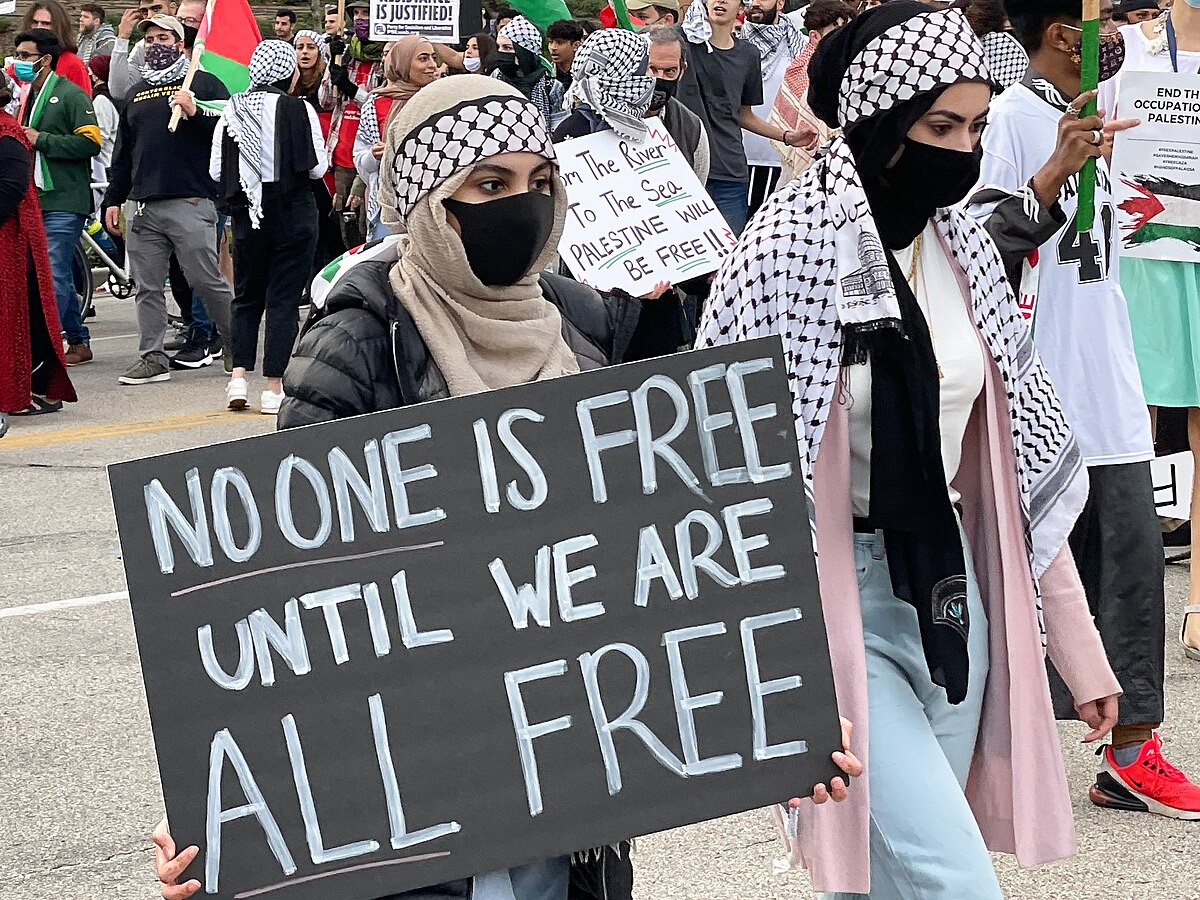
Protester at a Free Palestine march holds a sign reading “No one is free until we are all free,” expressing global working-class solidarity and resistance to imperialism.

With U.S. imperialist confrontations sharpening on multiple fronts — from the New Cold War against China and the proxy war in Ukraine to the genocide in Gaza and military threats against Venezuela — seeing how these battles link with the liberation struggles spreading across the African Sahel — from Mali to Burkina Faso and Niger — has never been more urgent.

These are not isolated crises. Each reflects the same global struggle between the imperialist powers and the oppressed peoples fighting for sovereignty, equality, and self-determination.

To fight against racism, sexism, transphobia, LGBTQIA oppression, and capitalist exploitation here, we need to connect with the struggles abroad — we need to see the world as one battlefield. 

Sam Marcy provided that view in his theory of the global class war — developed in the wake of the 1949 Chinese Revolution, the Korean War, and the great wave of decolonization. These upheavals transformed the global balance of forces and confirmed Lenin’s insight that the struggle between imperialism and the oppressed nations had become the decisive front of world politics. Marcy’s framework still helps us make sense of today’s world — and reminds us which side we’re on.

Lenin’s foundations

Lenin had already shown that imperialism created a single, interlinked global system — a world economy dominated by finance capital and monopolies, where a handful of oppressor nations exploited the labor and resources of the vast majority.

In “Imperialism: The Highest Stage of Capitalism” (1916), he demonstrated that this new stage fused banking and industrial capital into finance capital, turned capitalism’s main drive from exporting goods to exporting capital, and made colonial conquest an essential part of the economic rivalry among imperialist powers.

From that point forward, class struggle could no longer be understood as separate national battles. Imperialism had created a global class war: workers in imperialist countries and the liberation struggles of colonized nations were now fighting the same enemy — the system of finance capital and imperialist domination.

The Communist International under Lenin captured this new reality by updating the Communist Manifesto’s call to read: “Workers and oppressed peoples of the world, unite!”

It made clear that workers in the imperialist countries and the peoples of the oppressed nations share one fight against imperialist domination.

Just as important was Lenin’s work on the national question, especially “The Right of Nations to Self-Determination” (1914). He argued that the fight of oppressed nations against imperialist domination was objectively revolutionary, regardless of the class composition of their leadership. Each victory of a colonized or semi-colonized people struck a direct blow against the imperialist system as a whole.

The right of nations to self-determination was not an abstract slogan but a concrete weapon against imperialist rule. Lenin understood that genuine independence required breaking not only the grip of foreign imperialism but also the power of local capitalist collaborators who profit from it.

Lenin also showed how super-profits from the colonies allowed the ruling class of the imperialist countries to “bribe” an upper layer of the working class, creating a social base for opportunism and reformism. Lenin called this layer a “labor aristocracy.”

This analysis explained why revolutions were likely to break out first in the “weakest links” of the imperialist chain, rather than in the most advanced capitalist countries.

At the Communist International, Lenin stressed that communists in the imperialist centers had a special duty to support the liberation struggles of colonized peoples, even when led by moderate non-aligned forces.

In short, Lenin uncovered the global structure of capitalism — and therefore the global character of the class struggle itself.

Marcy’s development of the framework

Sam Marcy took this Leninist insight — the global nature of imperialism and the global character of class struggle — and developed it into a guide for revolutionary strategy in the post–World War II world.

Lenin revealed how imperialism worked; Marcy took those lessons and applied them to the battles of the mid- and late-20th century: the global class war was not a metaphor but a living struggle between the imperialist powers, led by the United States, and the oppressed nations — at home and abroad — united with the working peoples of the world.

Marcy recognized that the rise of socialist states, the national liberation movements sweeping Asia, Africa, and Latin America, and the uprisings against racism, inequality, and imperialist war inside the imperialist countries were all fronts of the same world conflict.

He emphasized that workers in the imperialist countries bore a special responsibility to fight against their own ruling class’s wars, sanctions, and occupations — embodied in Lenin’s slogan: “The main enemy is in your own country — your own ruling class.”

By bringing Lenin’s ideas into the age of neocolonialism and nuclear threat, Marcy developed the concept of global class war as the central dynamic of the postwar world.
This framework transformed Lenin’s theoretical discovery into a method of political practice — linking every struggle, whether in the workplace or in the streets, to the worldwide fight against imperialism.

From theory to political practice

This analysis shaped a practical program of revolutionary organizing.

It meant active involvement in strikes and workplace struggles and militant participation in movements against systemic racism, police violence, mass incarceration, and for Black liberation and self-determination.

It meant standing with struggles for women’s equality, trans rights and LGBTQIA liberation, immigrant rights, Indigenous sovereignty, disability justice, and environmental survival — understanding all of them as connected struggles in the same global fight against imperialism.

The fight against racism, sexism, and all forms of oppression inside the imperialist countries was inseparable from the anti-imperialist fight abroad.

These systems of oppression keep capitalist power in place at home — and work hand in hand with imperialism abroad.

Marcy’s outlook also demanded unwavering opposition to one’s own government’s wars and interventions.

Support for states and movements resisting U.S. domination — from socialist Cuba to national-liberation fronts in Africa, Asia, and the Middle East — was not charity but solidarity in a common war against the imperialist system itself.

Imperialism and resistance in our time

Marcy’s framework, grounded in Leninism and shaped by the great struggles of the 20th century, still guides revolutionaries today.

The world Marcy described has only intensified: more billionaires, more bombs, and more lies to keep the workers of the world divided.

From Gaza to Venezuela, from the Sahel to the streets of New York, the same forces are colliding: the drive of U.S.-led imperialism to maintain world domination, and the determination of oppressed peoples to break free.

The unity of domestic and international struggle — and the recognition that the main enemy is at home — remain the foundation of true internationalism.

For Marcy, the global class war was not a contest of blocs or nations but of classes. It was a dialectical struggle — constantly shifting with the contradictions of imperialism — internationalism, not geopolitics, and solidarity rooted in working-class unity, not allegiance to states or ruling classes.

The global class war is not an abstraction — it is the daily fight between imperialism and humanity. It is the recognition that our struggle is bound up with the struggles of workers and oppressed peoples everywhere.

Every struggle — for housing, for land, for liberation — is part of the global class war.

Sam Marcy’s insight was simple but revolutionary: The front lines of the class struggle encircle the globe.

Our task is to join them — and win.

Gary Wilson, a managing editor at Struggle-La Lucha, worked closely with Sam Marcy in the 1980s and 1990s, transcribing and editing his political writings.

Strugglelalucha256


NYC tenants fight billionaire land grab

March against public housing demolition in NYC

The fight to save public housing brought people to the streets of New York City on Nov. 8. They gathered at three Manhattan locations — the Fulton, Elliott-Chelsea and Amsterdam houses — to stop urban removal.

These communities are home to thousands of people, including seniors and people with disabilities. Real estate tycoons want to make big bucks by tearing them down to build high-priced luxury apartments.

That’s what the Related Companies is seeking to do with the Fulton and Elliott-Chelsea homes in the Chelsea neighborhood. The outfit’s founder, Stephen Ross, who has a $17 billion stash, is determined to extend his Hudson Yards project along the west side of Manhattan.

Ross has already gotten $6 billion in government subsidies and wants $2 billion more for Hudson Yards, where the cheapest one-bedroom apartment rents for $4,500 per month. Among these handouts was the $3 billion spent by former mayor and fellow billionaire Michael Bloomberg to extend the No. 7 subway line to Hudson Yards.

A rally was held inside a courtyard at the Elliott-Chelsea homes. Talks were given in English, Spanish and Chinese.

Speakers included an elderly blind man who denounced the proposed tearing down of the seniors’ building, the newest structure there. A woman fighting cancer described the harassment of tenants— which includes the pounding of doors — who are being urged to leave.

“This is so painful,” she said, urging people to “don’t sign the lease.” Developers want tenants to sign away their Section 9 subsidized apartments —which protects them from being evicted— by offering a temporary 8 lease that can be canceled.

Dr. Jesse Fields reminded people of that grand old freedom song, “we shall not be moved.” “Housing for people, not for profit!” was the message of Oliver from the Young Communist League.

Other groups and individuals helping to build the protest were the Parents to Improve Safe Transportation (PIST); trade unionists; the Party for Socialism and Liberation; and Workers World Party.

Marching on the billionaires and trillionaires

Folks from the Fulton Houses, Amsterdam Houses in Harlem and the Holmes / Isaacs Houses on the East River had already arrived. It was time to start marching up Ninth Avenue to Hudson Yards.

Manhattan’s West Side was once filled with workplaces that employed thousands, including the biggest Nabisco cookie factory. Around 900,000 manufacturing jobs have been eliminated in New York City since 1958.

Thousands more were employed on the docks, whose jobs were destroyed by containerization. Now the area is being seized by real estate developers who are building housing for the well-to-do.

City officials have allowed public housing administered by the New York City Housing Authority (NYCHA) to deteriorate. A frightening example was the Oct. 1 partial collapse of a Mitchel Houses building in the Mott Haven neighborhood of the Bronx, which was probably caused by a gas explosion.

The ending rally was held across from the Related Companies H.Q. at Hudson Yards. People gathered in front of the financial octopus BlackRock, which controls over $13 trillion in assets.

That represents around $1,600 for every person on the planet. It’s obscene that this fantastic amount of social wealth is controlled by a handful of power brokers. So is the trillion dollars being spent by the Pentagon on war, not for human needs?

Among those who spoke truth to power there were representatives from the Coalition to Protect Chinatown and the Lower East Side, who spoke in both Chinese and English. They described their successful struggle to protect the Bowery tenants.

Tenants from the Holmes / Isaacs Houses told of how they fought off attempts to seize their courtyards and playgrounds. That’s what the authorities want to do with the basketball courts at the Fulton Houses.

Real estate interests consider these “infill” areas, where people can relax and enjoy themselves, to be wasted space that should be filled with luxury housing instead.

Johnnie Stevens of the Direct Action committee concluded by inviting people to join the informational picketing outside the HOU trailers. They’re located on West 17th and 19th Streets and West 27th Street between 9th and 10th avenues.

Picketing is being done Mondays through Fridays, to encourage tenants to exercise their legal rights not to sign away their Section 9 subsidized apartments prematurely. Please sign up at tinyurl.com/DefendHome.

Organizers will distribute signs to hold and “know your rights” pamphlets to explain why nobody has to sign anything or even enter the trailers being operated by the developers.

Strugglelalucha256


Why we should commemorate Nov. 11

Even though Veterans Day is a federal holiday, only 19 percent of workers employed by private business get the day off. Originally called Armistice Day, it marks the end of World War I “at the 11th hour on the 11th day of the 11th month” of 1918.

Twenty million people were killed during this imperialist war, half of whom were civilians. It was waged between colonial powers that had enslaved hundreds of millions in Africa, Asia and the Americas.

Lenin, the leader of the socialist Bolshevik Revolution, called it a “war between the biggest slaveowners for preserving and fortifying slavery.”

The Belgian King Leopold II had killed as many as 15 million Africans in Congo for rubber profits. British capitalists made fortunes from famines in India and occupied a quarter of the planet. Fresh from genocidal wars against Indigenous nations, the U.S. army had killed a million Filipina/os fighting for independence.

Another 50 million people died in the 1918-1919 influenza pandemic that may have started at U.S. Army bases in Kansas.

Around 117,000 U.S. GIs died in the war. Three months after the U.S. entered the conflict, at least 100 Black people were murdered in East St. Louis, Ill., by white racist mobs.

Black soldiers returning from combat were among those killed in the race riots that swept U.S. cities in 1919. But World War I was swell for U.S. big business.

According to Marine Corps Maj. Gen. Smedley Butler in his book “War is a Racket,” “at least 21,000 new millionaires and billionaires were made in the United States during the World War. That many admitted their huge blood gains in their income tax returns. How many other war millionaires falsified their tax returns no one knows.”

This was back in 1918, when the dollar was worth 16 times as much as it is now.

The du Ponts weren’t even mentioned in “The History of Great American Fortunes” by Gustavus Myers, which was published in 1909. The family’s vast profits from selling explosives during World War I catapulted them into the superrich.

Besides their chemical empire, the du Ponts controlled General Motors, which had been the world’s largest corporation, for decades.

Never forget Nat Turner

So why should poor and working people commemorate Nov. 11? Because on Nov. 11, 1831, the liberator Nat Turner was executed.

Turner led a revolt of enslaved Africans in Virginia that terrified all the slave owners. Beginning on Aug. 21, 1831, Black people marched from plantation to plantation in Southampton County fighting for liberation. Black Panther Field Marshal George Jackson was murdered 140 years later on Aug. 21, 1971, in California’s San Quentin prison.

The reaction of slave masters was merciless. They thought they were facing another Haitian Revolution.

Soldiers and sailors were mobilized to crush the rebellion. Militia members were sent from both Virginia and North Carolina.

The Rev. G.W. Powell said there were “thousands of troops searching in every direction,” with many Black people killed. The editor of the Richmond Whig newspaper admitted that “men were tortured to death, burned, maimed and subjected to nameless atrocities.” (“Before the Mayflower, A History of Black America” by Lerone Bennett Jr.)

Nat Turner was captured but never flinched. He was executed in Jerusalem, Va. It’s named after the eternal capital of Palestine, also known as Al-Quds.

The slave masters called Nat Turner a “terrorist.” That’s the same term used today to smear Palestinian freedom fighters.

Hanged for the eight-hour day

Labor leaders George Engel, Adolph Fischer, Albert Parsons and August Spies were hanged in Chicago’s Cook County Jail on Nov. 11, 1887. Twenty-three-year-old Louis Lingg was also slated to be executed, but he was either murdered or committed suicide the day before.

These martyrs died for the eight-hour work day. Most workers in those days worked 10 or 12 hours a day, sometimes even longer.

On May 1, 1886, hundreds of thousands of workers across the U.S. went on strike to demand an eight-hour work day. Capitalists were terrified. Workers marched from factory to factory urging employees to strike.

Chicago was the center of this movement. Chicago police fired on striking workers at the McCormick reaper works — which later became part of International Harvester — on May 3, killing at least two.

The next day, a protest meeting was called at Chicago’s Haymarket Square. Police attacked the crowd, and someone threw a bomb at the cops. Eight policemen died as well as possibly some protesters.

The ruling class went berserk. Police arrested hundreds, but the bomber, who may have been a provocateur, was never found.

Instead, well-known labor leaders were put on trial for their lives because they supposedly incited the bombing. Years later, Illinois Gov. John Peter Altgeld courageously pardoned those who had been jailed.

Four of the five Haymarket Martyrs were immigrants. All were labeled anarchists. Trump wants us to hate immigrants while he calls anti-racist protesters “anarchists.”

As he was about to be hanged, Albert Parsons declared, “The day will come when our silence will be more powerful than the voices you strangle today.”

Lucy Parsons, a Black woman who was Albert Parsons’ partner, continued fighting for the working class until she died in a house fire in 1942. Chicago police said that she was “more dangerous than a thousand rioters.” Lucy Parsons’ books and papers were confiscated by the FBI.

May 1 became the international holiday of the working class. In Mexico, it’s known as the Day of the Chicago Martyrs.

Long live the People’s Republic of Angola!

The People’s Republic of Angola was born on Nov. 11, 1975. Vice President Nelson Rockefeller, along with his employees Secretary of State Henry Kissinger and White House occupant Gerald Ford, sought to kill it. They had the Nazi armies of then-apartheid South Africa invade the African country.

Angola’s independence was historical justice that resonated around the world. Four million Angolans had been kidnapped in a slave trade that lasted four centuries. Brazil’s sugar plantations were fed by Angolan slave pens.

Millions of Brazilians have Angola in their blood. So do some African Americans.

The largest prison in the U.S. is in Angola, La. The sugar plantation which became the core of the prison was named Angola because that’s where the enslaved Africans working there came from.

Today, thousands of slaves work on the Angola prison’s 18,000 acres. The “Angola 3” — Herman Wallace, Robert King Wilkerson and Albert Woodfox — spent decades in solitary confinement on frame-up charges of killing a prison guard before being freed.

Their real crime was forming a chapter of the Black Panther Party. Herman Wallace died of liver cancer a few days after being released.

Five hundred years of Portuguese colonialism in Angola were 500 years of resistance. The founding of the Popular Movement for the Liberation of Angola (MPLA) in 1956 was a decisive step. Forced labor was halted only after 50,000 Angolans were killed during the 1961 revolts.

When South Africa invaded Angola, Cuba came to Africa’s assistance. As the Pan African educator and organizer Elombe Brath said, “When Africa called, Cuba answered.” Two thousand Cuban soldiers died fighting alongside their African comrades.

The initial defeat of South Africa helped inspire the Soweto Uprising on June 16, 1976. The total defeat of the apartheid army at Cuito Cuanavale in 1988 led to Nelson Mandela walking out of prison two years later.

So let us remember Nat Turner and the Haymarket Martyrs while celebrating Angola’s independence. And be prepared to stop any new wars for the rich.

Strugglelalucha256


Zohran Mamdani: From postcolonial legacy to the heart of empire

A new generation, a deep inheritance

The new mayor of New York, Zohran Mamdani, embodies a new political generation — but also a singular intellectual legacy: that of his parents.

His mother, Mira Nair, is one of the greatest contemporary Indian filmmakers, author of acclaimed films such as Salaam Bombay! and Monsoon Wedding.

His father, Mahmood Mamdani, is a historian, political scientist, and professor at Columbia University whose work has transformed our understanding of the relationship between colonization, modernity, and political violence.

Their son thus grew up at the crossroads of two inheritances: engaged cinema and critical thought — two forms of resistance to oblivion and to the established order.

The making of a postcolonial thinker

Born in 1946 in Bombay, Mahmood Mamdani grew up in Uganda, within an Indian-origin community that had settled in East Africa during the colonial era.

He studied in the United States, at Harvard, before returning to teach in Africa, notably at Dar es Salaam, a vibrant center of intellectual ferment in the 1970s.

Exiled after the expulsion of Asians by Idi Amin in 1972, he became a central figure of postcolonial thought. His personal experience fueled his reflection: to understand how colonial power survived decolonization — under other forms — within the structures of the state, of memory, and of violence.

Citizen and subject

In his major work, Citizen and Subject: Contemporary Africa and the Legacy of Late Colonialism (1996), Mamdani shows that the African states born from independence never truly broke with the colonial system.

Colonial power, he explains, divided societies into two worlds: urban citizens governed by civil law, and rural subjects ruled by customary law and “administrated” chiefs.

This split between “modernity” and “tradition” — between citizen and subject — survived independence and continues to structure political and social inequality.

This book established Mamdani as one of the most lucid thinkers of African postcolonialism — an author intent on revealing the continuities of domination hidden beneath the language of freedom.

When victims become killers

A few years later, in When Victims Become Killers: Colonialism, Nativism and the Genocide in Rwanda (2001), Mamdani challenged the dominant interpretation of the Rwandan genocide.

Rejecting moralizing or culturalist readings, he shows that the categories “Hutu” and “Tutsi” were not ancestral identities but the product of colonial racial classifications imposed by European powers — administrative inventions that froze hierarchies and fueled violence.

Mamdani advanced a disturbing thesis: genocide is not a regression into barbarism but the culmination of a colonial modernity that naturalized difference.

Those whom the West depicts as “peoples without history” are, in truth, both the victims — and at times the products — of its own racial order.

Good Muslim, bad Muslim

It was, however, with Good Muslim, Bad Muslim: America, the Cold War and the Roots of Terror (2004) that Mamdani gained worldwide recognition.

Published in the aftermath of September 11, the book dismantles the new ideology of the age: the “clash of civilizations.”

Mamdani demonstrates that the division between “good” and “bad” Muslims is not religious but geopolitical.

The “good Muslim” is the one who conforms to Western order; the “bad” is the one who resists it.

This dichotomy, he writes, was born during the Cold War, when the United States — seeking to weaken the Soviet Union — financed, armed, and supported the Afghan mujahideen, transforming jihad into a political weapon.

Political Islam, he argues, was created by empire before being demonized by it. The “freedom fighters” of the 1980s became, twenty years later, the “terrorists” of the War on Terror.

What Mamdani denounces is the moralization of politics. Instead of explaining violence through historical and geopolitical causes, the West attributes it to the “culture” of others — never asking what it has done, only who “they” are.

This reversal of the gaze — where the politics of domination becomes a defense of civilization — constitutes, for Mamdani, the heart of modern imperial ideology.
“When we explain the behavior of others by their culture, we justify our own by our politics,” he writes.

Good Muslim, Bad Muslim is therefore far more than a critique of post-9/11 Americanism; it is a genealogy of imperial lies.

Mamdani exposes the continuity linking colonial wars, the Cold War, and the so-called “War on Terror”: a single moral narrative in which the West imagines itself the guardian of reason and freedom, while the dominated peoples are reduced to primitive passions — to threats that must be civilized.

His work calls on us to repoliticize violence, to break with the discourse of fear, and to recognize the West’s historical responsibility for the very disasters it condemns.

The struggle against amnesia

All of Mahmood Mamdani’s work can be read as a struggle against amnesia. It lays bare the persistence of colonial power within the institutions, discourses, and wars of the present.

And so we grasp the symbolic weight of the fact that his son, Zohran Mamdani — heir to such an intellectual and activist lineage — has today become the mayor of New York, the capital of global capitalism and of the American narrative itself.

It is an irony of history, but also a promise: that a world critical of empire might finally speak from its very center.

Zohran Mamdani once appeared in one of his mother’s films, Queen of Katwe (2016), contributing to its soundtrack as the rapper Young Cardamom, later known as Mr. Cardamom.


Translated from the French using AI. Originally published in Investig’Action (6 November 2025). This work is distributed under a Creative Commons license (CC BY-NC-SA 4.0).


Abbas Fahdel is an Iraqi-French filmmaker and writer. Born in Babylon, Iraq, he moved to France as a young man and studied cinema at the Sorbonne. His acclaimed documentaries Retour à Babylone and Homeland: Iraq Year Zero explore memory, war, and the enduring legacies of empire. Fahdel’s work, rooted in personal experience and political reflection, has been honored at international festivals for its anti-imperialist vision.

Strugglelalucha256


Operación Carlota: 50 Years of Cuba and African liberation

“The Cuban people hold a special place in the hearts of the people of Africa. The Cuban internationalists have made a contribution to African independence, freedom and justice unparalleled for its principled and selfless character.” Nelson Mandela, July 26, 1991

November 5 2025 marks the 50th anniversary of Operación Carlota, Cuba’s internationalist mission in southern Africa, which was pivotal in securing Angola and Namibia’s independence and hastening the fall of apartheid South Africa. The 50th anniversary of Operación Carlota marks a milestone in the global struggle against colonialism, apartheid, and imperialism. The successful military defense of Angola by Cuban and Angolan forces hastened the independence of Namibia in 1990 and dealt a severe blow to the apartheid regime in South Africa, hastening its demise.

On 5 November 1975, in response to a direct and urgent appeal from the newly independent government of Angola, Cuba launched Operación Carlota. This bold act of internationalist solidarity was in direct response to a military invasion by apartheid South Africa, which, backed by the United States and other Western powers, sought to crush Angola’s fledgling Black-led government and halt the broader tide of African liberation. Angola had only just emerged from a protracted and brutal anti-colonial war against Portuguese colonialism. Its independence, won through great sacrifice, was immediately threatened by a foreign-backed effort to impose a client regime and derail genuine sovereignty.

In this context, Operación Carlota—named after Carlota Lucumí, an enslaved African woman who led a revolt in Cuba on 5 November 1843—was a decisive intervention. Cuban forces, in coordination with Angolan troops, halted the South African advance toward Luanda and drove the invading forces out of Angola. This victory marked a turning point in the African anti-colonial and anti-apartheid struggles. The defeat of the apartheid army on the battlefield shattered the myth of white invincibility and emboldened liberation movements across the continent. The significance of Cuba’s action was not lost on the African continent. The World, a Black South African newspaper, captured the moment: “Black Africa is riding the crest of a wave generated by the Cuban success in Angola. Black Africa is tasting the heady wine of the possibility of realizing the dream of ‘total liberation.”

Operación Carlota would last more than fifteen years. More than 400,000 Cuban soldiers, teachers, doctors, engineers, and workers served in Angola in various capacities during the mission. More than 2,000 Cubans lost their lives defending Angola’s sovereignty and supporting the right of the peoples of southern Africa to self-determination and freedom. This long struggle culminated in 1987–88 at Cuito Cuanavale, where combined Cuban and Angolan forces dealt a decisive defeat to the apartheid South African military. The 1987-88 military reversal in Angola constituted a mortal blow to the apartheid regime. The battle of Cuito Cuanavale ended its dream (nightmare for the region’s peoples) of establishing hegemony over all of southern Africa as a means by which to extend the life of the racist regime. This defeat on the ground forced South Africa to the negotiating table, resulting in Namibian independence and dramatically hastening the end of apartheid. Yet Cuba’s extensive and crucial role in the struggle against apartheid, and the broader regional war of terror waged by the apartheid regime that set the context for Cuba’s intervention, remain virtually unknown in the West. This extraordinary example of anti-imperialist solidarity remains largely erased from mainstream historical memory.

Apartheid South Africa’s War of Terror

Equally forgotten is the apartheid state’s regional war of terror—waged in Namibia, Angola, Mozambique, and beyond—which made Cuba’s intervention not only necessary, but historic. The struggle for and against apartheid unfolded both inside and beyond South Africa’s borders. Determined to secure and entrench its regional dominance, the apartheid regime waged war across southern Africa. Indeed, far more people—tens, if not hundreds, of thousands—lost their lives outside South Africa than within it. As the Truth and Reconciliation Commission observed, “the number of people killed inside the borders of the country in the course of the liberation struggle was considerably lower than those who died outside.” The human toll was staggering, between 1981 and 1988 alone an estimated 1.5 million people were killed directly or indirectly, among them 825,000 children.

Cuban involvement in Southern Africa has been repeatedly dismissed as surrogate activity for the Soviet Union. This insidious myth has been unequivocally refuted. John Stockwell, the director of CIA operations in Angola during and in the immediate aftermath the 1975 South African invasion, in his memoir, In Search of Enemies: A CIA Story, stated “we learned that Cuba had not been ordered into action by the Soviet Union. To the contrary, the Cuban leaders felt compelled to intervene for their own ideological reasons.” In his acclaimed book, Conflicting Missions: Havana, Washington and Africa, 1959-76, Piero Gliejeses demonstrated that the Cuban government – as it had repeatedly asserted – decided to dispatch combat troops to Angola only after the Angolan government had requested Cuba’s military assistance to repel the South Africans, refuting Washington’s assertion that South African forces intervened in Angola only after the arrival of the Cuban forces and; the Soviet Union had no role in Cuba’s decision and were not even informed prior to deployment. In short, Cuba was not the puppet of the USSR. Even The Economist magazine (no friend of Cuba) in a 2002 article, acknowledged that the Cuban government acted on its “own initiative.”

That Cuba could act on its own initiative, independent of the great powers, was not only an anathema to Washington but also inconceivable. In 1969 Henry Kissinger, then National Security Advisor and later US Secretary of State, expressed characteristic chauvinism: “Nothing important can come from the South. History has never been produced in the South. The axis of history starts in Moscow, goes to Bonn, crosses to Washington, and then to Tokyo. What happens in the South is of no importance.” That Cuba—a poor “Third World” Latin-African nation—could act independently and shape history enraged Kissinger. At his behest, the Pentagon drew up extensive military plans in 1975–1976 to punish the island for defying the imperial order and its racist hierarchy. These plans, ranging from naval blockade to invasion, were seriously debated at the highest US levels, illustrating the dangers Cuba faced and accepted in defending Angola.

Paying Humanity’s Debt to Africa

The Cuban leadership justified the military missions in southern Africa as both defending an independent country from foreign invasion and repaying a historical debt owed by Cuba to Africa. Fidel Castro frequently invoked Cuba’s historical links to Africa. On the fifteenth anniversary of the Cuban victory at Playa Girón (Bay of Pigs), he declared that Cubans “are a Latin-African people.” The late Jorge Risquet, Havana’s principal diplomat in Africa from the 1970s to 1990s), was also unambiguous in explaining Cuba’s military intervention in terms of Cuba’s obligations to Africa, and this linkage resonated especially with black Cubans, who were able to make a symbolic connection with their African roots. As scholar Terrence Cannon for many blacks fighting in Angola was akin to defending Cuba except that the fight was “this time in Africa. And they were aware that Africa was, in some sense, their homeland.” Reverend Abbuno Gonzalez underscored this connection: “My grandfather came from Angola. So, it is my duty to go and help Angola. I owe it to my ancestors”. General Rafael Moracen echoed this sentiment and the words of Amilcar Cabral: “When we arrived in Angola, I heard an Angolan say that our grandparents, whose children were taken away from Africa to be slaves, would be happy to see their grandchildren return to Africa to help free it. I will always remember those words

Today, thousands of Cuban medical personnel provide essential services across dozens of African countries. In 2014, Cuba made a decisive contribution to the fight against the Ebola epidemic in Guinea, Liberia, and Sierra Leone, sending the largest medical mission of any country.” More than 450 Cuban doctors and nurses—selected from over 15,000 volunteers—travelled to West Africa to stand alongside its peoples in the struggle against Ebola. As Cuba’s ambassador to Liberia, Jorge Lefebre Nicolas, affirmed: “We cannot see our brothers from Africa in difficult times and remain there with our arms folded.” At the 16 September 2014 United Nations Security Council meeting, Cuban representative Abelardo Moreno underscored: “Humanity has a debt to African people. We cannot let them down.” Even the Wall Street Journal acknowledged: “Few have heeded the call, but one country has responded in strength: Cuba.” Nevertheless, as Cuba specialist John Kirk notes, Cuba’s medical internationalism remains one of “the world’s best-kept secrets.”

Commemorating the anniversary of Operación Carlota is not simply an act of historical recovery. Fifty years on, Operación Carlota reminds us that the fight for African independence remains as urgent as ever. In a time when the struggle for authentic African independence and sovereignty is again under threat—from neocolonial economic domination, foreign military interventions, and resource plunder—it serves as a reminder of the possibilities of principled internationalism, solidarity, and collective liberation.

Professor Isaac Saney is a Black Studies and Cuba specialist at Dalhousie University and coordinator of the Black and African Diaspora Studies program. He is the author of several books including Cuba, Africa and Apartheid’s End: Africa’s Children Return

Source: Cuba Solidarity Campaign – UK / Resumen

Strugglelalucha256


Zohran Mamdani’s win: a vote against racism, a mandate for class struggle

Democratic Socialist Zohran Mamdani’s resounding victory for New York City mayor against billionaire-backed Andrew Cuomo was a vote against racism — and a direct rebuke to Trump’s “Make America White Again.”

The unabated Islamophobia in the campaign’s final days was aimed at whipping up racism and division. Cuomo joined right-wing shock jocks who claimed Mamdani would “cheer for another Sept. 11.” Trump called him a “communist,” threatened to deport him — though Mamdani is a U.S. citizen born in Uganda to South Asian parents — and vowed to cut off federal funds to a Mamdani-led city.

The electoral map tells the story. The wealthiest neighborhoods — the Upper East Side, TriBeCa, and longtime racist enclaves like Howard Beach — voted for Cuomo. But from Harlem and Washington Heights to the South Bronx, Jackson Heights, and the Black and Caribbean heart of Central Brooklyn, the working-class vote for Mamdani was overwhelming.

Cuomo, who made $5 million last year and lives in Sutton Place, carried his wealthy neighbors and most of TriBeCa, where homes average over $3 million. But money couldn’t buy this election.

Despite $40 million in Super PAC spending against him, Mamdani won more than a million votes — in what analysts say was the city’s largest turnout in 50 years.

The fight against racism is the fight for working-class power

The problem of bigotry, racism, and white supremacy — now visible in Gestapo-like ICE raids and the militarized occupation of cities, many led by Black mayors — must be confronted head-on.

This cancer has divided the working class since the twin crimes of slavery and Indigenous genocide. Every blow against racism today is a strike at the heart of capitalist exploitation.

A campaign powered by workers and youth

Mamdani’s campaign spoke directly to the grinding realities of working-class life — championing hospital workers, cab drivers, bodega owners, sanitation crews, and delivery drivers who keep New York running. His platform affirmed the right to affordable housing, food, free transit, and child care.

It was these workers — joined by young people alienated by capitalism, enraged by genocide, worried about the climate crisis, and open to socialism — who powered his victory. The campaign became a vehicle for struggle, not just for votes.

Gaza solidarity fueled the movement

Mamdani’s win would have been impossible without the thousands of protests against the U.S.-backed genocide in Gaza and the heroic resistance of the Palestinian people.

These mobilizations galvanized oppressed communities — especially Muslim voters — to stand up. In another era, even a whisper of sympathy for Palestine could end a political career. That Mamdani won while defying U.S. imperialism marks a seismic shift in political consciousness.

Wall Street won’t surrender

The struggle doesn’t end with an election. Wall Street and the state that defends it — including the 50,000-strong NYPD — will fight to contain this movement.

Already, backroom deals and media spin aim to “manage” Mamdani and lower expectations among the 90,000 mostly young volunteers who fueled his campaign.

Our task is to raise those expectations, deepen them, and transform them into a fighting movement.

National repercussions

This victory reverberates far beyond New York. It strengthens resistance to Trump’s MAGA bloc and the billionaires it serves. It could energize the fight against ICE raids and push labor toward militant tactics — including the general strike.

We know the limits of bourgeois elections and the Democratic Party’s tendency to co-opt radical energy and channel it toward imperialist war. But we also know this: Breakthroughs like Mamdani’s can open doors to deeper class struggle.

Lenin’s lesson on elections

Lenin argued that revolutionaries must engage in bourgeois elections — not to glorify them, but to reach and educate the masses where they are. To abstain is to abandon the field to capitalists and opportunists.

He insisted that revolutionaries contest power even in hostile institutions, exposing their limits while organizing for something beyond them.

That’s the task before us now: to use this victory to connect every reform demand to the fight for a new system — one that dismantles capitalism, ends imperialist war, and builds socialism.

As The Internationale, the 19th Century socialist anthem sung by workers worldwide, declares: “We have been naught, we shall be all!”


Strugglelalucha256


Mamdani’s win shows the tide is turning against Zionism

In the days before New Yorkers went to the polls, Wall Street billionaires and their media unleashed a barrage of lies, branding Zohran Mamdani a “Jew-hater.” It was a lie designed to destroy his campaign. And it didn’t work.

Over 1,100 Rabbis signed a petition labeling Zohran Mamdani an enemy of the Jewish people. According to these rabbis, Mamdani opposes Jewish self-determination simply because he refuses to support a U.S.-backed apartheid terror state.

Liel Leibovitz, editor of Tablet magazine, went so far as to declare that “any congregation that will accept Zohran Mamdani over Yom Kippur is not a Jewish congregation.” Such a statement is stunningly hateful — reducing the entirety of Judaism to the defense of genocide. No Jewish congregation worth its name would turn away a person based on faith, nationality, or political views.

Fascist-in-chief Donald Trump also jumped into the fray over Mamdani’s supposed “antisemitism.” True to form, Trump frothed, “Any Jewish person that votes for Zohran Mamdani, a proven and self-professed JEW HATER, is a stupid person!!!” This from the same man who claimed there were “fine people on both sides” when neo-Nazis marched in Charlottesville. For what it’s worth, the Jewish author of this article prefers to seek insight on antisemitism from someone other than a proven antisemite and demagogue.

Even with the massive propaganda blitz against him, Zohran Mamdani — a pro-Palestine, Muslim Democratic Socialist — won 33% of the Jewish vote in New York City. It’s true that Andrew Cuomo carried the majority of the still Zionist-leaning community with about 60%. But the fact that Mamdani won a third of the Jewish vote, despite the lies and hysteria, reveals deep cracks in the imperialist narrative surrounding “Israel.”

The fact that the Jewish community may be more divided on Mamdani — and, consequently, on Zionism — than the mainstream led us to believe became clear as the election drew closer. In response to the landslide of antisemitism accusations against the now soon-to-be Mayor Mamdani, a multitude of progressive Jewish organizations and individuals spoke out. Hundreds of rabbis and everyday Jewish people signed their own letter denouncing the attacks on Mamdani and supporting his stand against Zionist genocide.

The entire saga once again shows that the imperialist war drive to prop up “Israel” as the U.S. attack dog of West Asia has nothing to do with Judaism — and everything to do with profit. The working-class power behind Mamdani’s campaign represents a real opportunity to deepen revolutionary consciousness and expose the ruling class’s lies — lies like the claim that U.S. funding of a genocidal “Israel” somehow defends Jewish self-determination.

Mamdani’s victory presents a powerful opportunity for revolutionary-minded Jews to continue advancing the struggle for a broader revolution — one capable of toppling U.S. imperialism and the Zionist terror project it sustains. That same opportunity exists within the wider working-class movement. Now is the time to push revolutionary socialism and anti-imperialism more boldly than ever.

Lev Koufax is an anti-Zionist Jewish activist.

Strugglelalucha256


From Kaepernick to Bad Bunny: The NFL can’t stop bowing to racism

The NFL’s choice of Puerto Rican superstar Bad Bunny to headline the Super Bowl LX halftime show should have been cause for celebration. Instead, it’s a reminder that U.S. colonialism still dictates who gets to be on the biggest stage in this country.

The backlash from the right was immediate. Donald Trump called the selection “ridiculous.” Homeland Security Secretary Kristi Noem threatened that ICE would “be all over” the stadium. Conservative pundits sneered that he “has no songs in English” and is “not an American.” In reality, Bad Bunny — born Benito A. Martínez Ocasio — is a U.S. citizen from Puerto Rico, a colony Washington has ruled since 1898.

The NFL’s answer to the backlash was equally revealing. Instead of defending its headliner, the league quietly booked British rocker Sting to headline a Super Bowl-branded “pre-halftime” concert in San Francisco. Tickets start at $750 — an expensive concession to soothe what one columnist called “whiny white tears.”

It’s not the first time the NFL has bowed to bigotry. When players like Colin Kaepernick protested police violence, the league punished dissent before pretending to make amends. Now, as it courts its fastest-growing audience — Latine fans — it’s still trying to please both sides of a divide rooted in racism.

Strugglelalucha256


Venezuela: on maximum alert … but without alarmism


Besieged by a military force carrying out extrajudicial executions in the Caribbean and constant psyops, Venezuela is making sweeping preparations for the worst-case scenario, without renouncing normalcy and the cheerful spirit that defines its people.

Today, in any Venezuelan city, one might suddenly see a military convoy carrying equipment and weapons generally only seen during national celebrations such as June 24 or July 5. Yet what stands out most is not the vehicles or the weaponry, but the people operating and accompanying them: a diverse mix of soldiers and civilians.

This is not the classic mobilization of professional troops or conscripts seen in most parades or training maneuvers. Alongside the officers and enlisted personnel march militia members—civilians with some military training—as well as recently enlisted citizens, many of them still in civilian clothes, experiencing for the first time what it is like to ride in a combat vehicle or a Chinese-made Beiben 6×6 truck (model 2629).

The civic-military union—renamed by President Nicolás Maduro as the “popular-military-police fusion”—is striking in itself, particularly because among the militiamen and recruits are many older adults and, above all, women of all ages who have taken on the challenge of preparing for a possible U.S. military aggression. What is even more remarkable to any observer is that these convoys move through cities that remain vibrantly normal.

The country’s broad and intensive contingency plans are not disrupting the daily life of a pueblo that has endured more than a decade of resistance to all manner of destabilization attempts, machinations, and plots. People continue to work and study, and they have not given up leisure either. Nightlife venues, concerts, beaches, parks, and plazas remain packed. The Venezuelan people’s joyful spirit is intact. If the plan behind the extrajudicial killings at sea, siege tactics, and psychological operations was to sow panic and trigger supermarket stampedes, it has totally failed.

The nation is on maximum alert, but without alarmism. Some argue that this is due to a lack of awareness about the gravity of the threat posed by the world’s leading military power—one that has destroyed many nations, often without any justification. Others, however, see it differently: as a sign of the people’s deep consciousness, understanding that the enemy seeks first to invade minds before stepping onto the territory.

On Oct. 19, even as warships and submarines targeted Venezuela, Colombian-American singer Nicky Jam performed before 30,000 joyful and relaxed fans at Caracas’s Simón Bolívar Monumental Stadium, just south of the capital and near Fuerte Tiuna, the main military complex housing much of the capital’s defensive firepower.

The Strange “Nobel Effect” That sector of the Venezuelan opposition that has long called for a U.S. invasion became euphoric at the prospect seeming now closer than ever. Yet after the initial thrill came a wave of impatience, and even disappointment, as events did not unfold as expected.

Amid that anxious wait came another potential spark: the Nobel Peace Prize awarded to far-right leader María Corina Machado. But the decision produced a peculiar effect. Domestically, the reaction was lukewarm to nonexistent, revealing that Machado lacks the charisma her handlers claim and that her backing comes mainly from the country’s most hardline, pro-imperialist sectors.

On the international stage, her statements confirmed her role as an operator of U.S. and Zionist interests, a supporter of Benjamin Netanyahu, and not a force for peace but for deepening Venezuela’s internal conflict. She presented the award as the decisive event to overthrow President Maduro, speaking not of unity or reconciliation but of revenge, punishment, and persecution of defeated adversaries.

Machado and her followers even tried to turn the canonization of José Gregorio Hernández and Carmen Rendiles (Venezuela’s first Catholic saints) into a violent political moment. In contrast, that event actually united broad sectors of society. Their protest effort vanished here, and it took an ugly turn in Italy, where an agitated group of Machado supporters verbally assaulted former Ambassador Roy Chaderton inside a church, which is hardly the gesture of a peace-loving movement.

A People Trained in Survival Propagandists of the most extreme opposition sectors, joined by some supposedly neutral analysts, were betting that the deployment of warships, the bombing of small vessels, and above all the threat of invasion would spark collective panic and fracture the unity of the revolutionary government and public institutions.

But none of that has happened. The country remains calm, and the state continues to function cohesively. The experience accumulated since the beginning of the Bolivarian Process, especially over the past decade, has strengthened both the people and the authorities.

The population’s firm yet serene response reflects years of intensive preparation in resistance—ever since Barack Obama’s 2015 decree labeling Venezuela an “unusual and extraordinary threat” to U.S. national security, followed by nearly a thousand unilateral coercive measures, economic blockade, and the seizure of CITGO and other assets.

Venezuelans who stayed in the country through those years were forced to learn how to produce many goods once imported, sharpen survival skills, and advance new forms of social organization, most notably the communal system. In short, they already know what a war economy is. Psychological operations are hardly the right tool to intimidate a people who have endured so much.

The same can be said of the government, which has weathered every imaginable form of attack: coups, invasion attempts, color revolutions, assassination plots, sabotage of the oil industry, nationwide blackouts, currency attacks, and induced migration. Each episode has yielded new lessons in resistance and effective response. Security forces have become more adept at detecting and neutralizing these schemes, while diplomacy has refined its capacity to expose them internationally.

As has often been the case, those orchestrating these conspiracies underestimate both the Venezuelan people and their government. U.S. elites and their allies and lackeys persist in a supremacist mindset that has led them to failure time and again. It’s been nearly 27 years of U.S. miscalculation. We keep resisting.

Source: Venezuela Analysis/Resumen

Strugglelalucha256


While billionaires soar, SNAP funds vanish

Everyone knows the deck is stacked. The rich play by different rules — and they’re the ones who wrote them. Every gain workers have fought for is being rolled back — wages, rights, and affordability — while billionaires grow richer by the hour.

And now, 40 million people face hunger as the Supplemental Nutrition Assistance Program (SNAP) runs out of funds amid the government shutdown. Food banks across the country are swamped, trying to feed the same families the system has abandoned. In a country where billionaires measure their fortunes in hundreds of billions, tens of millions can’t afford groceries.

A new report from Oxfam America, Unequal: The Rise of a New American Oligarchy, lays bare what millions already know from lived experience: The rich are not just getting richer — they’re taking everything. The numbers confirm that U.S. capitalism has entered a new phase of concentration, a brazen revival of the Gilded Age, with wealth gushing upward in a torrent of accumulated profit and financial speculation.

The super-rich grew six times wealthier

While working-class families endured inflation, layoffs, and pandemic chaos, the top 10 U.S. billionaires saw their wealth increase by 526% since March 2020. Their combined fortunes multiplied sixfold in just five years.

Elon Musk alone ballooned from $33 billion to $469 billion, a 14-fold rise. These fortunes didn’t grow from creating new value. They grew because billionaires claimed an ever-greater share of the surplus value produced by workers everywhere — the unpaid labor that is the foundation of all capitalist profit.

Behind all the talk of “innovation,” the billionaire boom was built on cutting jobs, holding down wages, and demanding more for less. The so-called recovery didn’t lift workers up — it left them struggling while the rich climbed higher.

$700 billion more for 10 men

In the last year alone, those same 10 billionaires pocketed another $700 billion. According to Oxfam, the policies of the second Trump administration “added rocket fuel to the nation’s out-of-control inequality.”

Abby Maxman, Oxfam’s president, put it plainly:

“The new American oligarchy is here. Billionaires and mega-corporations are booming while working families struggle to afford housing, healthcare, and groceries.”

But this isn’t mere greed — it’s a system designed to extract and concentrate wealth at the top. Through state power, tax law, and monopoly control, capital guarantees that the fruits of social labor flow upward. The “oligarchy” is not a political accident; it is capitalism functioning as designed.

The 987-to-1 divide

Between 1989 and 2022, the least wealthy household in the top 1% gained 987 times more wealth than the wealthiest household in the bottom 20%.

This didn’t happen through production alone. The capitalist class has turned financial markets into engines of fictitious capital — paper wealth backed by speculation, not real value. Stocks, derivatives, and corporate bonds are claims on future profit, but they command real power over labor, housing, and resources today.

Decades of “upward redistribution” — tax cuts, deregulation, union-busting, and privatization — have ensured that more than 40% of the U.S. population now lives poor or low-income. The capitalist class has not merely accumulated wealth; it controls the means by which wealth itself is created, deciding what gets produced, who works, and who eats.

Who owns the U.S.?

The Oxfam data shows the real face of class power:

  • The top 0.1% own 12.6% of total U.S. assets, the highest share since records began.
  • That same 0.1% control 24% of the stock market.

Roughly 100,000 people now possess six times more wealth than 64 million working-class families combined. When ownership is this concentrated, the illusion of democracy is stripped away. Political power follows economic power — and the capitalist class owns both.

A new Gilded Age

The United States has officially surpassed the original Gilded Age. The richest 0.0001% — a few hundred individuals — now control a greater share of wealth than their robber-baron predecessors ever dreamed of.

As Elizabeth Wilkins of the Roosevelt Institute wrote, “Today, we are seeing the dark extremes of choosing inequality for 50 years.”

But inequality is not “chosen” by the people. It’s enforced — through law, through police, through war, and through the constant threat of unemployment. Today’s oligarchs command global production chains, extracting value from workers in every corner of the world. Their fortunes depend less on building factories than on monopolizing technology, logistics, and data — the latest form of imperialist super-profits.

The U.S. ruling class has engineered a brazen revival of the Gilded Age, one that feeds on exploitation at home and empire abroad.

Capitalism by design

The rise of a new American oligarchy is not the result of chance or corruption. It is the normal operation of capitalism in its imperialist stage — a system driven to concentrate wealth and power in ever fewer hands. Every tax loophole, every subsidy, every anti-union law serves to preserve class rule.

Oxfam calls for higher taxes and antitrust action — reforms that might slightly slow the looting. But the capitalist state cannot legislate away its own class character. Real equality demands working-class power over production itself.

The data confirms what Marx wrote long ago: Capitalism “accumulates wealth at one pole” and “misery at the other.” The only real alternative is an economy where the wealth created by workers serves the people — organized for human need, not private greed.


Strugglelalucha256
https://www.struggle-la-lucha.org/2025/page/10/