Pentagon profits, Tennessee funerals: 16 workers die feeding the war machine

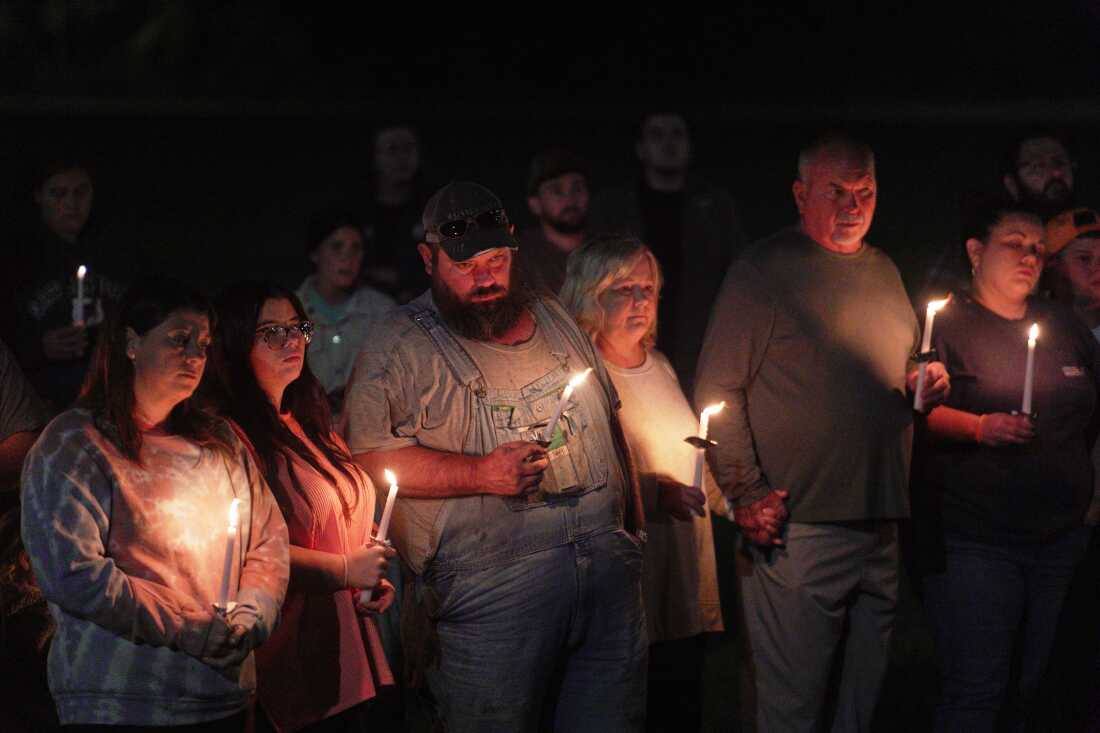
Vigil in Centerville, Tennessee, honoring the victims of a blast at an AES explosives plant on Oct. 10.

Sixteen workers died in an explosion at Accurate Energetic Systems in rural Tennessee. 

AES supplies explosives to the U.S. military and major contractors. Demand for munitions is rising across the Pentagon’s supply chain. 

Routine OSHA inspections are largely suspended during the shutdown. AES previously faced citations for RDX (an explosive with neurotoxic dust) exposure at the plant. 

This is the domestic face of permanent war. More missiles, less oversight, dead workers. Factories run at wartime tempo. Working‑class communities pay with their lives.

The blast, not a glitch

A pre‑dawn explosion leveled an AES production building near Bucksnort, rattling homes miles away as Sheriff Chris Davis called the scene “devastating,” with recovery hinging on days‑long, DNA‑based identifications amid dangerous debris and unexploded ordnance. 

Authorities have now identified all 16 victims, closing one chapter of uncertainty for a town where nearly everyone knows someone who worked behind those blast walls. The cause remains under investigation by federal and state agencies, but the pattern — production pressure outrunning protection — is already legible.​

War economy squeeze

AES manufactures and tests high‑energy materials for the Army and major contractors, tying a 1,300‑acre plant and its workers directly to the Pentagon’s procurement cycle as orders surge and schedules tighten. 

Lockheed Martin and its peers are accelerating weapons production — ramping up output of missiles, launchers, and interceptors. They’re expanding automation and factory floors to “deliver more, faster,” driving a chain reaction through their suppliers, especially smaller and more vulnerable shops like AES. 

Precision Strike Missile output alone is being pushed to 400 units per year, a symbol of an industry racing to boost firepower across everything from artillery rockets to anti-ship weapons.

Boeing has locked in $2.7 billion in contracts to build more than 3,000 PAC-3 seekers — the guidance systems that let Patriot missiles find and destroy incoming targets. Production will reach up to 750 units a year through 2030, cementing Boeing’s position as a key subcontractor to Lockheed Martin and the U.S. Army.

Lockheed, the Patriot program’s prime contractor, separately won a $9.8 billion Army deal in September for PAC-3 MSE interceptors. Together, the awards mark a full-scale production ramp from top contractors to component suppliers across the missile industry.

The New York Times headline on Oct. 13 declared: “Factory towns revive as defense tech makers arrive.”:

“In January, Anduril, an artificial-intelligence-backed weapons manufacturer, announced that it was building a $1 billion factory in Ohio to make drones and other A.I.-enabled weapons. It has since said it also plans to open factories in Rhode Island and Mississippi.

“Regent, a shipbuilding start-up, is constructing a factory in Rhode Island to make electric sea gliders for military purposes. And UXV Technologies, a Danish drone and robotics company, opened a manufacturing facility in Pennsylvania last year.”

The military-industrial monopolies tie this surge directly to active wars and military buildups in Ukraine, West Asia (including Palestine and Iran), and the Indo-Pacific, where Washington is preparing for war on China. Rising conflict is being turned into production orders — and subcontractors are under intense pressure to deliver on time.

In plants that handle missile explosive components like Tennessee’s AES, workers bear the brunt of this push, as the war economy turns public funding into private backlogs and rising shop-floor risk.

Oversight on ice

Since Oct. 1, the government shutdown has sidelined most federal workplace safety programs. Routine inspections are halted, and enforcement is on hold — just when high-risk industries need the closest oversight.

This isn’t just a delay in investigating accidents; it increases the danger in real time. Workers handling explosive materials now face greater risk without regular audits or the authority to stop unsafe work. With inspectors off the job, “run harder” becomes the unspoken rule on the factory floor.

Years before the explosion, Tennessee inspectors found AES workers suffering seizures and nervous system damage from exposure to RDX, a powerful explosive compound. Tests detected explosive residue on their skin — and even in the break room — showing that toxic exposure had spread into supposedly safe areas.

Inspectors labeled the violations “serious,” but AES settled the cases with minor fixes and light penalties. The deeper hazards stayed in place. 

The Pentagon pipeline

Between 2020 and 2024, private companies took in about $2.4 trillion in Pentagon contracts. The top five defense giants alone captured $771 billion — government money funneled through corporate pipelines, while the real danger lands on the factory floor, where explosives are poured, pressed, and packed.

Missile and launcher orders are surging, and backlogs are booming. But safety investment isn’t keeping pace. The subcontractors who turn contracts into weapons bear the risk. As the arsenal speeds up, the danger moves from the battlefield to the workshop.

Defense work is now fused with cloud computing and AI. Tech giants have landed multi-billion-dollar military contracts, wiring battlefield systems into the same digital networks that power everyday life. Silicon Valley is fully woven into the war machine.

Engineers who could be designing trains, housing, or renewable energy are instead building targeting software and missile guidance systems — because that’s where the guaranteed money is. Entire workforces and regions are being reshaped around permanent, low-level war instead of social rebuilding.

Sixteen dead, little said

Sixteen workers were killed in the mass detonation at AES. The blast tore through a plant that fed the U.S. war machine — and through families who now hold vigils few national outlets cover.

Media coverage faded within days. When production outruns protection, tragedy becomes routine. The permanent war economy treats domestic risk as the cost of global power. The workers who die in these plants are casualties of that system, even if they never leave U.S. soil.

Strugglelalucha256


‘We can win this struggle’: Sankara’s message for today

“We can win this struggle if we choose to be architects and simply not bees.” – Thomas Sankara, Imperialism is the arsonist of our forests and savannas, 1986

We honor the life and revolutionary achievements of Thomas Sankara, known as “Africa’s Che Guevara.” A man on a mission to lift Burkina Faso out of the death grip of imperialism and transform it into a beacon of progress and true liberation on the African continent.

Under the leadership of Thomas Sankara, Upper Volta became the country of Burkina Faso, “The Land of Upright People.” Literacy rates rose exponentially across the whole country. Over two million Burkinabé children were vaccinated. He ended Burkina Faso’s reliance on Western aid and set out to create self-sufficiency for the country.

Land was redistributed amongst the working class and peasants of the country, and out of the hands of wealthy landlords under the control of Western imperialists. Ten million trees were planted across the country. Roads and railways were built to connect the country. All of these steps helped create better living conditions for the people of Burkina Faso while also healing the old wounds caused by imperialism and setting the country on a path towards progress.

Thomas Sankara saw the full picture of the global class struggle. He did not set out to create a better Burkina Faso without the country’s women. He banned genital mutilation, forced marriages and polygamy. Women were appointed to government positions and were able to, and encouraged to, join the country’s workforce and military. Pregnancy leave was granted for all expectant mothers. 

He was a man committed to the people. Under his guidance, the old Western luxury and corruption within the Burkinabé government were done away with. Public servants drove cars produced in Burkina Faso and wore clothing made entirely of 100% Burkinabé cotton, tailored by Burkinabé artisans. He never allowed portraits and monuments of himself to be erected in public because he fully believed that it was the people who made this progress happen. He said himself that there are “seven million Thomas Sankaras.”

His love of his country extended to the entire African continent. He believed that all of Africa had the right to tear away from the claws of Western imperialism. His passion for pan African liberation made him a target of Western imperialists and those of the African elite who wanted to continue gutting their continent all for their Western masters.

Thomas Sankara was brutally assassinated and gunned down in 1987, only four years into his presidency. Betrayed by Blaise Compaoré, a onetime ally turned rival who seized power and reversed Sankara’s policies until a popular revolution ousted him in 2014 and sent him into exile. France has yet to release its classified records regarding the assassination of Thomas Sankara.

In the 21st century, the revolutionary spirit of Thomas Sankara lives on. Currently, Captain Ibrahim Traoré, the sitting president of Burkina Faso, is continuing the mission set out by Thomas Sankara to see a fully liberated Burkina Faso, free of neocolonial rule and Western interference. 

Strugglelalucha256


The defeat of Israel and the rebirth of Palestinian agency

If we are to speak of a Palestinian victory in Gaza, it is a resounding triumph for the Palestinian people, their indomitable spirit, and their deeply rooted resistance that transcends faction, ideology, and politics.

For decades, the prevailing notion was that the ‘solution’ to the Israeli occupation of Palestine lay in a strictly negotiated process. “Only dialogue can achieve peace” has been the relentlessly peddled mantra in political circles, academic platforms, media forums, and the like.

A colossal industry burgeoned around that idea, expanding dramatically in the lead-up to, and for years after, the signing of the Oslo Accords between Yasser Arafat’s Palestine Liberation Organization (PLO) and the Israeli government.

The Unmaking of ‘Peace’

The problem was never with the fundamental principle of ‘dialogue,’ ‘peace,’ nor even with that of ‘painful compromises‘ — a notion tirelessly circulated during the ‘peace process’ period between 1993 and the early 2000s.

Instead, the conflict has largely been shaped by how these terms, and an entire scaffolding of similar terminology, were defined and implemented. ‘Peace’ for Israel and the US necessitated a subservient Palestinian leadership, ready to negotiate and operate within confined parameters, and entirely outside the binding parameters of international law.

Similarly, ‘dialogue’ was only permissible if the Palestinian leadership consented to renounce ‘terrorism’ — read: armed resistance — disarm, recognize Israel’s purported right to exist as a Jewish state, and adhere to the prescribed language dictated by Israel and the US.

In fact, only after officially renouncing ‘terrorism’ and accepting a restricted interpretation of specific UN resolutions on the Israeli occupation of the West Bank and Gaza did Washington agree to ‘dialogue’ with Arafat. Such low-level conversations took place in Tunisia and involved a junior US official — Robert Pelletreau, Assistant Secretary of State for Near Eastern Affairs.

Not once did Israel consent to ‘dialogue’ with Palestinians without a stringent set of preconditions, driving Arafat to a unilateral series of concessions at the expense of his people. Ultimately, Oslo yielded nothing of intrinsic value for Palestinians, apart from Israel’s mere recognition, not of Palestine or the Palestinian people, but of the Palestinian Authority (PA), which, over time, became a conduit for corruption. The PA’s continued existence is inextricably linked to that of the Israeli occupation itself.

Israel, conversely, operated unchecked, conducting raids on Palestinian towns, executing massacres at will, enforcing a debilitating siege on Gaza, assassinating activists, and imprisoning Palestinians en masse, including women and children. In fact, the post-‘dialogue,’ ‘peace,’ and ‘painful compromises’ era witnessed the largest expansion and effective annexation of Palestinian land since the 1967 Israeli occupation of East Jerusalem, the West Bank, and Gaza.

Gaza as the anomaly

During this period, there was a widespread consensus that violence, meaning only Palestinian armed resistance in response to unconstrained Israeli violence, was intolerable. The PA’s Mahmoud Abbas dismissed it in 2008 as ‘useless,’ and subsequently, in coordination with the Israeli military, devoted much of the PA’s security apparatus to suppress any form of resistance to Israel, armed or otherwise.

Though Jenin, Tulkarm, Nablus, and other regions and refugee camps in the West Bank continued to forge spaces, however constrained, for armed resistance, the concerted efforts of Israel and the PA often crushed or at least substantially reduced these moments.

Gaza, however, consistently stood as the anomaly. The Strip’s armed uprisings have persisted since the early 1950s, with the emergence of the fedayeen movement, followed by a succession of socialist and Islamic resistance groups. The place has always remained unmanageable — by Israel, and later by the PA. When Abbas loyalists were defeated following brief but tragic violent clashes between Fatah and Hamas in Gaza in 2007, the small territory became an undisputed center of armed resistance.

This event occurred two years after the Israeli army’s redeployment out of Palestinian population centers in the Strip (2005), into the so-called military buffer zones, established on areas that were historically part of Gaza’s territory. It was the start of today’s hermetic siege on Gaza.

In 2006, Hamas secured a majority of seats in the Palestinian Legislative Council, an unexpected turn of events that infuriated Washington, Tel Aviv, Ramallah, and other Western and Arab allies.

The fear was that without Israel’s PA allies maintaining control over the resistance inside Gaza and the West Bank, the occupied territories would inevitably result in a widespread anti-occupation revolt.

Consequently, Israel intensified its suffocating siege on the Strip, which refused to capitulate despite the horrific humanitarian crisis resulting from the blockade. Thus, starting in 2008, Israel adopted a new strategy: treating the Gaza resistance as an actual military force, thereby launching major wars that resulted in the killing and wounding of tens of thousands of people, predominantly civilians.

These major conflicts included the war of December 2008-January 2009, November 2012July-August 2014May 2021, and the latest genocidal war commencing in October 2023.

Despite the immense destruction and the relentless siege, let alone external international and Arab pressures and isolation, the Strip somehow endured and even regenerated itself. Destroyed residences were rebuilt from the salvaged rubble, and resistance weaponry was also replenished, often utilizing unexploded Israeli munitions.

The October 7 rupture

The October 7 Hamas operation, known as Al-Aqsa Flood, constituted a significant break from the established pattern that had endured for years.

For Palestinians, it represented the ultimate evolution of their armed struggle, a culmination of a process that commenced in the early 1950s and involved diverse groups and political ideologies. It served as a stark notification to Israel that the rules of engagement have irrevocably shifted, and that the besieged Palestinians refuse to submit to their supposed historical role of perpetual victimhood.

For Israel, the event was earth-shattering. It exposed the country’s vaunted military and intelligence as deeply flawed, and revealed that the country’s leadership assessment of Palestinian capabilities was fundamentally erroneous.

This failure followed the brief surge of confidence during the normalization campaign initiated by the US and Israel with pliable Arab and Muslim countries during Trump’s first term in office. At that time, it appeared as though the Palestinians and their cause had been rendered irrelevant in the broader Middle Eastern political landscape. Between a co-opted Palestinian leadership in the West Bank and besieged resistance movements in Gaza, Palestine was no longer a decisive factor in Israel’s pursuit of regional hegemony.

The centerpiece of Israeli Prime Minister Benjamin Netanyahu’s strategy, and his aspiration to conclude his long political career with the ultimate regional triumph, was suddenly obliterated. Enraged, disoriented, but also determined to restore all of Israel’s advantages since Oslo, Netanyahu embarked on a campaign of mass killing that, over the course of two years, culminated in one of the worst genocides in human history.

His methodical extermination of the Palestinians and overt desire to ethnically cleanse the survivors out of Gaza laid bare Israel and its Zionist ideology for their inherently violent character, thus allowing the world, especially Western societies, to fully perceive Israel for what it truly is, and what it has always been.

Resistance, resilience, and defeat

But the genuine fear that unified Israel, the US, and several Arab countries is the terrifying prospect that Resistance, particularly armed resistance, could re-emerge in Palestine, and by extension across the Middle East, as a viable force capable of threatening all autocratic and undemocratic regimes. This fear was dramatically amplified by the ascent of other non-state actors, such as Hezbollah in Lebanon and Ansarallah in Yemen, who collectively with the Gaza resistance managed to forge a formidable alliance that required direct US involvement in the conflict.

Even then, Israel failed to achieve any of its strategic objectives in Gaza, owing to the legendary resilience of the Palestinian people, but also the prowess of the resistance that managed to destroy over 2,000 Israeli military vehicles, including hundreds of the pride and joy of the Israeli military industry, the Merkava tank.

No Arab army has managed to exact this scale of military, political, and economic cost from Israel throughout the country’s violent existence of nearly eight decades. Though Israel and the US — and others, including some Arab countries and the PA — continue to demand the disarming of the resistance, such a demand is rationally nearly unattainable. Israel has dropped over 200,000 tons of explosives over Gaza over the course of two years to achieve that singular objective, and failed. There is no plausible reason to believe that it can achieve such a goal through political and economic pressures alone.

Not only did Israel fail in Gaza, or, more accurately in the words of many Israeli historians and retired army generals, was decisively defeated in Gaza, but Palestinians have managed to reassert Palestinian agency, including the legitimacy of all forms of resistance, as a winning strategy against Israeli colonialism and US-Western imperialism in the region. This explains the profound fear shared by all parties that Israel’s defeat in Gaza could fundamentally alter the entire regional power dynamics.

Though the US and its Western and Arab allies will persist in negotiating in an attempt to resurrect the almost 90-year-old Palestinian leader Abbas and his Oslo paradigm as the only viable alternatives for Palestinians, the medium and long-term consequences of the war are likely to present a starkly different reality, one where Oslo and its corrupted figures are definitively relegated to the past.

Finally, if we are to speak of a Palestinian victory in Gaza, it is a resounding triumph for the Palestinian people, their indomitable spirit, and their deeply rooted resistance that transcends faction, ideology, and politics.

All of this considered, it must also be clearly stated that the current ceasefire in Gaza cannot be misconstrued as a ‘peace plan’; it is a mere pause from the genocide, as there will certainly be a subsequent round of conflict, the nature of which depends heavily on what unfolds in the West Bank, indeed the entire region, in the coming months and years.

– Dr. Ramzy Baroud is a journalist, author and the Editor of The Palestine Chronicle. He is the author of six books. His forthcoming book, ‘Before the Flood,’ will be published by Seven Stories Press. His other books include ‘Our Vision for Liberation’, ‘My Father was a Freedom Fighter’ and ‘The Last Earth’. Baroud is a Non-resident Senior Research Fellow at the Center for Islam and Global Affairs (CIGA). His website is www.ramzybaroud.net

Source: Palestine Chronicle

Strugglelalucha256


Palestinian Resistance: Our people’s steadfastness forced a ‘partial achievement’

Hamas, Palestinian Islamic Jihad and the Popular Front for the Liberation of Palestine — the three powers — issued a joint statement on Oct. 10, 2025, posted by Resistance News Network. https://t.me/PalestineResist/82612

O our noble Palestinian people:

In light of the announcement of the first phase of the agreement to stop and end the war of genocide and the marathon negotiations that the factions undertook to reach this national achievement, the three powers extend a salute of honor and reverence to the masses of our great people, especially our people in the Gaza Strip, who faced the most heinous Zionist crimes with legendary steadfastness and resolve.

We also salute all the martyrs and prisoners, their families, the families of the missing and every child, girl, mother, young man, elder and displaced person who stood firm on their land despite the tragedies, genocide, starvation, massacres, the suffering of displacement and the agonies of living amidst the destruction of the basics of daily life. We affirm that their steadfastness is a living symbol of our people’s will and unbreakable determination and proof that their will is stronger than any zionist machine of destruction.

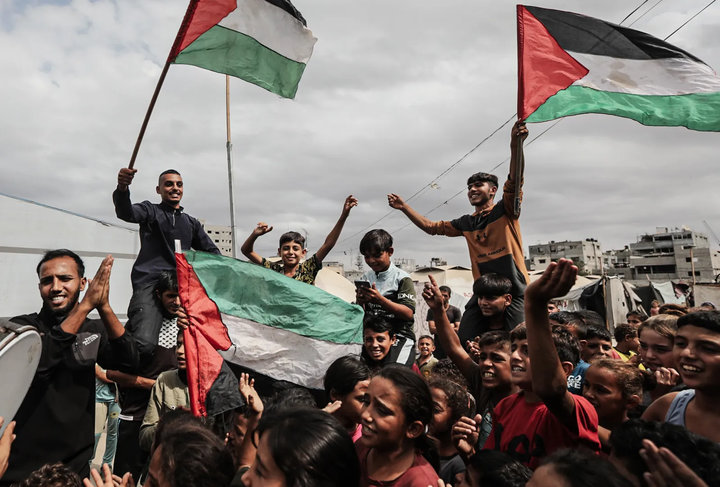
The resilience of the resistance fighters and all our people — including medical, ambulance and civil defense crews, journalists, the displaced and others — has thwarted the plans for displacement and uprooting and has recorded an immortal lesson in steadfastness and defiance that will remain engraved on the brightest pages of Palestinian history. The awe-inspiring scenes of our displaced people returning to Gaza City and the massive gatherings in its streets, camps and destroyed alleys are but an embodiment of the will of a people who reject forced migration and insist on returning and living on their land despite the immense destruction.

We also praise the heroism of the resistance, which stood tall and proud amidst the rubble, withstood the destructive machine of the occupation, broke the enemy’s morale and inflicted heavy losses upon it through its specific operations. This confirms that the will of our people and the heroes of the resistance are stronger than all attempts at oppression and destruction and that the enemy, for over two years, could not break the steadfastness and will of this resistance, despite all the weapons and the massive, lethal war machine it possesses.

The three powers also extend a salute of pride and honor to the support fronts in Yemen, Lebanon, the Islamic Republic of Iran and Iraq, who stood by our people and their resistance and offered martyrs on the path to Al-Quds and Al-Aqsa.

The three powers also express their deep appreciation for the tremendous efforts made by the brotherly mediators (Egypt, Qatar, Turkey) and all who supported this path, calling on the American side and all mediators to continue applying pressure to ensure the occupation’s commitment to all clauses of the agreement and to prevent any deviation from them in the slightest.

We highly value the unprecedented global solidarity movement that stood by our people, raising its voice to reject the genocide and to prosecute the occupation’s crimes. We affirm that the solidarity of free peoples with Palestine and Gaza is a powerful message that our people’s cause is a global political and humanitarian issue. This global support represents a significant moral boost for our resisting people and confirms that the occupation is a rogue entity that has become isolated and besieged, a state which must be increased and escalated.

‘A partial achievement in ending the suffering’

The powers clarify that, despite the occupation’s persistent attempts to derail the negotiation process and obstruct the agreement and Netanyahu’s efforts to prolong the war and quash any chance to stop the aggression, the Palestinian negotiating delegation kept the demands of our people to stop the war of genocide at the forefront of its concerns. It has so far reached an agreement to implement the first phase of this path, which is a fundamental step toward our people’s urgent demand: the final cessation of the criminal war, an end to the aggression on Gaza, the withdrawal of the occupation and the lifting of the siege.

What we have achieved represents a political and security failure for the occupation’s plans and a shattering of its goals to impose displacement and uprooting. It is a partial achievement in ending the suffering of our people and freeing hundreds of our heroic female and male prisoners from the occupation’s jails, in a step that expresses the strength of the resistance, the unity of the national position, and our people’s insistence on achieving their freedom and dignity.

When we engaged in this negotiation process amidst a war of genocide, our eyes were fixed on the suffering of our people, who are facing unprecedented horrors of killing, destruction, genocide and starvation. We acted with the highest sense of national responsibility, despite the level of bias in favor of the occupier, in order to open a new horizon for life in Gaza and for our steadfast people rooted there. The negotiation path and the mechanism for implementing the agreement still require high national vigilance and precise, around-the-clock follow-up to ensure the success of this phase. We will continue to work with high responsibility with the mediators to ensure the occupation is bound to what protects our people’s rights and ends their suffering.

We have made great and strenuous efforts to release all female and male prisoners and the leaders of the national prisoners’ movement. However, the occupation, as is its habit, thwarted the release of a significant number of them.

Despite this, we chose to proceed with implementing the agreement to ensure the halt of the war of genocide against our people and to prevent the enemy from continuing its collective extermination. We pledge to our people and the families of the prisoners that the issue of freeing all of them will remain at the top of our national priorities, and we will never abandon them. We also congratulate our people on the freedom of this blessed group of our prisoners and heroes.

‘We affirm continuing the resistance in all its forms’

Our steadfast people, this stage represents an opportunity to enhance social solidarity within the Gaza Strip by supporting affected families, securing the necessities of daily life and activating frameworks of cooperation between factions, society and relevant local and international institutions, creating a resilient and unified environment capable of facing all challenges and preserving our people’s steadfastness.

We renew the call for unity and national responsibility, to embark on a unified national political path with all powers and factions. We are working in cooperation with gracious Egyptian efforts to hold an urgent and comprehensive national meeting for the next step after the ceasefire to unify the Palestinian position, formulate a comprehensive national strategy and rebuild our national institutions on the foundations of partnership, credibility and transparency.

We also stress our categorical rejection of any foreign guardianship and affirm that determining the form of governance for the Gaza Strip and the foundations of its institutions’ work is an internal Palestinian matter to be jointly decided by the national components of our people. We are prepared to benefit from Arab and international participation in the areas of reconstruction, recovery and development support, in a way that promotes a dignified life for our people and preserves their rights to their land.

In conclusion, at this decisive historical moment, we renew our loyalty to the martyrs, prisoners, wounded and resistance fighters. We affirm our unwavering adherence to our people’s rights to their land, homeland, holy sites and dignity and our insistence on continuing the resistance in all its forms until all our rights are achieved, foremost among them the removal of the occupation, self-determination and the establishment of a fully sovereign and independent state with Al-Quds as its capital.

Strugglelalucha256


Cuban Foreign Ministry denies U.S. claims of troops fighting in Ukraine

Cuba categorically rejects claims of participation in the conflict in Ukraine 

Statement by the Ministry of Foreign Affairs

The Government of the Republic of Cuba rejects the mendacious allegations being spread by the United States Government concerning an alleged involvement of Cuba in the military conflict in Ukraine. This is a slanderous accusation first launched in 2023 by certain media outlets without offering any evidence or substantiation of any kind, and clearly serving an assigned purpose. 

The Cuban Government categorically reaffirms that Cuba is not part of the armed conflict in Ukraine, nor does it participate with military personnel there or in any other country. 

Our authorities have no precise information regarding Cuban nationals who, on their own initiative, have participated or are participating in the military forces of either side of the conflict. What is indisputable is that none of them acts with the encouragement, commitment, or consent of the Cuban State. 

In accordance with its national legislation and international obligations, the Cuban Government maintains a zero-tolerance policy toward mercenarism, human trafficking, and the participation of its nationals in any armed confrontation in another country — all of which constitute serious crimes subject to severe penalties under national law. 

As declared by the Ministry of Foreign Affairs on September 4, 2023, upon detecting the presence of Cubans in the conflict in Ukraine, steps were taken to neutralize recruitment within the national territory, and criminal proceedings were initiated accordingly. 

Between 2023 and 2025, Cuban courts have conducted nine criminal proceedings for the offense of mercenarism, involving forty defendants. In eight of these cases, trials have been held, and in five, guilty verdicts have been handed down against 26 defendants, with sentences ranging from 5 to 14 years of imprisonment. Three cases await the court’s judgment, and one case is pending trial.

Cubans participating on both sides of the armed conflict have been recruited through organizations not based in our country and having no connection whatsoever with the Cuban Government. In the vast majority of cases, this recruitment has been carried out abroad among Cuban nationals residing or temporarily staying in various countries, just as recruitment for that conflict has taken place among people of many other nationalities, in numbers that also remain imprecise. 

The United States Government has not provided and will not be able to offer a single piece of evidence to support its baseless and mendacious accusations in this new defamatory campaign against Cuba. 

Havana, October 11, 2025. 

(Cubaminrex)

Strugglelalucha256


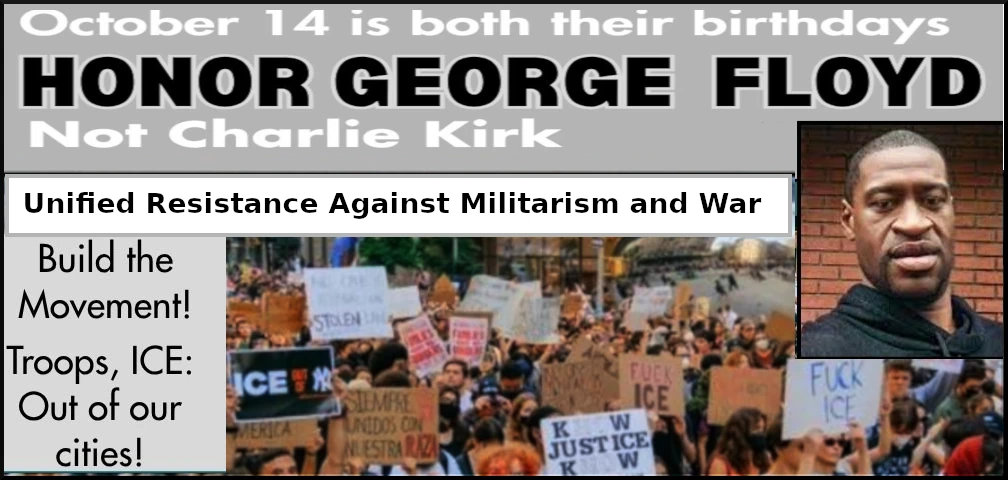
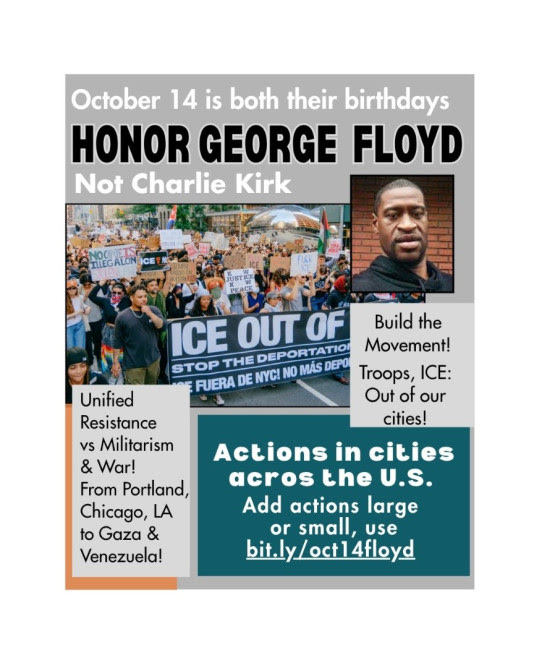
Honor George Floyd, not Charlie Kirk

On Sept. 18, the U.S. Senate voted unanimously to create a “day of remembrance” for the racist, fascist agitator Charlie Kirk. The date they chose, Oct. 14, is also George Floyd’s birthday.

This is a shocking choice. Charlie Kirk called George Floyd a “scumbag.” By honoring Kirk on Floyd’s birthday, the Senate is sending a clear message. It seems to be celebrating a man who spreads racist hate while ignoring the ongoing fight for justice that Floyd’s death started.

A call for a unified day of resistance on Oct. 14 has gone out in response. The Senate’s resolution “is not about honoring Charlie Kirk,” organizers of the call charge. “It’s about smothering a movement that refuses to die.”

The real crisis: militarism at home and abroad

The Senate’s move is a deliberate attempt to co-opt a date and strengthen a reactionary agenda of white supremacy, anti-LGBTQ+ bigotry, and perpetual war. The goal is to divert public attention from critical issues, including:

  • The ongoing genocide in Gaza.
  • Escalating war plans against Venezuela.
  • ICE raids, deportations, and the racist war on immigrant workers.
  • The deployment of troops and federal agents in U.S. cities like Portland, Oregon; Washington, D.C.; Chicago; and Los Angeles.

The preparation for potential widespread martial law — a concern underscored by reports that President Donald Trump recently told generals to prepare for war on the streets of U.S. cities.

This domestic militarism is linked to a broader war on the working class. The corporate media, organizers state, would rather focus on Kirk than on the reality that more than 300,000 government workers have been fired, hundreds of thousands more are being robbed of their right to unionize, and people are losing access to health care, food assistance, and housing.

October 14 as a test

Against that backdrop, organizers are calling to reclaim Oct. 14 in Floyd’s memory — with action, not applause lines. The ask is deliberately broad: If you can’t join a march, hold a teach-in; if you can’t host a forum, stage a banner drop; if you can’t mobilize a crowd, hold a picket sign with your union, your community group, your neighbors. The measure of the day isn’t scale but participation.

Suggested actions:

  • Speak-outs at schools, transit hubs, and workplaces
  • Rallies and marches
  • Teach-ins and indoor forums
  • Banner drops, art interventions, and vigils

The following have endorsed the call: Arm the Dollz; Black Alliance for Peace; Bronx Anti-War Coalition; December 12th Movement; Freedom Road Socialist Organization; International Action Center; International Concerned Family and Friends of Mumia Abu-Jamal; Jazz Against Genocide; Mobilization4Mumia; Mutual Aid Scientific Socialism; National Alliance Against Racist Political Repression; National Immigrant Solidarity Network; People’s Organization for Progress; Resist U.S.-Led War Movement; Struggle for Socialism Party; United National Antiwar Coalition; Veterans For Peace, Chapter 021, N.J.; Workers World Party.

To list or find an event: unac.notowar.net/list-your-action-for-october-14-no-to-fascism-and-war-commemorate-george-floyd/

Strugglelalucha256


Shutdown or shakedown? Trump fires thousands, threatens to steal workers’ wages

Oct. 10 — On Friday morning, Office of Management and Budget Director Russell Vought announced what federal workers had been dreading: “The RIFs have begun.” With that social media post, the Trump administration launched mass layoffs across multiple agencies during an active government shutdown — an unprecedented escalation in the war on public sector workers.

By Friday evening, pink slips were flying at the Environmental Protection Agency, the departments of Education, Health and Human Services, Homeland Security, Housing and Urban Development, and Treasury. The administration wasn’t even trying to hide its glee. Trump himself posted an AI-generated video depicting Vought as the Grim Reaper, scythe in hand, stalking through federal buildings as workers queue for unemployment.

This isn’t normal politics. This is class warfare dressed up as budget management.

The American Federation of Government Employees and the American Federation of State, County, and Municipal Employees immediately filed an emergency request for a temporary restraining order, asking U.S. District Judge Susan Illston to halt the mass firings pending an Oct. 16 hearing. The unions are fighting an uphill battle against an administration that sees the shutdown not as a crisis to resolve, but as an opportunity to gut the federal workforce.

“These mass firings are illegal and will have devastating effects on the services millions of Americans rely on every day,” AFSCME president Lee Saunders warned. 

AFGE president Everett Kelley was more direct: “In AFGE’s 93 years of existence under several presidential administrations — including during Trump’s first term — no president has ever decided to fire thousands of furloughed workers during a government shutdown.”

But the layoffs are only part of the story. The Trump administration is also threatening something even more audacious: wage theft on a massive scale.

From layoffs to wage theft

A leaked White House memo argues that furloughed federal workers — as many as 750,000 people — may not receive back pay after the shutdown ends. This would violate the Government Employee Fair Treatment Act of 2019, which Trump himself signed during the last shutdown. But the administration is claiming the law has been “misconstrued,” seizing on technical amendments to argue that back pay must be specifically appropriated by Congress.

Asked Tuesday whether furloughed workers would be compensated, Trump responded like a mob boss: “I would say it depends on who we’re talking about. … For the most part, we’re going to take care of our people. There are some people that really don’t deserve to be taken care of, and we’ll take care of them in a different way.”

This is the language of authoritarianism. The message is clear: Loyalty to Trump determines whether you eat.

Federal workers are understandably terrified. “Trump saying he won’t pay us really got me worried,” an EPA employee told reporters. “What’s crazy is that the law is there in black and white. It couldn’t be more clear that legally furloughed employees ‘shall be paid.’ There’s no room to interpret it.” 

A Smithsonian worker expressed broader fears: “There could be a possibility where Trump decides he no longer wants to fund the Smithsonian. They can pretty much take down the entire Smithsonian.”

Strugglelalucha256


Expand or die: a system that can’t stop creating crises

The two factories that tell the story

Walk through Fort Worth, Texas, and you’ll see the story of a declining empire written in steel and concrete.

At one end of town stands a vast Lockheed Martin plant, where workers in clean rooms assemble guidance systems for missiles. The plant runs three shifts a day. Its parking lot is full, the lights never go off, and the hum of war production fills the night.

A few miles away, the old General Motors transmission factory sits in silence. The windows are broken. Weeds push through the cracked pavement. The GM plant closed in 2009 — 1,100 workers lost their jobs. Lockheed opened its new plant in 2015. It employs 450.

 “Do the math,” a laid-off GM worker told a local reporter. “That’s what happened to this country.”

Capitalism can’t sit still

Corporate media calls this “globalization” or “market forces.” In reality, the U.S. economy has turned from one that made things into one that serves monopoly corporations and finance capital.

Capitalism is a system that must expand or die. A company that doesn’t crush competitors and extract ever-greater profit disappears. That’s true for corporations and for capitalist countries alike.

Profit doesn’t come from “innovation.” It comes from us — the working class. In every shift, part of the day covers wages; the rest produces unpaid value for the boss. That stolen time is the source of profit. The more the bosses can stretch it, the richer they get.

That’s why every struggle over housing, food, and health care is ultimately a fight over who controls the value workers create.

They shipped the jobs away — on purpose

For decades, U.S. corporations could afford higher wages because they had the world’s most advanced industry and access to cheap food and energy. But as other countries industrialized, the bosses sought new ways to keep profits up — slashing wages, busting unions, and exporting jobs.

Manufacturing’s share of the U.S. economy has dropped from about 16% in the 1990s to a little over 10% today, and the U.S. slice of global factory output has fallen as well. The National Association of Manufacturers (NAM) reports that the U.S. share of world trade in manufactured goods was 7.9% in 2023.

China now produces more than 30% of the world’s manufactured goods. This isn’t just an economic change — it’s a reshaping of working-class power across the globe.

But there’s one exception. The U.S. still clearly dominates in arms production: Between 2020 and 2024, it accounted for 43% of global arms exports, making it the single largest supplier by a wide margin.

The war economy

Defense spending, military contracts, and state procurement dominate advanced U.S. manufacturing. 

Fighter jets, drones, submarines, and missile systems — Lockheed Martin, Northrop Grumman, Raytheon, and General Dynamics get billions in guaranteed government contracts.

Even the tech giants are in on the game. Amazon’s cloud hosts military intelligence. Microsoft’s $22 billion contract builds “battlefield cloud computing.” Google designed AI to help drones analyze targets.

Big tech AI was built on government-funded research and development and is maintained on Pentagon contracts. The military-industrial complex has moved into Silicon Valley.

Engineers and machinists who could be building trains, housing, or clean energy systems are instead building killing machines. Factories that could make solar panels produce missile components. Entire towns depend on defense contracts to survive.

Every war or near-war means billions more for the weapons industry. Lockheed and Raytheon make their biggest profits not in all-out wars, but in endless, low-level conflict that never ends.

An economy that needs constant war to keep the assembly lines running isn’t strong — it’s sick.

The dollar weapon and the empire’s decay

How does Washington afford endless subsidies for billionaires and corporations while cutting aid for workers? Through the dollar system that acts like a global siphon.

For decades, oil, food, and nearly all global trade have been priced in U.S. dollars. That forces countries to hold dollars, use Wall Street banks, and buy U.S. Treasury bonds just to keep trade moving. Wall Street turned the dollar into a weapon that props up the empire while draining the world.

When Washington froze $300 billion of Russia’s reserves in 2022, every country saw the warning: Their wealth is safe in U.S. banks only as long as they obey Washington.

Now, nations from China and India to Brazil, South Africa and Saudi Arabia, as well as Indonesia, Thailand and Malaysia are moving away from the dollar — buying gold, trading in their own currencies, and building payment systems independent of Wall Street. On Oct. 7, 2025, gold broke $4,000 an ounce — a sign that the dollar’s grip is slipping, along with fears of Trump’s expanding war drive: trade wars, wars in Palestine and Ukraine, and the war buildup against Venezuela, Cuba, and China.

As the financial foundation weakens, the empire turns inward — seeking to preserve profit through repression at home.

Class war at home

While Wall Street and big corporations get blank checks, workers and the poor get the knife.

Trump’s so-called “Big Beautiful Bill” is an assault on survival. It cuts food stamps and Medicaid — pushing millions toward hunger and sickness. It forces people to “work” 80 hours a month, paid or unpaid “volunteer,” to keep health coverage — flooding the labor market with desperate workers and driving wages down.

Fifteen million people will lose health care under the new rules. That’s not an accident — it’s the point. A hungry, sick worker is easier to control.

The administration has purged hundreds of thousands of federal workers and gutted labor protections.

The austerity cuts, surveillance programs, and privatization drives are not separate events. They are a coordinated offensive — a dictatorship of capital to impose deeper exploitation in a crisis economy.

There’s always money for war. Never enough to keep people alive.

War doesn’t build — it destroys

Politicians love to say that military spending “creates jobs.” That’s half true.

Yes, war contracts make factories busy. But war production eats itself. You can’t live in a bomb. You can’t eat a missile. You can’t recycle a dead body.

Weapons don’t build wealth — they burn it.

World War II didn’t end the Great Depression because war is productive. It ended because it put idle factories and workers back to work — but at enormous human and material cost. After the war, the U.S. dominated only because every rival’s factories lay in ruins. That’s not happening again.

The empire abroad, repression at home

U.S. power abroad rests on the same foundation as inequality at home — domination through finance, coercion, and debt. Global South countries are forced to borrow in dollars, privatize services, and open their markets to U.S. corporations. At home, those same corporations cut wages, bust unions, and evict tenants.

The working class, both here and abroad, pays the same price for the same system.

To survive, capitalism must expand — into new markets, new resources, and new forms of exploitation. But every expansion creates new crises. The system’s hunger for profit is endless, and so is the destruction it brings — from shuttered towns in Texas to the burning forests of the Amazon.

Capitalism’s problem is not mismanagement or bad policy. It is the system itself — a machine that devours workers and the planet alike. To end its devastation, we need not reform it but replace it with an economy built on human need, not profit.


Strugglelalucha256


How pinkwashing is used to slander anti-colonial revolutions from Palestine to Burkina Faso

Oct. 15 marks the 38th anniversary of the assassination of Thomas Sankara, a Pan-Africanist and Marxist revolutionary, who seized state power in a 1983 popular coup. Sankara was president of Burkina Faso until his killing in 1987 by Western-backed forces. Sankara’s staunch anti-imperialist leadership radically transformed the nation, which threw off the shackles of French domination during that period. For more, see Thomas Sankara, “Africa’s Che Guevara.”

Additionally, October is the celebration of LGBTQ+ History Month, a history long defined by the blood and solidarity of all working-class LGBTQ+ people worldwide in their liberation struggle against capitalist, imperialist and neo-colonialist oppression in the forms of homophobia and transphobia.

On Sept. 1, 2025, Burkina Faso’s Legislative Assembly passed an updated family amendment code that included declaring “homosexual behavior as a criminal offense, punishable by two to five years in prison, fines, and possibly deportation for foreign nationals.” Almost immediately after this announcement, major Western capitalist media outlets used this to further justify their imperialist propaganda against Burkina Faso and President Ibrahim Traoré, whom they have already demonized as an “anti-gay dictator.” 

The audacity of the West to pretend like they care about LGBTQ+ rights in Burkina Faso, while actively committing and supporting multiple live-streamed genocides in Palestine, Sudan, the Congo and elsewhere, is nothing short of baffling. 

Western nations posture as the “safest places in the world for LGBTQ+ people.” But in the United States, the ruling class is backing a fascist political movement aimed at denying gender-affirming health care to trans and non-binary people, nullifying passports and other documents that affirm one’s gender, and allowing for the escalation of anti-trans and anti-queer violence to continue unchecked, and perhaps worst of all, falsely accusing “mentally ill” trans people as the primary cause of mass shootings. 

Pinkwashing: a tool in imperialism’s belt

Historically, pinkwashing has been nothing more than a means of manufacturing consent for pushing illegal sanctions and regime change in countries that either have overthrown Western imperialist influence or are in the process of doing so. The imperialists’ goal is to prevent them from achieving sovereignty and self-determination. The tactics to achieve this have always been the same:

  • Dehumanize the people, culture and society through capitalist media propaganda.
  • Destabilize the economic, social, and political climate through sanctions and military control.
  • Implement regime change by any means necessary to strengthen Western hegemony.

Burkina Faso now falls into that same category of nations that have Washington terrified.

Why does Washington hate Traore?

In a 2022 popular coup, Captain Ibrahim Traore seized governance from the French-installed puppet leader, Paul-Henri Damiba. He has since expelled all French and U.S. colonizers from the land and has re-nationalized its natural resources for the benefit of the Burkinabe people, rather than the predatory World Bank and IMF. 

Alongside the leaders of Mali and Niger, Traoré has joined the Alliance of Sahel States, a critical step towards achieving sovereignty and self-determination. Its formation and continued cooperation are reason enough for Washington to be unfriendly. 

Some have referred to Traoré as the “second coming of Sankara,” and for many reasons. He has already survived numerous Western-backed assassination attempts, as well as defended the nation against Western-backed ISIS and Al Qaeda terrorists. 

For more on the revolutionary government’s accomplishments, see “From Sankara to Traore: Burkina Faso’s anti-imperialist legacy.”

Colonial Europe plants the seeds of gender oppression and bigotry

This particular anti-LBGTQ+ policy didn’t just appear out of thin air.  

France, the colonial power in Burkina Faso, Mali, and Senegal, directly imposed its legal and cultural systems across West Africa, exporting the Napoleonic Code that criminalized “acts against nature.” This colonial legislation actively supplanted often more fluid pre-colonial social norms and planted the deep-seated seeds of institutionalized homophobia. The profound irony, therefore, is that the very anti-LGBTQ+ laws now used by Western powers to pinkwash and slander anti-imperialist governments like Traoré’s were themselves a Western colonial import.

International precedent

The pinkwashing campaign against Burkina Faso is reminiscent of the slanderous anti-LGBTQ+ propaganda the Zionist entity has used against Palestine to justify its illegal occupation. “Israel” has boasted for decades that it is the “bastion of democracy and LGBTQ+ rights in the Middle East,” while it has perpetuated ethnic cleansing against the Palestinian people, and also has treated its own LGBTQ+ population miserably.

Or take the example of Cuba. Even 10 years after overthrowing the U.S.-backed Batista dictatorship in 1959, the Cuban Revolution had to contend with patriarchal values. In 1971, a congress on education in Havana called for the removal of homosexuals from the field of education.

Western capitalist media used this policy in Cuba to try to discredit the revolution. Some anti-imperialist activists denounced Cuba, thinking that Cuba’s seizing state power should result in an instantaneous social transformation. 

At that time, the U.S. had widespread discriminatory policies against homosexuals in the workplace, including schools. In 1953, President Eisenhower signed Executive Order 10450, which banned homosexuals from working for the federal government or any of its private contractors. In 1978, Oklahoma and Arkansas passed laws banning gay and lesbian teachers from working in public schools.

Fast forward to 2022, when the Cuban Revolution, through a massive grassroots organizing and mobilization effort, achieved the Code of Families —the world’s most inclusive revolutionary code. Among its many leaps forward, the Code guarantees the right of all people to form a family without discrimination, legalizes same-sex marriage, and allows such couples to adopt children.

It is the duty and responsibility of queer anti-imperialist revolutionaries in the belly of the beast to defend all movements that are actively breaking the chains of Western imperialism when they are branded as homophobic by the same countries that scapegoat trans people at the first chance they get. 

To paraphrase what revolutionary trans communist Leslie Feinberg asserted regarding Cuba, the current problems that exist in Burkina Faso do not invalidate the anti-colonial revolution.

May we see a Burkina Faso that continues to build upon the revolution first undertaken by Thomas Sankara, and that lives to struggle internally on the principles of gender and sexual liberation, the same way that Cuban workers of all sexual and gender orientations have struggled against these contradictions post-Revolution, as they continue to build socialism.


Strugglelalucha256


A national call to action on Oct. 14: In memory of George Floyd

Georgefloydday

A National Call To Action On October 14

In Memory Of George Floyd — Let’s Build The Movement!

Unified Resistance vs Militarism & War From Portland to Chicago to LA to DC to Gaza and Venezuela!

We, the undersigned, call on you to endorse and plan activities in remembrance of George Floyd and the mass movement that took to the streets to protest his murder, and the murder of all of those who have died at the hands of racist police and fascist violence.

George Floyd and Charlie Kirk were both born on Oct. 14. This past Sept. 18, the Senate unanimously voted to declare Oct. 14 a “day of remembrance” for Kirk, who called George Floyd a “scumbag” and said that his murder should not have drawn such attention.

We must respond to this.  On Oct. 14, plan a speakout, a rally, a march, an indoor event, a banner drop, a vigil or other forms of protest.  Draft your Oct. 14 statements, signs and literature in various languages.

October 14 is not really about honoring Charlie Kirk. The white supremacists who control the government with the support of the super-rich want to prevent a reawakening of the movement catalyzed by George Floyd’s murder. This is what’s behind the deployment of troops on the streets in our cities and the racist war against immigrant workers.

These reactionary forces are co-opting Kirk’s birthdate to strengthen white supremacy, anti-LGBTQIA2S+ bigotry, and war at home and abroad. They want the corporate media to focus on Kirk instead of genocide in Gaza; war plans against Venezuela; ICE raids and deportations; deploying troops in our cities such as Portland, Washington, DC, and Los Angeles; and preparing to declare martial law on a wide-spread basis.

They want people to forget about their war on workers and labor unions. They need to try to distract us from the reality of nearly 200,000 government workers being fired and hundreds of thousands more being robbed of their right to a union. They’d rather we not focus on the fact that people are losing access to healthcare, food assistance and housing and can no longer afford basic necessities.

We can’t depend on the Democratic Party politicians and supposedly anti-Trump forces that have acquiesced to the Kirk pressure campaign. Instead of acquiescence, courage, militancy and struggle are the only ways to respond to this crisis.

The following groups urge actions, large and small on Oct. 14:  Arm the Dollz; Black Alliance for Peace; Bronx Anti-War Coalition; December 12th Movement; Freedom Road Socialist Organization; International Action Center; Jazz Against Genocide;  Mutual Aid Scientific Socialism;  National Alliance Against Racist Political Repression; National Immigrant Solidarity Network;  Peoples Organization For Progress,   Resist U.S. Led War Movement; Struggle for Socialism Party; United National Antiwar Coalition; Veterans For Peace, Chapter 021, N.J.; Workers World Party

Strugglelalucha256
https://www.struggle-la-lucha.org/2025/10/page/4/