Statue of Fidel Castro and Che Guevara in the struggle
written by Struggle – La Lucha
July 25, 2025
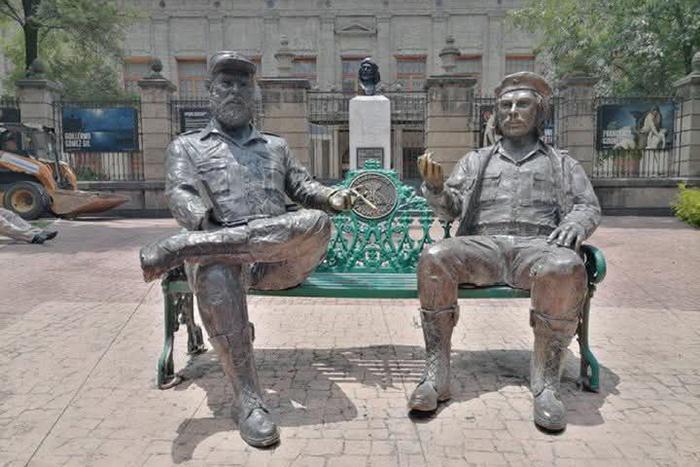
Monumento Encuentro, a bench with statues that commemorate the meeting in Mexico between Fidel Castro and Che Guevara, located in the Jardín Tabacalera (Plaza San Carlos). Photo: La Jornada
Once again, bronze statues are taking the front line in an ideological war. The statues of Fidel Castro and Che Guevara, both dressed in combat garb (one might say looking very Mexican), have been seated in a small park in Mexico City’s Colonia Tabacalera neighborhood since 2017. The Monumento Encuentro (Encounter Monument) monument was placed there by the Mexico City administration of then-Mayor Andrés Manuel López Obrador.
The statues were located near the historic first meeting place of Che and Fidel. It was here in 1955 that they began to plan their revolutionary campaign to free Cuba from the grasp of U.S. imperialism and the brutal despot, Fulgencio Batista.
Currently, a social media storm has countered the abrupt removal of the popular Encuentro monument by a right-wing borough president in the Cuauhtémoc district, where the monument was located.
Outspoken opposition has come from Mexico’s President, Claudio Sheinbaum. She has said she will make arrangements with Mexico City’s mayor, Clara Brugada, to place the historic monument in another part of the city.
Sheinbaum suggested that the removal of the Monumento Encuentro was political retaliation for her own widely applauded monument removal — the banishment of one of Mexico’s most infamous symbols.
In her former position as Mayor of Mexico City, Sheinbaum ordered the removal of the bronze statue of the genocidal conquistador Christopher Columbus from a pedestal dominating the capital’s Paseo de la Reforma.
Indigenous activists have led campaigns protesting the monument for years.
The traffic circle where the Columbus statue once reigned has been renamed “Glorieta de las Mujeres que Luchan” (Roundabout of the Women Who Fight). Today, it is a rallying point for the struggles of Indigenous peoples.
Women have installed an “anti-monument” featuring a purple-clad woman with a raised fist to honor women who have faced violence and injustice for their activism and struggles.
At San Diego Pride: ‘If you support trans rights, support ending genocide in Gaza’
written by Struggle – La Lucha
July 25, 2025
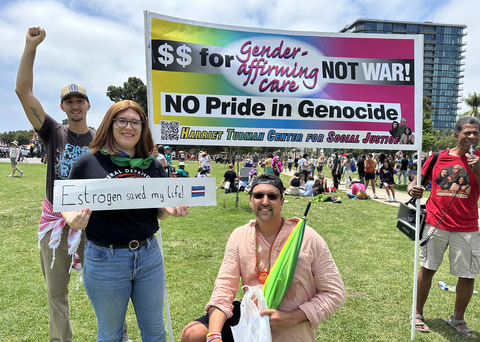
San Diego, July 19 – A contingent from the Harriet Tubman Center for Social Justice in Los Angeles joined members of the San Diego Struggle for Socialism Party to participate in San Diego’s 2025 Pride March. The group highlighted the Palestinian struggle and demanded an end to ICE raids. The Harriet Tubman Center for Social Justice is also part of L.A.’s Community Self Defense Coalition, which has been in the streets protecting community members from ICE.
The Harriet Tubman Center’s John Parker spoke with Nico, a local trans community member, about trans solidarity with Palestine.
Nico: “I’m a San Diego native born and raised. I grew up in the ‘gayborhood,’ and in regards to the work that you guys are doing, I just want to say first and foremost, thank you so much for the work that you guys are doing. It’s important. “And second of all, as someone who is politically minded and active, the amount of times that I have heard Zionists specifically use my trans identity and try to weaponize that as a means to divide me against what I believe is a fight for human rights.
“And if you support trans rights, then you have to support ending the genocide in Gaza. There’s no way that you can explain it away. There’s no dividing that. It’s very, very simple. It’s an all or nothing thing. This is a zero sum game. Are you for human rights or are you not for human rights?”
Cuba: ‘The beauty of this difficult hour lies in knowing that we are part of an undefeatable people’
written by Struggle – La Lucha
July 25, 2025
Speech delivered by Miguel Mario Díaz-Canel Bermúdez, First Secretary of the Central Committee of the Communist Party of Cuba and President of the Republic, at the closing of the Fifth Ordinary Period of Sessions of the National Assembly of People’s Power in its 10th Legislature, at the Convention Palace, on July 18, 2025, “Year 67 of the Revolution”
(Shorthand Versions-Presidency of the Republic)
Dear Army General Raúl Castro Ruz, leader of the Cuban Revolution;
Dear comrade Esteban Lazo Hernández, President of the National Assembly of People’s Power;
Dear deputies;
Compatriots:
This has been an authentic Assembly of the people, as the young deputy Danhiz expressed here. It has been so because its debates were the debates of today’s Cuban society on the enormous challenges ahead of us, but also because they once again revealed the impressive willingness of this people to fight when everything becomes more difficult.
Neither pessimism, nor defeatism, nor discouragement. What we found here were sober presentations, criticisms based on commitment and, above all, concrete proposals and demands to change what must be changed without delay.
The wisdom and enthusiasm that has characterized practically all the interventions of these days do not surprise me, it is what I have seen in the tours through the provinces. Just where the situation is hardest, after long hours of blackout, you always find the extra of Cubans.
It is not the first time nor will it be the last time that the Cuban Revolution faces its “most difficult moment”, although it will always seem to us that nothing can be worse than what we face at the instant we face it.
I will cite a few episodes in the history of Cuba: the Zanjón Pact after ten years of a bloody war that ended with the death or exile of its leaders; the fall in combat of José Martí and Antonio Maceo; the Yankee intervention that robbed us even of the right to enter the heroic city and to attend the signing of the Treaty of Paris because there two empires negotiated our freedom; the neocolonial republic with its appendix, and the Yankee military base where human dignity is tortured and violated.
Then comes the Machado times with its pomp and misery, and Julio Antonio Mella assassinated, and the Revolution that went to the dogs, and Antonio Guiteras massacred in El Morrillo for his profoundly anti-imperialist action. And the corruption of the authentic ones, and Batista’s coup d’état, and the murders of “our children” denounced by the Cuban mothers, and the repressed students and the massacre of the assailants of the Moncada, the Presidential Palace, the Goicuría.
With all this inheritance of heroism and frustrations of the revolutionary struggles, the Centennial Generation entered history, with its setback marking the victory in the attack to Moncada. They already had a program, an ideal and a willingness to carry it to the ultimate consequences. And so they did.
When we review all the periods of the 66 years of the Revolution in power, what we find, in addition to victories, are third world challenges, enemy obstacles and also our own mistakes and lessons learned, all fruits of the never abandoned eagerness to conquer and sustain social justice as a supreme aspiration, in a completely adverse world context, since the Soviet Union and the socialist camp ceased to exist.
If, in spite of all that, the Cuban Revolution is standing and fighting for the possible prosperity, it is because of its authentic and genuine character. We are not an accident of history. We are the logical consequence of a history of resistance and rebellion against abuse and injustice that has very deep reasons to believe in its own strength.
That is why the national dignity is offended by those who play at comparing times to praise “how well Cuba was before 1959”, posting photos of the palaces and the elegance of its ladies and gentlemen, but hiding those of the eviction, the machete plan, the misery, the children swollen with parasites who worked when they should have gone to school, the prostitutes, and the Italian-American mafias sharing the spoils of the hotels and cabarets for whites only in a mestizo country.
Because the Revolution that finally took power in 1959 was started by a small group of revolutionaries, but it was made by a whole people. And the people who made it have defended it and defend it today even with their teeth, let there be no doubt about it! (Applause).
Otherwise, it will never be possible to explain its existence in this uncertain decade of the 21st century, where dissidence from the single way of thinking, imposed by predatory capitalism, is paid for with smart bombs, the destruction of entire nations or with asphyxiating economic blockades, like the one that this small country of courageous people has been enduring for more than 60 years.
It is deeply insulting to human dignity that those who use the Internet in campaigns to denigrate the Cuban people do not react with equal indignation in the face of the scandalous crimes of those who blockade the country; They avoid calling by name the Israeli genocide in Gaza and Lebanon, and do not protest, do not rebel, do not have the courage to point the finger at those guilty of so much xenophobia, so much war, so many weapons and so much injustice, competing in news prominence with the rampage of billionaire pedophiles and the deportation or imprisonment, without proven crimes, of tens of thousands of migrant workers and their families.
What we learned from the Cuban Revolution is that ideals are not changed because circumstances change; that the trench is not abandoned when the enemy siege tightens. We learned that only by having clear convictions as principles is it possible to sustain and win battles. And we also learned that we can fight our way out of the siege! (Applause).
Fellow Members:
I am not going to expand on the topics already addressed. The gravity of the times demands more actions than words, although we will always have the duty to say them and above all to honor them before the people who elected us. The guide is in the concept of Revolution that Fidel bequeathed us: “Never lie or violate ethical principles”.
These working sessions leave us with an important lesson. This is the Assembly of the Cuban people and everything that is discussed and approved in it has to connect with the feelings, needs and demands of the Cuban people. But let us not forget, as we rethink these days, the revolutionary ethics, that which Fidel taught us; let respect and not hatred prevail in us after learning, we cannot for any reason resemble our enemies.
On the other hand, it would not be realistic or honest to commit ourselves to fulfill the solution of all those needs and demands, always growing, where the main obstacle to achieve it is external. What we can and have the duty to commit is our energy, our effort, our tireless search for new ways and actions towards the satisfaction of those demands.
As the main obstacle is not within reach, all solutions depend entirely on the ability to foresee, to anticipate events and to face them with intelligence, effort and innovation. But, first of all, with the indispensable participation of our heroic people.
The recently launched Soberanía information and services platform and the proposal of several deputies to reach a consensus and make transparent the measures of the Government Program to correct distortions are strengths of the digital transformation, which should speed up processes that are still running too slow for the seriousness of the urgencies.
The Cuban economy operates under many risks for any decision, largely derived from the fierce enemy persecution. We cannot add more with our own inadequacies.
We maintain the conviction reiterated by Army General Raúl Castro Ruz that it is possible to move forward and overcome the current situation through our own efforts and results; but to achieve this, more discipline, organization, awareness and perseverance are required.
I believe that the reports of the Prime Minister and the Ministers of Economy and Planning and of Finance and Prices have been sufficiently commented on and received observations and proposals that should be taken into account.
An encouraging example is the fiscal results analyzed in this Assembly. I will not dwell on the details, but I do think it is good to remember that we will close the year 2023 with a 35% increase in the fiscal deficit. Many will remember the alarm that this caused and the fatalistic prediction of those who calculated up to a decade to recover that indicator. A year and a half later, the encouraging news is that we were able to achieve a significant reduction. In fact, during the first four months of this year we had surplus results and up to this moment the current account closes without deficit, which had not been achieved for more than ten years.
This has been an authentic Assembly of the people. Photo: José Manuel Correa
How was this possible? The main formula: discipline and exigency in the fight against tax evasion, in the collection of taxes and fines. The work is not perfect yet, this is an area in which a lot of awareness and control work is needed, until we gain in tax culture.
This result, very important for the economy, has a transcendental social impact: it will allow us to redistribute that income to the most vulnerable sectors, such as our retirees. This is what has enabled us to bring their pensions to a level that, while not sufficient, does put them in a better condition.
The main currency in fiscal policy is and will continue to be to attend to those, in society, who suffer most severely from the difficult situation of the country under the noose of the asphyxiation plan contained in Mr. Trump’s Presidential Memorandum.
With the conviction that “Yes we can”, we have to turn to other vital areas for development, such as achieving an increase in foreign currency income, in the midst of a very hostile scenario in which the United States Government is reinforcing its siege to prevent the entry of a single cent into the country every day.
We cannot remain impassive, much less feel defeated. We must focus on all our export capacities, which inevitably start from an increase in production in all possible areas, to do so in sufficient quantity and quality, which will then allow us to impose ourselves against the siege and global competition.
It is up to us, and only us, to be sufficiently efficient, even in the difficult circumstances of acting with our hands tied by the blockade that some try to avoid. It is a challenging challenge, but not an impossible one.
Here, I would like to return to what we find in every tour we make week after week through the country’s municipalities: how some, in the same circumstances of shortages, can overcome difficulties and demonstrate results.
An undeniable answer to this question, which we constantly ask ourselves, lies in the potential of leadership and the value of successful collectives.
The import mentality that has corroded us for years, in addition to generating dependence, whose negative effects are felt more in times of crisis, curbs internal capacity and potential and facilitates the actions of persecution against Cuba.
We cannot say that we will renounce imports, they will always be necessary at some level; but it is urgent to change the matrix and work on the basis of consuming more of what we produce internally than what is imported.
These productive processes, which we urgently need to dynamize, we cannot expect them to be only from large structures or companies.
As a way of contributing to municipal development, we must bet on boosting local production systems. Let us defend once and for all that the municipalities finally occupy the leading role they should have in national development.
Dear deputies:
We are facing a world in which an attempt is being made by the main military and economic power to impose a hegemonic and neoliberal approach.
During this semester we have consolidated foreign relations, which are being strengthened in the midst of constant pressures from sectors of extreme anti-Cuban hatred to promote economic and political isolation, which they will never achieve.
Cuba continues to be that benchmark of dignity and national sovereignty that many governments and peoples of the world look up to with admiration.
We have reached a higher level in strategic relations with China, Vietnam, Russia and other friendly countries that participate in a growing and mutually beneficial way in economic and social development plans.
Our support for the Bolivarian Revolution, the Sandinista Revolution and the ever-sister nation and people of Mexico is ongoing.
We have continued the respectful dialogue and cooperative relations with the member countries of the European Union, on the broad basis and legal framework offered by the Political Dialogue and Cooperation Agreement between Cuba and that bloc of countries.
Cuba will maintain its solidarity and cooperation with the sister nations of Africa and Latin America and the Caribbean that continue to denounce the blockade and the arbitrary certifications, in spite of the different pressures to which they are subjected.
In the important events we have participated in this year, such as CELAC, the summits of the Eurasian Economic Union and the BRICS, the understanding, sensitivity and willingness to insert and support Cuba in these international mechanisms have been ratified.
We observe in the reactions of the people many favorable expectations about the strengthening of these exchanges and their results. Although it takes time to consolidate the incorporation into these mechanisms, they mean new and hopeful opportunities.
For this we also have to work together, at all levels, with a high sense of belonging, responsibility and without that persistent bureaucracy that we still encounter and not infrequently hinders and frustrates important projects.
Any strategy to move forward must take into account that the new U.S. doctrine, which seeks to impose peace by force, is a latent threat to true peace at the global level, which poses, in the particular case of Cuba, a very dangerous scenario.
No one is safe when the most powerful empire in history breaks all the rules of international relations to impose its hegemonic will against countries it intends to subjugate, even, as we have seen, its own traditional allies.
In our case, the attempt to subjugate us, much older than the Revolution, has intensified in recent years, and very recently the current Republican administration has taken it upon itself to declare it, formally and publicly, in a Presidential Memorandum on National Security.
The main measures contemplated in this Memorandum have actually been applied since Donald Trump’s first term in office and are aimed at closing all access to the financing that is essential for the normal performance of the economy.
This brutal siege, in combination with the unacceptable inclusion of Cuba on the list of alleged sponsors of terrorism, reinforces the blockade policy to unprecedented levels and causes a multiplied impact of the coercive measures on the economy and, by extension, on the standard of living of the Cuban population. We cannot hide or ignore this effect, much less its destructive purpose.
The combination of the limited availability of foreign currency income, as we have already mentioned, the high dependence on imports and the transversal effects caused by the instability of the national electro-energy system cause a significant paralysis or slowdown of economic activity which imposes a deficit in the supply of goods and services to the population, and a contraction of exports.
Consequently, the capacity to import foodstuffs for the basic food basket and the fuels necessary for the generation of electricity and the functioning of the economy is limited. The scarce availability of medicines, the decrease in transportation services, solid waste collection and water supply, among others, make up the harsh panorama that our people face every day.
To overcome this situation, we have been forced to accept the partial dollarization of the economy, which undoubtedly, in some way, favors those who possess certain capital resources or receive remittances, which translates into an undesired widening of the gaps that mark social inequality.
In this context, we must increase the effectiveness of the redistributive social function of the State with public and fiscal policies that, without restricting solutions, prevent the concentration of wealth in the hands of a few, thus increasing inequality and poverty. And to pay the greatest attention to inflation which, although maintaining a slight deceleration, is still very high, limiting the purchasing power of workers’ salaries and the lower income of pensioners and retirees.
It is urgent to reorder the relations between the state sector and the private sector to correct distortions, bad practices and negative tendencies that deviate from the principles of socialist construction. Strengthen business ethics to avoid bribery, favoritism and corruption.
It is precisely in this scenario that we are working to enforce and support the Government Program to eliminate distortions and re-drive the economy, whose progress, results and projections were presented by comrade Marrero.
It is essential to make it known, from its foundations to its actions, so that it can be truly supported with popular participation and control.
The eminent scientist and member of our Council of State, Yury Valdés Balbín, very graphically exposed here the importance of the people’s participation in the control and in all the processes that have an impact on their welfare, always from a perspective free of formalisms, which really connects with the interests of those who participate.
It is necessary to articulate and promote in municipal and community spaces participatory forms to meet the needs of citizens. And municipal management must be based on avoiding and preventing problems in the community, leaving behind tolerance and justifications, and designing a true and effective popular control, exercising it on the fulfillment of approved public policies and their effective implementation.
Another decisive front of national sovereignty is the battle in the digital ecosystem. This is demonstrated by the constant discrediting operations against the country; the networks of influencers, media and algorithms that amplify negative narratives; digital weapons such as bots and fake accounts that saturate that space with distorted narratives. It is also confirmed by the use of emotional techniques that seek to erode the credibility of leaders, institutions and public media.
There we also have to be able to defend the truth with ethics, decency, ingenuity, optimism, confidence and energy; go on the ideological offensive; seek international alliances that allow us to break the media encirclement; promote sovereign technological solutions and, increasingly, build an articulated cyberspace of emancipation.
Ladies and gentlemen:
In the Session that concludes today, four laws were approved, all with a gender focus, which will strengthen the institutional order of the country, with a determining role in the economic and social sphere of the nation.
The Law of the Cuban Sports System establishes and regulates the areas, objectives, principles, components, organization and its operation, favoring its integral development in the midst of the current challenges.
The Law of the General Regime of Contraventions and Administrative Sanctions provides modifications that bring its content into greater harmony with the constitutional postulates and with the legislative provisions adopted lately, related to public administration to guarantee compliance and respect for legality.
The Civil Registry Law makes it possible to set up a single civil registry for the whole nation that contributes to achieve a more agile and efficient processing of the population’s affairs, incorporating the use of new information and communication technologies.
They are all important norms, but one, in my opinion, stands out among them all and reveals in all its beauty the importance of what we do as legislators: I am referring to the Code of Children, Adolescents and Youth. By approving it, we legislate on the most sacred rights in our society, according to the future that is already walking with us.
The Code of Children, Adolescents and Youth is a source of pride for Cuba, as was and still is the Code of Families. Photo: José Manuel Correa
The Code is a guide and a tool. Everyone who has to do with the formation of Cuban children, adolescents and youth must imbibe the spirit and the letter of the norm so that the future they symbolize finds its life project in the nation. And that this project is saved from the terrible plagues of this era, such as drugs and violence.
This Code is a source of pride for Cuba, as was and still is the Code of Families, in the midst of an increasingly hostile and aggressive world. It is also a tribute to Vilma, who dedicated her life to Cuban children, adolescents and young people, and opened the way for us with her always humanist, feminist and, above all, revolutionary vision (Applause).
Nothing of what we dream and do would make sense without our greatest treasure: the new generations. Or to put it in more personal words: our children and grandchildren. Their happiness and the better possible world we want to bequeath to them is what the Code seeks to promote. Thanks to those who made it possible in such a short time (Applause).
On the other hand, the approved constitutional reform constitutes a legitimate and fair fact, responds to the current realities of the country and is faithful to our history. In such a way that the Constitution favors the possibility of a wider selection of comrades with conditions to be elected as President of the Republic. Finally, we defend the future of the nation with the approval of this constitutional reform (Applause).
Compatriots:
Today, when only hours away from a new commemoration of that key moment in history that was July 26, 1953, it is worth remembering what Fidel said at the Fourth Party Congress in 1991, the year that would end with the disappearance of the USSR and the socialist camp.
Faced with the challenging uncertainty that this scenario posed for Cuba, the Commander-in-Chief responded as follows: “To those who say that our struggle would have no perspective in the current situation and in the face of the catastrophe that has occurred, we must respond categorically: The only thing that would never have any perspective is if the homeland, the Revolution and socialism were lost. It is as if we had been told that we had no perspective after the Moncada attack…”.
His legendary optimism is summed up in that phrase and in the ways out that he always saw, not outside but within the people, with his tremendous intelligence potential, which is one of the great resources at hand. Aware of the absolute validity of those ideas, I reiterate today what Fidel told us then: “There are possibilities, that is the important thing, there are possibilities, but the possibilities are for the peoples who fight, the firm peoples, the tenacious peoples, the peoples who fight; the possibilities exist for a people like ours” (Applause).
That is the Cuban people who, represented by you, have illuminated the days to come and have done so with just criticisms and hopeful proposals, from the magnificent sessions of this Assembly that has left us with lessons, lessons learned, heartbreaks, but above all an extraordinary inspiration to undertake today’s decisive combat: to prepare ourselves to leap over the obstacles of the economic war that the greatest empire in history is waging against us with its infamous Memorandum and its plan to suffocate our sacred independence and sovereignty.
On July 26th in Ciego de Avila, whose industrious people we congratulate, we shall celebrate the certainty that Yes we can! History says so and the present certifies it! (Applause).
On behalf of the Party and the Government, I extend my congratulations and deepest gratitude to all the people of Cuba (Applause). For their resistance to so many difficulties. For their inexhaustible creativity. For never giving up when everything is lacking, sometimes even the indispensable communication that we are obliged to give them.
In less than a month we will be celebrating the beginning of Fidel’s centennial year, which will take place in August 2026. The best tribute to the political-military genius, the educator, the scientist, the leader of just causes in Cuba and the world, is the work of the Cuban people! (Applause).
Thank you, Cuba! The beauty of this difficult hour lies in knowing that we are part of an undefeatable people.
Surrender has never been an alternative. Independence or death, yes! Homeland or death, yes! Socialism or death, yes! Surrender, never! (Applause).
This was certified with his powerful voice by Commander Juan Almeida under a hail of bullets in Alegria de Pio:
Nobody surrenders here…!
Fatherland or Death!
We will win!
(Ovation)
Struggle for Socialism Party salutes tremendous accomplishments of Sandinista government
written by Struggle – La Lucha
July 25, 2025
To: Honorable Mauricio Lautaro Sandino Montes, Ambassador of the Nicaraguan Embassy
From: Struggle for Socialism Party
Revolutionary Greetings,
On behalf of the Struggle for Socialism Party of the U.S., we take this opportunity to extend our best wishes on the occasion of the 46th anniversary of the Sandinista Revolution.
We salute the tremendous accomplishments of your revolution, which now has 90% self-sufficiency in food, mainly grown by small farmers who received land during the 1980s agrarian reforms and who are supported today by government programs focused on the popular economy.
We celebrate with you the reduction of maternal mortality by 80%, as well as the reduction of infant mortality by 66% when the people regained control of the government.
We applaud your efforts to make housing a priority so that all in your country will have decent and dignified housing.
We stand in solidarity with the people of Nicaragua and the leadership of the Sandinista government against the continued efforts of the U.S. government to interfere and turn back the hard-won gains of the revolution.
Long live international solidarity.
L.A. boycott of Home Depot over ICE partnership
written by Struggle – La Lucha
July 25, 2025
“It is our Duty to fight for Freedom!!! It is our Duty to Win!!!” – Assata Shakur, Veteran of the Black Panther Party and the Black Liberation Army
On July 3, a coalition of diverse organizations announced a boycott of the Home Depot, challenging the company’s collaboration with the discriminatory and unjust targeting of workers and immigrants by U.S. Immigration and Customs Enforcement (ICE). With the Home Depot at Western Ave. and Slauson Ave. as the backdrop, this coalition announced the boycott campaign and made the following demands:
STOP the immigration raids NOW! Stop the militarized assault on Los Angeles NOW!
Home Depot must prohibit all federal immigration agencies from accessing its stores and parking lots.
Protect day laborers NOW!
Justice for impacted families NOW!
Coalition Members had the following to say:
“We are robbed of empathy if we only fight for a comfortable position in capitalism. We have to resist getting comfortable within capitalism. We have to hold onto our humanity and imagination. Capitalism does not inspire innovation; it leads to competition that limits our potential as a society. When we only create things for profit, our needs cannot be fully met and we are left in a cycle of exploitation. How we spend our money is a powerful statement, and as a collective that power becomes exponentially stronger. To come together to make a political statement against ICE, through the boycott of Home Depot, is to stand up against two entities that clearly do not care about workers,” Nicole, organizer, The Harriet Tubman Center for Social Justice
“The Home Depot makes billions of dollars from the labor of migrant workers, and they thank them by allowing the kidnappers to use their facilities to abduct them. All people of conscience should support the boycott to pressure the Home Depot to not allow ICE operations on any of their properties,” Ron Gochez, organizer, Unión del Barrio
Analysis
The toxic military apparatus of the U.S. empire is on full display in Los Angeles streets: collaboration between the LAPD, FBI, the National Guard, U.S. Marines, and increased ICE activity. The fascist show of force in MacArthur Park on July 6 would be another prime example.
In Los Angeles alone, over 500 individuals have been kidnapped from their communities, with 17 reported deaths in custody.
Let that sink in.
The ice cream cart of a vendor in my neighborhood was found after ICE kidnapped him. A snapshot of fascist dystopia clawing at the self-determination and sanctity of our communities.
And what’s the response to our neighbors being racially profiled and swept up as criminalized waste?
I don’t have all the answers. This is not a “holier than thou” article.
But I did learn something from Malcolm X’s example and teachings. Even as a young child, he learned that if he wanted something, he had to make noise.
Today, People Power is alive and well in Los Angeles. Resistance thrives under the California sun, distinct from the propagandized entertainment industry.
This is not a time for complacency and tacit acceptance of injustice.
Instead, the organizations announcing this boycott have chiseled a line in concrete for The People to join and support.
We must make our neighborhoods into our nation-states when fascism and authoritarianism rear their ugly heads.
This requires organization.
This requires demands.
This requires investments of time, resources, and effort.
The battle against ICE has necessitated the actions of this coalition. Let’s not forget the horrors and poison of the capitalist AmeriKKKan system that put a target on the backs of workers, immigrants, and our neighbors alike.
Another organizer asked me recently: “How would you want someone to show solidarity with you?”
I would want them to join my fight. Dignify my reality. Contribute to changing the material conditions that made the AmeriKKKan battlefield what it is.
This coalition has picked up the gauntlet to directly resist the combined forces of capitalism, xenophobia, greed, and injustice in Los Angeles and beyond.
Choosing to be a beacon of resistance on a hill of darkness.
Today’s press conference echoed how the resistance to the Trump administration must continue to evolve to meet the moment.
Fighting for Freedom requires strategy.
Now it is The People’s choice whether to join this righteous fight.
“The true revolutionary is guided by great feelings of love,” Che Guevara
Let Revolutionary Love be the root of our actions for our neighbors.
BOYCOTT HOME DEPOT.
MELT ICE.
ALL POWER TO THE PEOPLE.
Trump’s war in Ukraine
written by Struggle – La Lucha
July 25, 2025
July 16 — A day of reactions, broad-brush analyses, and self-serving positions on the message of each of the parties directly or indirectly participating in the war in Ukraine. Tuesday passed between the uncertainty of the signal sent on Monday by Donald Trump, the exaggerated hope of those who already see themselves as victors, and the fear of those who doubt whether the president of the United States will actually follow through on his threats.
“Fifty days,” lamented Anne Applebaum, one of the usual propagandists of this war, suggesting that Trump’s announcement will be nothing more than a bluff. “Trump can’t back down and not help Ukraine,” headlined yesterday’s editorial in The Washington Post, using the acronym “TACO” (Trump Always Chickens Out), used by Chuck Schumer and other Democrats to claim that the president of the United States is a chicken who first threatens and then backs down.
“Ukraine needs more weapons. But Putin needs more pressure to end the war,” the outlet writes, insisting that “so far, Putin has calculated that time is his ally; he could wait for the West’s patience to run out with a grueling and costly war of attrition. Trump is trying to change Putin’s assumptions, forcing substantive negotiations within a tight deadline by wielding an economic weapon — secondary sanctions — that the United States has been hesitant to use” because, as the outlet admits, they are also a threat to the global economy.
Demanding compliance and praising the measure has also been the official position of the European Union, although there have been two sides to the issue. Like a good cop always trying to please Trump, the president of Finland wrote that he welcomes “the decision of the president of the United States to provide Ukraine with more weapons in its fight against Russia’s illegal war of aggression. The 50-day ceasefire, coupled with the threat of sanctions, including those included in the Lindsey Graham and Richard Blumenthal package, constitutes an important step forward in forcing Russia to the negotiating table. Collaboration with allies toward a just and lasting peace continues.”
Like Iran when it was attacked, Russia was already at the negotiating table, although not in a position of weakness or faced with the need to unconditionally accept the terms offered by the West. Alexander Stubb’s counterpoint was, predictably, Kaja Kallas, who believes the 50-day grace period Trump has granted Vladimir Putin to reach an impossible agreement, given that Ukraine has never sent a delegation mandated to negotiate political issues, is “very long.” No measure can fully satisfy the continent’s most belligerent hawks.
Meanwhile, the work of Trump’s envoy to Ukraine continues, remaining in the country for a week that, in terms of logistics and planning, is significant. “I met with General Keith Kellogg: a clear voice of strength and strategy. We discussed weapons, sanctions, and the principle of peace through strength. We thank the U.S. president for his firm decisions. That’s what it takes to stop Putin: strength. Ukraine remembers those who lead with courage,” wrote Andriy Ermak, intoxicated with success since he managed to place his successor, Yulia Svyrydenko, as a candidate for prime minister and obtained from the United States exactly what Kiev was looking for: a large arms package that will not come with any restrictions.
This was reported yesterday by media outlets such as Axios and The Washington Post, each citing their own sources in the Pentagon or the White House, who announced that Ukraine will have no restrictions on the use of the weapons it currently possesses.
“A source involved in the decision has told me that this likely includes permission to use the 18 long-range ATACMS missiles now in Ukraine at their maximum range of 300 kilometers (about 190 miles). That wouldn’t reach Moscow or St. Petersburg, but it would allow attacks on military bases, airfields, and supply depots deep inside Russia that are now out of reach. The package could also include more ATACMS,” David Ignatius wrote yesterday in The Washington Post.
Moscow and St. Petersburg were also part of the speculation that circulated throughout the day due to allegations by Ignatius and Financial Times reporters Max Seddon, Christopher Miller, and Henry Foy. “‘Volodymyr, can you attack Moscow? Can you attack St. Petersburg, too?’ Trump asked on the call, according to the sources. Zelensky responded: ‘Absolutely. We can if you give us the weapons,’” they wrote yesterday in an allegation that the White House later sought to deny. “Let them feel the pain,” Donald Trump reportedly added, referring to the population of the two Russian capitals. According to The Washington Post, he is even considering sending Ukraine Tomahawk missiles capable of reaching both cities.
If the weapons currently on the ground will have no restrictions on their use, it is to be expected that the weapons sent to Kiev from now on will not have any restrictions either, from which the United States will derive significant economic benefits, which is why Donald Trump’s team is currently congratulating itself in the press.
“The days of the United States sending unlimited amounts of taxpayer money to defend Ukraine are over. The president of the United States has made a very intelligent decision and reached an agreement with NATO, which stipulates that Europe and Canada will pay for the weapons; the United States will manufacture them,” boasted the U.S. ambassador to NATO in an interview with Fox News.
European partners, proud that the United States is progressively moving closer to their position on the use of force and the need to escalate the war one step closer to direct confrontation with a nuclear power, have responded by expressing their pride at being chosen to pay for the weapons with which Donald Trump will finally and completely join the common proxy war against the Russian Federation.
“President Trump took an important initiative today: the United States will provide Ukraine with large-scale weapons if its European partners finance it,” wrote Chancellor Friedrich Merz on social media, adding that he had assured Trump that “Germany will play a decisive role,” Merz concluded. So decisive that Defense Minister Boris Pistorius of the SPD has insisted that German soldiers will be prepared to kill Russian soldiers in the event of an attack — a completely gratuitous warning that, in the current context, in which Germany emerges as the continental leader in the discourse of massive shipments of weapons for war, sounds like a threat.
“This,” Merz added, referring to the supply of Western weapons, “will help Ukraine defend itself against terrorism through Russian bombings. Only in this way will pressure increase on Moscow to finally negotiate peace. In short, we are showing that we are working together as partners in security policy,” Merz concluded, describing a partnership in which one side bears the costs and the other reaps the economic benefits.
“The threat of imposing 100% secondary sanctions if Russia fails to reach an agreement within 50 days is unlikely to succeed,” wrote Ukrainian-Canadian academic Ivan Katchanovski, adding that “this has been demonstrated by the failure of numerous previous sanctions against Russia and the imposition of even higher tariffs against China, which had to be reversed due to the reciprocal tariffs imposed by China against the United States and their economic consequences for the United States.”
Focusing on the purely military issue, analyst Patricia Marins added that “if Putin is confident of forcing a breakthrough in 60 days and achieving his goals, Trump has given him 50 days,” she summarized, for example. “That is being pragmatic,” she added, “whether [Putin] will achieve those goals or not is his own problem. What cannot be done is to indefinitely delay the end of the war through politics.”
That last sentence perfectly sums up Donald Trump’s thinking. Despite the fact that there hasn’t been any kind of peace process, only isolated negotiations with Ukraine and its European allies and initial talks with the Russian Federation, he is convinced not only that the peace process existed, but that it was on the verge of resolving the conflict.
“I’m not done with it, but I’m disappointed,” Donald Trump stated, adding, incredibly, that he thought “we had reached an agreement four times, and then you come home and see he just attacked a nursing home or something. … I said, ‘What the hell was that all about?’” Donald Trump hasn’t noticed that Ukraine derailed a passenger train, causing civilian casualties, but he has been informed of a nonexistent bombing of a nursing home.
The U.S. president is simply projecting frustration at his failure to initiate a peace process that was supposed to involve direct dialogue between the parties and which, due to the complexity of the causes and the contradictory red lines of both countries, was always going to be long, hard, and difficult — a very different kind of negotiation from the one Trump enjoys.
Unable to reach an agreement and without the possibility of applying against Russia the measures he applied against Iran, the moment he realized Tehran would not accept the unacceptable agreement he offered as his only option, with no possibility of negotiating, the U.S. president moves into the phase of threats.
Explaining the sharp increase in arms deliveries expected to occur over the coming days, weeks, and months as the equivalent of the military attack on Iran, analysts like David Ignatius referred to the intention to “escalate to de-escalate,” a concept widely used by Israel to describe its bombing campaigns to force its numerous regional enemies to accept, by force, the conditions imposed by Tel Aviv.
However, threatening and even attacking a smaller country, subjected to sanctions for decades and under an arms embargo that has only been lifted in recent years, is not the same as attacking a nuclear power whose population is increasingly aligning with the official narrative that they are not confronting Ukraine but the West as a collective.
“We have already been through all this. … We are overcoming it and we will overcome it,” Russian Foreign Minister Sergey Lavrov said in a statement that contrasts with that of Kremlin spokesman Dmitry Peskov, who did not downplay Trump’s threats, which he described as “very serious.” In this context, the press yesterday not only tried to decipher what Trump will do in the medium term, but also what Vladimir Putin’s response will be in the short term.
“Putin intends to continue fighting in Ukraine until the West accepts his peace terms, and his territorial demands could expand as Russian forces advance,” three sources close to the Kremlin told Reuters. The Russian president believes Russia’s economy and military are strong enough to withstand additional Western measures, the sources said.
One of the sources stated that Moscow could halt its offensive after conquering Ukraine’s four eastern regions if it encounters strong resistance. “But if he falls, there will be an even greater advance on Dnipropetrovsk, Sumi, and Kharkov,” the Reuters news agency wrote yesterday.
Without the possibility of negotiations — which Russia has not refused to accept, but as Sergey Lavrov recalled yesterday, Ukraine has not responded to the proposal for a new meeting — Russia’s only option is active defense, an attempt to consolidate its positions on the front, weaken the Ukrainian ground contingent as much as possible in key locations such as Krasnoarmeisk-Pokrovsk, Konstantinovka, Kupyansk, and Sumi, and prepare its air defenses for the massive use of Ukrainian drones accompanied by Western-made missiles.
If there’s no agreement in 50 days, “bad things will happen,” “sanctions and more,” Donald Trump declared yesterday afternoon. The threats continue and will increase as time passes and the deadline approaches.
“If Putin and others are wondering what will happen on the 51st, I would suggest they call the Ayatollah,” said Senator Lindsey Graham, emboldened by his recent successes.
His fanaticism is nothing new, nor is the attempt to take the war to Russia, a rhetoric that is increasingly becoming the official one.
July 12 – It was not that long ago that the shiny new internet and social media world dangled before us visions of instant communications with friends and the possibility of international collaboration for a better world.
Increasingly, it seems harder to sort through all the layers of ads and fake news. An example of how far the online world has become a political battleground can be seen in the topic of travel to Cuba.
Suddenly, previously unknown online travel sites are popping up with blaring and alarming false headlines that travel to Cuba could result in exorbitant fines. Not true!
The reality is that travel to Cuba is legal for many purposes that are not “tourism.” Every day, many regularly scheduled flights depart from U.S. airports carrying hundreds of travelers to Havana and other Cuban cities, just like anywhere else.
Check out this thorough YouTube video for details on the many ways YOU can travel to Cuba:Yes You Can Travel to Cuba.
But, in the online world, the headline often is the story. That false headline may be all a reader digests to scare them away.
Was the travel site just trying to get people to make their online publication look popular with clicks to find out the details? Maybe their online advertisers will pay more. There is also a very good chance that those scary headlines aren’t clickbait to boost web viewers – they could be part of the media war against Cuba. The media war is high on the State Department agenda, as demonstrated in a March 19 Resumen article about how news outlets squealed at USAID’s initial budget cuts. (Funding has since been restored.) The article states:
“The Pan American Development Foundation (PADF) had an active grant approved in 2023 and valid until September 2025, for $2 million, for ‘democracy programs in Cuba for independent media and free flow of information.’
“According to USAID’s own statistical sources, in 2023 the agency dedicated a budget of $9.5 million to programs on Cuba. While in 2024, USAID graciously handed over a total of $2.9 million to these dependent media outlets alone.”
For fiscal year 2024, the U.S. government’s Office of Cuba Broadcasting alone had a $25 million budget.
Like all Caribbean islands, the tourism industry provides critical income for Cuba. Tourism underwrites the free healthcare, education, and other rights that Cuba guarantees to all its people, thereby maximizing human development to the best of its ability.
It isn’t far-fetched to conclude that false headlines predicting astronomical fines for exercising the statutory right to travel to Cuba are another weapon in the media war.
The largest wealth heist in U.S. history: Trump’s bill sacrifices lives for billionaires
written by Struggle – La Lucha
July 25, 2025
Trump’s “One Big Beautiful Bill” is now law. It’s big, but there’s nothing beautiful about it. We’re about to see the largest upward transfer of wealth in U.S. history. It’s also going to be the largest cut to health care in the history of the U.S. The “Big Bill” includes over $1 trillion in cuts to Medicaid, Medicare, and the Affordable Care Act (ACA). About 66 million people in the U.S., or 20% of the population, live in rural areas. They will be especially hard hit. Rural hospital access has been declining for a long time, with Medicaid being the only thing that has saved many hospitals. (This is proof you don’t have to be on Medicaid to benefit from the program.)
At least 338 rural hospitals are at risk of closing right now. That means grandparents who have heart attacks will die because there’s no hospital to take them to. Children with allergies will die from anaphylactic shock because they can’t get to the ER.
All so the billionaire oligarchs can steal even more of the people’s money. Much of it will be stuffed into the coffers of the weapons manufacturers and private prison contractors. Those who wrote and voted for the bill know it’s going to kill people, and they don’t care. The Institute on Taxation and Economic Policy analyzed data from the Congressional Joint Committee on Taxation, along with other sources, to assess who will win and who will lose because of this bill. They said their analysis “suggests that a tiny sliver of affluent families — the top 1% by income — will receive tax cuts totaling $1.02 trillion over the next decade. For comparison, the bill’s cuts to the Medicaid health care program will total $930 billion over the same period.” Meanwhile, an analysis by researchers at Yale University and the University of Pennsylvania predicted that the House version of the budget bill would lead to 51,000 excess deaths in the U.S. annually. They were just looking at the medical side of things: health care coverage and things like that. They weren’t even considering other areas like food access or rising prices. They sent letters about these findings to Senate leaders, but even if they hadn’t, these politicians know very well that their policies kill people. These same politicians were unbothered by over 1 million people dying from COVID-19 in the U.S., and millions more dying globally. In U.S. politics today, they scarcely mention these deaths anymore. The ruling class and their Washington minions just don’t care. In fact, they applauded as they cast their votes in favor of this bill that would result in so much death. The oligarchs rule. It’s time to throw them out and replace them with an equitable socialist system.
SCOTUS to workers: drop dead — Trump’s layoffs can proceed
written by Struggle – La Lucha
July 25, 2025
On July 8, the Supreme Court rubber-stamped another one of Donald Trump’s fascist policies. This time, the Court lifted all judicial holds on the implementation of Trump and DOGE’s massive layoffs of federal workers.
Seventeen different government agencies with 40 different layoff actions will now begin those cuts in earnest. Tens of thousands, if not hundreds of thousands, of federal workers will likely find themselves without a job quickly and without ceremony.
While the Federal layoffs resume, Donald Trump and his billionaire friends are demanding tax cuts and deregulation in an effort to consolidate their already massive profits. SCOTUS allowed Trump’s layoffs to resume four days after the passage and signing of the “Big Beautiful Bill.” The fascist megabill ravages what was left of an already meager social welfare net and effectively reinvests that money into a more profitable industry – war.
Less money for federal worker salaries, Social Security, Medicare, Medicaid, and SNAP means more for war planes, tanks, and bombs from Lockheed Martin, General Dynamics, Boeing, and Northrop Grumman. The wealthy of this country have decided they will no longer approve any social programs for the people. It’s a massive across-the-board wage and benefit cut for the whole working class.
Musk and Trump may be having a public personal dispute, but their fundamental program of austerity and repression continues to be implemented. These layoffs are a brainchild of Musk and DOGE and represent the agenda of a broader class of billionaires beyond just Musk.
Bezos, the Walton Family, the Koch Brothers, and many more benefit greatly from the massive corporate tax cuts and austerity to social programs at the core of the “Big Beautiful Bill.” Trump and company aim to completely break the back of the organized working class by destroying what is left of the labor movement and forcing millions of workers into lower-paying jobs.
The SCOTUS rubber stamp on Musk’s layoffs, along with the passage of the “Big Beautiful Bill,” signal a deepening of the capitalist crisis. The billionaire class no longer feels like it can afford a single cent invested into society beyond police and the military. As such, the myth that capitalism is a tide that raises all boats is more exposed than ever. The U.S. capitalist system was never meant to share the wealth, but to hoard it at the top on the backs of workers and oppressed people.
And now, Trump is ensuring that the U.S. capitalist system pursues that purpose without compromise. There is no solution to capitalist greed or fascist repression in the furtherance of that greed within the framework of capitalism. Only a socialist system based on the power of the working class can end the exploitation and racism at the core of this rotten capitalist system, a system that only benefits the likes of Trump and Musk.
Reading Fanon in the age of ICE raids and Gaza genocide
written by Struggle – La Lucha
July 25, 2025
“Colonialism is not satisfied merely with holding a people in its grip and emptying the native’s brain of all form and content. By a kind of perverted logic, it turns to the past of the oppressed people, and distorts, disfigures and destroys it.” – Frantz Fanon, “The Wretched of the Earth”
The attacks on the past, as Fanon puts it, are also attacks on the history, culture, and very way of life of oppressed people.
Algeria had been occupied by the French since 1830. In the country, the French tried to secure their domination over the people through dismantling the cultural norms of Algerian society and maintaining an air of absolute violence on anyone who attempted to resist.
In colonial Algeria, infrastructure was named after famous settlers, colonists or military figures of the occupation.
In its colonial crusade to erase Islam from Algeria, France relied on deceit, intimidation, and brute force to replace Algerian Islamic culture with French, European, and Christian norms. Mosques were closed or converted into Catholic churches. Quranic schools were shut down or replaced with French-language Catholic schools.
Regarding news and media, French or colonial-friendly newspapers and radio stations were the main source of information and music that could be found in colonial Algeria.
Finally, the separation of the Algerian villages and towns from the cities and metropolises of the French colonists and settlers was maintained by military checkpoints and a deep culture of racism.
Committed to decolonization
In Fanon’s writings during the period, he details how the Algerian people, committed to liberation, were able to fight the French. The Algerian people were committed to decolonization, both physically with the removal of French troops and settlers and also culturally through destroying the idea of supremacy of Western values and destroying the divisions between people living in Algeria.
Women played a crucial role in Algeria’s War of Independence (1954–1962). Their contributions were vital to the success of the National Liberation Front (FLN) and the broader revolutionary movement.
Algerian women who joined the struggle used the French arrogance and chauvinism against them. Western-dressed women were able to move more freely across checkpoints, taking with them all sorts of material and equipment that could aid the revolution. Veiled women hid weapons, equipment or money under their wardrobes.
Women and men fought together. In cities, women were lookouts, guides and partners to their male counterparts, doing whatever was needed to beat back French occupation. Out in the mountains and countryside, women were armed to the teeth, carrying weaponry and heavy equipment to engage the French military.
Women and men not only fought side by side to achieve liberation, but the addition of women in the struggle on all fronts saved the very revolution itself.
Rejected French-friendly media
French domination was also challenged in the information space. The Algerian population rejected Radio Algiers and other French-friendly stations. These stations did nothing but affirm the colonial rule of the French in the region and normalize their genocidal strategy of occupation and suppression.
It was the “Voice of Fighting Algeria” that brought the news to the masses. This station was a direct lifeline to tap into the struggle for liberation. It was broadcast in many different languages, to include the entirety of Algeria’s diverse population.
Also, newspapers began to spring up that directly challenged the written word of the colonial administration, with the written testimonies of revolutionaries and survivors of French atrocities. The masses were able to tune into these new channels of information, gaining insight and guidance on the struggle and the path the new nation was now on. Also, through these new media outlets, organizing to disrupt the colonial war machine became easier.
Against kidnappings and torture in L.A. (and Gaza)
In the spirit of the revolutionary women of Algeria, indigenous and immigrant women in the United States are leading the struggle out West against the kidnappings and torture of their friends, family and coworkers. This is especially evident in Los Angeles, where women fill the ranks and largely lead organizations like the Community Self Defense Coalition. They do everything from creating literature, scouting for ICE, training new members, to actively alerting areas about ongoing ICE operations. They do everything they possibly can to disrupt this repressive machinery.
It is Black mothers and sisters who lead in the calls for justice against police brutality and terror, organizing their neighborhoods and communities to take action.
In today’s information sphere, corporate and state media are constantly challenged by independent reporting and smaller, more community-driven outlets.
In occupied Palestine, the Zionist entity is unable to destroy the ability of the Palestinian resistance to communicate to the outside world. Outlets like the Resistance News Network are able to get the word out about Palestinian victories over the Zionist enemy while also revealing the truth about Israeli massacres of civilian populations all around the Gaza Strip.
People in Palestine and Los Angeles (and worldwide) are recording police as they attack peaceful demonstrations and also recording atrocities against civilians to share with the world, destroying narratives that normalize genocide and occupation.
Fanon’s teachings are applicable on any scale of struggle, from labor struggles to wars of national liberation. His teachings on anti-imperialist and anti-colonial resistance provide strategies for survival and resistance against the capitalist system.
It is capitalism that tears communities apart to make room for profits, capitalism that pits communities against each other, capitalism that strangles human rights for the sake of the dollar, capitalism that enables the oppression of women and other oppressed people, capitalism that normalizes genocide for the creation of markets, and finally capitalism that nurtures the rise of fascism.