Massive D.C. protest targets U.S. role in Gaza genocide, ICE crackdown on activists

Dc3
SLL photos: Stephen Millies

April 5 — Tens of thousands came to the U.S. empire’s capital in the Black colony of Washington, D.C., today to stop the genocide in Gaza. They marched on the headquarters of ICE to demand an end to the kidnapping of political activists and immigrant workers.

People gathered on Constitution Avenue with the U.S. Capitol in the distance. A huge banner reading “Let Gaza Live!” was a backdrop on the stage.

Dc1

The banner also carried the names of Mahmoud Khalil, Rumeysa Ozturk, and Badar Khan Suri — two students and a professor who were seized by ICE for simply speaking out against genocide.

This important action was initiated by the Palestinian Youth Movement; American Muslims for Palestine; U.S. Palestinian Community Network; Palestine Feminist Collective; U.S. Campaign for Palestinian Rights; Al-Awda, the Palestine Right to Return Coalition; Jewish Voices for Peace; and the ANSWER Coalition. Hundreds of organizations endorsed it. Organizers estimated that at least 30,000 participated in the demonstration.

Dc4

Eugene Puryear of Breakthrough News chaired the event. He paid tribute to the hundreds of journalists whom the Zionist apartheid state has assassinated.

Among the speakers were Iman Abid of the U.S. Campaign for Palestinian Rights; Nihad Awad of the Council on American-Islamic Relations; Imam Omar Suleiman; Taher Dahleh of the Palestinian Youth Movement; Gabby Ballard of the Party for Socialism and Liberation; and Layan Fuleihan of The People’s Forum.

Dc2

Also speaking was Grant Miner, president of UAW Local 2710, Student Workers of Columbia University. (Most of the actual teaching in universities is done by “adjuncts,” low-paid graduate students.) Miner was expelled and fired by Colombia for his solidarity with Palestine.

There was a labor contingent that included members of UE (United Electrical workers) and SEIU. Union activists carried a banner reading “Free Mahmoud, Rumeysa and Badar! Stop the repression! Free speech is a union issue!”

Dc5

Activists from the People’s Power Assembly and Struggle-La Lucha came from Baltimore.

People marched to the headquarters of ICE. A long scroll, 200 feet long, with the names of over 40,000 people murdered by the U.S. and “Israel” was carried by demonstrators.

Thousands of colorful signs and banners were carried.

Three tall, narrow banners were carried that said: “Israel bombs / USA pays / Maersk delivers genocide.” This referred to the criminal role of the Danish shipping giant that carries U.S.-made bombs and shells to the Zionist military.

Doctors Against Genocide carried an extended red banner reading “End Genocide.”

Dc6

A woman carried a sign saying “Thank you South Africa for your voice!” Trump is punishing South Africa for daring to bring genocide charges against Netanyahu.

At the ICE headquarters, people turned around and marched toward the White House before dispersing. The struggle to stop the genocide in Palestine will continue.

Strugglelalucha256


Gaza solidarity clinic defies crackdown at Wayne State University

Sick from Genocide? A Pop Up Clinic prescribed by Doctors Against Genocide and Health Care Workers for Palestine to help “end this genocide and alleviate the stress the horrors of genocide have put on our community,” exercised its right April 4 to speak out about the harm in Gaza and Palestine and its repression reverberating across the streets and campuses of the U.S. 

According to an article in The Metro Times the initial bi-weekly gathering on a sidewalk at Wayne State University, which began on Jan. 17 near the Medical School, was suppressed by the Wayne State University officials.  

Although several weeks ago, WSU administration officially recognized that university guidelines permitted such gatherings, they called police to rout and potentially arrest participants on March 21. It took a signed contract binding the university to respect the right of faculty, students and community to call out the ongoing genocide in Gaza for the event to take place on April 4 without incident.  

Strugglelalucha256


Tariffs and spectacle

Tariffwhiteboard

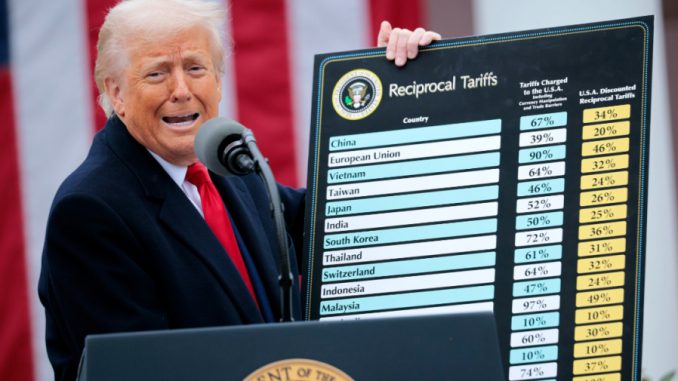
April 4 — “Cambodia, oh, look at Cambodia! 97%. We’re going to take it down to 49% and make a fortune for the United States of America,” Donald Trump boasted in true telemarketing style. 

“South Africa. Oh, 60%, 30%. There are some very bad things going on in South Africa. We pay them trillions of dollars a week in financing, but we’re cutting them off because there are so many bad things going on in South Africa,” he continued after announcing 10% tariffs on British goods. 

Faced with worldwide astonishment at the attempt to make a spectacle of what could be the beginning of a trade war, the U.S. president continued with the list of usual grievances stemming from economic nationalism and xenophobia, such as hatred of the current South African government, which is largely influenced by the racist vision of defending the white population against a false “white genocide.” 

In the end, without fireworks but with a whiteboard where the White House presented data on the tariffs it believes other countries impose on its products and another column where the United States reciprocally adds its own, Donald Trump called April 2nd “America’s Liberation Day.”

In its magnanimity, there is no such thing as U.S. reciprocity. Instead, Washington creates the tariffs it imposes on the rest of the world using a deceptive formula that doesn’t calculate a country’s tariff level but simply the trade deficit, which Trumpism equates to tariffs. Thus, poor countries like Cambodia that barely import products from the United States — virtually any product Cambodia might need will be purchased more cheaply from China, which, in addition to being closer, hasn’t bombed the country to the point of littering its land with unexploded ordnance — are outstripped by their exports to the United States, products manufactured in the country due to the relocation of U.S. industry. 

Although imperceptible in absolute terms, calculated using the Trump administration’s formula (trade deficit with a country divided by that country’s imports), the result is the 97% Trump mentioned, a figure that has nothing to do with the tariffs Cambodia imposes on products from the United States, which are not taken into account in the calculation.

American protectionism responds to the deficit in the U.S. trade balance, which, by introducing yet another trick, takes into account trade in goods but not in services, and not necessarily the rates imposed by individual countries. Israel, for example, unsuccessfully attempted to preempt Trump’s announcement on Wednesday by zeroing tariffs on U.S. products. At the end of the night, Tel Aviv received a figure of 17% tariffs on its products based on the trade balance. 

The figures, and above all, the strange distribution, with which not only China but also former enemies such as Cambodia, Laos, and Vietnam were disproportionately punished, while others, such as what Washington perceives as its Latin American backyard, with low levels of exports to the northern country, received lesser penalties, sparked all kinds of speculation throughout yesterday morning. Before economic experts deciphered the formula, it was also noted that U.S. allies such as the European Union were faring worse than some opponents.

“Russia, Cuba, and North Korea escape the worst of Trump’s tariff wrath,” Reuters headlined yesterday in an article that included two other sworn enemies of the United States that also apparently emerged unscathed from the American “liberation”: Belarus and Iran. “Trump said he would impose a 10% base tariff on all imports to the United States and higher tariffs on dozens of other countries. Russia, Cuba, and North Korea do not appear on the list of countries facing higher ‘reciprocal’ tariffs released by the White House,” writes Reuters, adding that “in their annual threat assessment, U.S. intelligence agencies said China, Russia, Iran, and North Korea were the biggest potential nation-state threats to the United States, and Trump had threatened Moscow with new trade measures.” 

Only after falsely portraying favoritism toward these enemies does the article explain that the level of sanctions those countries are under makes any additional levies unfeasible. “Asked why Russia was not on the list, U.S. Treasury Secretary Scott Bessent told Fox News that the United States did not trade with Russia and Belarus and that they were subject to sanctions. Trade in goods between Russia and the United States was $3.5 billion last year, according to U.S. figures. In 2021, the year before Russia invaded Ukraine, it was $36 billion,” the article explained. 

The figures — $3 billion in Russian exports to the United States and $526 billion in imports —  would, according to the formula applied, result in tariffs of more than 40% on Russian imports. But compared to Ukraine, an ally and proxy that has received 10% tariffs, which it has received with the resignation of someone who lacks the tools to defend itself and knows it cannot raise its voice against those who supply it with weapons and intelligence, Russia has not received additional sanctions. 

On the contrary, this week it was announced that the United States has temporarily lifted coercive measures against senior Russian advisor Kiril Dmitrev, who traveled to Washington to meet with the Trump administration as part of the negotiations between the two countries. “A real understanding of Russia’s position opens up new possibilities for constructive cooperation, including in the economic and investment sphere,” Dmitrev commented on his Telegram channel.

The economic content of the visit, the first time a Russian representative will meet with White House officials on U.S. soil since 2022, is particularly striking given the timing, not least because it is tariff week. Hours before Donald Trump tossed around tariffs in a televised auction, two well-known senators, both friends of Ukraine, Republican Lindsey Graham and Democrat Richard Blumenthal, introduced a proposal in the Senate to impose draconian primary and secondary sanctions if Russia does not negotiate in good faith or reach a peace agreement with Ukraine. The senators, who obtained the signatures of 24 other representatives from both parties, propose 500% tariffs on imports from countries that purchase Russian products if peace efforts fail. 

“Sanctions against Russia require tariffs on countries that buy Russian oil, gas, uranium, and other products. They are tough for a reason,” the senators assert. Lindsey Graham, who has made no secret of the need to continue fighting “to the last Ukrainian,” and his usual ally have not lost hope of using the war not only to seize Ukraine’s mineral resources but also to severely sanction opponents like China, Russia’s main economic ally. Even if this requires a measure that is difficult to implement and has more than uncertain consequences for world trade.

Uncertainty was also one of the words repeated throughout yesterday when trying to predict the short- and medium-term effects of the announced measures. Donald Trump assumed that the White House would begin receiving calls pleading for the withdrawal of tariffs or wanting to negotiate, while Treasury Secretary Bessent warned countries not to respond reciprocally, which would be considered an escalation, and recommended sitting back and waiting. 

The main lesson from the way the United States has calculated the level of tariffs and the rhetoric accompanying the measures is the double definition of the word. In the United States, “tariff” is the most beautiful word, a way to reduce taxes for the population and to recover what other countries have stolen from the American people. Abroad, “tariff” does not equate to the tax applied to imported products, but to a trade deficit. Thus, when Donald Trump demands that different countries withdraw their tariffs if they want American tariffs to be reduced, the U.S. president is not seeking to reduce those duties, but rather to eliminate the trade deficit. In other words, Trumpism demands that the rest of the world purchase more American products. 

“The High Representative of the European Union for Foreign Affairs, Kaja Kallas, asserts that there are no ‘winners’ in trade wars. She acknowledges that the EU currently buys a lot of defense equipment from the United States,” EFE wrote yesterday. It is there, in this second idea, the acquisition of more U.S. military equipment, that European countries can achieve a reduction in the 20% tariffs imposed on EU imports. In this way, Trump would also guarantee that the European rearmament he has been demanding for years will not occur by acquiring strategic autonomy from Washington.

Translated by Melinda Butterfield

Source: http://Slavyangrad.es

Strugglelalucha256


Gobierno local arrodillado ante compañias de gas estadounidense

En esta colonia, los poderes emanan del Congreso estadounidense. Ha sido así desde la invasión yanki y será hasta que logremos nuestra soberanía con la independencia. Sin embargo, hasta hace poco, Puerto Rico había tenido una pequeña autonomía en cuestión de la política local y se redactaban algunas leyes para beneficiar al pueblo. Como la Ley que prohíbe la Pena de Muerte, a diferencia del gobierno Federal estadounidense que la permite. Pero ahora, los gobiernos locales, especialmente las administraciones del Partido Nuevo Progresista que de nuevo no tiene nada y menos aún de progresivismo, y que su intento es forzar la integración de Puerto Rico al imperio gringo como un estado más, han abandonado totalmente su obligación de velar por el bien del pueblo.

El ejemplo más reciente de esta falta y que constituye un verdadero crimen ambiental y contra la salud del pueblo por parte de la nueva gobernadora trumpista Jenniffer González, ha sido la firma, al estilo de su amo gringo, de una orden ejecutiva declarando un estado de emergencia de la infraestructura energética donde establece un proceso rápido para aprobar proyectos de reconstrucción de la infraestructura basados en combustibles fósiles. Esta orden va en contra de nuestra Ley Número 17 que establece como objetivo hacer a Puerto Rico 100% sostenible en energía solar para el año 2050 y que abarataría el costo de la energía además de proteger el ambiente y la salud del pueblo.

Sin embargo, estas iniciativas impulsadas por la gobernadora, incluyen el extender por más de treina años la generación por quema de carbón a una firma en el sur, prolongando el ya deteriorado estado de la salud de los habitantes de esa zona. Además, y sobre todo, para favorecer a sus benefactores gringos del sector del gas metano, ordena la activación de procesos expeditos para la reparación y construcción de plantas generadoras basadas en gas, exigiendo que se ignore cualquier requerimiento de permiso de Recursos Naturales, de Salud, del Instituto de Cultura Puertorriqueña, de cualquier entidad que vele por la seguridad del país y su gente. 

Para traer el gas se han roto las leyes de puerto, se han obviado los requerimientos de tamaño de barcos, y peor aún, se ha puesto en peligro las vidas de quienes habitan en las costas.

En fin, no importa el daño que se le haga al ambiente, a las personas, o a cualquier hallazgo arqueológico de nuestra historia, porque según ella misma dice: “lo importante es que cuando en su casa presione el botón del enchufe, la luz se encienda”. No importa si renglón seguido las 100 x 35 millas que mide nuestra isla grande, también se prendan, exploten y dejemos de existir. 

Hace unos años, nuestro pueblo combatió y venció la propuesta de un gasoducto desde el sur de la isla, ahora nos toca volver a las calles y frenar de una vez por todas estas órdenes abusivas. 

Desde Puerto Rico, para Radio Clarín de Colombia, les habló, Berta Joubert-Ceci

Strugglelalucha256


Demonstrate April 5 in Washington, D.C., for Palestine!

Ig+post+ +free+mahmoud,+rumaysa,+stop+the+attacks+on+free+speech

April+5+graphic

Strugglelalucha256


Profit over peace: European capitalists push for war

In the wake of his election, incoming German Chancellor Frederick Merz proclaimed on Jan. 22 that Europe’s defense would be his highest priority. Merz moved quickly, securing a deal in the German legislature on March 5 to spend hundreds of billions on “defense” and loosen the limit on German borrowing for military spending. Merz’s Christian Democratic Union and the opposition Social Democratic Party of Germany joined forces to ensure the war budget spike.

Merz followed this with another deal on March 14. This time, Merz allied with the Green Party to ensure that Merz’s government could change the German constitution to allow the government to take endless loans to increase military expenditure. The message is clear: Germany is back on its war horse. Upon this supposed triumph, Merz proclaimed, “Germany is back!” This proclamation has eerie echoes of the last time Germany rearmed in 1935, upon the order of Chancellor Adolf Hitler. 

This momentous political shift in Germany was quickly followed by action from another prominent German politician: European Commission President Ursula Von Der Leyen, a fellow Christian Democrat and Ukraine hawk, along with Merz. Von Der Leyen proposed a broader “ReArm Europe Plan” on March 3. The plan aims to “help member states quickly and significantly increase expenditures in defence capabilities.” On March 21, top EU officials announced a deal to secure the funding for Von Der Leyen’s rearmament plan. Again, the message is clear: European capitalism is in a full drive towards war. 

So, why this spike in German and European military spending? Merz and Von Der Leyen would have the public believe that this shift towards war is a response to Trump’s move away from Ukraine. 

The European leaders have maintained this line even as the Trump administration has restored full military funding and assistance to fascist Ukraine. Trump has even begun to threaten more sanctions against Russia based on allegations of sabotaging peace talks. Yet, Europe continues to push for war. 

The answer can at least be partially found in the absurd profits that the German arms industry has reaped since the beginning of NATO’s proxy war in Ukraine against Russia. Since the beginning of Russia’s special military operation in Ukraine, German arms manufacturers have experienced a boon unseen since World War II. The largest German benefactor of NATO’s proxy war against Russia so far has been Rheinmetall AG, an automobile and arms manufacturer. 

Rheinmetall has experienced a 1000% increase in stock price since the beginning of the war in Ukraine in February of 2022. While Europe had not taken steps towards complete rearmament until now, Germany and many other European countries had already increased military spending to support Ukraine’s fascist military. 

This increase in military expenditure alone created a massive boon for Rheinmetall, driving the company to 9.8 billion euros in profit in 2024. These numbers represent billions upon billions of dollars and euros being pocketed by German and American war financiers. And to think, all this profit was before Merz’s election and the move towards complete rearmament in Europe. 

Rheinmetall is not the only German defense magnate that has profited handsomely from the war in Ukraine or who would profit further from a complete European rearmament. The KNDS Group, a defense conglomerate of German and French arms manufacturers, has recorded 11.2 billion euros in profit selling tanks, artillery, and armored vehicles to various European governments, who have then sent the equipment to Ukraine as military aid. That is billions upon billions made off the suffering of the Russian and Ukrainian people. 

If capitalism has taught the world anything, it’s that its wealthiest individuals will never stop in their dogged pursuit of profit. Given their record profits from the war in Ukraine, it makes sense these German and European defense magnates would want to escalate the war climate to increase profits. Enter the rearmament of Germany and Europe more broadly. 

In fact, the rearmament of Europe, led by Germany, has little to do with Trump “abandoning” Europe and everything to do with European war capitalists expanding their profit base. And when Europe makes money, wealthy U.S. investors almost always make money. 

Germany’s rearmament has not come without a heap of fascist symbolism. It began with cat-named (Leopard) tanks rolling into Eastern Europe to fight the Russian military. Now, Rheinmetall seeks to acquire a closing Volkswagen plant to convert it for arms production. This almost feels cosmic, as Volkswagen itself would not have existed without German fascism. As if icing on the cake, Donald Trump’s connection with electric car magnate Elon Musk conjures images of a similar alliance between Adolf Hitler and Henry Ford. 

Europe’s move towards military investment signals a dangerous escalation towards Russia and should be broadly condemned. The money of the working class does not need to be plundered to fuel the profits of blood sucking arms manufacturers like Rheinmettall and the NDS Group. All workers need jobs, health care, and self-determination – not capitalist war. 

Strugglelalucha256


Against fascism: New book challenges Trump’s ‘populist’ label

Version 1.0.0

You might clench your teeth just like I do when someone calls Donald Trump a populist.

As the new book — “Against fascism: Reclaiming populism’s legacy for today’s class struggle” — points out, that’s using populism to mean making phony patriotic appeals to “the everyday person,” in the style of Mussolini and Hitler … or Donald Trump.

Trump’s “populism” bears no resemblance to the populist movements organized by workers and farmers over a century ago.

Populism was progressive

In the book’s introduction, author Gregory E. Williams writes:

“Populism was a progressive – that is, left-wing – movement of the late 19th Century, having farmers as its base, both Black and white. The movement fought big business and the big banks, and generally insisted that workers of different races share common interests, and ought to work together.

“This doesn’t sound like any of the politicians called populists except for Bernie Sanders. However, unlike Sanders, the populists in their heyday were an independent mass movement. They were a big coalition of labor and farm organizations, and founded a political party to challenge both the Republicans and Democrats. They were a real threat to the ruling class.

“This radical tradition influenced subsequent politics in the Progressive era and the New Deal, but was largely forgotten by the 1950s. …

“In his 2020 book ‘The People, No: A Brief History of Anti-Populism,’ Thomas Frank presents evidence that the consensus historians used the language of the horrified ruling class during the 1890s and the 1930s to characterize populism. This is how populism came to mean any mass movement, right or left, as well as demagogic appeals to ‘the common man.’ …

“So, in an era when we are told that there is no alternative to capitalism, or even the possibility of a liveable future for humanity, they are trying to take away our history. But our movements need to know. Learning from history makes our movements stronger and more capable of going on the offensive …

“This book is about strategizing for the current fight against the billionaire oligarchs like Elon Musk and the fascist movement they’re backing in order to save the decaying capitalist system. This book is a call for a revolutionary socialist response – a communist response – to the situation.”

Resistance amid Jim Crow

Williams’ book covers the history of populism as a people’s movement. This includes Black populism, which is rarely found in U.S. history books.

From the “Reclaiming Populism” book:

“The [historical populist] movement was based especially among farmers in the South and West, but included alliances with industrial workers and even small shopkeepers. 

“Although populism was overwhelmingly anti-racist, a fundamental weakness of the movement was that it remained mostly white. The populist movement was not able to create the big, multiracial alliance that was needed to take on the rich successfully. 

“But to leave the story at that would be misleading. In fact, there was a significant Black populist movement that had its own dynamics. What they achieved was impressive, especially considering the extreme racist violence that characterized this period. 

“When the populist movement was in full swing in the 1890s, the Southern ruling class’s shock troops were carrying out over 100 lynchings annually, rolling back the many political, economic, and social gains made by Black people after the Civil War. 

“The Black populists organized and fought back during the height of this post-Reconstruction Klan terror, leaving a legacy that influenced movements going forward.”

Also included in this book is Vincent Copeland’s “Southern Populism & Black Labor,” which was written in 1972.

You’ll want to get this book:

BUY NOW  |  FREE PDF

Strugglelalucha256


‘Netanyahu bombs Gaza hospitals, Musk shuts them down’: Speakers slam corporate greed and genocide at Land Day rally

Five thousand people marched in New York City on March 30 to protest the U.S./Zionist genocide against the Palestinian people. Along with protesters all over the world, they were commemorating Palestine Land Day.

In 1976, the Zionist apartheid regime announced plans to steal nearly eight square miles of Palestinian land in the Galilee region. A general strike was declared on March 30, 1976, to stop this land theft.

Tens of thousands protested all over occupied Palestine. At least six Palestinians were killed, many more were injured, and hundreds were arrested. Since that time 49 years ago, Palestinians and their supporters have marked Land Day by protesting the Zionist occupation of their homeland.

In New York City this year, the Shut It Down 4 Palestine Coalition called for people to gather in Manhattan’s Union Square. Among the organizations building the action were the Palestinian Youth Movement; PAL-AWDA, the Palestine Right to Return Coalition; Neturei Karta (anti-Zionist Orthodox Jews); the Party for Socialism and Liberation; and The People’s Forum.

Among the speakers were Taher Dahleh from the Palestinian Youth Movement; Layan Fuleihan from The People’s Forum; Claudia De La Cruz, the PSL presidential candidate last year; and Bill Dores representing PAL-AWDA.

Dores said, “It is to keep the wealth of the world pouring into the coffers of the 1% here” that the U.S. finances and supplies the Zionist war machine. “They are looting our communities here to pay for their bombs, while Elon Musk is shutting down hospitals,” he said.

Dores pointed out that while the U.S. bombed a cancer hospital in Yemen, Netanyahu bombed the last remaining cancer hospital in Gaza.

People marched out of Union Square and into the street, going uptown. “From the river to the sea, Palestine will be free!,” and other chants echoed against skyscrapers.

Supporters of Nodutdol for Korean Community Development carried a banner saying, “Korea for Palestine.” An even longer banner read “Staten Island 4 Palestine.”

People showed their support along the side of the march. Drivers honked their horns in support.

The march ended with a brief rally in Times Square. People were reminded of the massive march planned for Washington, D.C., on April 5.

Land back from South Dakota’s Black Hills to Palestine!

Unionsquare2

Strugglelalucha256


‘Free Trade’ and Trump’s tariffs: A response to Shawn Fain

Elon Musk and his puppet “King Donald Trump” have laid a political trap against the United Auto Workers (UAW) leadership and the U.S. working class as a whole with their escalating tariff war. Now is the time for unionists to call on our leadership to not be diverted by Trump’s tariffs from engaging in global class solidarity and militant struggle. By being immune from Trump’s tariffs, Elon Musk hopes to strengthen Tesla company’s market position. And all Silicon Valley billionaires seek to replace workers with AI-controlled robots.

In a March 8 speech, UAW President Shawn Fain gave a rousing, militant introduction of reformist Senator Bernie Sanders to a crowd of 10,000 at a high school in the working-class community of Warren, Michigan. Wearing a t-shirt showing “Eat the Rich” at a podium with a sign reading “Fight Oligarchy”, Fain’s speech and the tremendous response it received from the crowd shows a rising tide of class consciousness among U.S. workers.

Fain opened his talk by describing how autoworkers 40 years ago had incomes and benefits high enough to own a home, raise a family with decent health care, and retire with a pension high enough to live comfortably.

Fain told the crowd that autoworkers in turn had generated billions of dollars in profits for the bosses over the decades.

He then condemned the recent layoffs at both the Stellantis Warren Truck Plant and the General Motors Warren Tech Center of thousands of union workers, a violation of the hard-won contract after a lengthy strike in 2023. Fain blasted Stellantis for laying off  union workers at the Truck Plant while shifting the work to Mexico, where workers are paid a paltry $3 an hour.

Fain did note that he was not attacking those Mexican workers, whom he called “part of our family”. Instead, he blamed all this on the greed of the auto company owners and Wall Street bankers. He pointed out that these same companies were bailed out by worker concessions and the taxpayers 15 years ago, only to have them maintain high prices and rob the workers of their jobs.

Fain correctly blamed both political parties for this attack on the working class here and abroad.

He saved his harshest rebuke for Elon Musk, the world’s richest man. Fain condemned Musk’s attacks on government workers and social services cutbacks. He blasted Musk calling social security a “Ponzi scheme”, and said the only such scheme was the billionaires like Musk amassing huge wealth while working people are left behind.

Fain proclaimed: “Billionaires do not have a right to exist!” to thunderous cheers and applause from the crowd.

UAW statements support Trump’s tariffs.

Before and after Fain’s talk, the UAW released statements supporting Trump’s tariffs. The March 4 statement included:

The UAW is in active negotiations with the Trump Administration about their plans to end the free trade disaster. We look forward to working with the White House to shape the auto tariffs in April to benefit the working class. We want to see serious action that will incentivize companies to change their behavior, reinvest in America, and stop cheating the American worker, the American consumer, and the American taxpayer.

On March 26, after Trump announced a 25 percent tariff on foreign-made vehicles and parts across the board, the UAW released a statement titled: “In a Victory for Autoworkers, Auto Tariffs Mark the Beginning of the End of NAFTA and the “Free Trade” Disaster.”

This afternoon, the Trump administration announced major tariffs on passenger cars and trucks entering the U.S. market, marking the beginning of the end of a thirty-plus year “free trade” disaster.

“We applaud the Trump administration for stepping up to end the free trade disaster that has devastated working class communities for decades. Ending the race to the bottom in the auto industry starts with fixing our broken trade deals, and the Trump administration has made history with today’s actions,” said UAW President Shawn Fain.

Across a dozen Big Three auto plants that have seen major declines, production has fallen by 2 million units per year in the past decade, while millions of vehicles sold here are made with low-wage, high-exploitation labor abroad.

The statement then lists Big 3 plants across the country that have been shuttered, and then suggests dreamingly the benefits of their being reopened and the workers rehired:

The economic benefits of filling these plants back up with product and good auto jobs would be enormous and have a cascading effect throughout communities from Michigan to Tennessee.

Fain and the UAW leadership are perfectly correct in condemning the so-called “free trade” agreements like NAFTA, which have allowed corporations to close plants here and move our jobs to low-wage states and countries. But the question must be asked: Is that the aim of these Trump tariffs, to reopen plants and rehire the tens of thousands of laid-off auto workers and hire new ones into good-paying jobs? Does that sound like something that Trump and his master, Elon Musk, are aiming for? Is that really going to happen?

Musk’s Tesla wins big.

Trump’s tariffs will apply to nearly all automakers, foreign and domestic. That’s because even the Big 3 have some or most of their parts manufactured abroad, and many of their vehicles are partly or entirely assembled abroad as well. Below is a graph of manufacturers and each of their domestic versus foreign final assemby:

Share of us sold vehicles asembled in the us

Rivian is a very small EV company. But Musk-owned Tesla is another matter entirely. Notorious for using every anti-union measure, legal and illegal, to prevent UAW recognition, it would mostly be immune from Trump’s tariffs, while its competitors, experts agree, would raise their prices by around $6,000 per vehicle.

This tariff will give Tesla a big competitive advantage.

Tesla is not just a car company. It is currently manufacturing its AI-powered Optimus robot which could replace workers in Tesla auto plants:

Given Optimus’ ability to deadlift 150 pounds and carry 45 pounds while walking at 5 miles per hour, it makes sense to use the robots in factory settings. In fact, Musk has suggested Optimus robots could address labor shortages, and he even intends to introduce the robot in Tesla factories.

Musk announced his Optimus production plans on March 21 in his typical fascist style:

“But even 5,000 robots, that’s the size of a Roman legion, FYI, which is like a little scary thought. Like a whole legion of robots, I’ll be like ‘whoa.’ But I think we will literally build a legion, at least one legion of robots this year, and then probably 10 legions next year. I think it’s kind of a cool unit, you know? Units of legion. So probably 50,000-ish next year,” Musk said.

Getting human workers good paying jobs doesn’t sound like it’s on these billionaires’ tariff agenda.

And finally, Trump’s tariffs will actually cost the jobs of many autoworkers, as a March 27th article in the Guardian points out:

Slumping consumer confidence, together with soaring sticker prices, could take a serious bite out of US car sales and cause production to sink. In an unhappy forecast, Jonathan Smoke, chief economist at Cox Automotive, a market research firm, said that as a result of Trump’s auto tariffs, US plants would churn out 20,000 fewer cars per week, about a 30% drop compared with before Trump imposed the tariffs. “By mid-April we expect disruption to virtually all North American vehicle production,” Smoke said in a Wednesday conference call with clients and journalists. “Bottom line: lower production, tighter supply and higher prices are around the corner.”

Fain and the UAW leadership are absolutely correct in condemning the billionaire class and their “free trade” agreements like NAFTA, which cost hundreds of thousands of auto worker jobs and hurt the living standards of millions here and abroad. Preparing militant strategies like sit-down strikes and general strikes are perfectly appropriate for this period.

But attaching the union to Musk’s and Trump’s tariff strategy, which is only designed to restore U.S. corporate hegemony and not improve our families’ living standards, is a mistake. UAW President Fain has been perfectly correct in condemning both the Democratic and Republican parties as being devoted to upholding corporate interests. Each party represents only different segments of the billionaire class.

Our class must follow a path devoted only to our interests and willing to “stand up” to these wealthy parasites. We must develop our own strategies, based on class solidarity, not nationalism, to wage that struggle. Unions, like the UAW, can play a pivotal role in the rapidly developing fightback movement against racism, economic attacks and war.

Fry is a UAW retiree and former assembly line worker at the now closed Chrysler Lynch Road Assembly plant.

Source: Fighting Words

Strugglelalucha256


Liberation day

It’s not April Fool’s Day (1 April).  But it might as well be, as later today U.S. President Donald Trump announces another barrage of tariffs on imports into the U.S. in what Trump calls ‘Liberation Day’ and what America’s voice of big business and finance, the Wall Street Journal, has called “the dumbest trade war in history.”

In this round, Trump is raising tariffs on imports from countries that have higher tariff rates on U.S. exports, ie, so-called ‘reciprocal tariffs’. These are supposed to counter what he views as unfair taxes, subsidies and regulations by other countries on U.S. exports. In parallel, the White House is looking at a whole host of levies on certain sectors, and the tariffs of 25 per cent on all imports from Canada and Mexico, which were earlier postponed, are now being reapplied.

Image1

U.S. officials have repeatedly singled out the EU’s value-added tax as an example of an unfair trade practice. Digital services taxes are also under attack from Trump officials who say they discriminate against U.S. companies.  By the way, VAT is not an unfair tariff as it does not apply to international trade and is solely a domestic tax – the U.S. is one of the few countries that does not operate a federal VAT, relying instead on varying federal and state sales taxes.

Trump claims that his latest measures are going to ‘liberate’ American industry by raising the cost of importing foreign goods for American companies and households, and so reduce demand and the huge trade deficit that the U.S. currently runs with the rest of the world. He wants to reduce that deficit and force foreign companies to invest and operate within the U.S. rather than export to it.

Image2

Will this work?  No, for several reasons.  First, there will be retaliation by other trading nations. The EU has said it would counter U.S. steel and aluminium tariffs with its own duties affecting up to $28bn of assorted American goods. China has also put tariffs on $22bn of U.S. agricultural exports, targeting Trump’s rural base with new duties of 10 per cent on soyabeans, pork, beef, and seafood. Canada has already applied tariffs to about $21bn of U.S. goods, ranging from alcohol to peanut butter, and around $21bn on U.S. steel and aluminium products among other items.

Second, U.S. imports and exports are no longer the decisive force in world trade. U.S. trade as a share of world trade is not small, currently at 10.35%.  But that is down from over 14% in 1990.  In contrast, the EU share of world trade is 29% (down from 34% in 1990) while the so-called BRICS now have a 17.5% share, led by China at nearly 12%, up from just 1.8% in 1990. 

Image 1

That means non-U.S. trade by other nations could compensate for any reduction in exports to the U.S..  In the 21st century, U.S. trade no longer makes the biggest contribution to trade growth – China has taken a decisive lead.

Image 1 1

Simon Evenett, professor at the IMD Business School, calculates that, even if the U.S. cut off all goods imports, 70 of its trading partners would fully make up their lost sales to the U.S. within one year, and 115 would do so within five years, assuming they maintained their current export growth rates to other markets.  According to the NYU Stern School of Business, full implementation of these tariffs and retaliation by other countries against the U.S. could cut global goods trade volumes by up to 10 per cent versus baseline growth in the long run. However, even that downside scenario still implies about 5 percent more global goods trade in 2029 than in 2024.

One factor that is driving some continued growth in world trade is the rise of trade in services.  Global trade hit a record $33 trillion in 2024, expanding 3.7% ($1.2 trillion), according to the latest Global Trade Update by UN Trade and Development (UNCTAD). Services drove growth, rising 9% for the year and adding $700 billion – nearly 60% of the total growth. Trade in goods grew 2%, contributing $500 billion.  None of Trump’s measures apply to services. Indeed, the U.S. recorded the largest trade surplus for trade in services among the trading countries – some €257.5 billion in 2023 — while the UK had the 2nd largest surplus (€176.0 billion), followed by the EU (€163.9 billion) and India (€147.2 billion). 

Image 3

However, the caveat is that services trade still constitutes only 20% of total world trade. Moreover, world trade growth has fallen away since the end of the Great Recession, well before Trump’s tariff measures introduced in his first term in 2016, furthered under Biden from 2020, and now Trump again with Liberation Day.  Globalization is over and with it the possibility of overcoming domestic economic crises through exports and capital flows abroad.

And here is the crux of the reason for the likely failure of Trump’s tariff measures in restoring the U.S. economy and ‘making America great again’: it does nothing to solve the underlying stagnation of the U.S. domestic economy – on the contrary, it makes that worse.

Trump’s case for tariffs is that cheap foreign imports have caused U.S. deindustrialization. For this reason, some Keynesian economists like Michael Pettis have supported Trump’s measures. Pettis writes that America’s “long-term massive deficits tell the story of a country that has failed to protect its own interests.”  Foreign lending to the U.S. “force[s] adjustments in the U.S. economy that result in lower U.S. savings, mainly through some combination of higher unemployment, higher household debt, investment bubbles and a higher fiscal deficit,” while hollowing out the manufacturing sector.

But Pettis has this back to front. The reason that the U.S. has been running huge trade deficits is because U.S. industry cannot compete against other major traders, particularly China.  U.S. manufacturing hasn’t seen any significant productivity growth in 17 years.  That has made it increasingly impossible for the U.S. to compete in key areas.  China’s manufacturing sector is now the dominant force in world production and trade.  Its production exceeds that of the nine next largest manufacturers combined.  The U.S. imports Chinese goods because they are cheaper and increasingly good quality.

Maurice Obstfeld (Peterson Institute for International Economics) has refuted Pettis’ view that the U.S. has been ‘forced’ to import more because mercantilist foreign practices. That’s the first myth propagated by Trump and Pettis.  “The second is that the dollar’s status as the premier international reserve currency obliges the United States to run trade deficits to supply foreign official holders with dollars. The third is that U.S. deficits are caused entirely by foreign financial inflows, which reflect a more general demand for U.S. assets that America has no choice but to accommodate by consuming more than it produces.” 

Obstfeld instead argues that it is the domestic situation of the U.S. economy that has led to trade deficits. American consumers, companies, and government have bought more than they have sold abroad and paid for it by taking in foreign capital (loans, sales of bonds, and inward FDI). This happened not because of ‘excessive saving’ by the likes of China and Germany, but because of the ‘lack of investment’ in productive assets in the U.S. (and other deficit countries like the UK).  Obstfeld: “we are mostly seeing an investment collapse. The answer must depend on the rise in U.S. consumption and real estate investment, to a large degree driven by the housing bubble.”  Given these underlying reasons for the U.S. trade deficit, “import tariffs will not improve the trade balance nor, consequently, will they necessarily create manufacturing jobs.” Instead, “they will raise prices to consumers and penalize export firms, which are especially dynamic and productive.”

As I have explained before, the U.S. runs a huge trade deficit in goods with China because it imports so many competitively priced Chinese goods. That was not a problem for U.S. capitalism up to the 2000s, because U.S. capital got a net transfer of surplus value (UE) from China even though the U.S. ran a trade deficit. However, as China’s ‘technology deficit’ with the U.S. began to narrow in the 21st century, these gains began to disappear.  Here lies the geo-economic reason for the launching of the trade and technology war against China.

Trump’s tariffs will not be a liberation but instead only add to the likelihood of a new rise in domestic inflation and a descent into recession. Even before the announcement of the new tariffs, there were significant signs that the U.S. economy was slowing at some pace. Already, financial investors are taking stock of Trump’s ‘dumbest trade war in history’ by selling shares.  America’s former ‘Magnificent Seven’ stocks are already in a bear market, ie, falling in value by over 20% since Xmas.

Image 2

The economic forecasters are lowering their estimates for U.S. economic growth this year.  Goldman Sachs has raised the probability of a recession this year to 35% from 20% and now expects U.S. real GDP growth to reach only 1% this year.  The Atlanta Fed GDP Now economic forecast for the first quarter of this year (just ended) is for a contraction of 1.4% annualised (ie, -0.35% qoq).  And Trump’s tariffs are still to come.

Tariffs have never been an effective economic policy tool that can boost a domestic economy. In the 1930s, the attempt of the U.S. to ‘protect’ its industrial base with the Smoot-Hawley tariffs only led to a further contraction in output as part of the Great Depression that enveloped North America, Europe, and Japan. The Great Depression of the 1930s was not caused by the protectionist trade war that the U.S. provoked in 1930, but the tariffs then did add force to that global contraction, as it became ‘every country for itself’. Between the years 1929 and 1934, global trade fell by approximately 66% as countries worldwide implemented retaliatory trade measures.

More and more studies argue that a tit-for-tat tariff war will only lead to a reduction in global growth, while pushing up inflation. The latest reckons that with a ‘selective decoupling’ between a (U.S.-centric) West bloc and a (China-centric) East bloc limited to more strategic products, global GDP losses relative to trend growth could hover around 6%. In a more severe scenario affecting all products traded across blocs, losses could climb to 9%. Depending on the scenario, GDP losses could range from 2% to 6% for the U.S. and 2.4% to 9.5% for the EU, while China would face much higher losses.  

Image 1

So no liberation there.

Source: Michael Roberts Blog

Strugglelalucha256
https://www.struggle-la-lucha.org/2025/04/page/4/