Struggle ★ La Lucha PDF – November 4, 2024

Get PDF here

  • Beyond the ballot: Trans community calls for united resistance
  • Baltimore activists take on Amazon
  • Justice for Jordan Neely! Vigilante killings must be stopped!
  • LA Times won’t endorse genocide: Nika Soon-Shiong
  • Los Angeles stands with Gaza
  • Billionaire’s agenda: Silencing anti-Zionism
  • Stop the sanctions against Zimbabwe!
  • U.S., British bombing of Yemen’s port threatens renewed famine, war
  • Oil-rich Nigeria charges hungry children with treason for protesting
  • Longest-held U.S. political prisoner Leonard Peltier is hospitalized
  • New York City rally demands: ‘Stop the U.S. blockade of Cuba!’
  • Elecciones de esperanza en Puerto Rico
  • Elections of hope in Puerto Rico
Strugglelalucha256


Elecciones de esperanza en Puerto Rico

En esta primera semana de noviembre aquí en Puerto Rico, hay una atmósfera de mucho nerviosismo, pero también de una gran esperanza de cambio. El próximo martes 5 de noviembre serán las elecciones generales y todo indica que será un proceso histórico.

Por décadas, los partidos dominantes ya sean el Partido Popular Democrático, el PPD, que aboga por la continuación del estado colonial, como el Partido Nuevo Progresista, el PNP, que quiere que PR se convierta en el estado 51 de los Estados Unidos, nos han sumido en la crisis más grave de nuestra historia. Partidos corruptos que han vendido la isla a millonarios extranjeros y se han robado los presupuestos públicos abandonando totalmente la función de un gobierno que administre para beneficio de su pueblo. Vivir en PR ahora es sumamente difícil, sin transporte público, aumento gigantezco en el costo de vida, todos los servicios públicos deteriorados ya sea por la privatización, o por su ineficiencia.  En consecuencia, hemos perdido población que se ha visto empujada a migrar para poder sobrevivir.

Ahora, esos partidos están deseperados ante el auge de la Alianza de País, un junte progresista entre el Partido Independentista Puertorriqueño el PIP, y el Movimiento Victoria Ciudadana, el MVC, porque están aumentando las adhesiones tanto de populares y penepeístas desafectos, abochornados por la vileza y descaro de sus partidos, como del pueblo en general. Ven en la figura del Juan Dalmau, del PIP, para gobernador, una persona honesta que detendrá y revertirá los desastrses de las pasadas administraciones.

Dondequiera que se vaya, se siente ese sentimiento de esperanza. Si bien se ha acusado al pueblo boricua de indiferentes y de ser “agiantones”, hay que recordar que es ese pueblo el que se tiró a las calles para sacar de la isla de Vieques, a la Marina estadounidense después de décadas de bombardeos y contaminación de su suelo. Ese mismo pueblo en las calles, sacó al corrupto gobernante penepeísta Ricky Roselló en el famoso Verano del 19. 

Ahora, sale nuevamente a las calles en apoyo a la Alianza en caravanas extensas por la isla y a defender su voto el 5 de noviembre.

Lo que sí es seguro, es que salga quien salga en la gobernación, el pueblo ha dicho Basta a la corrupción y esta vez no se detendrá luego del 5 de noviembre.

Desde Puerto Rico, para Radio Clarín de Colombia, les habló, Berta Joubert-Ceci

Strugglelalucha256


Elections of hope in Puerto Rico

This first week of November, here in Puerto Rico, one can feel an atmosphere of both nervousness and profound hope for change. Next Tuesday, November 5th, general elections will be held, and everything indicates that it will be a historic process.

For decades, the prevailing parties, namely the Popular Democratic Party (PPD), advocating for the continuation of the colonial state, and the New Progressive Party (PNP), which seeks to transform Puerto Rico into the 51st state of the United States, have contributed to the most severe crisis in our history. Corrupt political entities have exploited the island for the benefit of foreign interests, misappropriating public funds and neglecting their duty to govern in the service of the people. Life in Puerto Rico has become increasingly challenging, characterized by a lack of public transportation, a substantial rise in the cost of living, and a decline in public services due to both privatization and inefficiency. Consequently, many have been compelled to migrate in search of better opportunities.

Currently, these established parties find themselves under pressure from the emergence of Alianza de País, a progressive coalition formed by the Puerto Rican Independence Party (PIP) and Movimiento Victoria Ciudadana (MVC). This coalition is gaining support among disaffected members of both the PPD and the PNP, who are disillusioned by the actions of their parties. The figure of Juan Dalmau, representing the PIP for governor, is perceived as a trustworthy leader capable of addressing the failures of previous administrations.

There is a palpable sense of optimism throughout the island. Despite occasional characterizations of the Puerto Rican people as indifferent, it is essential to recognize that this is the same people who mobilized to remove the US Navy from Vieques after years of military bombing and environmental degradation. It was also these same people who massively went into the streets to oust the corrupt PNP governor, Ricky Roselló, during the Summer of 2019.

Now, the people are once again taking to the streets in support of the Alianza, participating in extensive caravans around the island and mobilizing to protect their vote on November 5th.

Regardless of the outcome in the governor’s race, the people have unequivocally expressed their rejection of corruption, and this time they will not stop after November 5th.

Reporting from Puerto Rico for Radio Clarín of Colombia, Berta Joubert-Ceci.

Strugglelalucha256


Nigeria’s economic crisis deepens: Children facing death penalty for protesting cost of living

In Nigeria, 29 children aged 14 to 17 could face the death penalty after being arraigned in Abuja on Nov. 1 with 76 others for participating in protests against the country’s severe cost-of-living crisis. 

The children were charged with multiple felonies, including treason and public disturbance, despite Nigeria’s Child Rights Act, which prohibits criminal proceedings against children or sentencing them to death. Bail was set at an impossible 10 million naira ($5,900) per defendant; some have endured 90 days in detention without adequate food.

Four children collapsed in court from exhaustion. They should be freed and allowed to unite with their families.

Nigeria, one of Africa’s top oil producers, continues to struggle with extreme poverty, rampant corruption, and high inflation. A significant portion of its 210 million people face food insecurity, and the inflation rate is at a 28-year high. Meanwhile, the government has implemented austerity measures at the behest of the World Bank, which is dominated by the U.S.

Strugglelalucha256


U.S., British bombing of Yemen’s key port threatens renewed famine, war

The United States and British air forces launched a series of air strikes against the Yemeni port city of Al Hudaydah on Oct. 31. This is the second of their kind launched by Western forces against the port, specifically since the beginning of 2024. 

In July, Zionist forces carpet-bombed the Al Hudaydah port region, killing six people and wounding another 80. The July strikes also destroyed oil facilities and a crucial power station. At the time, United Nations Secretary-General Antonio Guterres condemned the strikes and accused the Zionist entity of unnecessary escalation against Yemen. 

The United Nations World Food Program later found that the July 20 Zionist strikes destroyed 800,000 liters of UN-owned fuel supplied for humanitarian purposes. Even the U.S.-friendly Western think tank, Human Rights Watch, condemned the strike as apossible war crime,” citing the scorched earth nature of the strikes that targeted civilian infrastructure. 

This recent round of strikes on the port, this time perpetrated directly by the U.S. and Britain, signals a dangerous escalation in the region and threatens to plunge Yemen back into a bloody civil war after an uneasy armistice has held for roughly five years. Further attacks on the port could also reintroduce famine conditions in Yemen and worsen the current cholera outbreak. 

The port at Al Hudaydah is a crucial supply point for Yemen and the entire Arabian peninsula. Regarding Yemen, 70% of the country’s food imports enter via the Al Hudaydah port. Further, the port is also the entry point for over 80% of all humanitarian aid that enters Yemen. 

The targeting of Al Hudaydah’s civilian port capacity is not a mistake. It is an intentional attempt to destabilize the legitimate Ansar Allah-led government of Yemen and to place the people of Yemen under siege conditions as they fight to end the genocide in Gaza. This is not the first time Western-backed forces have attempted to starve out Ansar Allah via the Al Hudaydah port.

In 2018, a U.S.-backed joint Saudi and UAE forces besieged the port city in the hopes of striking a fatal blow against the growing then-named “Houthi Movement.” That movement, now known as the Ansar Allah Yemen Government, led an uprising in 2014 against a Saudi puppet government that aimed to open the country to predatory Western monopolies. In 2014, the rebel forces captured the Yemeni capital city of Sanaa and established a new seat of government. 

Four years into a bloody war between Saudi Arabian proxy forces and Ansar Allah, the Saudi and Emirate forces decided to make a move against the new Yemeni government by attacking the Al Hudaydah port. This deadly move came after years of human rights abuses against the Yemeni people. To be clear, the United States, France, and Britain supplied weapons to the Saudi forces, who used those weapons to wage a terror campaign against Ansar Allah and the citizens of Yemen. 

U.S.-supplied Saudi forces began their attack on the Al Hudaydah port in June of 2018. The battle quickly intensified, engulfing the entire city and placing the port at the risk of total shutdown. The Saudi forces’ aim was the same as the U.S. forces today: to starve the people of Yemen and undermine Ansar Allah’s ability to govern Yemen. 

Like today, the strategy ultimately failed, but not before it launched Yemen into famine conditions, which the country is just now recovering from. Even with that recovery, the Famine Early Warning Signs Network still considers Yemen to be in a state of acute food insecurity. 

The intensity of the 2018 fighting around Al Hudaydah port, combined with the growing humanitarian crisis, was the spark that began a peace process in Yemen. The Stockholm Agreement, signed in December 2018, was the first of several ceasefire agreements that temporarily put the Saudi war on Yemen on hold. The Stockholm Ceasefire was not fully implemented until 2021 when Saudi and Emirati forces finally withdrew from the port region. 

Throughout this time, the United States never actually recognized the validity of the Stockholm Agreement. That said, the United States did not reject the ceasefire plan either, until possibly now. 

With its recent escalations against the Al Hudaydah port, specifically, the lifeline of Yemen, the United States threatens to launch the country back into civil war and famine, all while Yemen fights a cholera epidemic. In the week before the most recent strikes on the port, the U.S. signaled to Ansar Allah through back channels that it may formally reject the Stockholm Agreement and open the door for renewed Saudi and Emirati intervention. The U.S. would take this step to prevent Yemen from further assisting the resistance in Gaza, the West Bank, and Lebanon. 

The United States government and military often act as if they are peace brokers. Their actions prove quite the opposite. The true greatest threat to peace and stability in the Middle East is the United States itself. Its recent brutal escalations against the free people of Yemen are stone-cold proof of that. 

Strugglelalucha256


Stop the sanctions against Zimbabwe!

Africa says no to economic terrorism

Since 2001, Zimbabwe has lost more than $150 billion from the sanctions imposed by the United States and European Union, according to the country’s Vice President Constantino Chiwenga.

That’s around $9,000 stolen from each of the African nation’s 17 million citizens. Just the higher bank fees and interest rates that result from these sanctions cost Zimbabwe a billion dollars per year. 

As Zimbabwe’s President Emmerson Dambudzo Mnangagwa noted, “It is the ordinary people, particularly the vulnerable, who bear the brunt of these heinous and inhumane measures, which also stifle economic and social progress in Zimbabwe.”

What crime did Zimbabwe commit to earn such severe punishment? Is it accused of laundering money for the drug cartels, like TD Bank did? No.

The Canadian bank with over 1,100 branches in the United States just paid a $3 billion fine after it confessed to funneling drug profits. Meanwhile, Canada, along with Australia, still sanctions Zimbabwe.

The great offense that Zimbabwe’s people committed — in the eyes of the wealthy and powerful — was that they took back their land. After being colonized by British settlers for 90 years, Africans said their time was up.

Cecil Rhodes’ British South African Company invaded Zimbabwe in the late 1880s. The obscenely rich diamond king modestly proclaimed the country “Rhodesia” after himself. The Rhodes scholarships are named after this war criminal.

Freedom fighters including the woman resistance leader Nehanda Charwe Nyakasikana were hanged. 

Theodor Herzl, the founder of Zionism, was so impressed by the stealing of African land that he wrote to Cecil Rhodes asking for his support. Since Zimbabwe won independence, hundreds of white settlers have moved to the Zionist state.

“Israel” — which is really occupied Palestine — will be wiped off the map just like “Rhodesia” was.

Anti-Sanctions Day backed by millions

The cruel sanctions against Zimbabwe have been protested by the 16 countries belonging to the Southern African Development Community. More than 384 million people live in these countries.

Since 2019, SADC has designated Oct. 25 as anti-sanctions day. This year, SADC’s chairperson is Zimbabwe President Emmerson Dambudzo Mnangagwa.

President Mnangagwa is the world’s only head of state to have been on death row. As a teenage freedom fighter, his life was spared, but the future president spent 10 years in prison.

Zimbabwe’s president spoke to thousands in Bulawayo, the country’s second-largest city, on Oct. 25, denouncing the sanctions. Also speaking in Zimbabwe was December 12th Movement chairperson Omowale Clay.

The December 12th Movement held a meeting on Anti-Sanctions Day at Sistas’ Place in Brooklyn, New York. D12 member Colette Pean chaired the event. Videos were shown, including South African President Cyril Ramaphosa denouncing the sanctions on Zimbabwe.

Pean described how the European settlers seized Zimbabwe’s land. Cecil Rhodes allowed them to grab as much land as could be ridden around by a horse.

Yet the U.S. and European capitalist governments are howling about the righteous farm seizures by the African inhabitants!

The vicious sanctions were meant to break Zimbabwe, but the country is moving forward. Colette Pean explained how Zimbabwe has one of Africa’s two highest literacy rates.

Hospitals are being built, and drought-resistant crops are being developed. Zimbabwe’s “Look East” policy has greatly increased trade with China and other Asian countries.

Minister Plenipotentiary Donald L. Charumbira, a member of Zimbabwe’s mission to the United Nations, was the special guest. He said that 80% of manufactured goods are domestically produced despite the sanctions.

The diplomat described how British Prime Minister Tony Blair double-crossed Zimbabwe when he refused the promised compensation for the white farmers. This necessitated the farm takeovers, many of which were led by veterans of Zimbabwe’s liberation war, called the Chimurenga.

Blair also refused to reveal where the body of Field Marshal Dedan Kimathi was buried. The freedom fighter, a leader of Kenya’s Land and Freedom army which the corporate media called the Mau Mau was hanged by the British on Feb. 18, 1957.

Dedan Kimathi was avenged every time a white farm was seized in Zimbabwe.

Rosemari Mealy brought greetings from the Cuban solidarity movement. The Caribbean nation has been sanctioned by the United States for over 60 years.

Sanctions are a war crime and must be stopped.

Strugglelalucha256


Longest-held U.S. political prisoner Leonard Peltier is hospitalized

As of October 28, the longest-held political prisoner in the United States, Leonard Peltier, has been hospitalized. Peltier, who recently turned 80 behind bars, has dealt with various health concerns due to his long confinement, which include diabetes, high blood pressure, and surviving COVID-19. Peltier’s supporters are calling for him to receive an emergency medical transfer out of prison to a medical facility.

“Leonard is confined in a small cell, most of the time being on lockdown, where he can’t even walk properly and have circulation and sunshine and proper food,” said close advocate Gloria La Riva in a recent interview. “I imagine anybody who thinks about Leonard wonders how does someone survive this? How do you live through this for 49 years? That’s what the US government does to political prisoners. Whether it’s Mumia Abu-Jamal, or Mutulu Shakur, or Sundiata Acoli, who spend 40, 50 years in prison. It’s called political vengeance. It’s telling them, you will pay a price for your political activism.”

Peltier, who is hailed as a hero of the Indigenous struggle for his activism with the American Indian Movement (AIM), was denied parole in July after almost half a century behind bars. According to Peltier’s lawyer, Kevin Sharp, an interim hearing has been scheduled for 2026, while a full hearing has been scheduled for June 2039, when Peltier will be 94.

Strugglelalucha256


Venezuela condemns the blockade and expresses solidarity at the UN

Once again the U.S. along with Israel, its partner in genocide against the Palestinian people, were alone against the annual vote condemning the blockade of Cuba at the UN.

In a strong statement from the General Assembly of the United Nations, Venezuelan President Nicolás Maduro condemned the economic blockade imposed on Cuba by the United States, reaffirming Venezuela’s unwavering support for the Caribbean island. On this occasion, 187 countries joined together to demand the lifting of sanctions that severely affect the Cuban people.

“Today, for the thirty-second time, 187 countries raise our voices in the General Assembly to demand the lifting of U.S. sanctions. Cuba deserves, and has earned, the right to choose its path to develop in peace and with total freedom,” Maduro declared in his speech.

The Venezuelan leader extended his solidarity to President Miguel Díaz-Canel and General of Armies Raúl Castro, as well as to all Cubans who continue to fight for their sovereignty and well-being. “On behalf of Venezuela, I express my willingness to continue opening paths and creating formulas that allow us to advance in the search for concrete solutions that lead us to the integral well-being of our nations,” he added.

Maduro emphasized the importance of unity among Latin American and Caribbean peoples to face the challenges imposed by hegemonic powers. “A new world is possible, and free peoples will build it. We will not allow sanctions and blockades to divide our struggle for justice and self-determination,” he asserted.

Venezuela’s statement adds to a long history of mutual support between the two countries, which have faced the onslaught of imperialism together. The international community has reiterated its rejection of the aggressive policies of the United States, which not only affect Cuba but also seek to destabilize sovereign nations like Venezuela.

Javier Milei removes Argentine Foreign Minister following vote for UN Resolution against U.S. blockade

Meanwhile in an unexpected turn of political events in Argentina, President Javier Milei decided to dismiss his Foreign Minister Diana Mondino following the UN vote, where Argentina joined 186 countries in rejecting the blockade imposed on Cuba.

This decision was confirmed by presidential spokesperson Manuel Adorni, who announced that Gerardo Werthein, the current Argentine ambassador in Washington, D.C., will take over the position.

The vote, which reflects the long history of solidarity between Argentina and Cuba, has been a point of tension in Milei’s government, which has shown a clear alignment with the policies of the United States and Israel.

However, Argentine diplomacy had maintained its commitment to historical causes, such as supporting the Caribbean island in its struggle against the blockade.

On social media, Milei hinted at his dissatisfaction by sharing a tweet from PRO deputy Sabrina Ajmechet, who expressed: “Proud of a government that neither supports nor is complicit with dictators. Long live #CubaLibre.”

This message seems to have set the course for Argentine foreign policy, prioritizing a critical stance towards Cuba and its leaders. Despite this change in the foreign ministry, it is important to remember that Cuba has been a steadfast ally of Argentina in its claim for sovereignty over the Malvinas Islands.

Over the years, the Cuban government has strongly supported Argentina’s cause in international forums, reinforcing ties between both nations. The recent vote in New York serves as a reminder of the overwhelming support Cuba receives annually at the UN to end the blockade.

Similarly, Argentina has garnered support from the Decolonization Committee for Britain to recognize its sovereignty over the Malvinas and open a dialogue on this matter.

With Mondino’s dismissal, questions arise regarding how this decision will affect bilateral relations between Argentina and Cuba. International observers expect that Cuba will continue to support Argentina’s sovereign claim despite internal diplomatic tensions.

This episode could serve as a call for reflection for the new Argentine government on the importance of maintaining a coherent and supportive stance in international matters.

Source: Telesur / Resumen LatinoAmericano English

Strugglelalucha256


Statement by the Network in Defense of Humanity on Brazil’s veto of Venezuela at the BRICS 2024 Summit

The Network of Intellectuals and Artists in Defense of Humanity (REDH) rejects the decision of the Government of Brazil to veto the incorporation of Venezuela as a partner country to the BRICS bloc.

We consider that this decision delays the progress of the project of integration and resistance of the countries of Latin America and the Caribbean with the rest of the nations of the Global South, to confront the neocolonial policies of U.S. and European imperialism, as well as the risks implied by the warlike and unpunished actions of NATO.

In this sense, Brazil’s veto against Venezuela implies the existence of a despicable mechanism of pressure by the U.S. and its international partners on the Brazilian government in office, showing the extreme fragility or complicity of that government before the internal conservative forces, which leads it to act according to the dictates of the national and international right wing.

The veto against Venezuela indicates that the Brazilian government not only yields to Washington’s pressures to exclude Venezuela from an international articulation that would link it, in a coordinated and programmatic way, to a sphere of power of alternative forces, determined to organize and make possible a new world order and balance, but also demonstrates its disagreement with the rest of the founding powers of the BRICS with respect to Venezuela.

With this hostile position towards Venezuela, Brazil goes against its own statement issued in the videoconference for the BRICS on October 23, 2024 where it was expressed that one of the priorities would be the strengthening of the Global South. Now, vetoing the inclusion in the BRICS of the country that has the largest oil reserves in the world and a set of coherent policies and programs that make up the Bolivarian Revolution, starkly contradicts the position of being in favor of strengthening the Global South.

The same statement also claims the installation of financial policies that will allow for a decrease in the weight of the dollar in the world economy, as well as its use as a financial weapon of war against countries; being that Venezuela, victim of the unilateral coercive measures (economic war) imposed by the US government and its allies, is among the countries most affected by this modality of aggression. Why then prohibit Venezuela from having the historical opportunity of a coordination with a policy of confronting the dictatorial financial effects of unilateralism?

The Brazilian foreign policy registers conflicts, discrepancies and differences with several countries in the international scenario, even with some of the BRICS countries, which makes even more absurd a selective veto against Venezuela and also against Nicaragua, another country that also deserved from the Brazilian government a persecutory action, with the expulsion of the Sandinista ambassador from Brasilia, which generates additional conflicts with countries that, in Latin America, have a heroic and coherent resistance to the aggressions programmed by the US.

For all of the above, we call on the government of Brazil to rectify a course of action that only benefits U.S. imperialism and its associates, and not to continue joining the international campaign of defamation and isolation against Bolivarian Venezuela.

For more than two decades, Venezuela has been a key player in the struggle for a multipolar world, possessing strategic natural resources and one of the countries most attacked by unilateral logic. The creation of CELAC, UNASUR and ALBA cannot be understood without its leadership.

Venezuela plays a fundamental role in the integration of the Global South and is a major geopolitical actor that can and should play a leading role in the construction of a new multipolar world. To this end, its entry into the BRICS is a fundamental step.

Our America, October 26, 2024.

Source: Cuba en Resumen / Resumen LatinoAmericano English

Strugglelalucha256


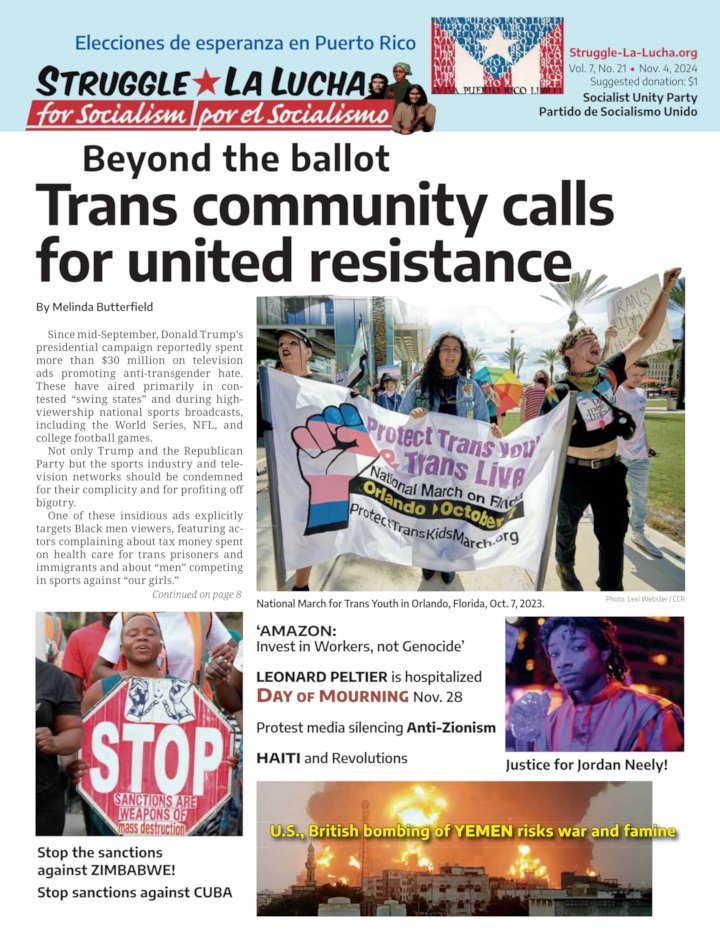
Beyond the ballot: Trans community calls for united resistance

Since mid-September, Donald Trump’s presidential campaign reportedly spent more than $30 million on television ads promoting anti-transgender hate. These have aired primarily in contested “swing states” and during high-viewership national sports broadcasts, including the World Series, NFL, and college football games.

Not only Trump and the Republican Party but the sports industry and television networks should be condemned for their complicity and for profiting off bigotry.

One of these insidious ads explicitly targets Black men viewers, featuring actors complaining about tax money spent on health care for trans prisoners and immigrants and about “men” competing in sports against “our girls.”

This ad, in particular, seeks to erase the solidarity trans people and other queers of all colors showed during the 2020 uprising after the police murder of George Floyd – when Trump, then in the White House, threatened to unleash the military against Black Lives protesters.

Likewise, Trump ads targeting immigrants and refugees contribute to whipping up a lynch-mob atmosphere ahead of the Nov. 5 general election. Trump has vowed to ban trans health care and begin a military roundup of migrants. He says he will make good on the threat to deploy U.S. troops against Palestine solidarity protests.

During the last year, trans and queer people have also been in the forefront of protests and actions against the U.S.-Israeli genocide in Gaza.

Speakers at Trump’s neo-Nazi rally in Madison Square Garden on Oct. 27 – in the middle of multinational, immigrant, queer New York City – likewise used openly genocidal language against trans people, along with racist hate directed at immigrants, African Americans, Puerto Ricans, and Palestinians.

No support from Harris

Democratic candidate Vice President Kamala Harris has gone out of her way to avoid any hint of support for trans people, who are under vicious attack from the far right. In fact, Harris hasn’t even offered the hollow “thoughts and prayers” for which President Joe Biden became notorious.

In an interview with NBC News on Oct. 22, Harris deflected a softball question about her position on trans rights. Instead of expressing support for trans people, their rights, and their health care, Harris simply said she would “follow the law.”

While some Harris supporters attempted to paint this as a win for the LGBTQ+ community, many trans people pointed out that this is no kind of support at all – given that half of U.S. states have now passed anti-trans laws. The ultra-right U.S. Supreme Court is set to hear a case in early December that could have devastating consequences for trans youth health care and beyond.

As the anti-trans panic continues to crest at home and abroad, in defiance of medical science and the lived experience of trans people, there is a high likelihood that a new Democratic administration and Congress will follow the example of the Labour government in Britain – which adopted the anti-trans policies set out under the previous right-wing Tory government.

After all, Harris, following Biden, has already taken up the Trump policy against immigrants and refugees at the Mexican border. Her campaign has steadily moved to the right since her nomination, courting right-wing war criminals like Dick Cheney and other anti-LGBTQ+ Republicans who oppose Trump and declaring her total support for the genocidal apartheid regime in Israel. 

Harris told “The View” that the only difference between her and Biden is that she would include Republicans in her administration.

Taking their cue from the Harris campaign, Democratic congressional candidates in Ohio and Texas have adopted openly anti-trans positions.

The ballot box? Or another way

The city of Odessa, Texas, just enacted a ban on trans people using public restrooms that match their gender. The law includes a $10,000 bounty for people who report trans people using the “wrong” bathroom.

A new study published by the Journal of the American Medical Association (JAMA) has once again confirmed the high rate of long-term satisfaction among people who started gender-affirming health care in their youth. But another study published in September by the journal Nature found a 72% increase in suicide attempts by trans youth and young adults in states that have enacted measures like Texas, with its ban on gender-affirming care and other legal attacks on trans rights. 

Trump applauds such measures. Harris stays quiet and will “follow the law.” What choice is there in November for trans people, their families, and supporters?

Progressive third-party campaigns are an option for a protest vote at the ballot box. Black activist Cornel West and socialist Claudia de la Cruz have both taken strong positions in favor of trans rights and queer liberation, as well as for Palestine. Jill Stein, who has received a lot of publicity as an opponent of U.S. collaboration with Israel, has a platform that is generally pro-LGBTQ+, though it makes unnecessary concessions on trans youth health care. 

However individual trans people and allies choose to vote or choose not to vote, what’s most important is to recognize that we must organize and prepare to fight for our right to live – no matter the outcome on Election Day.

If Harris is elected, we must be in the streets to help stop the probable coup attempt by Trump while continuing to fight the genocidal policies of the Democratic Party in Palestine. If the Democrats concede to Trump, we must resist the new fascist regime by any means necessary.

The most crucial thing trans people can do is learn from the example of the heroic Palestinian resistance. We must work to build alliances with immigrants and other communities facing genocidal attacks.

As I wrote during Pride month: “It’s the same U.S. ruling class, the same bosses and profiteers, the same reactionary politicians and media – the same capitalist system – aiming at people in Gaza and trans and queer people here at home. We are all sand in the gears of their efforts to turn back the clock on people’s rights worldwide.

“Let’s do whatever we can to unite our struggles, together with all workers and communities under attack, to say: Our rights are not negotiable, and we are not going anywhere!”

Melinda Butterfield is an organizer with Women In Struggle-Mujeres En Lucha. She was the initiator of the National March and Speakout to Protect Trans Youth in Orlando, Florida, on Oct. 7, 2023.

Strugglelalucha256
https://www.struggle-la-lucha.org/2024/page/8/