‘Black and a Red’: Rank-and-file ILWU Local 10 leader Leo Robinson linked local and global fights for justice

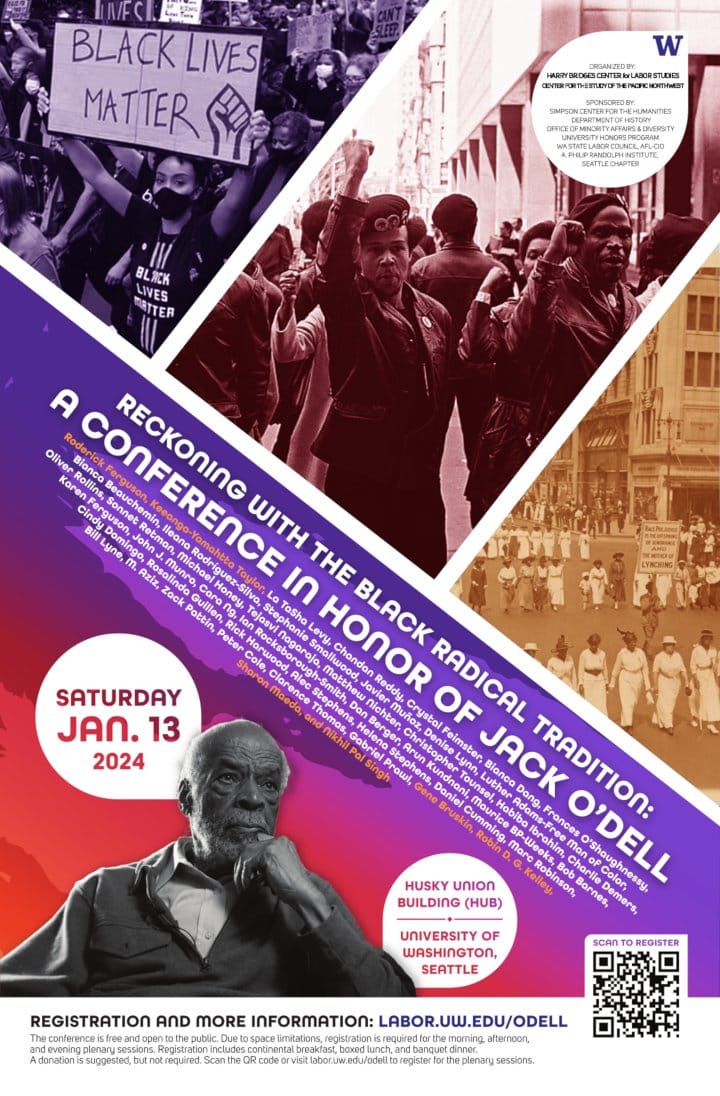
Following is a presentation by Clarence Thomas, a retired member of the International Longshore & Warehouse Union (ILWU) Local 10 in San Francisco. The event was “Reckoning with the Black Radical Tradition: A Conference in honor of Jack O’Dell on January 13, 2024, at the University of Washington in Seattle, sponsored by the Harry Bridges Center for Labor Studies.

Thomas was part of a Black and Red on the Waterfront workshop moderated by Zack Pattin (ILWU Local 23). Panel members included Peter Cole, professor (Western Illinois University), and Gabriel Prawl (ILWU Local 52, President, A. Philip Randolph Institute).

Jack O’Dell (1923-2019) was a visionary intellectual and an astute organizer who helped shape the course of the Black freedom movement in the second half of the 20th century.

Reckoning With the Black Radical Tradition: A Conference in Honor of Jack O’Dell

A profile of Leo L. Robinson

Solidarity greetings to all assembled here for this important conference in honor of Brother Jack Hunter O’Dell. 

I had the honor and privilege of meeting Brother O’Dell in Oakland, California, in 2012. The occasion was a lecture sponsored by Congresswoman Barbara Lee and former Oakland Mayor Elihu Harris. It was part of a series of civil rights lectures by veterans of the movement. I shall always remember our relatively brief but memorable and meaningful conversation about the ILWU and Local 10 specifically. He was very well acquainted with the history of our union, including our then-recent “Shut Down Wall Street on the Waterfront,” a coordinated West Coast Port Blockade in solidarity with the Occupy movement.

When reckoning with the Black radical tradition inside of the ILWU, particularly Local 10, the person who comes to mind is Leo L. Robinson — a second-generation Longshore worker. In my opinion, Robinson is one of the more important rank-and-file leaders in the union’s modern era (1970s-90s). I say that because he was in the tradition of the founders of the ILWU, leftists who were committed to rank-and-file democracy, as well as the working class at home and abroad. 

Like Jack O’Dell, Leo was “Black and a Red!”

Labor historian Peter Cole described Leo Robinson in an article following his passing in 2013 thusly: “Legendary Local 10 activist, recently passed away. His intellect, commitment, passion, and savvy allowed him to help lead Local 10, though he served as an elected official only once. He loved this union and fought to improve the lives of all working people, but Robinson might be best known for leading the ILWU and the fight against racial oppression, in South Africa.“

Leo Robinson. Photo: David Bacon

Born May 26, 1937, in Shreveport, Louisiana, to the proud parents of Arthur Robinson Jr. and Pearl Lee Young. His mother moved to the West Coast in 1942 to work at the Moore Shipyard in Oakland and prepare a place for his family. His father and four siblings moved to Oakland in 1943.

Leo’s dad also worked at Moore Shipyard and was hired on the waterfront in 1944. This was the same year my maternal grandfather found work on the docks during the second great migration of African Americans to the Bay Area.

Leo attended public schools in both Los Angeles and Oakland. George Washington Carver Junior High School’s motto stuck with him all of his life. Leo said, “I’ll never forget. I remember it as “a man educated is easy to lead but impossible to enslave.” The quote is from Henry Peter Brougham: “Education makes people easy to lead but difficult to drive; easy to govern, but impossible to enslave.” 

Brougham, a British statesman, played a prominent role in passing the Slavery Abolition Act of 1833.

Leo attended Oakland Technical High School and asked his mother for permission to join the Navy after completing the eleventh grade. Leo said, “I knew, running around with my hoodlum friends, that I wouldn’t graduate from the 12th grade.” 

He enlisted in the Navy in 1954 and spent three years, 11 months, 22 days, 11 hours, and 45 minutes of what he described as “wasted time.” He briefly worked for ILWU Local Two as a ship scaler. After working on an assembly line for General Motors, he became a longshore worker in 1963. 

When he came to the waterfront, he wasn’t that political. His issues were all local, and it was only later that it occurred to him that everything local was also national and international. During the Vietnam War, a question by a young longshore worker changed his political outlook for life and led him into activism. 

He said, “I want to ask you a question, and you don’t have to answer it now, but I want you to answer this question. Of what kind of threat do the Vietnamese pose to you?” Leo became politicized in the late ’60s, discussing the Vietnam War with fellow longshore workers and eventually joining the Communist party.

Photojournalist David Bacon wrote of Brother Robinson, “One of the things I learned about Leo was that he was not afraid of being called a Red. He took great pride in it.”

“When some people insult you and call you a Red,” Leo said, “that’s when you know you’re doing good work. When you’re hurting the racists, that’s their weapon of choice.“

With radical leaders on the docks, both Black and white, Leo’s emergence as a rank-and-file leader began to emerge in the early ‘70s. He became an active rank-and-file union member, vigilantly protecting workers’ rights, union democracy, and workers’ contracts. He was repeatedly elected to the local’s executive board and the union’s key decision-making body, the Longshore Caucus.

Local 10 predominantly African American

It is important to mention that ILWU Local 10 is the only predominantly African-American longshore local on the West Coast. It is also the most radical of all longshore locals in the ILWU. 

In the 1970s and 1980s, Leo’s leadership exercised the power of the rank and file of Local 10 and the U.S. working class on the side of the South African liberation struggle and against the racist apartheid regime. In July 1976, after the SOWETO uprising and youth were massacred, Leo introduced the resolution to Local 10 for a boycott of goods to and from South Africa. 

Leo assisted in forming Local 10’s South Africa Liberation Support Committee (SALSC), the first anti-apartheid group in a U.S. labor union. In April 1977, he put the resolution into action. A 5,000-person-strong community picket was honored by ILWU Local 10 members, stalling South African cargo at San Francisco’s Pier 27 for two days at a time when then-imprisoned Nelson Mandela and the African National Congress was slandered as terrorist by the U.S. government.

Leo was appointed by Local 10 to speak at rallies regarding anti-apartheid actions and the South African liberation movements, along with the Coalition of Black Trade Unionists (CBTU) and other community organizations. He organized the first trade union anti-apartheid conference at San Francisco State College and brought high officials from the African National Congress to San Francisco. 

The ILWU sponsored media events to bring the ANC and South African trade unionists involved in the liberation movement to the West Coast and beyond to speak on their struggles. They organized nightly meetings and radio interviews, traveled to other cities, raised funds, and worked with coalitions that raised money to build a clinic in Mozambique.

SALSC was successful in securing containers from longshore employers and collected tons of food and medical supplies for freedom fighters in Mozambique, South Africa, and Zimbabwe. The most impressive action of Local 10 occurred in 1984 when they initiated the longest boycott of South African cargo in U.S. history. 

When the Nedlloyd Kimberly docked at San Francisco Pier 80, Robinson and other longshore workers refused to touch the South African cargo, though they unloaded the rest of the ship’s contents. Thousands from the community rallied in support, and this cargo remained in the hold. Finally, on the 11th day, they unloaded it under pressure from the employers and a federal injunction that threatened massive fines on the union and leaders like Leo Robinson and others personally. 

This revolutionary, courageous act on the part of Local 10 and Local 34 immediately energized the Bay Area anti-apartheid movement, including students at the nearby University of California, Berkeley. It sparked a movement that spread throughout the West Coast and played a big part in anti-apartheid actions throughout the country.

Leo and his wife, Johnnie Pearl Robinson, opened their home to South African freedom fighters who were living underground in the U.S. They also provided financial support to some attending universities in the states. During this period, Leo, along with Sister Geraldine Johnson and several others, was a founding member of the Northern California chapter of the Coalition of Black Trade Unionists. It was the most radical of all the chapters in the country. 

Leo stated, “Sister Geraldine Johnson, my mentor, my sister and my teacher, was one of the most dynamic women I have ever laid eyes on. When Geraldine gave you your marching orders, you didn’t deviate, you didn’t equivocate, you just did it, even if you didn’t know how.” 

CBTU was one of the key coalition groups in the Bay Area in the anti-apartheid movement. It initiated broader support for the struggle within the ranks of Black labor.

Nelson Mandela thanked the ILWU

In 1990, when Nelson Mandela toured the United States after his release from 27 years in prison, he thanked the ILWU before a mammoth crowd at the Oakland Coliseum.

During the early 1980s, Leo, along with David Stewart and other local members of the CBTU, brought a resolution passed at its convention to Local 10 calling for all international unions to include in their union contracts, making Dr. Martin Luther King Jr.’s birthday a paid holiday. Local 10 adopted it as a contract caucus demand for the Longshore Caucus. The Longshore Division gained Dr. King‘s birthday as a paid holiday. 

Leo was a strong believer in rank-and-filers belonging to working-class organizations outside of their local, for the purpose of building coalitions, movements, and solidarity.

Leo Robinson was indeed an internationalist. He and others believed that Black people would not be free in the United States if they were not free in South Africa. They were determined to end support given by the U.S. government that kept the apartheid regime alive. 

Leo knew that workers in both countries had the potential to bring down apartheid. If longshore workers in San Francisco could find a way to support Black workers in South Africa, it would help the liberation movement there survive, win, and change the conditions for Black workers here at home.

Leo was a tremendous speaker. He possessed a commanding presence and voice. When he spoke, he had the full attention of every member of Local 10’s cavernous union hall. 

When he was once asked what the anti-apartheid struggle had to do with workers here at home, Leo responded by explaining that while plants were being shut down here, corporations were investing in industry in South Africa and taking advantage of the subjugation of Black workers under apartheid. He further highlighted that the cargo discharged from the boycotted ship Nedlloyd Kimberly in 1984 contained steel, glass, and apple juice concentrate, all products that had once been produced here in the U.S.

Leo had a way with words to hammer home a point. Here are some that come to mind:

  • “We have permanent interests, not permanent friends.”
  • “If you don’t know your rights, you don’t have any.”
  • “They’re not worth two dead flies on a syrup bucket.”
  • “Rank-and-file members should introduce resolutions that say if workers take a cut in wages, the leadership takes a cut in their wages as well.”
  • “The power of the rank-and-file resides in their back pockets.” (wallets)
  • “Only in unity is there strength. You will either organize or you will starve. It is as simple as that.”

Leo was a guy close to the members. They would come to him and express their concerns about matters on the job or in the community. They knew he could facilitate discussion of the issue at the executive board or union meetings. Members trusted his judgment because he believed in what was right as opposed to who was right. 

He was excellent at dominoes and played in the hall on occasions before dispatch. He was also effective in getting members who may have disagreed with his politics to support the efforts he initiated, such as volunteering to stuff and load containers with humanitarian supplies for freedom fighters in Southern Africa.

Leo was cited for heroism when he and two other Longshore workers rescued a fellow worker from sinking in tons of raw sugar. When a longshore brother and his family were being attacked by the KKK in Contra County in the Bay Area in 1981, Leo and others organized the ILWU Civil Rights Committee, which included interfaith, labor, and community forces. Longshore workers provided security for the brother and his family 24/7.

One day, while listening to a progressive radio station, he heard two Black women being interviewed about being harassed by the KKK and other racists in Oroville, California. Leo invited them to speak to the membership. The rank-and-file wanted to give support to their plight. He wrote a resolution to have the next membership meeting in Oroville, a “stop work meeting” with the employers’ approval. 

On the morning of the meeting, members loaded buses and cars to the city and marched through the town’s main thoroughfare to deliver a message to the police chief. Their message was to stop the harassment (cross burning, graffiti, etc.) of the single mothers.

Leo wrote the ILWU position paper on the Israeli-Palestinian question, calling for the recognition of the Palestine Liberation Organization as the sole representative of the Palestinian people and calling for the establishment of peace talks between Israeli and Palestinian governments.

In 1992, Leo and other rank-and-filers organized the African American Longshore Coalition to address racism, sexism, gender, and other forms of discrimination in the ILWU Longshore Division. Its objective was to resolve such problems internally. He believed such issues would ultimately lead to the demise of the union.

In 1994, while Leo was teaching middle school children in Berkeley the history of the ILWU, a former UC professor listened in the audience. They had previously worked together sending books to students in South Africa. The professor sought the union’s help to move his African Studies Library to Tanzania. A total of ten thousand books were sent. Many said, “This is a very unusual act of solidarity.” People from both continents called to find out how that was accomplished.

Call for a Million Worker March

Leo Robinson, in collaboration with Trent Willis and myself (Clarence Thomas of Local 10), wrote the resolution calling for a Million Worker March, an event that took place at the Lincoln Memorial on October 17, 2004, in Washington, D.C. The gathering, which took place a few weeks before the presidential election, faced tremendous opposition from the Democratic Party and the AFL-CIO. In fact, the latter instructed all labor councils and state labor federations not to endorse, support, or provide any financial support to the MWM. On June 28, 2004, Marilyn Sneiderman, Director of Field Operations, AFL-CIO, wrote a letter to all of its affiliates stating: “ While we agree with many of the aims and goals of the March, we are not endorsing this mobilization.”

On September 20, 2004, Mike Mathis, Director of the Teamsters’s government affairs, sent a memo to local unions and Joint Council principal officers, reading in part: “We agree, as does the AFL-CIO, in principle, with the idea of the Million Worker March. However, we also believe the timing of the March will divert valuable time and resources away from my efforts in the Battle Ground States.”

A month earlier, at the 29th Annual Educational Conference of the Teamsters National Black Caucus (TNBC) in Orlando, Florida, a motion was made to contribute $10,000 to the MWM. C. Thomas Keegel, General Secretary-Treasurer, IBT, assured TNBC delegates that this would get done, and it was.

Brother Gabriel Prawl, executive board member of ILWU Local 19 in Seattle and the MWM coordinator of the Pacific Northwest, introduced a motion to allow Brother Leo Robinson to address the membership. Prawl was motivated to do this because he was very disappointed at the local’s $500 donation for the MWM. Robinson had a reputation in the Longshore Division for speaking before audiences that did not necessarily share his political views. However, members never doubted his commitment to the ILWU and its rank and file. During Robinson‘s remarks to Local 19, he asserted, “I couldn’t stop the MWM even if I wanted to.“ He made such a compelling case for supporting the MWM that a white member of the local stood and made a motion that the local make a $5,000 contribution to the MWM. The motion passed unanimously!

On the weekend preceding the start of the 2004 Democratic Convention in Boston, Massachusetts, Senator Edward Kennedy, Democrat Massachusetts, hosted a mini-Labor summit, which included James P. Hoffa, General President of the International Brotherhood of Teamsters, Andy Stern, International President of SEIU, James Spinosa International President of the ILWU, and John Sweeney President of the AFL-CIO. One of the items on the agenda was the MWM. They said the MWM may be a good idea, but not at that time; maybe sometime later.

Brother Robinson contributed $50,000 towards the building of the MWM. He demonstrated his unwavering commitment to making MWM a reality, no matter what lengths the Democratic Party and the labor officialdom went to stop it. His contribution was truly revolutionary. Other pensioners also made significant contributions. I lost two qualifying years of retirement benefits due to my organizing for the MWM in 2004. and the subsequent MWMM in 2005. Leo demonstrated that the power of the rank-and-file resides in their hip pocket, as Harry Bridges (founding President of the ILWU) had pointed out many times.

Leo was also responsible for creating the MWM logo, which is emblazoned on tee-shirts and includes the MWM motto: “Mobilizing in Our Own Name,” with the joining of four hands of different hues, followed by a ribbon, which reads Million Worker March, encapsulates the beliefs and guiding principles of the intent of the MWM.

The MWM was initiated by the Black left of ILWU Local 10. Leo Robinson was the undisputed leader of that tendency in the entire ILWU.

Sister Brenda Stokely, a leading radical African American labor and community activist as well as the coordinator of the MWM Eastern Region, described Brother Leo in this way: “Leo embodied courage and commitment to his class and stood unwaveringly on the side of the aspirations of that class. His skills as an effective working-class strategist and organizer encouraged others never to falter in the face of opposition. He was vigilant in ensuring that ILWU Local 10 maintained its revolutionary character, remained capable of stopping their employers’ attacks on their contracts, and was able to exercise their right to carry out both political and economic strikes. Leo will forever be an inspiring model of revolutionary leadership.”

On March 23, 2013, a memorial service was held for Brother Leo Robinson at the William “Bill” Chester Hiring Hall of Local 10 in San Francisco. He was posthumously awarded the Nelson Mandela Humanitarian Award and the Nelson Mandela Freedom Award by the South African Ambassador, the Honorable Ebrahim Rasool, and Consul-General, the Honorable Cyril Ndaba respectively.

Submitted by: Clarence Thomas, ILWU Local 10 pensioner. Co-founder of the MWMM and DeClare Publishing. www.MillionWorkerMarch.com

Thomas is the author and co-publisher of “Mobilizing in Our Own Name: Million Worker March” and “Cleophas Williams: My Life Story in the International Longshore & Warehouse Union Local 10.”

Strugglelalucha256


🇵🇸 Sat. Jan. 27, 1 p.m. – Protest Baltimore Police Dept & City Divest Now

#Free Palestine – Stay in the streets

Baltimore Police & Baltimore City:
Divest from Genocide
Community Control of Police Now!

Demonstration & March
Saturday, January 27, 1 pm
Gather at Police Headquarters,
601 E. Fayette Street, Baltimore 21202

Demand Stop BPD’s relations with the “deadly exchange program”

And demand Community Control of the Police Now!

March to Ivan Bates office.

Join victims of police injustice including Tawanda Jones, Van Cherry Green and others.

Sponsored by: PPA, West Wednesday Coalition, Ujima Peoples Progress Party, Prisoners Solidarity Committee.

Strugglelalucha256


South African lawyers prepare lawsuit against U.S., Britain for complicity in Israel’s war crimes in Gaza

– No one held U.S. accountable for crimes it committed in Iraq as issue was not given necessary importance, Rensburg tells Anadolu

– South African lawyer says people believe what is happening now in Palestine is ideal scenario for legal process as U.S. continues to send money, resources to allow Israel to commit crimes in Gaza

After South Africa filed a case against Israel at the International Court of Justice (ICJ) for genocide in Gaza, the country’s nearly 50 lawyers are preparing a separate lawsuit against the U.S. and British governments on the grounds that they are complicit in Israeli forces’ war crimes in Palestine.

The initiative, led by South African lawyer Wikus Van Rensburg, aims to prosecute those who are complicit in the crime in civilian courts in collaboration with lawyers from the U.S. and Britain, with whom he is already in contact.

Rensburg, who has been writing letters to various countries and the ICJ for the last few weeks demanding that Israel and its supporters be prosecuted, has begun preparations to file a lawsuit against the two Western countries with the support of his colleagues.

“The United States must now be held accountable for the crimes it committed,” Rensburg told Anadolu in an interview, detailing the process by which Washington and London will be tried as complicit in Tel Aviv’s war crimes against the people of Gaza.

‘ICJ case will guide us’

When he told the people around him about filing a lawsuit, Rensburg said he received a lot of support. “Many lawyers decided to join us in the lawsuit. Many of those who have joined are Muslims, but I am not. They feel obligated to assist this cause, but I believe that what is happening is incorrect.”

What happened in Iraq is an example of this, he said, noting that no one held the U.S. accountable for the crimes it committed in the Middle Eastern country as the issue was not given the necessary importance.

But now people believe what is happening in Palestine is an ideal scenario for the legal process to be carried out, the South African lawyer said, adding that “the U.S. is busy spending more money and more resources to (allow Israel) commit the crime.”

“No one says stop, enough is enough,” he remarked.

Rensburg said the genocide case filed by South Africa against Israel at the ICJ will serve as a guide for their case against the U.S. and Britain and that they will begin the process based on the outcome of the case and the steps to be taken by the United Nations.

‘The U.S. must now be held responsible’

If the ICJ trial against Israel is concluded in favor of South Africa, Rensburg believed that the U.S. may face sanctions even if it does not accept the verdict.

The ICJ ruling will also strengthen a case against the Joe Biden administration, he added.

Rensburg said he and his colleagues in South Africa are making preparations by contacting law firms in the U.S. and Britain.

Reminding that Berlin is still paying compensation for the crime of genocide committed by Germany even today, Rensburg said, “The U.S. must now be held responsible for the crimes it has committed. It must accept its responsibilities.”

Pointing out that similar cases were filed against former U.S. President George Bush in the 2000s, he said they believed that they could successfully carry out the legal process abroad by working as a team.

He said South Africa made stronger arguments in the case in The Hague, and that he is intimidated by the argument that an attack against Israel could happen again if the court ruled in favor of South Africa.

Last week, the group of lawyers, which has now grown to 47, wrote an open letter to the leaders of the U.S. and Britain governments, stating that they could not avoid responsibility.

Source


Strugglelalucha256


Argentina: Milei’s blitzkrieg and the unconstitutional plan

The rush to violate the Argentine Constitution and constitutional guarantees is part of a deliberately executed plan to carry out the biggest plundering of resources transfer while implementing a model of famine.

Article 29 clearly states; “The Congress may not grant the national Executive, nor the provincial Legislatures to the provincial governors, extraordinary powers, nor the sum of public power, nor grant them submissions or supremacy by which the life, honor or fortunes of the Argentine people are at the mercy of any government or person. Acts of this nature carry with them an irrevocable nullity and will subject those who formulate, consent, or sign them to the responsibility and penalty of the infamous traitors to the homeland”.

Milei’s plan and his fascination for the Yankee capitalism model resembles the one implemented by Martínez de Hoz when he was minister of the economy during the dictatorship.

The purpose of auctioning off the social programs and annihilating social justice, provokes a mobilization at all levels. Wherever an offensive originates, a conflict is born, and the resistance generated by hunger disrupts the totally unfounded idea of national subjugation.

The functionality of the State was deployed in Argentina with the “Welfare State” during Peronism when progress was made in the socialization of medicine (Carrillo Plan). There were improvements in the care of the most vulnerable sectors, in areas such as education and housing, responsibility and commitment to the dispossessed was the main objective of a present state.

The Revolución Libertadora and subsequent governments forged a path to tear apart and put an end to it.

To say that the origin of the decadence and social conflicts is due to the state interventionism carried out from the 1930s onwards is part of the discourse of the last dictatorship in our country.

In their anti-state epic, what they seek is to dismantle the state, devalue it, and turn it into an instrument of the market that functions as a guarantor of the dominant order.

In view of the whole world, in Davos, the current president gave an anachronistic speech, where he harangued wildly that “the world is going through its best moment…” a world where millions are discarded due to economic precariousness, climate threat, and territorial exclusion.

Unless the schemes based on the brutal exploitation and transfer of resources are changed, poverty and inequality will increase. The proposed economic measures respond to capitalist maxims, greater social inequality, the concentration of wealth in small groups, surrender of natural resources, and control of territory through security forces.

The urgent aspirations of liberalization predict a high level of conflict where the country is evolving rapidly toward the abandonment of legality to become a de facto government with a constitutional mask.

The dissolution of historically conquered rights responds to a plan based on the global strategy of “preventive war”, which builds or empowers enemies whose offensive will be the justification of the necessary transformations in the legal and political sphere to have the country under control.

Milei’s blitzkrieg tries to impose its purposes based on the shock doctrine, provoking an artificial hyperinflation and generalized unemployment, terror among the beneficiaries of plans with respect to losing them, and among those who protest against the threatening repression, harming hundreds of sectors, public employees, doctors, pharmacists, architects, small businesses, etc.

The prognosis regarding the possibilities of his policies prevailing is not good, first of all, because of the long tradition of resistance of the Argentine people.

The tactic of the most needy, faced with the threat of seeing their meager incomes liquefied, will be to remain mobilized to force the libertarians to stop the onslaught. This will rapidly converge into a resistance movement, initially economic and defensive.

Milei’s is a plan to apply to a defeated people and the resistance movement is intact, this is just beginning.

In March, it will become political against the decretazo and the omnibus law, in defense of wages, employment and the constitution.

This model is not viable due to its own contradictions and internal limitations. The stabilization plan they are executing is more recession with inflation, it is the ultra-right economic model. The economic fall that comes in a long spiral seems to have no ceiling, except the one emanating from the popular brake.

These measures, typical of dictatorial regimes, such as the Omnibus Law, which requires extraordinary delegations for the entire government, directly attack the people because of their unconstitutional, recessive, and regressive character.

The unions have already confirmed a strike and mobilization for tomorrow.

The limit will be set by the people, it will be our capacity of resistance in the streets, who will stop the adjustment.

Source: Resumen Latinoamericano – Buenos Aires

Strugglelalucha256


Salt Lake City: Rally Against Transphobia and HB 257 – Jan. 25

Thursday, January 25 – 12 Noon
Utah State Capitol, Salt Lake City

Salt Lake City, Utah: Join several community organizations who loudly oppose HB 257 and stand firmly with our transgender community. This bill is just the latest in a series of ongoing attacks against our transgender community that the Utah legislature has allowed to be introduced and is on its way to becoming law. But we will not be silent about it, and neither should you!
Meet us on the steps of the Utah State Capitol on Thursday, January 25th, at noon. Bring your signs, flags, and friends to make some noise! We understand that this bill may be voted on before Thursday, but this is a coordinated community effort, and we will not allow this transphobia to go unchallenged and unchecked, nor will we permit our trans siblings and neighbors to feel unsupported or unsafe in their own community.
As this will affect so many, we encourage and welcome all ages to join our rally and protest. This is one of many actions being planned by a number of groups, and we will continue to amplify other events and gatherings taking place, so be sure to show up and show out!
If your organization would like to sign on for this rally or if you’d like to speak, please DM us directly at the Nuanua Collective @nuanua.collective. We’ll see you at the Capitol! 🏳️‍⚧️🏳️‍⚧️🏳️‍⚧️

https://www.instagram.com/p/C2WB395x-78/

Strugglelalucha256


Justice for Tawfik Aldeljabbar: Louisiana teen killed by U.S.-funded occupation force

Community members are mourning the death of Tawfik Abdeljabbar. The 17-year-old native of Gretna, Louisiana – a U.S. citizen – was murdered on Jan. 19 by an Israeli Occupation Force officer in the occupied West Bank, in the Palestinian town of Al-Mazra’a. The U.S. State Department has confirmed the killing.  

The young man was a student at the Muslim Academy Gretna Islamic School. The family returned to Palestine last year to reconnect with their relatives. Tawfik hoped to improve his Arabic and had college plans.  

On the night of Jan. 20, several hundred gathered for a vigil at Masjid Omar mosque in Harvey, Louisiana. A separate vigil was held at a family home. One attendee spoke to Struggle-La Lucha about the experience.

“The house was full, people in every corner, in every room. Some were crying and being consoled; others were consoling until it was their turn to be consoled.

“As I scanned the sea of faces, looking for Tawfik’s closest relative in order to pay my respects, every face in that sea was one I knew. These are the faces of the moms of the countless kids I’ve taught in my 17 years at Muslim Academy. I knew everyone. Instantly, I felt soothed, relieved that I was surrounded by people who felt this loss as deeply as I did.

“As I hugged each one, probably longer than I would have normally, my tears fell. The hugs tightened. I didn’t want to let go. These mothers understood me, understood the pain of loss. We birth these babies, raise the children, and nurture the youth in the security afforded to us by where we live. But when we go home, instead of security in the knowledge that we’ll see our children, the insecurity of IF we see our children becomes an ever-present thought. I cried.

“‘I didn’t see you this morning,’ Tawfik’s father cried at his side when he bid his boy a final farewell.

“It reminded me of the last time I saw Tawfik. ‘Have a great summer! Stay out of trouble!’ I advised him, knowing that going home (to Palestine) meant IF, yet safe in the assumption of ‘it couldn’t happen to someone I know.’

“I cried a little more. I thought about Khair, Tawfik’s younger brother, the child I taught for nine months, who I grew to love and nurtured through the year. I cried harder. But surrounded by my people, by our faith, by our shared resilience, and in the knowledge that death is not the end for our martyrs, gave me peace … for a while. Until I left, until I returned home, where my rage at the ongoing genocide of my people welcomed me home.”

Another NOLA Palestinian community member spoke to Struggle-La Lucha.

“This needs to stop — the murder, us in the U.S., funding these murders. I want the broader community to understand that this is not the first time this happens. Shireen Abu Akleh was a Palestinian with American citizenship, and she, too, was killed by the IOF.

“We should care, regardless of the citizenship a person holds. And the only reason we’re telling everyone this is a murdered child from our community is so that the next time you see your Palestinian friend or co-worker, you understand that this – the occupation — is a dark shadow in their life – and that it could be any of us killed.

“What would you do and/or say if this was your Palestinian American friend or colleague killed? Will you remain silent and pray for us in the quiet? I fear the disappointment that may come with this answer.

“I think the media coverage needs to get better. Media claims objectivity, and yet, the biased reporting that favors Israel shows otherwise.”

Struggle-La Lucha also spoke with Kevin Ericksen, a Louisiana State University employee in finance. Ericksen says that he has “a quarter century of trying to change American policy toward Palestine” behind him and associates with Faith Organizing for a Free Palestine. Some of the members attended vigils for Tawfik.  

“Americans know more than they let on. But they’re good at deflecting, always bringing it back to Hamas and how Hamas is the alpha and omega of this tragedy.

“But no more. We now realize that there are clear victims of the $10 million per day that America gives the Israeli military. 

“Until Troy Carter [U.S. representative for Louisiana’s second congressional district] flies over to Nablus or Jenin and sits in front of one of the mothers whose son was killed by American guns and looks her in the eyes and tells her why her son’s killing was necessary for American national security, until Troy Carter looks her in the eyes, we don’t want to hear from him or any news outlet about how evil Hamas is the cause of all this.”

We at Struggle-La Lucha say justice for Tawfik Abdeljabbar! In the name of workers and oppressed people here in the belly of the beast — who have no interest in upholding U.S. imperialism — we say end the occupation! Free, free Palestine!

Strugglelalucha256


The U.S. military’s real intentions in Ecuador

History repeats itself. For centuries, the United States has sought ways to intervene in Latin America to strengthen its military presence and dominance in the region whenever a country is in crisis. And it is happening again. The current security crisis in Ecuador is presented as an opportunity for the United States to deepen its military presence in the Andean country.  Under the guise of “contributing together to a safer and more stable region,” Washington announced on January 12 that it was sending the head of the Southern Command, General Laura Richardson, and other senior counter-narcotics and diplomatic officials to Ecuador to discuss with the government of President Daniel Noboa how to combat organized crime. According to the U.S. State Department, this visit seeks to “promote dialogue among the region’s defense chiefs to exchange ideas, experiences and perspectives in order to achieve consensus on security and defense issues, and to promote the strengthening of cooperation among the armed forces.”

But what is happening in Ecuador? In this country, one of the most violent ones in the world, with 45 intentional homicides per 100,000 inhabitants in 2023, organized crime has since mid-January led an escalation of violence, with riots in several prisons, kidnappings, explosions, attacks, and even the armed assault on a television station in the city of Guayaquil.

Given this situation, the government of newly inaugurated President Daniel Noboa has declared an “internal armed conflict” and has considered these gangs to be terrorist groups and military targets. The escalation of violence occurred amid efforts by the young president, 36, to regain control of Ecuador’s prisons, many of them internally dominated by these groups.

In this context, the U.S. government was one of the first to express its explicit support for the Ecuadorian president’s declaration of “internal armed conflict.”  Although Washington ruled out sending troops, Ecuador is currently the country that receives the most U.S. military assistance in the region, according to experts.

A study prepared by the Latin American Center for Geopolitics (CELAG) identified that between 2021 and 2022, Ecuador received U.S. military assistance in the amount of 172 million dollars. In addition, former president Guillermo Lasso, shortly before leaving office, signed a military cooperation agreement with President Joe Biden.

Tamara Lajtman, Ph.D. in Social Sciences, one of the authors of the report, explained in declarations to the local press that the cooperation agreement is oriented, broadly speaking, to the fight against illicit drug trafficking and related crimes. “However, there is no official document disclosing the details of the bi-national exchange. It is known from the U.S. embassy in Quito itself that Washington foresees the investment of some 3.1 billion dollars over the next seven years in Ecuadorian affairs.”

According to the report, military cooperation has as a counterpart a series of permissions that both military personnel and U.S. officials will have. The analysis states that the U.S. envoys will have the same “privileges and exemptions” traditionally assigned to diplomats. U.S. personnel will also not be required to pay any taxes within Ecuadorian territory. The agreement also allows the U.S. Southern Command to move into Ecuadorian territory and patrol the maritime and airspace, all under the pretext of combating drug trafficking and organized crime.

For Lajtman, signing this type of exchange at a time of security crisis is also evidence of the interest Ecuador has for the U.S. “in the context of a hegemonic dispute with China and Russia.” The expert pointed out the “key role” of the Galápagos Islands, located in the Pacific Ocean, a little more than 900 kilometers from the Ecuadorian coast and under its administrative control.

The analyst and co-author of the study, Aníbal García, also pointed out that “the U.S. Department of Defense has been trying for some time to establish a military base in the Galápagos” because it would allow it “to control a certain part of the Pacific in a war scenario with these powers.”

Meanwhile, the Ecuadorian people pay for the consequences of a poorly managed internal conflict. Terror is there to stay, and the U.S. military presence, far from being a relief, poses greater risks to the tranquility of the citizens and the sovereignty of the country. History repeats itself once again with a new page from the Monroe Doctrine.

Source: Resumen Latinoamericanno – English

Strugglelalucha256


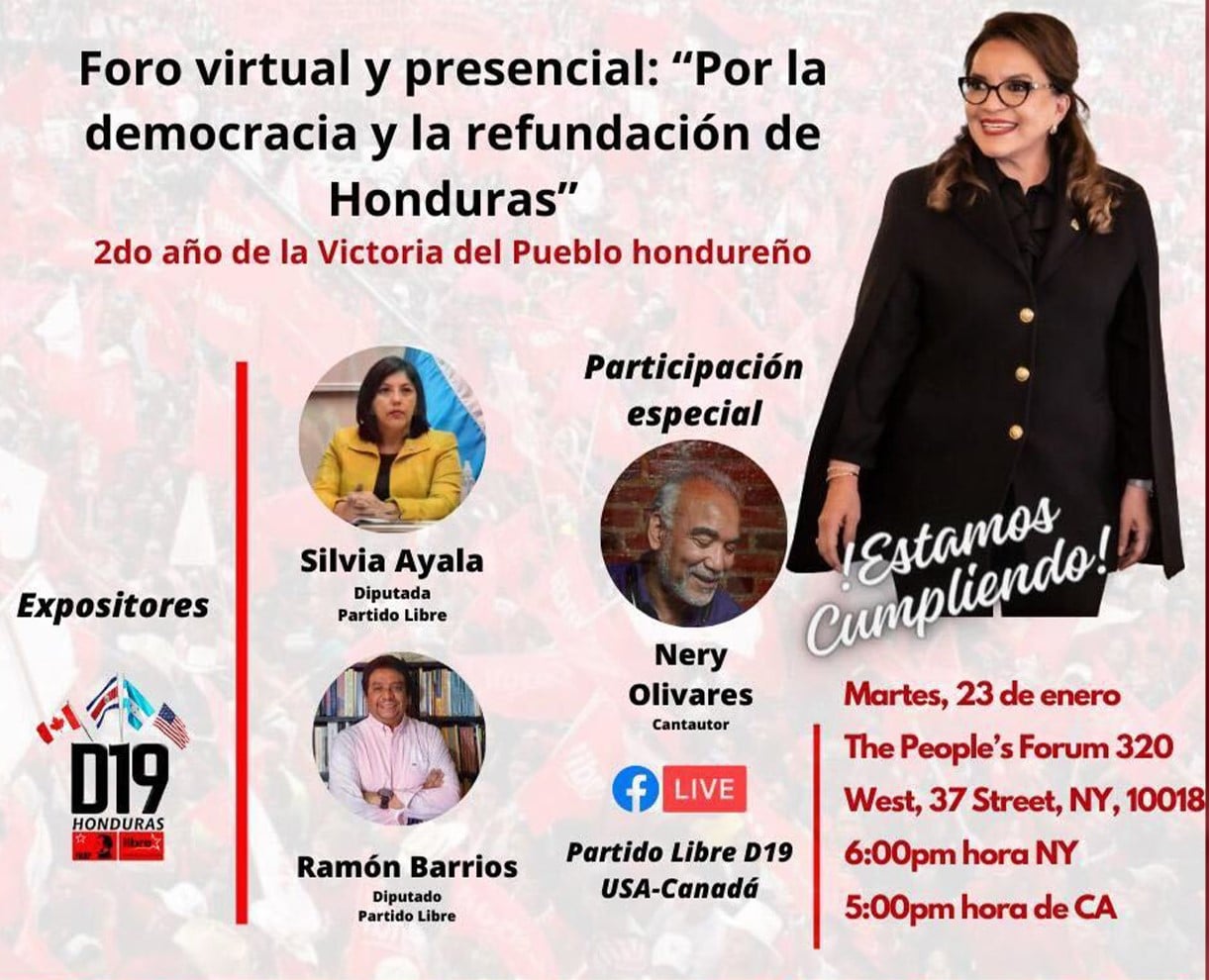
New York City: For Democracy and the Refoundation of Honduras, Jan. 23

Tuesday, January 23 – 6:00 p.m.
The People’s Forum, 320 W. 37th Street, Manhattan

Please join D19 for its virtual and in-person forum: For Democracy and the Refoundation of Honduras.

An event to celebrate two years of the electoral victory of the Honduran people. Accomplishments and challenges of the first female president in the history of Honduras, Companera Xiomara Castro de Zelaya.

With the participation of Congresswoman from the Libre Party, lawyer Silvia Ayala, and Libre Congressman, constitutionalist lawyer, Ramon Barrios. Also live music with Dominican musician and singer Nery Olivares.

Strugglelalucha256


Hamas document reveals: Why we carried out Al-Aqsa Flood Operation

The Palestinian Resistance Movement Hamas issued a 16-page document on Jan. 21 entitled ‘Our Narrative … Operation Al-Aqsa Flood’. The document addresses many critical questions about the context, the timing, and the events of October 7.

The document (PDF) was released in both the Arabic and English languages by the Hamas Media Office. It offers a rare insight into the reasons that led the Palestinian Resistance leaders to carry out a major Resistance operation on October 7, in addition to what actually transpired on that day.

The document starts by addressing “Our steadfast Palestinian people,” who have been subjected to a genocidal Israeli military campaign, which is, as of today, at its 107th day.

“In light of the ongoing Israeli aggression on the Gaza Strip and the West Bank, and as our people continue their battle for independence, dignity, and breaking-free from the longest-ever occupation during which they have drawn the finest displays of bravery and heroism in confronting the Israeli murder machine and aggression,” the introduction of the document reads.

The other target audiences are “The Arab & Islamic nations” and “The free peoples worldwide and those who advocate for freedom, justice, and human dignity.”

Why Operation Al-Aqsa Flood?

The first section is entirely dedicated to the reasons behind Operation Al-Aqsa Flood.

Hamas contextualizes the events by describing the brutal colonization process launched by the Zionist movement and, even before, by the British colonial authorities.

“Over these long decades, the Palestinian people suffered all forms of oppression, injustice, expropriation of their fundamental rights and the apartheid policies,” the document reads.

The paper also lists official figures related to the period between 2000 and 2023, revealing shocking numbers of Palestinians killed and injured.

Hamas also blames the so-called ‘peaceful settlement process’ and the obstinacy by the US administration and its Western allies that “have always been treating Israel as a state above the law; they provide it with the needed cover to maintain prolonging the occupation and cracking down the Palestinian people, and also allowing ‘Israel’ to exploit such situation to expropriate further Palestinian lands and to Judaize their sanctities and holy sites.”

“After 75 years of relentless occupation and suffering, and after failing all initiatives for liberation and return to our people, and also after the disastrous results of the so-called peace process, what did the world expect from the Palestinian people to do?” the document asks.

The Events

The second section, entitled ‘The events of Operation Al-Aqsa Flood,’ describes the events of that day and debunks some of the Israeli lies.

“Avoiding harm to civilians, especially children, women, and elderly people, is a religious and moral commitment by all the Al-Qassam Brigades’ fighters. We reiterate that the Palestinian resistance was fully disciplined and committed to the Islamic values during the operation and that the Palestinian fighters only targeted the occupation soldiers and those who carried weapons against our people.”

“If there was any case of targeting civilians; it happened accidentally and in the course of the confrontation with the occupation forces,” the document highlights.

International Investigation

In the third section, Hamas reiterated that “When Palestine asked for investigation into Israeli war crimes committed on its territories, it was faced by Israeli intransigence and rejection, and threats to punish the Palestinians for the request to ICC.”

“We urge these countries, especially the US administration, Germany, Canada and the UK, if they are meant for justice to prevail as they claim, they are ought to announce their support to the course of the investigation in all crimes committed in occupied Palestine and to give full support for the international courts to effectively do their job.”

Who is Hamas?

In the fourth section, entitled “Who is Hamas,” the group describes itself as a “national liberation movement that has clear goals and mission” and “gets its legitimacy to resist the occupation from the Palestinian right to self-defense, liberation, and self-determination.”

“Our steadfast Palestinian people and their resistance are waging a heroic battle to defend their land and national rights against the longest and brutalist colonial occupation. The Palestinian people are confronting an unprecedented Israeli aggression that committed heinous massacres against Palestinian civilians, most of them were children and women.”

What is Needed?

In the fifth section, entitled ‘What is Needed’, Hamas calls for an “immediate halt of the Israeli aggression on Gaza, the crimes and ethnic cleansing committed against the entire Gaza population”.

Moreover, it urges “to hold the Israeli occupation legally accountable for what it caused of human suffering towards the Palestinian people, and to charge it for the crimes against civilians, infrastructure, hospitals, educational facilities, mosques and churches.”

“We call upon the free peoples across the world, especially those nations who were colonized and realize the suffering of the Palestinian people, to take serious and effective positions against the double standard policies adopted by powers\countries that back the Israeli occupation. We call on these nations to initiate a global solidarity movement with the Palestinian people and to emphasize the values of justice and equality and the right of the peoples to live in freedom and dignity.”

To view the full document as a PDF, please click HERE

Source: Palestine Chronicle

Strugglelalucha256


On the 100th anniversary of the death of V.I. Lenin

Statement of Socialist Unity Party and Struggle-La Lucha for Socialism on the 100th anniversary of the death of V.I. Lenin.

It’s really a shame that Vladimir Lenin is such a maligned figure in the capitalist world. Not surprising, but a shame.
If more people knew the truth about Lenin and the Russian Revolution, they’d see another Che, another Harriet Tubman, or another Geronimo.
And not necessarily the liberation fighters as individuals but the mass struggles they led and were part of and what they won for their people. They won their liberation. They won their ability to determine their own futures.
If more people knew about Lenin, that would mean more people knowing another example that, if the masses of working and oppressed people can come together and get organized, we can fight for and win a better world.
And not only CAN we — we MUST. The same way Palestine MUST be free. Because ALL of our futures are at stake.
We honor the anniversary of Lenin’s death every year, but in this hundredth year, at this historical moment, we pay particular tribute. More people must be strengthened by the true history of the Russian Revolution.
Strugglelalucha256
https://www.struggle-la-lucha.org/2024/page/64/