New York City continues to ‘get louder’ for Palestine

SLL photos: Stephen Millies

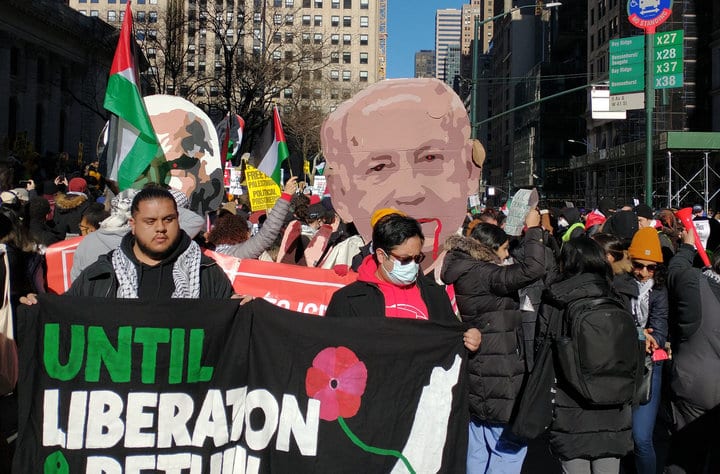
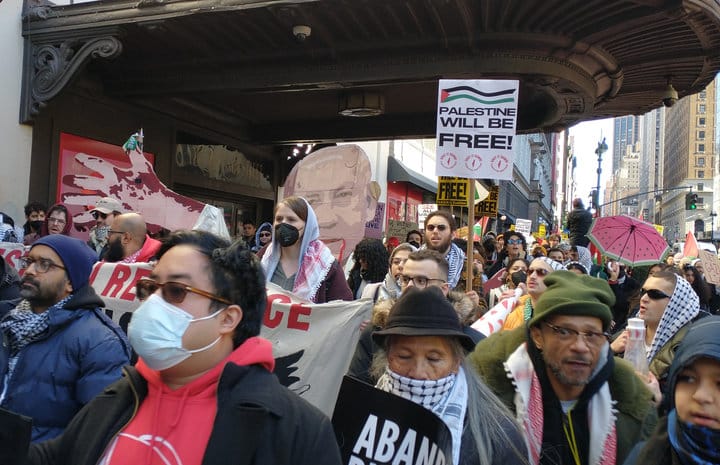
Thousands of people marched in Manhattan on Feb. 4 to demand a ceasefire and an end to the genocide in Gaza. At least 30,000 Palestinians, including 10,000 children, have been murdered there.

The action, called by the Shut It Down for Palestine Coalition, started with a rally in front of the great reference library on Fifth Avenue.

One of the speakers was Manolo De Los Santos, executive director of The People’s Forum, who has been targeted for arrest by the cops. Police busted De Los Santos again at Sunday’s peaceful protest, along with six other people.

The recent series of arrests is part of an attempted crackdown on the pro-Palestinian events. It’s reminiscent of police attacks on the Black Lives Matter movement.

One of the cops’ excuses for busting protesters is the use of bullhorns and other sound devices. So people were encouraged to bring noisemakers, drums and anything else to make it louder for Palestine.

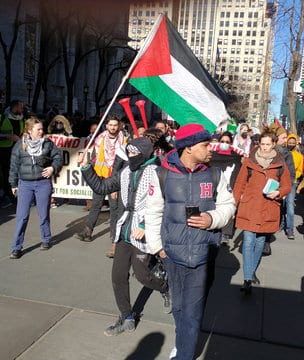
Thousands marched down Fifth Avenue and across 34th Street, past the block-long Macy’s department store. Police continually played a recorded message threatening arrests if people didn’t stay on the sidewalk. Nobody was intimated and marchers took to the streets when they could. 

People then marched north on Eighth Avenue, stopping briefly at the New York Times, which has been lying about Palestine for 75 years. The march ended at the Lincoln Center for the Performing Arts.

The complex was built by evicting thousands of Puerto Rican and Black families from the neighborhood. It was a mini-Nakba, like the Nakba that drove 750,000 Palestinians from their homeland.

Among the groups that organized the protest were the Palestinian Youth Movement; Al Awda NY/NJ, The Palestine Right to Return Coalition; Students for Justice in Palestine; The People’s Forum; ANSWER Coalition; Party for Socialism and Liberation; and Neturei Karta, Jews Against Zionism.

Keep it louder for Palestine!

Strugglelalucha256


‘A slap in the face’: Trump meeting sparks outrage in Teamsters union

By acting in the role of the old racist and sexist business-unionism leadership, Teamsters union President Sean O’Brien made a sharp break with the new progressive union movement  — personally visiting Donald Trump in Mar-a-Lago, Florida, on Jan 26. Subsequently, O’Brien demanded the entire Teamsters General Executive Board meet with Trump at the union’s headquarters in Washington, D.C., on Jan. 31

Forming a vocal opposition, John Palmer, a Teamsters International vice president from Texas, refused to attend the meeting with an “insurrectionist.” In an interview with Steve Zeltser on WorkWeek Radio, Palmer said: “There’s zero – nothing on issues that affect labor that Donald Trump supports nor has he ever supported. Trump basically spits in our faces.”

The Teamsters National Black Caucus said in a statement about O’Brien’s meeting with Trump:  Trump’s “union-busting tactics, blatant disregard for government, and his bigotry are known  … as he has proudly touted his vile rhetoric to any listening audience.” 

Chris Silvera, a leader of Teamsters Local 808 and former chair of the Teamsters Black Caucus, said: “We’re not dealing with the Republican Party anymore. People should be very clear about this. They are confederates, people who think there needs to be a Civil War. You’ve got a president of the Teamsters union who’s consorting and is actually helping give credibility to this person who’s calling for a dictatorship.” 

Silvera explained: “O’Brien went to Mar-a-Lago, the place where people go to bow down there to ‘Kiss the Ring of Donald Trump.’ There’s something improper with our president making this trip to the headquarters of the confederacy.

“It is an affront to all those members who are not a party to this fascist movement. It sends a message to all the Black, Latin, Muslim, and women union members that you really don’t care about them. 

“O’Brien’s worrying about the racist elements within the union. Instead he should be trying to either convert those elements over to a newfound reality or to isolate them. To really believe that we had to play with them at this moment in history is troubling, to say the least.”

Gained appearance of militant leader

During Teamsters union organizing campaigns at Amazon and contract negotiations such as that with UPS last July, Sean O’Brien gained the appearance of a militant labor leader, covering up an earlier image of a tough guy with shady connections.

The Teamsters UPS contract campaign, “while notable for its bloviating, looked hollow compared with the UAW ‘Stand Up Strikes’ against the former Big Three automakers,” writes Joe Allen, author of “The Package King: A Rank and File History of United Parcel Service.” 

O’Brien comes from Teamsters Local 25 in Boston, which is reported to have a long history of racism. Silvera says there are no Black workers there. Strangely enough, Black workers sat on the Executive Board of Local 25 at the turn of the century. Silvera says, “Local 25 has fallen behind.”

Last February, former Black and Latino workers for the Teamsters International Union initiated a legal suit accusing the union of racism after O’Brien became the union’s president in March 2022. The lawsuit says that “rather than maintaining or increasing diversity, more than a dozen people of color were fired, setting back the Organizing Department’s goals of effectively recruiting and organizing non-whites, in favor of bolstering the majority white membership.”  

It also claims that O’Brien “publicly humiliated” the plaintiffs in the case, calling them “bad apples” and “lazy.” 

Teamsters for a Democratic Union (TDU), the promoters of O’Brien, were once seen as rank-and-file reformers in the union. At its November convention, the TDU tabled a motion for a ceasefire in Gaza. The motion for a ceasefire had been put forward by Teamsters Mobilize (TM) members, a much smaller network of Teamsters activists. One member of TM was banned from the TDU convention for criticizing it. TM has campaigned for $25 per hour starting pay for part-timers and for solidarity with Palestine.

‘A slap in the face’

Richard Hooker Jr., the secretary-treasurer of Teamsters Local 623 and vice-president of the Philadelphia AFL-CIO Board, said: “As leaders, we have to do a better job of explaining to our members that a vote for Trump is a vote against your pension, a vote for Trump is a vote against organizing workers, a vote for Trump is another vote against the working class.”

Jess Lister, a shop steward in Georgia and member of the Teamsters LGBTQ caucus, who has helped lead a campaign to organize part-time UPS workers, called the meeting “a slap in the face.” 

Lister added that she did not support Biden, but that she viewed the Trump meeting as especially galling given his record of stacking the courts with anti-union judges and overseeing a National Labor Relations Board (NLRB) that issued rulings making it harder for workers to organize.

“He has a longstanding history of racism, of hate towards women, towards minorities, towards the LGTBQ community – he is not accepting of other people,” Lister said. “Our union president shouldn’t even entertain the idea of a meeting. That shouldn’t have even been on the table.”

Strugglelalucha256


Why ‘blood libel’ charge against South Africa case trivializes real antisemitism

On Jan. 26, the International Court of Justice accepted South Africa’s landmark genocide case against the Zionist entity. The court issued the following ruling:

“The Court indicates the following provisional measures:

(1) By fifteen votes to two,

The State of Israel shall, in accordance with its obligations under the Convention on the Prevention and Punishment of the Crime of Genocide in relation to Palestinians in Gaza, take all measures within its power to prevent the commission of all acts within the scope of Article II of this Convention, in particular:

  1. killing members of the group;
  2. causing serious bodily or mental harm to members of the group;
  3. deliberately inflicting on the group conditions of life calculated to bring about its physical destruction in whole or in part.”

The ICJ’s ruling, while imperfect, was welcomed by the various resistance groups in Palestine, including the Popular Front for the Liberation of Palestine (PFLP) and the Islamic Resistance Movement – Hamas. 

However, the imperialist world met the ICJ’s decision with vitriol. Zionist officials and their allies have ranted and raved against the South African genocide case since its inception

As published by the CIA mouthpiece Voice of America, White House National Security Council spokesperson John Kirby claimed that South Africa’s ICJ filing was “meritless, counterproductive and completely without basis in fact whatsoever.”

The thousands of Palestinian children fighting for their lives while buried under rubble may disagree with Kirby’s assessment. 

To think, Kirby’s cruel comments came weeks before the ICJ even decided to accept South Africa’s case and order provisional measures for the Zionists to fulfill within 30 days. 

The wave of Western outrage at the South African filing did not end with U.S. security officials. Zionist media outlets and officials went on a full blitz against the accusations of genocide, including alleging that the South African case was a “blood libel.” 

Needless to say, the reaction of the U.S., the Zionist entity, and the other imperialists when the ICJ actually ruled in favor of South Africa was extreme. 

Falsely invokes historical accusation

In the wake of the ICJ’s ruling, Zionist officials again raised the claim of blood libel. In particular, Zionist president and war criminal Isaac Herzog issued a statement in response to the ruling. Herzog frothed, “Israel has the right of full self-defense” and “everyone with sense can see that Israel is acting in accordance with international law.” 

Herzog didn’t stop there. The blowhard child murderer went as far as to argue that any accusation of genocide against the Zionist entity is blood libel. There’s that phrase again! 

To fully dissect Herzog’s comments as the hateful and toxic venom that they are, it is important to first reckon with the blood libel conspiracies that have been weaponized against the Jewish community for hundreds of years. 

A blood libel is a superstitious accusation that Jewish people perform ritual blood sacrifice of Christians for a variety of reasons. The myth developed in medieval Europe in the 12th century. Originally, it was claimed that Jews sacrificed Christian children to obtain the blood needed to make unleavened bread, or matzah. 

As if the idea that Jews require blood to make matzah is not ridiculous enough on its own, the blood libel mythology further evolved in meaning and connotation. 

One of the most famous depictions of such a blood libel is William Shakespeare’s play, “The Merchant of Venice.” In the play, a Jewish merchant named Shylock demands a “pound of flesh” from a Christian whom Shylock believed wronged him. This version of the blood libel myth became more and more common as antisemitism focused more on ethnic than religious hatred. 

It was this particular and broader formulation of the blood libel myth that rose to mass prominence in Nazi Germany and its fascist allies in the 1930s and 1940s. 

At the core of the contemporary blood libel charge is the idea that Jews are inherently devious and unreasonable. To that end, Jews will demand a blood libel not only to practice their “satanic rituals,” but as recompense for perceived wrongs. 

Simply put, any accusation from the Jewish community about antisemitism is really just a pretext for a pound of flesh, according to this lie.

Antisemitism alive and well – in U.S. 

There is no doubt that blood libel antisemitism is alive and well – not only in the growing U.S. neo-Nazi movement but in depictions of Jewish people in mainstream media

For an institution supposedly run by a global Jewish cabal, Hollywood certainly produces a lot of television and films that depict Jews as unreasonable, vengeful, and bloodthirsty. 

With all that said, for the war criminal Herzog to assert that a thorough South African ICJ case against the Zionist entity is equivalent to hundreds of years of antisemitic mythology is a disgrace. 

Herzog and the broader Zionist movement’s accusations of blood libel against South Africa trivialize the very real phenomena of blood libel antisemitism and all antisemitism. 

The attempt to use the oppression of Jewish people to justify the genocide of the Palestinian people and obfuscate any attempt to stop that genocide is as callous as it is arrogant. 

In fact, the current greatest purveyors of the blood libel myth are the wealthy and powerful of the United States and its Zionist project. 

Is it not the U.S. government, the Zionist government, and all their allies who incessantly assert that to be Jewish is to have a blood feud against all Arab people? Is it not Benjamin Netanyahu who insists that every Jew has a solemn and inherent responsibility to kill Arab people? 

The real antisemitism lies within the U.S. ruling class, and that same ideology permeates even into what is supposed to be a “Jewish state.” 

Zionism is not about Judaism. Zionism is not about combating antisemitism. Zionism is only about the proliferation of the imperialist agenda and expansion of Western ruling class profits. 

Lev Koufax is an anti-Zionist Jewish activist.

Strugglelalucha256


Shut Down D.C.: Stop U.S.-led war on Palestine & Yemen

As February 2024 began, the struggle in solidarity with the Palestinian resistance continued in earnest. 

As the sun rose on Feb. 1, approximately 200 protesters, including a reporter from Struggle-La Lucha, gathered in front of Union Station in Washington, D.C., to demand an end to the U.S.-led war on Palestine and Yemen, and to restore funding for the United Nations Relief and Works Agency (UNRWA). 

The Biden administration led the charge for the West to collectively withdraw all funding for UNRWA after the Zionist entity levied phony accusations regarding UNRWA involvement in the Oct. 7, 2023, attacks against occupation forces.

Today’s protests weren’t limited to Union Station. Hundreds of anti-Zionist demonstrators took to the streets to stop traffic at intersections and exit ramps across the capital. The message was clear: no business as usual in the imperial core as long as Palestine remains under siege. 

The coalition that organized the “Shut Down D.C.” day of demonstrations included the Palestinian Youth Movement, the U.S. Campaign for Palestinian Civil Rights, Party for Socialism and Liberation, and many more. 

Strugglelalucha256


Karl Marx’s debt to people of African descent

In this blogpost, Biko Agozino argues that Karl Marx was among the few European theorists of his time who did not try to conceal his ‘debt’ to Africa but celebrated such knowledge as foundational. Agozino shows how people of African descent were central to the theory, practice and writings of Marx. Marxism is not a Eurocentric ideology.

Described by one editor as ‘nothing short of pathbreaking’, I am pleased to have been invited by roape.net to summarize in a blogpost the arguments in my paper ‘The Africana Paradigm in Capital: The Debts of Karl Marx to People of African Descent’ (published in the journal in 2014 and free to access until the end of November). The original claim in the paper that Marx borrowed from the knowledge and experiences of people of African descent has also been described as ‘surprising’ by Micco Sarno who nevertheless concluded his detailed intertextual review by stating that the paper has deepened the understanding of Capital as a truly global critique of capitalism by a European author who was not Eurocentric. Adam Mayer wrote that the article ‘demolished the myth that Marxism was a Eurocentric ideology incompatible with African pride.’ In this summary of the paper, I highlight the key points and clarify some issues raised by some authors.

Contrary to claims by many that Marx was Eurocentric just like other European intellectuals of his time, my article argued that people of African descent were central to the discourse of Marx. I suggested that the earlier work of Marx, such as The Manifesto of the Communist Party, may have misled some readers into assuming that his writings about class struggles dealt with only the European working class. This may be so because the history of slavery outlined in the Manifesto referred mostly to ancient slavery in Europe, but my article also shows that some of the references in the manifesto concerned modern slavery in the New World. I delved into his mature work, Capital, to reveal that it was centered on people of African descent as the paradigm for explaining the struggle for liberation from oppression with emphasis on race-class-gender articulation contrary to crude economists, feminists, and Afrocentric scholars alike who assume that Marx was concerned only with male European working class struggles.

I concluded that article by suggesting that the epistemology and methodology of Marx as a scholar-activist who went beyond explaining the world and got involved in trying to change it for the better was a mirror image of the critical, creative, and centered paradigm that is privileged in Africana Studies and other critical disciplines today.[1] Therefore, the work of Marx should remain among the required readings for scholar-activists today instead of being subjected to rejectionist ideologies out of fear of marginalization by dominant powers or fear of the loss of originality if Marx is uncritically accepted as being relevant to all current struggles globally.

The rejectionist readings of Marx in relation to people of African descent can be illustrated in Cedric Robinson’s influential text, Black Marxism, which dismissed Marxism as ‘a Western construction’ with a philosophy, methodology, sociology and historical perspective that is ‘decidedly Western’. People of African descent were challenged by Robinson to develop their own original theory and methods instead of relying on Marx. The charge of Eurocentrism against Marx can also be found in the work of  Reiland Rabaka who lumped Marx together with Max Weber and Émile Durkheim in his work, Against Epistemic Apartheid, where he held up the work of W.E. B Du Bois but did not add that Du Bois himself rightly found Marx to be an ally of the Africana struggle for social justice. In the work of Molefi Kete Asante, rejectionism appears to be a strategy for originality lest Eurocentric scholars claim that Afrocentricity has nothing new to offer in An Afrocentric Manifesto. Some feminist writers have also rejected Marxism under the mistaken assumption that it neglected the oppression of women under the mode of reproduction.

While I support the call for more originality by scholars of African descent, I demonstrated that some of the most original thinkers in the Africana tradition are decidedly Marxist without apology precisely because Marxism allows room for internal criticism in the concrete analysis of concrete situations, Marx borrowed from Africana traditions of intellectual and moral leadership, and the Marxist perspective has a track record of sticking up for struggles against racism-sexism-imperialism.

Since Africana scholars are not completely against citing the work of some European scholars with approval, the tendency among some of them to insist on rejecting the work of Marx is a curious case of the choice of allies especially when those who reject Marx rarely cite specific texts by him. There is absolutely no reason for the online journal, Socialism and Democracy, to fantasize about a ‘science fiction gun fight’ between Marxists and Kawaida philosophers (a synthesis of nationalist, pan-Africanist, and socialist ideas) since Kawaida and Marxism are not mutually exclusive or at war with each other.

On the other hand, Eurocommunists may be responsible for the rejectionism from Africana scholars because they have tended to present Marxism as an exclusive heritage of European thought that should not be borrowed by people of African descent without obtaining permissions from the rightful owners. The Africa-born Eric Hobsbawn, in How to Change the World, mistakenly asserted that the historical knowledge of Marx and Engels was ‘nonexistent on Africa’. Far from it, there are hundreds of references to Africans and to people of African descent in Capital. I agree with the Africa-born Jacques  Derrida that we all owe it to ourselves to return to an activist reading of The Specters of Marx instead of shying away from the task to avoid being seen as trespassing on the exclusive private intellectual property rights of Marx and Sons of Europe.

Stuart Hall built partly on the teachings on C.L.R James to offer an Africana interpretation of Marx in Cultural Studies 1983. In his view, Eurocommunism made the error of reading Marx simply from the perspective of what the Africa-born Louis Althusser called crude economic determinism that is not attributable to Marx who saw other struggles articulated with the economic class struggle. On the contrary, the work of Marx is also simultaneously against racism-sexism-imperialism as systems of oppressive power to be fought against through party building, alliances and coalitions.

Similarly, Du Bois, C.L.R. James, Amilcar Cabral, Walter Rodney, Frantz Fanon, and Angela Davis, among others, saw the struggle against apartheid not only as class struggles but also primarily as a struggle against racism-sexism-imperialism in articulation or intersectionality. To suggest that the class struggle was the only important struggle in apartheid South Africa as Archie Mafaje implied was ‘mechanical’ and strategically misleading as Ruth First stated in her response to Mafaje in a debate in ROAPE in 1978. Nathaniel Norment was right in listing Marxism as a major current in African American Studies and the Black Lives Matter movement is justified in organizing against racism-imperialism-patriarchy globally.

My article filled a gap in knowledge by going beyond what Marx could contribute to Africana Studies and focusing on what Marx borrowed from Africana Studies. Relying on the ease with which modern technology enables us to conduct a discourse analysis of soft copies of texts, I used the PDF versions of Capital and other works by Marx to see the frequency with which he referred to the struggles of people of African descent against slavery, racism, and imperialism and the struggle of women against sexism as part of his core concerns in opposition to racism-sexism-imperialism. The difficulty of reading his hefty tomes in hard copies may be responsible for the fact that this gap in knowledge existed for so long before the research I conducted for the 2014 study. However, my discourse analysis should not be mistaken for a quantitative analysis just because I noted the frequency or number of times that Marx referred to Africa and Africans.

The notion that Europeans borrowed from Africa should not be surprising because Cheikh Anta Diop already warned that Africans should not be too quick to reject European ideas because when you scratch their surface, you will find that some of the most profound European ideas were borrowed or stolen from Africa. Karl Marx was among the few European scholars of his time who did not try to conceal his ‘borrowings’ from Africa but celebrated such knowledge as foundational. Although his references to Africa in volume one of Capital are few, numbering about six, a discourse analysis rather than quantitative number crunching will show that the references to Africa are substantively higher because Marx indicated over and over again that the references to Africa were paradigmatic for understanding the capitalist system of production as a system of ‘wage slavery’. The only error that Marx made was to use the term common in his time and since then by referring to the human trafficking of kidnapped Africans as a ‘slave trade’. Du Bois also called it a ‘trade’ in his doctoral dissertation at Harvard University even though he proved that it was suppressed by law. The Marxist theory of primitive accumulation rightly identified it as robbery, plunder, and violence and as a consequence Marxists should support the demand for reparative justice.

On the ‘Negro’, the number of references increase to 14 in volume one of Capital, five times in volume three and six times in Grundrisse, the methodological work in preparation for Capital. But these were not passing references or frequencies to be counted for quantitative analysis, they were foundational for Marxist theory. For example, Marx stated as follows:

A negro is a negro. In certain circumstances he becomes a slave. A mule is a machine for spinning cotton. Only under certain circumstances does it become capital. Outside these circumstances, it is no more capital than gold is intrinsically money, or sugar is the price of sugar …  Capital is a social relation of production. It is a historical relation of production. (Marx 1867, Vol. I, footnote 4, 541)

Here, Marx was giving a definitive role to people of African descent in the formation of the capitalist mode of production. The word slave was referenced 150 times in volume one and 72 times in volume three of Capital. In volume one, Marx critiqued Aristotle on the commodity fetishism of equal values because Aristotle failed to acknowledge that Greece was a slave society, what he was comparing were labors of equal value and not commodities. Africana Studies would not refer to people as slaves and Marxists would agree that they should be called enslaved people.

In his preface to the first English edition of volume one of Capital, Engels observed that after the abolition of slavery, the next struggle was to revolutionize the relationship between capital and land and he concluded (perhaps in acknowledgement of the Africana philosophy of nonviolence) that England held the promise of nonviolent revolution provided that the capitalists did not launch a pro-slavery rebellion. Although the references to slavery in volume three were to ancient slavery in Europe due to the influence of Engels who competed the volume posthumously, Engels still added an appendix on the fascinating defeat of the British army by the Zulu who were armed with only sticks and stones. Marx had set up the First International Workingmen’s Association precisely to oppose the British plans to join the American civil war on the side of the pro-slavery confederacy.

Numerous references to the concept of race can be found in Capital with a defiant usage that rejected white supremacy by consistently talking about the ‘human race’ and by questioning the concept of civilization when those who presumed themselves to be civilized were guilty of barbarous acts against indigenous people, women, and Africans. On the few instances when he used offensive words like the N-word or Kaffir, he was mocking the white supremacists who used such terms to signify white privilege. A collection of his work on colonialism also highlighted hundreds of refences against racism, slavery, and colonialism. This short blogpost does not have the space to highlight and analyze each reference of relevance to people of African descent and to women but hopefully, a book will emerge from this project to detail the evidence more comprehensively.

W.E.B. Du Bois used terms like the proletariat and the bourgeoisie to corroborate Marxist theory in Black Reconstruction in America. C.L.R. James concurred in The Black Jacobins where he stated that the enslaved Africans on the sugar plantations represented the most industrialized workers of their time and he went on to write a series of essays on The Negro Question as foundational in Marxist theory and revolutionary practice. However, George Padmore concluded that Pan-Africanism was a better strategy for Africans than communism due to the exclusionary practices of Eurocommunism. Eric Williams completed the Africana trilogy on Capitalism & Slavery a few years after The Black Jacobins by James in his DPhil thesis at Oxford University.

Claudia Jones and later, Angela Davis, also underscored the relevance of Marxism to the scholar-activism against racism-sexism-imperialism as articulated or intersectional systems of oppression to be opposed simultaneously. Fanon in The Wretched of the Earth, Cabral in Unity and Struggles, and Rodney in How Europe Underdeveloped Africa, reached similar conclusions. There are still Marxist political parties and activists in Africa and they should be encouraged to unite to demonstrate the relevance of Marxism to Africana struggles against imperialism-racism-sexism globally worldwide and towards the social democratic building of the Peoples Republic of Africa or the United Republic of African States.

You do not need to be a Marxist to agree that the methodology of historical materialism is relevant to struggles on the ground in Africa and globally, not only to the European working-class. Since Africans continue to read the work of bourgeois European thinkers with approval despite their silence on Africa, there is no reason why we should continue to reject Marxism as foreign without attempting to read the powerful body of work that was partly based on Africana knowledge and struggles. European Marxists have no excuse to continue ignoring original work by scholar-activists of African descent given that Marx would have paid close attention to such work.

—–

The arguments in this blogpost are developed further by Biko Agozino in his ROAPE paper ‘The Africana Paradigm in Capital: The Debts of Karl Marx to People of African Descent’. Published in 2014, this ground-breaking article is available on free access until the end of November.

Biko Agozino is a Professor of Sociology and Africana Studies at Virginia Tech and the author of Counter-Colonial Criminology: A Critique of Imperialist Reason (London, Pluto, 2003) and of Black Women and the Criminal Justice System: Towards the Decolonisation of Victimisation (Aldershot, Ashgate, 1997; reissued by Routledge, 2018).

Notes

[1] A largely US based approach, Africana Studies is a multidisciplinary engagement to the research, experience and understanding of African people and African-descended people throughout the world.

Source: ROAPE.net

Strugglelalucha256


Feminicidios y el estado colonial

Si algo refleja el estado de deterioro de esta colonia, es la caótica situación de las mujeres y la infancia. Apenas en el inicio de este nuevo año, se ha asesinado a una mujer cada semana en una población de apenas 3 millones. Cuatro mujeres en las primeras cuatro semanas, de forma barbárica y en algunos de estos casos, incluyendo la matanza de familiares.

Pero hay que analizar más profundamente, porque expone no solo el deterioro, sino el carácter fallido de todo el entramado gubernamental que ha sustituido su deber de administrar para el beneficio de la población, por el de interceder para el beneficio de intereses privados y privatizadores. Todo esto avalado y promovido por el gobierno de facto, la nefasta Junta Dictatorial de Control Fiscal impuesta por el Congreso estadounidense. 

Cuando se han examinado los casos de violencia doméstica, se ha comprobado el escalofriante fracaso de las agencias gubernamentales para resguardar la vida de las mujeres y sus familias. Desde la misma policía que cuenta con 422 querellas por violencia doméstica contra sus miembros desde el 2017, hasta el sistema judicial en el que muchísimos fiscales, abogados y jueces ignoran las pautas y medidas precisas que pudieran salvar la vida de las mujeres que solicitan órdenes de protección. 

Esto ha quedado evidenciado estos días después de que uno de los medios del país forzó a que el tribunal publicara los audios de unas de estas vistas. El pueblo entero pudo escuchar el angustioso pedido de una mujer al sistema de justicia para que se le protegiera. Pero ese mismo sistema permitió, por inacción, que el violador la asesinara horas más tarde junto a su madre y a su hermano.

Por esto, periodistas independientes, personalidades competentes que luchan por los derechos de la mujer y organizaciones feministas han alzado su voz para denunciar la inacción de este gobierno indolente y exigir actuaciones contundentes para prevenir estas muertes.

Para eso, la organización Colectiva Feminista en Construcción ha convocado a una jornada que han llamado “Nosotras por nuestras vidas”. Son jornadas de denuncias y exigencias al Estado para que implemente medidas de prevención. Desde ahora se celebrarán foros y otros eventos, que culminarán con una manifestación masiva el 8 de marzo.

Desde Puerto Rico, para Radio Clarín de Colombia, les habló Berta Joubert-Ceci.

Strugglelalucha256


Migrant caravans are challenging an oppressive border regime

Over Christmas, images of thousands of women, men, and children walking behind a banner and a man carrying a white cross appeared on the front pages of media outlets worldwide. They were Venezuelans, Hondurans, Guatemalans, Cubans, Haitians, and others who together formed the “exodus from poverty” (Exodo de la Pobreza), as the banner reads. Many of them looked tired after walking dozens of miles through southern Mexico. Many carried their children, belongings, and even their pets toward the North.

Mexican authorities disbanded the caravan by offering regularization and transport buses just after New Year’s Eve. About ten days later, the caravaneros reassembled in Oaxaca to make their way northward.

This was by no means the first border caravan to progress through Mexican territory. A month earlier, another caravan, also several thousand participants strong, had marched through the south of Mexico. In April 2023, three thousand migrants gathered in Tapachula, united in a northward march to protest the country’s detention system.

The urgency of their cause was underscored just weeks prior when a fire killed forty detained migrants in Ciudad Juárez, within sight of El Paso, demonstrating the lethality of the existing border-control system. The people who take part in the border caravans are mounting a challenge to that system by voting with their feet.

Challenging the border regime

When the largest caravan to date approached the US border during the 2018 midterms, Donald Trump sent the military to the border. Trump spoke of a foreign invasion and promised to crush the caravans.

Joe Biden’s rhetoric as president has been less harsh. However, despite Republican claims that his administration has somehow pulled US border security to pieces, Biden has quietly continued and intensified the violent, senseless border and migration strategies of his predecessor.

Nevertheless, “irregular” migration has increased, and caravans full of people fleeing dispossession become increasingly frequent. It is almost as if the globalized US border regime and the imperialism it backs are not preventing but rather precipitating the caravans.

Decades of dispossession and destabilization in Latin America have shrunk the space people see for their future. Yet, when they gather to take on one of the world’s most tightly-knit border regimes, they find collective agency precisely where hope seems least probable.

False Images

Too often, analyses of these caravans, be they in Mexico, Belarus, or Turkey, take one of two positions. The Right paints them as “invading hordes” directed by NGOs, activists, or other enemies of the state. Liberals, on the other hand, tend to see them as pawns manipulated by politicians and deceived by smugglers.

Migrants themselves rarely appear in these analyses as anything other than passive witnesses of the horrors of irregular migration. While there is much truth in the descriptions of violence, exploitation, and abuse along the US’s vertical border, a crucial part of the story is missing: self-organization by migrants to overcome this violence. This makes it all too easy to shift the blame to anyone and anything but the imperialist border regime that produces it.

Caravans are an active response to border externalization — the extension of border regimes into the territory of third countries. This strategy makes migration increasingly dangerous and produces the precarity that makes migrants particularly exploitable once they arrive at their (often temporary) destination. It is an integral part of what migrant activist and author Harsha Walia calls “border imperialism.”

US foreign policy is to blame for much of the violence and poverty that robs people in Latin America of their right to stay in their home regions. This impact manifests itself in the form of direct or indirect interventions and dispossession through unequal trade and waves of ruthless privatization backed by US-supported local autocrats.

For a few decades now, the United States has attempted to remove the result of its politics — displaced people — from its immediate territorial boundary. This becomes evident through repeated statements from the US Customs and Border Protection (CBP) that declare the Southwestern border to be the “last line of defense, not the first.”

Borders without borders

Through a series of deals, the US border has, in effect, been extended deep into Mexican and even Guatemalan territory. The highly militarized, internationally active Border Patrol Tactical Unit (BORTAC) that “defends” the United States against transit migrants in Mexico and black lives matter protesters in Portland is just the most obvious example of this stretching.

Although such practices began earlier, the 2014 Southern Border Program (Programa Frontera Sur) introduced by the Mexican government under US pressure marks the beginning of its most intense period so far. This program declared migration to be a top priority of Mexican national security. It turned militarized and securitized approaches into the country’s main instruments to fend off Central American transit migrants and satisfy Mexico’s Northern neighbor.

One year later, Mexican authorities had already apprehended more Central Americans within their territory than the CBP did at the US Southwestern border. The process of externalization thus shifted the impact of the US border several thousand miles southward.

However, when we combine the numbers published by US and Mexican authorities, it reveals no significant change in apprehensions. Instead, the shift in border enforcement has restructured the transit space within Mexico.

Because migration is treated as a security issue, migrants have to become invisible. Aggressive border practices, which often include abuse and extortion by authorities, force migrants to move where they cannot be detected. The further they move away from public space, the more dangerous their journey becomes. Many migrants now refer to the journey across Mexican territory as “The Corridor of Death” (El corredor de la Muerte).

Crushed hopes

In late 2018, the biggest migrant caravan yet pulled thousands of migrants out of this invisibility. During the same period, left-wing candidate Andrés Manuel López Obrador (AMLO) won the Mexican presidential election in a landslide. There was a short glimpse of hope that the Corridor of Death might be abolished, as AMLO likened the Central American transit migrants to Mexican migrants in the United States and announced a far-reaching shift in Mexican migration policy.

Instead of securitizing the issue, he declared that his administration would approach migration from the standpoint of human rights and development. Migrants received transit documents and humanitarian assistance, and AMLO’s government lobbied the United States for a development initiative that would include not only the Mexican South but also Guatemala, El Salvador, and Honduras.

Unfortunately, these hopes of a new approach to migration and development in the region were quickly crushed. Trump infamously threatened to increase tariffs on all Mexican products on a monthly basis if Mexico refused to clamp down on migrant transit routes. For a country that has been highly dependent on regional trade since the introduction of NAFTA, it was easier to comply with Trump’s demands than to risk an open trade war.

US pressure did not merely restore the status quo ante but intensified it, with the newly created National Guard, a highly militarized police force, now focusing on the management of migration. Since then, there have been mass detentions and arbitrary internal deportations. Leon, a migrant activist, says that violence against migrants and activists has reached a new level:

They act with complete impunity. It is a violation of all rights a person has. They steal and destroy our papers, and the National Guard persecutes, beats up, and kidnaps activists and migrants. Before, you could at least exercise some of your rights.

Tapachula, a major transit site close to the Guatemalan border, has become such an intense focus of the National Guard that migrants started calling it “Prison City” (Ciudad Carcel). In spite of this pressure, “irregular migration” continues to the extent that commentators in the United States speak of “record levels” and conjure the specter of another “border crisis.”

The only thing that seems to have changed is that migration is now even more risky, and the trafficking business has become a major income source for Mexican cartels. If nobody is able to leave Tapachula through their own efforts, let alone reach the US border, they have to rely on the services of smugglers with their highly professional infrastructure.

On the march

It is this background that produces caravans. Migrants can only break out of invisibility, precarity, exposure to violence, and dependence on organized crime if they act collectively. It is not “false promises” or “manipulation” by smugglers that motivate people to join caravans. They do so because it is the safest and most accessible way for them to cross Mexico and overcome the vertical border that the United States installed within its territory.

In his study of the caravan of late 2018, Eduardo Torre Cantalapiedra concludes that most of the people who joined it were “involuntary nonmigrants” before the caravan picked them up. These are people who either got stuck in transit or were never able to leave in the first place. Most of them form part of what Mike Davis called the “outcast proletariat,” a class of people who never even had the chance to be exploited for profit by capital.

Many have been displaced and dispossessed through several rounds of land reforms and privatization. They suffer from chronic underemployment due to the premature deindustrialization that many Latin American economies have gone through in recent decades.

The caravan gives them the opportunity to change these circumstances without having to rely on organized crime. This is also why the caravans tend to have a more heterogeneous makeup than other forms of irregular migration. As Carla, an NGO worker in Tapachula tells me: “In every caravan, we see more women, more children, more families, people in wheelchairs, people with suitcases, with dogs, and people of the LGBTQ community.”

Misery and joy

Joining and keeping up with a caravan is hard. Often, the National Guard tries to break up the crowd violently, while organized crime tries to subvert them.

Even in the absence of such threats, the journey itself is exhausting and draining. People cross many hundreds or even thousands of miles by foot or on the back of La Bestia, the infamous freight train that many migrants use to travel northward. Upon reaching Mexico City, it is common for them to have blisters on their feet or wounds that have not been properly attended to.

Nevertheless, participants often describe the caravan as an exciting experience. It forms as a disorganized crowd and slowly develops into a cohesive collective. Sharing the misery and joy of transit, confronting and negotiating with authorities, and planning the next steps in democratic assemblies is a uniquely politicizing experience for many.

A movement that starts with the most fundamental political demand, the right to a better life, becomes increasingly self-aware as it crosses the vertical border regime. As they face that regime together, participants develop their own critiques of dispossession and border imperialism. As Leon puts it:

You learn a lot along the way. A migrant is very different when the caravan picks them up in Tapachula than when the caravan drops them in Tijuana. After they walk together all the way and see the struggle, they become a completely different person. Suddenly, they demand the right to asylum, free movement, and the right to walk in peace.

On January 21, another caravan formed in San Pedro Sula, Honduras. It is the first one that has been formed within Honduras in a while, but it will certainly not be the last.

US Secretary of State Antony Blinken speaks of great progress in Washington’s cooperation with Mexico in the “shared goal” of cracking down on what he calls an “unprecedented surge of migration.” The present and future caravaneros, however, already know that such cooperation is not going to provide them with the possibility to stay nor with the right to move. To challenge border imperialism, they have to move collectively. The caravans will not end until we undo the regime that produces the Corridor of Death in the first place.

Source: Internationalist 360

Strugglelalucha256


Washington announces sanction resumption against Venezuela, Caracas responds (+migrant repatriations)

Caracas (OrinocoTribune.com)—The United States government confirmed that it will not renew the U.S. Office of Foreign Assets Control (OFAC) License 44, which partially and temporarily relaxed some of the illegal sanctions imposed on Venezuelan oil and gas and mining sectors.

Through a statement released on Tuesday, January 30, the U.S. Department of State announced that General License 44, which contained these flexibilizations, will not be renewed after it expires on April 18, 2024.

“Actions by Nicolás Maduro and his representatives in Venezuela, including the arrest of members of the democratic opposition and the barring of candidates from competing in this year’s presidential election, are inconsistent with the agreements signed in Barbados last October by representatives of Nicolas Maduro and the Unitary Platform,” reads the U.S. empire’s statement, clearly twisting the essence of the Barbados Agreement.

The Barbados Agreement clearly states that all the parties will refrain from using violence for political gains, something that was violated by the far-right opposition that plotted to execute a coup and assassination attempt on January 1, 2024. The plot involved far-right politicians, including María Corina Machado. Moreover, the agreement did not provide carte blanche for disqualified politicians to get their disqualifications revoked.

VP Delcy Rodríguez responds

“Venezuela condemns the rude and improper blackmail and ultimatum announced by the United States government,” Venezuelan Vice President Delcy Rodríguez responded to the U.S. statement on Tuesday.

“If they take the wrong step of intensifying economic aggression against Venezuela, at the request of the extremist lackeys in the country, then starting from February 13, repatriation flights for Venezuelan migrants [in the U.S.] would be immediately stopped, and any existing cooperation mechanism would be reviewed as a countermeasure against the deliberate attempt to harm the Venezuelan oil and gas industry,” Rodríguez wrote on social media. “Venezuela, inspired by its glory and historical dignity, will continue its efforts to recover the Venezuelan economy with its own efforts, rooted in national unity!”

So far in 2024, the U.S. government has authorized 112 repatriation flights for migrants who entered the U.S. irregularly, the U.S. ambassador to Mexico, Ken Salazar, recently reported. Although there are no official figures about how many migrants have been returned to their countries of origin, Salazar said that the planes were destined for a total of 12 nations. Venezuela has received four such flights so far this year, same as Ecuador. Colombia has received five flights. Guatemala, Honduras, and El Salvador have received 48, 31, and 9 flights, respectively, so far in 2024.

National Assembly President Jorge Rodríguez responds to U.S. blackmail

The president of the National Assembly of Venezuela, Jorge Rodríguez, described as blackmail the ultimatum given by Washington. Rodríguez stressed that the Political-Administrative Chamber of the Supreme Court of Justice ruling on disqualifications is similar to that of “April 17, 18, and 19, the day of our Cry of Independence, because that decision is res judicata.”

“Save yourselves the timeline, shitty Yankees,” said Rodríguez, paraphrasing Commander Hugo Chávez when he cut ties with the United States government due to its continuous threats against Venezuela’s sovereignty. The National Assembly president made these statements during the debate on a resolution on “Repudiation of any type of ultimatum by the U.S. government.” The resolution was praised by Venezuelan President Nicolás Maduro on social media.

Statement of the Venezuelan government

The Venezuelan Minister for Foreign Affairs, Yvan Gil, released a statement on this issue. “The Bolivarian Republic of Venezuela repudiates the most recent attempts of blackmail and interference in its internal affairs by the Government of the United States of America, which constitute an ultimatum against the entire Venezuelan society and, through coercion and threats, seeks to impose the coup, ignore the institutions of the Republic, apply new coercive measures, and destabilize the Venezuelan economy and the well-being of its people,” Gil wrote on social media.

Below is the full unofficial translation of the statement:

The Bolivarian Republic of Venezuela repudiates the most recent attempts of blackmail and interference in its affairs by the Government of the United States of America, which constitute an ultimatum against Venezuelan society and, through coercion and threats, seeks to impose a coup, ignore the institutions of the Republic, apply new coercive measures, and destabilize the Venezuelan economy and the well-being of its people.

Venezuela absolutely and unequivocally condemns the neocolonialist interventionism that Washington attempts to impose against a country that fully exercises its national sovereignty and that has the right to choose its own destiny without the constant pressure and aggression by a government complicit in massacre and genocide in Gaza, with a bloody history of human rights violations in Our America and a record of repression of its own indigenous, Afro-descendant and migrant population.

The government of the Bolivarian Republic of Venezuela calls for unity and mobilization of the Venezuelan people in defense of national sovereignty and for international solidarity to repudiate this interventionist attack that supports sectors of the oligarchy, the oligarchic families, associated with calls for the imposition of illegal sanctions in the past that have affected the national and global economy.

Venezuela will not surrender to any blackmail. Its institutions will continue to comply with the laws and the national Constitution, per the mandate of the Venezuelan people. Moreover, it will adopt all necessary measures to continue the course of economic growth and social development that it has undertaken with its own efforts, amid the hostilities applied against its citizens.

Caracas, January 30, 2024

Source: Orinoco Tribune

Strugglelalucha256


Cuban leader calls for unity of anti-imperialist forces to support Palestine Resistance

‘If we save Palestine, there will be a future for the world’

Speech by Mariela Castro at the II International Meeting of Europe for Cuba

Good morning.

First of all, I would like to thank comrade José Antonio Toledo and the team in charge of organizing the II International Meeting of the Europe for Cuba Channel, which is being held these days in the city of Bilbao, in the Basque Country.

I would like to highlight the symbolic impact of holding this meeting within the framework of several important historical celebrations, the 171st anniversary of the birth of the apostle of Cuban independence, José Martí, because of the validity of his thought and for what it means in the historical continuity of the emancipation project, initiated in 1868; and that after sixty years of the neocolonial US occupation, the full sovereignty of Cuba was achieved with the revolutionary victory of 1959, led by Fidel.

In spite of so many difficulties, it satisfies our hopes to be able to verify that 65 years after that epic, the liberating, popular, anticolonial, Third Worldism, socialist and anti-imperialist character of our revolutionary project has been strengthened, which considers respect for the full dignity of man as one of its fundamental pillars; which proposes to conquer all justice, equality before the law, social equity, solidarity and unity in the struggle to face the challenges of the process of socialist transition.

History has shown that all revolutionary processes that confront the power of the national oligarchies and the interests of the imperialist conglomerate have been the object of the most cruel and sophisticated strategies of aggression. Every liberating social project must study the lessons learned from the first socialist revolution in history, led by Vladimir Ilich Ulyanov, Lenin. In the centenary of his death, he continues to be an indispensable reference for the organization of the revolutionary struggle against capitalism, including the processes of decolonization and decolonization of peoples. It must be clear to us that we can never abandon the ethical principles that guide the strategies and tactics of socialist experimentation. Even in the face of the tremendous obstacles and contradictions that, in each concrete historical context, impose themselves as challenges.

Lenin, as well as Fidel and so many other revolutionary leaders, in all continents, made very valuable contributions that we must study in depth and apply in a creative and rigorous manner. We must strengthen the spaces for popular dialogue and consensus building in the unique national projects of revolutionary transformation aimed at the creation of mechanisms of true democracy.

Cuba faces colossal campaigns of economic, financial, commercial, ideological, cultural and communicational aggression. The enemies of the Cuban Revolution believe, once again, that this is the moment to undertake a final offensive to achieve our destruction. Trump’s genocidal policy and Biden’s continuism, combined with the consequences of the post-pandemic world economic crisis, have created a very difficult economic scenario. The arrogance of the empire and its acolytes pretend to ignore the histories of resistance of the oppressed and threatened peoples. In the face of the traitors and cowards, a history is built with the courage of women and men willing to give everything. “He who defends his homeland longs to defend it. Neither in blood nor in obstacles repairs…” said José Martí in the epic poem “Abdala.” “Fatherland or death, we will win” is not only a slogan; it is a conviction that runs through the veins that mobilize and unite several generations of our people when it comes to defending the Revolution.

Today, the unity of the revolutionary forces continues to be the backbone of our resistance. Unity is the most effective weapon against the aggressions of imperialism. The international solidarity of the revolutionary forces, in the present context where hegemonic imperialism since World War II sees its unjust order threatened, is an essential part of that unity that we owe in our struggle for a better world. Only this global unity of the revolutionary forces will be able to stop the advance of fascism, Zionism, xenophobia, racism, and the recolonization of our people.

Today, the defense of all emancipatory and anti-imperialist projects is a priority. And this unity and world mobilization, as rarely before, has been manifested in recent months to denounce and combat the genocide committed against Palestine by the Zionists, with the absolute backing of the U.S. and the complicity of the European Union and the United Kingdom.

The Palestinian resistance demonstrates the weaknesses of imperialism and Zionism, they are giving lessons to the world and have managed to awaken the conscience of the peoples. As never before, they achieved the unity of the insurgent forces in a strategy that encompasses all the fronts of struggle, including the communicational, but with an extraordinary human cost of sacrifice that hurts in the deepest. It is the price paid by all the peoples of the world for defending their independence and the right to self-determination. The cause of Palestine is the cause of all humanity. If we save Palestine, there will be a future for the world.

The people of Cuba, firm and in solidarity, gratefully embrace the solidarity it receives from other peoples, for the unceasing struggle against the arbitrary and illegal blockade imposed unilaterally by the U.S. government for more than six decades, for the sustained efforts to have Cuba removed from the infamous list of countries sponsoring terrorism, whose document has been drawn up by none other than the U.S., the most terrorist and aggressive country in history; for fighting the media war of the hegemonic press at the service of imperialism, full of insolent lies to numb the conscience of the peoples and annul critical thinking.

I welcome the reissue in Havana of Operation Truth to articulate the efforts of journalism and communication in an emancipatory key and defend the truths that they try to kidnap and distort.

I also welcome South Africa’s initiative to accuse Israel of genocide before the International Court of Justice. An initiative supported by Cuba and other States.

I would like to emphasize the admiration I feel for the different forces of the Axis of Resistance that are confronting imperialist aggressions, devoting their lives to the Palestinian cause and in support of their heroic resistance. I will not name them all, but I cannot fail to highlight the honorable role of the Yemeni Houthis.

At this moment, I ask that we do not forget Julian Assange and that we do not weaken the necessary efforts until we achieve his full freedom. In this same line of confronting the communicational war and fighting for the truth, I want to remind you that our dear comrade José Manzaneda will soon face a trial, accused by one of the most active organizations of the counterrevolution. Let us not allow another of our brave compatriots to be unjustly penalized. I urge all comrades participating in this meeting to express their commitment to Assange, Manzaneda, along with other journalists, artists, activists, politicians and intellectuals who suffer similar processes.

For the anti-imperialist and anti-fascist unity of peoples

For Socialism

For world peace

Homeland or death, we will win!

Source: Cuba en Resumen


Strugglelalucha256


Commentary: Israel suffers a defeat at ICJ – time to push harder!

Before 2015, Palestinians’ evidence of genocide by the Israeli state and militarized settlers was ignored by the ICC and the International Court of Justice (ICJ). In 2015, Palestine was accepted as a member state of the International Criminal Court (ICC). 

An investigation by the ICC covering 2014 to 2021 concluded there was a  “reasonable basis” for the allegation of war crimes ongoing in Palestinian territories. However, Karim Khan, the new chief prosecutor, showed bias for Israel by stalling the continued investigation of the crimes.

But then, amidst the ongoing Israeli genocide in Gaza, South Africa stepped in – a former victim of apartheid with international support and the means to take on the ICJ on behalf of Palestine – and that could not be ignored. 

African solidarity with Palestine, like the solidarity of Black people in the U.S., has a long tradition. That solidarity inspires the support of all sectors of the working class. The courage and skills of South Africa’s representatives greatly moved our class.

The war wasn’t won with the Jan. 26 ruling by the International Court of Justice calling on Israel to “prevent death, destruction and any acts of genocide in Gaza.” But a battle was won by exposing and weakening Israel, forcing the ICJ to recognize almost every point in South Africa’s charges and to take up the issue of genocide.

South Africa was clear about the necessity of calling for an immediate ceasefire. Many were hoping for this as well. But the ICJ failed humanity on that point and fell into its historic Western imperialist biases by demanding Hamas release Israelis captured during the conflict while ignoring the much greater number of Palestinians kidnapped by the Israeli “Defense” Forces (IDF). 

The ICJ also seemingly forgot that the ongoing occupation of Palestine establishes the right to fight that occupation. It ignored the right of self-defense of Palestinians in Gaza and the West Bank.

Genocide? Court couldn’t decide

The ICJ ruling was indeed a gain. But it falls far short of the necessity of stopping the Israeli massacres that now have reached unprecedented levels of daily killings, threatening the entire 2.3 million population in Gaza, with Palestinian deaths since Oct. 7, 2023, nearing 30,000.

Add to those the deaths from famine and lack of health care as a result of the Israeli war, and many thousands could be added to that number in the near future.

Emergency medical care for the people of Gaza will continue to be denied as long as the Israeli massacres continue. After months of bombing, just 20% of hospital capacity remains. The crisis of health care and hunger is driven by showers of bullets and 155mm artillery shells provided by the United States, aimed at people attempting to distribute humanitarian aid – like the flour provided by the United Nations. 

For attempting to feed children, parents and aid workers are being sentenced to death by the Israeli military. Do the people in the ivory towers of the ICC and ICJ really need a year to figure out whether these atrocities against humanity should be considered genocide? A clear and formal call for a ceasefire, requested by South Africa, should have been made, given that about 30,000 Palestinians have been killed, with nearly 50% being children.

The week before the ICJ ruling, the Israeli bombings and massacres of Palestinians continued at the pace set after the Oct. 7 Israeli raids inside Gaza. Just one day before the ruling, 150 people were injured receiving food, and Israeli terrorists attacked civilians next to a shelter and hospital. 

Al Jazeera reported: “On Jan. 25, the Gaza Health Ministry said the Israeli attacks killed 200 Palestinians in the last 24 hours and injured 370, as Israeli forces surrounded Nasser and Al-Amal hospitals in Khan Younis.

“At least 20 killed and 150 wounded as Israeli tanks fire shells and live rounds at people in northern Gaza City who lined up to receive much-needed humanitarian supplies, health officials say.

“The Israeli military demolished hundreds of buildings near its fence with Gaza as it seeks to create a ‘buffer zone’ in clear defiance of U.S. demands.

“Death toll from yesterday’s Israeli attack on UNRWA facility in Khan Younis rises to 13, as U.N. says Israel’s assurances of protecting civilians not being followed.”

And the day after … the ICJ couldn’t decide whether the incidents should be considered genocide or if calling for a ceasefire was really necessary.

Every hour in Gaza:

  • 15 people are killed (six are children)
  • 35 people are injured
  • 42 bombs are dropped
  • 12 buildings are destroyed

This is based on Israeli military figures for the first six days of the genocide, and it has not de-escalated since then. In fact, the Israeli military needed to re-order more artillery shells with special overnight delivery from Antony Blinken and Joe Biden, sidestepping Congress.

Congress probably didn’t mind, though, in light of the almost unanimous Democratic and Republican vote for a bill supporting Zionism – in its most reactionary, fascist form, represented by Benjamin Netanyahu.

So every day of killing means 15 x 24 Palestinians, with 6 x 24 being children. 

Killed by the U.S.-funded, U.S.-armed Israeli military. Every day.

U.S. cuts relief funds

On the same day the ICJ made its ruling, Washington decided that cutting off funds to the United Nations Relief and Works Agency (UNRWA) was a good idea. Even though the UNRWA facility in Gaza that provides vital, life-saving medical care to the injured was the site of a massacre the day before. Even though civilians there were bombed by shells from tanks launched by the Israeli military, it seems this was a good idea. 

The decision to freeze UNRWA funds was based on an allegation made solely by Israel, claiming that 12 members of UNRWA were part of the Oct. 7 military operation by the Palestinian resistance. (Israel’s government has been caught in numerous lies before and since Oct. 7.)

According to Reuters: “Since Israel launched its war following the Oct. 7 attacks, around a million Gazans, or nearly 45% of the enclave’s population, have been sheltering in UNRWA schools, clinics, and other public buildings.

“Nearly the entire Gazan population now relies on UNRWA for basic necessities, including food, water and hygiene supplies.

“More than 150 UNRWA staff have been killed since the start of the conflict, making it the deadliest conflict ever for U.N. employees.”

Philippe Lazzarini, commissioner general of the agency, said it was “shocking” that the U.S. and others cut off UNRWA’s funds. 

“I urge countries who have suspended their funding to reconsider their decisions before UNRWA is forced to suspend its humanitarian response,” Lazzarini said in his statement. “The lives of people in Gaza depend on this support, and so does regional stability.”

Victory forced out of ICJ

The ICJ ruling is certainly a historic development and a victory for South Africa and the world’s people in attempting to weaken and isolate Israel’s policies of genocide and apartheid.

It also clearly implicates not only Israel for its crime of genocide but also the givers of funds and weapons who make that genocide possible. So far, this has not deterred the direction of Israel or the U.S., Britain, Australia, and Canada, which follow the lead of the Biden administration and the Republican Party.

The ICJ said the continuation of famine and targeting of civilians and children are genocidal attacks and must end. Although giving Israel a month to check on the progress shows a lack of urgency in the ICJ, the ruling does allow the U.S. to be implicated in the crime of genocide – but the U.S. chose the day of the ICJ ruling to announce it was freezing funds for the U.N. agency standing in the way of famine and providing shelter and a modicum of safety, especially for Palestinian children.

The U.S. doubled down on genocide by defunding UNRWA. The next day, Britain, Germany, Italy, Switzerland, Finland, and the Netherlands also suspended funds.

The ICJ gave the world a victory that it did not want to give. It had no choice – not if it wants to keep some legitimacy in the eyes of the international working class. It was in spite of the historic role the ICJ and ICC have played in denying the suffering, the occupation, the right of self-defense of Palestinians, and the internationally legal right to fight an occupation, politically and militarily. That is exposed by the court’s refusal to call for a ceasefire and its lack of courage to label Israeli genocide now – not in months or years.

In spite of this, the international community and Palestinian leadership take the victory and demand they give us more, and we and they don’t have to ask for it in a nice way. However, we also have to make room for the visibility of people in Gaza who shed tears after finding out the ceasefire was not demanded clearly and that there was no clear condemnation of genocide.

Bisan Owda, a Palestinian filmmaker, activist, and journalist, has documented the crisis in Gaza since the latest Israeli terror campaign started. Owda has worked with the United Nations and shared footage with Western corporate media. After the IDF told Gaza residents to evacuate, Owda and her parents relocated from Beit Hanoun to Al-Shifa Hospital. Her family’s home and her office in Rimal were both bombed, destroying all of Owda’s film equipment.

Using only her phone for documentation, she shared a video of Gaza after the ICJ ruling. You could hear the sirens and the commotion in the background – the sounds of a war Zone:

“There is no justice in the International Court of Justice. The ICJ is dealing with a case of genocide that Israel is committing against Palestinians in Gaza Strip, forgets to tell Israel in her decision today to cease fire against Palestinians in Gaza. 

“We are under fire and under killing. We are under genocide for day 112 and the ICJ says the only solution for us and the final hope for us is forgetting to tell Israel to cease fire against us. Forgets to tell Israel that Israel must allow people who are displaced from the north of Gaza strip to return to their homes again. There is no justice in this world. ICJ is a lie, that’s it. Thanks world. 

“We are continuing this alone as we started this alone, with our own mobiles, to tell you the truth and to seek for justice. Now there’s no truth or justice. I’m just stuck out of my home and can’t get back and no one can get me back to my home or to stop killing us day after day for 112 days. There is no justice in this world.”

As Owda shed a tear, so did I.

All forms of struggle must continue

The struggle in all forms must continue. As Hamas Chair Ismail Haniyeh said, the ruling “confirms the legitimacy of the Palestinian resistance and the criminality of the Israeli occupation.” 

Palestinian Authority President Mahmoud Abbas said the ruling “proves that the Palestinian people have the right to defend themselves and to seek justice and accountability for the crimes committed against them.”

South African determination and ability to build international support for the effort forced the ICJ to take their case and moved the struggle forward. South Africa’s Foreign Ministry said it was a “landmark ruling… [which] determined that Israel’s actions in Gaza are plausibly genocidal” and can only be interpreted as ordering an end to Israeli attacks.

“South Africa sincerely hopes that Israel will not act to frustrate the application of this order, as it has publicly threatened to do,” said the Foreign Ministry statement. 

South Africa was disappointed that the ruling did not order Israel to halt its military offensive in Gaza, as it had requested. But the people will take this limited victory and demand they give us more, and we don’t have to ask in a nice way. 

The Ansarallah movement in Yemen certainly isn’t – and we also support that.

John Parker is running for Congress in California (CA-37), representing the Socialist Unity Party on the Peace and Freedom ticket. Learn more about his campaign here.
Strugglelalucha256
https://www.struggle-la-lucha.org/2024/page/62/