‘Keep Fighting’: Leonard Peltier’s message to supporters on 48 years since arrest
written by Struggle – La Lucha
February 9, 2024
Leonard Peltier has been unjustly imprisoned for 48 years on Feb. 6. In this letter, he reflects on the anniversary of his incarceration and calls upon all to “keep fighting.”
As NDN Collective works in coalition with others on the release of Leonard Peltier, we are in close communication with our dear elder and relative Leonard. He shared this letter with NDN Collective and has given permission to share on our platforms.
From Leonard Peltier:
February 6, 2024
My life was taken 48 years ago, at 11:00 am. The sweater that my adoptive mother Ethel and her daughter Donna placed on my shoulders as I was taken in the bitter cold of Canada was a kindness that I still remember.
I could not foresee that 48 years later I would be entombed in a lockdown nightmare. I live in lockdown, for no reason other than that they can get away with it.
If I had been tried with the others, I would be a free man. They were rightly found not guilty by reason of self-defense. We were under attack. We were facing the extermination of our people.
Justice never came for those they killed. I was chosen to be the sacrifice to cover up the crimes committed on that reservation. I am not here because I committed a crime. I am here because I stood in the way of their greed and corruption.
…no one can break the spirit of a Sundancer.
James Reynolds, the State Attorney who supervised my prosecution, has admitted that they could not prove I committed any crime. He stated, “We were not able to prove that Mr. Peltier himself committed any offense on the Pine Ridge Reservation.”
Time has become so twisted with these lockdowns that night blurs into day, a miasma of time that has no sense to it. All hours are the small hours of the night. Life itself is suspended. We wait for a brief glimpse of what life looks like. We exist in cold, filthy cells, and we wait. The voices of those murdered on Pine Ridge Reservation are a constant echo in my mind.
Time has become a weapon they use to try and annihilate the essence of who I am. They have done their best to break me. They started by holding me in a lightless cell block in Canada, telling me that I was awaiting my execution, to try and force a confession.
But no one can break the spirit of a Sundancer.
I have fought for my freedom every single day of these past 48 years.
You, my people, my supporters, my family in a very real way, lift my spirit and enable me to hold fast to the beliefs they want me to denounce. You get me through these hours that last for days or years.
NDN collective protest at the White House, photo: Willi White for NDN Collective.
Keep fighting. Fight the parasitical influence of colonialism. Fight the lies, the greed, the corruption of the oppressor. Fight for the survival of our people.
The greed and corruption of the colonizers is infectious. My own Committee, which has stood behind me and been a training ground for activists for over four decades, was lost to the parasite of greed and corruption the colonizers infected us with.
The very greed and corruption that imprisons me will be the undoing of those who take too much. Power arises from truth, from the willingness to give voice to that truth, from lifting the voices of your brothers and sisters when they speak their truth. Truth is power. That is why they try to silence us, you know. You also know they are losing their ability to silence us.
I know you are out there, my relations, my friends, my supporters.
Take care, my relations. Ask the Creator to set your path before you. Live in ceremony. When I choose my actions, I watch carefully to make sure those actions come from spirit, not ego. Sometimes the greatest enemy we will face comes from within. At times I want to lose myself to rage. The rage of being unlawfully imprisoned, the rage that drifts through the air here, a haze you can almost see, that arises from men caged in conditions that would be illegal for dogs.
If I allow that rage to take me, I may never come back. That is not who I am. I know who I am. That is why I am still here – I will not lie, I will not grovel, I will not beg. I will not denounce my beliefs. I will not betray myself.
I know you are out there, my relations, my friends, my supporters. You know the meaning of Mitakuye Oyasin. You give me the courage to stay strong and face these eternal twilight hours of lockdown. I know you are fighting for me, fighting with me, fighting for an end to the oppression and tyranny that take so many of us, in so many ways.
I have heard of a new cry going out. NOT ONE MORE YEAR. It has been said that I am a common man who stood up to an uncommon enemy.
Let this be the year that America learns to live up to its own principles.
People think of me as a symbol. I suppose I am, but I am a man. A man who wants to go home to his family.
Cuban children call for Leonard Peltier’s release. Photo: Bill Hackwell
Let this be the year that common sense prevails. Let this be the year that “liberty and justice for all” are not words that ring hollow. Let this be the year that America learns to live up to its own principles.
We will prevail. Our children will know who they are and know they are cherished. All of them, not just a privileged few, while the rest go hungry and lose their connection to Mother Earth. That connection is everything.
Never, ever forget who you are. Mother Earth births us. She fires the blood that runs through our veins. She takes us back to her womb when our journey ends.
We will prevail. I can see a world that is not powered by lies, manipulation, greed. This will not happen by magic. We must come together, my brothers and sisters in solidarity, and let our truth illuminate the dark recesses of society.
Countries which aid Israel complicit in genocide – South Africa warns
written by Struggle – La Lucha
February 9, 2024
Minister Naledi Pandor says all states have a legal obligation to ensure respect for the provisional measures, and not be complicit in genocide.
South Africa’s Minister of International Relations, Naledi Pandor, has warned that all states have a legal obligation to uphold the provisional measures ordered by the ICJ in regard to Israel’s actions in Gaza, adding that failure to do so is complicity in the crimes of genocide.
“Despite its claims, these orders are binding upon Israel. It has to immediately implement these provisional measures to prevent a further increase of its human rights violations,” Pandor said on Sunday. She was speaking at a public report back session on the case, at a Cape Town mosque.
“In fact, all states now have a legal obligation to ensure respect for the provisional measures as well as ensure that they are not complicit in the genocide,” Pandor explained.
She added, “Essentially if the case proceeds as we anticipate, and it is found that Israel committed genocide, all those who were complicit are as guilty as Israel.”
On January 26, the International Court of Justice ordered Israel to adopt six provisional measures to ensure it, inter alia, takes all measures within its power to prevent genocide. South Africa brought the case to the World Court in December, accusing Israel of committing the crime of genocide in Gaza in violation of the 1948 Genocide Convention, which both countries are party to.
Minister Pandor said “There are many who are seeking to undermine these orders, for example, the attempt to redefine it so that the killings continue.”
“Some Western governments immediately said, ‘we hear the judgement, but they didn’t order a ceasefire.’ We can see this only as aiding and abetting.”
The minister said “This order for us, is a win for international law, and for the Genocide Convention which embodies the solemn pledge to prevent the crime of genocide and hold those responsible to account.”
She continued that it is “truly tragic” that the Genocide Convention “which was drafted following the holocaust against Jewish people in Europe, that it is the very people who then moved to Palestine who are offending this Convention.”
‘israel stands naked to the world’
Minister Pandor stressed that despite Israel’s “attempts to block the ICJ from making this order, and in its failed attempt to spin the judgment itself as a victory for them, Israel stands facing the international community and peoples of the world.”
It stands “having failed to deflect attention from its crimes or justify its unfolding genocide. It is now naked to the world, for the first time.”
She explained that “for the first time in 75 years, Israel is being held accountable by an institution and by the global community.”
“We have now as South Africa broken a dangerous culture of impunity that has characterized the illegal occupation of Palestine. The oppression of apartheid in Palestine, and its now unfolding genocide. For the first time, we have opened up for the world to see. We, South Africa.”
The minister impressed upon the audience that “although we have won our freedom from the oppression of apartheid, it is our duty to seek that freedom for all humanity, for all who are oppressed, this is our duty and we must carry it out.”
Before filing a case against Israel at the ICJ, South Africa also referred Israel to the International Criminal Court for an investigation into alleged war crimes committed in its ongoing assault on the Gaza Strip. A few other countries joined South Africa in that referral.
Minister Pandor said South Africa took those actions “in an attempt to save lives, for justice, peace, and for an end to violent occupation.”
She emphasized that during the struggle against apartheid, the international community joined in, “in developing a concept, some of us forget, called international solidarity.”
“While we waged a mighty struggle against apartheid, our leaders went from country to country across the world and asked for support,” she explained.
“That is all that is making us stand up today, that being free, enjoying human rights, having a constitution, having sovereign right to your land does not mean you enjoy it purely for yourself. Having been joined in international solidarity, your task today is to join the world in fighting for the people of Palestine until they are free. This is what we must do.”
Killed and displaced
Israel is being accused of committing genocide in Gaza. According to Gaza’s Ministry of Health, 27,478 Palestinians have been killed, and 66,835 wounded in Israel’s ongoing genocide in Gaza starting on October 7.
Moreover, at least 8,000 people are unaccounted for, presumed dead under the rubble of their homes throughout the Strip.
Palestinian and international estimates say that the majority of those killed and wounded are women and children.
The Israeli aggression has also resulted in the forceful displacement of nearly two million people from all of the Gaza Strip, with the vast majority of the displaced forced into the densely crowded southern city of Rafah near the border with Egypt – in what has become Palestine’s largest mass exodus since the 1948 Nakba.
As I’m Dying I have so many people, from across all the eras of my life and all the communities I’ve felt so loved in, asking how can they help. By the time you read this, I may have died of a glioma in the left temporal lobe of my brain. So how can you help?
You Can Fight against transphobia in society, in law, and in the streets. You can listen when trans people cry out that we are already being murdered and a vast worldwide network of power is in motion pushing toward our eradication. You can listen when we say what we need that’s currently unreachable or withheld. You can listen when we talk about the threats to our lives and freedom that are currently under construction or waiting in the shadows. Learn from the oppressed the nature of their oppression.
Right Now powerful forces are using the state, their money, and their connections to make sure trans kids never see that there’s a way to live as themselves. As I write this, bills are being passed in the US which lay the foundation for the removal of the very idea of transness from the widely visible internet. I hope you seek out trans-created content wherever you live online and amplify it. I hope you read trans-recommended writing on the subjects of gender and transition. I hope you listen to what we say publicly until we’re no longer “those transgender people” but Hannah, Quinn, Andy… I hope if there are local organizations or campaigns that need volunteers you will step up and help. I hope if there are queer events in your area you will look into what they need and try to provide it. If necessary, contact the organizers directly and ask if there’s anything you can do. If you are unwilling to spend time working for your values, you don’t have values.
Right Now government powers from school boards to executives are actively working on banning transgender people being in public as themselves and limiting or removing our access to gender-confirming medical care. Many already have. Both are condemnations to a short lifetime full of pain. Transgender people are among the most impoverished groups because of the normalization and amplification of transphobia. We need resources to escape regions actively trying to kill us and find new homes in, for now, safer places. I hope you will seek out people asking for help on social media. While there are groups like Rainbow Railroad that work to evacuate those that can handle their submission process and queue, many trans people don’t qualify or can’t wait. They need to get out. The place they can post their fundraisers or even just venmo/cashapp is social media. I hope you will send them what money you can. If you are unwilling to put any resources toward your values, you don’t have values.
Right Nowthe worldwide conversation, on which the future of every trans person hinges, is driven by transphobes that want us erased from existence and history. That’s made milder and more widely palatable by a news media that frames everything around gender as a complex question when “Should people die for being trans?” is a simple one. I hope when friends or coworkers or strangers say transphobic things you will butt-in, even if it’s uncomfortable, and be an advocate for us. I hope you will actively take our side when we are attacked, verbally or violently, around you. I hope you will get one of the many trans flag “I’ll Pee With You” pins or patches, and wear it out. You might actually be asked to make sure someone can use the bathroom safely. I hope you are willing to live up to your words. Often what pride events need is people to physically stand between queers and the transphobes who want to hurt or kill us. I hope you’re willing to be brave and put your body on the line. If you are unwilling to take any risks for your values, you don’t have values.
You Must Choose whether to be an ally or an accomplice. An ally is cheering from the stands as we are murdered. An accomplice is with us on the field fighting back. I hope you will choose to be an accomplice.
In recent days, U.S. media have been proclaiming that North Korea plans to initiate military action against its neighbor to the south. An article by Robert L. Carlin and Siegfried S. Hecker, neither previously prone to making wild assertions, created quite a splash and set off a chain reaction of media fear-mongering. In Carlin’s and Hecker’s assessment, “[W]e believe that, like his grandfather in 1950, Kim Jong Un has made a strategic decision to go to war.” They add that if North Korean leader Kim Jong Un is convinced that engagement with the United States is not possible, then “his recent words and actions point toward the prospects of a military solution using [his nuclear] arsenal.” [1]
U.S. officials have stated that while they do not see “an imminent risk of a full-scale war on the Korean Peninsula,” Kim Jong Un “could take some form of lethal military action against South Korea in the coming months after having shifted to a policy of open hostility.” [2] How do these sensationalist claims stack up against the evidence?
It is no secret that lately, the stance of the United States and South Korea has hardened against the Democratic People’s Republic of Korea (DPRK – the formal name for North Korea). Since the centerpiece for suggesting that war may be on the horizon is Kim’s speech at the 14th Supreme People’s Assembly, its content is worth examining in some detail. [3] What strikes one when reading the text is that mainstream media have taken quotes out of context and ignored much of the content of Kim’s speech, creating an impression of unprovoked belligerence.
Also generally absent from media reporting is the speech’s relationship to the backdrop of events since the far-right Yoon Suk Yeol became president of South Korea in May 2022. Yoon came into office determined to smash every vestige of the improved inter-Korean environment established during his predecessor’s term. Instead, Yoon prioritized making South Korea a subordinate partner in the Biden administration’s hyper-militarized Indo-Pacific Strategy.
To fully understand Kim Jong Un’s speech, one must also consider the nature of the Biden administration’s rapid military escalation in the Asia-Pacific. The United States conducts a virtually nonstop series of military exercises at North Korea’s doorstep, practicing the bombing and invasion of that nation. One South Korean analyst has counted 42 joint U.S.-South Korean military exercises conducted in 2023 alone, along with ten more involving Japan. [4] Those totals do not include exercises that the U.S. and South Korea engaged in outside of Northeast Asia, such as Exercise Talisman Sabre in Australia and Exercise Cobra Gold in Thailand. Moreover, U.S. actions on the Korean Peninsula must also be situated within the broader geopolitical framework of its hostility towards China.
Last year, in an act of overt intimidation, the United States conducted seven exercises with nuclear-capable bombers over the Korean Peninsula. [5] Additional flights involved the B-1 bomber, which the U.S. Air Force says “can rapidly deliver massive quantities of precision and non-precision weapons.” [6] Through its actions, the United States sends far more provocative messages than anything that could be honestly construed in Kim’s speech. But then, we are led to see nothing amiss in such aggressive behavior from the United States. Nevertheless, the threat is real and unmistakable from the targeted nation’s perspective.
It also has not gone unnoticed in Pyongyang that U.S. and South Korean military forces regularly conduct training exercises to practice assassinating Kim Jong Un and other North Korean officials. [7] Just this month, U.S. Green Berets and soldiers from South Korea’s Special Warfare Command completed training focused on the targeted killing of North Korean individuals. [8] The Biden administration avers that it harbors no hostile intent toward the DPRK, but its actions say otherwise, loud and clear.
North Korea, with a GDP that the United Nations ranks just behind that of Congo and Laos, is considered such a danger that the U.S. must confront it with substantial military might. An inconvenient question that is never asked is why the DPRK is singled out for punishment and threats when the other nuclear non-members of the Non-Proliferation Treaty – each armed with ballistic missiles — are not. What distinguishes North Korea from India, Pakistan, and Israel? How is it that North Korea is regarded as a threat to peace but not Israel, notwithstanding mounting evidence to the contrary? The essential distinction is that North Korea is the only one of the four that is not a U.S. ally; moreover, one which the U.S. wishes to retain the ability to bomb, whether or not it ever exercises the option to do so.
It is a tribute to the persuasiveness of propaganda that the United States, with its record of multiple wars, bombings, and drone assassinations in recent decades, can convince so many that the DPRK, which has done none of these things during the same period, is a danger to international peace and stability. Yet, such towering hypocrisy goes largely unnoticed. It would appear that there is no principle involved in targeting only North Korea and not the other nuclear-armed non-members of the NPT — unless outrage over a small nation following an independent path being able to defend itself can be regarded as a principle.
Predictably, Washington think tank analysts and media commentators are throwing more heat than light on the subject of Kim’s pronouncements, and they are always ready with a cliché at hand. Some, like Bruce W. Bennett of RAND Corporation, let their imagination run wild, conjuring bizarre absurdities. Bennett suggests that armed with more nuclear weapons in the years ahead, North Korea “could threaten one or more U.S. cities with nuclear attack if the United States does not repeal its sanctions against North Korea.” Or perhaps, he suggests, the DPRK could threaten the U.S. with a limited nuclear attack “unless it abandons its alliance with [South Korea]” or “disengage from Ukraine.” As for South Korea, Bennett warns that Kim might insist that it “pay him $100 billion per year and permanently discontinue producing K-pop…” [9] This is what passes as expert analysis in Washington.
The military section of Kim’s speech was at root defensive, pointing out that North Korea’s “security environment has been steadily deteriorated” and that if it wants to take “the road of independent development,” it must be fully prepared to defend itself. Kim quotes specific threats made by U.S. and South Korean leaders to emphasize his awareness that his nation is in the crosshairs.
At one point in his speech, Kim suggested that the constitution could specify “the issue of completely occupying, subjugating and reclaiming the ROK [Republic of Korea, the formal name for South Korea] and annex it…in case war breaks out…” He added, “There is no reason to opt for war, and therefore, there is no intention of unilaterally going to war, but once a war becomes a reality facing us, we will never try to avoid it.” Such a war, he warned, “will terribly destroy the entity called the Republic of Korea and put an end to its existence” and “inflict an unimaginably crushing calamity and defeat upon the U.S.” Kim continues, “If the enemies ignite a war, our Republic will resolutely punish the enemies by mobilizing all its military forces including nuclear weapons.” Harsh language, indeed, intended to remind the war hawks in Washington and Seoul not to imagine that their nations are invulnerable if they attack the DPRK. Note also the conditional phrasing, which tends to get downplayed in Western media.
Even less attention is paid to more direct clarifying language, such as Kim’s statement that the DPRK’s military is for “legitimate self-defense” and “not a means of preemptive attack for realizing unilateral reunification by force of arms.” And: “Explicitly speaking, we will never unilaterally unleash a war if the enemies do not provoke us.”
It was entirely predictable that Western media would put the worst spin on Kim’s blunt language that mirrored earlier South Korean pronouncements. The month before Kim’s speech, South Korean Defense Minister Shin Won-sik warned, “North Korea has only two choices – peace or destruction. If North Korea makes reckless actions that harm peace, only a hell of destruction awaits them.” [10] A few days later, Yoon ordered his military to launch an “immediate and overwhelming response” to any provocation by the DPRK. [11] Yoon and South Korean military officials use the term ‘provocation’ so loosely as to encompass almost any action the DPRK takes that they do not like, including what is normal behavior for other nations – or for South Korea itself, for that matter. South Korean and North Korean rhetoric identifying each other as enemies and destruction in the event of war differ in that the former preceded the latter. By ignoring the fact that North Korea is reacting to prior South Korean statements, mainstream media can portray Kim’s language as unprovoked.
Last December, Yoon heightened the risk of conflict when he visited an infantry division near the border and gave them an order: “In case of provocations, I ask you to immediately retaliate in response and report it later.” [12] Vague in defining neither “provocation” nor the appropriate response level and delegating to lower-level commanders to decide those questions, this formula potentially can transform a minor clash of arms into a conflict of wider impact.
Kim’s statements are presented in Western media as tantamount to a plan to start a war. Earlier statements of a similar nature by the Yoon administration that created an acrimonious atmosphere are rendered invisible or uncontroversial. It is fair to say that given North Korea’s longstanding practice of responding in kind, Kim may have adopted more restrained phrasing without South Korean officials setting the tone.
Western media have raised concerns over Kim’s labeling of South Korea as a “principal enemy.” We are not reminded that nearly one year before, South Korea had re-designated the DPRK as “our enemy” in its Defense White Paper. [13]Under Yoon’s predecessor, Moon Jae-in, the defense paper dropped the reference to North Korea as an enemy. [14]The general pattern has been for liberal presidents to shun that tag in the interests of inter-Korean relations and for conservative presidents to embrace it as one element in their project to undo progress. Yoon himself frequently refers to North Korea as the enemy, and his administration’s National Security Strategy document describes the Kill Chain system, which is designed to launch preemptive strikes on North Korea. [15] In omitting such details, cause and effect are inverted, reinforcing the media-constructed Orientalist image of an irrational leader at the helm of the DPRK, prone to unpredictable statements and rash acts.
Patience has run thin in Pyongyang, as Biden’s trilateral alliance with South Korea and Japan, “buoyed with war fever,” as Kim put it, sharply escalates military tensions in the region. In a sharp reversal, North Korea has abandoned its longstanding policy of seeking improved inter-Korean relations and working toward peaceful reunification. Any headway achieved in the past has quickly been undone in South Korea whenever the conservative party came to power. Still, Yoon has taken matters further than the norm, not only willfully dynamiting inter-Korean relations but also deliberately raising the risk of military conflict. Inter-Korean relations have reached such a nadir under Yoon that the DPRK sees no hope of progress in the current circumstances. The North Koreans are not wrong in that perception.
Sadly, in a clear signal of its exasperation with Yoon, North Korea demolished the Arch of Reunification in Pyongyang, and all governmental bodies responsible for reunification planning and projects were shut down. The latter steps are not inherently irreversible, however. But as long as Yoon remains in power, there is no conceivable possibility of progress on reunification. Yoon has slammed the door shut on inter-Korean relations.
One would never know it from Western reports, but more than two-thirds of Kim’s speech focused on economic development. “The supreme task,” Kim announced, “is to stabilize and improve the people’s living as early as possible.” Peace is an essential prerequisite for the realization of that goal. North Koreans are well aware of American and South Korean military capabilities, and a war would not only wipe out new economic projects but most of the existing infrastructure as well.
Immense damage has been done to the DPRK’s economy by sanctions designed to target the entire population and inflict as much suffering as possible. [16] The period when North Korea closed its border with China in response to the COVID-19 pandemic added to economic challenges. Reversing direction is imperative. In his speech, Kim called for “a radical turn in the economic construction and improvement of the people’s living standard” and said that progress is being made “despite unprecedented trials.” Kim enumerated industrial, power, housing, and other ongoing projects.
Kim admitted there have been internal challenges in economic development. “It is a reality that the Party and the government yet fail to meet even the simple demand of the people in life…” In particular, regional and urban-rural economic imbalances have plagued the North Korean economy for decades. “At present,” Kim continued, “there is a great disparity of living standards between the capital city and provinces and between towns and the countryside.” Kim acknowledged that these issues have not been adequately addressed in the past, but it “is an immediate task” to do so now.
Kim took the occasion to officially unveil the launch of the Regional Development 20×10 Policy. This ambitious plan calls for substantially raising material and cultural standards in twenty counties over the next ten years, including constructing regional industrial factories and establishing advanced educational institutions. In particular, emphasis is to be given to scientific and technological development. The aim is to even out regional imbalances and to accelerate overall development.
None of this can be achieved if the U.S. and South Korea are showering the DPRK with high explosives, and the Regional 20×10 Policy makes nonsense of Western scaremongering that Kim has decided to go to war. As usual, though, when it comes to reporting on North Korea, assertion substitutes for evidence, and we can expect Washington think tanks, U.S. media, military contractors, and the Biden administration to capitalize on the manufactured image of a war-mad Kim Jong Un to accelerate the military buildup in the Asia-Pacific, aimed against the DPRK and the People’s Republic of China. For his part, Yoon can be expected to amplify military tensions on the Korean Peninsula and sharpen his war on South Korean progressives. What is not in the cards is militarism abating in the foreseeable future.
Notes.
[1] Robert L. Carlin and Siegfried S. Hecker, “Is Kim Jong Un Preparing for War,” 38 North, January 11, 2024.
[2] Edward Wong and Julian E. Barnes, “U.S. is Watching North Korea for Signs of Lethal Military Action,” New York Times, January 25, 2024.
[3] “Respected Comrade Kim Jong Un Makes Policy Speech at 10th Session of the 14th SPA,” KCNA, January 16, 2024.
Gregory Elich is a Korea Policy Institute board member. He is a contributor to the collection, Sanctions as War: Anti-Imperialist Perspectives on American Geo-Economic Strategy (Haymarket Books, 2023). His website is https://gregoryelich.org Follow him on Twitter at @GregoryElich.
‘We will fight in the streets of Nairobi for our brothers and sisters in Haiti’
written by Struggle – La Lucha
February 9, 2024
Despite the prohibition by Kenya’s High Court, President William Ruto has vowed to deploy policemen within this week to Haiti. Communist Party of Kenya leader Booker Omole says Ruto is selling the country’s foreign policy to the highest bidder, namely the U.S.
“We will fight in the streets of Nairobi for our brothers and sisters in Haiti” if Kenya’s government proceeds to deploy its police to the Caribbean nation, Booker Ngesa Omole, National Organizing Secretary of the Communist Party of Kenya (CPK), told Peoples Dispatch.
Despite the prohibition by Kenya’s High Court, Kenyan policemen “can be deployed to Haiti as soon as next week” President Willian Ruto said on Tuesday, January 30, speaking from Rome, where he was wooing European investors at the Italy-Africa summit.
“Any decision by any state organ or state officer to deploy police officers to Haiti … contravenes the constitution and the law, and is therefore unconstitutional, illegal and invalid,” Kenya’s High Court had ruled only days ago on January 26.
The ruling dealt a setback to the planned US-sponsored intervention in Haiti, to which Kenya is to give an African face by deploying a thousand police personnel to lead the mission, whose purported objective is to restore security by ridding Haiti of the menace of criminal gangs.
Amid the chaos in the aftermath of the assassination of the then president Jovenel Moise in June 2021, Haiti, already destabilized by three foreign interventions in the last thirty years, descended into an anarchy in which gang violence has become rampant. Gangs have reportedly killed and kidnapped thousands, sending hundreds of thousands fleeing last year, setting a new record of violent crimes.
Jamaica has also had a comparable rate of gang violence. Its homicide rate has “for several years been among the highest in the Western Hemisphere,” the US said in a travel advisory on January 23. “Violent crimes, such as home invasions, armed robberies, sexual assaults, and homicides, are common,” it explained. Nevertheless, Jamaica, far from being slated for foreign intervention, will be contributing police to the US-funded mission to ostensibly restore security in Haiti.
Another 150 personnel-strong deployment has been promised by the Bahamas, where the US embassy has issued a security alert, warning about “gang violence” and “murders” occurring “at all hours including in broad daylight on the streets.” The small islands of Antigua and Barbuda, whose government has promised to contribute a police force to this mission, are also in the throes of gang violence.
This smaller Caribbean deployment is to supplement the lead deployment of over a thousand Kenyan policemen, whom Booker described as an “extremely unprofessional force, frequently used by political leaders to carry out criminal activities, including political assassinations.”
“The biggest killer of young people in Kenya is not malaria but the police”
He alleged that the “biggest killer of young people in Kenya today is not malaria or any other disease, but the police. Every day, we continue to register the murder of several young poor people by the Kenyan police in the informal settlements of Nairobi. This is the kind of police the US has chosen to lead its intervention in Haiti.”
With abstentions from Russia and China, the UN Security Council authorized this mission with a vote on October 2, 2023. However, it is not an official UN peacekeeping mission. It was christened as a ‘Multinational Security Support (MSS) mission’, which is a “novel mechanism,” as acknowledged by the US, which is largely funding the mission and has pledged USD 200 million already.
“If the Kenyan police was serious about eliminating criminal gangs, they would have done so here in Kenya first,” Booker said, arguing that the police have instead been collaborating with gangs that are in a nexus with political leaders. “There is only a thin line between the Kenyan police and the criminal gangs that continue to terrorize residents of, say, the northeastern province or the poor neighborhoods in Nairobi.”
This line is even thinner in Haiti, where many current gangsters have been former members of the Haitian National Police, which this US mission led by Kenya is to assist in restoring law and order. Such a coalition “will only end up committing more crimes in Haiti,” adding to the violence its people are already suffering, Booker argued.
US Defense Secretary Lloyd Austin claimed last September that “This [mission] will be in total respect to the human rights of all the civilians in Haiti.”
Haitians, however, are not convinced that “this” particular foreign intervention will respect human rights, unlike the previous three in the past three decades, or “41 in the last 108 years” as FP reported. Perceiving these interventions by the US and its proxies as the root of the current crisis, Haitians have organized several rounds of protests ever since its acting President Ariel Henry called for foreign intervention in October 2022.
Henry is neither an elected representative of the Haitians, nor was he chosen by the elected representatives. He was nominated to the second highest position in the government, that of the Prime Minister, by the then-President Jovenel Moïse in mid-2021, only two days before his assassination. Henry, who was a prime suspect in the murder, was directed to take power by the so-called Core Group.
Alongside the US, this group consists of representatives from France, Canada, Germany, Spain, Brazil, the UN, the Organization of American States (OAS) and the European Union (EU). Henry is in effect “a puppet appointed by the West,” Booker insists.
When the humanitarian crisis, worsening since he took power, provoked protests calling for his resignation, Henry called for a foreign intervention to ostensibly free Haiti from gangs, which are awash with arms and ammunition from the US.
The US first leaned on Canada, and then on Brazil, to lead the intervention. Both refused. Over 12,000 km away from Haiti, the east African country of Kenya, which has been playing second-fiddle to US interests ever since Ruto assumed its presidency in late 2022, rushed to volunteer, asking for USD 237.55 million in return.
Ruto, who had “coined the term ‘economic diplomacy’, which means diplomacy without principles,” is selling Kenya’s foreign policy to the highest bidder, criticized Booker. With this approach, Ruto has reduced Kenya’s government to “an American puppet.” Soon after coming to power, Ruto had hastened to rescind Kenya’s recognition of Western Sahara and legitimize Morocco’s occupation of the country, only to revert after facing a backlash.
Cheered on by the US and the IMF, Ruto introduced the Finance Act 2023 mid-last year, which aggravated the cost of living crisis, but was nevertheless praised by the US ambassador to Kenya for giving Americans “safety on investing in the country.” The “reforms” provoked mass protests against Ruto’s government, which unleashed the police that killed dozens and arrested hundreds in July 2023. When the High Court struck out parts of the Finance Act as unconstitutional, “the ruling party even sponsored protests against the judiciary,” recalled Booker.
‘A continuation of Ruto’s policy of appeasing his Western masters’
“Ruto has even defended the Genocide in Gaza by unequivocally saying that Israel has the right to self-defense, even though the Kenyan public see a massive genocide being supported by their own government,” Booker said. Ruto’s offering of the Kenyan police to do the bidding of the US and its allies in Haiti is a continuation of his policy of appeasing “his Western masters,” Booker argued.
But the National Security Council (NSC) led by President Ruto has no authority to deploy the police force outside the country, the High Court ruled on January 26. Article 240 of Kenya’s constitution, which established the NSC, only allows the council to deploy the military outside Kenya — not the police.
The judge added that the police can only be deployed in accordance with the National Police Service Act, which requires “reciprocal arrangements” with the country hosting the foreign deployment. “[T]here is no reciprocal arrangement between Kenya and Haiti and for that reason, there can be no deployment of police to that country,” the judgment states.
Ruto has reassured reporters in Rome that the requirement for “reciprocal arrangements” will be quickly met and the police will be deployed in the coming days “if all the paperwork is done between Kenya and Haiti on the bilateral route that has been suggested by the court.”
Dashing out the “paperwork” may indeed be easy for the unelected, foreign-directed president of Haiti, who has no need to secure the confidence of parliamentarians, all of whose terms have lapsed as he has refused to hold parliamentary elections. Whether Kenya’s High Court will accept the “paperwork” with a government of such questionable legitimacy as sufficient proof of a ‘reciprocal arrangement’ with Haiti remains to be seen.
Regardless of the High Court’s position, “Kenya’s ruling class led by Ruto’s administration is determined to have their way, even if it would mean violating the judiciary and the constitution,” Booker maintains.
Only days after the UNSC approved this mission last October, Kenya’s High Court had already issued a “conservatory order” against the deployment to Haiti, while it considered the case brought against it by the Third Way Alliance, which Booker described as a “sister party.”
Despite the order, Kenya’s parliament gave its approval to the deployment only a month later in November. The Parliament enjoys little confidence of the people, Booker maintains, dismissing the legitimacy of the nod it gave to the deployment.
“Every time the President wants a law passed, he invites the MPs to the state-house and issues them with envelopes of money, and the majority of them fall in line. Even MPs of opposition parties, which have taken a position against this deployment, either abstained from voting or did not attend the session. The ruling party can get any rubbish passed by this parliament,” he said.
Only hours after the parliament’s approval, the High Court extended its blockade on the deployment until its ruling on January 26. Without waiting for the ruling, a “pre-planning conference” was convened in Nairobi, with representatives from the US, Kenya and Jamaica in attendance.
The pending court case was merely “acknowledged” in this conference, while Ruto was “lauded” for “securing Cabinet and parliamentary authorization for the deployment,” according to a joint statement published on the website of the US State Department. By early January, weeks before the ruling, the training of the police units slated for deployment was completed.
“We remind these policemen that they have to be prepared to pay with their lives if they allow themselves to be brokered out for imperialist use by corrupt political leaders,” Booker said. “If they think they will just walk in and shoot some gangsters, they are naive – they don’t know Haiti’s history of resistance to imperialism.”
Study finds media giants New York Times, CNN, and Fox News pushing for U.S. war in Yemen
written by Struggle – La Lucha
February 9, 2024
A MintPress study of major U.S. media outlets’ coverage of the Yemeni Red Sea blockade has found an overwhelming bias in the press, which presented the event as an aggressive, hostile act of terrorism by Ansar Allah (a.k.a. the Houthis), who were presented as pawns of the Iranian government. While constantly putting forward pro-war talking points, the U.S. was portrayed as a good faith, neutral actor being “dragged” into another Middle Eastern conflict against its will.
Since November, Ansar Allah has been conducting a blockade of Israeli ships entering the Red Sea in an attempt to force Israel to stop its attack on the people of Gaza. The U.S. government, which has refused to act to stop a genocide, sprang into action to prevent damage to private property, leading an international coalition to bomb targets in Yemen.
The effect of the blockade has been substantial. With hundreds of vessels taking the detour around Africa, big businesses like Tesla and Volvo have announced they have suspended European production. Ikea has warned that it is running low on supplies, and the price of a standard shipping container between China and Europe has more than doubled. Ansar Allah, evidently, has been able to target a weak spot of global capitalism.
Western airstrikes on Yemen, however, according to Ansar Allah spokesperson Mohammed al-Bukhaiti, at least, said that they have had only a “very limited” impact so far. Al-Bukhaiti made these comments in a recent interview with MintPress News.
Biased reporting
MintPress conducted a study of four leading American outlets: The New York Times, CNN, Fox News and NBC News. Together, these outlets often set the agenda for the rest of the media system and could be said to be a reasonable representation of the corporate media spectrum as a whole.
Using the search term “Yemen” in the Dow Jones Factiva global news database, the fifteen most recent relevant articles from each outlet were read and studied, giving a total sample of 60 articles. All articles were published in January 2024 or December 2023.
For full information and coding, see the attached viewable spreadsheet.
The study found the media wildly distorted reality, presenting a skewed picture that aided U.S. imperial ambitions. For one, every article in the study (60 out of 60) used the word “Houthis” rather than “Ansar Allah” to describe the movement which took part in the Yemeni Revolution of 2011 and rose up against the government in 2014, taking control of the capital Sanaa, becoming the new de facto government. Many in Yemen consider the term “Houthi” to be a derogatory term for an umbrella movement of people. As Mohammed Ali al-Houthi, Head of Yemen’s Supreme Revolutionary Committee, told MintPress:
‘Houthis’ is not a name we apply to ourselves. We refuse to be called Houthis. It is not from us. It is a name given to us by our enemies in an attempt to frame the broad masses in Yemeni society that belong to our project.”
Yet only two articles even mentioned the name “Ansar Allah” at all.
Since 2014, Ansar Allah has been in control of the vast majority of Yemen, despite a U.S.-backed Saudi coalition attempting to beat them back and restore the previous administration.
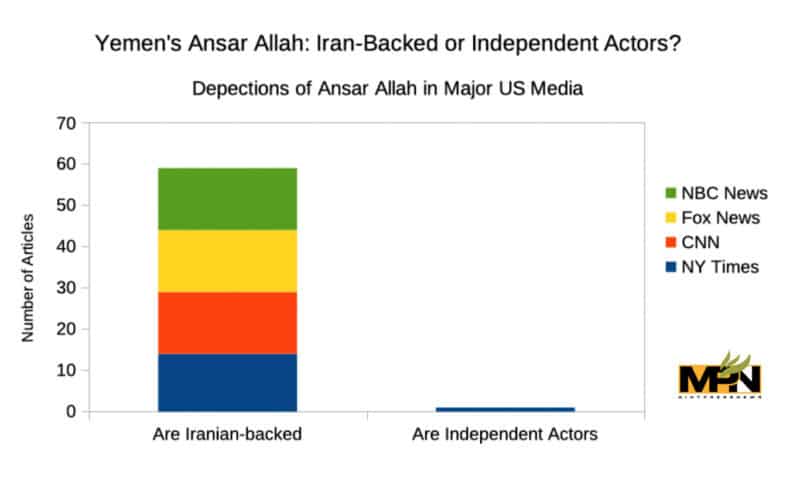
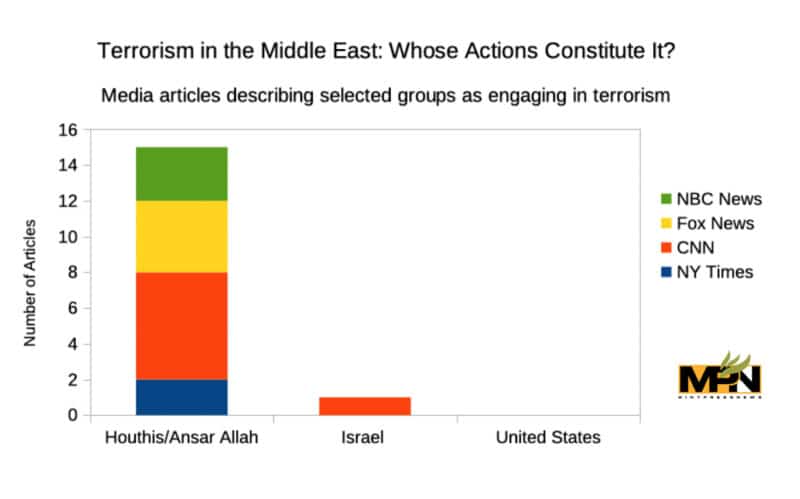
Many of the articles studied, however (22 of the 60 in total), did not present Ansar Allah as a governmental force but rather as a “tribal group” (the New York Times), a “ragtag but effective” rebel organization (CNN), or a “large clan” of “extremists” (NBC News). Fourteen articles went further, using the word “terrorist” in reference to Ansar Allah, usually in the context of the U.S. government or American officials calling them such.
Some, however, used it as a supposedly uncontroversial descriptor. One Fox article, for example, read: “For weeks, the Yemeni terrorist group’s actions have been disrupting maritime traffic, while the U.S. military has been responding with strikes.” And a CNN caption noted that U.S. forces “conducted strikes on 8 Houthi targets in Iranian-backed Houthi terrorist-controlled areas of Yemen on January 22.”
Ansar Allah is responding to an Israeli onslaught that has killed tens of thousands of civilians and displaced around 1.9 million Gazans. Yet Israel and its actions were almost never described as “terrorism,” despite arguably fitting the definition far better than the Yemeni movement. The sole exception to this was a comment from al-Houthi, whom CNN quoted as calling Israel a “terrorist state.” Neither the United States nor its actions were ever described using such language.
Eyes on Iran
Although the perpetrator of the attacks on shipping is unquestionably Ansar Allah, corporate media had another culprit in mind: Iran. Fifty-nine of the 60 articles studied reminded readers that the Yemeni group is supported by the Islamic Republic, thereby directly pointing the finger at Tehran.
It is indeed true that Iran supports Ansar Allah politically and militarily. When directly asked by MintPress if Tehran supplies it with weapons, al-Bukhaiti dodged the question, calling it a “marginal issue.” Why this facet of the story needed to be repeated literally hundreds of times is unclear. Often, the media studied would repeat it ad nauseam, to the point where a reader would be forgiven for thinking Ansar Allah’s official name was the “Iran-backed Houthis.” One CNN round-up used the phrase (or similar) seven times, a Fox News article six times, and an NBC News report five times.
Not only was the “Iran-backed” factoid used constantly, but it was also made a prominent part of how the issue was framed to the American public. The title of one Fox News report, for instance, read (emphasis added throughout): “U.S.-U.K. coalition strike Iran-backed Houthi targets in Yemen after spate of ship attacks in Red Sea,” its subheadline stated that: “Yemen’s Iranian-backed Houthi militants have stepped up attacks on commercial vessels in the Red Sea in recent weeks,” and its first sentence read: “The United States and Britain carried out a series of airstrikes on military locations belonging to Iran-backed Houthis in Yemen early Friday in response to the militant group’s ongoing attacks on vessels traveling through the Red Sea.”
From a stylistic point of view, repeating the same phrase continuously is very poor form. It does, however, drive the point home, suggesting perhaps that this was an inorganic directive from above.
This is far from an unlikely event. We know, for example, that in October, new CNN CEO Mark Thompson sent out a memo to staff instructing them to always use the moniker “Hamas-controlled” when discussing the Gazan Health Ministry and their figures for deaths from Israeli bombardment. This was done with the clear intent to undermine the Palestinian side of the story.
Not only did the four outlets studied constantly remind readers that Ansar Allah is supported by Iran, but they also regularly framed the violence as orchestrated by Tehran and that Ansar Allah is little more than a group of mindless, unthinking pawns of Ayatollah Khamenei. As the New York Times wrote:
Investing in proxy forces — fellow Shiites in Lebanon, Iraq and Yemen, and the Sunni Hamas in the Gaza Strip — allows Iran to cause trouble for its enemies, and to raise the prospect of causing more if attacked…The Houthi movement in Yemen launched an insurgency against the government two decades ago. What was once a ragtag rebel force gained power thanks at least in part to covert military aid from Iran, according to American and Middle Eastern officials and analysts.”
This “Iran is masterfully pulling all the strings” framing was present in 21 of the 60 articles.
The fearmongering about Iran did not stop there, however, with some outlets suggesting Tehran is building an international terror network or constructing an atomic bomb. The New York Times quoted one analyst who said:
Iran is really pushing it…It’s another reason they don’t want a war now: They want their centrifuges to run peacefully.” The Iranians do not have a nuclear weapon but could enrich enough uranium to weapons-grade in a few weeks, from the current 60 percent enrichment to 90 percent, he said. ”They’ve done 95 percent of the work.’”
The point of all this was to demonize Ansar Allah and ramp up tensions with Iran, leading to the inevitable calls for war. “The U.S. needs to strike Iran, and make it smart,” ran the (since changed) title of a Washington Post editorial. “The West may now have no option but to attack Iran,” wrote neoconservative Iran hawk John Bolton in the pages of The Daily Telegraph. Bolton, of course, is part of a group called United Against Nuclear Iran that, since its inception, has been attempting to convince the U.S. to bomb Iran. Earlier this year, MintPress News profiled the shady think tank.
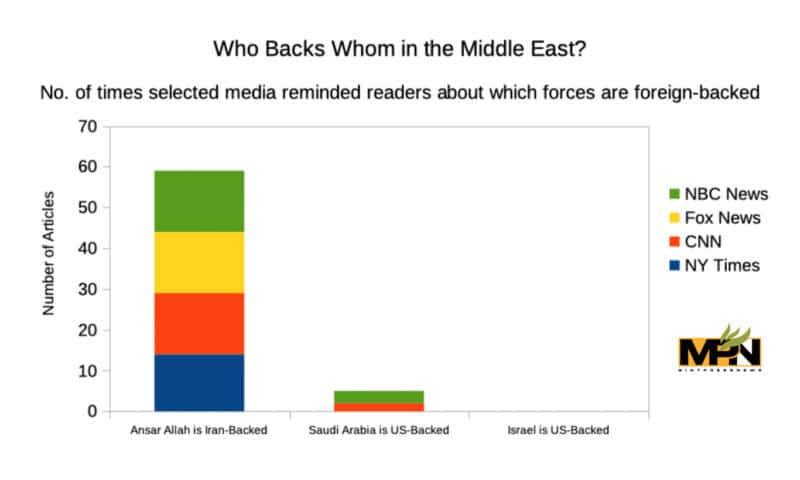
While the media in the sample reminded us literally hundreds of times that Ansar Allah is Iran-backed, similar phrases such as “U.S.-backed Saudi Arabia” or “America-backed Israel” were never used, despite the fact that Washington props both those countries up, with diplomatic, military and economic support. The Biden administration has rushed more than $14 billion in military aid to Israel since October 7, sent a fleet of warships to the region, and blocked diplomatic efforts to stop Israel’s attack on Gaza.
Meanwhile, it is doubtful whether Saudi Arabia would exist in its current form without U.S. support. Militarily alone, the U.S. has sold tens of billions of dollars worth of weaponry to Riyadh, helping the petro-state to convert its oil profits into security. From 2014 to 2023, Saudi Arabia led a U.S.-backed coalition force attempting to remove Ansar Allah from power. This consisted primarily of a massive bombing campaign against civilian targets in Yemen, including farms, hospitals and sanitation infrastructure. The violence turned Yemen into what the United Nations regularly called the “world’s worst humanitarian crisis,” with around 400,000 people dying and tens of millions going hungry and lacking even basic healthcare.
The U.S. backed Saudi Arabia the whole way, selling the government at least $28.4 billion worth of arms, according to a MintPress study. In 2021, the Biden administration announced it would only sell the kingdom “defensive” technology. However, this has included shipments of cruise missiles, attack helicopters, and support for gunships.
Both Saudi Arabia and Israel featured prominently in the articles studied. But only five of the 60 mentioned U.S. support for Saudi Arabia, and none at all for Israel. This context is extremely important for American audiences to know. Without their government’s political, military, economic and diplomatic support, none of this would be possible, and the current situation would be radically different. Only six articles mentioned U.S. support for the Saudi onslaught against Yemen – and none featured the fact prominently as they did with Iranian support for Ansar Allah.
Only one article in the sample suggested that Ansar Allah might not simply be an Iranian cat’s paw. The New York Times wrote that: “The Houthis are an important arm of Iran’s so-called ‘axis of resistance,’ which includes armed groups across the Middle East. But Yemeni analysts say they view the militia as a complex Yemeni group, rather than just an Iranian proxy.” This was the sum total of information given suggesting Ansar Allah is an independent actor.
A humanitarian blockade?
Yemen considers its actions in blocking Israeli traffic from the Red Sea as a humanitarian gesture, similar to the “right to protect” concept the U.S. frequently invokes to justify what it sees as humanitarian interventions across the world. As al-Houthi toldMintPress:
First, our position is religious and humanitarian, and we see a tremendous injustice. We know the size and severity of these massacres committed against the people of Gaza. We have suffered from American-Saudi-Emirati terrorism in a coalition that has launched a war and imposed a blockade against us that is still ongoing. Therefore, we move from this standpoint and do not want the same crime to be repeated.”
Al-Bukhati said that Ansar Allah did not intend to kill anyone with their actions and that they would stop if Israel ceased its attack on Gaza, telling MintCast host Mnar Adley that:
We affirm to everyone that we only target ships associated with the Zionist entity [Israel], not with the intention of sinking or seizing them, but rather to divert them from their course in order to increase the economic cost on the Zionist entity [Israel] as a pressure tactic to stop the crimes of genocide in Gaza.”
However, this “humanitarian” framing of Yemen’s actions was not prominently used and was only introduced by identifying it as a Houthi claim. Many articles only alluded to the position of Ansar Allah. CNN wrote that “The Iran-backed Houthis have said they won’t stop their attacks on commercial shipping in the Red Sea until the war between Israel and Hamas in Gaza ends.” Meanwhile, NBC News and Fox News frequently presented Ansar Allah’s actions as purely in support of their ally, Hamas, as the following two examples illustrate:
“The Iran-backed militants, who say their actions are aimed at supporting Hamas, vowed retaliation and said the attacks had killed at least 5 fighters at multiple rebel-held sites” (NBC News).
“Houthi forces have taken credit for continued attacks on merchant vessels and threatened to expand their targets to include U.S. and British vessels — all in a campaign to support Hamas in its war against Israel” (Fox News).
Therefore, humanitarian action was refashioned into support for terrorism.
Other articles also suggested a wide range of reasons for the blockade, including to “expand a regional war” and “distract the [Yemeni] public” from their “failing…governance” (New York Times), to “attempt to gain legitimacy at home,” (CNN), and “revenge against the U.S. for supporting Saudi Arabia,” (NBC News). Many offered no explanation for the blockade whatsoever.
A war ‘nobody wants’
As al-Bukhaiti’s comments suggest, there would be a very easy way to end the blockade: get Israel to end its operations in Gaza. But only twice in 60 articles was this reality even mentioned; one noting that Omani and Qatari officials advised that “reaching a cease-fire in Gaza would remove the Houthis’ stated impetus for the attacks,” and once in the final sentence of an NBC News article quoting al-Bukhaiti himself saying exactly as much. However, due to the placement of the information and the fact that it came from an organization regularly described as an Iran-backed extremist terrorist group, that idea likely held little weight with readers. Instead, military solutions (i.e., bombing Yemen) were the overwhelming response offered by the corporate press in their reporting.
Despite this, the media consistently presented the United States as a neutral and honest actor in the Middle East, on the verge of being “sucked” into another war against its will. As the New York Times wrote, “President Biden and his aides have struggled to keep the war contained, fearful that a regional escalation could quickly draw in American forces.” There was a profound “reluctance,” the Times told readers, from Biden to strike Yemen, but he had been left with “no real choice” but to do so.
This framing follows the classic trope of the bumbling empire “stumbling” into war that media watchdog Fairness and Accuracy in Reporting has documented, where the United States is always “responding” to crises and is never the aggressor. “How America Could Stumble Into War With Iran,” wrote The Atlantic; “Trump could easily get us sucked into Afghanistan again,” Slate worried; “What It Would Take to Pull the US Into a War in Asia,” Quartz told readers.
None of the journalists writing about the U.S.’ frequent misfortune with war ever seem to contemplate why China, Brazil, Indonesia, or any other similarly large country do not get pulled into wars of their own volition as the United States does.
The four media outlets studied regularly presented the U.S. bombing one of the world’s poorest countries as a method of defending itself. CNN wrote that “Administration officials have repeatedly said that they see these actions as defensive rather than escalatory,” without comment. And Fox News ran with the extraordinary headline, “U.S. carries out ‘self-defense’ strike in Yemen against Iran-backed Houthi missiles” – a framing which could surely only fly in a deeply propagandized nation.
In reality, the United States’ military meddling in Yemen did not start this winter. Biden is the fourth successive U.S. president to bomb the country. In December, the White House confirmed that there are already American troops in Yemen, though what their precise focus is remains unclear.
How propaganda works
This sort of wildly skewed coverage does not happen by accident. Rather, it is the outcome of structural and ideological factors inherent within corporate media. The New York Times is committed to Zionism as an ideology, and its writers on the Middle East are not neutral actors but protagonists in the ongoing displacement of Palestinians. The newspaper owns property in West Jerusalem that was seized from the family of writer Ghada Kharmi during the 1948 ethnic cleansing. And while many Times writers are openly supportive of the Israeli project and have family members serving in the Israeli Defense Forces, staff who speak out against the ongoing genocide are promptly shown the door.
Fox News is no less complicit in the Israeli project. Its owner, Rupert Murdoch, is a major owner in Genie Energy, a company profiting from oil drilling in the illegally occupied Golan Heights region. Murdoch is famously hands-on as a boss and makes sure all of his media outlets follow his line on major issues. And on Israel, the Australian billionaire is explicit: “Israel is the greatest ally of democracy in a region beset with turmoil and radicalism,” he said in 2013. The network’s massive Evangelical Christian viewership would expect little else than strong support for the U.S.-Israeli position, either.
CNN, meanwhile, operates a strict, censorious, top-down approach to its Middle East coverage, with everything the outlet prints having to go through its notoriously pro-Israel Jerusalem bureau before publishing. Senior executives send out directives instructing staff to make sure that Hamas (not Israel) is always presented as responsible for the current violence while, at the same time, barring any reporting of Hamas’ viewpoint, which its senior director of news standards and practices told staff was “not newsworthy” and amounted to “inflammatory rhetoric and propaganda.”
Therefore, the results of this study, while shocking, should not be surprising, given this context. Through examining the coverage of Yemen in four leading U.S. outlets, it is clear that corporate media are failing to inform the public of many of the basic realities of who Ansar Allah is, why they are carrying out their campaign, and what it would take to end the hostilities, they are perpetuating this war, and therefore are every bit as responsible as the politicians and military commanders who keep the bloodshed going.
2/10/24 “Stop the Hate: Build People’s Unity” – Madison
written by Struggle – La Lucha
February 9, 2024
Justice demands reparations: Socialist candidate on Black History Month
written by Struggle – La Lucha
February 9, 2024
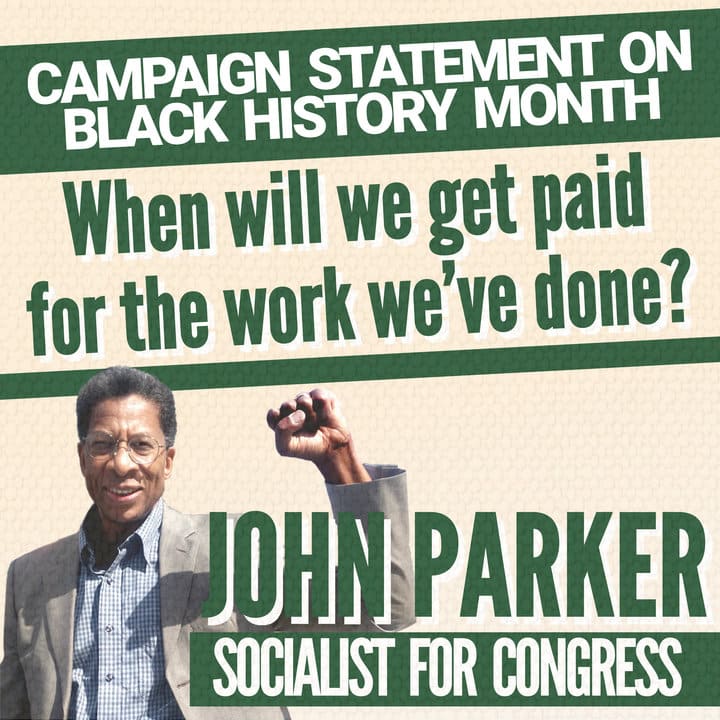
California’s 37th district socialist congressional candidate John Parker declared that “justice demands reparations” at the beginning of Black History Month. While supporting the efforts of California legislators to secure restitution of stolen property and other important items, Parker believes more has to be fought for.
“Over 50 years ago, the Staples Singers asked ‘when will we be paid for the work we’ve done?’” said John Parker. “The money is there. Just the four richest California billionaires have a total stash of over $600 billion. All of their loot represents the unpaid wages of workers that produced that vast wealth.”
Parker pointed out that “Biden can hand over $14 billion to Israel to kill over 30,000 Palestinians in Gaza, of whom over 10,000 were children. Meanwhile SNAP benefits, formerly known as food stamps, were cut by a monthly average of $90 per household last year. Gaza’s children are literally starving while millions in the United States are forced to line up for food banks.
“Reparations include bringing home the sisters and brothers who’ve been railroaded to prison,” said Parker. “Trump and all the other corporate gangsters, banksters and slumlords should be locked up instead.”
The socialist candidate declared that “capitalist deindustrialization has deliberately targeted Black workers. While 50 years ago General Motors was the largest employer of Black workers, who were members of the United Auto Workers, today more Black workers are employed at low-wage, non-union Walmart than anywhere else.
“Stopping the war against Black people will be a victory for all poor and working people,” said John Parker. “It goes hand-in-hand with demanding a ceasefire in Gaza and justice for Palestine.”
John Thompson Parker is a member of the Socialist Unity Party who’s running as the Peace and Freedom Party candidate for the 37th congressional district, which includes much of South Los Angeles, as well as parts of Culver City and Inglewood. He was jailed in Egypt while part of a solidarity delegation seeking to bring aid to Gaza.
John Parker can be contacted at John.Parker@voteforsocialism.org.
Cuba solidarity, what else can we do?
written by Struggle – La Lucha
February 9, 2024
Car license plates in the United States have the standard format of 150×300 mm. The top part shows the name of the state, and the bottom part usually has a motto or phrase famous in the state. This is the story told by Cheryl LaBash, the owner of a Toyota with an unusual, interesting, and supportive license plate circulating around that country.
So many I can’t remember, Cheryl LaBash replies with a smile when asked how many times she has visited Cuba. She is one among countless Americans who call for the rapprochement of the two shores with the love, energy, resilience, and nobility of a people who have managed to survive against all odds.
She is like an industrious ant when it comes to Cuba. How does Cheryl manage to be in Detroit one day, Boston the next, and Washington, D.C., the next? And in that back and forth, she drives her dark gray Toyota on roads, highways, and streets with a singular license plate: “Cuba Sí”.
The idea, she says, came from Lisa Valenti, founder of the Pittsburgh-Matanzas Sister Cities Association for 30 years. She has the same license plate on her car, and “then I said to myself, why not? Her action was my inspiration.”
So “we have mine from Michigan and Lisa’s from Pennsylvania. That means there are 48 other opportunities for people to show their love for Cuba in this way, with this special license plate,” she said, referring to the possibility in the remaining 48 states.
Sometimes, she is surprised when other drivers honk their horns as they pass by, and she says: “It obviously means there is a feeling for Cuba,” and she proudly insists that “my car has driven from coast to coast and even all over Florida.”
In addition to the license plate, Cheryl carries with her a “major league baseball cap with the “C” on the front and a Cuban flag folded in the wallet. It’s a good way to make sure Cuba is always there, too.”
A shortwave radio
Soft-spoken and noble-looking, Cheryl is a woman who has long embraced the struggle for justice and human rights in a general sense. Although she feels her heart is young, she says she has “lived several years.”
It was her grandparents, immigrants from Eastern Europe, who raised her and forged her personality back in Arizona in a period that sensitized her to the struggles of migrants coming to the U.S. without speaking English.
“I lived through the Vietnam War period, which opened the eyes of a generation, as Palestine is doing today to a much more educated and advanced generation, who realize that war is something more than an accidental policy.”
Her husband back then, a graduate student at a Midwestern university, was in danger of being drafted and sent to war, and “part of our activism consisted of listening to Radio Habana Cuba’s English-language programming on a shortwave radio to update ourselves with real news about Vietnam.”
Since those youthful years, Cheryl has “participated in activism to end America’s many unjust wars, abroad and at home.”
“The harshest police brutality against black youth and immigrants in the global south, militarization of local police, repression of the rights of workers and the poor, an end to racism, oppression of women and LGBTQ2 people. For me, all of this is connected to capitalism and its highest imperialist stage,” she warned.
Today, we too are challenged by climate catastrophe, and it’s all happening in real-time, LaBash said.
For the co-chair of the National Cuba Solidarity Network, which brings together more than 70 organizations in the country, it is a shame that the U.S. government is not in tune with the numerous “resolutions to remove Cuba from the list of state sponsors of terrorism and end the blockade are calling for.
Those of us who live here in the United States – she argues – have a great responsibility to put an end to the unjust economic war that our country is waging against Cuba, the Cuban government, and, ultimately, the Cuban people.
“Whatever the outcome of the 2024 elections, our main task is to build ties of friendship and solidarity with the Cuban people through travel, collaborative projects and awareness-raising,” the activist considered.
LaBash believes that, clearly, these are dangerous and unstable times, with rampant genocide in Gaza, the impoverishment of the working class for the benefit of the world’s ultra-rich, and the threat of a third world war looming over us all.
“Cuba’s internationalism is a wonderful example of José Martí’s statement that Homeland is Humanity and an alternative to the global conflict we see today.”
At first glance
Cheryl LaBash ratifies that she loves Cuba because “it is a small but powerful example of how humanity can move forward even when faced with a cruel and aggressive economic, financial, commercial, and media blockade. “It is an inspiration and a northern star, which has now moved south, of how human beings can live with dignity.”
From that first time, in 1985, that she traveled to the Caribbean nation, as happens with lovers, she was captivated by that “indomitable and rebellious Cuba”. It was the celebration of May Day, where she was representing her union at the Detroit Health Department, that had a life-changing impact on her.
“The scandal of black infant mortality in the United States and in Detroit in particular made headlines in the media. In Cuba I saw with my own eyes the care and resources provided to pregnant women and the special care provided to all children so that they can develop fully.”
Meanwhile, she laments that “black infant and maternal mortality remains shamefully high in the United States. Cuba shows another way, and I just learned that they have extended maternity leave to 15 months. This is just a dream for most new parents in the United States.”
That clash with the Island in the 1980s allowed her to help start a labor solidarity organization to exchange with the Central de Trabajadores de Cuba.
“We organized two worker delegations per year in the early 1990s. I then helped in the first Pastors for Peace caravans with Rev. Lucius Walker that challenged the blockade at both the Mexican and Canadian borders. I often don’t go, but I help with the preparations.”
In 2009, a year after retiring, she returned for May Day with a delegation from the International Longshoremen’s and Warehousemen’s Union.
For the freedom of the Cuban 5
It was the struggle for the release of Gerardo Hernández, Ramón Labañino, Antonio Guerrero, Fernando González, and René González from US prisons that intensified her commitment to Cuba.
“The International Committee for the Freedom of the Cuban Five (currently the International Committee for Peace, Justice and Dignity), led by Graciela Ramirez in Cuba and the late Alicia Jrapko, in the United States, organized creative projects such as the national tour of La Colmenita”, and she confesses that at that stage she learned that “you can never stop fighting”. And looking back at that memorable time Cheryl reflects that “in a few months it will be ten years since their freedom in December 2014. That victory made us cry with joy when Gerardo, Ramón and Tony finally returned home”.
“It ended that terrible chapter. That tremendous struggle to free the Five was such a victory. It makes me so I am happy when I now see the photos with their families, next to their people”, adds Cheryl, who affirms that the closing of the special presentation of La Colmenita in 2011 is still a driving force and inspiration for her.
“I remember the children concluding the play with the cry, ‘Now what more can we do!’ and, you know, that’s my motto right now and every day. What more can we do to get Cuba off the SSOT (State Sponsors of Terrorism) list? What more can we do to end the blockade and let Cuba live?”
Deisy Francis Mexidor is a correspondent with Prensa Latina in the U.S.
Studying Lenin to fight imperialist war and racism
written by Struggle – La Lucha
February 9, 2024
Introductory presentation to the Struggle-La Lucha class on the book “War and Lenin in the 21st Century,” Feb. 4, 2024.
This year marks the centennial of V.I. Lenin’s death. His famous pamphlet “Imperialism, the Highest Stage of Capitalism” has immensely influenced the politics of the last century. That’s in part because Lenin was the leader of the first socialist revolution as well as the de facto leader of the Third (Communist) International. Even if Lenin had not led a socialist revolution, his pamphlet likely would have been influential, though maybe not as much as it has been.
To fully understand the importance of Lenin’s pamphlet, you need to know the circumstances in which it was written and why Lenin wrote it. Lenin always had a specific political purpose for his major writings.
So, Lenin wrote “Imperialism” while European capitalism was tearing itself apart in the upheaval of the First World War.
Leaders of the Second International — an international organization that was established in 1889 to unite socialists worldwide — had recognized the growing likelihood of a major conflict among the European powers. While Lenin expected the war, the disintegration of the Second International caught him off guard. As the war unfolded in Europe in the summer of 1914, most of the Second International’s branches sided with their own countries against the other countries, effectively ending the Second International.
Before the war, there had been widespread anti-war agitation on the part of the socialist parties of Germany, France, and other European countries. Mass anti-war rallies were staged in most capital cities. At that time, the anti-war struggle was considered an inseparable part of the working-class struggle against capitalism.
Based on the sizable anti-war movement before the war and the anti-war conferences held by the parties of the Second International from all countries, the outbreak of the war was expected to put the overthrow of capitalism at the top of the Second International’s agenda. The workers of all these countries were united to defend their interests against the capitalists and their war.
Capitalism, imperialism and inter-imperialist rivalries were the root cause of the war; therefore, overturning capitalism would end the war. And that’s what the Second International had pledged before the war. But too many of the Second International’s parties in the imperialist countries ended up supporting their own imperialists in the war.
So, Lenin’s writings in those years were linked to the Second International’s collapse and the efforts to establish a new Third International. From Lenin’s perspective, the new International would be based on the lessons learned from the Second International’s failure. At the center of Lenin’s analysis was the phenomenon Lenin and other leaders of the Second International had come to call “imperialism.”
The meaning of imperialism
Today’s socialists are coming up against the questions that confronted earlier generations of socialists, both in the U.S. and worldwide, especially this question of imperialism and imperialist war. What is the meaning of the word “imperialism”?
What position should you take on the wars now raging in Palestine, Yemen, and Syria and the threatening spread of a U.S. war on Iran? What about the U.S./NATO proxy war in Ukraine? Or Washington’s threats targeting Venezuela and North Korea? Or the war buildup against China?
Struggles against imperialism are often fought with socialist goals, such as the Cuban Revolution in 1959. Socialists today support and defend Cuba and the Cuban Communist Party.
But anti-imperialist struggles are not always led by people who share our aims. Sometimes, as we have seen, resistance to imperialism is led by reformist political forces that are pro-capitalist, even reactionary, the opposite of all that socialists believe in. What stand should we take when Biden mobilizes the Army and Navy, the Air Force and Marines, and billions in weapons and ammunition to Ukraine for war on Russia to enforce, in his words, a civilizing “rules-based international order” against the evil Putin?
Back before World War One, socialists in the Second International opposed the imperialist war against the reactionary monarchy of China as a colonialist war of aggression. But the right wing of the Second International began to argue that imperialism had a civilizing mission. They claimed that Western capitalism was bringing the benefits of capitalism and Western civilization to the “uncivilized nations.” They said those countries must go through a stage of capitalism to become civilized.
A majority of the leaders of the Second International rejected these arguments. However, the openly pro-imperialist, pro-colonial, racist right-wing Social Democrats who supported the “civilizing mission” of imperialism were tolerated as a legitimate current within the Second International.
Later, as I said before, the whole Second International was ripped apart as various sections of the International supported their own imperialist governments against other imperialist governments. After this occurred, Lenin and his supporters concluded that the Third International they were trying to build would have to exclude such racist, pro-imperialist, pro-colonial forces.
Uniting two revolutionary currents
Lenin’s pamphlet on imperialism connects two revolutionary currents — the proletarian revolution in the imperialist countries and the anti-imperialist liberation struggles in the colonized nations.
Rather than being separate, unequal events, Lenin shows they are interdependent; they are linked.
Imperialism is global, making the world revolutionary process also global. Lenin’s analysis extended Marxism from being a theory of the proletarian revolution in the advanced capitalist countries to a theory of world revolution.
Lenin wrote in another document that the Communist International’s entire policy should rest primarily on a closer union of the proletarians in the imperialist countries and the oppressed masses of all countries for a joint revolutionary struggle to overthrow the landowners and the bourgeoisie. (Thus, the slogan “Workers and oppressed peoples of the world unite!”) That unity alone can guarantee victory over capitalism.
Socialism is now the goal of all revolutions, no matter where they occur.
As for why the Second International collapsed, Lenin answered based on an earlier suggestion by Frederick Engels that a “labor aristocracy” had risen in the imperialist countries that were “bribed” from imperialist super-profits.
At that time, the U.S. was an emerging imperialist power. As a settler state, its colonies were internal, starting with the brutal subjugation of the Indigenous population and the enslaved African American colony.
Following enslavement, African Americans were forced to sell their labor power at a considerably cheaper price than the white workers and, therefore, perform extra unpaid labor compared to white workers. This extra unpaid labor created a profit above and beyond the average rate of profit, the super-profit that was partially shared with a privileged, segregated labor aristocracy, particularly the labor leaders and politicians.
This is the material basis for the widespread racism among white workers that has so weakened the U.S. working class and the labor unions. The U.S. has also attracted many immigrants from countries around the world who can also be super-exploited. Among the most super-exploited were the immigrants from China starting in the late 1800s. The various immigrant communities, in some cases, have served as what amounted to “internal colonies” that produced extra surplus value.
That’s why the fight against racism, against national oppression, for Black and Brown liberation, for gender liberation, and international working-class solidarity is paramount in the struggle for socialism.
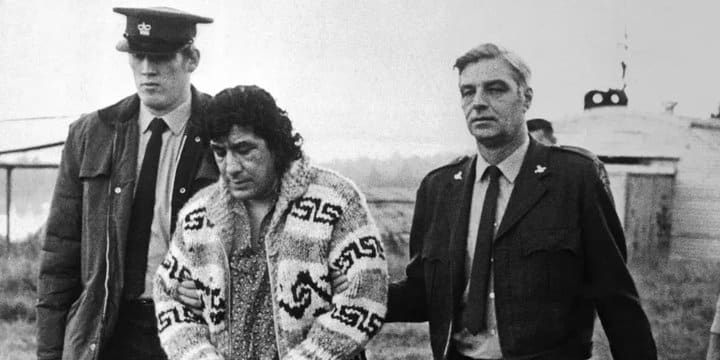



 As I’m Dying