Biden’s final days: Escalating aggression against Venezuela

Supporters of Nicolás Maduro attend a rally in Caracas on July 18, 2024.

After imposing genocidal policies that cost his party the U.S. election, President Joe Biden is filling out his final days of office with a slash-and-burn agenda that is even worse than the one he instigated before the elections.

In an outrageous attack on a sovereign country, the U.S. government is attempting to deny the Venezuelan people the leadership of their freely elected president, Nicolás Maduro. The Biden administration declared its belated recognition of Edmundo Gonzalez, the U.S.-funded candidate and big-time loser, in the July elections four months ago.

Biden waited until after the U.S. elections on Nov. 5 to more fully exercise his powers of “regime change” — a bid to overthrow a democratic election in Venezuela. Gonzalez is an old hand, a mercenary for the U.S. During the 1980s Contra war in Central America, Gonzales, operating from then-President C. A. Pérez’s Venezuelan embassy in El Salvador, was instrumental in running the covert U.S. counter-revolutionary campaign responsible for murdering thousands of Salvadorans.

Even before the Venezuelan election took place, the United States government preemptively declared them illegitimate. Nicolás Maduro succeeded in winning the election despite widespread sabotage and an economy devastated by U.S. sanctions. The election was conducted with internationally recognized standards of transparency. Following Maduro’s victory, the U.S.-backed rightwing opposition encouraged street violence in an attempt to invalidate the election and ignite a civil war. This failed completely, and Gonzalez quickly fled to exile in Spain.

During his first term in office, President Donald Trump imposed harsh punitive actions by tightening sanctions and seizing Venezuelan assets. President Joe Biden maintained the brutal sanctions in punishment for Venezuela’s resistance to the imperialist expropriation of their vast reserve of oil. Opposition in Venezuela is rooted in the oligarchy that profited from their affiliation with the U.S. oil companies.

Sanctions on Venezuela, as on Cuba and at least 13 other countries, have a lethal impact on the general population. Their imposition has been called “A War Without Bombs” in the outstanding book The Social, Political and Economic Impact of Sanctions Against Venezuela. An authorized abridged and edited version of the book is titled U.S. Sanctions Are Killing Venezuelans.

Strugglelalucha256


Solidarity network in the U.S. ratifies the struggle against the blockade on Cuba

Representatives of more than 70 organizations of the National Network on Cuba in the United States (NNOC) concluded last night the annual meeting of this broad coalition with a call for the lifting of the blockade of the Caribbean country.

For two days, activists from Michigan and others from South Carolina, Florida, Illinois, Massachusetts, New York, Minnesota California, Tennessee, Virginia, Washington DC and others who participated on line, met in the city of Detroit to discuss strategies for solidarity work towards 2025. The weekend event was highlighted by an atmosphere of positive energy as this solidarity network continues to push the demand that calls for Biden to take Cuba off of the fictitious list of State Sponsors of Terrorism before he leaves office, while preparing for the next years of Trump in the White House.

On Saturday three other organizations joined the NNOC in the first day of discussions of the event: Arise for Cuba (Chicago); Community Movement Builders (Detroit) and Diaspora Pa’lante (New Jersey).

In its final statement, the NNOC celebrated achievements in “strengthening solidarity with Cuba and advancing the broader struggle to support the removal of Cuba from the list of countries sponsoring terrorism and ending the genocidal U.S. economic embargo against Cuba.”

For the coming year, the “objective is to continue our collaborative efforts with like-minded organizations,” the text stressed, emphasizing that its members will broaden and diversify networks to make the issue of the need to lift the blockade relevant at the local level.

The communiqué emphasized that to raise awareness they will link “the impacts of the blockade with tangible costs, both material and physical, here in the United States; our goal is to make our message resonate with ordinary people, galvanizing broader support,” it stressed.

At the meeting, it was announced that the International Conference on Normalization of U.S.-Cuba Relations will be held in March next year and that the next annual meeting of the NNOC will be held in November 2025 in South Carolina.

On Friday night at the Swords to Plow Shares gallery in downtown Detroit, as a lead up to the conference, there was an inauguration of the exhibition of photographs of the Latin American news agency Prensa Latina commemorating“65 Years in the Service of Truth”, which includes moments in the history of this Cuban media, founded on June 16, 1959 at the initiative of Fidel Castro.

In her account in the social network X, the Chargé d’Affaires of the Cuban Embassy in the United States, Lianys Torres, thanked the numerous expressions of solidarity of the American people, whose voices have been strongly raised against the blockade and the inclusion of the island in the unilateral list of sponsors of terrorism.

Photos: Bill Hackwell

Source: Radio Havana Cuba from Prensa Latina / Resumen

Strugglelalucha256


The secret weapons were Trump’s

Lying is not Complicated, but Enduring a Lie over Time is.

Seven years have passed since the great hoax known as the “Havana syndrome”, according to which U.S. diplomats suffered alleged acoustic attacks in Cuba that compromised their health. One of the speculations in vogue was that the “painful sounds” selectively perceived by the officials were due to attacks with microwave weapons. Over time, the hoax faded for lack of scientific evidence – there was no way to explain how a sound attacks some individuals and not others in the same room – but now we learn that the U.S. government has been experimenting with high-power microwave (HPM) systems to stop vehicles or ships by jamming their electronic systems.

According to an investigation published in the U.S. magazine Wired

(https://acortar.link/s0CXpG), the U.S. Central Intelligence Agency has at least one mysterious system capable of “covertly (and nonviolently)” disabling ships, including large ones. The device was considered for use against oil-laden ships sailing between Venezuela and Cuba during Donald Trump’s presidency.

“The Trump administration thought that if the US intercepted or otherwise sabotaged oil tankers sailing from Venezuela to Cuba, it could strike a blow to both regimes,” a CIA source told Wired, which published this revelation on October 31 as part of a broader investigation into Washington’s failed efforts to overthrow Venezuelan President Nicolás Maduro between 2018 and 2020.

The system in question not only has the capability to employ techniques to stop or slow a vessel without causing damage to the ship’s structure, but is complemented by electronic attacks that jam key communications on the vessel. According to Wired, the CIA assessed the use of microwaves that require discreetly approaching the target, that involved the use of unmanned or disguised platforms to reduce the risk of detection.

“At least one option involved the CIA, which has a mobile system that can covertly (and nonviolently) disable ships. Trump administration officials wanted the agency to move the system near Venezuela, to target some of its fuel ships,” Wired continues. “The agency refused. CIA officials explained that they only had one such system, which at the time was in another hemisphere, and that they didn’t want to move it to the northern tip of South America.”

The detail that the CIA only had one of these systems in another hemisphere is very significant, according to The War Zone (TWZ), a military analysis platform: “This would seem to indicate that the system in question is already being deployed outside the Western Hemisphere, and possibly with a very specific target in mind. This could also indicate a reluctance to potentially expose what this system can do, unless there is a particularly serious crisis or very high priority clandestine operations.”

TWZ claims that U.S. defense contractors have been working for years on specially developed microwave emitter systems to shoot down swarms of drones quickly and at very low cost. There are at least two programs for the use of these weapons, such as the High Power Joint Electromagnetic Non-Kinetic Strike (Hijenks) and the Counter-electronics High Power Microwave Missile Project (Champ), apparently used against Iranian ships in the Red Sea and under the protection of the alliance between Washington and Tel Aviv.

Having eliminated the esoteric clue of the “Havana Syndrome” that fooled even respectable US academics, what remains is what the US government and some of its satellites can do. We now know that the uproar of the first Trump administration over the alleged attacks on its diplomats was nothing more than the projection of what was cooking in Washington and what the U.S. government refused to see of itself: its violence, its injustice, its disregard for the truth, its indifference to the fate of others, its fierce individualism.

Let us not forget that under the pretext of the “Havana syndrome” more than 240 additional blockade sanctions were imposed on Cuba, which has led the Caribbean country to the current crisis. And if this was the first season of Trump and his hawks, what other secret weapons are awaiting us? With what lies will they try to politicize their new outrages?

Source: La Jornada, translation Resumen Latinoamericano – English

Strugglelalucha256


Anti-trans campaign incites violence, as Congress seeks federal restroom ban

In the wake of Donald Trump’s election, Nancy Mace, a far-right representative from South Carolina, has been the figurehead for a move to ban transgender people from using restrooms on Capitol Hill that correspond to their gender. Publically, this campaign was aimed at Representative-elect Sarah McBride from Delaware, who will be the first openly trans woman in Congress.

Speaker of the House Mike Johnson, another fascist, backed Mace and implemented a rule banning trans people from Capitol Hill restrooms.

Unfortunately, the moderate Democrat McBride (who is also a Zionist supporter) followed her party’s line and backed down from a fight, agreeing to submit to the new rule. McBride has a private bathroom in her offices, but the rule will harm trans people who work at the Capitol as well as visitors. 

McBride (and, by extension, all trans women) are being subject to humiliating discussions of our bodies, misgendering, and deadnaming in the corporate media.

As many trans community voices predicted, McBride’s capitulation was immediately followed by Mace introducing a bill to ban trans people from using the correct restrooms in all federal facilities nationwide. 

All of this unfolded on Nov. 20, the 25th annual Trans Day of Remembrance, when the community mourns those lost to anti-trans violence — every year, the vast majority of whom are trans women of color.

This attack is a signal that the new administration and Congress will move rapidly to enact measures intended to drive trans people out of public life, prevent us from living visibly or holding jobs outside the home, and vastly increase the incidence of violence and state repression. 

The Democratic establishment has so far given every indication that it will continue to capitulate as it seeks to secure a role under the new regime and move further to the right after its election losses.

In December, the U.S. Supreme Court will take up a case on health care for trans youth that is likely to result in strengthening restrictions and set the stage for a planned nationwide ban on life-saving gender-affirming care, including for adults. 

Hateful anti-trans scapegoating, which originates with the billionaire class that both Trump’s Republicans and the Democrats represent, has other consequences. 

On Nov. 10, a pogrom took place at a Minneapolis light rail station (in Minnesota, considered a liberal “trans sanctuary” state). Two trans women were brutally attacked by men while onlookers cheered on the attackers. 

Both women were knocked unconscious, with one having her nose broken and the other receiving “multiple contusions” on her ribs.

In the coming weeks, the trans community will be reckoning with how to respond to these assaults on our very right to exist. Working-class and progressive movements must be ready to play an important supporting role in these efforts.

In the meantime, understand that the trans community is in crisis. We have already lost people who have given up hope and will lose more. Reach out and offer support to the trans people in your life. In public, be supportive of our rights and stand up for people using the restrooms.

Strugglelalucha256


Dutch fascism revisited: From Nazi collaboration to defending Zionist-led pogrom

As Struggle-La Lucha recently reported, the Western mainstream press has been flooded with alligator tears regarding alleged antisemitic attacks on “Israeli” soccer fans in Amsterdam. In fact, the recent events in Amsterdam constituted a racist Zionist-led pogrom against Amsterdam’s Arab community. The second that community fought back, the U.S. imperialist mouthpieces immediately cried antisemitism. 

War criminal in chief Joe Biden referred to the Arab community and pro-Palestine movement’s self-defense against Zionist mobs as “antisemitic attacks” that “echo dark moments in history when Jews were persecuted.” Amsterdam’s mayor, Femke Halesma, went as far as to say that the pro-Palestine demonstrations that confronted the Zionist fascist mobs actually committed a pogrom against Jewish people. The King of the Netherlands echoed this sentiment, stating: “Jews must feel safe in the Netherlands, everywhere and at all times. We put our arms around them and will not let them go.”

The Dutch government’s newfound concern for the Jewish community clashes with their historical record of antisemitism. 

There is a common national mythology in the Netherlands that all Dutch people were united in their resolve to combat Nazi occupation and the Holocaust. The Netherlands’ government and media often point to a general strike in February of 1941. The Communist Party of the Netherlands was the main force behind this strike and called the strike in response to the first round-up of Dutch Jews. In response to the strike, the Nazi occupation government and their Dutch counterparts apprehended and murdered over 2,000 communists. 

The mythology is not that there was resistance. As just stated, there obviously was a communist-led resistance to Nazi occupation in the Netherlands. 

The myth is that most Dutch people actively resisted the Nazis. However, the truth is that resistance came from the working class, with those in power collaborating instead.

After the initial Nazi occupation, the civilian government of the Netherlands actually ordered its bureaucrats and administrators to stay in place to assist Germany with its occupation. Unlike France or Belgium, the pre-war Dutch bureaucratic state mainly stayed in place during Nazi occupation. The Dutch police coordinated with Nazi authorities to round up the Jewish community, and the Dutch National Railway Company played an active role in deporting Jews to death camps. 

The scope of Nazi collaboration in wartime Netherlands was expansive. The Dutch National Socialist Movement, about 100,000 members strong at the time, played an active role in enforcing Nazi social norms and crushing resistance. The “Germanic SS” units in the Netherlands found recruitment of agents seamless. At their height, the “Nederlandsche SS” had over 6,000 fanatical members. 

As part of the Nazi’s final solution, the occupation government employed as many as 80 bounty hunters who roamed the Netherlands countryside searching for Jews. Those 80 “Jew hunters” arrested and delivered over 8,000 Jews to Nazi authorities, all of whom were delivered to death camps. 

In 2025, the Dutch government will actually release a list of over 300,000 individuals who collaborated with the Nazi occupation government during World War II. Since the end of the war, a Dutch law has kept the public from accessing these records to protect the families of Nazi collaborators.

Beyond civilian government and military cooperation, the Dutch industrial sector welcomed Nazi occupation with open arms. Dutch textile magnate C&A stole Jewish property and used Jewish slave labor during the Holocaust. Oil magnate Royal Dutch Shell, or “Shell,” was run by Nazis as early as 1929, and was openly supportive of a Nazi client regime in the Netherlands. The German government trusted Shell so much that the Germans allowed Shell’s ownership to stay in Dutch hands, which was rare for Nazi-occupied countries. 

The depth and strength of this collaboration led to the extermination of 75% of the Netherlands’ Jewish community. In a way, the Dutch government, corporations, and media mouthpieces have been consistent in their support for fascism. The same way those institutions came to the aid of Nazi occupiers in the 1940s, the current U.S.-backed fascist project of “Israel” has found a friend in the Netherlands’ ruling class and its state apparatus.

The Dutch response alleging antisemitism is not a genuine defense of Jewish people, just another chapter in the long history of Dutch collaboration with fascism. 

Lev Koufax is an anti-Zionist Jewish activist.

Strugglelalucha256


Ten things to know about Hana’s haka

Māori MP Hana-Rāwhiti Maipi-Clarke captured global attention with a powerful haka performed to protest the controversial Treaty Principles Bill

On Nov. 14, 22-year-old Hana-Rāwhiti Maipi-Clarke made global headlines when she performed a powerful haka, a Māori war cry, in New Zealand’s Parliament, tearing a copy of a controversial bill as part of her protest. A TikTok video of the moment, posted by Māori Television, has since been viewed over 200 million times and has garnered over 25 million likes in just three days. Online pundits have debated the effectiveness of the theatrical protest, but the bigger questions remain: Who is this young lawmaker? Why did she perform this haka? And what impact is her action likely to have on the broader movement for Māori sovereignty? Here are ten things you should know about Hana’s haka.

Hana’s election victory

Hana-Rāwhiti Maipi-Clarke was elected to Parliament at just 21 years old, making her New Zealand’s youngest Member of Parliament in 170 years. Her victory was surprising—not because of her age, but because she unseated one of the country’s most seasoned politicians, Nanaia Mahuta, to win the Hauraki-Waikato Māori electorate seat.

Mahuta, a long-serving Labour MP, was widely considered certain to retain her seat. In 2017, experienced tribal leader Rāhui Papa had contested the seat against Mahuta with the full backing of the Māori King, only to suffer a crushing defeat in a race that seemed to solidify Mahuta’s unshakeable hold on the electorate.

Hana’s rise in popularity

So how did Hana-Rāwhiti Maipi-Clarke secure her historic election victory against such a formidable opponent? Part of the shift in voter preference can be attributed to declining support for the Labour Party, which, despite two terms in power, had delivered little for Māori. In contrast, the Māori Party’s popularity had been rising since it secured two seats in the 2020 election with its campaign to be “unapologetically Māori.”

A key factor in Hana’s rise was the series of threats she faced in the lead-up to the election—including home invasions, vandalism, and a threatening letter. When asked if these attacks had intimidated her, Hana responded with resolve: “Don’t be scared, because the Kohanga Reo generation is here,” referring to the generation of Māori educated in Māori language immersion schooling from an early age. Rather than weaken her campaign, Hana’s steadfastness in the face of these threats only secured greater support.

Why Hana performed a haka

Hana performed the haka Ka Mate during Parliament’s first reading of the controversial Treaty Principles Bill—an attempt by the far-right coalition government to strip Māori of their Treaty rights. The bill is widely regarded as one of the most egregious measures in a series of legislative changes pushed by the government, which Māori view as direct attacks on their health, language, culture, and land rights.

A 9-day nationwide hīkoi (protest march), beginning at the northern tip of New Zealand’s North Island, was planned to arrive at Parliament on the day of the bill’s first reading. However, with just two days’ notice, the government moved the first reading forward, scheduling it for a date just four days into the hīkoi—when the marchers had only reached the Waikato region. This move was widely perceived as a cynical, anti-democratic attempt to stifle debate and avoid the pressure of Māori exercising their right to protest. By performing the haka, Hana disrupted parliamentary proceedings as the votes were being counted.

What Hana said in Parliament

Hana began by calmly stating in her native language, “Six votes opposed.” She then performed a pao—an impromptu song—reminding members of Parliament of their place within the country: “Government! You were made a guest by me!” Despite Speaker of the House Gerry Brownlee’s attempt to interrupt, Hana launched into the iconic haka Ka Mate. She was joined by members of her own party, Māori MPs from Labour and the Greens, and a packed public gallery.

The haka Ka Mate was composed in 1820 by celebrated Māori leader Te Rauparaha of the Ngāti Toa Rangatira tribe. It speaks to moments of “life or death” and celebrates the triumph of surviving seemingly insurmountable odds, making it an apt protest against the controversial bill.

Hīkoi as a tactic in Māori activism

Hīkoi is a Māori word meaning “walk,” but as a form of activism, it has taken on a deeper significance and played a central role in the Māori sovereignty movement. The tactic was famously used in the 1975 Land March to oppose the theft of Māori land and again in 2004 to protest the Foreshore and Seabed Act.

The latest hīkoi was led by Toitū Te Tiriti, a group with strong ties to Hana’s political party. It began at Te Rerenga Wairua, the northernmost point of New Zealand, and involved relay teams physically traversing the land, accompanied by car convoys traveling between protest action points. In this way, the land was symbolically and physically reclaimed, while momentum built as the hīkoi progressed toward Parliament. On Tuesday, November 19, the hīkoi reached Wellington, where the march on Parliament was one of the largest in the nation’s history.

Hana’s role in the hīkoi

While Hana has received widespread praise for her haka, less attention has been given to her earlier work that day in the Waikato region, 550km north of Parliament. Hana met the hīkoi in her hometown and completed a 16km relay leg through her electorate. There, she delivered a speech and expressed a mix of weariness and hope, saying, “I’m sick of fighting.” She urged Māori to update the rallying cry, Ka whawhai tonu mātou! Ake! Ake! Ake! (We will fight forever and ever and ever), to Ka ora tonu mātou! Ake! Ake! Ake! (We will live and be well forever and ever and ever).

Hana’s international recognition

Despite being only one year into her political career, Hana-Rāwhiti Maipi-Clarke has already received international recognition. This year, Time magazine named her as a ‘next generation leader’, and she was one of four people to be awarded the ‘One Young World Politician of the Year’.

Hana’s view of the world

Hana is a member of Te Pāti Māori (The Māori Party), which currently holds six seats in Parliament and has been vocal in its criticism of New Zealand’s foreign policy. In a statement on Gaza, the party condemned the government for “turning a blind eye to genocide” and urged New Zealand to end its role in “providing political cover for US-funded imperialism” and “acting as a Pacific spy base for the Five Eyes Alliance.” The party also demanded “an immediate ceasefire in Gaza” and called for New Zealand to “expel the Israeli and United States ambassadors” until a ceasefire is achieved.

Reactions to Hana’s haka

The viral video of Hana’s haka has sparked online debate about the effectiveness of using haka as a protest tactic, particularly when performed by a member of Parliament. Critics who argue that a haka alone won’t achieve meaningful change often fail to acknowledge the broader context of the concurrent mass mobilization. Meanwhile, those who label Hana’s haka as “uncivilized” can be dismissed as racist.

Some critiques, however, have raised important points—ones that those within the Māori protest movement are acutely aware of. Protest movements should be led by the people, not politicians. Yet, the group leading the recent hīkoi has become closely associated with Hana’s Māori Party, creating a contradiction: the type of transformative change needed cannot be achieved through electoral politics alone. A broader political solution, such as constitutional transformation, is essential. Māori must remain vigilant to ensure the movement for constitutional justice is not co-opted for electoral gains within the settler government framework.

Additionally, hīkoi as a tactic alone would be insufficient unless it is clear that the mass mobilization is prepared to escalate if their demands are not met. Hana hinted at this potential, stating that if the government continues to push the bill, “honestly, it’s going to cause riots.”

Hana’s own reaction to her haka

After halting proceedings with her haka, Hana exited the House, where she was immediately surrounded by reporters asking why she had performed the haka. Hana casually responded that she was simply being Māori, as that’s all she knows. Her words reflected those of the late Māori King, Tūheitia Pōtatau Te Wherowhero VII, who addressed legislative attacks on Māori at a gathering earlier this year. In August, he said:

“The best protest we can make right now is being Māori. Be who we are. Live our values. Speak our reo. Care for our mokopuna, our awa, our maunga. Just be Māori. Be Māori all day, every day. We are here. We are strong.”

Upholding Te Tiriti

On Tuesday, November 19, the hīkoi arrived at Parliament. While the Treaty Principles Bill is unlikely to pass its second reading, there remains the possibility of a citizen-initiated referendum on the bill. If this occurs, Māori—who make up 17.8% of New Zealand’s population—could face the tyranny of the majority, similar to what happened during Australia’s Voice to Parliament referendum.

However, the hīkoi has always been about more than the Treaty Principles Bill. The Toitū te Tiriti hīkoi is a movement to uphold Te Tiriti o Waitangi—the true Treaty, written in Māori. If fully honored, the Treaty calls for radical constitutional change in Aotearoa. While the current far-right government’s attacks on Māori have been distressing, they have also served to unite, galvanize, and radicalize the community. As Hana herself put it:

“Why are they [the Crown] consistently dictating over us when that’s not what the Treaty says? That is not what our founding document says. It says, you look after your people, we’ll look after our people, and we can get along. It does not say you govern over us. And that’s the bigger question that we’re starting to ask ourselves now.”

Dr. Arama Rata is a Māori independent researcher in Aotearoa New Zealand.

Source: Peoples Dispatch

Strugglelalucha256


With two months left, Biden escalates NATO war on Russia

In a menacing shift of U.S. policy with less than two months left in office, President Joe Biden has authorized Ukraine to use U.S. long-range missiles for strikes deep within Russian territory, potentially engaging in a direct NATO war on Russia.

The authorization, reported on Nov. 17 by the New York Times, explicitly permits Ukraine to employ the Army Tactical Missile System (ATACMS) — a long-range missile designed for support of ground troop incursions — against both Russian forces and North Korean troops allegedly operating in Russia’s Kursk region.

Kim Jong Gyu, North Korea’s vice foreign minister, described the dispatch of Korean People’s Army forces to Russia as a “rumor.” U.S. Secretary of State Anthony Blinken, at a news conference with Defense Secretary Lloyd Austin, seemed to admit this when he said that “we’ve not seen” any North Korean troops in combat.”

So, while there are no North Korean troops active in combat in Russia, the Biden administration’s authorization for ATACMS missiles specifically says North Korean troops are a target, according to the New York Times.

The missile authorization also opens the door for U.S., British, and French long-range weapons to target Russian cities far from the front lines, including potentially Moscow itself. 

This development crosses what Russian President Vladimir Putin has explicitly labeled a “red line.” This can be taken as an act of war by NATO, not the Ukraine proxy army.

The Biden administration had delayed the authorization until after the presidential election, hoping a victory for Vice President Kamala Harris would provide a mandate for escalation. 

A recent White House meeting between Biden and Trump ostensibly focused on ensuring a “smooth transition” of power, including “cordial” discussions about Ukraine. National Security Advisor Jake Sullivan emphasized Biden’s intention to use his remaining 70 days to continue the proxy war against Russia. Biden promised to extend arms and other resources to the war effort.

On Nov. 8, just days after the defeat of Kamala Harris (the defeat was in part a refusal to vote for the Gaza siege and her pro-war message — “I will ensure America always has the strongest, most lethal fighting force in the world”), the Biden administration lifted a de facto ban on U.S. military contractors deploying to Ukraine to help the country’s military maintain and repair U.S.-provided weapons systems, particularly F16 fighter jets and Patriot air defense systems. This sets up a potential tripwire scenario should U.S. military contractors be casualties of Russian airstrikes, which could serve as a justification for significantly escalating U.S. military involvement in the war.

The Biden administration’s significant escalation occurs against the backdrop of the ongoing genocide in Gaza, intensified Israeli airstrikes on Lebanon and attacks on Iran, with growing talk in the U.S. media about the possibility of a “Third World War.”

Politico had declared this the World War III election. George Will wrote in the Washington Post that World War III is already underway. “Beginning Jan. 20, 2025, the next president will cope with today’s axis: China, Russia, Iran, and North Korea,” Will says.

Although Trump says he will end the Ukraine war quickly, he never says how. His is a “strongman” boast, not an anti-war message. In his first term in office, Trump’s administration laid the groundwork for escalating NATO intervention. In 2019, Trump became the first U.S. president to authorize large-scale shipments of lethal weapons to Ukraine, a move seen as integrating the country’s military into NATO, which eventually provoked Russia’s Special Military Operation against NATO expansion. 

In 2018, the Trump administration’s national security strategy marked a pivot for U.S. foreign policy. It emphasized “great power competition” over the previous focus on combating terrorism, explicitly identifying China and Russia as the central priority of U.S. national security efforts. Trump comes now not to end war but to expand the war efforts.


Strugglelalucha256


Aotearoa: The week it all erupted

[Editor’s note: Aotearoa is the Māori-language name for New Zealand.]

There is a common thread that runs through all of this week’s events for whānau Māori — from the final words of the last surviving Māori Battalion veteran, to the abuse in care apology, to the hīkoi for Te Tiriti and the introduction of the bill that seeks to undermine it. Jamie Tahana explains.

Sometimes significant events seem to erupt like a geyser. A deluge in which an entire year seems to happen in just a few days. Bubbling away beneath the surface, these events build over time before blowing at once in a vent of awesome fury. This week was certainly one of them.

It started in the steaming village of Ōhinemutu, its waters simmering on the shores of Lake Rotorua, where thousands gathered to farewell Tā Robert “Bom” Gillies, the last surviving member of the Māori Battalion, who died at 99. Shy and reluctant, he’d stepped into prominence in his later years as the final rangatira of that great battalion, laying a wero for both the Crown and Māori to carry the mauri of what they stood for.

As he departed, he would have passed the flags and placards fluttering in the hands of those gathered in the morning mist at Te Rerenga Wairua, huddled together to take their first steps down State Highway One.

From the country’s northernmost tip, the hīkoi followed a well-trodden path to Parliament. Thousands of people — both Māori and Pākehā, young and old — joined that initial crowd in defence of Te Tiriti.

Day after day, clips and pictures showed town and city streets filled with the red, white and black of tino rangatiratanga. In Auckland, they flooded across the Harbour Bridge waving their signs: “Toitū Te Tiriti”, “Whaka Round and Find Out”.

Then came word that Ricky Mitai, the esteemed rangatira tāne of Ōpōtiki Mai Tawhiti, had died. Only 36, he was already a leader, a passionate advocate for te reo and tikanga Māori, whose early loss was keenly felt. Hundreds took a side trip to his tangi in the eastern Bay of Plenty, as the hīkoi continued to work its way down Te Ika a Māui and up Te Waipounamu.

In Rotorua, Tā Bom’s hometown, tamariki carried his portrait at the head of a phalanx of 10,000 people. Horses clopped down the wide boulevard of Fenton Street alongside bare-chested warriors who, chests high and movements staunch, formed a defensive wall, taiaha in hand.

The ongoing hīkoi was a response and challenge to what was finally tabled on Thursday. Parliament fired up as Act leader David Seymour introduced his Treaty Principles Bill, the source of so much angst this past year, but also the source of much of the kotahitanga seen by many Māori, who rallied against an attempt to redefine the country’s founding document and its promises.

A bill the Waitangi Tribunal said would, if passed, “be the worst, most comprehensive breach of the Treaty/te Tiriti in modern times.” A bill that was developed in a way that “deliberately excluded any consultation with the Māori Treaty/te Tiriti partner.”

Hana-Rawhiti Maipi-Clarke, 22, in announcing Te Pāti Māori’s six votes against the bill, started a rendition of the Ngāti Toa haka Ka Mate that had opposition parties and the public gallery on their feet. The bewildered speaker, Gerry Brownlee, briefly suspended the House, later censuring Maipi-Clarke as he described her conduct as “appallingly disrespectful” and “grossly disorderly”.

In Wellington, politicians and the press gallery were distracted debating decorum while the hīkoi marched on. Ngāti Toa, however, said it was an entirely appropriate use of haka. Helmut Modlik said the bill had put Māori self-determination at risk —“ka mate, ka mate” — and Māori were reclaiming that — “ka ora, ka ora”.

A former National prime minister, Jenny Shipley, said “the voices of this week were completely and utterly appropriate.” The current prime minister, Christopher Luxon, was not there, again insisting National will not support the bill beyond a first reading, calling it “simplistic”.

In the House, his MPs spoke against the bill before voting for it. The government might struggle to honour one agreement, the Treaty, but at least it held strong in honouring another, the coalition agreement. A former National attorney-general, Christopher Finlayson, spoke out to say the bill would greatly damage the party’s relationship with Māori.

But the cat is already out of the bag, the damage already done. The Treaty Principles Bill may be a lame duck without National and New Zealand First’s continued support, but te iwi Māori have already stirred in a way not seen in at least 20 years.

The Clark Labour government and its ministers are forever stained by the Foreshore and Seabed Act of 2004 and the Tūhoe terror raids. It would be a miracle for the Luxon government to not be similarly stained by the furore of ‘24.

And let us not forget the omnibus of other laws that have specifically targeted Māori and Te Tiriti in the past year. The Treaty Principles Bill may be dead on arrival, but the principles are still being examined and possibly written out of existing legislation. The government has already started its targeting of the Waitangi Tribunal, while criticising the courts over Te Tiriti.

Sadly, the introduction of the bill had been brought forward by a week, and Thursday’s pantomime overshadowed an event at parliament that was decades in the making. On Tuesday, thousands of morehu came together to hear the words it’s taken successive governments generations to say: Sorry.

The Royal Commission of Inquiry into Abuse in Care’s final reports, released earlier this year, make for harrowing reading. An estimated 200,000 people endured abuse in state- and faith-based care between 1950 and 2019 which, in many cases, amounted to torture. The vast majority of these victims were Māori.

The odious history of abuse in care is a national disgrace where, over decades, children were stripped from their whānau and identities and placed into institutions or foster homes where they were physically, mentally and sexually abused while the state did nothing to help. Instead, it often moved to bury the evidence and protect itself.

Over the years, I’ve done a few stories — nothing compared to the incredible work of the likes of Aaron Smale and others — but I’ve spent time with survivors, and sat through some of the Royal Commission hearings, in marae, on Zoom during Covid, and in the sterile makeshift courtroom above an Irish bar in Newmarket.

The testimony and stories are painful, from people whose entire lives were torn to shreds before they’d even started.

There were stories of people who, as babies, were taken from whānau, split from siblings, and placed with strangers. Others were held in state or church institutions where they endured physical, sexual, and psychological abuse. Young people who were locked in solitary confinement for weeks, in boys’ and girls’ homes that were nothing more than gang recruitment centres. Tamariki Māori who were shipped to remote farms and made to work as slave labour; who were rendered invisible.

When they tried to tell someone, they were only met with the callous indifference of bureaucracy. When they tried to run away, they were picked up by the police and returned to the centres that tortured them, and punished even more harshly.

At the long-abandoned site of the Kohitere Boys’ Home, on the windswept plains near Levin, there remains the skeleton of a concrete building, set away and obscured by trees. It was known as “the block” by those who were there. Inside were concrete cells, where young boys would spend 23 hours a day in solitary confinement. No bed sheets, no toys, no natural light. Nothing to do but sit and stew.

Just as violence was meted out to erase te reo in schools, state care was a tool of assimilation in the 20th century.

The Royal Commission heard from many people whose Māori names were taken away because they were too hard for Pākehā to pronounce. At one boys’ home, a child was struck around the head for saying “kia ora”. Others were belittled for being Māori, discouraged from any cultural practice, denied knowledge of their ancestry, and written off for any education because of who they were.

The only education they got was an induction into a world of crime, a preparatory course for prison. It was the experience of Dr Rawiri Waretini-Karena, whom I spoke to in 2022, when he recalled arriving in prison in the 1980s. “You go out into the yard for the first time and you actually know about 80 percent of the people there [from the boys’ home].” Another ran away from an abusive foster home, stole several bottles of liquor, then drank himself into a stupor in the urupa. It was the only way he could speak to his dead mother. No one else would listen.

It always requires a certain courage to speak the unspeakable. To have the courage and the fortitude to fight the machinery of the state and its army of servants, just for the truth to finally be acknowledged.

The men and women who spoke of the sexual, physical and emotional abuse they suffered refused to back down for decades as the state refused to listen, hold an inquiry, or admit that it was systemic. They fought for decades to hear a prime minister admit that the state committed these heinous acts.

Luxon’s apology on Tuesday was powerful, and I have no doubt he was sincere in his apology. But the dignity and mana with which ngā morehu have carried (and continue to carry) themselves should never be forgotten.

However, they’re also right to be sceptical. There is still no appropriate redress system, and some fear they will die before it finally happens.

Too often for the Crown, sorry seems to be the easiest word, and the risk that this apology rings hollow is huge.

In 2021, Jacinda Ardern apologised for the racist, bipartisan Dawn Raids of the 1970s, which targeted tangata Moana. (Many Māori were targeted by police too, assumed to be Pacific Islanders by officers who were racially profiling.) But the very morning of the apology, immigration officers were conducting raids at dawn.

For more than 30 years now, iwi and hapū have also been hearing the Crown say sorry for its breaches of Te Tiriti, for failing to act in partnership, for its acts of stripping land, lives, culture and power, and for promising to restore its honour as it finally acts as a Treaty partner.

This week has shown those apologies might be hollow, too.

Because an apology is made good not through words, but action. And, so far, the signs have not been promising, as the survivors also made clear on Tuesday. “We’ve heard those words from the state before, and they are meaningless because they have not resulted in change or progress,” Keith Wiffin told Newsroom.

Across decades, officialdom has obfuscated, fabricated and blocked any redress to this history of shame in a series of moves that, with the light of day, look morally reprehensible. The Solicitor General, Una Jagose, who in previous roles at Crown Law played a part in aggressively stymying survivors’ legal claims, gave a tepid apology littered with qualifications. She was heckled and jeered by survivors, but still insists she’s the right person for the job.

The government has also promised to ensure this never happens again while at the same time stripping the legal provisions that ensure Oranga Tamaraki upholds Te Tiriti and keeps tamaraki connected to their whakapapa. It has also announced plans to expand the number of youth detention facilities, and re-introduced boot camps.

It promises things will be different this time, though. As the survivors said this week, they’re sceptical of that.

The thread that runs through all of this week’s events for Māori is the context and history of colonisation and its continuing consequences. It’s the assumption and presumption that the Crown can usurp its Treaty promises, impose its values and institutions, and make unilateral decisions for whānau, iwi and hapū, often with damaging and devastating consequences.

In parliament this week, we saw survivors of abuse in care say “no more”, just as we also saw thousands take to the street to also say “no more”.

Not long before he passed, Bom Gillies wrote a brief of evidence for the Waitangi Tribunal’s ongoing veterans’ inquiry.

“I had served for a country that had not, and still does not, respect me as a Māori,” he wrote. “I look back and I ask: ‘Was it worth it’? The cream of our race lie overseas while we continue to struggle against the Crown to this very day.”

Jamie Tahana (Ngāti Pikiao/Ngāti Makino/Tapuika) is a journalist and broadcaster who has worked in both Aotearoa and the Pacific. He grew up between his Dutch mother in the Hutt, Wellington, and his Te Arawa dad in Rotorua, going on to qualify with a master’s degree at Te Herenga Waka – Victoria University. He was Māori News Editor at RNZ until May 2023, and is now working in London.

Source: E-Tangata

Strugglelalucha256


Sri Lanka’s National People’s Power sweeps general election

On October 15, data from the Election Commission of Sri Lanka showed that the National People’s Power (NPP) coalition scored a decisive victory in Sri Lanka’s first general election since defaulting on its external debt.

With 61.56 percent of the popular vote, the NPP won 159 seats in Parliament. This gave President Anura Kumara Dissanayake (AKD) a supermajority in parliament and the power to make constitutional amendments.

The NPP won a majority of the popular vote in 21 out of 22 electoral districts in the country. In the southern district of Hambantota, a traditionally left-wing Sinhala nationalist constituency that was the stronghold of the Rajapaksa family, the NPP secured 66.38 percent of the vote.

In the central Nuwaraeliya district, where many of the voters are Tamil-speaking workers in tea estates, the NPP secured a 41.57 percent plurality of the vote. In the northern Jaffna district, a stronghold of conservative Tamil nationalist parties, the NPP secured a plurality, with 24.85 percent of the popular vote.

This is a significant turnaround for the NPP, as during the presidential election, AKD polled poorly in both the north and in the central tea estate regions.

These developments may indicate that traditional identity-based parties are undergoing a significant crisis of legitimacy, as economic grievances and bitterness toward the established political elite take center stage.

They also indicate the success of the NPP in driving a grassroots campaign that emphasized national unity, or in their words, “a national renaissance.”

Several parliamentarians who were a mainstay in electoral politics for decades lost their seats entirely. The disintegration of the two great poles of Sri Lankan electoral politics—the center-right United National Party (UNP) and its breakaway Samagi Jana Balawegaya (SJB), and the center-left Sri Lanka Freedom Party (SLFP) and its breakaway Sri Lanka Podujana Peramuna (SLPP)—continued.

Sajith Premadasa’s SJB, with just 17.66 percent of the vote, will sit in opposition. Namal Rajapaksa’s SLPP secured just 3.14 percent of the vote. Ranil Wickremesinghe’s new alliance, the New Democratic Front, secured just 4.49 percent of the vote.

Importantly, voter turnout declined from 79.46 percent in the September presidential election to 68.93 percent—the lowest turnout for an election since 2010. This likely played some role in boosting pro-incumbent bias as disenchanted voters of parties other than the NPP chose to stay at home.

Challenges ahead

In the realm of economic policy, the new NPP government is sitting on the ticking time bomb that is Sri Lanka’s 17th IMF program and its accompanying debt restructuring deal, sealed by AKD’s predecessor Ranil Wickremesinghe. One of AKD’s key campaign promises was to conduct an independent debt sustainability analysis and renegotiate this deal. This will be much easier said than done.

The debt restructuring deal negotiated by Wickremesinghe includes novel instruments such as “governance-linked bonds” which link interest rates to the government’s willingness to pass “anti-corruption” legislation—corruption being a dog whistle reserved for countries in the Global South that are insufficiently subordinated to the neoliberal paradigm.

The deal also includes “macro-linked bonds” which have no upside for Sri Lanka. According to these, higher GDP growth rates in the country will be met with higher interest payments to private bondholders, like BlackRock, who own the largest share of Sri Lanka’s debt.

Some analysts predict an economic meltdown starting in 2027 when Sri Lanka will have to begin repaying its external debt, likely running down its foreign currency reserves and forcing it to borrow again from international bond markets. In order to deliver on its campaign promise of system change, the NPP will have to put an end to this debt spiral and begin to industrialize the country.

In the realm of foreign policy, the NPP will have to navigate the recently elected Trump administration, which is likely to double down on the Indo-Pacific Strategy to contain China. Following the end of Sri Lanka’s Civil War in 2009, the U.S. has applied increasing pressure on the country, often leveraging human rights issues to push through a combination of economic and governance reforms.

In the past decade, the U.S. has attempted to push through economic agreements like the Millennium Challenge Compact which contained provisions to privatize land. It has also promoted military agreements like the Status of Forces Agreement and the Acquisition and Cross-Servicing Agreement, both of which aimed to improve interoperability between the U.S. and Sri Lankan military in order to draw the latter into the United States’ New Cold War on China.

Should it choose to take on these tasks, the NPP will have to tap into the insurgent multipolar movement in the Global South in order to build a united front against debt and imperialism. They will need to rekindle the Bandung Spirit and restore Sri Lanka’s leading position in the Non-Aligned Movement. Time will tell if the NPP is up to this task.

Internal contradictions

A decisive factor in the next four years will be how the internal balance of forces plays out within the NPP coalition, where the biggest party is the Janatha Vimukthi Peramuna (JVP). Many of the NPP’s new parliamentarians are young and inexperienced and have few links with the old JVP. The latter was modeled on a Marxist-Leninist cadre-based party.

The ideological makeup of the NPP is therefore eclectic, including many middle-class professionals, academics, artists, and political activists. Some have a markedly liberal cosmopolitan character that is in stark contrast to the old JVP’s base of mainly rural cadres known for their militancy and patriotism. Managing this dialectic of old and new will be another challenge for AKD.

Meanwhile, the shock of an electoral wipe may force the right-wing forces, namely the UNP and SJB, to regroup. They will take every opportunity to evoke a red scare and paint even the most moderate reform as a communist takeover. They will use their links with imperialists in the West to do this.

Finally, there is the traditional nationalist camp which includes the Rajapaksas, various splinters of the Old Left, and Sinhala nationalists. It is clear that it is primarily the disenchanted voters of this bloc that form the bedrock of support for the NPP. Therefore, there will likely be much pressure on the NPP to live up to the populist and patriotic traditions of southern Sri Lanka.

This article was produced by Globetrotter. Shiran Illanperuma is a Sri Lankan political economist and writer. He is a researcher and editor at Tricontinental: Institute for Social Research. He holds an MSc in economic policy from SOAS University of London. His research interests include industrial policy and structural transformation.

Strugglelalucha256


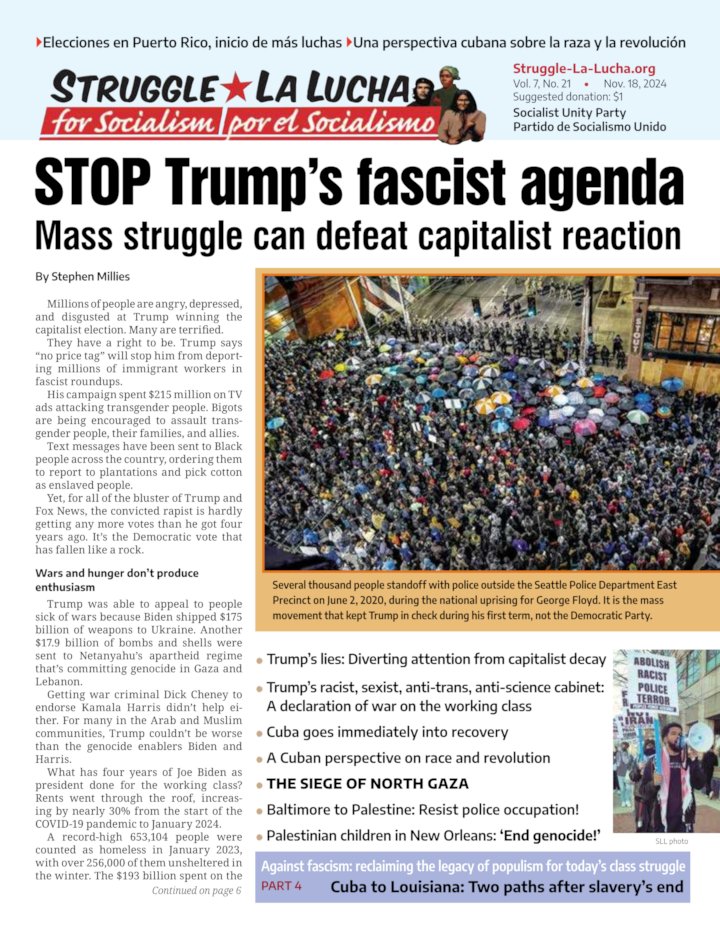
Struggle ★ La Lucha PDF – November 18, 2024

Get PDF here

  • STOP Trump’s fascist agenda
  • The revolution never gets old!
  • The siege of North Gaza
  • Trump’s anti-immigrant lies: Diverting attention from capitalist decay
  • No votes for genocide!
  • Cuba goes immediately into recovery after Hurricane Rafael leaves the island
  • From Cuba to Louisiana: Two paths after slavery’s end
  • Trump’s racist, sexist, anti-trans cabinet: Declaration of war on the working class
  • Palestinian children in New Orleans: ‘END GENOCIDE!’
  • From Baltimore to Palestine: Resist police occupation!
  • Working class activists and U.S. President cross paths in Baltimore
  • A Cuban perspective on race and revolution
  • Elecciones en Puerto Rico, inicio de más luchas
  • Una perspectiva cubana sobre la raza y la revolución
Strugglelalucha256
https://www.struggle-la-lucha.org/2024/page/5/