Hands off the UAW!

Feds’ probe is retaliation for urging peace in Gaza

On Dec. 14, 2023, UAW President Shawn Fain called for a ceasefire alongside congresspersons Rashida Tlalib, Ayanna Pressley, and Ilhan Omar outside the U.S. Capitol. Photo from Tlaib on X.

What’s behind the investigation of United Auto Workers union president Shawn Fain by U.S. government-appointed monitor Neil Barofsky? The inquiry comes just eight months after UAW members won big wage gains by striking Ford, General Motors, and Stellantis (which took over Chrysler).

This was the first big strike in the U.S. since the Teamsters’ strike against UPS in 1997. The UAW has started organizing drives in southern auto plants. It won a union recognition election at the Volkswagen plant in Chattanooga, Tennessee.

The capitalist government took advantage of corruption charges involving both UAW officials and Chrysler corporation executives to impose a monitor on the UAW in 2021. Stealing money from a union is reprehensible, but it’s chicken feed compared to the crimes committed by the auto companies and their government.

Over 40 years of givebacks and job cuts devastated entire cities, including Detroit and Flint, Michigan. General Motors closed nine of its ten plants in Flint, impoverishing the Black-majority city.

Why wasn’t former Michigan Gov. Rick Snyder sent to jail for poisoning the children of Flint with filthy water?

The 2009 government bailout imposed pay tiers that sharply cut the pay of newly hired employees. These pay cuts helped GM to rake in $100 billion in profits in the following decade.

The victorious UAW strike last year restored equal pay for equal work. 

‘Stay in your lane’

The current investigation is ostensibly about an internal union dispute concerning UAW Secretary-Treasurer Margaret Mock. But it’s really about the UAW President Shawn Fain supporting a ceasefire in Gaza.

The UAW is so far the largest union to demand an end to the killing of Palestinians. Other union leaders urging a stop to the war include American Postal Workers Union President Mark Diamondstein, who is Jewish. 

Government monitor Barofsky urged Fain to be silent. Barofsky called Fain the night before the UAW president spoke at a Dec. 14, 2023, news conference calling for a ceasefire. 

As the UAW attorney Benjamin Dictor pointed out, Barofsky’s action had nothing to do with his job as a monitor. Even Barofsky admitted that “this issue is outside the Monitor’s jurisdiction.”  

This was an outrageous attempt to make a union leader shut up. Big business, if they tolerate unions at all, want labor leaders to “stay in their lane.” 

The wealthy and powerful want to go back to the days of the Cold War. AFL-CIO President George Meany supported the dirty U.S. war against Vietnam, Laos, and Cambodia that killed millions, including 58,000 GIs.

Unions supporting a ceasefire in Gaza is a good first step. We hope the UAW and the rest of the labor movement go further.

The UAW’s endorsement of Joe Biden won’t stop the Trumps. Only mass action, like the UAW strike last year, can do that.

Government Monitor Neil Barofsky needs to be fired. Hands off the UAW.

Strugglelalucha256


Huelga en la Suiza Dairy, una cuestión de soberanía alimentaria

NOTA: A la hora de terminar el artículo, se reporta que la Fuerza de Choque de PR arrestó a 16 manifestantes frente a los portones de la Suiza Dairy para derle paso a los rompehuelgas.

Ya va más de un mes que la Central General de Trabajadores de Puerto Rico está en huelga contra la patronal peruana Grupo Gloria, que administra la procesadora de productos lácteos Suiza Dairy (SD). Ésta, es una de las tres procesadoras de leche en este país que juntas representan una de las menguadas industrias alimentarias autosuficientes que quedan.

Hay un convenio colectivo acordado entre las partes, pero faltaba la aportación de la empresa al plan de salud, lo que se había establecido durante las negociaciones que la SD respondería en otro momento.

Para obtener más detalles de esta lucha, Struggle-La Lucha entrevistó al secretario del sindicato, Scott Barbés Caminero. Aquí se incluyen extractos de esta entrevista.

SLL: ¿Cual es el motivo de la huelga?

SBC: “Estamos reclamando que se solucione la aportación al plan médico, puesto que las condiciones de salud que padecen nuestras trabajadoras y trabajadores están estrechamente vinculadas al trabajo que realizan. Y que ante la privatización de los servicios de salud en Puerto Rico la empresa entonces tiene que asumir los costos de la salud de estos trabajadores. Hay una alta incidencia de cáncer, problemas óseos, diabetes, presión alta. Se nos han muerto compañeros incluso estacionando estos

camiones, allí luego de trabajar 14, 16, 18 horas y ahí quedan en el camión con ataques cardíacos”.

“También estamos reclamando que se respete un acuerdo que llegaron con el grupo de los vendedores de la empresa, y luego de haber llegado a un acuerdo sobre el tema de las comisiones y los salarios, la

empresa desde el Perú determinó que no iba a honrar el acuerdo y en menos de 24 horas de alcanzado ese acuerdo lo retiró de la mesa”.

“Además, denunciamos la represalia en contra de los trabajadores a su ejercicio democrático y

constitucional y humano sobre todo al derecho de la huelga. La compañía en vez de traer una propuesta para solucionar el conflicto lo que hizo fue el despido masivo de más de 400 trabajadores y trabajadoras estableciendo un cierre patronal ilegal”.

“Estamos en un momento crítico de la lucha ante la insistencia de un juez que emitió una orden de cese y desista de las actividades de paralización que aquí se realizan. Y tenemos información de que la empresa ha contratado una empresa violenta de seguridad para romper la huelga y permitirle el acceso a otra compañía de limpieza de toda esta maquinaria. Planteamos que no vamos a permitir ni a los rompehuelgas ni a esa empresa subcontratada porque ese trabajo le pertenece a la unidad de trabajadores y trabajadoras de nuestro sindicato y no vamos a dejar que le quiten su trabajo”.

“Por eso solicitamos al pueblo solidario a que se den cita en aras ya no tanto de apoyar solidariamente la huelga, sino de defender combativamente la línea de piquete porque se juega la vida de la industria lechera completa de Puerto Rico porque es la más grande y poderosa y ellos la quieren destruir”.

SLL: ¿Cual ha sido el papel del gobierno?

SBC: “De parte de Fortaleza (residencia oficial del gobernador Pedro Pierluisi) no ha habido ninguna expresión positiva; al revés, dijo que él no está interesado después que el producto llegue a las casas de la manera en que debería estar llegando. Aquí se juega la seguridad alimentaria de un pueblo; esto es importante dentro de la canasta básica y evidentemente el gobierno no tiene interés en el pueblo. Es un gobierno neoliberal extremadamente abusivo que esta misma semana aumentó la luz y el agua. Así que en ese sentido el gobierno no está protegiendo al pueblo”.

“Ante esa realidad nuestro planteamiento ha sido que alguien tiene que intervenir en lo que aquí está

sucediendo. Es una industria esencial y lo que la empresa Gloria del Perú está haciendo en Puerto Rico es lo que otras empresas hicieron por ejemplo con la industria agropecuaria. Aquí hubo un ataque masivo en contra de una industria que proveía alimentos, como el pollo, a toda la isla. Desde que nacía el primer huevito hasta que llegaba al plato del hogar y estas grandes industrias grandes multinacionales distribuidoras de pollo congelado en el mundo empezaron un ataque en contra de nuestra industria hasta destruirla. Y eso es lo que está sucediendo aquí. Incluso tenemos la sospecha de que el objetivo que está tratando de lograr la empresa es destruir o llevar a un mínimo la producción de leche fresca en Puerto Rico para entonces apropiarse totalmente de la industria de la leche de larga duración ó UHT con el objetivo entonces de matar la ganadería en Puerto Rico para el beneficio de ganaderos del extranjero y traer importada la leche UHT a Puerto Rico. Hacer un ‘dumping’ al igual que hicieron con los huevos y los pollos. Y básicamente someternos a más a la dependencia y la inseguridad alimentaria hacia el beneficio de otras industrias que no tienen nada que ver con el pueblo de Puerto Rico y mucho menos con el deseo de salud y de producción nacional. Eso obviamente sigue debilitando al pueblo, a nuestra fuerza trabajadora, y sigue creando condiciones para que los puertorriqueños y puertorriqueñas tengamos que abandonar nuestra tierra.

Por eso que estamos dando esta lucha porque aquí se juega mucho más que la aportación al plan médico que nosotros estamos exigiendo”.

Strugglelalucha256


Strike at Suiza Dairy, a question of food sovereignty

NOTE: At the time of finishing this article, it was reported that the PR Police’ Tactical Unit Force had arrested 16 protesters in front of the gates of the Swiss Dairy to make way for the strikebreakers.

It has been more than a month since the General Central of Workers of Puerto Rico has been on strike against the Peruvian capitalist association Grupo Gloria, which manages the dairy processing company Suiza Dairy (SD) here. This is one of the three milk processing companies in this country that together represent one of the few remaining native food industries.

A collective agreement was reached between the CGT and SD, but the company’s contribution to the health plan was not included because it had been established during the negotiations that SD would respond at a later time.

To get more details on this strike, Struggle-La Lucha interviewed the union’s secretary, Scott Barbés Caminero. Excerpts from this interview are included here.

SLL: What is the reason for the strike?

SBC: “We are demanding that the contribution to the medical plan be resolved, since the health conditions suffered by our workers are closely linked to the work they do. And that given the privatization of health services in Puerto Rico, the company then has to assume the health costs of these workers. There is a high incidence of cancer, bone problems, diabetes, high blood pressure. Our coworkers have even died when parking these trucks, after working 14, 16, 18 hours and there they lie in the truck, with heart attacks.”

“We are demanding also, that the agreement reached with the group of the company’s salespeople be respected. But after having reached an agreement on the issue of commissions and salaries, the

company from Peru determined that it was not going to honor it and in less than 24 hours after reaching that agreement, they withdrew it from the negotiating table.”

“In addition, we denounce the retaliation against the workers for exercising their democratic and

constitutional human rights, above all, the right to strike. “The company, instead of bringing a proposal to solve the conflict, what it did was the massive dismissal of more than 400 workers, establishing an illegal lockout.”

“We are at a critical moment in the struggle because of the insistence of a judge who issued a cease and desist order on the stoppage activities we carry out here. And we have information that the company has hired a violent security company to break the strike and allow another company access to clean all these machineries. We state that we are not going to allow either the strikebreakers or that subcontracted company because that job belongs to the workers of our union and we are not going to let them take their jobs.”

“That is why we ask the people solidarity in order not so much to support the strike, but to combatively defend the picket line because the life of the entire dairy industry of Puerto Rico is at stake since it is the largest and most powerful and they want to destroy it.”

SLL: What has been the role of the government?

SBC: “On the part of Fortaleza (official residence of Governor Pedro Pierluisi) there has been no positive expression; On the contrary, he said that he is not interested as long as the product reaches the homes. The food security of our people is at stake here; This is important within the basic food basket and evidently the government has no interest in the people. It is an extremely abusive neoliberal government who this week increased electricity and water fees. So, in that sense the government is not protecting the people.”

“Faced with this reality, our approach has been that someone has to intervene in what is happening here. It is an essential industry and what the company Gloria from Perú is doing in Puerto Rico is what other companies did, for example, with the agricultural industry. Here there was a massive attack against an industry that provided food, like chicken, to the entire island from the moment the first egg was born until it reached the families’ tables. Then, these large multinational industries that distributed frozen chicken in the world began an attack against our industry until it was destroyed. And that’s what’s happening here. We even have the suspicion that the company’s objective is to destroy or bring to a minimum the production of fresh milk in Puerto Rico and then completely take over the ultra-pasteurized milk or UHT milk industry. Killing the livestock industry in Puerto Rico for the benefit of farmers from abroad who would bring imported UHT milk to Puerto Rico. Do ‘dumping’, just like they did with the eggs and chickens. And basically subject our country to more dependency and food insecurity towards the benefit of other industries that have nothing to do with the people of Puerto Rico and much less with our health and national production. This obviously continues to weaken the people, our work force, and continues to create conditions that push Puerto Ricans out our land.

That is why we are fighting this struggle; because here there is much more at stake than the contribution to the medical plan that we are demanding.”

Strugglelalucha256


Haiti may end up foiling U.S. plans for Kenya

Just over three weeks after he was sworn in on Jun. 3, Haiti’s de facto Prime Minister Garry Conille – without even the knowledge, much less the approval, of the Transitional Presidential Council (CPT) that appointed him – boarded a plane on Jun. 28 to visit Washington, DC, where he reported to his bosses in meetings with U.S. Secretary of State Anthony Blinken, Assistant Secretary of State for Western Hemisphere Affairs Brian Nichols, Deputy National Security Adviser Jonathan Finer, and paymasters from the World Bank and Interamerican Development Bank (IDB), among others.

He then traveled to New York, where he addressed the UN Security Council on Jul. 3. “The arrival of the Multinational Security Support [MSS] mission’s first contingent is the dawn of a new era in Haiti,” Conille said in his address in French to the body. “Haiti is currently at a critical point with 12,000 armed individuals holding a population of 12 million hostage.”

“We will restore our territory house by house, neighborhood by neighborhood,” he continued. “This isn’t just a security operation; it is a renaissance of the national spirit.”

Such hyperbole aside, with the honeymoon hardly begun, it already looks like the MSS may “monte yon resif,” as the Kreyòl proverb says: hit a reef.

First, all hell continues to break loose in Kenya itself, where massive demonstrations occupied and partially burned the Parliament in Nairobi on Jun. 25 in response to massive tax hikes and austerity cuts that the government proposed so it can try to pay off its crushing $46 billion external debt, owed largely to the International Monetary Fund (IMF).

At first defiant, President William Ruto, whose resignation many are demanding, has bowed to popular ire, rescinded the tax hikes for now, and promised to overhaul his cabinet, although impatience grows with his sluggishness in doing so.

“The disbandment of the Cabinet is not an expectation but a demand from the people of Kenya,” Nairobi Senator Edwin Sifuna told The Standard. “He starts off with a serious deficit of trust from citizens; he must convince us otherwise.”

But other opposition leaders think the problem is deeper than a mere lack of sincerity.

“The only reason why Ruto has not changed his cabinet is because the power brokers around his office are blackmailing him,” said Kisii Senator Richard Onyonka, alluding to the deep corruption that permeates the Kenyan state.

Indeed, violence and greed are at the heart of Kenya’s political culture today. “At least 39 people were killed during clashes with the police in June, according to the Kenya National Commission on Human Rights,” the New York Times reported in a long article July 6 article. “At least 32 people, including activists, medical workers and social media influencers, have been abducted or arbitrarily detained, according to interviews with human rights monitors and dozens of activists, including five who recounted being seized.”

Meanwhile, money is the carrot for the Kenyan police being deployed to Haiti. In short, they are mercenaries.

In Kenya, General Services Unit (GSU) cops – who comprise much of the MSS – make between $373 to $500 monthly, after they just received a 40% raise starting Jul. 1. (Another MSS component, Kenya’s Administration Police or AP, make even less, starting at $189 monthly). While deployed, they will receive their normal salaries plus between $1,170 and $1,559 monthly for the rank-and-file soldiers. In contrast, Kenyan MSS Commander Godfrey Otunge makes $7,797 monthly, in addition to other “huge perks and allowances.”

This wage gap and other bait-and-switch tactics have angered the grunts, as The Standard recently reported. There is “a standoff reportedly pitting junior officers against their seniors over the vexing subject of allowances,” the news site wrote.

For example, deploying MSS cops were promised a $780 (100,000 Kenyan shillings) “departure allowance” to give to their families, but just before leaving, the allowance was slashed by 80% to a mere $156. “This is not what they promised us,” one cop anonymously told The Standard. “What can it buy? Does it mean that we are leaving our families empty-handed?”

A Kenyan security analyst, George Musamali, complained that the Kenyan soldiers were not even given life insurance. “It is unheard of,” he told the outlet. “How do you send an officer overseas without life insurance? This is a life-and-death kind of mission. Let’s face it, not everyone will come out alive, and we have to be aware of this fact.”

It is certain that such grievances and the turmoil at home will impact the morale and effectiveness of the Kenyan troops in Haiti. But the inevitable massacres, abuse, pollution, and resistance that the MSS deployment will bring – as in all previous foreign interventions into Haiti – will likely stoke the growing protest movement back in Kenya, possibly leading to Ruto’s ouster.

If this were to happen, it would be a huge setback for Washington’s plans in Africa. Last Sep. 25, U.S. Defense Secretary Lloyd Austin was in Nairobi to ink a still shrouded security deal with Kenya, making it a key U.S. chess piece in East Africa. The Kenyan police deployment to Haiti and the drafting of Kenya into NATO were only parts of Washington’s larger plan to use Kenya as its regional cop to fight “terrorism” and stop the growing influence of Russia and China across Africa.

There are many other signs of trouble back in Haiti. After months of delay and missed deadlines, the first contingent of Kenyan cops finally arrived in Haiti on Jun. 25. Some reports said that it was 400 troops, while others reported only 200. Originally, 1000 Kenyans were supposed to deploy. They would lead other cops from Antigua and Barbuda, Bangladesh, Barbados, Benin, Chad, Guyana, Grenada, Saint Lucia, Dominica, Saint Vincent and the Grenadines, Jamaica, Suriname, and the Bahamas. However, none of these small nations have made a firm troop commitment except for Benin ( 2,000 supposedly, more than Kenya) and Bahamas (150).

“The full force is set to number over 2,500,” Reuters reports, “but it remains unclear when these could arrive, while funding has lagged far behind requirements.” The U.S. has pledged $300 million, Kenyan officials say the cost will be some $600 million, while a UN fund for the force has only raised $21 million.

So far, the Kenyan cops have only made a couple of photo-op patrols with their Haitian counterparts around Port-au-Prince but have not engaged in any battles with Haiti’s armed groups.

In an effort to reassure, the Kenyan MSS Chief Godfrey Otunge and new Haitian National Police (PNH) chief Normil Rameau held a Jul. 8 joint press conference, but they offered little more than platitudes.

Otunge promised that his men would accomplish their mission “to support the efforts of the National Police, to reestablish security in Haiti, and build security conditions conducive to holding free and fair elections.”

He said the Kenyans and PNH would operate “joint security operations,” guard “critical infrastructure sites and transit locations” such as “airports, ports, schools, hospitals, and key intersections,” and that the MSS “will operate and comply with international law… and local laws while executing its mandate,” even though its very deployment violates Article 263-1 of Haiti’s 1987 Constitution, tramples a Kenyan Court stay, and disregards the UN Charter’s prohibition against foreign troops interfering in any nation’s internal affairs.

Rameau was somewhat on the defensive, saying that the “15 days [since his appointment] is not 15 months nor three years,” an apparent reference to his deposed predecessor Frantz Elbé lackluster performance.

He said that “we’re coming with new strategies to replace the old ones, which are obsolete, to track the criminals everywhere they are,” and that “we’re in a period of evaluation and planning” but “for strategic reasons, we can’t go into details.”

Rameau claimed to “know how [the armed groups] function” and explained that some armed group takeovers of police stations were because “police have not been present in 7 of Haiti’s 10 departments” but he was working to “allow all the police to return to their posts.”

Rameau wants “the population to accompany the police in reinforcing this marriage which already has the nickname of MPP, or marriage of the police with the population… So we will have the PNH, MSS, and MPP,” he concluded.

Meanwhile, on Jun. 27, Jimmy “Barbecue” Cherizier, a leader and principal spokesman of the Viv Ansanm (Live Together) coalition of armed groups which prevented the return of former PM Ariel Henry on Feb. 29 and which the MSS is tasked with crushing, released a viral video in which he explains his resistance to the Kenyan deployment.

“As people who love this country, we’ve arrived in a situation where we’re obliged to put our foot down to liberate this country for a second time,” he tells his troops. Sold-out politicians “have become the tool of the imperialists and have brought foreign troops into the country to continue stealing our resources and killing [founding father Jean-Jacques] Dessalines’ children… The same way they called Dessalines’ a gang and bandit leader, they call us gang and bandit leaders. But we are the ones here to liberate this country. Today the entire world is watching us, and we have the responsibility to write history. Never forget that!

“The battle is not a battle for ourselves. In a war, any one of us can die because it is a battle. But it is better to die fighting than to die as cowards. Die as good soldiers. And just as our ancestors said, anybody who dares step into or attack the quarter where we live, we’ll destroy this neighborhood, reducing it to ashes, and we’ll continue to fight them even amidst the ashes.

“We don’t care if you’re white or black. If you’re not Haitian, and you’re on our soil, we consider you to be an invader. An invader is never a helper. Remember they already did this to us. They came with MINUSTAH and gave us cholera, and raped young boys and young girls. Today, we are facing history. Remember that what is in your hands are arms to liberate this country…

“We’ll stand up and fight until our last drop of blood and to liberate this country.

“We will respect everybody, but we won’t be scared of anybody. We are always open to speak to everybody. But we will never lower our head before anybody. If you are someone who wants to talk to us, we’ll talk to you. But if you want to fight with us, we’ll fight you…

“And in this neighborhood where we live as Haitians, as people they have marginalized, who don’t have water to drink or houses to live in, the state makes no professional schools for us and doesn’t create the conditions for us to live like people. Today we have to take up arms to liberate our country.

“Remember that they brought the weapons into our neighborhoods, always with the goal of destabilizing the country. And that’s why every day, every minute, every second, we should always be on guard and ready for the first attack the adversary makes on us. We’ll respond to the adversary immediately.

“I repeated this already. Any one of us could die here, but we should die fighting. And I promise to every man here, and there are other guys who are in their posts, you guys have to carry the message to the other guys in their posts…

“Tell those guys this. I’m the first guy, when they attack, who will fall in the fighting, and I’m the last guy who will stop fighting…

“We will repeat for the entire world, contrary to what some would have people think. When we speak of dialogue, a lot of people say we are afraid and that we’re asking for a pardon, which is why we’re talking about dialogue.

“Today I think that people who have military training, or at least have a sense of police security, you know that even when you are fighting, you have to always leave a door open for negotiating.

“The response we give is clear. We are patriots and nationalists that love this country. Everything that is good for the country, we are ready to enter into dealings which will be good for the country. They are not little personal dealings, dealings where we get money or nice houses. What is important for us today is the majority, the collective. As Thomas Sankara said: ‘Rather than drink champagne with a small group of people, I would rather drink water with everybody’…

“Today, those of us with arms in Viv Ansanm, we are fighting to get water for everybody. I know that a number of groups in Viv Ansanm have done bad things, which society decries. But today, as Dessalines’ children,… we can’t let any foreign troops come and assassinate people in the nation.

“Putting our lives on the line, whether our blood flows, we’ll continue to fight until our last drop of blood to defend the country’s sovereignty and integrity.”

On Jul. 5, dressed in a natty red suit, Cherizier made another more formal formulation of the dialogue gauntlet he was throwing down before Conille.

“We want dialogue because we want peace,” he said. “Those who don’t want dialogue always rely on war… and want war… Since 1806 [when Dessalines was assassinated] until 2024, it’s been 218 years since the weakest have suffered under the war that the economic, political, social mafias, like the Church mafia, the Media mafia, the human rights mafia… have waged…. The political and economic mafias that promise democracy in the place of dictatorship have not stopped putting strategies in place to sow war among Haitians…

“The suffering we have endured has opened the eyes of us former slaves around the country, and we have decided over several years to follow the example of the Cacos and the Piquets, to revolt and take up arms around the country, above all here in the West Department [Port-au-Prince]….

“Today, let’s focus rather on the true solution, which is national dialogue, where every Haitian without discrimination has the right to speak, and that’s what the mafias don’t want… We want dialogue because we want to fight against war… because we want peace…

“Why doesn’t PM Garry Conille take the opportunity to have a national dialogue to stop war and create peace across the country?… As we wait for Dr. PM Garry Conille to see and understand clearly that national dialogue is the only way the mafias aren’t going to control him and lead him down the same road as previous authorities like former Prime Minister Ariel Henry, we have decided to announce publicly that the strategy to silence the guns, put down the guns, and facilitate national dialogue, destroy the mafias’ war, and encourage peace is already written in black on white in our agenda… We want dialogue because we want to stop war and have peace.”

Source: Haïti Liberté

Strugglelalucha256


No tears for Trump!

Gaza is still being bombed! The struggle must go forward

The first question that must be asked about the shootings at the July 13 Trump rally is: who does it benefit? It’s obviously Trump himself. 

All it took was a bloody ear for the corporate media to place a phony crown of martyrdom on the billionaire’s head. Florida Senator Marco Rubio declared, “God protected Donald Trump.”

Nobody is protecting 1.8 million poor people in Florida who have been kicked off Medicaid. 

The spectacle at the Butler, Pennsylvania, fairgrounds was televised and conveniently occurred just days before Trump’s coronation at the Republican National Convention.

However, Saturday’s event doesn’t pass the smell test for millions of poor and working people. The alleged shooter, 20-year-old Thomas Crooks, was killed at the scene. Dead people can be blamed but can’t testify.

Once again, it’s claimed that a wannabe assassin was a “lone nut.” No motive has been ascribed to Crooks.

With dozens of police and Secret Service agents present, how was Crooks allegedly able to climb up on a roof overlooking Trump’s rally without being stopped?

It should be recalled that former Vice President Mike Pence feared being kidnapped by pro-Trump Secret Service agents on Jan. 6, 2021, and taken to Andrews Air Force Base. He would then be prevented from presiding over the count of the electoral votes in the capitol. 

President Biden lectured people on July 14, declaring, “We can’t allow this violence to be normalized.” What about the violence in Gaza, Mr. President? At least 40,000 Palestinians have been killed there with bombs and shells you’ve shipped to Netanyahu.

‘As ye sow so shall ye reap’

Donald Trump has a long history of advocating and committing violence. His rallies are up-to-date Ku Klux Klan cross-burnings. 

Syria was bombed and occupied throughout Trump’s presidency. His imposition of economic sanctions against Cuba, Venezuela, Nicaragua, Zimbabwe, and other countries were acts of wanton violence that resulted in hunger and a lack of medical supplies.

Trump had Iranian Gen. Qasem Soleimani assassinated by a U.S. drone strike on Jan. 3, 2020. Soleimani was on a peace mission — mending relations between Saudi Arabia and Iraq — when he was murdered along with four Iraqi government officials at Baghdad International Airport. Among them was Abu Mahdi al-Muhandis, commander of Iraq’s Popular Mobilization Forces.

These murders were violations of international law and an act of war against both Iran and Iraq. Trump deserves Nuremberg justice for this bloody crime.

In 1989, Trump took out full-page ads calling for a return of the death penalty in response to the arrest of five Black and Latinx teenagers on rape and assault charges.

The Exonerated Five — Antron McCray, Kevin Richardson, Yusef Salaam, Raymond Santana and Korey Wise — were framed and spent years in prison before authorities admitted they were not guilty. Yusef Salaam is now a member of the New York City Council.

The capitalist media is virtually conceding Trump’s election. They are seeking to demoralize poor and working people, as well as all activists.

Whoever wins the November election — U.S. presidential elections are really selections by the wealthy and powerful — we have to struggle. Both Trump and Biden are war criminals.

We have to continue to organize and protest. One of the first steps is confronting war criminal Benjamin Netanyahu when he speaks to Congress on July 24.

The people united will never be defeated!

Strugglelalucha256


Haiti and Bastille Day: Tear down the walls!

The pushing back of the fascists in the French election gives new hope for an upsurge of the working class. So many French capitalist fortunes — like those in the United States and Britain — originated with slavery.

Haiti defeated the French slave masters in the only successful slave revolution in history. It’s outrageous that Haitians were later forced to pay $21 billion to their former masters — the odious debt that impoverished Haiti wasn’t paid off until 1947.

Haitian President Jean-Bertrand Aristide justly demanded $21 billion in reparations from France for this robbery. The U.S. and France responded by overthrowing the democratically elected Aristide in a 2004 coup.

The New Popular Front in France should demand reparations be paid to Haiti. The U.S., France, and Britain need to be kicked out of Africa. And the Haitian Revolution should be studied by all working and poor people.


Haiti and Bastille Day

July 14 is Bastille Day. On that date, in 1789, tens of thousands of poor people in Paris attacked a hated prison called the Bastille and began the French Revolution. The continual intervention of poor people in the cities and countryside — particularly in Paris — drove the revolution forward.

The modern political world began with the French Revolution. Karl Marx and Frederick Engels — the founders of communism — lived in that revolution’s afterglow.

Lenin and the other leaders of the Bolshevik Revolution studied the French Revolution. Lenin became chairperson of the Council of People’s Commissars, a term derived from the French “commissaire.”

Even the terms “left” and “right” derive from the French upheaval. When the National Assembly met in 1789, the supporters of the king seized the right portion of the chamber and forced revolutionaries to sit on the left. They did this because of an ancient prejudice against left-handed people.

The French Revolution started in Europe, but it belongs to the world. And there would have been no French Revolution without Haiti.

Capitalist riches from enslaved workers

The French Revolution was a capitalist, or bourgeois, revolution. It swept away all the old feudal rubbish, like the remnants of serfdom, that oppressed people. Even the formation of a national market, a necessity for capitalism, had to be fought for.

The capitalist class or bourgeoisie was not a new class. It began its rise centuries earlier in merchant trading. Its earliest attempts to challenge the old feudal order, usually under the guise of religious differences, were thrown back with bloody reprisals.

The Bourbon kings and the big nobles of France were aristocratic parasites who feasted while millions starved and lived in rags. They were symbolized by Queen Marie Antoinette, who, when informed that people had no bread, exclaimed, “Let them eat cake!” (This referred to the burnt remnants of bread caked inside communal ovens.)

During the 1700s, the Bourbon monarchy was increasingly challenged by the bourgeoisie. Its ideologues, led by Voltaire, questioned everything and led the great intellectual movement known as the Enlightenment. Voltaire campaigned against executing people on “the wheel,” a torture device to which people were tied while their bodies were broken, sometimes just for allegedly mocking a religious procession.

But what gave the bourgeoisie its newfound confidence to oppose the monarchy were the profits flowing into its coffers from the labor of people held in slavery.

As C.L.R. James pointed out in his classic book “The Black Jacobins”: “Nearly all the industries which developed in France during the eighteenth century had their origin in goods or commodities destined either for the coast of Guinea or for America. The capital from the slave-trade fertilized them; though the bourgeoisie traded in other things than slaves, upon the success or failure of the traffic everything else depended.”

The livelihood of 2 to 6 million people in France — out of a total population of 25 million — depended on slavery and products grown by enslaved people. French possession of Haiti meant it owned the richest colony in the world. Its trade employed 24,000 French sailors on 750 ships.

While Britain had an export trade of 27 million British pounds, the French were close behind with 17 million. The wealth produced by the Haitian people in slavery accounted for nearly 11 million pounds alone.

Liberty seized by enslaved people

The French bourgeoisie declared “Liberty, Equality, Fraternity” as the watchwords of their revolution. This is still the motto of France today.

But most French capitalists never wanted to abolish slavery or grant liberty to Black people kidnapped from Africa who were worked to death in Haiti, Guadeloupe, and Martinique.

At that time, conditions were such in Haiti that the average life expectancy for a Black person on the island was 21 years. Then, news of the French Revolution reached Haiti and created a political ferment as it became known to people in slavery.

Dutty Boukman, an African originally enslaved in Jamaica, started a revolt in August 1791. Over 1,800 plantations were burned. Boukman was eventually killed, bravely fighting. But new leaders like Toussaint Louverture and Jean-Jacques Dessalines arose. The rising of Haiti’s enslaved people could not be stopped, and it found support among the French poor.

“The Blacks were taking their part in the destruction of European feudalism begun by the French Revolution,” James wrote, “and liberty and equality, the slogans of the revolution, meant far more to them than to any Frenchman.”

‘The aristocracy of the skin’

While the French Revolution was a bourgeois revolution, it was poor people in the cities and countryside who fought for it. In Europe, there was as yet no modern working class because there were no big industries. The Industrial Revolution had just started in Britain a few years before with the first cotton spinning machines.

Haiti was different. As James pointed out, “Working and living together in gangs of hundreds on the huge sugar-factories which covered the North Plain, they were closer to a modern proletariat than any group of workers in existence at the time.”

The French poor hated aristocrats and royalty like Marie Antoinette. But the “aristocracy of the skin,” as it became known, became the most hated. Poor people in Paris found it detestable that people could be enslaved, branded, and sold like cattle just because of their skin color.

James wrote: “In these few months of their nearest approach to power [the French poor] did not forget the Blacks. They felt towards them as brothers, and the old slave-owners, whom they knew to be supporters of the counterrevolution, they hated as if Frenchmen themselves had suffered under the whip.

“It was not Paris alone but all revolutionary France. ‘Servants, peasants, workers, the laborers by the day in the fields all over France were filled with a virulent hatred against the ‘aristocracy of the skin’ [James was quoting a supporter of slavery]. There were many so moved by the sufferings of the slaves that they had long ceased to drink coffee, thinking of it as drenched with the blood and sweat of men turned into brutes.”

As the French Revolution went forward, those bourgeois political leaders who opposed radical measures became known as Girondists. They were named for the region surrounding the French port of Bordeaux. Like Liverpool in England, Bordeaux’s economic life depended on the slave trade.

The opponents of the Girondists were known as Jacobins. Most schoolbooks slander Jacobins like Maximilien Robespierre or other radicals like Jean-Paul Marat as bloodthirsty “terrorists.”

But most of the Girondist leaders who talked so grandly about liberty didn’t want to abolish slavery. It was only when Robespierre and the radical Jacobins were in power that slavery was formally ended in all French possessions by the decree of Feb. 4, 1794.

This was a historic measure by France’s National Convention, but it only confirmed the freedom that the enslaved people themselves had already seized.

Defending the revolutions

The French Revolution was opposed by all of feudal Europe and by Britain, its commercial rival. Like the Bolshevik Revolution more than a century later, France was invaded on a dozen fronts. The Duke of Brunswick, commander of the Allied Army (principally Austrian and Prussian), issued a manifesto threatening the destruction of Paris.

Although Britain bankrolled some of the armies invading France, its own army was absent. That’s because it was invading Haiti. This move was a disaster for the British ruling class. “By the end of 1796, after three years of war, the British had lost in the West Indies 80,000 soldiers including 40,000 actually dead,” wrote James.

If the British army that invaded Haiti had marched on Paris along with other European powers, the French Revolution might have been crushed. By defending their own freedom in a battle with British invaders, the Haitian people also defended the freedom of 25 million people in France.

“It was the decree of abolition, the bravery of the Black [people], and the ability of their leaders, that had done it,” wrote James. “The great gesture of the French working people towards the Black slaves, against their own white ruling class, had helped to save their revolution from reactionary Europe. Held by Toussaint and his raw levies, singing the Marseillaise and the Ça Ira [two revolutionary songs], Britain, the most powerful country in Europe, could not attack the revolution in France.”

In “A History of the British Army,” J.W. Fortescue concluded that people who had been enslaved “had practically destroyed the British Army.” He admitted that “the secret of England’s impotence for the first six years of the war may be said to lie in the two fatal words, St. Domingo [the old name for Haiti].”

Two centuries of revenge

After the French Revolution, the radical Jacobins were overthrown, and many were executed. Napoleon Bonaparte eventually seized power and became a military dictator.

Napoleon defeated one European feudal army after another. But he couldn’t conquer Haiti. Napoleon sent an army to Haiti commanded by his brother-in-law, Charles Leclerc, and Toussaint Louverture was kidnapped and died in a French prison.

But as Leclerc wrote to a French government minister: “It is not enough to have taken away Toussaint; there are 2,000 leaders to be taken away.” Leclerc died in Haiti, knowing he was defeated. (Aldon Lynn Nielsen, “C.L.R. James: A Critical Introduction”)

Despite massacres that included drowning a thousand Black people at a time, as well as public burnings and hangings, the French army suffered a worse defeat than the British. Out of 34,000 French troops, 24,000 died.

Dessalines declared Haiti’s independence on Jan. 1, 1804. But the world capitalist class has never forgiven Haiti for its revolution. U.S. slave masters had nightmares about leaders in the mold of Dessalines, like Nat Turner, who led an 1831 uprising of enslaved people in Virginia. Haiti is still deliberately kept the poorest country in this hemisphere by the United States and other capitalist countries.

However, the Haitian Revolution changed history forever.

Tear down the walls

French capitalists use Bastille Day to glorify French colonialism. But socialist revolutionaries should celebrate Bastille Day by demanding that the more than 2 million prisoners locked up in U.S. bastilles be freed, starting with Leonard Peltier, Mumia Abu-Jamal, Dr. Aafia Siddiqui, and Simón Trinidad.

Bastille Day should also be celebrated because of the Iraqi Revolution that overthrew the U.S.-backed and British-backed monarchy on Bastille Day: July 14, 1958. Capitalists never forgave Haiti’s revolution and haven’t forgiven Iraq’s people for taking over their own oil. The Pentagon has invaded Iraq twice and still occupies it.

The U.S. capitalist class is as obsolete and useless as the French aristocracy was 235 years ago. Capitalists want to take away health care, privatize Social Security, and cut wages even further. A socialist revolution is needed just to stop capitalism from cooking the earth.

The multinational working class in the U.S. will be forced to rise, as the French and Haitian masses did. An absolutely necessary requirement for success is that millions of white workers, part of this multinational class, break with racism. They need to see, and will see, that they are being used as political cattle by the wealthy and powerful, like Donald Trump, who actually despise them.

Tear down the Bastilles! Down with the aristocracy of the skin! Reparations for Haiti!

Source: C.L.R. James, “The Black Jacobins: Toussaint L’Ouverture and the San Domingo Revolution.”

Strugglelalucha256


Pacemakers for Cuba, a unique effort to save lives

More than 300 pacemakers will reach Cuban institutions thanks to a campaign in the United States and Europe aimed at supporting the health system in one of its most urgent needs.

The initiative, coordinated by the non-profit organizations Global Health Partners (GHP) and MediCuba Europe, is a unique effort, according to Bob Schwartz, vice-president of the former and with a long history of solidarity work with the Ministry of Public Health (Minsap).

In an interview with Prensa Latina, Schwartz described the project as one of the most valuable ones promoted by GHP in three decades of work in the Antillean country.

At the beginning of May, both organizations announced their intention to raise $150,000 to send 300 pacemakers to five hospitals in four months. The goal was reached in the middle of that period. By the second month, the amount exceeded $187,000.

During COVID-19, Global Health Partners launched a similar initiative to support immunization with Cuban vaccines, which raised six million syringes in a few months.

“In some ways, it’s similar to that project that captured the same imperative, but for cardiac patients a pacemaker is a matter of life and death,” he remarked.

Both projects, however, had to overcome restrictions imposed by the United States that limit access to a large part of the market and prevent the shipment to Cuba of equipment with more than 10 percent of U.S. components.

A respite for Cuba

The campaign coincides with a particularly sensitive moment for the health system in the Caribbean country. According to figures published by GHP, Cubans with heart disease face a three-year wait for pacemakers because of the U.S. encirclement policy that prevents the country from buying these devices on the market.

Some 70 elderly Cubans cannot leave their hospital beds until they receive pacemakers, while the country’s overall demand is estimated at about 2,000 patients in need.

In particular, Cuba’s inclusion on the U.S. list of alleged sponsors of terrorism hinders the nation’s access to the international banking system and limits its supply of foreign exchange.

It also obstructs the ability to purchase pacemakers from international suppliers in a market dominated by U.S. industry.

“We made the decision to launch this campaign not as a substitute, but to give Cuba a break and take some pressure off the Ministry of Public Health,” Schwartz explained.

The idea is to address the most serious cases of patients and acquire equipment in Europe with the support of MediCuba Europe and the coalition to save lives, which brings together a dozen organizations in the United States opposed to the blockade, he said.

Three years later on the list

The impact of sanctions on Cuba’s healthcare system poses difficult obstacles such as relationships with providers, imports and access to nearby markets to high transportation costs.

The designation as an alleged terrorist state prevents, in particular, access to most banks or the Swift system for electronic payments worldwide.

Cuba was first included on the US State Department’s list of sponsors of terrorism during the first term of President Ronald Reagan (1980-1982).

In 2015, then-President Barack Obama considered that designation to be without merit and withdrew it. However, his successor, Donald Trump, reinstated it before leaving the White House.

It has since remained in that relationship during Joe Biden’s presidency, despite calls for him to rectify that policy.

Cuba’s exit would represent a major relief for the work of Global Health Partners and the Ministry of Health.

During the campaign to carry syringes, the organization paid almost four times as much for them in the United States because of the fears of vendors who knew they would be going to Cuba, Schwartz confessed.

Without the designation, he added, the banking system would open up to Cuba, transportation costs would be drastically reduced, and they would be able to access more markets.

“The truth is there is no reason to keep Cuba on the terrorist list. No reason to return it to begin with. The Trump administration did it in a very vindictive way and here we are three years later.”

Three decades of work in Cuba

In all his years of work with Cuba, Schwartz has known all too well the complex web of obstacles to the shipment of medicines, equipment, or medical supplies to the largest of the Antilles.

From the convoluted journeys through third and fourth countries to send a shipment when it is impossible to do so directly to the request for more than 60 licenses in three decades to acquire equipment with more than 10 percent U.S. components.

“If the designation as a sponsor of terrorism did not exist, if the blockade did not exist, the truth is that there would be no need for the work we do, because Cuba could solve all the problems on its own,” assured the also consultant to the United Nations Economic and Social Council.

Even with these obstacles, the representative ratified the organization’s commitment to maintain its work in the Caribbean nation with the premise of “promising less and delivering more”. “I don’t think there is any case in which I have told Minsap that we are going to do something that we haven’t done; our word is important to us,” he acknowledged.

Removing Cuba from the list of sponsors of terrorism and ending restrictions on activities such as tourism or travel would do much to improve the lives of every Cuban, he further considered.

“I am amazed at what they have been able to accomplish with the limited resources they have.”

Elizabeth Borrego Rodríguez is the Chief UN Correspondent for Prensa Latina

Source: Prensa Latina, translation Resumen Latinoamericano – English

To make a donation to this important project, go to https://ghpartners.org/cuba2024/

Strugglelalucha256


Puerto Rico: Strike at Switzerland Dairy

In Puerto Rico, being a colony, each of our struggles has several ramifications and consequences. A simple strike conflict can become a real national conflict. This is the case of the strike of the Suiza Dairy workers who have been demonstrating since June 11.

Suiza Dairy is one of the three milk processing companies in Puerto Rico. But unlike the other two, since 2002, it has been managed by a Peruvian foreign capital group, the Gloria Group.

The workforce is represented by the Central General de Trabajadores, the CGT, which in 2013 signed a collective bargaining agreement with the company, but the part of the company’s contributions to the medical plan were left pending to be negotiated later. It should be noted that due to the privatization of the healthcare system, the cost of medical care in Puerto Rico has increased significantly.

Now, when it was time to resume these negotiations, the Company stepped back and refused to negotiate in good faith. It asked for more time and instead of submitting a counter offer, it shut down operations and laid off 483 workers.

So since then, the union has been demonstrating daily in front of the plant. La Suiza, for its part, by laying off its workers, stopped delivering fresh milk, especially to the most distant and mountainous places.

The most sinister objective in this conflict is that they are trying to replace fresh milk with UHT, or ultra-pasteurized milk, which lasts longer and can, therefore, be imported instead of produced locally. This would destroy the dairy industry, one of the few we have left in this colony. They already did it with the poultry industry when gringo companies flooded the country with chickens and eggs from the United States at very cheap prices and thus killed local production.

But besides the CGT, other organizations and the people are joining the picket lines and the struggle for food sovereignty.

Berta Joubert-Ceci on Radio Clarín de Colombia from Puerto Rico.

Source: Struggle-La Lucha, translation Resumen Latinoamericano – English

Strugglelalucha256


Western Yemen comes under heavy attack by U.S.-British warplanes

A violent and illegal bombing campaign on Yemen by the U.S. and Britain has failed to deter Ansarallah from continuing its maritime blockade against Israel

U.S. and British warplanes launched several airstrikes on Hodeidah International Airport in western Yemen on 12 July.

“U.S.–British aircraft targeted Hodeidah International Airport with three raids,” a security source told Yemen’s SABA news agency.

The renewed attacks came after several U.S.–British attacks on Yemen on Thursday. “American and British fighter jets launched five raids on various Ansarallah sites in the Ras Issa area, which includes an oil berth affiliated with the port of Al-Salif, north of Hodeidah,” a local source in the western Hodeidah province told Sputnik on 11 July.

U.S. Central Command (CENTCOM) said shortly after midnight on Thursday that it destroyed five uncrewed vessels and three drones belonging to the Ansarallah resistance movement on 11 July in the Red Sea and in “a Houthi controlled area of Yemen.”

Yemen has imposed a naval blockade on all ships delivering goods to Israeli ports in the Red Sea, Arab Sea, Gulf of Aden, the Indian Ocean, and the Mediterranean – in support of the Palestinian resistance in Gaza. It also recently expanded its campaign to include joint operations with the Iraqi resistance.

Ansarallah and the Armed Forces of Yemen’s Sanaa government, which are merged with one another, have also been striking U.S. and British warships in response to a violent and illegal campaign of airstrikes launched by Washington and London against Yemen in January. Ansarallah leader Abdel al-Malik al-Houthi said in a speech on 11 July that 57 people have been killed and 87 wounded in 570 airstrikes carried out by the U.S. and Britain against Yemen since the start of the Western campaign.

The Yemeni army has vowed not to stop its operations until the war in Gaza comes to an end.

U.S. and British warplanes carried out intense airstrikes targeting several Yemeni provinces on 30 May, destroying civilian infrastructure, killing 16 people, and injuring 41 more.

Yemen responded by targeting Washington’s USS Eisenhower aircraft carrier in the Red Sea. The renowned aircraft carrier was struck by Yemeni forces two more times in the days that followed.

The Western campaign has done nothing to deter the Yemenis. U.S. and EU maritime task forces have failed to progress in preventing attacks on ships, which have strained both the Israeli economy and international shipping as a whole.

Source: The Cradle

Strugglelalucha256


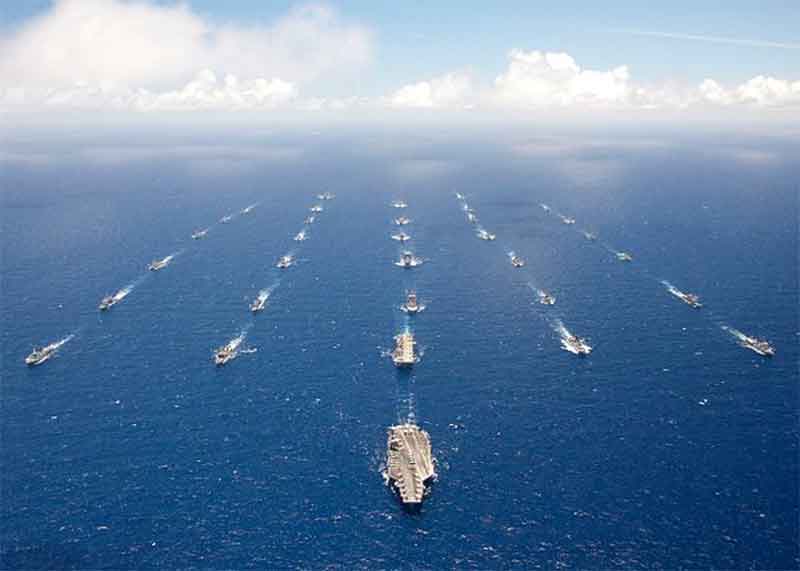
U.S. war games in Pacific seek global participation in imperialist maneuvers

Every two years, the Indo-Pacific Command Center of the United States convenes the largest maritime war exercises on the planet. With over 35,000 troops participating, 29 nations, 46 naval surface ships, 4 nuclear submarines, and a multitude of air and ground forces, the Rim of the Pacific military exercises, or RIMPAC, is one of the most destructive training events globally.

Through these exercises, the U.S. consolidates its control of the Pacific. RIMPAC began as an annual training exercise in 1971 and became bi-annual in 1974. Since it began, some of the historically worst human rights abusers, like the U.S., Australia, Canada, and Israel, have participated in the exercise. The U.S. has a long history of using the Hawaiian islands for target practice. In 1965, the U.S. Navy detonated a bomb on the Kaho’olawe, the equivalent of 500 tons of dynamite, breaking the island’s water table and carpeting the island with unexploded ordinances.

Hawaiʻi was illegally seized by American sugar planters in 1893 who were supported by the U.S. military and sought the Hawaiian harbor of Puʻuloa (Pearl Harbor) for a coaling station. In 1898, the U.S. Congress, which had actually lost the treaty of annexation, illegally took Hawaiʻi by joint resolution. Hawaiʻi has remained under illegal occupation by the U.S. and its military since then.

U.S. militarism destroys our land through RIMPAC

RIMPAC, as a symptom of the U.S. empire, has immense environmental and cultural ramifications. Geopolitically, the exercises are used to control trade routes, train genocidal regimes, and posture against China. Since Obama’s “Pivot to Asia” strategy, the U.S. has shifted from cold war tactics of diplomacy and arms procurement to hot war tactics of aggressive invasion and unchecked military build-up. RIMPAC is used to test weapons and military technology for weapons manufacturers.

Between San Diego to Hawaiʻi, havoc is wrought upon both our land and sea through the U.S. military and their war games. They sink ships, carry out mock marine invasions of urban and jungle warfare, and engage in live fire training in conservation zones that cause fires across thousands of acres and threaten endangered species. All of these “routine” exercises take place in areas that are cultural and ancestral sites of deep value.

The U.S. military’s largest base in our islands is Pōhakuloa, a sacred region of Hawaiʻi Island, thousands of acres utilized as a firing range to train militaries in the tactics of warfare, suppression, and invasion. Mākua Valley was a former civilian town turned into a firing range between World War II and 2004, which filled the valley with unexploded ordinances, white phosphorus, and other forever chemicals. The U.S. Marine base at Mōkapu is built upon one of the most ancient villages in Hawaiʻi where residents were expelled to make room for the base. In addition to the massive pollution and raw sewage spills the base puts out into the surrounding ocean, it is also a sacred burial site where many iwi kūpuna (ancestral bones) are buried near the coast.

RIMPAC also threatens vulnerable and delicate ecosystems and our vast oceanic nature reserves which are restricted conservation zones except for the military. The U.S. Navy has faced multiple lawsuits for the death of whales from mass beachings to escape naval sonar, multiple helicopters and planes have crashed onto our beaches and ocean, and sea turtles lose access to their traditional nesting grounds due to the practice of amphibious assaults on our beaches. The U.S. military is the largest driver of the climate crisis and RIMPAC’s environmental impact only adds to this catastrophe by risking the livelihood of ocean nations through repeated missiles, explosions, and heavy metal waste being driven into the Pacific as a result of these exercises. Therefore, RIMPAC is in direct violation of its own Marine Species Awareness Training (MSAT) and its own Protective Measures and Assessment Protocols (PMAP) which require that the Navy be in compliance with the Marine Mammal Protection Act and the Endangered Species and ensure mitigation to prevent any injury, behavioral change, or death. Each year RIMPAC is planned, the U.S. Navy Indo-Pacific Command requests exemption to these laws from NOAA and the Department of Defense, with extraordinary requests to allow incidental “takes” (deaths) of marine mammals in the millions. There is also no limit to the number of marine birds it can take during the exercises. RIMPAC threatens no less than 12 endangered species.

RIMPAC: Exporting violence

Besides its obscene show of environmental destruction, RIMPAC supports the repression of Indigenous cultures throughout the world by actively training regimes that are currently inflicting genocide or other human rights violations on its Indigenous peoples. RIMPAC plays out various “future scenarios of potential terrorists.” In 2022, RIMPAC enacted a pretend invasion of North Korea, going house to house executing a regime change operation with houses decorated with pictures of Kim Jong Un. Prior to that, in 2016, RIMPAC used the Hawaiian Islands to play out a scenario of imaginary so-called “enemy states” seeking to expand power that played counter to Western influences. And of course, there is the constant saber-rattling and escalation against China which is used as a scapegoat by the new U.S. Cold War.

RIMPAC also brings with it a significant increase in gender-based violence. Studies have shown a significant leap in human trafficking and sexual exploitation, especially of young Native Hawaiian girls every year. In 2022, a former U.S. Naval petty officer was sentenced to 20 years in prison for the sex trafficking of Native Hawaiian girls. The influx of more than 25,000 international military personnel into Hawaiʻi ensures a constant market for the exploitation of women and gender non-conforming people.

RIMPAC exposes enduring U.S. military dominance

This year’s exercises are notable given the current geopolitical context. RIMPAC is taking place amid the ninth month of Israel’s genocidal war in Gaza. This war has isolated the U.S. and its junior partner Israel and united much of the world in the demand for a ceasefire and in opposition to the West’s murderous violence against Palestinians and oppressed people across the world.

However, some of the voices that have been strongest on the world stage in condemning Israel and the U.S. today have sent their Armed Forces to participate alongside the U.S. and Israel in RIMPAC. Countries such as Colombia, Brazil, Chile, Ecuador, Mexico, and Indonesia are participating and have either closed their Israeli embassies or publicly renounced Israel for its ongoing genocide of the Palestinian people. While the mood in the Global South is one of challenging Western dominance and hypocrisy, challenging U.S. military supremacy as its bloc leads spending at 74.3% proves to be harder.

Yet, these war games are not mere pastimes and excursions; they are a declaration of national values and a statement of political intention. The strategies and tactics, weapons, and technologies practiced and mastered at RIMPAC are utilized by participant nations for weaponization at home. Be it for the worst form of atrocities such as genocide or repression of any form of resistance to the state or to control “free trade” routes to ensure capital continues to move for the benefit of the international capitalist elite. In other words, RIMPAC trains governments that have a long history of developing repressive techniques to control their colonies and are now deploying those same techniques on its citizens. As with all imperialist activities, it is up to the social and people’s movements of the respective impacted nations to take a stand and reject this continuous arming and military expansion of our collective oppressors.

The Hawaiian people stand arm in arm with the peoples of the world to demand an end to these war games and to sharpen our fight against U.S. imperialism and colonialism, which today is the biggest threat to the survival of our planet—especially those of us from island nations in the “strategic” Pacific. It is people’s movements who will mobilize to remind the governments of those participating nations that they must withdraw from this exercise, end their collaboration with the Israeli Occupation Forces, and stand firm upon their declarations at the United Nations and other various forums. Together, we can build a better world.

Kawenaʻulaokalā Kapahua is a community organizer with Hui Aloha ʻĀina, Honolulu branch, a leading Hawaiian independence organization. He is based out of Honolulu, Hawaiʻi, is a PhD student of Political Science at the University of Hawaiʻi and is also a labor organizer.

Joy Lehuanani Enomoto is a community organizer, Pacific Islands Studies scholar, and artist who lives in Honolulu, HI. She is currently the Executive Director of the demilitarization organization, Hawaiʻi Peace & Justice, and the vice president of the Hawaiian sovereignty organization, Hui Aloha ʻĀina o Honolulu.

This article was produced by Globetrotter.

Strugglelalucha256
https://www.struggle-la-lucha.org/2024/07/page/4/