Reuters exposes Washington’s global disinformation campaign: The rest of the story

In a recent article, Reuters confirms what many knew for years, that the United States government and its various departments and agencies have been conducting global disinformation campaigns targeting nations it seeks to undermine, and whose governments it seeks to overthrow.

Washington was Deliberately Harming American “Allies” 

The article titled, “Pentagon ran secret anti-vax campaign to undermine China during pandemic,” admits:

At the height of the COVID-19 pandemic, the U.S. military launched a secret campaign to counter what it perceived as China’s growing influence in the Philippines, a nation hit especially hard by the deadly virus.

The clandestine operation has not been previously reported. It aimed to sow doubt about the safety and efficacy of vaccines and other life-saving aid that was being supplied by China, a Reuters investigation found. Through phony internet accounts meant to impersonate Filipinos, the military’s propaganda efforts morphed into an anti-vax campaign. Social media posts decried the quality of face masks, test kits and the first vaccine that would become available in the Philippines – China’s Sinovac inoculation.

The article reveals that the campaign was not conducted only in the Philippines, but across the rest of Southeast Asia and far beyond.

The U.S. government campaign, carried out by the U.S. military, was not conducted because it was actually believed that China’s Sinovac vaccine or any of the protective equipment it manufactured was faulty, but purely to undermine China.

Reuters would cite a senior military officer involved in the disinformation campaign who claimed, “we weren’t looking at this from a public health perspective. We were looking at how we could drag China through the mud.”

Reuters also interviewed doctors who admitted, “it put civilians in jeopardy for potential geopolitical gain.”

The U.S. Military Wasn’t the Only Culprit 

As revealing and disturbing as Reuters’ article is, it falls far short of fleshing out the full extent of U.S. disinformation, manipulation, and coercion regarding Chinese vaccines and medical equipment.

In addition to a large-scale campaign across social media conducted by the U.S. military, the U.S. State Department through the National Endowment for Democracy (NED, is banned in Russia) called on various opposition groups and political parties the U.S. government had built up over the course of years in targeted countries, including in Southeast Asia, to amplify these same narratives both across the media, and even into the streets.

In Thailand, the U.S.-backed “Future Forward Party” headed by billionaire-turned-politician Thanathorn Juangroongruangkit and his NED-funded opposition movement helped spread the Pentagon’s admitted lies and disinformation through a series of protests demanding the Thai government end cooperation with China and instead procure vaccines from the United States, and more specifically, U.S. pharmaceutical giants Pfizer and Mondera.

The South China Morning Post in a 2021 article titled, “How China’s Sinovac vaccine got caught in the crossfire of Thailand’s anti-government protests,” would report:

Thailand’s anti-government movement has gone beyond calls for reforming politics and the monarchy and is zooming in on Prayuth’s handling of the pandemic and his reliance on the Sinovac vaccine amid a Delta-fuelled third wave.

The article would avoid mentioning who the opposition was specifically, and what potentially compromising connections they may have had motivating them to “coincidentally” take the Pentagon’s narrative into the streets of Bangkok.

It was clearly no coincidence that a U.S.-back opposition was conducting such protests, especially now that Reuters has revealed the Pentagon as the source of the anti-China claims the U.S.-backed Thai opposition were repeating.

The U.S. used all of its assets, far beyond media operations conducted by its military, but also opposition groups and political parties it had built up and is funding around the globe, to likewise participate in Washington’s global disinformation campaign against China.

Far from a single example, the U.S.-backed opposition in Thailand (and elsewhere) has sided with Washington against China on all conceivable issues, including issues that have nothing to do with Thailand directly, including the South China Sea, of which Thailand is not a claimant.

This Wasn’t the First, Nor the Last U.S. Disinformation Campaign 

While Reuters focuses primarily on this one single aspect of a single disinformation campaign now admittedly and deliberately conducted by the United States knowingly causing harm to allies and enemies alike, the report alludes to the existence of many more campaigns like it.

Reuters would note:

Clandestine psychological operations are among the government’s most highly sensitive programs. Knowledge of their existence is limited to a small group of people within U.S. intelligence and military agencies. Such programs are treated with special caution because their exposure could damage foreign alliances or escalate conflict with rivals.

While Reuters omits any mention of specific campaigns, it admits that the U.S. government has conducted similar disinformation campaigns aimed at undermining public opinion of China.

Reuters admits:

In 2019, Trump authorized the Central Intelligence Agency to launch a clandestine campaign on Chinese social media aimed at turning public opinion in China against its government, Reuters reported in March. As part of that effort, a small group of operatives used bogus online identities to spread disparaging narratives about Xi Jinping’s government.

These campaigns continue today, calling into question the quality and safety of other Chinese products and projects, ranging from telecommunication equipment manufactured by Huawei, to major infrastructure projects, all with the aim of not supplying or selling the developing world with American alternatives, but to simply deny the developing world the opportunity to develop altogether.

Just as was the case with Chinese vaccines and protective medical equipment, the U.S.-back Thai opposition has played a direct role in amplifying these other media campaigns.

For example, Thanathorn Juangroongruangkit was cited by Bloomberg, denouncing the Thai government’s plan to jointly build a high-speed rail line connecting Thailand to China via Laos who already has a functioning Chinese-built high-speed rail line.

The U.S. State Department regularly decries China’s Belt and Road Initiative, condemning it as a means of “entrapping” nations in debt and reliance on China.

The 2018 article titled, “Thailand Needs Hyperloop, Not China-Built High-Speed Rail, Junta Critic Says,” would report:

A tycoon turned politician who opposes Thailand’s military government has criticized its $5.6 billion high-speed rail project with China because hyperloop technology offers a more modern alternative.

Thanathorn Juangroongruangkit would also organize a press event in which he promoted the non-existent “hyperloop” as an alternative to the Chinese-Thai high-speed railway. During this event, he would reveal the true purpose of opposing Chinese-built infrastructure:

I think over the past five years we have been giving too much importance to China. We want to reduce that and rebalance our relationship with Europe, with Japan, [and] with the U.S. more.

In reality, Thailand places importance on China because of its geographic proximity, common cultural and historical ties, and more pragmatically, the fact that China is Thailand’s largest trade partner, investors, source of tourism, infrastructure partner, and even increasingly a partner in the realm of defense.

Reducing a successful and growing relationship to pivot toward the U.S. and its European and Japanese proxies, all of whom are unable to offer alternatives to opportunities provided by China, is an irrational policy. It is only “rational” if those proposing such a policy serve U.S. interests rather than Thailand’s.

Considering the close relationship Thanathorn Juangroongruangkit himself has with Washington, and the fact that his opposition movement is funded by Washington, his proposal of policies that serve U.S. interests at Thailand’s expense comes as no surprise.

This is just a small illustration of just how much larger the scale is of U.S. manipulation and coercion around the globe, far exceeding dishonest and abusive activities across social media platforms, but going as far as building up opposition movements and political parties to not only express opposition to China, but to forcibly pivot nations away from working with China by politically capturing their governments, installing client regimes into power, and having policy irrationally tilted in favor of serving U.S. interests as the expense of the targeted nation, in this case, Thailand.

This is done not only through the U.S. military, but also the U.S. State Department and a vast global network of organizations and political parties built up, funded, and directed by Washington.

For nations around the world, it is important to understand the abuse exercised by the U.S. within their own respective information spaces, and the necessity to protect their public against such abuse by controlling the social media networks serving as a vector for this abuse.

By forcing foreign social media companies to open offices in targeted countries and holding them accountable for violating local laws prohibiting abusive disinformation campaigns conducted by foreign entities like Washington, and by developing local alternatives to U.S.-based social media platforms, targeted nations can decide for themselves who can use their information space and for what purpose – and whether or not to tolerate the sort of manipulation and coercion exercised by Washington as exposed by Reuters in their recent report.

For China and Russia, who have already gone far in securing their own respective information spaces, they could perhaps add the means of defending information space to the portfolio of defense articles both nations already export around the globe.

Brian Berletic is a Bangkok-based geopolitical researcher and writer, especially for the online magazine “New Eastern Outlook”.

Strugglelalucha256


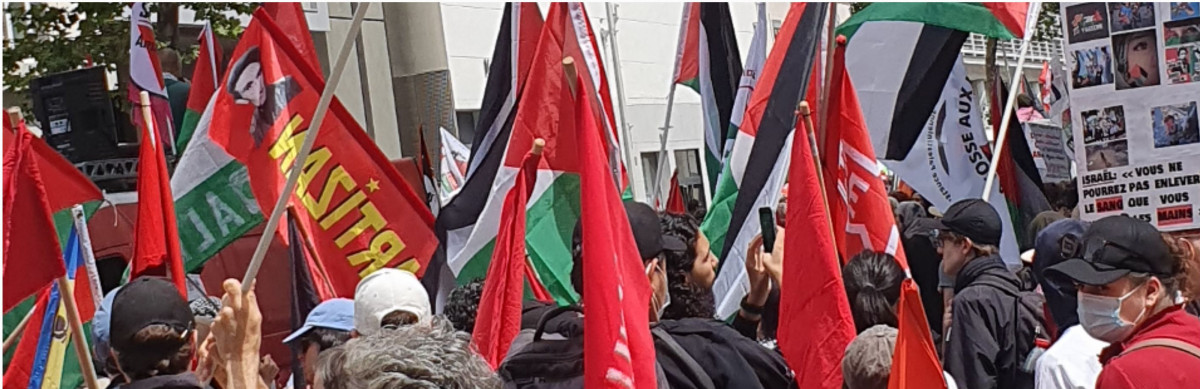
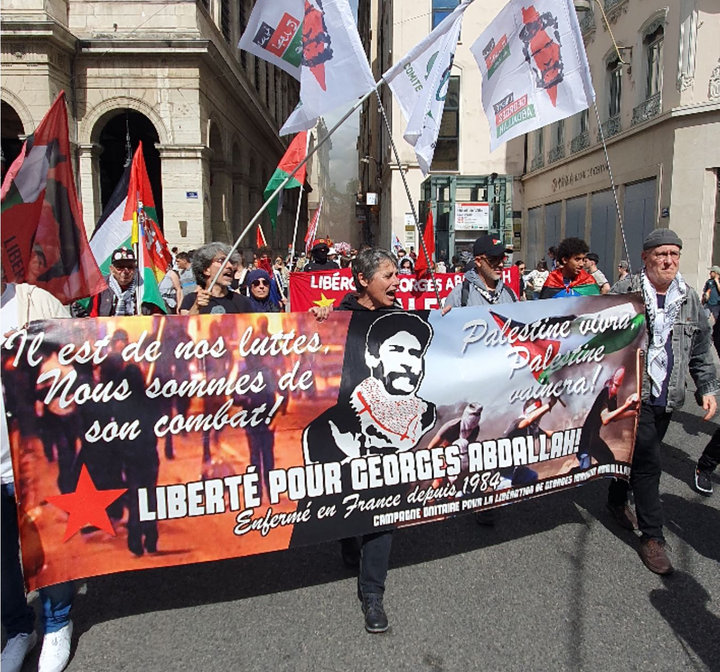
Lyon roars: ‘Free Palestine! Free Georges Abdallah!’

Lyon, France — Another great success – after the last mobilization in Lannemezan on April 6, which brought together over 2,000 people – for the national demonstration for the release of Georges Abdallah called by the Campagne Unitaire pour la Libération de Georges Abdallah, co-organized by the Ligue de la Jeunesse Révolutionnaire and the Collectif 69 Palestine!

More than 3,000 participants turned out on Saturday, June 15, 2024, in Lyon to support the heroic resistance of the Palestinian people, Georges Abdallah, and two LJR comrades who will be tried tomorrow, June 18, for their support of Palestine and our comrade Georges Abdallah.

In this long, determined, and combative procession, numerous political and trade union organizations marched from the 4 corners of France and neighboring countries (Germany, Austria, and Spain), carpooling or using the two buses that left from Marseille and Paris.

In addition to the organizers, the event was also attended by (in no particular order, and perhaps not exhaustively… ) activists from FSE, JR, Secours Rouge Arabe, Collectif Georges Abdallah 74, Collectif Georges Abdallah 38, Collectif Georges Abdallah 33, Cause du Peuple, Nouvelle Époque, Comité Action Palestine, PRC, Thawra, Soutiens de Bagnolet, Fosse aux Lyons, ANC, FUIQP, Collectif Palestine Vaincra, UP Lyon, UP Marseille and UP nationale, UJFP, BDS, AFPS, OCML-VP, Ligue Communite Internationale, CGT UL Mirail, Solidaires, Comité Palestine 31, Action Antifasciste Paris Banlieue, Jeune Garde, France Insoumise, NPA, PCF, JC, UCL, Ensemble, CRI Rouge, Kurdistan activists, Solidarité Indonésie, Solidarité Kanaky, Partizan, Rote Fahne. All united around slogans and declarations unapologetically supporting resistance and denouncing the genocidal war waged by the Zionist entity and its imperialist and reactionary allies.

Once again, Georges Abdallah, your comrades were there, and they all reaffirmed their unwavering determination to continue the fight until your release!

Our thanks also go to the comrades who were unable to attend but who made this June 15, wherever they were, a day of action for the release of Georges Abdallah: in Hamburg, Bastia, Istanbul, Italy, Mexico, India, and elsewhere.

Palestine will live! Palestine will win! Free Georges Abdallah!

We are the people, and victory is ours!


Strugglelalucha256


Debbie Johnson, ¡presente!

Deborah Johnson of Detroit, a longtime revolutionary and community activist, died on June 8 after a protracted illness. She was 74. Debbie, or DJ, as her friends and comrades called her, is survived by her spouse, Michael Shane, and children Deana Johnson, Paul Johnson, Ariana Shane, and Phillip Shane, along with grandchildren and other family members.

Debbie became a revolutionary in the late 1970s as a single mother struggling to provide for her family in a racist society. For decades she was a dynamic leader in the Detroit branch of Workers World Party. Her love for working and oppressed people fueled her activism and drew in others with her no-nonsense explanations of the racism and capitalist exploitation facing so many people.

As a leader of the All-People’s Congress (APC) in the early and mid-1980s, Debbie helped organize and carry out many campaigns for concrete rights for poor and working people. A skilled legal assistant by trade, she used her legal acumen to help develop programmatic demands to reach the masses in the fight against capitalism.

One such struggle -the Food Is A Right Campaign – helped win monthly distributions of cheese and other food products in Detroit, which went on for 17 years. Whether on the picket lines for welfare rights or to stop tenant evictions, at demonstrations for a moratorium to stop plant closings and layoffs, or in protests against the Pentagon wars abroad, Debbie was an outspoken leader who motivated others to keep struggling for justice.

Debbie deeply felt her oppression as an African-American woman and helped organize other women in the fight for reproductive rights and to stop mass foreclosures and evictions, which impacted women of color disproportionately in Detroit and around the U.S. She was a founder and leader of DANFORR, the Detroit Action Network For Reproductive Rights, which was formed in 2006 and recognized by the Wayne County National Organization for Women as a fighting force for all women’s right to reproductive justice.

She was an internationalist and anti-imperialist through and through. Debbie supported national liberation movements in general and opposed all U.S. wars. She was a strong supporter of socialist Cuba and Palestine, which she supported since the 1970s. She once spoke at a Detroit Public Schools board meeting in opposition to military recruiters in high schools after an army recruiter started calling the house trying to entice her son to enlist. She also mobilized against the Klan and Nazis.

Debbie was a leader of the Free South Africa movement in the 1980s and beyond. She, along with other Detroit activists raised thousands of dollars for the African National Congress (ANC) [at the time designated by the U.S. government as a “terrorist organization”] by silk-screening T-shirts which were sold around the country. She helped lead a “Free Nelson Mandela” petition and ribbon campaign which brought awareness to the plight of the imprisoned ANC leader, who most people at the time had never heard of.

The Detroit APC brought in ANC leaders many times to speak at public meetings and events before the end of apartheid, most of which were emceed by Debbie. Nelson Mandela’s organization didn’t have the funds to put people up at fancy hotels, but Debbie was proud to host these comrades in her home. Her hospitality and gregarious personality put them at ease, knowing they were with comrades in the struggle even thousands of miles from South Africa. She also hosted members of the American Indian Movement and other leaders at her home.

Debbie was a co-founder of the Moratorium NOW! Coalition to Stop Foreclosures, Evictions, and Utility Shutoffs in 2008 and played a leading role in many of its activities, including the fight against mass bank foreclosures and evictions as previously mentioned, and the City of Detroit bankruptcy. One young activist said:

“Debbie made a big impression on me years ago when I was first getting into activism, going to Moratorium NOW meetings, and meeting folks who were for the people in ways I had never seen before.”

In 2018 Debbie joined most of the Detroit Workers World members in leaving that organization. But they continued their work against racism, capitalism and imperialist war by founding the Communist Workers League/Fighting-Words.net.

Debbie was known by comrades and friends in Detroit and around the country as a fantastic cook. She provided delicious meals for almost every public meeting and helped organize soup kitchens at national events held in Detroit. All of her delectable meals were tasty, balanced and nutritious, whether she was serving international people’s leaders or homeless people on the streets. Her soul food dinners at Black History Month forums sometimes had lines going out the door. She also kept activists together socially by hosting barbeques at her home, where comrades could relax and sup together.

Debbie was a beloved comrade even as her health deteriorated and she retired from her job and political life. She will be sorely missed. Debbie Johnson, ¡Presente!

The celebration of the life of Debbie Johnson will take place on Saturday,  July 6, 2024, at 11 am at Historic St. Matthew’s & St. Joseph’s Episcopal Church, 8850 Woodward Ave., Detroit, MI 48202.

Source: Fighting Words

Strugglelalucha256


Cuban expert discusses the presence of Russian ships in Cuba

An interview with the Director of the Center for Investigations of International Politics (CIPI) José Ramón Cabañas, to the Spanish press outlet El Periódico on June 14, 2024

“ Is this (the October Crisis) a valid referent  for what is currently occurring ?”

Relating this news with what occurred in October 1962 is as inadequate as supposing that each time a U.S. naval detachment moves through Southeast Asia, alarms should be sounded in Hiroshima and Nagasaki.

Today, the USSR does not exist, nor does the so-called socialist bloc, and NATO has failed to keep all the promises made after the disappearance of both, promises not to expand eastward, creating enormous strategic risks.

The installation of defensive missile systems in Cuba during that period occurred immediately after a military invasion of Cuba organized by the U.S.  The Cuban government was always in favor of making this action public, the Soviet authorities opposed this, and the rest is well-known history. Today, Cuba and the U.S. have formal diplomatic relations and, therefore, various channels to deal with this and with other even more sensitive affairs.  We are speaking of three naval vessels (a submarine, a tanker, and a tugboat) that have come to a Cuban port in a region in which the U.S. has 80 military bases and many other means of domination.  Cuba has divulged the information in sovereign form, with adequate advance notice.

In recent years, we have received naval detachments from Canada, France, Spain, the UK, Japan, Holland, Mexico, Guatemala, Brazil, Jamaica, China, and Russia on friendly and cooperative visits.  The majority of these have not been worthy of international press attention. In fact, the arrival in Cuba on June 14 of a ship of the Royal Canadian Navy, the HMCS Margaret Brooke, has already been announced. Until now, the Canadians haven’t been worth the headlines.

On June 5 2023, Cuba denounced the presence of a U.S. nuclear submarine on the outlying areas of the Naval Base located in the illegally occupied territory of Guantanamo, Cuba.  Few media outlets in countries allied with the United States considered our concerns worthy of being a news item.

Therefore, we need to place each fact in its context and evaluate it in an objective way.

“How much should we be worried about the current situation?”

If this question is in reference to the particular fact of the naval visit, we repeat what we have already said, in the sense that it has no repercussions beyond bilateral friendly Cuban-Russian relations.

Now, if this refers to the current situation in a more general context, there is a lot we should worry about.  The genocide against Palestine has not stopped, and the international community is not capable of articulating a coherent response that can halt this massacre.

NATO insists on seeking a military solution in Ukraine, with the only goal of satisfying the great arms producers.  The countries that have the greatest reserves of strategic (or desirable) minerals are those that are least developed, and they are victims of constant destabilization plans.

Humanity as a whole has not learned the basic lessons from the experiences of the struggle against COVID-19 and has not prepared for the next similar events, at the same time that biological weapons labs financed by military institutions proliferate in the world.

A fourth industrial revolution is taking place that will create even more disparity between the more developed countries and those that have been spurred on repeatedly to guarantee the well-being of the colonizers.

There are many reasons to worry and to see the concept of peace as a goal to be reached rather than as an already shared achievement.

“What are the potential consequences, what are the current real impacts and the threats to keep in mind , though they have not yet materialized?”

The theme that is worrying you has no other repercussions beyond the end of the visit to Cuba.  If perhaps it remains in history, it will be another opportunity to attract attention to Cuban themes with a negative slant and, in passing, to stir up anti-Russian feelings.

Curiously enough, the press is very active in dealing with certain themes, but they seldom look back at what they have already said and fail to reflect on whether they have stuck to the truth or not.  Just in the last few years, there has been unlimited speculation about supposed attacks on the health of foreign diplomats located in Havana and about a supposed Cuban military presence in Venezuela.  Time and again, they have spoken of alleged Chinese spy stations in Cuba, and now there is a “worry”  about the visit of three naval vessels.

But they do not give information about the inexplicable retaining of Cuba on the list of countries that supposedly patronize terrorism, made up by the U.S. State Department, and the impacts that this has for our economy.

They do not say that Cuba is one of the countries that has made the most contributions to peace, not just in Colombia but in the whole continent.  It isn’t reported that Cuba is the only country that has organized two summits of the Nonaligned Countries Movement (1979 and 2023) and two summits the South, or G77 plus China (2000 and 2023), all of which imply enormous support by the international community.

Source: Minrex, unofficial translation by Leni Villagomez Reeves / Resumen Latinoamericano in English

Strugglelalucha256


Up to half a million NATO soldiers waiting to enter Ukraine

When Russia launched its special military operation (SMO) on February 24, 2022, it became the active part of the Kremlin’s strategic counteroffensive against crawling NATO aggression. At the time, President Vladimir Putin made it clear that anyone foolish enough to get directly involved would be met with consequences they’ve never experienced in their entire history. And indeed, nobody dared to get into a direct confrontation with Moscow. This forced the political West to find workarounds in order to provide indirect support for its favorite Neo-Nazi puppets. However, what started out with batches of ATGMs (anti-tank guided missiles) and MANPADS (man-portable air defense systems) ended up with heavy armor and even nuclear-capable fighter jets. In other words, NATO keeps probing Russia, testing its patience and willingness not to escalate the already highly volatile situation.

And yet, in recent months, the world’s most aggressive racketeering cartel has become more brazen than ever before. Its advanced ISR (intelligence, surveillance, reconnaissance) systems are being actively used for target acquisition and guidance of Western weapons delivered to the Kiev regime forces. Luckily, through the use of its advanced SAM (surface-to-air missile) systems and world-class electronic warfare (EW), Russia is able to negate most of the advantages that the Neo-Nazi junta is getting in this way. All this is making NATO leaders quite nervous, as they believe that Russia’s victory would have disastrous consequences for the collective West’s geopolitical standing. This is going so far that the mainstream propaganda machine is now openly advocating for NATO and Neo-Nazi junta-sponsored terrorist attacks across Russia (public schools included).

However, that’s not the end of it. Despite troubles in meeting their recruitment goals, countries of the political West are looking to accumulate large concentrations of troops along Russia’s borders. Estimates vary significantly, but at this very moment, there could be up to half a million NATO soldiers stationed in Eastern Europe alone, heavily armed and maintaining high battle readiness. According to Western military sources, there are no less than 300,000 troops stationed along the borders of Russia, Belarus, and Ukraine. Quoting a senior NATO official, the Defense Post reports that “[the alliance] countries have comfortably exceeded a target of placing 300,000 troops on high-readiness”. The mainstream propaganda machine insists these forces are there to allegedly “stave off any potential Russian attack”. However, their composition tells a different story.

Namely, NATO forces in Eastern Europe rely on the same offensive-oriented approach that the belligerent alliance usually uses in its aggression against the world. This means that there’s a significant focus on air superiority and rapid deployment of frontline troops, particularly airborne and special forces. It’s certainly a challenge to coordinate a dozen or so different countries in the region, particularly as they have highly diverging foreign policy frameworks. Namely, while the endemically Russophobic EU/NATO member states such as the Baltic republics and Poland are far more committed, others such as Slovakia and Hungary aren’t as thrilled to get into a confrontation with Russia. There are also those who don’t belong to either category, such as Romania, where the political leadership is decisively pro-EU/NATO, but the population is generally more ambivalent.

Interestingly, the belligerent alliance itself also admits that its forces in the area are offensive-oriented, albeit indirectly. Namely, NATO commanders are complaining that “the alliance faces shortfalls in key weaponry such as air defenses and longer-range missiles”, insisting there are “capability gaps” and “things that we don’t have enough of as an alliance at the moment and we need to tackle”. And while the lack of missiles is not exactly true (as evidenced by constant ATACMS deliveries to the Neo-Nazi junta), the complaint about SAM systems holds, as many of those have been delivered to the Kiev regime forces and haven’t proven to be very effective, despite all the war propaganda. Losses of “Patriot” SAMs and similar NATO-sourced air defense systems led to more “begmanding” from Volodymyr Zelensky and his entourage (although it was all futile for the most part).

However, once again, the admission that NATO forces lack enough SAM systems suggests that they are offensive-oriented. One of the most prominent Russian military experts, Konstantin Sivkov, also argues that these troops are there to get directly involved in the NATO-orchestrated Ukrainian conflict. According to his assessment, the delivery of F-16s will serve as a cover for NATO air incursions, followed by land forces. Sivkov believes that at least five countries will take part in the operation and that they’ve already assembled 500,000 soldiers for this purpose. According to his estimates, this incursion could take place as early as August-September. Sivkov’s stellar career in the military (specifically the Soviet Navy), as well as the numerous positions he still holds in various domestic and international scientific institutions, imply that his warning should be taken very seriously.

Another clear indicator that the political West is preparing for a large-scale confrontation is the fact that the U.S. House passed a bill automatically registering men aged 18-26 for the draft. And while American congressmen are insisting this measure serves “only to cut down on bureaucratic red tape and help U.S. citizens avoid unnecessary legal issues”, the timing is far too peculiar. The draft, while mandatory, hasn’t been invoked in over half a century, particularly after the crushing defeat Vietnam inflicted on U.S. occupation forces. This clearly indicates that the political West is becoming desperate to prevent Russia’s victory. However, as former U.S. Army Colonel Douglas McGregor warned repeatedly, this will be met with a swift response from Russia, as its unrivaled hypersonic missiles will rain down and obliterate any large NATO troop concentrations.

Source: InfoBrics
Strugglelalucha256


Venezuela pide apoyo contra ataques de EEUU a elecciones

El 13 de junio, Yván Gil Pinto, ministro de Asuntos Exteriores de Venezuela, habló ante una multitudinaria recepción en el Foro del Pueblo de Nueva York. Manolo de los Santos, director ejecutivo del Foro del Pueblo, dio la bienvenida a Pinto y ayudó a enmarcar la conversación con preguntas capciosas.

Jóvenes de color llenaban la sala, muchos de ellos procedentes de una protesta ante la sede mundial de Citibank como parte de una semana de acción mundial contra Citibank, que ha financiado el genocidio en Gaza. También se invitó a representantes de organizaciones políticas y periodistas al acto titulado “Venezuela contra la guerra híbrida”.

Gil Pinto habló sobre los intentos coercitivos del imperialismo estadounidense para socavar el proceso de construcción de una democracia revolucionaria en Venezuela, en un momento en que Venezuela se prepara para las elecciones de finales de julio.

Venezuela ha celebrado más de 30 elecciones en los últimos 25 años a pesar de enfrentarse a las agresivas hostilidades del imperialismo estadounidense. Gil Pinto señaló: “Nuestra resistencia demuestra la fortaleza de nuestro proceso democrático revolucionario”.

Este año, las elecciones tendrán lugar durante el décimo año de sanciones destinadas a perturbar la economía de Venezuela. “Hemos sido víctimas de una amplia gama de ataques cuyo objetivo es romper nuestra unidad revolucionaria”, dijo Gil Pinto. “El imperialismo no ha podido triunfar porque el propio pueblo creó las bases de la democracia venezolana”.

Y continuó: “Para entender cómo resistimos estas agresiones, hay que remontarse a 1998, cuando el comandante Hugo Chávez nos convocó a una revolución popular para reconstruir la nación”. La gran promesa de Chávez en 1998 fue la formación de una Asamblea Constituyente.

“Desde entonces, hemos coordinado un proceso de discusión a todos los niveles y en todos los ámbitos de nuestra sociedad, preguntándonos qué queremos obtener de una nueva Constitución venezolana. El proceso construyó la unidad democrática. Como resultado, tenemos una Constitución que es una herramienta a prueba de balas que nos permite proceder sin saber cómo o cuándo podemos ser atacados.

“En abril de 2002, fuerzas hostiles destituyeron al presidente Chávez durante 72 horas. La Constitución hizo posible la unidad civil y militar. Ha sido la columna vertebral capaz de resistir todos los ataques graves.

“En 2019, se les ocurrió el falso gobierno de Juan Guaidó, junto con medidas dirigidas a atacar la estabilidad de la economía. La cohesión popular del pueblo venezolano le permitió resistir ataques que han continuado sin parar, incluyendo varios intentos de asesinato contra la vida del presidente Nicolás Maduro.

“Hoy, bajo la constricción de las sanciones estadounidenses, hemos descubierto que la única manera de movilizarnos es decir la verdad y depender de la sabiduría del pueblo. Los imperialistas nos atacan con una fuerte guerra mediática. Estados Unidos promueve a sus aliados: la pequeña oposición de derechas que espera recuperar una parte del petróleo de Venezuela. No tienen vergüenza en apoyar las sanciones y ser títeres de los imperialistas. No tienen apoyo popular.

“Para contrarrestar este ambiente coercitivo, el presidente Nicolás Maduro ha salido a la calle, casa por casa, a todo el país socialista, compartiendo el enorme sufrimiento causado por las sanciones y asegurándose de que se identifica al enemigo.

“Confiamos en que el resultado electoral será sólido. Nuestra preocupación es que Estados Unidos no lo respete. Esta noche les pedimos que nos den su apoyo y defiendan nuestro camino de desarrollo”.

Strugglelalucha256


First pro-Palestine contingent in Baltimore’s Pride Parade makes history

June 15 — Dozens of activists made history as the first pro-Palestine contingent in the Baltimore Pride Parade. A huge Palestine flag along with the banners: “No Pride in Genocide, $$ for Gender-Affirming Healthcare, not War” Peoples Power Assembly and “Stonewall Means Fight Back” Socialist Unity Party led the contingent.

Thousands along the route cheered the group, many joining the chant, “Free, Free Palestine!” Drummers and horn instruments kept marchers’ spirits high, along with colorful placards, banners, and flags. Parents brought young children, and seniors who had participated in the original pride marches also attended.  

On-lookers eagerly grabbed hundreds of copies of the Struggle-La Lucha publication, including flyers advertising the National March for Trans Lives on Oct.19 in Columbus, Ohio. Flyers were also distributed demanding justice for Donnell Rochester, murdered by Baltimore City police.

The overall activity was organized by the Peoples Power Assembly and supported by many other local groups. After a mile of marching in the hot sun, the group finished exhausted but extremely elated, recognizing that this was a first declaring of “Baltimore supports Palestine.”


Strugglelalucha256


Brace for hurricanes: In the U.S., ‘on your own;’ in Cuba, ready & united

New Orleans — The 2024 Atlantic hurricane season officially began on June 1, and meteorologists expect a bad one. Record ocean temperatures associated with climate change, combined with La Niña conditions, have led the U.S. National Oceanic and Atmospheric Administration (NOAA) to issue its most dire warnings on record.

They anticipate 17-25 named storms, with 8-13 of those growing into hurricanes with wind speeds of at least 74 mph. This comes on the heels of last year’s record-shattering heat, drought, and fire conditions that affected even the normally damp Gulf Coast just as they did the western U.S.

When people meet here in Louisiana these days, they ask one another, “Have you started making hurricane plans?” The question itself evinces that there is no plan for the state and country as a whole.

The state government issues some statements telling residents to stock up on water, fill their vehicle’s gas tanks, and so on. The meaning is clear: We’re on our own.

The Cuban approach

Socialist Cuba may be only 90 miles from South Florida, but it’s a world away, especially when it comes to dealing with storms. The whole of Cuban society is mobilized to deal with hurricanes, and the aftermath is about recovery, not greed. Regular preparedness drills are conducted everywhere. The focus is on risk reduction with an integrated response from local fire departments, health, transportation, and other public services.

Before storms occur, Cuban government officials, police, and military personnel help people move their belongings to safer locations. The government also guarantees replacement of all lost property.

Most impressively, they have a 100-year plan to move towns further inland in response to climate change. Cuba is carrying out major reforestation efforts. They have increased forest cover to 30.6% of the island, up from the mere 14% that existed at the time of the 1959 revolution. The country is a leader in urban agriculture, with 35,000 hectares being used for farming in the capital city, Havana. These are only a couple examples of Cuba’s proactive approach to dealing with the ecological crisis that is driving more frequent and intense storms. 

Cuba was prepared to help during Katrina

When discussing Cuba and hurricanes, we must never forget that Cuba prepared to send 1,600 medics, field hospitals, and 83 tons of medical supplies to help the devastated Gulf South after Hurricane Katrina. The George W. Bush administration refused while botching its own response. The racist indifference of the administration to the plight of Black and working-class victims of the storms marked the era and, for many, was as much a source of politicization as the Iraq war and then the 2007-08 financial crisis. 

After being brushed off, the Cuban medics continued to prepare, just in case they got the go-ahead to help. A Sept. 12, 2005, NBC News article reported:

“They remain on stand-by, their bags packed. And while they wait at a Havana medical school that normally houses international scholarship students, the brigade has been brushing up on English skills, the epidemiology common to natural disasters, and the local history of Louisiana and Mississippi.”

Testimony from a Cuban citizen

A Cuban friend of Struggle-La Lucha – who spent a great deal of time with us in May 2023 during the U.S. Friends Against Homophobia and Transphobia delegation to Havana – kindly summarized Cuba’s approach. We thank her for this contribution, and for all the solidarity we in the U.S. get from Cuba.

“As a consequence of its geographical position, Cuba has been repeatedly affected by several tropical storms and hurricanes, receiving the onslaught of a little more than 20 of these organisms during the last 50 years.

“For 2024, the seasonal forecast, issued since 1996 by the Cuban Institute of Meteorology, suggests the emergence of 20 tropical storms, 11 of them could reach the category of hurricane. Before 1959, there was no integral national system in our country to act preventively in the face of natural disasters, so their effects caused real catastrophes with very high numbers of material losses and human lives. The 1926, 1932, and 1944 hurricanes were among the most lethal phenomena of the time.

“Many people wonder how is it possible that a country with so many economic limitations can evacuate more than 700,000 people in a short time and reduce mortality to a minimum. In the first place, it is due to the political will of the Cuban Government and State, which, from the very beginning of the triumph of the Cuban Revolution, outlined strategies to safeguard the lives of citizens without sparing resources.

“Among the main actions carried out was the creation of the Civil Defense System in July 1966, which to date has been in charge of controlling the protection measures for the population and its assets, economic resources, social infrastructure, and natural resources that must be adopted before, during and after the occurrence of disasters.

“Also key is the organization of our society, the strengthening of the meteorological service and its early warning systems (including the timely transmission of information), the active participation of the people in compliance with the protection measures oriented and the role of the media. Every year during the month of May, the Meteoro Popular Exercise is carried out in the national territory, where all national institutions are prepared not only to face the cyclonic season but also to mitigate vulnerabilities to other possible catastrophes.

“In Cuba, the damages caused by disasters are further aggravated by the U.S. blockade, which considerably limits a quick and effective recovery. However, in the face of natural hurricanes, the Antillean nation has received hurricanes of solidarity in response, with the U.S. people among the main protagonists.

Sources https://www.granma.cu/ciencia/2024-05-31/preparados-y-alertas-comenzo-la-temporada-ciclonica-31-05-2024-22-05-14 https://www.dimecuba.com/revista/cuba-tiempo/huracanes-cuba/ https://www.granma.cu/granmad/2007/07/31/nacional/artic01.html https://www.presidencia.gob.cu/es/noticias/la-recuperacion-de-la-vivienda-el-principal-desafio-que-dejo-el-huracan-ian/

“Como consecuencia de su posición geográfica, Cuba se ha visto afectada en reiteradas ocasiones por el paso de diversas tormentas tropicales y huracanes, recibiendo los embates de poco más de una veintena de estos organismos durante los últimos 50 años.

“Para el 2024 el pronóstico estacional, que desde 1996 emite el Instituto Cubano de Meteorología, plantea el surgimiento de 20 tormentas tropicales, de las cuales 11 podrían alcanzar la categoría de huracán. Antes de 1959, en nuestro país no existía un sistema integral nacional que permitiera actuar de manera preventiva frente a los desastres naturales, por lo que sus efectos provocaban verdaderas catástrofes con elevadísimas cifras de pérdidas materiales y de vidas humanas. Entre los fenómenos más letales de la época pueden mencionarse los huracanes de 1926, 1932 y 1944.

“Muchas personas se preguntan ¿cómo es posible que un país con tantas limitaciones económicas pueda evacuar hasta más de 700 000 personas en poco tiempo y reducir al mínimo la mortalidad? En primer lugar, se debe a la voluntad política del Gobierno y el Estado cubanos, que desde el mismo triunfo de la Revolución trazaron estrategias para salvaguardar la vida de los ciudadanos sin escatimar recursos.

“Entre las principales acciones llevadas a cabo estuvo la creación del Sistema de Defensa Civil en julio de 1966, encargado hasta la fecha de controlar las medidas de protección de la población y sus bienes, los recursos económicos, la infraestructura social y los recursos naturales que deben adoptarse antes, durante y posterior a la ocurrencia de desastres.

“También resulta clave la organización de nuestra sociedad, el fortalecimiento del servicio meteorológico y de sus sistemas de alerta temprana (incluido la transmisión oportuna de la información), la participación activa del pueblo en cumplimiento de las medidas de protección orientadas y el papel de los medios de comunicación. Cada año durante el mes de mayo, se lleva a cabo en el territorio nacional el Ejercicio Popular Meteoro, donde todas las instituciones nacionales se preparan no solo para enfrentar la temporada ciclónica, sino también para mitigar vulnerabilidades ante otras posibles catástrofes.

“En Cuba los perjuicios causados por situaciones de desastres son arreciados aún más por causa del bloqueo impuesto por EEUU, que limita considerablemente una recuperación rápida y efectiva. Pero, ante embates de huracanes naturales la nación antillana ha recibido huracanes de solidaridad como respuesta, con el propio pueblo estadounidense entre los principales protagonistas.

Fuentes: https://www.granma.cu/ciencia/2024-05-31/preparados-y-alertas-comenzo-la-temporada-ciclonica-31-05-2024-22-05-14 https://www.dimecuba.com/revista/cuba-tiempo/huracanes-cuba/ https://www.granma.cu/granmad/2007/07/31/nacional/artic01.html https://www.presidencia.gob.cu/es/noticias/la-recuperacion-de-la-vivienda-el-principal-desafio-que-dejo-el-huracan-ian/

Strugglelalucha256


Venezuela calls for support against U.S. attacks on elections

On June 13, Yván Gil Pinto, ­Venezuela’s foreign minister, spoke to a packed reception at the People’s Forum in New York. Manolo de los Santos, the People’s Forum executive director, welcomed Pinto and helped frame the conversation with leading questions.

Young people of color filled the room, many coming from a protest at Citibank’s World Headquarters as part of a global week of action against Citibank, which has financed the genocide in Gaza. Representatives of political organizations and journalists were also invited to the event called “Venezuela vs Hybrid War.”

Gil Pinto talked about the coercive attempts of U.S. imperialism to undermine Venezuela’s process of building a revolutionary democracy at a time when Venezuela is preparing for elections at the end of July.

Venezuela has held over 30 elections in the past 25 years despite facing aggressive hostilities from U.S. imperialism. Gil Pinto noted, “Our resilience demonstrates the strength of our revolutionary democratic process.”

This year, the elections will take place during the 10th year of sanctions aimed at disrupting Venezuela’s economy. “We have been the victim of a wide range of attacks whose objective is to break our revolutionary unity,” Gil Pinto said. “Imperialism has not been able to succeed because the people themselves created the basis of Venezuelan democracy.”

He continued, “To understand how we resist these aggressions, go back to 1998, when Comandante Hugo Chavez called on us for a popular revolution to rebuild the nation. Chavez’s great promise in 1998 was the formation of a Constituent Assembly.

“Since then, we’ve coordinated a discussion process at all levels and all areas of our society, asking what we want to get out of a new Venezuelan Constitution. The process built democratic unity. As a result, we have a Constitution that is a bulletproof tool that allows us to proceed without knowing how or when we may be attacked.

“In April 2002, hostile forces removed President Chavez for 72 hours. The constitution made civil and military unity possible. It has been the backbone able to resist all serious attacks.

“In 2019, they came up with the fake government of Juan Guaidó, together with measures aimed at attacking the stability of the economy. The grassroots cohesion of the Venezuelan people enabled them to withstand attacks that have continued nonstop, including various assassination attempts on the life of President Nicolas Maduro.

“Today, under the constriction of U.S. sanctions, we have found that the only way to mobilize is to tell the truth and depend on the wisdom of the people. The imperialists are targeting us with a strong media war. The U.S. promotes their allies — the small right-wing opposition who hope to regain a share of Venezuela’s oil. They have no shame in supporting sanctions and being puppets of the imperialists. They have no popular support.

“To counter this coercive environment, President Nicolas Maduro has gone to the streets, house to house, to the whole socialist country, sharing the enormous suffering caused by sanctions and making sure the enemy is identified.

“We are confident that the election outcome will be solid. Our concern is that the U.S. will not respect it. Tonight We are asking you to give us your support and to defend our path of development.” 

Strugglelalucha256


The Puerto Rican people are tired of energy privatizers

This past week, the Puerto Rican people have begun to strongly express their opposition to the privatization of energy. Both Luma Energy, which is responsible for transmission and distribution, and Genera PR, which, as its name indicates, is responsible for generation, have been put on notice.

Starting with the governor’s defeat in his party’s primaries, he received the message of rejection for having been an incompetent colony administrator but above all for having defended and justified the private energy companies that are causing so much suffering to our people.

But the breaking point came in the middle of the week. After nearly two weeks of several towns in the south enduring a complete lack of electricity, which in many cases also means a lack of water that is pumped by electric pumps, under a streak of intense heat, a large-scale blackout occurred in the northern part of the island.

More than a million people remained in the dark for over ten hours. The University of Puerto Rico had to cancel classes, and the Medical Center and health offices had to cancel appointments for their patients. In short, the daily lives of the majority of the country were affected.

But since this does not matter to these privatizers, they did not even face the people to explain the causes. It was after several days that they came up with the excuse that the trees were to blame. And they are waiting for emergency federal funds to carry out tree-clearing that will last for 3 years and will begin on July 1. In other words, instead of systematically pruning as the public company used to do, they are trying to deforest wherever there are power lines to make their work easier, at the expense of devastating consequences for the climate and our people.

The incompetence of Luma, which has been here for three years already and had a year before starting the contract to get to know the system, is inconceivable. And that’s how the people have been responding. From the first night of the almost total blackout, they began protesting in front of La Fortaleza, the governor’s residence, and several demonstrations have already been called, including nightly protests with pots and pans banging at 8 p.m.

It is predicted that Luma and Genera have little time left because the people are demanding that their contracts be CANCELED and that energy return to the hands of the people.

From Puerto Rico, speaking to Radio Clarín of Colombia, Berta Joubert-Ceci

Strugglelalucha256
https://www.struggle-la-lucha.org/2024/06/page/4/