‘Exodus from poverty’: Thousands join huge migrant caravan heading to U.S. border
written by Struggle – La Lucha
December 27, 2023
‘Exodus from poverty’ moves North.
On Christmas Eve, a caravan of close to 10,000 migrants from dozens of nationalities began its journey from Mexico’s southern border northward up the American continent. It is possibly the largest this year and comes just days before a high-level U.S. delegation visits Mexican President Andres Manuel Lopez Obrador to discuss new measures to contain migration in the region.
Latin American and Caribbean nationals who come from more than 20 countries left last week from Tapachula, a city in the state of Chiapas that borders Guatemala. The first stop was Álvaro Obregón, where they spent a complex Christmas between hardships and deprivation. “Our only option is to walk. I rely on the caravan, because it is where we feel safer with other Latino brothers and sisters who are leaving with a new dream,” Carlos Rodriguez, of Guatemalan nationality, told local reporters.
According to the media, this new caravan is a group made up, for the most part, of complete families, many of them with children. The images are shocking: thousands of men, women, and children sleeping in tents, with clothes unfit for the low temperatures recorded in the north. But this growing phenomenon is not really a surprise anymore. Unfortunately, the world is used to seeing these mobilizations impassively, as they have become more frequent since the health crisis caused by COVID-19 and the failed anti-immigrant measures imposed by Washington in the last five years.
On Friday, Mexican President AMLO assured he was willing to work again with the US to address concerns about migration, as he prepares to meet the US Secretary of State Antony Blinken this Wednesday. According to experts, the surge in immigration will be a hot political topic during the meeting, while President Joe Biden is heavily questioned about the flow across the US southern border and his lack of any humane plan to alíviate the problem.
In September 2023 alone, US Border Patrol detained over 200,000 migrants crossing the US-Mexico border illegally, and last week alone, 50,000 people were apprehended, according to US Homeland Security data. It is also noted that the record number of immigrants without papers has exhausted federal and local resources in small cities in the states of California and Arizona as well as in large ones like New York, Chicago, and Denver.
This reality is taking place amid a controversial agenda in the U.S. House of Representatives, which is more focused on the Ukraine-Russia conflict than on addressing domestic conflicts and finding a sustainable and humane solution to the immigration crisis. Instead, immigration is more about political maneuvering than solutions, While some legislators are deadlocked in discussions over a package that includes more than $61 billion for Ukraine, others are urging more funding to increase security and crackdowns on the southern border with Mexico. In other words punitive policies instead of any comprehensive policy to regulate the flow. Migration has happened throughout humanity, and it is as much of a reality as gravity. The rich in Congress look at it not as a natural outgrowth of exploitation and oppression but as criminal behavior.
Still, those on the march are holding on to hope. “We have been waiting here for three or four months with no response,” Cristian Rivera of Honduras told local news. And he added: “Hopefully with this march there will be a change and we can get the permission we need to head north.”
Migrants advance relentlessly towards the border with its leaders carrying banners that a powerfully honest, “Exodus from poverty”. “Migrants will not become a bargaining chip of the U.S. presidential campaign. Nothing will stop us, we will keep walking,” commented Luis Garcia Villagran, an immigrant rights activist.
Villagrán, who is one of the key organizers of the caravan, told reporters, “We are fleeing our brutal living conditions. The only hope for these people is to go out, to call attention, and to say that we exist. The only thing we want is to work. The only thing we want are documents to get out of poverty and help our families and children,” he concluded.
Israeli general killed Israelis on 7 October then lied about it
written by Struggle – La Lucha
December 27, 2023
Video and witness accounts recently published by Israeli media reveal new details about how Israeli forces killed their own civilians in Kibbutz Be’eri on 7 October.
Last week, Israel’s Channel 12 released previously unseen footage of an Israeli tank firing at a civilian home in the settlement just a few miles east of Gaza.
The new evidence shows that the Israeli commander on the scene, Brigadier General Barak Hiram, lied to a top Israeli journalist about what happened in the kibbutz that day after Palestinian resistance fighters launched a large-scale assault on Israeli military bases and settlements across the boundary from Gaza.
This amounts to an attempted cover-up by a senior military officer with media complicity.
But far from being held in any way accountable, Hiram is soon set to take up his new role as commander of the Gaza Division, the Israeli army brigade that was routed by Palestinian forces on 7 October.
Hiram resides in the settlement of Tekoa, built in violation of international law, near the occupied West Bank city of Bethlehem.
In an interview with Ilana Dayan, the host of Israeli Channel 12’s prestigious investigative program Uvda, on 26 October, Hiram gave a false account of the efforts to rescue civilians in Be’eri.
He also fabricated atrocity propaganda, claiming that Palestinian fighters had tied up and executed in cold blood 10 civilians in the kibbutz, eight of them children.
These sorts of lurid stories – amplified by Israeli leaders and relayed directly to the White House and world media – played a direct role in inciting Western governmental and public support for Israel’s genocidal response.
Hiram’s interview with Dayan was broadcast more than 10 days afterYasmin Porat gave her own testimony to Israeli state radio – a very different account from Hiram’s and one much less flattering to Israeli forces.
Porat was among 15 civilians held by Palestinian fighters in the house shot at by a tank seen in the new video, the home of Kibbutz Be’eri resident Pessi Cohen, who was also killed there.
In her 15 October interview with Israeli radio, which went viral after The Electronic Intifada translated it, Porat described how she and her partner Tal Katz had been at the Supernova rave when rocket fire from Gaza began early on the morning of Saturday, 7 October.
The couple got in their car and escaped to Be’eri, where they knocked on the door of kibbutz residents Adi and Hadas Dagan.
They hid with the Dagans until Palestinian fighters found them and took them to another nearby house where more civilians were being held by several dozen Hamas fighters.
Early reports mistakenlystated these events took place in the kibbutz dining hall.
At Pessi Cohen’s house, according to Porat, the Palestinian fighters treated the dozen-plus Israeli civilians “humanely,” and assured them they would not come to any further harm.
The Palestinians provided them with water and allowed them outside onto the lawn to escape the heat.
According to Porat, the fighters wanted Israeli authorities, who they thought would already be massing in the area, to grant them safe passage back to Gaza, where they would then release the civilians at the border.
The fighters’ demands were relayed to Porat via Suhayb al-Razim, a Palestinian minibus driver from occupied East Jerusalem, who they had also captured and forced to serve as their Hebrew translator.
Al-Razim had been taken captive earlier in the day while ferrying Israeli partygoers to and from the Supernova rave.
At the behest of the Palestinian fighters, Porat called the Israeli police so that the gunmen could negotiate their way out.
After numerous phone calls with the police, the hostages and their captors waited out the arrival of Israeli forces. When those forces finally pulled up to Pessi Cohen’s home, they began firing without warning, Porat said.
Killed by their own side
“We were outside and suddenly there was a volley of bullets at us from the [Israeli unit] YAMAM. We all started running to find cover,” Porat told Channel 12.
Amid the gun battle that ensued, one Palestinian commander, later identified as Hasan Hamduna, negotiated his own surrender with the Israeli forces. They instructed him to strip and come outside with Porat.
As they came out, Porat called on the Israelis to stop firing, which they did. Then she saw several kibbutz residents lying on the ground – people who, with one exception, would end up dead.
Asked if Israeli forces may have killed them, Porat replied, “undoubtedly.”
“They eliminated everyone, including the hostages. Because there was very, very heavy crossfire,” Porat said. “I was freed at approximately 5:30 pm. The fighting apparently ended at 8:30 pm. After insane crossfire, two tank shells were shot into the house.”
Among those killed by the tank shells were Adi Dagan and Porat’s partner, Tal Katz.
Hadas Dagan was injured but survived – the only Israeli aside from Porat to come out of the battle alive.
In another interview last month, Porat revealed that according to Hadas Dagan, the tank shelling had also killed Liel Hatsroni, a 12-year-old girl whom Israeli propagandists had been claiming was murdered by Palestinians.
Earlier this month, Hadas Dagan gave her first interview, confirming key parts of Porat’s account.
It is part of a half-hour-long Channel 12 report published on 9 December that also features Porat as well as family members of other Israeli captives killed in the same incident.
“It’s obvious that this incident presents a very heavy moral dilemma. I don’t want someone to take the story with the very difficult moral dilemma presented here and point an accusatory finger at the army,” Dagan says when identifying the immediate cause of her husband’s death. “To me it’s very clear that I, and Adi, were wounded from the shrapnel of the tank shell because it happened at that very moment.”
She describes the horrifying experience of watching her husband bleed out onto her from a hole in his neck several centimeters long until he stopped moving.
“I am mad, I am very mad. I am mad that we were abandoned, that we were betrayed, that we were alone, alone, alone, for so many hours,” she says. “Adi, to end his life like that, in that way, crunched up.”
“Suddenly I saw a tank”
A video shot near ground level shows a tank rolling through the kibbutz on 7 October, while aerial footage taken by an Israeli helicopter shows a tank firing a shell at Pessi Cohen’s house at 5:33 pm. Israeli fighters present described it as a warning shot.
That tank then suffered damage, possibly by an RPG rocket reportedly shot from inside the house by the Hamas fighters. “Afterwards, the tank was damaged and another tank arrived and it completed the mission,” Channel 12 reported.
In the 9 December report, Hadas Dagan corroborates Yasmin Porat’s account of extensive negotiations with the Palestinian fighters before Israeli forces arrived and began shooting.
Channel 12 played audio from phone calls made by Porat in which she, 12-year-old Israeli twins Liel and Yanai Hatsroni, and Palestinian commander Hasan Hamduna spoke to emergency services.
Hamduna tells the Israeli officer that he wants the army to ensure their passage to Gaza, claiming the Palestinians are holding some 50 Israelis.
As Porat has explained, Hamduna was deliberately exaggerating the number of Israelis being held, apparently in an attempt to make the police and army treat the situation more urgently.
After Hamduna surrendered with Porat, there is video of him in Israeli custody, naked, blindfolded, and handcuffed, calling on his comrades to surrender as well, telling them through a megaphone that the Israelis would treat them humanely and tend to any injuries.
Eventually, a second Israeli tank rolled up, likely commanded by armored battalion commander Lieutenant Colonel Salman Habaka, who was killed weeks later in Gaza.
“I myself arrived in Be’eri and reported to Brigadier General Barak Hiram,” Habaka said in a video produced by the Israeli army in the days following the battle at Be’eri.
“The first thing that he demands of me: to fire a shell into the house.”
Instead, he said his mission was “to locate and destroy terrorists,” and if they were found indoors, “we destroyed the terrorists before we sent in the infantry to bring people out.”
The arrival of such weaponry immediately raised Yasmin Porat’s fears.
“Suddenly I saw a tank,” she told Kan. “I remember, I said to one of the police officers, ‘What, are you going to fire a tank shell? There are hostages outside.”
“And he says to me, ‘No it’s just so that the units are able to break into the house, they are bringing down the walls,’” Porat added.
But those were not the only heavy weapons Israeli forces used in Be’eri.
But none have been asking the obvious question: How could Hamas fighters armed only with AK-47 assault rifles and a few RPGs have done such extensive damage?
The answer, of course, is that they didn’t do so alone. Israeli state television has reported that in addition to tanks, Israeli forces utilized combat helicopters in their counter-strike to reconquer Be’eri.
Two veterans of the Israeli military’s elite tactical rescue squad Unit 669, who were volunteer rescuers on 7 October, told Kan earlier this month what they witnessed in Be’eri.
“This was the situation: You’re sitting in a kibbutz in the state of Israel where we take the kids bike riding on weekends. Every second a missile falls on you. Every minute,” says Erez Tidhar, one of the volunteers. “Suddenly you see a missile from a helicopter that shoots into the kibbutz.”
“An IDF helicopter firing into an Israeli kibbutz,” Tidhar adds in consternation, “and then you see a tank rolling down the roads of the kibbutz, fire the cannon, and shoot a shell into a house. These are things you can’t quite comprehend.”
Tidhar, notably, is the head of Israel’s national cybersecurity directorate.
Israel’s American-built Apache helicopters were already known to have been deployed in large numbers across the region on 7 October, firing enormous quantities of devastating Hellfire missiles and exploding cannon shells, killing Palestinians and Israeli civilians alike.
This fierce firepower burned to death hundreds of people so completely that Israeli authorities could not tell for weeks if they were Palestinian fighters or Israeli civilians.
The confusion led to Israel reducing its death toll to 1,200 on 10 November, with senior Israeli government spokesperson Mark Regev admitting that 200 of the dead it had originally counted as Israelis had actually been Palestinian fighters.
“Authorization to shoot”
But this is not how Barak Hiram, the brigadier general who was on the scene, describes events in Be’eri.
Hiram portrays himself as heroically stepping into a chaotic situation, assuming command, bravely battling terrorists and rescuing civilian hostages.
He also tells atrocity tales exposed as lies by the accounts of the two survivors, Yasmin Porat and Hadas Dagan.
“Saturday morning, when we understood there was an invasion happening in the area around Gaza, many soldiers and former soldiers from around Israel came together to defeat the terrorists and save Israeli families in their homes,” Hiram told Israel’s i24News on 11 October.
Two weeks later, he expanded on his version in his 26 October interview with Channel 12’s Ilana Dayan.
“At a certain point Nissim Hazan also arrived, who was a brigade commander in my division,” Hiram explains.
Like Hiram, Hazan also resides in a settlement in the occupied West Bank
“He arrived as a tank commander on a single tank that he managed to put into use after it was damaged, and he was our first tank inside the settlement,” Hiram says.
“And I gave him authorization to shoot mortars into structures to simply stop the terrorists,” Hiram adds.
Speaking about the hostage situation, Hiram says that while an Israeli commando unit known as YAMAM was “purifying” one of the neighborhoods, “one of the citizens manages to flee from the buildings.”
This appears to be a reference to Porat’s negotiated exit from the Cohen house with Palestinian fighter Hasan Hamduna.
“And it creates a kind of dynamic or feeling that the terrorists are barricaded there inside the block [of houses] might be ready to talk or something like that,” Hiram recalls.
A special negotiations team arrived on the scene and tried to communicate with the fighters inside, according to Hiram.
Hiram’s distortions and lies
Up to this point, Hiram’s account is more or less congruent with Porat’s but then, with Ilana Dayan’s complicity, it spirals into distortion and outright fiction.
“Do they answer?” Dayan asks regarding the efforts at negotiation. “They answer us with an RPG rocket,” Hiram says.
“At this stage I authorize the YAMAM force commander there to burst inside and to try to save the citizens trapped in those buildings,” Hiram claims.
“So the YAMAM force wages a truly heroic battle there, and charges inside,” Dayan embellishes. “Does any hope remain that there are still hostages that can be saved?”
“I think in that block there were about 20 citizens and I think the YAMAM force managed to save about four of them,” Hiram asserts.
“All the rest were murdered,” Dayan says.
“All the rest were murdered in cold blood,” Hiram replies. “And there we found eight children tied together and shot, a couple, husband and wife, tied together and shot.”
Deadly lies heard in Washington
Hiram’s story is likely the source of Israeli Prime Minister Benjamin Netanyahu’s assertions, made directly to US President Joe Biden in the immediate aftermath, that “They took dozens of children, bound them up, burned them and executed them.”
Israeli newspaper Haaretzdebunked the claim, reporting early this month that “There is no evidence that children from several families were murdered together.”
This is also true for the families held hostage at the home of Pessi Cohen, as confirmed by the only captives to leave it alive.
Hadas Dagan has never claimed that hostages were tied up and Yasmin Porat noted in a 12 October interview with Channel 12 that her partner Tal Katz, also killed by the final tank shelling, was the only one in their group of 15 hostages whose hands had been tied up by the Hamas fighters.
Dagan has never claimed there were executions and Porat has insisted that there were none.
In the same 12 October interview, Porat said that although the Palestinian fighters all had loaded weapons, she never saw them shoot captives or threaten them with their guns.
“By that I mean they guard us. They give us something to drink here and there. When they see we are nervous, they calm us down,” she added. “It was very frightening but no one treated us violently. Luckily nothing happened to me like what I heard in the media.”
Furthermore, neither Porat nor Dagan ever reported, nor has any video emerged, of Israeli commandos storming the house in an attempt to save captives.
And contrary to Hiram’s portrayal, there had been negotiations – as Porat described.
Days after Channel 12 published its interview with Hiram, Channel 13 broadcast recordings of calls to the emergency services in which the Palestinian fighters sought to negotiate their safe passage back to Gaza.
An account of events at Be’eri published in The New York Times on 22 December also portrays Hiram as being in a hurry to use force, even when other officers thought negotiations might produce better results.
“As the dusk approached, the SWAT [commando] commander and General Hiram began to argue,” the Times reports. “The SWAT commander thought more kidnappers might surrender. The general wanted the situation resolved by nightfall.”
“Minutes later, the militants launched a rocket-propelled grenade, according to the general and other witnesses,” the newspaper states.
“The negotiations are over,” Hiram recalled telling the tank commander, according to the Times. “Break in, even at the cost of civilian casualties.”
Instead of saving four people as he claimed to Ilana Dayan, with his order to shoot tank shells at the house, Hiram ensured that everyone on the battlefield save for Hadas Dagan was killed and that at least three others – Liel Hatsroni, her aunt and guardian Ayala Hatsroni and Suhayb al-Razim – were almost totally incinerated on the spot.
Relatives call for investigation
Relatives of those killed in Be’eri are asking questions about what happened to their loved ones, and they are taking note of Hiram’s lies.
“We collect bits and pieces of information, no one talks to us in an orderly manner,” says Naama Ben Ami, whose mother Hava was killed in Be’eri. “We don’t really know what happened here.”
Ben Ami and other relatives were interviewed amid the ruins of Be’eri, in the same 9 December Channel 12 report in which Hadas Dagan spoke out for the first time.
“I think there are a lot of disturbing operational questions here,” says Omri Shifroni, nephew of Ayala Hatsroni and cousin of the 12-year-old twins she raised, Liel and Yanai Hatsroni, all of whom perished in the Be’eri bloodbath.
“How did they get here? When did they open fire, who fired? I do not know whose shooting killed them,” Shifroni says.
He then refers directly to Hiram’s claims made in the interview with Dayan.
“He had no idea!” Shifroni says of the brigadier general. “Even when he spoke, and this was two weeks after [the events of 7 October], he had no idea what happened here. No clue – because it was not the truth.”
“This is something that has to be investigated,” says Sharon Cohen, the daughter-in-law of Pessi Cohen. “It must be.”
They were speaking specifically about their own kin, but what occurred at Kibbutz Be’eri was no singular incident of Israel killing its own people, whether through reckless incompetence or by design.
The truth leaks out
Until now, the truth has been leaking out only in dribs and drabs.
In November, an Israeli police source admitted that military helicopters shot at civilians at the Supernova rave – the desert dance party near Be’eri that Yasmin Porat and her partner had attended.
Nof Erez, an Israeli air force colonel, has even gone as far as to call the Israeli response to 7 October a “mass Hannibal” – an application on a wide scale of Israel’s military doctrine that allows the deliberate killing of its own people rather than permitting them to be taken captive.
That same month, Israel revealed that hundreds of unrecognizably burned bodies it thought were its own civilians were actually Hamas fighters – a clear admission of indiscriminate fire on a massive scale.
Earlier this month, the Israeli military admitted to an “immense” quantity of so-called friendly fire incidents on 7 October but asserted that it would not be “morally sound” to investigate them, as Israeli newspaper Yedioth Ahronothreported.
Israel has moreover faced huge international embarrassment and anger at home after its army admitted to killing three Israeli prisoners who had managed to get away from their captors in Gaza.
The Palestinian “monster”
While the killing of Israeli civilians – men and women, young and old – by Palestinian fighters on 7 October has been widely reported, the killing of Israeli civilians by Israeli forces on the same day is being covered up by the Israeli state.
Meanwhile, Israel’s media and its sympathizers abroad blast unverified claims and lies at full volume in order to distract from or justify the genocide in Gaza.
But in an Israel more hyped up than ever to annihilate Palestinians, there are few voices calling for any real accountability about what happened on and after 7 October.
Take Ilana Dayan for instance.
As one of Israel’s premier “investigative” reporters, she has tried to clear Barak Hiram of culpability in the Be’eri tank shelling that killed Israeli citizens by claiming, “When the news reports on a hostage incident at Be’eri, in actuality, sadly, there were no hostages.”
Here’s how she explained what happened on that day in a recent episode of the Unholy podcast, hosted by Channel 12’s Yonit Levy and The Guardian’s Jonathan Freedland: “There’s a monster that grew up on the other side of the fence, on the other side of the border.”
While happy to repeat exaggerations and fictions, Dayan expressed no interest whatsoever in what Israel has been doing for over 75 years to Palestinians across the country, and especially in Gaza, that would lead them to launch an armed attack against Israel at any scale.
When asked if Israelis would one day have to reckon with the horrifying scale of death, suffering and devastation their army is inflicting on civilians in Gaza, Dayan pushed back indignantly.
“Is it possible to understand that a heartbroken nation is too broken to have a reservoir of empathy for the other, for the enemy?” Dayan asked. “What was Hamas expecting when they launched this brutal, sadistic, terrible, horrific atrocity? What were they expecting?”
And asked whether Israelis should be shown that reality, Dayan responded: “We are not foreign reporters, we are Israeli reporters. This is not the time for us to weigh both sides.”
That might explain why Dayan was willing to carry water for Barak Hiram and buttress his fictional account of the battle at Be’eri, burying the truth about how Israel killed its own citizens there.
It does not, however, explain why international media, organizations, and governments, including the UN, continue to accept Israel’s lies and have failed to call for credible, independent investigations into what really happened on 7 October.
The price of this complicity is being paid by the people of Gaza.
Ali Abunimah is executive director of The Electronic Intifada.
Thousands march in New Orleans, shut down tourism district
Denver erupts: Palestine protests converge on Zionist genocide conference
Mobilize resistance to Gov. Landry’s attacks in Louisiana
The fight for trans lives and building an anti-fascist front
GLOBAL CAPITALIST CRISIS: Are we at a pivotal point?
Exposing complicity in genocide despite detention
To support the struggle of Palestine is to support the struggle against anti-Semitism
‘We focus on the liberation movement of Donbass and Ukrainian exiles’
As recession looms: Spending soars for U.S. war operations
The dawn of a working-class upsurge
International labor union actions support Palestine
Criminalizing homelessness solves nothing
Say NO to anti-Muslim bigotry!
U.S., Big Oil exploit Guyana border dispute to attack Venezuela
Se destruye nuestra identidad boricua
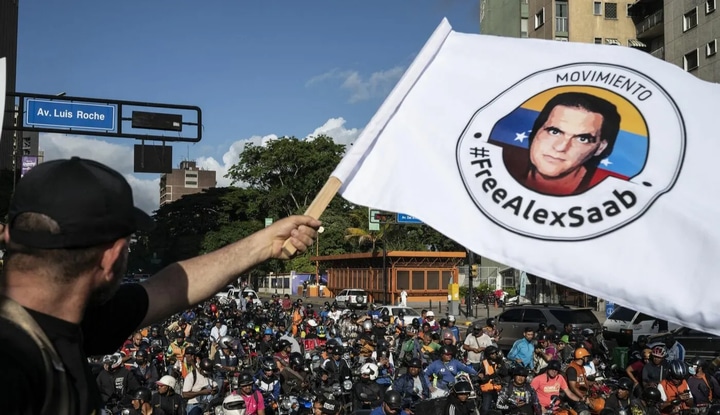
How the campaign to free Venezuelan political prisoner Alex Saab succeeded
written by Struggle – La Lucha
December 27, 2023
Alex Saab was freed from US captivity in what Venezuelan Prof. Maria Victor Paez described as “a triumph of Venezuelan diplomacy.” The diplomat had been imprisoned for trying to bring humanitarian supplies to Venezuela in legal international trade but in circumvention of Washington’s illegal economic coercive measures, also known as sanctions.
Negotiated prisoner exchange
In a prisoner exchange, Venezuela released ten US citizens and some other nationals to free Alex Saab after his over three years of imprisonment.
Saab’s plane landed in Venezuela on December 20. He was tearfully greeted by his family, friends, and Venezuela’s primera combatiente Cilia Flores, wife of the president. Shortly after, President Nicolás Maduro made a triumphal public address with Alex Saab at his side at the presidential palace.
Unlike Maduro, US President Biden made no such public address with his releasees beside him. Had he done so, he would have had to stand with “Fat Leonard” Francis, who had escaped US captivity after being convicted in a major US Navy corruption case implicating some sixty admirals. The US badly wanted him back in their custody. He knew too much about officials in high places.
The White House has so far declined to reveal the full list of those released. John Kirby, US Security Council spokesperson, tweeted, “Sometimes tough decisions have to be made to rescue Americans overseas.” Among the others released were mercenaries Luke Deman and Airan Berry, who were captured after the “Bay of Piglets” attempt to assassinate the Venezuelan president.
The US government would have liked nothing more than to have locked Alex Saab up and thrown away the key. And for a while, it looked like that was going to happen. Saab’s crack legal team had tried unsuccessfully to free him on the grounds that he was a diplomat who, under the Vienna Convention for Diplomatic Relations, is supposed to enjoy absolute immunity from arrest. Although the US is a signatory to the convention, Uncle Sam saw no reason to abide by international law.
The US Department of Justice lawyers argued, in effect, that because the US does not recognize the legitimacy of the democratically elected government in Venezuela, it certainly does not have to accept its diplomats. Although appeals were made, the US government simply delayed the case.
In short, the likelihood of achieving justice from the US justice system was slim. The last hope for freeing Alex Saab was a prisoner exchange. And that turned out to be the route to freedom.
How the campaign succeeded
The saga of Alex Saab and his ultimate emancipation is similar to the campaign to free the Cuban 5. The five had infiltrated terrorist groups in the Miami area, which were planning attacks on Cuba. When the Cuban authorities notified the FBI in 1998 of these illegal actions being planned on US soil, the US government instead arrested the five Cuban heroes, as they became to be known in their homeland.
Cuban President Fidel Castro vowed that the five would be freed, and they were. Two of the five eventually completed their prison sentences. Then in 2014, the remaining three were released in a prisoner exchange after a successful international campaign.
Like the campaign to free the Cuban 5, the FreeAlexSaab campaign rested on four legs: the remarkable resoluteness of Alex Saab himself, the mobilization of the entire Venezuelan nation on his behalf, an international movement, and the support and involvement of his family.
Alex Saab’s resoluteness was exemplary. Unlike many prisoners, Saab had a get-out-of-jail-free card that he could have played if he had chosen to do so. He did not.
As US officials admitted, Saab was a high value asset because he had information that the US security state wanted regarding contacts and means to circumvent the illegal coercive economic measures. All he had to do was sing and renounce Venezuelan President Maduro and the Bolivarian Revolution. But he did not, even under extreme pressure. Not simply pressure, but he was tortured while imprisoned in Cabe Verde.
In his emotional welcoming speech to Alex Saab, President Maduro remarked on Saab’s Palestinian heritage, noting that came with a capacity to resist. Venezuela has been among the Latin American nations most critical of the Israeli assault on Palestine.
The second pillar to the successful campaign was the mobilization of the Venezuelan nation behind freeing their national hero. This mobilization extended from the grassroots to the head of state.
Maduro noted that even while Saab was languishing in jail, the diplomat’s efforts had not been in vain. Although Saab was behind bars for 1280 days, the Venezuelan people were benefiting from the vaccines, food, and fuel that Saab had arranged to be delivered, circumventing the US blockade. Sharing the podium with them at the welcoming speech was a high-ranking Venezuelan general who, hearing this, cried.
Efforts of friends and family
The third element in the successful effort was launching an international campaign to #FreeAlexSaab. All over the world, friends of Venezuela’s sovereignty united to hold actions demanding his freedom.
Out of Vancouver, Canada, Hands Off Venezuela! conducted monthly online virtual picket lines featuring guest speakers on the Saab case. British rock star Roger Waters spoke out for Alex Saab’s freedom, as did distinguished Nigerian lawyer Femi Falana, United Nations special rapporteurs Alfred-Maurice de Zayas based in Switzerland and Alena Douhan based in Belarus, international law expert Dan Kovalik at the University of Pittsburgh, and Puerto Rican national hero and former political prisoner Oscar Lopez Rivera. Also weighing in on the injustice to Alex Saab were the American Association of Jurists, the National Lawyers Guild, United Nations Human Rights Committee, and the African Bar Association, along with the Economic Community of West African States’ (ECOWAS) Court of Justice.
Head of the North American FreeAlexSaab Campaign, Venezuelan-American William Camacaro commented that this was an important victory for President Maduro and by extension the larger Bolivarian Revolution. An already fractious opposition in Venezuela, he observed, has gotten even more divided while the Chavista movement is more unified going into the 2024 presidential election year.
Parallel campaigns for a prisoner exchange were waged on behalf of US citizens imprisoned in Venezuela. Prominent among those drives were the friends of Eyvin Hernández. The Los Angeles public defender had been arrested in March 2022 when he illegally entered Venezuela from Colombia. The Hernández campaign waged a strong effort reaching government officials and doing effective lobbying.
Speaking of government officials, the removal of disgraced Democrat Robert Menendez as chair of the powerful Senate Committee on Foreign Relations eliminated a significant obstacle to the prisoner exchange. Surprisingly, Maduro revealed that a deal to free Saab had previously been made with Trump, but when Biden won the election, they had to start again from scratch.
The fourth and indispensable pillar for the successful campaign was Alex Saab’s family, who had been targeted by the US but stood firm and supportive. The day that Saab’s son turned eighteen, the US slapped him with sanctions along with his uncles and other family members. Camilla Fabri de Saab, the former prisoner’s wife, led the effort even though she was a young mother with two young children.
As would be expected, Fabri was initially devastated by her husband’s imprisonment. She too was targeted and even her parents in Italy were hit. But out of adversity came strength. Fabri took the lead in uniting the many pieces of the campaign and the legal effort. With no exaggeration, she became a major international leader. She was appointed by Maduro to be on the sensitive negotiating team meeting with members of the Venezuelan opposition in Mexico City to retrieve some of Venezuela’s assets that had been illegally seized by the US.
Fabri’s moving video, made just five days before her husband’s release, was about what the holidays would be like without him. As it turned out, this will be a more joyous holiday season for all the prisoners freed in this historic exchange and their families. The release of Alex Saab is a victory for Venezuelan sovereignty and shared with the third of humanity still under US sanctions.
Argentina: Mapuche people are on high alert as Milei’s government takes office
written by Struggle – La Lucha
December 27, 2023
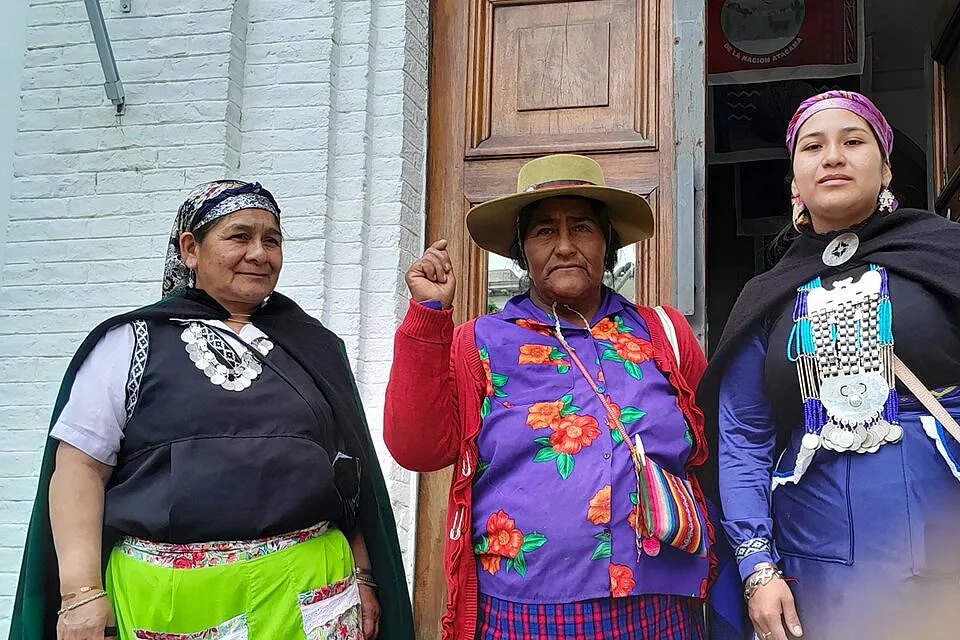
The land recovery of the Mapuche people is no living a moment of extreme vulnerability with the entry into the government of Javier Milei, a president who vindicates the indigenous massacre headed by General Roca. Although an agreement was reached at the Dialogue Table in June 2023, which recognized the Rewe as a sacred place and authorized the return of Machi Betiana, the outgoing government did not implement the return of the land nor the reconstruction of the houses. In addition, the legislature of Río Negro approved reforms that favor mining companies without respecting the right to free consultation of the native communities.
The recognition of the ancestral rights of the Mapuche people will be one of the first issues to be addressed by the new government. The decision taken in previous months at the Dialogue Table between the Mapuche communities and the ministries of the Fernández government to recognize the Rewe, where the Machi Betiana Colhuan deployed her task of healing and spirituality, will have to be executed by a government whose president vindicated General Roca as a national hero, responsible for the indigenous genocide perpetrated in the Campaign to the Desert, and whose Minister of Security is Patricia Bullrich, responsible six years ago for the disappearance of Santiago Maldonado and the crime of Rafael Nahuel, the 22-year-old Mapuche murdered in the back, when the first eviction of that sacred territory was carried out, on November 25, 2017.
This November 29, the Federal Oral Court of General Roca, admitting the responsibility of 5 prefects in the crime of Rafa Nahuel, sentenced them in a clearly racist sentence, to absurd sentences between 5 and 4 years. Rafael Nahuel (Rafita), cousin of the Machi Betiana Colhuan, had been participating for two months in a land recovery operation together with the Lof Winkul Mapu near Lake Mascardi. His body was brought down from the mountain wounded by the young men Lautaro González Curruhuinca and Fausto Jones Huala (brother of the lonko Facundo Jones Huala, who is about to be extradited to Chile in extremely serious conditions, as he has been on a dry hunger strike for 25 days).
Lautaro and Fausto were arrested when they arrived at the base of the mountain carrying Rafita’s dead body. Lautaro later assured that they decided to take Rafita’s body down themselves so that they would not do to him what they did to Santiago Maldonado by disappearing him. Recent ancestral memory: the same day of Rafita’s crime, a wake was being held for Santiago, disappeared for 78 days, and then mysteriously “found dead” in the Chubut River. Santiago had disappeared in a repressive operation by the Gendarmerie, in which the Lof en Resistencia Cushamen was attacked. The blood of the Mapuche and of those who accompany their resistance was once again being shed in Rebel Patagonia.
The Mapuche people’s right to spirituality
The recovery of lands in which Rafael Nahuel participated had as its objective the creation of a space in a sacred territory where the Machi Betiana Colhuan could develop her spiritual and healing activity. The space of the Rewe was identified according to the Mapuche cosmovision and was recovered so that the Machi could be erected. We are talking about seven hectares, which means nothing in terms of the land dispute in Patagonia but is fundamental in terms of the Mapuche people’s right to spirituality, health, and life.
In the trial, it was demonstrated that the prefects fired at least 151 rounds of lethal ammunition. That they specifically went out to hunt and kill Mapuche. The stories seem far-fetched, but they are not. They are all chained together in the labyrinth of criminalization of the Mapuche people and repression of the autonomous communities that continues nonstop.
On October 4, 2022, the four federal forces of the Unified Security Command (Federal Police, National Gendarmerie, Naval Prefecture and Airport Security Police) created by Aníbal Fernández as Minister of Security of the Nation, once again raided and evicted women, girls and children of the Lafken Winkul Mapu community with tear gas and rubber bullets. The information was received with indignation at the 35th Plurinational Meeting of Women, Lesbians, Trans, Transvestites, Bisexuals, Bisexuals, and Non-Binary in San Luis, which led to the call for the 36th Meeting in Bariloche, to demand the release of the Mapuche women prisoners, and the return of the Machi to the Rewe.
The Mapuche communities managed to meet with President Alberto Fernandez in December 2022, who convened a Dialogue Table, which began to meet with a safeguard commission, which included, among others, the Nobel Peace Prize winner Adolfo Perez Esquivel and the Mother of Plaza de Mayo Founding Line Nora Cortiñas, along with other human rights defenders. After six months of dialogue, greatly hindered by representatives of the National Parks and the government of Río Negro, an agreement was reached on June 1, 2023, in which the State committed to recognize the Rewe as a sacred place, and to authorize the return of the Machi and the reconstruction of three rukas (houses) that had been destroyed in the repressive operation, and proposing another place for the rest of the community.
This agreement led to the release of the four Mapuche women imprisoned with their daughters and sons. However, the national government’s administration ended without implementing the return of the Rewe or the construction of the houses, and the delivery of a new territory for the community. According to what the president of INAI, Alejandro Marmoni, informed in a meeting held days before the end of his mandate with Machi Betiana and her mother, María Nahuel, the execution of this decision was suspended in order to favor the next government’s administration of Milei.
Now, the Mapuche community and Machi Betiana Colhuan face this new stage with enormous vulnerability, with no support from the Fernandez administration as it left office, they are now left to negotiate with the reactionary Milei regime. Already the legislature of Río Negro has rapidly approved a reform of the Land Law and other projects, adding mining and tourist activity as a possible purpose for the use of fiscal land, clearly favoring mining companies, and ignoring the right to free, prior and informed consultation of the native communities, who mobilized to reject this measure.
These days, spiritual leaders of different peoples are speaking out to demand the return of the ancestral territory to Machi Betiana, basing the importance of these ceremonial and healing spaces for the life of the Mapuche communities. We are talking about human rights and the rights of the people. The government has in its hands the possibility of recognizing them and acting in accordance with them.
Regardless, the community has indicated that they will return to the Rewe, their ceremonial and health space because otherwise it means the loss of strength and energy for the Machi and for the children who accompany her. This decision surely will be made with the support of spiritual leaders and native peoples from all over the continent.
Global capitalist crisis: Are we at a pivotal point?
written by Struggle – La Lucha
December 27, 2023
Analyzing imperialist wars, economic contractions, and the struggle for a multipolar world
Presentation given at the Socialist Unity Party national plenum on Dec. 16, 2023.
Our plenum is dedicated to the Palestinian people and all who resist!
We dedicate this weekend’s plenum to the courage, resistance, and sacrifice of the Palestinian people! In addition, our dedication extends to the global movement of workers and youth, including in the belly of the beast, who have taken to the streets in unprecedented resistance.
It is this movement of the oppressed against the oppressor, workers against capitalists, youth against the fascist imperialist war machine that points the way to the future.
Are we at a pivotal point in the global capitalist crisis?
In Ernest Hemmingway’s “The Sun Also Rises,” one of the main characters, Mike Campbell, a bankrupt Scottish war veteran, was asked how he went bankrupt. He replied: “Two ways. Gradually and then suddenly.”
Change can seem imperceptible for long periods, before it bursts forth in a major break that is impossible to ignore
The question before us is, have we entered that period for the world imperialist system?
At the conclusion of World War II, the United States emerged as the world’s most powerful imperialist power. It gained control of the former European empires in Asia and Africa and engaged in a never-ending series of wars to maintain its dominance.
In the recent decade, notwithstanding the wholesale wars on Iraq and Afghanistan, much of the anti-imperialist movement has been focused on what has been called hybrid war, a grinding combination of conventional military actions combined with cyber-attacks, economic sanctions, and political subversion.
Its targets include Cuba, Venezuela, Iran, Zimbabwe, North Korea, as well as Russia and China. The U.S. Africa Force, for example, has been engaged in military operations across Africa, including in Burkina Faso, Mali, Niger, Cameroon, Somalia, Libya, Djibouti, Uganda, Sudan, Rwanda, and Chad. As we speak, Haiti, the first republic to overthrow slavery in this hemisphere, is threatened.
Today, we are at an unprecedented acceleration of overt, interconnected, and overlapping wars.
We will be discussing some of the particulars of the current imperialist war in Palestine, the U.S./NATO proxy war in Ukraine, and the deepening threats against China in the following reports.
The danger hasn’t been lost in bourgeois press discussions.
The headlines of two very recent Bloomberg articles outline their fears: “The World Risks Sliding Into a New Global War” and “Fears of World War III Prey on Hedge Fund Titans and Policymakers Alike.”
Quoting from the first article,
“Some officials and investors suggest the web of overlapping conflicts stretching from West Africa through Ukraine to the Middle East could be the prelude to another global conflagration. That, this time it begins not with a bang, but with several.” (alluding to WWI)
What lies beneath the surface of military and political developments is the contraction of the capitalist economy — which should awaken our interest for both the dangers and opportunities.
Struggle for a multipolar world against dollar supremacy
Following World War II, the U.S. dollar became the dominant currency in the capitalist world market, and at that time, it was linked to gold.
By 1971, in a secret meeting at Camp David, it took three days, Nixon and his team, including top representatives of the imperialist banking system, decided to delink the dollar from gold in the international arena. That event alone could be the subject of an entire report.It was a symptom of the weakness in the U.S. economic system and simultaneously a kind of global economic coup against any nation holding dollars.
What has been a constant, and we are all thoroughly versed in, is the stranglehold that the IMF and the World Bank, and for that matter the entire U.S. banking system, have over the oppressed world and smaller developing capitalist countries.
No matter how uneven or jagged, the struggle against imperialism — just like a river pushing its way through rock — will find an avenue to express itself. In many ways, this describes the movement for a multipolar world. It is a part of the fight to break from the dependence on the U.S. dollar — in other words, from the U.S. imperialist system.
As revolutionary communists, we aspire to the abolition of the capitalist market. The period following the collapse of the Soviet Union handed difficult obstacles both materially and ideologically to the global working class, the oppressed, and the movement for socialism — all of which are intertwined. It is in this historical context that the anti-imperialist struggle for a multipolar world should be viewed.
While there are many reasons for why and how this is happening — the unprecedented growth of the Chinese economic system has undergirded this development, particularly the Belt and Road Initiative and, in general, China’s economic growth.
What is taking place now is an acceleration of this process. A firestorm of recent economic summits this past year is an expression of this phenomenon. This includes the BRICS (Brazil, Russia, India, China, South Africa) held in South Africa in August; the G20 in India; and notably the G-77+China in Cuba in September.
In addition, the Far East Economic Forum, held in Vladivostok, Russia, took place in the same month.
The process of de-dollarization has been moving quickly and is an indicator of the weakening of the global power of the U.S.
Here are some statistics from Rodríguez Gelfenstein, a Venezuelan international relations expert.
“The figures are clear: In 2001, world reserves in dollars were 73% of the total; by 2021, that figure had been reduced to 55% and to 47% the following year. This exposes that last year, the dollar’s share of world finance fell ten times faster than the average of the last two decades, which is undoubtedly a figure of extraordinary impact. According to the Brazilian international analyst Pepe Escobar: ‘Now it is no longer unreasonable to project a world share of the dollar of only 30% by the end of 2024, coinciding with the next U.S. presidential elections.’
“Paradoxically, the origin of this abrupt drop came from the freezing of Russian reserves in the West (an amount greater than $300 billion), sounding the alarm that it was no longer safe to hold dollar reserves abroad. The decision to freeze unleashed a veritable avalanche of de-dollarization that has been evidenced through decisions of countries and international alliances throughout the planet.”
In a recent trip to China, Brazil’s President Lula da Silva questioned, “Who decided that the dollar was the currency after the disappearance of the gold standard? Why not the yuan or the real or the peso?”
Other countries have joined this process. This includes Russia, Iran, Saudi Arabia, Belarus, and Egypt, which are promoting the use of national currencies for bilateral currencies. All of this alarms Washington.
In March, a Reuters calculation based on data from China’s State Administration of Foreign Exchange reported that the yuan became the most used financial instrument for cross-border transactions in China, surpassing the dollar for the first time.
In May, the Zimbabwean government set out to launch a gold-backed digital currency to reduce its dependence on the dollar and protect its people from currency fluctuations.
What is at the heart of these crises, including the threat of worldwide war — the unmerciful and grotesque genocide taking place in Palestine — the utter destruction taking place on the Ukrainian battlefield and, for that matter, the planet and every aspect of oppression that keeps us up at night?
At the heart of capitalist crises is capitalist overproduction and, at a more micro level, production for profit.
Karl Marx described it, and Lenin expounded on it.
Without capitalist overproduction (and let me say that on the surface that sounds like an oxymoron — how can there be too much food when people are starving, or for that matter, any particular commodity or service, when people need housing, clothing, technology or so many other things) the genesis of imperialism would not have occurred.
It is the great conundrum — that technology itself, a product of the collective labor of the global working class, has now made it possible to produce in such breathtaking abundance — cannot be used or consumed if it is not profitable.
The consequence of the inherent contradictions in capitalism is ultimately economic contraction. It is the motive force behind war.
Many times, the anti-war movement will say in a popular way that oil or gas or diamonds or gold are the cause of war.
But it is not the commodity itself that causes war — but rather the built-in drive of imperialist countries for control of those commodities, which also includes wholesale destruction. This extends to the arms industries, including all the technology involved in their development.
Capitalist contraction, the outcome of overproduction inherent in the for-profit capitalist economic process — is like the Sword of Damocles hanging over the world capitalist class. The thread holding that sword is wearing thin.
In conclusion
I have likely elaborated too much or too little on one aspect or another in this report. We certainly have not explored the impact of the COVID epidemic, nor is my brief discussion of overproduction and capitalist contraction adequate.
I have not elaborated enough on the general trend of U.S. capitalism to rely more and more on war production, popularly referred to as the military-industrial complex, as opposed to the production of useful goods and services.
It is also critical to underscore that in discussing trends, it is clear that none of these developments take place in a linear fashion but rather in an uneven, jagged, up-and-down fashion, as explained in the boom and bust cycles of capitalism.
An explanation and study of imperialism is imperative for us, and I’m confident that the launch of the book authored by Gary Wilson and its introduction to Lenin’s “Imperialism the Highest Stage of Capitalism” will be a contribution and part of our work.
What’s urgent, in my opinion, is that we take up what I believe is a qualitative change in the world situation including how it impacts here in the metropolis of imperialism.
While it has major implications for the direct struggle against imperialism abroad, it also has implications for the working class inside the United States, a working class that is thoroughly multinational and multi-gendered.
The growing isolation and failures of U.S. imperialism impact everything from the 2024 bourgeois elections to the growing emergence of working-class struggle, as evidenced by the phenomenal strike wave of workers.
Is the bourgeois electoral system teetering on collapse, and what does this mean for the growth of state violence and the far right?
The expansion of U.S. capitalism and imperialism allowed a certain level of stability or bourgeois norms to exist, even if it was extended to only a certain segment of the working class, which in most cases was denied to the oppressed.
Social and economic problems haunt the U.S., from housing to the growing epidemic of drug addiction, alienation, and violence.
The question of access to food and water is not just a problem of what is called the developing world, but it is right here in the belly of the beast.
The world that at least the older generation has been accustomed to is radically different from the one the current generation is experiencing — and even it is changing at breakneck speed.
Understanding these crises is critical to map out where we are and what we need to do. It is important in the metropolis of imperialism that the final solution — the death of the decaying capitalist system — must find its solution — socialist revolution.
Exposing complicity in genocide despite detention
written by Struggle – La Lucha
December 27, 2023
Presentation given at the Socialist Unity Party national plenum on Dec. 16, 2023.
After the U.S. killed the U.N. Security Council resolution for a ceasefire on Dec. 8 — and today delayed another vote of the Security Council demanding an immediate ceasefire — Washington continues to pour gas on the fires in Gaza.
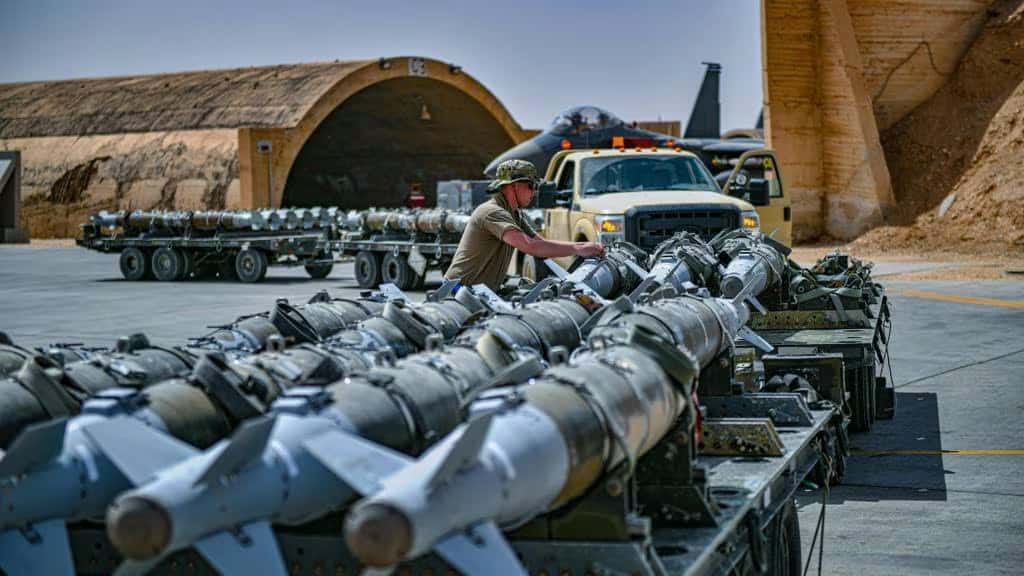
Bypassing Congress, the State Department sent 14,000 rounds of tank ammunition to Israel on the same day. The war crimes, with more than 20,000 Palestinians killed — 40% children, including so many babies — precede that transfer to Israel, assisting even more in the genocide.
“It’s just awful,” said one of the U.S. embassy representatives in Cairo, Egypt, about the killing going on in Gaza. With a bowed head with apparent frustration at their supposed inability to stop the killing in Gaza, the embassy representatives told our U.S. delegation of World Conscience Convoy participants nothing of value.
With the help of an Egyptian lawyer, we were able to have a meeting with the U.S. embassy. When we pressed to get answers about why the U.S. sent the massive amount of weapons that Israel received before and after Oct. 7, they said the U.S. uses weapons to get leverage to persuade Israel not to take things too far.
A five-year-old could come up with a better answer. And, even at an early stage of development, the child would most likely have a better sense of humanity regarding the massacre of children.
We went to the meeting to ask the U.S. to use its influence with the Egyptian government, which refuses to allow the World Conscience Convoy (organized by the Egyptian Journalist‘s Syndicate) to deliver humanitarian aid and journalists to Gaza and to help stop the genocide.
We told them, but they already knew, that there were just two days during the ceasefire “pause” to get humanitarian aid, journalists, and medical care into Gaza. Despite the ongoing genocide, as a Jewish delegation member explained and a mother and preschool teacher and others laid out, we were told the U.S. has no influence with the Egyptian government, and we were again told the U.S. uses the weapons for “leverage.”
After the U.S. veto of the U.N. Security Council resolution for an immediate ceasefire, one Saudi official said, “Leverage has failed.”
International delegates in the World Conscience Convoy decided that our only chance to get the convoy through (or failing that, to at least make visible the complicity in war crimes by both Egypt and imperialist countries led by the U.S.) was to petition the Ministry of Foreign Affairs once again to allow a permit for passage to Gaza. We preceded the presentation of the permit request with the unfurling of a banner in front of the building reading: “From the river to the sea – Palestine will be free.”
The over 30-hour detention in Egypt that this writer and three other delegates – from France, Australia, and Argentina – received made it clear that the government would not tolerate being embarrassed about their complicity. We were immediately detained.
Although our embassies never visited us after being made aware that we were being detained, Egyptian lawyers came to our rescue, and folks from back home in our respective countries were able to put pressure on them and the Egyptian government.
After 30 hours of no sleep, no bed, and continuous glaring lights, we were finally deported.
Before our detention, we got a good understanding of the political climate in a meeting with journalists at the Egyptian Journalist‘s Syndicate building. In Egypt, the people and even the media and corporate media were united in their rage against the Gaza genocide. Even the Egyptian National Security police let us know they agreed with what we were doing but had to listen to the “higher-ups.” This is why President Abdel Fattah el-Sisii has to hide his complicity in the economic cooperation with the Zionist regime.
One common interest of the U.S., Israel, Saudi Arabia, and Egypt in Gaza and the West Bank was the discovery of over 122 trillion cubic feet of natural gas and 1.7 billion barrels of recoverable oil, which the Zionist regime claimed it owned in 2008, to the detriment of Palestinians.
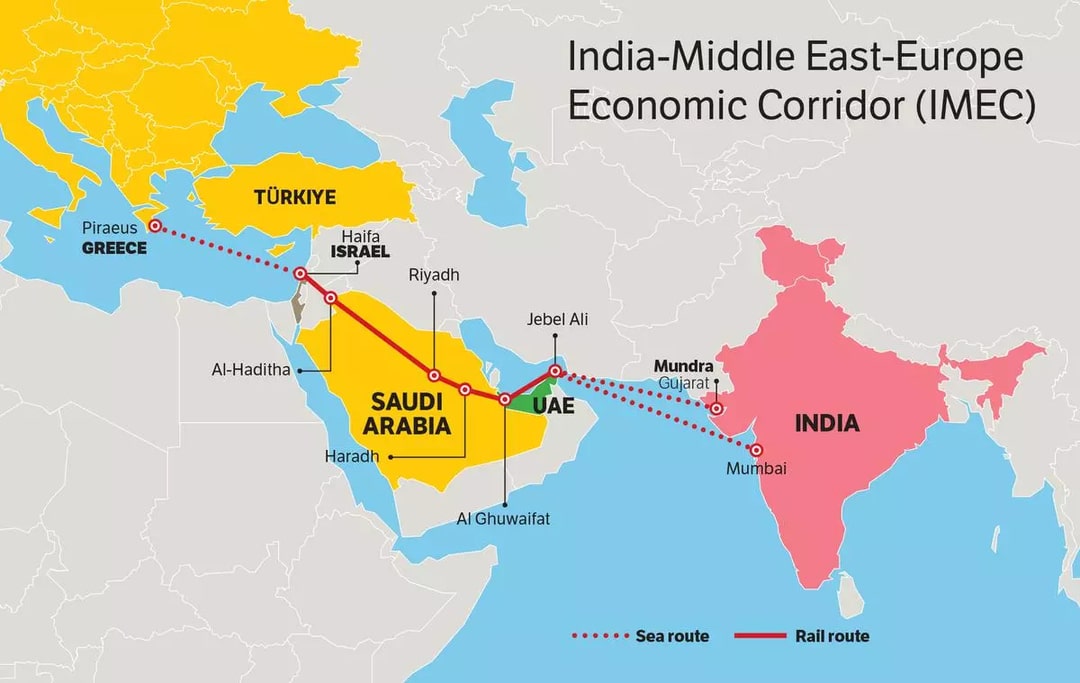
In September, the U.S. held a meeting in India pushing the Indian Middle-East Corridor (IMEC) with cooperation between Saudi Arabia, India, and the U.S., with invites to Jordan. This was designed to counter China’s mutually beneficial Belt and Road Initiative and alternatives to the IMF and World Bank.
The destruction of Russia’s Nord Stream pipeline by the U.S. and the U.S. proxy war in Ukraine helped the IMEC initiative. An alternative hydrogen pipeline — to replace the natural gas that Russia had provided to Europe — from India to Saudi Arabia to Jordan to Haifa in occupied Palestine, close to the West Bank and Gaza, is proposed as part of IMEC.
According to a statement by the Democratic Front for the Liberation of Palestine, which is one of the Palestinian organizations in Gaza that were part of the action with Hamas on Oct. 7, the IMEC agreements were targeted.
“The Al-Aqsa Flood operation was launched only after all diplomatic means had been exhausted. It was a specific confrontation due to the racist policy implemented by the Israeli occupation government headed by Benjamin Netanyahu. It was a move to prevent the Arab regimes from signing peace agreements with Israel and derail American attempts to build economic blocs in the region to besiege China, Iran, and Russia – the most recent of which is the India-Middle East-Europe ‘corridor.’”
The pipeline would then go to Greece to supply Europe.
It is also interesting that before Oct. 7, the U.N. reported record-breaking violent settler attacks against Palestinians in Gaza and that Israel’s Benjamin Netanyahu presented a new map of Israel that eliminated Palestine.
A corporate and capitalist government think-tank, APCO, sums up the plan goals and initiatives in its advisory work around IMEC:
Sept. 22 — The recent G20 summit in New Delhi witnessed the launch of a $20 billion India-Middle East-Europe Corridor (IMEC), an ambitious multi-pronged network aiming to connect goods and services between Europe and Asia — via the Middle East — more sustainably and efficiently. G20 countries involved in this initiative will hold a follow-up meeting to develop an action plan with defined timetables for implementation.
Alongside the practical economic and infrastructure benefits for the involved regions, IMEC aims to strengthen United States and EU leadership based on multilateral cooperation and prosperity across Eurasia and boost global supply chain solutions. Within this context, the G20-backed corridor seeks to constitute a geopolitical counterweight to China and its intercontinental Belt and Road Initiative (BRI) while checking Russia’s interconnectivity aspirations.
Summary and opportunities
IMEC’s transport competent envisions a combined maritime-overland network that circumvents the existing maritime route via the Suez Canal: beginning with sea lanes connecting western India to the UAE, a rail network linking the UAE, the Kingdom of Saudi Arabia, Jordan, and Israel, and culminating in a maritime route from Haifa to several European ports. The transport section is to be culminated by fiber-optic cables and a hydrogen pipeline spanning the 5,000-km route. In addition, the G20 envisions three complementary commercial-industrial corridors to IMEC in the fields of renewable energy, food security and the digital economy. …
Countering Russia and the Ukraine war impact
IMEC also serves to check Russian influence and overcome large-scale supply chain and logistics disruptions brought on by the invasion of Ukraine. As Europe eyes energy replacements for Russian gas and Middle Eastern countries seek to diversify food sources away from the Ukrainian-Russian conflict zone, IMEC has the potential to provide long-lasting remedies to these challenges. The G20-backed corridor also targets Russia’s proposed International North-South Transport Corridor to connect European markets to India via Iran, weakening the latter project’s viability and helping to encourage the maintenance of US-led international sanctions regimes against Moscow and Tehran.
The deal, however, was stalled after Oct 7.
Criminalizing homelessness solves nothing – Socialist planning could end the crisis
written by Struggle – La Lucha
December 27, 2023
Presentation given at the Socialist Unity Party national plenum on Dec. 16, 2023.
Homelessness, housing, prisoners, and the formerly incarcerated are all domestic issues.
According to National Homeless Facts, over half a million people are homeless in the U.S. in 2023. This is a low estimate.
Homelessness is a humanitarian crisis. Here are some statistics on homelessness in the U.S.
43% of the homeless youth are LGBTQ+. Transgender youth homelessness is the worst.
23% of people without housing are children, families, and veterans.
40% of homeless people have disabilities, and 70% are living with mental Illness.
Single adults over 50 now make up half of the homeless population. If nothing changes in the next 15 years, Harvard University estimates that an additional 2.4 million seniors in the U.S. will have no access to affordable housing.
Among the nation’s racial and ethnic groups, Black people have the highest rate of homelessness.
Thirty percent to 50% of the formerly incarcerated on parole have no place to stay, making it more likely that some will go back to prison. Their challenges are tripled when searching for a job, following parole terms and agreements, getting up to date on current events and trends, and reaching out to loved ones for support.
The unemployment rate for the formerly incarcerated is over 27% — which is higher than the total U.S. unemployment rate during any historical period, including the Great Depression.
California, New York, Florida, and Washington had the most homeless people in 2022, according to the Annual Homeless Assessment Report. These four states accounted for more than half of the country’s homeless population, with 30% of the total living in California alone.
It’s been 10 years since thousands of workers and supporters in California joined the nationwide demand to raise the minimum wage to $15.00 per hour.
On Jan. 1, 2022, San Diego, California’s hourly minimum wage reached $15. It was recently announced that San Diego’s minimum wage will be $16.85 per hour, effective Jan. 1, 2024.
In San Diego, there are over 10,000 homeless — termed unsheltered people according to the regional task force on homelessness and this number is increasing.
In San Diego, the cost of living is ridiculous.
According to the MIT Living Wage Calculator, the minimum living wage for a single adult in San Diego is at least $22.31. That means that the current minimum wage is not enough to support a single adult living on their own. A family of four (two adults, two children) in San Diego with one adult working full time needs to earn at least $46.66 per hour for a living wage; with both adults working, each would have to make $30.58 an hour.
Many seniors — some on fixed incomes — are homeless because they can no longer afford rent.
The San Diego City Council approved the homeless encampment ban, which bans sleeping in public parks, beaches, downtown, and residential areas. They claim this is for the safety of the unsheltered.
Many feel the current Mayor, Todd Gloria, broke his promise to set up a task force to come up with a plan to help people without housing. Instead, he is criminalizing the homeless by using the police to enforce the encampment ban. What did they expect?
San Diego started enforcing the homeless encampment law in July of 2023. The law allows officers to jail unhoused people camping in certain locations if they have previously been cited for being homeless.
Todd Gloria explained that many remain on the streets and won’t accept the services that the police are offering. Fines and jail threats can be a “leverage” to force them into shelter.
Local academics researching the homeless crisis have shown that criminalization does not reduce the number of unsheltered people.
The city is developing homeless encampments in designated areas where people stay and keep all their stuff and safe spaces where people can sleep in their cars overnight.
Outside tents and parking spaces for overnight sleeping are what some would see as a good alternative to overnight homeless shelters, where there are many rules, including what you can and cannot bring into the shelter.
The solution to homelessness is complicated, difficult to resolve, and impossible to end in a capitalist system of government. The truth is reducing homelessness just isn’t profitable.
Socialism is the solution to ending homelessness, and here are some reasons why.
Under socialism, people do not fear unemployment, old age, sickness, losing their jobs, rent increases, or losing their homes.
A socialist government plans for the general welfare of all residents. It owns the wealth used for industry. It plans production and seeks to distribute everything according to need.
Only socialism can resolve the homeless, housing, and prison crisis.
We must study socialism. We must fight for socialism.
🇵🇸 Sat. 2 p.m. MARCH: No Business As Usual Christmas Weekend
written by Struggle – La Lucha
December 27, 2023
NO BUSINESS AS USUAL ON CHRISTMAS WEEKEND
Baltimore All Out for Palestine
Saturday, December 23, 2 pm
McKeldin Square,
Light & Pratt Streets downtown March at 2:30 pm sharp
Noise protest: Bring drums, noise makers and your voice
As recession looms: Spending soars for U.S. war operations
written by Struggle – La Lucha
December 27, 2023
Presentation given at the Socialist Unity Party national plenum on Dec. 16, 2023.
It’s a war economy.
You may have heard of Bidenomics — Genocide Joe’s economic policy. The New York Times reported last October that the White House was telling Democrats that Biden’s reelection will be won because of Bidenomics. Since then, what’s happened? Bidenomics has quietly disappeared from all Democratic campaign talk.
The National Priorities Project reports that Biden’s military budget is one of the highest in history. “The Biden request calls for $886 billion in spending for the military and war preparations.” The NPP points out that this is at the level of spending at the height of the Iraq and Afghanistan wars and is approaching the level of military spending during World War II.
In an October Oval Office Address, Biden said sending weapons to Ukraine is actually an investment in U.S. industry, strengthening the economy and creating new jobs. Politico quotes Biden: “As we replenish our stocks of weapons, we are partnering with the U.S. defense industry to increase our capacity … This supplemental request invests over $50 billion in the American defense industrial base … expanding production lines, strengthening the American economy and creating new American jobs.”
So here’s the thing. All the financial indicators point to a major recession soon. Is Biden attempting to divert an economic bust? Can a large-scale military buildup or even a war avoid a recession?
A war economy produces the means of destruction or subsistence for soldiers instead of profit-producing production and profit-producing workers. Bidenomics may keep unemployment levels from rising with low-wage, non-union jobs, but it’s driving down the capitalist profit rate.
Financing the enormous military budget is the primary reason for the massive federal debt, and it led to the greatest bond market crash in history in October. You probably didn’t hear about it. They don’t like to talk about these things. The government issues bonds, called Treasuries, when they want to borrow money. That’s how they’ve been paying for the massive military budget.
In the financial press, Bloomberg reported that Treasury bonds with maturities of 10 years or more plummeted 46%. That’s just under the losses in the stock market when the dot-com bubble burst in 2000.
What’s coming out of this is higher taxes and cuts in social spending to pay for the massive military buildup and warfare.
The current economic slowdown is because of general overproduction, with manufacturers facing excess inventory.
Economic growth (not slowdown) is the lifeblood of capitalism. Industrial production is not growing; it has stagnated for the past year.
On Dec. 4, Reuters reported that “makers of computer and electronic products said the ‘economy appears to be slowing dramatically.’ Miscellaneous manufacturing firms said, ‘Customer orders have pushed into the first quarter of 2024, resulting in inflated end-of-year inventory. Producers of food, beverage, and tobacco reported that ‘our executives have requested that we bring down inventory levels considerably.’”
Industrial capitalists are building new factories even as their current factories cannot run at their full capacity due to a lack of markets. As the new factories come online, the gap between the ability to produce and the market’s ability to absorb the increasing volume of commodities at profitable prices is growing dramatically.
The growing gap between expanding production capacity and limited market demand is unsustainable. A recession looms.
Bidenomics a failure
As any worker will quickly confirm, Bidenomics is a failure. Really. Have prices rolled back? Overall, prices have surged by more than 17 percent since January 2021 — nearly 20 percent for food, more than 43 percent for gasoline, and 18 percent for housing, according to data from the U.S. Bureau of Labor Statistics.
Workers are fighting for and winning wage increases, but overall, for most workers, wages still lag behind inflation. 60% of the workforce is living paycheck to paycheck. Homelessness in the U.S. jumped to a record level in 2023, the highest number of people reported as experiencing homelessness since reporting began.
Anyway, as we’ve seen in our discussions today, the U.S. is engaged in war, hybrid war, economic war, and multiple kinds of warfare in several parts of the world. Genocide Joe’s war on Gaza. The U.S.-NATO proxy war on Russia.
There is also the possibility of a U.S. and/or Israeli attack on Iran.
CBS News reported on a major deployment of U.S. warships to the region. The aircraft carrier USS Eisenhower’s strike group arrived in the Red Sea in mid-November. An unknown number of nuclear submarines armed with hundreds of cruise missiles are there. The aircraft carrier USS Ford strike group is in the area in the Mediterranean along with at least five other battleship groups. CBS adds that 45,000 U.S. service members and contractors are now stationed in the Middle East.
U.S. Secretary of Defense Lloyd Austin just announced the start of Operation Prosperity Guardian, a naval operation in the Red Sea and Gulf of Aden targeting Yemen’s Ansarallah-aligned armed forces and threatening Iran.
That’s three fronts in U.S. imperialism’s global war – Palestine, Russia, and Iran.
Of course, there’s also the sanctions, economic warfare against Cuba, Venezuela, Zimbabwe, and others.
War buildup in Asia
Then, there are the war fronts against the Democratic People’s Republic of Korea and China.
The U.S. has imposed sweeping sanctions on China’s semiconductor industry, aiming to restrict China’s advanced computing and supercomputing abilities and prevent it from becoming a global leader in semiconductors. The New York Times called the semiconductor blockade “an act of war.” Saying, and I quote: “The controls essentially seek to eradicate, root and branch, China’s entire ecosystem of advanced technology.”
And then there is Taiwan.
Taiwan has been part of China for centuries. Japan colonized Taiwan in 1895 and Korea in 1910. After the victory of the Communist Party of China in 1949, the defeated Kuomintang took over Taiwan with U.S. support. The U.S. later acknowledged the People’s Republic of China’s sovereignty over Taiwan under the One China policy but never relinquished its de facto control.
Now, the U.S. has virtually dropped its One China policy and has started a massive military buildup in Taiwan combined with a significant naval buildup in the South China Sea.
Unlike previous administrations, including Donald Trump’s, the Biden administration has not confirmed the One China policy. Responsible Statecraft reported that “Assistant Secretary of Defense for Indo-Pacific Security Affairs Ely Ratner made an unprecedented public statement by a serving senior U.S. official. In testimony before the Senate Committee on Foreign Relations, he stated that the island of Taiwan is strategically “critical to the region’s security and critical to the defense of vital U.S. interests in the Indo-Pacific.” He’s saying that Taiwan is “ours.”
In August, the U.S., Japan, and South Korea established what’s being called an Asian NATO, a trilateral military cooperation agreement, including a joint missile defense system. This is aimed at both North Korea and China.
Biden’s massive military budget must be paid for by the workers. The U.S. is imposing a wartime economy, hoping to rescue the capitalists from the coming economic collapse while at the same time threatening imperialist war around the globe.