Food deserts: Grocery giant shuts down in southwest Baltimore

The Price Rite Marketplace in southwest Baltimore will permanently close its doors by the end of December. Photo: Baltimore Afro

Over the past two years, grocery store closures have rolled across the U.S. like an epidemic. In particular, these closures have occurred in working-class communities, especially where most residents are Black or Brown. 

Whether it is Kroger, Aldi, Stop and Shop, etc., huge grocery store magnates are closing stores that serve working-class neighborhoods. Corporate public relations departments and their allies in the media tell us that the reason for these closures is shoplifting or a shortage of workers. 

In reality, these stores close because of corporate greed. There is no better demonstration of this reality than the recently announced closure of a Price Rite Marketplace in the heart of southwest Baltimore. Price Rite is part of the giant Wakefern Food conglomeration that includes ShopRite, Fresh Grocer, Dearborn Market, Fairway Market, and more. Wakefern is one of the top 25 grocery retailers in the U.S., with 365 supermarkets, and is the largest private employer in New Jersey, with 40,200 employees. 

This particular Price Rite store has been a staple in the Baltimore “Pigtown” neighborhood for over two decades. The Pigtown Price Rite is the only full grocery store easily accessible to those living in Pigtown and all the southwest Baltimore neighborhoods. 

The recently announced Price Rite closure has sent a wave of shock and concern through the surrounding community. For years, this store has been the only source of fresh produce and meat in the area. Without it, the evolution of southwest Baltimore into a food desert is tragically complete. 

Further compounding the injustice, the Giant grocery store chain announced the opening of a new location in the Locust Point neighborhood of Baltimore. Locust Point is a rapidly gentrifying majority-white middle-class neighborhood just east of Pigtown. While Locust Point is not geographically distant from Pigtown, because of economic segregation, it might as well be. 

Due to the lack of public transportation and racist wealth inequality, overpriced grocery stores in the heart of gentrifying neighborhoods are just not an option for the working-class Black and Brown communities in west Baltimore. 

As if the closure itself wasn’t bad enough, it seems unlikely that a different store will replace the Price Rite due to greedy developers. Several months ago, the Carlyle Development Group purchased the shopping center where the Pigtown Price Rite is currently located from the Baltimore City Government for an unbelievably low price. After the market announced its closure, the Carlyle Development Group made it clear that it would not seek to rent to another grocery store. 

Their reason? Private medical practices and laboratories have a higher profit margin than grocery stores; working-class communities be damned. 

The recent closure of the Pigtown Price Rite is one development in a broader trend in the capitalist market. Grocery store magnates have strategically decided to abandon working-class neighborhoods for wealthier, usually white, areas. 

For example, when workers at the Kroger-owned Ralph’s supermarket in South Central Los Angeles demanded hero pay for hours worked at the height of the COVID-19 pandemic, what was the store’s reaction? Well, Kroger decided to close that store, much like the Price Rite development in Baltimore, which deepened the food desert crisis in South Central Los Angeles. 

The developers don’t care about people. The grocery store chains don’t care about people. The politicians in their pockets don’t care, either. The capitalists only care about their bottom line.  

We must fight back against these racist and anti-worker closures that cost the community healthy food access and jobs. The only people helped by these closures are millionaire and billionaire investors.

Strugglelalucha256


2 days before coup, U.S. ambassador in Peru, veteran CIA agent, met with defense minister

The U.S. ambassador in Peru, a veteran CIA agent named Lisa Kenna, met with the country’s defense minister just two days before democratically elected left-wing President Pedro Castillo was overthrown in a coup d’etat and imprisoned without trial.

Peru’s defense minister ordered the military to turn against Castillo.

The coup set off mass protests all across Peru. The unelected regime has unleashed brutal violence, and police have killed numerous demonstrators.

Meanwhile, the U.S. government has staunchly supported Peru’s unelected coup regime, which declared a nationwide “state of emergency” and deployed the military to the streets in an attempt to crush the protests.

Most governments in Latin America have criticized or even refused to recognize Peru’s unelected coup regime, including Mexico, Argentina, Bolivia, ColombiaHonduras, Venezuela, Cuba, and various Caribbean nations.

The CIA has organized many coups against democratically elected left-wing leaders in Latin America, from Guatemala’s President Jacobo Árbenz in 1954 to Chile’s President Salvador Allende in 1973.

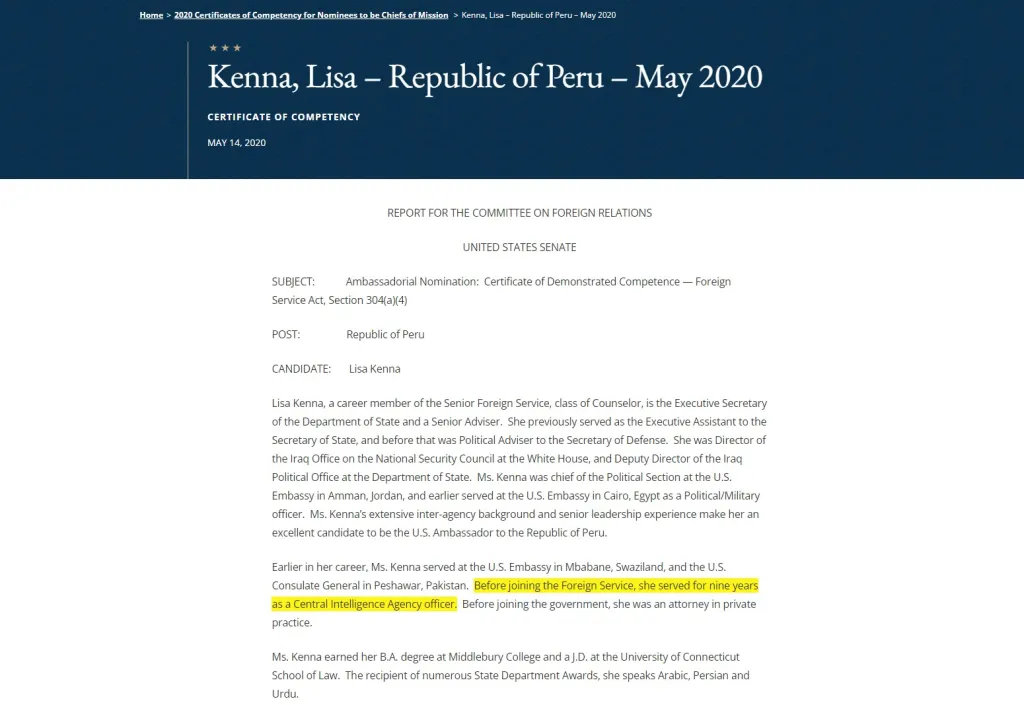
When the Donald Trump administrated nominated Lisa Kenna to be ambassador to Peru in 2020, the State Department released a “certificate of competency” that revealed that “Before joining the Foreign Service, she served for nine years as a Central Intelligence Agency officer.”

This important fact is curiously absent from most of Kenna’s bios, including her page on the U.S. embassy’s official website.


Under Trump, Kenna also served as executive secretary of the State Department and was “senior aide” to Trump’s Secretary of State Mike Pompeo, who previously headed the CIA.

In regard to his work for the notorious spy agency, Pompeo admitted in 2019, “I was the CIA director. We lied, we cheated, we stole. We had entire training courses.”

At a Congressional nomination hearing in 2020, Kenna admitted that, as executive secretary, she saw “nearly all” of the memos that were sent to Pompeo, adding, “I am aware of the vast majority of” calls made to and by him.

Kenna also previously worked for the Defense Department and served State Department roles in Iraq, Jordan, Egypt, Swaziland, and Pakistan.

When President Joe Biden entered in January 2021, he kept Kenna as ambassador in Peru.

On December 5, 2022, Kenna met with Gustavo Bobbio Rosas, who had officially been appointed as Peru’s defense minister the day before.

Peru’s Ministry of Defense published a photo of their friendly chat.

At the time of this meeting, it was known in Peru that the notoriously corrupt, oligarch-controlled congress was preparing for a new vote to overthrow democratically elected left-wing President Pedro Castillo.

Article 113 of Peru’s constitution allows the unicameral congress to remove presidents simply by voting to declare that they have a “moral incapacity,” in a process known as “vacancy.”

Peru’s congress is well known for its extreme corruption. In the infamous “Mamanivideos” scandal, congress members from the far-right Fuerza Popular party were filmed bribing other congress members to vote against impeaching previous right-wing President Pedro Pablo Kuczynski.

Fuerza Popular is run by the family members of Alberto Fujimori, the far-right dictator who ruled Peru with an iron fist from 1990 until 2000. With the support of the U.S. government, Fujimori committed genocide, sterilizing approximately 300,000 Indigenous people, while killing, torturing, and disappearing large numbers of leftist dissidents.

The Mamanivideos scandal showed that it is quite easy for Peru’s rich oligarchs to buy votes in congress to overthrow democratically elected presidents.

And as soon as Castillo entered office on July 28, 2021, the congress tried to do exactly this.

Just two days after the U.S. ambassador met with Peru’s defense minister, on December 7, 2022, the right-wing-dominated congress launched a parliamentary coup against Castillo, using article 113.

This was the third coup attempt in just over a year by Peru’s congress, which in September 2022 had a mere 7% approval rating.

Hoping to stop the coup, Castillo responded by trying to dissolve the congress. This is allowed in cases of obstructionism by article 134 of Peru’s constitution.

Defense Minister Bobbio immediately denounced the president’s actions. He published a video resigning from his position (that he had only held for three days).

In the video, Bobbio told Peru’s armed forces not to support President Castillo and to oppose his attempt to dissolve the coup-plotting congress.

Bobbio claimed Castillo was launching a “coup attempt,” but in reality Bobbio was instructing the Peruvian military to support a coup against the democratically elected president, on behalf of a notoriously corrupt oligarch-controlled congress that had almost no support from the population.

While Bobbio ordered the military to rebel against the president, the U.S. government promptly attacked Castillo.

Former CIA agent and current Ambassador Kenna tweeted, “The United States categorically rejects any extra-constitutional act by President Castillo to prevent the congress from fulfilling its mandate.”

Kenna failed to mention article 134 of Peru’s constitution, which states:

The President of the Republic is authorized the dissolve the Congress if it has censured or denied its confidence to two Councils of Ministers [the official name of Peru’s cabinet]. The dissolution decree contains the call for elections for a new Congress.

When Castillo moved to dissolve the congress, he cited article 134 and he made it clear that it was only going to be a “temporary” closure. The president said new congressional elections would be held as soon as possible.

Kenna ignored all of this context. Instead, the ambassador declared, “The United States emphatically urges President Castillo to reverse his attempt to close the congress and allow the democratic institutions of Peru to function according to the constitution.”

By this, the CIA veteran meant that Castillo should simply allow the anti-democratic, oligarch-controlled congress to launch a coup against him.

The U.S. embassy in Peru subsequently published an official statement echoing exactly what Kenna had said.

This was Washington’s green light for Peru’s corrupt, right-wing-dominated congress to overthrow President Castillo, and for the state security services to arrest him, without trial.

Mere hours after Castillo was imprisoned, the oligarch-controlled congress appointed his vice president, Dina Boluarte, as leader of the country.

Boluarte promised on the floor of the congress that she would create “a political truce to install a government of national unity” – that is, a pact with the right wing.

Boluarte had been expelled in January 2022 from the leftist Perú Libre party that Castillo had campaigned with. She proudly declared that she “had never embraced the ideology” of the socialist political party.

The day after the coup, on December 8, the State Department gave its rubber stamp to Boluarte’s unelected regime.

“The United States welcomes President Boluarte and hopes to work with her administration to achieve a more democratic, prosperous, and secure region,” stated Brian A. Nichols, the U.S. assistant secretary for western hemisphere affairs.

“We support her call for a government of national unity and we applaud Peruvians while they unite in their support of democracy,” the top State Department official added.

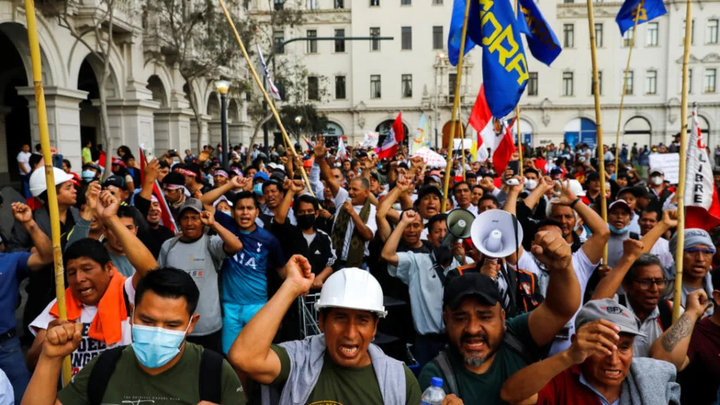
In the meantime, the Peruvian people were filling the streets, condemning the coup against their elected president.

Peru’s police responded with violence, harshly cracking down, killing several protesters.

On December 14, the coup regime imposed a national “state of emergency” for 30 days and said it might also declare a curfew.

At the same time, the coup regime also said it plans to sentence Castillo to 18 months in “preventative prison,” without a proper trial that resembles anything remotely like due process.

Just one day before the coup regime made these authoritarian announcements, former CIA agent and current U.S. Ambassador met with Peru’s unelected leader, Dina Boluarte, and reiterated Washington’s wholehearted support.

Kenna praised the right-wing “unity government” that Boluarte pledged to form, adding, “We hope to strengthen our bilateral relationship.”

Brian Nichols, the top State Department official on Latin America, added with a touch of deep irony, “We support the Peruvian people and their constitutional democracy.” He urged protesters to “reject violence.”

On the same day, Mexico, Argentina, Bolivia, and Colombia released a joint diplomatic statement with a completely contrary message, supporting elected President Castillo, saying he was the victim of “anti-democratic harassment.”

In a press briefing on December 13, the State Department was asked about the protests in Peru.

State Department spokesman Ned Price – who, like Lisa Kenna, was also a CIA agent – emphasized Washington’s steadfast support for Peru’s coup regime.

“We do commend Peruvian institutions and civil authorities for safeguarding democratic stability,” he said, as Peru’s repressive police killed protesters.

https://twitter.com/MMinperu/status/1602496806331580417

Instead of condemning the rampant police brutality, the U.S. State Department blamed the protesters themselves. Price stated, “we are troubled by scattered reports of violent demonstrations and by reports of attacks on the press and private property, including businesses.”

“When it comes to Peruvian President Dina Boluarte, we of course do recognize her as such. We will continue to work with Peru’s democratic institutions, and we look forward to working closely with President Boluarte and all branches of the government in Peru,” the former CIA agent stressed.

In addition to serving as a CIA agent for nine years and current U.S. ambassador to Peru, Lisa Kenna served as a:

  • political adviser to the secretary of defense
  • director of the Iraq office on the National Security Council at the White House
  • deputy director of the Iraq political office at the Department of State
  • chief of the political section at the U.S. embassy in Jordan
  • political/military officer at the U.S. embassy in Egypt
  • staff member at the U.S. embassy in Swaziland
  • staff member at the U.S. consulate general in Peshawar, Pakistan

At a Congressional nomination hearing on July 23, 2020, Kenna boasted of her U.S.-supremacist worldview, stating, “The longer I have been in public service, the more I am convinced that America is the world’s most exceptional nation.”

She also vowed, “I will maintain the United States’ vital relationship with Peru which has long been one of our closest partners in the region. Recently, Mission Peru has performed heroically to sustain our strong partnership and serve our fellow Americans in these challenging times.”

At the time of the hearing, Peru had a right-wing government, led by President Martín Vizcarra.

Kenna praised Peru’s conservative government, “as founder of the Lima Group,” for backing the United States in its right-wing coup attempt against Venezuela’s democratically elected President Nicolás Maduro, claiming, “The U.S. and Peru are also growing our shared support for a peaceful return to democracy in Venezuela.”

She also pledged in the hearing that, as U.S. ambassador to Peru: “I commit to meet with democratically oriented opposition figures”; “We also commit to meet with independent, local press in Peru”; and “I am committed to meeting with human rights, civil society, and other non governmental organizations in the United States and in Peru.”

Source: Multipolarista

Strugglelalucha256


Peru: Chronicle of a coup in slow motion

Dec. 14 — The fascist right wing of Peru was finally able to do on Wednesday, December 7, what it had been trying to do for more than a year — depose Pedro Castillo, the elected president of the country. The war of power between the government on one side and the parliament and the judiciary on the other that had started the day that the ousted president, Pedro Castillo, took office culminated in a parliamentary coup. In many ways, it was expected to happen at any moment, yet it happened quite suddenly and unexpectedly on December 7, 2022.

The events of December 7

That morning, Castillo, in a message to the nation, announced the dissolution of Congress and the formation of a “government of exceptional emergency.” He also announced that new legislative elections will be called as soon as possible, and the new Congress elected, via said elections, would draft a new constitution within a period of no more than nine months. Until that time, the country will be governed by the emergency government. Castillo also announced a reorganization of the judiciary and the Constitutional Court. A new constitution was one of Castillo’s principal electoral promises.

In his message, Castillo accused the majority of Congress members of responding to “racist and elitist interests,” and of doing nothing except planning “the presidential vacancy, suspension, a constitutional accusation, or resignation at any cost.” “They have created chaos in order to control the government, bypassing the popular will and the constitutional order,” he stated.

On Wednesday itself, Congress was to debate a motion to remove the president from office for “permanent moral incapacity,” an ambiguous tool for removing a president that can mean anything. This was the fourth attempt to remove him from the presidency and the third one for “incapacity.” After Castillo’s announcement, Congress moved swiftly and approved the motion of vacancy without any discussion, with 101 votes, much higher than the 87 required. Several Congress members belonging to parties that supported Castillo voted in favor of the vacancy, while seven ministers out of 19 resigned after the president had dissolved Congress.

Subsequently, as if everything was premeditated, Pedro Castillo was arrested and taken to the police headquarters of the Lima Prefecture. The attorney general of Peru, Daniel Soria Luján, filed a criminal complaint before National Prosecutor Patricia Benavides against Castillo “for the alleged commission of the crimes of sedition, abuse of authority, and serious disturbance of public peace.”

Later in the afternoon, Vice President Dina Boluarte was sworn in as the new president by the Congress.

The Armed Forces and the Peruvian National Police did not support Castillo’s move and, through a joint statement, called upon “the citizens to remain calm and trust the legally established State institutions.”

The next day, the Supreme Court of Preparatory Investigation ruled a 7-day preliminary detention for Castillo.

Who couped whom?

Peruvian and international media, Castillo’s opponents, and even some of his former associates, including the now de facto President Dina Boluarte, described Castillo’s decision to dissolve the Congress as a “coup d’état,” meanwhile his removal was hailed as “restitution of democracy” by the Organization of American States (OAS). In spite of all this noise, it must be clarified that what Castillo did was legal and constitutional, although poorly planned and badly executed.

Article 134 of the current Constitution of Peru, in force since 1993, bestows on the president of the nation the power to dissolve Congress under certain circumstances. It states:

The President of the Republic has the power to dissolve Congress if it has censured or denied its confidence to two Cabinets. The decree of dissolution shall contain a call for the election of a new Congress. Such elections shall be held within four months of the dissolution of Congress without any alteration of the existing electoral system.

The constitution does not define any fixed time period during which the acts of censure or the denial of confidence should have taken place, except that they should be in the same presidential term. In Castillo’s 16 months of government, the Congress denied its vote of confidence multiple times and censured a number of his ministers, forcing the president to remove them from their posts. The first casualty of the putschist Congress was Castillo’s first foreign minister, Héctor Béjar, who was smeared as a terrorist and forced to resign within weeks of his appointment. Soon after, the president was forced to change his entire cabinet. The latest such incident occurred on November 9, when Congress denied confidence to Prime Minister Aníbal Torres’ request for a session on a constitutional reform. Torres resigned on November 25. Betssy Chávez, whom Castillo named as Torres’ replacement, had been censured by Congress while she functioned as labor minister.

This was not all. The majority right-wing Congress, supported by the judiciary and the media, systematically sabotaged Castillo’s administration from day one, making it impossible for him to carry out any of his electoral promises. It constituted a commission to investigate an electoral fraud that never existed—a fraud supposedly committed by Castillo’s presidential campaign, although the right controlled, and still controls, the electoral authorities. It tried to oust him thrice for “permanent moral incapacity.” It opened a political trial against him for allegations of corruption, although the president enjoys constitutional immunity from such prosecution. Before the third vacancy motion, the Congress tried to impeach Castillo for “treason against the homeland,” an absurd accusation based on the sympathy he had expressed in an interview for Bolivia’s demand of access to the sea.

The Congress’ unconstitutional attacks did not stop there. It appropriated to itself the power of a constituent assembly, modifying 50 articles of the Constitution, all with the blessing of the judiciary. It curtailed the people’s right to call for a referendum on a constituent assembly through signature collection, and passed a law that gave the Congress the authority to reject a popular call for referendum, thus making almost impossible the realization of any such vote. On December 1, the Constitutional Commission of Congress approved a rule that allows the “temporary suspension” of the president for up to 36 months, by the simple majority of 66 votes only, instead of the 87 required for presidential vacancy. This probably acted as the final straw for Castillo.

In reality, the corrupt, racist and oligarchic right wing of Peru considered the victory of an indigenous trade unionist promising to implement a program of socio-economic justice and national sovereignty as a threat to the powers and privileges they enjoyed for centuries. That is why that oligarchy had launched a fierce smear campaign against Castillo even before he won the election, and once he did win, they refused to recognize the result. The president of Venezuela, Nicolás Maduro, correctly pointed out the real reason behind the coup: “The oligarchic elites do not want to allow a simple teacher to win the presidency and try to govern for the people. Through the coup they tried to send a message to the social and popular movements: ‘We will not let you govern.’”

Jeanine Áñez 2.0?

The removal of an elected president and the hasty swearing-in of a de facto president is reminiscent of the coup against Evo Morales of Bolivia in 2019, although there are important differences. Pedro Castillo’s government, although democratic and moderately progressive, could not be considered socialist or revolutionary, and his replacement Dina Boluarte, although not a “leftist activist” or “social leader,” is not exactly Jeanine Áñez, the xenophobic fascist ex-senator of Bolivia who was put in Morales’ place by the Bolivian extreme right and high officials of the army. The Peruvian Congress still has two cases opened against Boluarte for allegations of corruption and conflicts of interest. There existed the possibility that Congress would pressure her to resign as vice president, in which case the presidency of the nation would have passed to the president of Congress, José Williams Zapata, a military general accused of massacre and human rights violations during his career. In fact, Williams was the president of the country for some minutes before passing over the charge to Boluarte.

Unlike Áñez, Boluarte betrayed her own support base as well as the president with whom she ran in the elections of 2021 and served as the vice president in his government. She publicly accused Castillo of “perpetrating the breakdown of constitutional order with the dissolution of Congress,” thus echoing the right wing. She began her first speech as de facto president with the same accusation, “As we all know, there has been an attempted coup d’état, promoted by Mr. Pedro Castillo, which has not found support in the institutions of democracy and the streets.”

“Aware of the enormous responsibility” that she has to assume, Boluarte called for “the broadest unity of all Peruvians” and requested a “political truce to install a government of unity,” a request she made to a parliament accustomed to removing presidents at will. “It is up to us to talk, to dialogue, to reach an agreement, something so simple but so impracticable in the last months,” she added, without mentioning that it was the Congress itself that made it impracticable.

In the same vein, Boluarte announced that her “first measure will be to confront corruption in all its ugly dimensions.” “I have seen with revulsion how the press and the judiciary have reported shameful acts of theft of the money of all Peruvians,” she continued, thus placing her trust in two institutions totally dominated by the right. She promised to cooperate with the judiciary, the attorney general and the national prosecutor, entities that have been openly hostile to the Castillo administration.

Perhaps the action most reminiscent of Áñez was Boluarte’s show of support and gratitude for the Armed Forces and the National Police, whom she called “fundamental institutions of democracy,” in a country that experienced years of military dictatorships and a dictatorial regime—that of Alberto Fujimori—imposed by the same forces. In fact, Fujimori’s daughter, Keiko Fujimori, who lost the presidential race to Castillo, expressed her support, and that of her party, extreme right Fuerza Popular, for Boluarte. “This is not a time for ideologies, neither right nor left. President Boluarte, we wish you success in forming a government of national unity,” she wrote on social media. The US government and the OAS recognized the new de facto president, like what they did in Bolivia three years ago.

Western liberal media did not waste time in launching the usual identity propaganda, taking advantage of Boluarte being a woman and the first woman to be named president of Peru, very similar to what they did in the case of Bolivia. Boluarte herself played the identity politics card, though not the feminist one. She presented herself as a daughter of rural Peru, of humble origin, probably trying to cater to Castillo’s support base. “I am from the interior of the country, I was born and grew up in a small town in Peru, the youngest daughter of a large family who lived in precariousness and grew up in the affection of my parents,” she said towards the end of her speech. “I commit myself to the country to fight so that the nobodies, the excluded, the outsiders, have the opportunity and the access that historically has been denied to them.”

Customary political instability
Pedro Castillo is the latest, though surely not the last, victim of the political instability that has become customary in Peru. In the recent past, the last Peruvian president to complete his term in office was Ollanta Humala (2011-2016). Since then, Peru has had six presidents, only two of whom were elected by popular vote — Pedro Pablo Kuczynski in 2016 and Pedro Castillo in 2021. Of the six, five were dismissed by the Peruvian Congress over accusations of corruption or institutional breakdown, and it is uncertain how long the latest in the Government Palace, Dina Boluarte, would last, although she insists that she will complete Castillo’s mandate, which is to end in July 2026. However, under pressure from protests, she announced that she would request Congress for declaring early elections in April 2024.

Kuczynski, who came to power in 2016 by winning the presidential election in the second round as a “center-right liberal” with US backing, lost his appeal within months as his role in corruption linked with the infamous Brazilian construction company Odebrecht surfaced. However, his definitive fall came after he had granted a humanitarian pardon to imprisoned dictator Alberto Fujimori in 2017, which led to uprisings all over Peru and the announcement of a vacancy motion by Congress. Before that motion could be debated, videos were leaked showing Fujimori’s son, Kenji Fujimori, bribing parliamentarians to vote against the motion. Kuczynski resigned amidst the ensuing scandal in March 2018. His successor was his vice president, Martín Vizcarra, whose period in office was marked by constant confrontations with Congress. In September 2019, he dissolved Congress, citing Article 134, but could not get the desired support from the new Congress elected in January 2020, which ended up removing him in November that year, for allegations of corruption. Since there was no vice president in line, the presidency of the nation passed to the then-president of Congress, Manuel Merino. However, protests erupted against the vacancy of Vizcarra, and after two protesters were killed due to police repression, Merino was forced to resign after only five days in government on November 15, 2020. In the absence of any line of succession, Congress selected as interim president Congressman Francisco Sagasti, whose party, centrist Partido Morado, had not supported the vacancy motion against Vizcarra. Sagasti managed to remain in that position for the remaining six months of Kuczynski’s original term and hand over the presidency to the elected president, Pedro Castillo.

Castillo won the 2021 presidential election in the second round as a leftist candidate for the self-styled Marxist-Leninist party Perú Libre, by a small margin against Keiko Fujimori, but the right wing, with full support and participation of the hegemonic media, launched its plans to get rid of him even before he could take office. The Congress, in which his party was a minority, tried to derail his administration from the beginning, and the consequent political instability forced the president to appoint five cabinets and name 80 ministers in less than a year and a half of government, which is a record even for Peru.

The story would not be complete without mentioning the curious case of Mercedes Aráoz, who functioned as “acting president” for only one day. Aráoz was Kuczynski’s second vice president and hence moved to the position of vice president when Vizcarra took office. After Vizcarra had set in motion the procedure to dissolve Congress in September 2019, Aráoz openly condemned it and agreed to be sworn in by the same Congress on September 30, 2019, as “acting president,” in an attempt to set up a Juan Guaidó-style parallel government, also reminiscent of what happened after Castillo announced the dissolution of Congress. However, at that time Vizcarra won the battle against Congress, and Aráoz had to resign from her “post” on October 1, 2019.

In this context, the institutional reorganization and the creation of a new constitution, tasks that President Castillo wanted to carry out before being ousted, become relevant for the establishment of a real balance of power among different branches of the State.

Castillo’s biggest mistake
Pedro Castillo’s biggest mistake was to continue governing under the Constitution of 1993, elaborated during dictator Alberto Fujimori’s regime (1990-2000). Although a new constitution was one of his principal electoral promises, he delayed in calling a constituent assembly election, trying to appease the racist oligarchic right that hates him so that they would allow him to govern, until the Congress, dominated by the very same right-wing, severely limited the power of the people to demand a referendum on constituent assembly.

“The 1993 Constitution continues to govern us. Pedro Castillo is under arrest, and unfortunately, he will suffer the consequences of having continued governing with the 1993 Constitution,” commented Rogelio Rivas Toro, coordinator of RUNASUR in Peru.

Venezuelan journalist Clodovaldo Hernández pointed out the same, as he explained how calling a constituent assembly and drafting a new constitution has been a deciding factor for the continued resistance of the Venezuelan government against all internal and external attacks, coup attempts and invasion attempts coming from the US and the servile domestic right-wing:

Had the convening of a National Constituent Assembly not been Chávez’s first decree, if he had resigned himself to governing under the Constitution of 1961, it is very likely that he would have suffered a similar fate as Castillo, facing impossible obstacles to carrying out the reforms expected by the electorate and a perpetual political conflict that would have ended with his expulsion from Miraflores or, in the best case, with a brief five-year term of office. 

Modifying the constitutional order allowed the Bolivarian Revolution to armor itself against the typical conspiracies of the recently displaced elites and to respond in critical situations that have been springing up since the early days of the Revolution.

It was not an easy task; Chávez faced resistance from all sides, including the lack of a legal framework as he had inherited the right-wing State of the Fourth Republic, very similar to the one that exists in Peru. However, Chávez remained true to the people who supported him, and that was his biggest strength that allowed his administration to successfully complete the constituent process against all odds.

The social movements of Peru, whose votes took Castillo to the presidency, have been demanding for months the calling of a constituent assembly and the dissolution of Congress. Yet, unlike Hugo Chávez, Castillo continuously moved to the center-right, made questionable ministerial appointments, including a few from the right wing, resigned from his own party as contradictions and tensions increased, and even invited the OAS to Peru and requested the US “ministry of colonies” to activate its Inter-American Democratic Charter to protect him from Congress’ destabilization attempts.

“We always told President Castillo, he lacked experience to govern, but that can be covered with good advisors, that can be covered by listening to the people,” Rivas Toro stated. “The various organizations that have supported him, we told him repeatedly, ‘President, you have to surround yourself with loyal and consistent people,’” advice that the president seemingly did not take. When he finally did try to do what he should have done over a year ago, his hands were already tied.

What lies ahead

The coup in slow motion in Peru has been consummated, and for the moment, the right holds all the powers of the State. Castillo, from prison, has submitted to Mexico a request for political asylum, and Mexican authorities are reviewing the possibilities of getting the deposed president out of harm’s way like they had done for Evo Morales. Meanwhile, the attorney general of Peru has submitted to the Congressional Subcommittee on Constitutional Accusations a constitutional complaint against Castillo for “rebellion, conspiracy, and serious disturbance of public peace,” charges that may keep him incarcerated for at least 20 years. Three of his closest associates – former ministers Betssy Chávez, Willy Huerta, and Roberto Sánchez have been named as co-conspirators. Another close associate, former PM Aníbal Torres, who was part of Castillo’s legal defense, is also reportedly under investigation for the same charges and has been forced to go into hiding. Boluarte reigns for the moment, but there is every possibility that the right-wing will use her as long as she serves their interests and then will get rid of her.

While the right tries to close the circle around Castillo, protests have erupted throughout the country, calling for the resignation of Boluarte, the liberation of Castillo, dissolution of Congress, and early general elections, in addition to the demand of constituent assembly. The de facto president declared a state of emergency in the departments of Apurimac, Arequipa, and Ica where the largest demonstrations are taking place, and at the time of writing, seven protesters have died from violent police repression, but all this has not been able to dampen the protests. While demonstrations continue in front of the Congress building, and there are roadblocks and taking over of airports, and people from communities around the country continue to march to Lima, a number of trade unions and social movements have jointly declared an indefinite national strike. It remains to be seen whether Peruvian authorities can manage to calm the protests the way they did in 2020 through the appointment of Sagasti or whether the social movements and trade unions can force the authorities to yield to their demands.

The coup in Peru should also be considered in the context of the broader war against the new Pink Tide in the region. The day before Castillo was ousted and detained, the right wing-judiciary-media team in Argentina took out Vice President Cristina Fernández de Kirchner from next year’s presidential race by employing a clear process of lawfare, reminiscent of the lawfare against Brazil’s Lula da Silva in 2018. In the preceding years, Dilma Rousseff and Fernando Lugo were removed from the presidencies of respectively Brazil and Paraguay through parliamentary coups, just like Castillo. There is an ongoing violent coup attempt in Bolivia, where the extreme right based in Santa Cruz is using as an excuse something as simple as the postponement of the census. We cannot overlook the constant “soft coup” attempts against the president of Mexico, Andrés Manuel López Obrador, either. All the while, the imperialist West, led by the United States, maintains total economic-financial blockades and global smear campaigns against Cuba, Venezuela, and Nicaragua. Thus, the West and its regional arm, the Latin American right wing, seem to be applying a hybrid arsenal of weapons against the new Pink Tide, including sophisticated ones like parliamentary coup, lawfare, and the “judicial party,” all of which were utilized in Peru.

Source: Orinoco Tribune

Strugglelalucha256


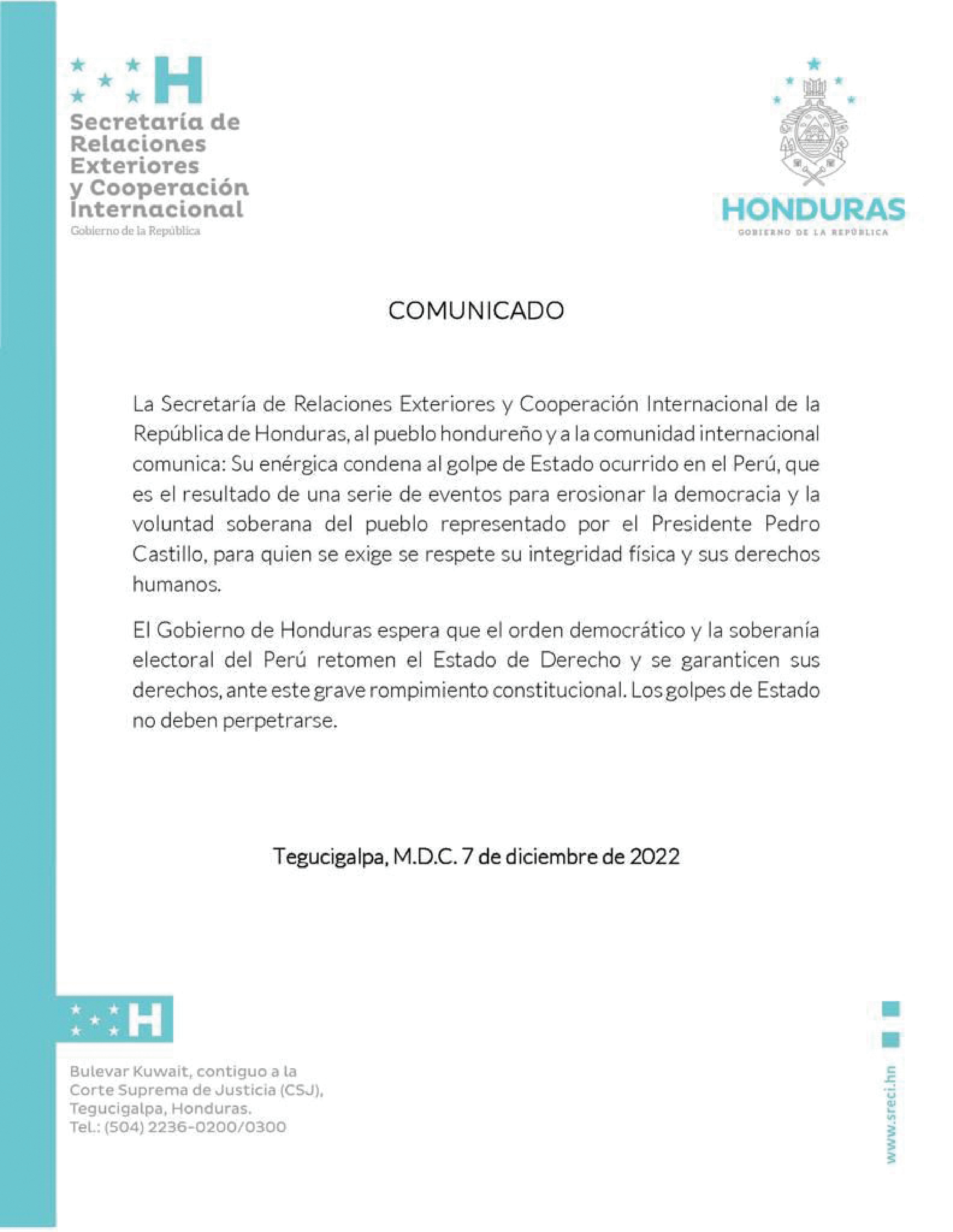
Honduras condemns coup in Peru

HONDURAS
Ministry of Foreign Affairs
and International Cooperation
Government of the Republic

COMMUNIQUÉ

The Ministry of Foreign Affairs and International Cooperation of the Republic of Honduras communicates to the Honduran people and the international community: Its energetic condemnation of the coup d’état that occurred in Peru, which is the result of a series of events to erode democracy and the sovereign will of the people represented by President Pedro Castillo, for whom it demands respect for his physical integrity and human rights.

The Government of Honduras hopes that the democratic order and electoral sovereignty of Peru will return to the rule of law and that its rights will be guaranteed in the face of this serious constitutional breakdown. Coups d’état must not be perpetrated.

Tegucigalpa, M.D.C. December 7, 2022

HONDURAS
Secretaría de Relaciones Exteriores
y Cooperacion lnternacional
Gobierno de República

COMUNICADO

La Secretaría de Relaciones Exteriores y Cooperación Internacional de la República de Honduras, al pueblo hondureño ya la comunidad internacional comunica: Su enérgica condena al golpe de Estado ocurrido en el Perú, que es el resultado de una serie de eventos para erosionar la democracia y la voluntad soberana del pueblo representado por el Presidente Pedro Castillo, para quien se exige se respete su integridad fisica y sus derechos humanos.

El Gobierno de Honduras espera que el orden democrático y la soberanía electoral del Perú retomen el Estado de Derecho y se garanticen sus derechos, ante este grave rompimiento constitucional. Los golpes de Estado no deben perpetrarse.

Tegucigalpa, M.D.C. 7 de diciembre de 2022

Strugglelalucha256


‘Nurses have had enough’: Largest-ever NHS strike kicks off in Britain

Tens of thousands of nurses across Britain are set to walk off the job Thursday in what’s been described as the largest-ever strike by National Health Service workers, who said they were forced to act after the government refused to negotiate over pay amid painfully high inflation.

The walkout represents NHS nurses’ first national strike, and it comes as British rail and postal workers are also taking major labor actions in response to falling real pay, meager benefits, and worsening conditions.

Nurses taking part in Thursday’s walkouts in England, Wales, and Northern Ireland — one of two scheduled days of action in the week—lamented that a strike became necessary but said they had no choice as inadequate pay and staffing shortages put themselves and patients in danger. Healthcare workers also pointed to years of Tory-imposed funding cuts as a factor harming nurses and compromising Britain’s public healthcare system.

“Nurses have had enough — we are underpaid and undervalued,” said nurse anesthetist Lyndsay Thompson of Northern Ireland. “Yes, this is a pay dispute but it’s also very much about patient safety. The fact we cannot recruit enough nurses means patient safety is being put at risk.”

Pat Cullen, general secretary and chief executive of the Royal College of Nursing (RCN) — the union that represents NHS nurses — said in a statement Thursday that “for many of us, this is our first time striking, and our emotions are really mixed.”

“The NHS is in crisis, the nursing profession can’t take any more, our loved ones are already suffering,” said Cullen. “It is not unreasonable to demand better. This is not something that can wait.”

https://twitter.com/josiahmortimer/status/1603334285917814785

The RCN said a strike became inevitable after British ministers declined every offer to start formal pay negotiations. Earlier this week, Cullen met with Tory Health Secretary Steve Barclay in a last-ditch effort to discuss pay before launching the national strike, but he refused to budge.

“I asked several times to discuss pay and each time we returned to the same thing—that there was no extra money on the table, and that they would not be discussing pay with me,” Cullen said. “I needed to come out of this meeting with something serious to show nursing staff why they should not strike this week. Regrettably, they’re not getting an extra penny.”

Strike actions had also been planned in Scotland, the RCN noted, but they were put on hold after the Scottish government agreed to negotiate.

According to the Health Foundation, an independent British charity, nurses saw a 5% pay cut between 2011 and 2021 when accounting for inflation.

Earlier this year, the British government backed a 4-5% pay raise for most NHS nurses, but the RCN said that’s far from enough given the country’s inflation rate of nearly 11%. RCN is demanding a 5% raise on top of inflation, which British officials have rejected as too high.

As a result of the strike, Thursday, and the next planned action on December 20, parts of the NHS will be shut down but urgent services will remain fully staffed.

recent survey found that nearly 60% of Britons support the nurses’ decision to approve a strike.

“It is a tragic first for nursing, the RCN, and the NHS,” Cullen told The Guardian of Thursday’s national walkout. “Nursing staff on picket lines is a sign of failure on the part of governments.”

Source: Common Dreams


Strugglelalucha256


Baltimore: Stop Price Rite Market closing – End food deserts! Dec. 17

SATURDAY, DEC 17, AT 2 PM – 3 PM
Stop Price Rite Market Closing – End Food Deserts
1205 W Pratt St, Baltimore

Join us in a community protest to stop the closing of the PriceRite Market Place and to end food deserts. We will be canvassing the neighborhood beginning at 12 pm and will start the picket at 2 pm.

Strugglelalucha256


Baltimore picket line: Drop the charges! Support squeegee workers! Dec. 19

MONDAY, DECEMBER 19, 2022, AT 5 PM
Picket Line: Drop The Charges! Support Squeegee Workers! Self-Defense Against Racism Is Not A Crime!
414 Light St, Baltimore

Peoples Power Assembly, together with the Prisoner Solidarity Committee and Youth Against War & Racism, has been holding demonstrations in defense of Tavon Scott Jr., a 15-year-old Black youth, who is alleged to have shot and killed a 48-year-old white man who attacked a group of squeegee workers with a baseball bat.

These organizations contend that self-defense against racism is not a crime and that the persecution of this Black youth is racist, riddled with double standards, and will serve to make an example of young Tavon and as a warning to Baltimore’s Black youth and workers.

Ahead of this case’s next hearing on December 20th, the Peoples Power Assembly will hold a demonstration and informational picket at the corner of Light Street and Conway Street, demanding: Justice for Tavon Scott Jr.! Drop the charges! Stop the attack on Black youth in Baltimore

Strugglelalucha256


U.N. rights group files brief about systemic racism in Mumia Abu-Jamal’s case

The United Nations Working Group of Experts on People of African Descent filed an amicus brief on Dec. 6 with the Philadelphia Court of Common Pleas Judge Lucretia Clemons regarding the case of Mumia Abu-Jamal.

“The United Nations Working Group of Experts on People of African Descent (WGEPAD) has followed Mumia’s case for years and has just filed an amicus brief for his hearing,” says Julia Wright, elder daughter of renowned author Richard Wright. “Given instances of the pervasive systemic racism tainting the case to this day, these experts note that international human rights law requires jurists to take responsibility for ongoing effects of racial discrimination, even decades later.”

According to WGEPAD’s amicus brief, “Presumed victims of racial discrimination are not required to show that there was discriminatory intent against them … The case of Mumia Abu-Jamal may present such concerns. …

“A significant percentage of the police officers involved in gathering evidence and presenting the case were investigated and eventually convicted and jailed on charges including corruption and evidence tampering, information that was unavailable to the jury at the time it was assessing the credibility, tendency toward bias, and reliability of these officers.”

Strugglelalucha256


Free Mumia Abu-Jamal now!

Statement of Vermont AFL-CIO President David Van Deusen

“The Vermont AFL-CIO declares that it is time that Mumia Abu Jamal, and all Black political prisoners in the U.S. who were engaged with organizing through the Black Panther Party, be set free! We also declare that the time has come for Organized Labor, without hesitation, to stand with working-class Black communities when they demand true freedom, economic equity, and self-determination!

“The long march towards true freedom and working class liberation has taken many turns since our anti-imperialist revolution of 1777. A generation ago, that turn, that righteous and justified struggle, brought us the Black Panther Party. This Party, one dedicated to engaging in the fight for Black liberation, socialism, and Power to The People served as an example of militant struggle across the U.S. and produced countless organizers and resistance leaders including brother Mumia Abu Jamal.

“Brother Jamal spent his free life struggling for the liberation of his people, and as he gained the ear of the many, as his fight for a better world become a threat to the entrenched ruling classes of Philadelphia, Pennsylvania, and the American Empire, those same ruling classes, through their agents, actively sought to silence him. And here, on trumped-up charges, after a charade of a trial, he was imprisoned and sentenced to death for a crime he did not commit. Like Sacco and Vanzetti, or Joe Hill before, the capitalist state sought to execute him, not for the crime he is innocent of, but because of the threat that his words and actions represented to the racist and classist status quo.

“The ruling class has, in fact, forced brother Jamal to ‘walk through the valley of the shadow of death,’ straight to death row, but brother Jamal, like so many of our political martyrs who have come before, has ‘feared no evil.’ And because of the outcry of tens of thousands of workers like you, because even the rich and powerful have been made to understand that if Mumia dies, Philly burns, he is still alive, and there is still a chance, through struggle, for true justice to prevail.

“Therefore I join with you today in the call for Mumia to be set free! I lend my voice to yours as we demand justice! I too say that brother Jamal must be led out from behind those prison bars of oppression, and back into the struggle for long overdue change! And together, through a working class unity which articulates the aspirations of all workers (be they Black, White, Latino, Native American, or Asian) may we endeavor to once and for all break the chains of exploitation and capitalism and deliver henceforth a new world grounded in economic equity, cooperation, a more direct and participatory democracy, and pro-Union to the core! Free Mumia Abu Jamal!”

David Van Deusen
President of the Vermont AFL-CIO

Strugglelalucha256


Uncertainty in Peru as the people remain in the streets

Peru is experiencing a new episode of its long history of institutional crisis. Today, a new president occupies the seat in the Government Palace, only 16 months after the country elected the leftist teacher Pedro Castillo, and Peruvians are once again suffering uncertainty about the political future of their Andean nation.

In his time in office, the teacher of humble origins has been cornered and unable to implement any social change because of a neoliberal unicameral congress that spent its time not legislating but plotting non-stop to impeach Castillo.

Congress’s decision to remove Castillo from office came after he tried to dissolve it, and that political move gave his former vice president Dina Boluarte a free hand to abandon Castillo’s loyalty, which got her there in the first place, to take his seat. The bottom line is that the coup was orchestrated by the rich elites of the country with encouragement from abroad.

According to Sebastian Fernandez De Soto, Peru analyst for Control Risks, “Castillo made a hasty decision to try to dissolve Congress, probably hoping to have the support of the people and the Armed Forces, but the reaction of the power elites was the opposite.”

Today, people are in the streets demanding justice and urging new elections. The death toll has risen to seven, and the number of people injured, including children, has increased to more than 100 due to police brutality. Meanwhile, the international community has strongly rejected this development in a sister country of the region, including strong statements from the presidents of Bolivia, Venezuela, Argentina, and Mexico condemning the coup and demanding Pedro Castillo’s release from prison.

The leftist teacher is the sixth president Peru has had since 2016, and this political instability has shaken confidence in the country’s credit rating, which had already been downgraded

Analyst Fernandez de Soto explained, “Peru has a dysfunctional political system, and this has once again become evident. The recent situation has accelerated the country’s deterioration, along with the depreciation of the local currency, which would compromise the evolution of the Gross Domestic Product in 2023. The crisis is deepening economic uncertainty, which could stimulate the paralysis of investments in key sectors such as mining,” he said.

But the people who popularly elected Castillo as their president are furious and believe the election has been stolen from them. Not only do they reject Bularte because of her illegitimacy, but they are also calling for a new constitution to replace the one imposed on them in 1993 by the reactionary Alberto Fujimori with one that would not grant power of the Congress over the figure of the president, who on this occasion was democratically elected.

There is a repetition now of the painful images of the protests that occurred in the country at the end of 2019 and the beginning of 2020 under the mandates of the ousted Martin Vizcarra (2018-2020) and Manuel Merino (2020). People beaten, the nights illuminated by firelight on barricades, and people fleeing police tear gas.

Thousands of Peruvians remain in front of Congress, demanding its closure. What will happen next? The only sure path to peace will be for Peru’s political leaders to respect the vote of its citizens and the human rights of its people, and for them to do that, the people will have to remain determined and mobilized.

Source: Resumen Latinoamericano – US

Strugglelalucha256
https://www.struggle-la-lucha.org/2022/12/page/4/