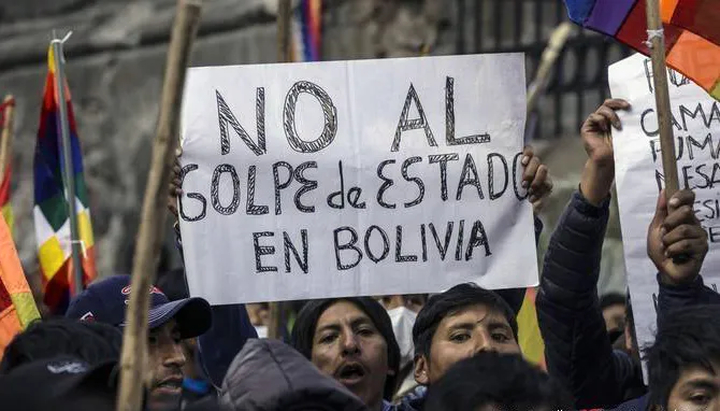
Bolivia in the crosshairs of Yankee hegemonism

No to the coup d’etat in Bolivia, Photo: Perez del Carpio, picture-alliance

Once again, the oligarchy allied with the U.S. government and the Yankee transnationals are waving in Bolivia the banner of division, rupture and regression to the past of exclusion, inequality and oblivion.

Camouflaged under the cloak of “rights,” the narrative of the soft coup seeks to destabilize the country, tear down the pillars that support the plurinational State and bring about chaos leading to a new coup d’état.

It is not surprising that, recently, the governor of Santa Cruz, Luis Fernando Camacho, took up again his proposal for a “federal Bolivia,” a project that aims “to confront the plurinational State model” established in the Constitution.

The plurinational State was consecrated by the 2009 Constitution, Magna Carta promulgated by President Evo Morales (2006-2019), which proclaims a “decentralized and autonomous” Bolivia.

The conservative sectors of Santa Cruz defend the idea of federalism, even with a proposal for autonomy that did not prosper in the Constituent Assembly of 2007-2008.

The national strike called in the department of Santa Cruz (east) to demand a census in 2023 is going on without its organizers listening to reason, despite the government’s constant commitment to dialogue and understanding.

The President of Bolivia, Luis Arce, presented, this past Friday night, the work of the technical table that will have the purpose of defining the date of the new national census.

At the opening ceremony, held in the city of Trinidad, capital of the department of Beni, the Bolivian president denounced the attempts of the ultra-right to overthrow him.

“This view of the census, unfortunately, generated a political approach, since it was not only used as an instrument of destabilization of the government, but also seeks to overthrow it,” said the Bolivian Head of State.

The Population and Housing Census, established in the Bolivian Constitution to be carried out every ten years, was announced for November 16, 2022, but was postponed for technical reasons to 2024.

The results from the population registry are used for the reallocation of parliamentary seats in each region and the redistribution of public resources, which is based on data from the last census in 2012.

Recently, President Arce exposed the true coup intentions of the opposition, which are hidden behind destabilizing actions, such as the indefinite departmental strike called by Governor Luis Fernando Camacho in Santa Cruz on October 22.

According to Bolivian political analyst and sociologist Eduardo Paz Rada, this is an action that seeks to bring about the fall of the government. “For the great majority of the people of Santa Cruz, this is an action of the oligarchic elites of Santa Cruz, who want to generate a political conflict,” said the analyst to Telescopio.

Meanwhile, the leader of the Movement Towards Socialism (MAS) and former Bolivian president, Evo Morales, asked the militancy of that organization to avoid the provocations of those who want to generate violence in the country.

Who pulls the strings that rocks the cradle

The social researcher and writer Marcelo Colussi, born in Argentina, wrote: “we must never forget that the enemy is not the master’s bodyguard: he is still the master.”

The United States is losing ground, and its projected dream of an American 21st century is fading. It is no secret to anyone today that the People’s Republic of China, with its booming economy, is on its way to becoming the world’s number one power by 2030 at the latest, and Russia is not far behind.

The confluence of international interests of these two powerful nations and their allies make them an influential alternative front to U.S. power, with increasing weight south of the Rio Grande.

In these circumstances, the United States believes it is more necessary than ever to control its “backyard” to subdue the restless nations of the continent in any way possible. In the U.S. geopolitical map, Bolivia plays an extremely important role due to its geographic location and the enormous wealth of its minerals in the soil.

These are the reasons this nation is in the crosshairs of the main actions of unconventional warfare to bring about a regime change that favors the interests of the empire. If we follow, step by step, what is happening today in the South American sister nation, we will see that the tactic used in 2019 is being repeated.

It is not surprising then that, in the recent U.S. report presented by the Government of Joe Biden, the farce that, in October 2019, the then-candidate and also president, Evo Morales (2006-2019), committed electoral fraud to stay in power, a version sustained by the Organization of American States (OAS), is reaffirmed.

This document constitutes an endorsement of the de facto government that the U.S. financed, supported, and defended, as well as a significant encouragement to the opposition to Luis Arce’s government.

Source: Granma, translation Resumen Latinoamericano – US

Strugglelalucha256


The best elections money can buy

Nov. 10 — After the midterm elections, it looks like the Democrats may keep running the U.S. Senate. The Republicans may take over the House of Representatives by a small margin.

Meanwhile, Mumia Abu-Jamal and Leonard Peltier continue to be unjustly imprisoned. These two political prisoners have each spent more than 40 years in jail after being framed. 

At thousands of food banks across the United States, people will stand in line—sometimes for hours—in order to feed their families. In states that provide deposits on cans and bottles, seniors will collect them in order to eat or pay their rent. Capitalist elections won’t change this misery.

Big capitalists are the real winner of U.S. elections. Over $16.7 billion was spent on them. 

Some 465 billionaires dumped $881 million into the midterms. This dough could house thousands of homeless children. For the super-rich it’s just chump change.

While people voted for candidates, money bags were buying their employees. That’s if they don’t run for office themselves, like the billionaire Democrat J.B. Pritzker, who got re-elected as Illinois governor.

Real-estate tycoon Rick Caruso is dipping into his $4 billion stash to become mayor of Los Angeles. He’s trying to defeat congresswoman Karen Bass, who if elected would be the first Black woman mayor of the metropolis.

Despite most of the polls predicting a Republican sweep of the elections, poor and working people said no. They voted in 2020 for an end to over 40 years of political reaction and cutbacks.

President Biden deserves none of the credit for limiting Republican gains. It was hundreds of thousands of volunteers operating out of Black churches and union halls that defeated Donald Trump’s clones.

Biden could immediately free 78-year-old American Indian Movement leader Leonard Peltier, who has spent 46 years in jail. With another pen, he could largely normalize relations with Cuba. 

The man in the White House refuses to do either. Biden and Congress instead have shoveled over $70 billion into a war against the Russian Federation that could lead to World War III.

A sewer of hate

It’s good that the midterm elections are over. They featured a gusher of racism and bigotry that poisoned millions.

Immigrants with their children seeking asylum were described as invaders.

It was racism that Wisconsin Sen. Ron Johnson used to narrowly defeat the Black Lt. Gov. Mandela Barnes. In a debate, Johnson claimed Barnes “incited” the anti-racist uprising in Kenosha following the police shooting of Jacob Blake. 

Some of Johnson’s ads featured pictures of Barnes that darkened his skin. Wisconsin Gov. Tony Evers attacked Johnson’s racism. 

While the white Democratic governor was re-elected by an 89,000-vote margin, Mandela Barnes narrowly lost by 27,000 votes.

It was bigotry that re-elected Florida Gov. Ron DeSantis with a 1.5 million vote landslide. Voter suppression also helped.

DeSantis spent years attacking Black history—calling it “critical race theory”—and forbade school discussion of gender and sexuality with a “don’t say gay” law.

Most heartbreaking and dangerous was DeSantis forbidding medical and gender-affirming care for transgender youth.

Fox News and the New York Post propelled Trump-supporting Congressman Lee Zeldin’s campaign to be New York governor. Zeldin got 47% of the vote on a lock-em-up, pro-cop and jail-the-poor platform.

Zeldin promised that he would fire Manhattan District Attorney Alvin Bragg, the first Black person to be elected to that post.

A special target of Zeldin was bail reform, which was enacted after the innocent Black youth Kalief Browder committed suicide. Browder spent three years in jail because he couldn’t afford cash bail.

Rick Caruso’s drive to become Los Angeles mayor was also a law-and-order campaign that featured attacks on homeless people. That doesn’t prevent the pop singer Katy Perry from supporting this billionaire bigot. 

Organize to fight back!

Even in conservative states where the working class is more suppressed, people will vote for progressive issues.

Voters in Kentucky voted against adding an anti-abortion amendment to the state constitution. In South Dakota, voters passed a referendum to expand Medicaid that will cover 40,000 more poor people. 

Many people will feel relieved that some of the worst bigots were defeated in the midterms. But the election results will be used to try to push through more cutbacks, including cuts in social security and Medicare.

That’s what happened after the Republicans won control of Congress in 1994. Then-Speaker of the House Newt Gingrich wanted to take thousands of Black children away from their parents and put them in orphanages.

It was 2 million Black people coming to the 1995 Million Man March, followed by another 2 million Black people in the 1997 Million Woman March, that stopped Gingrich. Not Democratic President Bill Clinton, who wanted to go along with Gingrich’s reactionary program.

Biden’s Labor Secretary Marty Walsh has already threatened railroad workers with congressional action if they go on strike. All workers have the right to strike!

We need to continue organizing. Social Security needs to be expanded. The minimum monthly benefit should be raised to $2,600. 

Whoever is in the White House, police will continue to kill an average of three people a day across the United States. It was Joe Biden, as a U.S. senator, who helped pass the mass incarceration laws in the 1990s. 

We need to bring people in prison home to their families. Workers at Amazon, Starbucks and every other workplace need union wages, protection and benefits.

Using the excuse of a looming recession, the billionaires will demand more cutbacks. The only answer is more fightback.

Strugglelalucha256


Why we should commemorate Nov. 11

Even though Veterans Day is a federal holiday, only 19 percent of workers employed by private business get the day off. Originally called Armistice Day, it marks the end of World War I “at the 11th hour on the 11th day of the 11th month” of 1918.

Twenty million people were killed during this imperialist war, half of whom were civilians. It was waged between colonial powers that had enslaved hundreds of millions in Africa, Asia and the Americas.

Lenin, the leader of the socialist Bolshevik Revolution, called it a “war between the biggest slaveowners for preserving and fortifying slavery.”

The Belgian King Leopold II had killed as many as 15 million Africans in Congo for rubber profits. British capitalists made fortunes from famines in India and occupied a quarter of the planet. Fresh from genocidal wars against Indigenous nations, the U.S. army had killed a million Filipina/os fighting for independence.

Another 50 million people died in the 1918-1919 influenza pandemic that may have started at U.S. Army bases in Kansas.

Around 117,000 U.S. GIs died in the war. Three months after the U.S. entered the conflict, at least 100 Black people were murdered in East St. Louis, Ill., by white racist mobs.

Black soldiers returning from combat were among those killed in the race riots that swept U.S. cities in 1919. But World War I was swell for U.S. big business.

According to Marine Corps Maj. Gen. Smedley Butler in his book “War is a Racket,” “at least 21,000 new millionaires and billionaires were made in the United States during the World War. That many admitted their huge blood gains in their income tax returns. How many other war millionaires falsified their tax returns no one knows.”

This was back in 1918, when the dollar was worth 16 times as much as it is now.

The du Ponts weren’t even mentioned in “The History of Great American Fortunes” by Gustavus Myers, which was published in 1909. The family’s vast profits from selling explosives during World War I catapulted them into the superrich.

Besides their chemical empire, the du Ponts controlled General Motors, which had been the world’s largest corporation, for decades.

Never forget Nat Turner

So why should poor and working people commemorate Nov. 11? Because on Nov. 11, 1831, the liberator Nat Turner was executed.

Turner led a revolt of enslaved Africans in Virginia that terrified all the slave owners. Beginning on Aug. 21, 1831, Black people marched from plantation to plantation in Southampton County fighting for liberation. Black Panther Field Marshal George Jackson was murdered 140 years later on Aug. 21, 1971, in California’s San Quentin prison.

The reaction of slave masters was merciless. They thought they were facing another Haitian Revolution.

Soldiers and sailors were mobilized to crush the rebellion. Militia members were sent from both Virginia and North Carolina.

The Rev. G.W. Powell said there were “thousands of troops searching in every direction,” with many Black people killed. The editor of the Richmond Whig newspaper admitted that “men were tortured to death, burned, maimed and subjected to nameless atrocities.” (“Before the Mayflower, A History of Black America” by Lerone Bennett Jr.)

Nat Turner was captured but never flinched. He was executed in Jerusalem, Va. It’s named after the eternal capital of Palestine, also known as Al-Quds.

The slave masters called Nat Turner a “terrorist.” That’s the same term used today to smear Palestinian freedom fighters.

Hanged for the eight-hour day

Labor leaders George Engel, Adolph Fischer, Albert Parsons and August Spies were hanged in Chicago’s Cook County Jail on Nov. 11, 1887. Twenty-three-year-old Louis Lingg was also slated to be executed, but he was either murdered or committed suicide the day before.

These martyrs died for the eight-hour work day. Most workers in those days worked 10 or 12 hours a day, sometimes even longer.

On May 1, 1886, hundreds of thousands of workers across the U.S. went on strike to demand an eight-hour work day. Capitalists were terrified. Workers marched from factory to factory urging employees to strike.

Chicago was the center of this movement. Chicago police fired on striking workers at the McCormick reaper works — which later became part of International Harvester — on May 3, killing at least two.

The next day, a protest meeting was called at Chicago’s Haymarket Square. Police attacked the crowd, and someone threw a bomb at the cops. Eight policemen died as well as possibly some protesters.

The ruling class went berserk. Police arrested hundreds, but the bomber, who may have been a provocateur, was never found.

Instead, well-known labor leaders were put on trial for their lives because they supposedly incited the bombing. Years later, Illinois Gov. John Peter Altgeld courageously pardoned those who had been jailed.

Four of the five Haymarket Martyrs were immigrants. All were labeled anarchists. Trump wants us to hate immigrants while he calls anti-racist protesters “anarchists.”

As he was about to be hanged, Albert Parsons declared, “The day will come when our silence will be more powerful than the voices you strangle today.”

Lucy Parsons, a Black woman who was Albert Parsons’ partner, continued fighting for the working class until she died in a house fire in 1942. Chicago police said that she was “more dangerous than a thousand rioters.” Lucy Parsons’ books and papers were confiscated by the FBI.

May 1 became the international holiday of the working class. In Mexico, it’s known as the Day of the Chicago Martyrs.

Long live the People’s Republic of Angola!

The People’s Republic of Angola was born on Nov. 11, 1975. Vice President Nelson Rockefeller, along with his employees Secretary of State Henry Kissinger and White House occupant Gerald Ford, sought to kill it. They had the Nazi armies of then-apartheid South Africa invade the African country.

Angola’s independence was historical justice that resonated around the world. Four million Angolans had been kidnapped in a slave trade that lasted four centuries. Brazil’s sugar plantations were fed by Angolan slave pens.

Millions of Brazilians have Angola in their blood. So do some African Americans.

The largest prison in the U.S. is in Angola, La. The sugar plantation which became the core of the prison was named Angola because that’s where the enslaved Africans working there came from.

Today, thousands of slaves work on the Angola prison’s 18,000 acres. The “Angola 3” — Herman Wallace, Robert King Wilkerson and Albert Woodfox — spent decades in solitary confinement on frame-up charges of killing a prison guard before being freed.

Their real crime was forming a chapter of the Black Panther Party. Herman Wallace died of liver cancer a few days after being released.

Five hundred years of Portuguese colonialism in Angola were 500 years of resistance. The founding of the Popular Movement for the Liberation of Angola (MPLA) in 1956 was a decisive step. Forced labor was halted only after 50,000 Angolans were killed during the 1961 revolts.

When South Africa invaded Angola, Cuba came to Africa’s assistance. As the Pan African educator and organizer Elombe Brath said, “When Africa called, Cuba answered.” Two thousand Cuban soldiers died fighting alongside their African comrades.

The initial defeat of South Africa helped inspire the Soweto Uprising on June 16, 1976. The total defeat of the apartheid army at Cuito Cuanavale in 1988 led to Nelson Mandela walking out of prison two years later.

So let us remember Nat Turner and the Haymarket Martyrs while celebrating Angola’s independence. And be prepared to stop any new wars for the rich.

Strugglelalucha256


Philadelphia: Come out for Mumia Abu-Jamal, Dec. 16

Philadelphia: Come out for Mumia Abu-Jamal

Friday, Dec. 16 – 9:00 a.m.

Criminal Justice Center, 1301 Filbert Street, Philadelphia

Strugglelalucha256


Baltimore film screening: Alex Saab, a Kidnapped Diplomat, Nov. 17

Baltimore Film Screening Premiere

“Alex Saab: A Kidnapped Diplomat”

Thursday, November 17, 7 pm @

NoMüNoMü Arts Collaborative
709 N. Howard Street,
Baltimore, MD 21201

Presented by: NoMüNoMü Arts Collaborative and Peoples Power Assembly

Endorsed by Prisoners Solidarity Committee, Women In Struggle, Struggle La Lucha/Socialist Unity Party (partial list)

Alex Saab is a Venezuelan diplomat, illegally detained in the U.S.

His next hearing is on December 12 in Miami.

Demand the Department of Justice drop the charges against Alex Saab.

To learn more about his important case and why this amounts to kidnap by the U.S. government, you can go to: https://afgj.org/alex-saab-case-the-fabrication…

*Attend this important screening and find out what you can do to work toward the freedom of Alex Saab.

Strugglelalucha256


New York City: Transphobes not welcome! Nov. 14

TERFS & anti-trans allies are ending their nationwide speaking tour here in NYC. But our voices are louder than their hate!
NYC, TELL EM: TRANSPHOBES NOT WELCOME!
Monday 11/14, midday
Exact time + location TBA
WATCH THIS SPACE!!
(@warmup_nyc on Instagram)
Bring your noisemakers, signs, and friends to show them NYC is not the platform they’re looking for.
From PDX to Chitown, we’ll show up and shut TERFs down!
Strugglelalucha256


Baltimore Solidarity Event for National Day of Mourning

THURSDAY, NOVEMBER 24, 2022 AT 12 PM – 1 PM
Baltimore Solidarity Event Day of Mourning
McKeldin Square

IMPORTANT BACKGROUND FROM UNITED AMERICAN INDIANS OF NEW ENGLAND
53rd Annual National Day of Mourning
November 24, 2022, 12:00 Noon Cole’s Hill (above Plymouth Rock), Plymouth, MA
Since 1970, Indigenous people & their allies have gathered at noon on Cole’s Hill in Plymouth to commemorate a National Day of Mourning on the US Thanksgiving holiday. Many Native people do not celebrate the arrival of the Pilgrims & other European settlers. Thanksgiving Day is a reminder of the genocide of millions of Native people, the theft of Native lands and the erasure of Native cultures. Participants in National Day of Mourning honor Indigenous ancestors and Native resilience. It is a day of remembrance and spiritual connection, as well as a protest against the racism and oppression that Indigenous people continue to experience worldwide.
Join us as we continue to create a true awareness of Native peoples and history. Help shatter the untrue image of the Pilgrims and the unjust system based on racism, settler colonialism, sexism, homophobia and the profit-driven destruction of the Earth that they and other European settlers introduced to these shores.
Solidarity with Indigenous struggles throughout the world!
We welcome all our relations crossed by the US border & ICE.
In 2022, while many supporters will attend in person, we will also livestream the event from Plymouth.
United American Indians of New England (decolonizing since 1970)
info@uaine.org * UAINE website * UAINE Facebook Group
Facebook event Donate Masks required! No social, but light box lunches may be available. #MasksUpMayflowersDown #NDOM2022 #NoThanksNoGiving
Strugglelalucha256


El malestar de Japón en la nueva guerra fría

A principios de octubre, las Fuerzas de Autodefensa de Japón y la Armada estadounidense se unieron para el Resolute Dragon. Durante la apertura del ejercicio en 2021, Jay Bargeron, general de la 3ª División de Marines de EE.UU. declaró que Estados Unidos está “preparado para luchar y ganar si se le convoca. Resolute Dragon 2022 siguió a la reanudación en septiembre de los ejercicios militares trilaterales de Japón, Corea del Sur y EE.UU. frente a la península coreana, que se habían suspendido cuando el anterior Gobierno surcoreano intentó acercarse a Corea del Norte. En noviembre, las fuerzas armadas estadounidenses y japonesas se unirán a las de Australia, Canadá y el Reino Unido para realizar el ejercicio Keen Sword, frente a aguas japonesas.

EE.UU. mantiene esta postura a pesar de las reiteradas aclaraciones chinas incluyendo la del vocero del Ministerio de Asuntos Exteriores, Zhao Lijian, este noviembre de que nunca buscará la hegemonía ni se dedicará al expansionismo.

Resolute Dragon 2022 se realizó en un contexto de tensión entre EE.UU. y China, con la Estrategia de Seguridad Nacional estadounidense identificando a China como su “única competencia. Siguiendo su propia lógica histórica, EE.UU. considera que China necesita ser limitada por sus aliados regionales y sitúa a Japón en el centro de su nueva Guerra Fría contra China.

Artículo 9

La Constitución japonesa (1947) prohíbe construir una fuerza militar agresiva. Dos años después de que se incluyera en la Constitución el artículo 9 (a instancias de la ocupación estadounidense) la Revolución China triunfó y EE.UU. comenzó a reevaluar el desarme de Japón. Los debates sobre la revocación del artículo comenzaron al inicio de la Guerra de Corea (1950), cuando el Gobierno estadounidense presionó al primer ministro japonés, Shigeru Yoshida, para reforzar el ejército y militarizar la Reserva de la Policía Nacional; de hecho, la Enmienda Ashida al artículo 9 debilitó el compromiso japonés con la desmilitarización y abrió la puerta al rearme a gran escala.

La opinión pública japonesa está en contra de la eliminación del artículo 9. No obstante, Japón ha incrementando su capacidad militar. En el presupuesto 2021, añadió 7.000 millones de dólares (7,3%) al presupuesto militar (de 54.100 millones de dólares), el mayor incremento anual desde 1972, según el Instituto Internacional de Investigación para la Paz de Estocolmo. En septiembre 2022, el Ministro de Defensa, Yasukazu Hamada, dijo que Japón reforzaría radicalmente las capacidades de defensa que necesitamos. Para protegernos, es importante que tengamos no sólo material como aviones y barcos, sino también suficiente munición para ellos. Japón aumentará su presupuesto militar en un 11% anual hasta 2024.

En diciembre, Japón dará a conocer una nueva Estrategia de Seguridad Nacional, la primera desde 2014. El primer ministro Fumio Kishida declaró al Financial Times: Estaremos totalmente preparados para responder a cualquier escenario posible en el este de Asia para proteger las vidas y el sustento de nuestro pueblo. Parece que Japón se precipita hacia más roces con China, su mayor socio comercial.

Este artículo fue producido para Globetrotter. Vijay Prashad es un historiador, editor y periodista indio. Es miembro de la redacción y corresponsal en jefe de Globetrotter. Es editor en jefe de LeftWord Books y director del Instituto Tricontinental de Investigación Social. También es miembro senior no-residente del Instituto Chongyang de Estudios Financieros de la Universidad Renmin de China. Ha escrito más de 20 libros, entre ellos The Darker Nations y The Poorer Nations. Sus últimos libros son Struggle Makes Us Human: Learning from Movements for Socialism y The Withdrawal: Iraq, Libya, Afghanistan, and the Fragility of U.S. Power (con Noam Chomsky).

Strugglelalucha256


La situación de Guinea pone al descubierto la codicia de las empresas mineras extranjeras en el Sahel

El 20 de octubre de 2022, en Guinea, el Frente Nacional de Defensa de la Constitución (FNDC) llamó a protestar en las calles. Los manifestantes exigían al Gobierno militar (el Comité Nacional de Reconciliación y Desarrollo, o CNRD) libertad para los presos políticos y un marco para regresar a un Gobierno civil. Se enfrentaron violentamente a las fuerzas de seguridad y en Conakry, la capital, al menos cinco personas resultaron heridas y tres murieron por heridas de bala. Los principales actos de violencia se produjeron en Ratoma, una de las comunas más pobres.

En septiembre de 2021, el CNRD, dirigido por el coronel Mamady Doumbouya, derrocó al Gobierno de Alpha Condé, con más de una década en el poder e impregnado de corrupción. En 2020, el Colectivo para la Transición en Guinea (CTG) denunció por soborno ante la Fiscalía Nacional Financiera al hijo de Alpha Condé (Alpha Mohamed Condé) y al ministro de Defensa (Mohamed Diané). Los acusaban de recibir sobornos de un consorcio internacional a cambio de derechos de explotación de bauxita cerca de Boké.

Boké, al noroeste de Guinea, es el epicentro de la extracción de bauxita (esencial para el aluminio). Guinea posee las mayores reservas del mundo de este mineral (estimadas en 7.400 millones de toneladas métricas) y es el segundo productor a nivel mundial (después de Australia). Toda la minería de Guinea está controlada por empresas multinacionales, como Alcoa (estadounidense), China Hongqiao y Rio Tinto Alcan (anglo-australiana), asociadas a entidades estatales guineanas.

Cuando el CNRD tomó el poder, uno de los temas principales era el control de los ingresos de la bauxita. En abril de 2022, Doumbouya reunió a las principales empresas mineras y dijo que antes de finales de mayo tenían que presentar una hoja de ruta para la creación de refinerías de bauxita en Guinea o abandonar el país. Doumbouya declaró: A pesar del auge de la minería en el sector de la bauxita, está claro que los ingresos previstos están por debajo de las expectativas. No podemos seguir con este juego de tontos que perpetúa una gran desigualdadentre Guinea y las empresas internacionales. El plazo se ha ampliado hasta junio, y las exigencias del ultimátum para cooperar o marcharse continúan.

Al igual que los Gobiernos militares de Burkina Faso y Mali, el CNRD en Guinea, llegó al poder en un contexto popular de hartazgo de las oligarquías locales y del dominio francés. Los comentarios de Doumbouya en 2017 en París reflejan este sentimiento. Dijo que los militares franceses en Guinea subestiman las capacidades humanas e intelectuales de los africanos… Tienen actitudes altaneras y se toman por el colono que todo lo sabe, que todo lo domina. Este Gobierno golpista conformado por una fuerza antiterrorista de élite creada por Alpha Condé – ha captado las frustraciones de la población, pero es incapaz de construir un programa viable para salir de la dependencia de las empresas mineras extranjeras. Mientras tanto, es poco probable que las protestas por el retorno a la democracia sean sofocadas.

Este artículo fue producido para Globetrotter. Vijay Prashad es un historiador, editor y periodista indio. Es miembro de la redacción y corresponsal en jefe de Globetrotter. Es editor en jefe de LeftWord Books y director del Instituto Tricontinental de Investigación Social. También es miembro senior no-residente del Instituto Chongyang de Estudios Financieros de la Universidad Renmin de China. Ha escrito más de 20 libros, entre ellos The Darker Nations y The Poorer Nations. Sus últimos libros son Struggle Makes Us Human: Learning from Movements for Socialism y The Withdrawal: Iraq, Libya, Afghanistan, and the Fragility of U.S. Power (con Noam Chomsky).

Strugglelalucha256


¿Es la prohibición de los chips de EE. UU. a China una declaración de guerra en la era de la computadora?

Los Estados Unidos han hecho una gran apuesta con sus últimas sanciones globales a empresas chinas de la industria de los semiconductores, creyendo que puede dispararle en la rodilla a China y retener la dominación global. Desde los eslóganes de la globalización y el “libre mercado” de los neoliberales 90, Washington ha regresado a “la vieja confiable” de los regímenes de denegación tecnológica que, junto a sus aliados, siguieron durante la Guerra Fría. Mientras que en el corto plazo pudiese ser efectivo para disminuir la velocidad de los avances chinos, en el largo plazo, para la industria del semiconductor estadounidense, el costo de perder a China (su mercado más grande) tendrá consecuencias importantes. En el proceso, las industrias del semiconductor de Taiwán y Corea del Sur, más los fabricantes de equipos en Japón y la Unión Europea, tienen más probabilidades de convertirse en daño colateral. Algo que nos recuerda de nuevo lo que una vez dijo el ex secretario de Estado Henry Kissinger: “Ser enemigo de los Estados Unidos puede ser peligroso, pero ser su amigo es fatal”.

El propósito de las sanciones estadounidenses (de segunda generación luego de las primeras en agosto de 2021) es restringir la capacidad de China para importar chips de computación, desarrollar y mantener supercomputadores, y fabricar semiconductores avanzados. Aunque las sanciones se esconden bajo términos militares negarle a China el acceso a tecnologías y productos que pudieran ayudar al ejército chino en realidad, apuntan contra todos los principales actores del semiconductor en China y, por lo tanto, también su sector civil. La ficción de “excluir el uso militar” solamente le ofrece una débil cobertura de acceso a todos, bajo las excepciones Organización Mundial de Comercio (OMC) en tener que proporcionar acceso al mercado a todos los miembros de la OMC. La mayoría de las aplicaciones militares emplean chips de viejas generaciones y no las últimas versiones.

Las sanciones específicas que los Estados Unidos impusieron incluyen:

  • Chips logic avanzados, requeridos en inteligencia artificial y computación de alto rendimiento

  • Equipos de 16nm logic y otros chips avanzados como FinFET y Gate-All-Around

  • La última generación de chips de memoria: NAND con 128 capas o más y DRAM con 18nm half-pitch

En las reglas, las ​prohibiciones de equipos específicos van aún más allá, incluyendo muchas tecnologías de vieja data. Por ejemplo, un comentarista señaló que la prohibición de herramientas es tan amplia que incluye tecnología usada por IBM a finales de los años 90.

Las sanciones también abarcan cualquier compañía que emplee tecnología o productos estadounidenses en esa cadena de suministro. Esta es una cláusula en sus leyes: cualquier empresa que “toque” a los Estados Unidos mientras se fabrican sus productos será llevada automáticamente al régimen de sanciones estadounidense. Es una extensión unilateral de la jurisdicción legal del país y puede ser empleada para castigar y destruir a cualquier entidad una empresa o cualquier otra institución que esté vinculada directa o indirectamente a los Estados Unidos. Estas sanciones están diseñadas para desconectar por completo la cadena de suministros de los Estados Unidos y sus aliados países de la Unión Europea y del este asiático con China.

Además de las últimas sanciones contra compañías que ya se encuentran en la lista de empresas chinas sancionadas, unas 31 compañías adicionales han sido añadidas a su “lista sin verificar”. Estas empresas deben suministrar toda la información a las autoridades estadounidenses en dos meses, o de lo contrario también serán excluidas. Aún más, ningún ciudadano estadounidense o nadie domiciliado en los Estados Unidos podrá trabajar para compañías sancionadas o en la lista sin verificar, ni siquiera para mantener o reparar equipos entregados con anterioridad.

Actualmente el tamaño de la industria global de los semiconductores es de más de 500 mil millones de dólares y es probable que para 2030 se duplique hasta un billón. Según un informe de la Asociación de la Industria de los Semiconductores y el Boston Consulting Group de 2020 (“Cambiando la marea para la fabricación de semiconductores en Estados Unidos”) se espera que China llegue a dar cuenta del 40% del crecimiento de la industria en 2030, desplazando a los Estados Unidos como el líder global. Este es el desencadenante inmediato para las sanciones y su intento de frenar a la industria china quitándole el liderazgo a los Estados Unidos y sus aliados.

​​Mientras que las medidas mencionadas más arriba tienen la intención de aislar a China y limitar su crecimiento, hay una desventaja para los Estados Unidos y sus aliados al sancionar al país asiático.

El problema para los Estados Unidos aún más para Taiwán y Corea del Sur es que China es su mayor socio comercial. Imponer este tipo de sanciones a equipos y chips también significa destruir una buena parte de su propio mercado sin perspectivas de un reemplazo inmediato. Esto es cierto no solo para los vecinos de China en el este asiático sino también para fabricantes como la compañía holandesa ASML, el único proveedor del mundo de máquinas de litografía de ultravioleta extrema (EUV) que produce los chips más recientes. Para Taiwán y Corea del Sur, China no solo es el destino de exportación más grande para su industria de semiconductores, como también de otras industrias, sino que además es uno de sus mayores abastecedores de una gama de productos. Es probable que la separación forzada de China de la cadena de suministros venga también acompañada de la ruptura con otros sectores.

También es probable que las empresas estadounidenses reciban un golpe a sus balances, incluyendo fabricantes de equipos como Lam Research Corporation, Applied Materials y KLA Corporation; las herramientas de diseño automático electrónico (EDA, por sus siglas en inglés) como Synopsys y Cadence; y proveedores de chips avanzados como Qualcomm, Nvidia y AMD. China es el mayor destino para todas estas compañías. El problema para los Estados Unidos es que China no sólo es la parte del mundo con mayor crecimiento de su industria de semiconductores, sino que también es su mercado más grande. Así que las últimas sanciones no sólo perjudican a las empresas chinas en la lista, sino también a las firmas de semiconductores estadounidenses, secando una parte importante de sus ganancias y, por lo tanto, su futuro en inversiones para investigación y desarrollo en tecnología. Mientras algunos de los recursos para inversiones provendrán del Gobierno estadounidense por ejemplo, el subsidio de 52,7 mil millones de dólares para la fabricación de chips no se comparan con las pérdidas en su industria que sufrirá como resultado de las sanciones a China. Por todo esto, la industria de semiconductores ha sugerido sanciones más limitadas en su objetivo a la industrias de defensa y seguridad chinas, no las sanciones abarcantes que ahora introdujo Washington: el escarpelo en vez del martillo.

​​El proceso de separar el régimen de sanciones y la cadena de suministros global no es un concepto nuevo. Los Estados Unidos y sus aliados tuvieron una política similar con la Unión Soviética durante y después de la Guerra Fría, vía el Comité Coordinador para el Control Multilateral de las Exportaciones (COCOM, por sus siglas en inglés) (reemplazado en 1996 por el Acuerdo de Wassenaar), el Grupo de Abastecedores Nucleares, el Régimen Tecnológico de Control de Misiles y otros grupos de la misma naturaleza. En esencia, fueron regímenes de denegación tecnológica que se aplicaron a cualquier país que los Estados Unidos considerase “enemigo”, con sus aliados siguiendo entonces y ahora lo que dictase Washington. Los objetivos en la lista de prohibición de exportación no sólo fueron los productos específicos sino también las herramientas que pudieran ser empleadas para fabricarlos. No únicamente en los países del bloque socialista sino también en otros que también, como India, fueron excluidos de acceder a tecnología avanzada, incluyendo supercomputadores, materiales avanzados y herramientas para maquinaria de precisión. Bajo esta política, el equipo crítico que India requería para sus industrias espacial y nuclear fueron puestas bajo completa prohibición. Aunque el Acuerdo de Wassenaar todavía existe, con países incluso como Rusia e India ahora dentro del ámbito del Acuerdo, no representa una amenaza. La verdadera amenaza proviene de pelearse con el régimen de sanciones estadounidenses y la interpretación de sus leyes suplantando a la legislación internacional, incluyendo las reglas de la OMC.

La ventaja que tuvieron antes los Estados Unidos y sus aliados militares dentro de la Organización del Tratado para el Atlántico Norte (la Organización del Tratado del Sureste Asiático, y la Organización del Tratado Central) fue que EE. UU. y sus aliados europeos eran los mayores fabricantes del mundo. Estados Unidos también controló los hidrocarburos de Asia occidental (petróleo y gas), un recurso vital para todas las actividades económicas. La actual guerra del chip contra China está siendo librada en un momento en el que China se ha convertido en el mayor centro manufacturero del mundo y el mayor socio comercial del 70% de los países del mundo. Con la Organización de Países Exportadores de Petróleo desobedeciendo los dictámenes de los Estados Unidos, Washington ha perdido el control del mercado energético global.

Así que, ¿por qué los Estados Unidos comenzó esta guerra del chip contra China en un momento en que sus posibilidades de ganar son limitadas? En el mejor de los casos, puede aplazar el ascenso de China como potencia militar de primer orden y la mayor economía del mundo. Una explicación yace en lo que algunos historiadores militares llaman “la trampa de Tucídides”: cuando un poder emergente rivaliza con un poder militar dominante, la mayoría de este tipo de casos conducen a la guerra. Según el historiador ateniense Tucídides, el ascenso de Atenas llegó a que Esparta, para el momento el poder militar dominante, fuera a la guerra con ella, en el proceso destruyendo a ambas ciudades-estados; por lo tanto, la trampa. Mientras tales alegatos han sido cuestionados por otros historiadores, cuando un poder militar dominante enfrenta a otro en ascenso, sí aumenta la posibilidad de una guerra bien sea física o económica. ¡Si la trampa de Tucídides entre China y Estados Unidos se restringe a una guerra económica la guerra del chip deberíamos considerarnos afortunados!

Con la nueva serie de sanciones estadounidenses, un tema queda establecido: se acabó el mundo del libre comercio neoliberal. Mientras más rápido otros países lo entiendan, mejor será para su pueblo. Y la autosuficiencia no significa simplemente la falsa autosuficiencia de apoyar la manufactura local, sino más bien los medios para desarrollar la tecnología y el conocimiento para sostenerlo y hacerlo crecer.

Este artículo ha sido producido en colaboración con Newsclick y Globetrotter. Prabir Purkayastha es el editor fundador de Newsclick.in, una plataforma de medios digitales. Es un activista de la ciencia y del movimiento del software libre.

Strugglelalucha256
https://www.struggle-la-lucha.org/2022/11/page/3/