U.S., NATO to expand arms industry, ramp up production

War and industrial policy

The U.S. is sending Lockheed Martin HIMARS rocket launchers to Ukraine, like the one shown here at a military arms convention.

War means industry.

Wars are not fought with global supply chains that crisscross a world where production happens across borders and oceans. War means preparing an industrial base for armaments — from ammunition to tanks and rockets.

So the U.S. and NATO have set up a new industrial production command center in Europe. At the direction of the U.S. Pentagon, a special meeting was held recently in Brussels. According to NATO Secretary-General Jens Stoltenberg, the meeting was to discuss plans to “expand their [NATO] nations’ industrial base” for building bombs, tanks, rockets and artillery for the proxy war against Russia in Ukraine.

Since February, the U.S. and NATO have sent tens of billions in arms to Ukraine. Washington’s military contribution has led by a significant margin, giving almost $70 billion to Ukraine in just over seven months.

The special meeting was reported in the New York Times on Sept. 28. The headline said: “Meeting in Brussels Signifies a Turning Point for Allies Arming Ukraine.”

According to the Times, “The top priority for the discussions was increasing ammunition for howitzers and rocket artillery, a senior U.S. defense official said.”

The rockets are produced by Lockheed Martin; howitzers are from Britain’s BAE, the largest defense contractor in Europe. Production is to be ramped up.

Boeing and Lockheed Martin are the two top arms manufacturers in the world – yes, the world, not just in the U.S. They are the top two of the five corporations that get 90% of Pentagon contracts. The other three are Raytheon, Northrop Grumman and General Dynamics. 

The five together are the infamous U.S. military-industrial complex. (U.S. Secretary of Defense Gen. Lloyd Austin was on the Raytheon board of directors when Biden picked him.)

Number six in Pentagon contracts is Britain’s BAE.

Buildup began in 2014

The New York Times noted that the U.S./NATO military buildup in Ukraine began in 2014:

“The effort to send weapons made by the United States and other Western nations to [Ukraine] began … in 2014. The United States, Britain and Germany formed a group called the Joint Military Commission that began sending weapons and military trainers to Ukraine.”

In Ukraine, the so-called Maidan coup in 2014 was openly supported and financed by NATO. The coup installed a government that made NATO membership a policy mandate. (Watch the Oliver Stone-produced documentary “Ukraine on Fire” to see the U.S. State Department’s active role in the Maidan coup.)

Many Ukrainians resisted the Maidan coup, particularly in the working class. In the Maidan civil war, fascist gangs such as the Azov Battalion emerged as a force for the coup. Resistance to the coup was strongest in the eastern section of the country. 

In Odessa, a neo-Nazi, pro-Maidan gang targeted the House of Trade Unions near the center of the resistance. The building was firebombed and at least 46 anti-fascists and labor activists were burned alive or shot to death.

The resistance to the Maidan coup has continued from 2014 to today. The independent Donetsk People’s Republic and Lugansk People’s Republic were created when the people there voted overwhelmingly (89% and 96%) to secede from the Maidan regime. They have been subjected to continuous attacks since then.

The U.S. has turned the neo-fascist Ukraine army, including the Azov Battalion, into a military force owned, armed and trained by NATO and the Pentagon.

Along with expanding the arms industry, the New York Times reported Sept. 29 that the Pentagon plans to set up a new command center for its Ukraine armaments and its proxy forces in the war effort. 

The Times says, “The system would be placed under a single new command based in Germany that would be led by a high-ranking U.S. general, according to several military and administration officials.”

The newspaper adds, “The new command, which would report to General Cavoli, would carry out the decisions made by the Ukraine Defense Contact Group, a coalition of 40 countries that the Defense Department created after the Russian invasion to address Ukraine’s needs and requests.

“About 300 people would be dedicated to the mission, which would be in Wiesbaden, Germany, the U.S. Army’s headquarters in Europe. Much of the training of Ukrainian soldiers on U.S. weapons systems is already taking place there or nearby,” the Times concludes.

Strugglelalucha256


‘Yankees want the cage but not the birds’

U.S. President Joseph Biden visited the Caribbean island of Puerto Rico on October 4 to examine the damage caused by hurricane Fiona. He promised all help to the island, which is a so-called “unincorporated organized territory of the U.S. with local self-government”.

Two weeks after the hurricane passed, the main energy provider LUMA energy reported that 120.000 homes were still without electricity.

But Berta Joubert, Member of the Organizing Committee of the Tribunal of Colonial Crimes of United States in Puerto Rico blames in interview with UWI LUMA and Washington’s policies behind it for the failure to struggle against damages caused by the hurricane. Joubert says the providers’ failure is part of the U.S. project to depopulate the island.

We spoke with Berta Joubert in Mexico City.

How is the current situation in Puerto Rico?

In Puerto Rico, we are in the middle of losing the country. Our country is being destroyed, not only politically by physically. A week ago, a hurricane of only category one passed through our country, exposing all the colonial crimes committed against Puerto Rico. All the inefficiency and cruelty of both, the local government and the United States became obvious.

They had installed a Supervision Agency, which we consider an agency of control, because it controls our entire economy, our lives and our income. This agency is taking away our money, is cancelling our essential basic services. They do not even recognize what our social basic services are. They are cancelling the budget of these services.

One of these is the electricity. They have imposed the privatization of energy and electricity, transferring the production and distribution to a mafiatic company. The company’s name is LUMA Energy, but in Puerto Rico, we call it Lumafia.

This company, which started operations in 2021, is robbing the Puerto Ricans’ money, while not working efficiently. They employ people who do not know our geography, our conditions, because they do not want to work with employees organized in our very strong local trade union. The company has laid off all these experienced workers, because it would not want to fulfill the agreed contract.

Now, the company has not enough workers to deliver the services in the energy sector. We have a mountainous island, but they brought from abroad people not experienced with this terrain.

They are responsible for the distribution and transmission of electricity. And they failed completely. Since they have started operations, we have had 7 complete blackouts, and 7 increases of electricity prices. Right now, hey have announced another increase. On paper, this is a public-private company, but the private side has not invested one cent. All the investment for operating costs comes from here.

Are the blackouts and lack of investment simply a result of mismanagement?

We have a national hero: Pedro Albizu Campos. He has spent almost all his life due the prosecution against the movement for independence. And Campos used to say: ‘The Yankees want the cage, but not the birds’.

People used to say that this evaluation constituted a conspiracy theory. But now, they see how the policies of the government, accounted for by the United States, suffocate the people in such a manner that they are forced to leave Puerto Rico.

One example is the following: They have privatized the health services, and now, people have to wait 6 months or even a year for medical assistance, because there are no doctors anymore. And hence, the people had to leave the country and get assistance elsewhere.

The emigration is a huge and imminent danger for Puerto Rico. This constitutes a brain drain for the country. People are forced to leave in order to get education for their children or basic medical services.

Currently, the referenda in the eastern parts of Ukraine are much discussed in international politics. Have you as a movement struggling for Puerto Rico’s independence demanded a referendum as well?

We as a movement for the independence of Puerto Rico demand that they, the U.S. and their representatives all get out of our country. That’s it. Those who demand a referendum here are the ones who want to be state within the U.S..

Those that did not want to be a colony anymore organized the last referendum. But that referendum had no effect. The results were only paper, they had no concrete results or effects. And currently, both the United Nations and the international community recognize that Puerto Rico is still a colony of the United States.


Yunus Soner, political scientist and former Deputy Chairman of Vatan Party (Turkey), has participated in diplomatic visits to China, Syria, Iran, Egypt, Russia, Venezuela, Cuba and Mexico, among others. He has conducted meetings with President Bashar Al Assad (Syria), President Mahmoud Ahmadinejad (Iran), President Andres Manuel Lopez Obrador (Mexico), Manuel Zelaya (Honduras) and Foreign Ministers, Ministers of Finances and Representatives of Parliament from various countries. He has worked on Turkish-Russian, Turkish-Syrian, Turkish-Chinese and Turkish-Egyptian relations as well as on Latin America. Soner has had media participation in various international media channels, among them Russia Today and Sputnik (Russia), CGTN (China), Press TV (Iran), Syrian TV, El Mayaddin (Lebanon) and Telesur (Venezuela) and Turkish media. He has been a columnist to Turkish daily newspaper Aydınlık

Source: United World

Strugglelalucha256


After all the pomp and pageantry for Queen Elizabeth II: The apology that never came

How should we remember Queen Elizabeth II and her 70 years on the British throne? It’s perhaps better to consider after the media parade about her funeral is in the rearview mirror.

A number of people have reacted to the glorification of her rule, pointing out the British Royals’ direct connection to the slave tradeBritain’s colonial massacresmass famines , and its loot from the colonies. Britain’s wealth—$45 trillion at current prices from India alone—was built on the blood and sweat of people who lost their land and homes and are today poor countries. Lest we forget, the slave trade was a monopoly of the British throne: first, as the Company of Royal Adventurers Trading into Africa in 1660, later converted to the Royal African Company of England. The battle over “free trade” fought by British merchant capital was against this highly lucrative Royal monopoly so that they could participate in it as well: enslaving people in Africa and selling them to plantations in the Americas and the Caribbean.

According to western legends of the European Age of Discovery, co-terminus with Enlightenment, was what started it all in the 16th century. Explorers such as Vasco de Gama, Columbus, and Magellan went across the world, discovering new lands. The Enlightenment led to the development of reason and science, the basis of the industrial revolution in England. The Industrial Revolution then reached Europe and the United States, creating the difference between the wealthy West and the poverty-stricken rest. Slavery, genocide, land expropriation from “natives” and colonial loot do not enter this sanitized picture of the development of capitalism. Or, if mentioned, only as marginal to the larger story of the rise of the west.

Actual history is quite different. Chronologically, the Industrial Revolution takes place in the second half of the 18th century. The 16th-17th centuries is when a small handful of western countries reached the Americas, followed by the genocide of its indigenous population and enslaving of the rest. The 16th-17th centuries also see the rise of the slave trade from Africa to the Caribbean and the Americas. It destroys African society and its economy, what Walter Rodney calls How Europe Undeveloped Africa. The plantation economy—based on slavery in the Caribbean and Continental America—created large-scale commodity production and global markets.

While sugar, the product of the plantations, was the first global commodity, it was followed by tobacco, coffee and coca, and later cotton. While the plantation economy provided commodities for the world market, let us not forget that slaves were still the most important “commodity”. The slave trade was the major source of European—British, French, Dutch, Spanish, and Portuguese—capital. Gerald Horne writes, “The enslaved, a peculiar form of capital encased in labor, represented simultaneously the barbarism of the emerging capitalism, along with its productive force” (The Apocalypse of Settler ColonialismMonthly Review, April 1, 2018).

Marx characterized it as so-called Primitive Accumulation and as “expropriation,” not accumulation. Capital from the beginning was based on expropriation—robbery, plunder, and enslaving of people by the use of force; there was no accumulation in this process. As Marx writes, capital was born “dripping from head to foot, from every pore, with blood and dirt.”

The British Royals played a key role in this history of slavery and the so-called primitive accumulation. Britain was a second-class power at the beginning of the 17th century. Britain’s transformation was initially based on the slave trade and, later, the sugar plantations in the Caribbean. Its ships and traders emerged as the major power in the slave trade and, by the 1680s, held three-fourths of this “market” in human beings. Out of this, the Royal African Company, owned by the British Crown, held a 90% share: the charge for Britain’s domination of the slave trade was led by the British Royals.

Interestingly, the slogan of “free trade,” under which slogan the World Trade Organization (WTO) was created, was the British merchant capital wanting the abolition of the Royal Monopoly over slave trade. It was, in other words, the freedom of capital to enslave human beings and trade in them, free of the royal monopoly. It is this capital, created out of slave trade and outright piracy and loot, that funded the industrial revolution.

While slavery was finally abolished, in Britain it was not the slaves but the slave owners that were paid compensation for losing their “property.” The amount paid in 1833 was 40% of its national budget, and since it was paid by borrowings, the UK citizens paid off this “loan” only in 2015. For the people of India, there is another part to the story. As the ex-slaves refused to work on the plantations they had served as slaves, they were replaced by indentured labor from India.

To go back to the British Royalty. The Crown’s property and portfolio investments are currently worth 28 billion pounds, making King Charles III one of the richest persons in the UK. Charles III personal property itself is more than a billion pounds. Even by today’s standards of obscene personal wealth, these are big numbers, particularly as its income is virtually tax-free. The royals are also exempt from death duties.

In the three hundred years of the history of British colonialism, brutal wars, genocide, slavery, and expropriation were carried out in its name and under its leadership. After the industrial revolution, Britain wanted only raw materials from its colonies and not any industrial products: the slogan was “not even a nail from the colonies.” All trade from the colonies to other countries had to pass through Britain and pay taxes there before being re-exported. The complement of the industrial revolution in Britain was de-industrializing its colonies, confining them to be a producer of raw materials and agricultural products.

Why are we talking about Britain’s colonial past on the occasion of the death of Queen Elizabeth II? After all, she only saw the last 70 years when the British colonial empire was liquidated. This is not simply about the past, but that neither the British Crown nor its rulers have ever expressed any guilt over the brutality of its empire, and its foundation based on slavery and genocide. No apology for the empire’s gory history: not even for the massacres and mass incarcerations that took place. In Jallianawala Bagh, which Elizabeth II visited in 1997, she called the massacre a “distressing episode” and a “difficult episode”; not even a simple “We are sorry.” Prince Phillip even questioned the number of martyrs.

How do we reconcile the anger that people who suffered from Britain’s colonial empire feel about their leaders making a bee-line to pay homage to the Queen? Does it not shame the memory of those who laid down their lives in the freedom struggle against the British Crown that India lowered the national flag to half-mast to honor the Queen?

One can argue that this happened long before Elizabeth II  took over the Crown, and we cannot hold her personally responsible for Britain’s colonial history. We should: she as Queen represented the British state: it is not Elizabeth, the person that people want an apology from, but the titular head of the British state. That is why Mukoma Wa Ngugi, the son of Kenya’s world-renowned writer Ngugi wa Thiong’o said, “If the queen had apologized for slavery, colonialism and neocolonialism and urged the crown to offer reparations for the millions of lives taken in her/their names, then perhaps I would do the human thing and feel bad,” he wrote. “As a Kenyan, I feel nothing. This theater is absurd.”

Mukoma Ngugi was referring to the Mau Mau revolt for land and freedom in which thousands of Kenyans were massacred, and 1.5 million were held in brutal concentration camps.

This was 1952-1960; Queen Elizabeth II came to the throne in 1952, very much in her lifetime!


This article was produced in partnership by Newsclick and Globetrotter.

Prabir Purkayastha is the founding editor of Newsclick.in, a digital media platform. He is an activist for science and the free software movement.

Strugglelalucha256


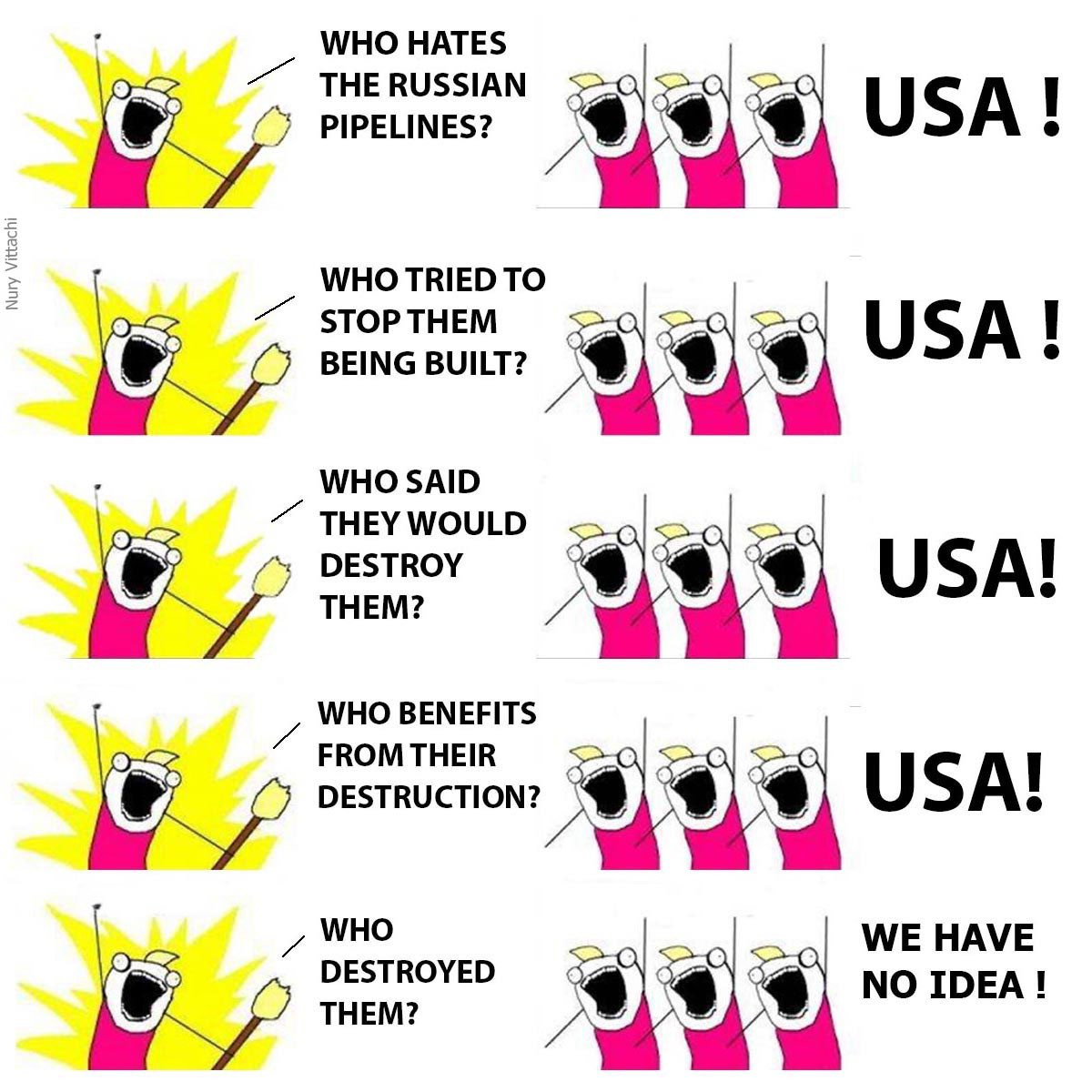
An act of war: Nord Stream pipelines bombed

You didn’t see it in the U.S. monopoly-controlled media, but throughout the month of September, there were mass demonstrations in Germany, the Czech Republic, France, Spain, Moldova and Belgium. A hundred thousand in Berlin; 70,000 in Prague. 

Primarily they were protests against skyrocketing energy prices and soaring inflation. They were also against war and the sanctions on Russia that are seen to be directly responsible for the cost of living crisis across Europe. Some protests demanded the opening of the Nord Stream 2 pipeline.

And then the pipeline was blown up.

U.S. Secretary of State Antony Blinken cheered the explosions at the Nord Stream pipelines, saying it’s a “tremendous opportunity” to stop European “dependence” on Russian natural gas.

Was this deliberate sabotage, a criminal act of war?

There is a precedent for this kind of pipeline sabotage by the United States. Some 40 years ago, the CIA blew up a Soviet natural gas pipeline from Siberia to Europe in an operation dubbed Farewell Dossier, as documented by Thomas Reed, a former U.S. Air Force officer.

Today no one thinks it is accidental that there were four almost-simultaneous explosions damaging both pipelines, Nord Stream 1 and 2. Neither pipeline was in current use: Nord Stream 2 was never opened, and Nord Stream 1 had been shut down for weeks because U.S. and NATO sanctions had blocked normal maintenance. 

Few dispute the charge that U.S. and NATO forces sabotaged Russia’s gas link with the rest of Europe.

The intention to do this was announced by President Joe Biden back in February. Biden declared, “If Russia invades … then there will no longer be a Nord Stream 2. We will bring an end to it.” A reporter asked, “How will you do that exactly since the project is in Germany’s control?” Biden responded, “I promise you, we will be able to do that.”

After the Sept. 27 reports of the pipeline bombing, Poland’s former minister of defense and former foreign minister, Radoslaw Sikorsky, publicly congratulated the United States for sabotaging the Russian pipeline. However, Sikorsky, currently a member of the European Parliament and well-connected in Washington and in NATO circles, has since removed his tweet (“Thank you, USA”), which was seen as a confirmation of U.S. and NATO guilt.

On social media, a retired U.S. Army colonel and former Pentagon adviser is quoted as saying that the U.S. likely attacked the Nord Stream pipelines to stop any reopening of Russian gas to Germany. Pointing to reports that thousands of pounds of TNT were used, the colonel says that only the U.S. Navy Special Operations and the British Royal Navy have that capability.

The Baltic Sea, where the bombing was carried out, is controlled by NATO. In June, the U.S. Navy Sixth Fleet was reported to be engaged in underwater vehicle “practice” mining and demining operations in the area. In addition, a large U.S. Navy fleet formation passed nearby just five days before the explosions were detected.

The bombing won’t end the protests in Europe against skyrocketing energy prices and the war-induced inflation, though NATO probably hopes it will. The bombing could move the U.S./NATO proxy war into an open war, which may be intentional.

The war economy

The U.S. is in a war economy. War means industry, be it a hot war or an economic war, such as sanctions.

The U.S. military-industrial complex is in heavy production mode. Since 2014, the U.S. has spent billions on arming and training the coup regime in Ukraine. In the last six months, the Biden administration has pumped $70 billion into Ukraine.

The U.S./NATO proxy war in Ukraine against Russia is seemingly a bottomless pit for military spending.

A recent Financial Times report noted that military stockpiles in Ukraine are not about high-tech weapons that need chips, but rather basic artillery, calling it “the return of industrial warfare.” 

“Fetishes for high-tech weapons and lean manufacturing have obscured the importance of maintaining stockpiles of basic kits [like artillery shells]. Total annual U.S. production of 155 million artillery shells, for example, would last only about two weeks in Ukraine. … Inexpensive ammunition that you can use on a large scale is essential.”

U.S. military spending has never been higher. The U.S. now has a trillion-dollar military budget.

The U.S. spends more on its military than any other country in the world by a massive margin.

The U.S. also has the deepest national debt in the world. The Oct. 4 New York Times reported that the U.S. “gross national debt exceeded $31 trillion for the first time on Tuesday.” But, of course, they don’t mention that military spending is the biggest chunk of debt.

Some have suggested that the big increases in the military budget under Biden were meant to rescue the economy from the COVID recession, including the $25 billion bailout of Boeing and the airline industry, a major part of the military-industrial complex. But using military production as a stimulant, like any other stimulant, eventually turns into its opposite and becomes a devastating depressant.

War is inflationary

The sharp oil price increases internationally are fueled by the U.S./NATO proxy war against Russia and the U.S. sanctions that have blocked Russian gas to Europe. The U.S.-British-controlled oil monopolies are a key part of the military-industrial complex.

Military production is a different kind of capitalist commodity production. The products of the military-industrial complex are commodities. However, as Karl Marx points out in “Capital,” capitalism requires that commodities have a use value. Marx says that a commodity is “a thing that by its properties satisfies human wants of some sort or another.”

The process of capitalist production and exchange means that the capitalist, to realize a profit, must produce a useful product.

Production from the military-industrial complex has no usefulness to society and no use value in capitalist production. The military-industrial complex stops production of useful commodities and instead produces commodities to be destroyed.

The U.S. military budget has devalued the dollar, increasing the debt. With no use value, there is no return value to compensate for the vast expenditures required to produce the jets, guns, cannons, tanks and other weapons of mass destruction in the Pentagon’s budget.

War is inflationary. Inflation did not start with the U.S./NATO proxy war in Ukraine, but the war put a fire under the smoldering inflation that was already there.

Strugglelalucha256


Cuba: Hope emerges with collective strength after Hurricane Ian

October 4, 2022 from Havana

On September 26, Cuba was hit by Hurricane Ian, which didn’t stop intensifying as it passed through the western part of the island where it hovered for hours. There it left a trail of pain and disaster in those areas that were very close to its center and in most of the territory that were hit by its bands of hurricane-force winds. Thousands of people were left in the dark after it knocked down trees and electric poles and caused failures in the main thermo electric plants of the country.

Two people lost their lives, thousands had to be evacuated, many others couldn’t return because the wind had blown down their homes leaving only debris. But at the exact moment when Ian ceased to be an imminent danger the people began raising their communities from the devastation with urgency, determination and resilience that characterizes the Cuban people. There was no time to lose.

One week after Ian’s devastating passage, the island continues its recovery already with great progress. The cities have almost completely regained a semblance of normalcy, although with many missing trees. Most of the communities that were left in darkness now have electricity and water services back.

Recovery is taking place in record time, considering the dimensions of the damage. Let’s highlight the fact that all of Cuba had zero electricity being generated on the night of September 27.

This rebound has been made possible thanks to countless anonymous heroes, like the linemen who worked from the heights to tie downed cables, putting their own lives at risk; or specialists from the country’s thermo electric plants, who struggled day and night to start up those mechanical beasts; or the neighbors who cleared the streets of fallen trees with axes, saws and their shoulders.

There were many other heroes, like those who offered their few resources to help the helpless, offering them a space in their refrigerators to cool their food; and the directors of medical institutions who allowed citizens to recharge their cell phones, which are, for many, their only means of communication.

But, above all, it has been admirable how the country’s authorities have not left the people alone even for a minute. President Miguel Díaz-Canel has been seen visiting the areas most affected by the hurricane, especially in the western part of the country.

This Monday, he went to Cocodrilo, a fishing community located on the Isle of Youth, where he got to see that all of its neighbors are involved in the recovery efforts. There, he spoke of rebuilding houses as beautiful as the environment, one of the most unique distinctions of that Cuban municipality. He made it clear that not only did they need to rebuild their homes but they had to be made better than before.

This is not the only trip made by the president. In just one week, he has visited most of the territories hardest hit by Ian in Pinar del Rio, where he got to see the pain of those who lost everything, and assured them they were not alone. This was not a president making token visits but one who is immersed in the process.

He also spoke through various media to the citizens who took to the streets in frustration due to the blackouts, the lack of water, and the loss of food that couldn’t be preserved in their refrigerators.

“All together, we will get out of this situation. It is understandable that citizens are upset about the damage left by Ian, but we are working tirelessly to solve the problems,” he said.

During a meeting with the country’s main authorities at the Palace of the Revolution, Diaz-Canel talked about the importance of people feeling accompanied by their leaders. “We have to reach all communities, he emphasized, especially the most remote ones and those that still remain without electrical service. We have to offer daily information on how the repair work is going in each community.”

This empathy is just one of the things missing for those affected by Hurricane Ian in Florida, where the death toll is well over a hundred due in part to the fact that state and local officials did not issue an evacuation notice until the storm was less than 24 hours away and even then there was no coordinated plan of how and where to go. Thousands of people are still without electricity, stores are out of supplies, and there is no hope of solutions in an atmosphere of uncertainty.

“We are tired, dirty and hungry. Hurricane Ian Survivors leave Fort Myers on Foot”, reads a Miami Herald headline. One citizen told that newspaper, “We’re alive. That makes us luckier than some of our neighbors.” Tragically the death toll in Florida continues to rise.

In Cuba, we feel confident because no one will be left behind. The people’s concerns will be heard, as long as they are expressed in a peaceful and civic manner. We approach disasters and recovery collectively and in every corner of the country where devastation and pain remain, hope will re-surge with new strength.

Source: Resumen Latinoamericano –  US

Strugglelalucha256


Haití: cuatro años seguidos de protestas ininterrumpidas

En julio de 2018 empezó un ciclo de protestas en Haití que se ha mantenido hasta ahora (a pesar de la pandemia). El principal motivo de la protesta en 2018 fue que en marzo de ese año el Gobierno de Venezuela (como consecuencia de las sanciones ilegales impuestas por los Estados Unidos) no podía seguir enviando petróleo con descuento a Haití a través del esquema de PetroCaribe. Los precios de los combustibles se dispararon hasta un 50%. El 14 de agosto de 2018, el cineasta Gilbert Mirambeau Jr. tuiteó una foto suya con los ojos vendados y sosteniendo un cartel que decía: “Kot Kòb Petwo Karibe a???” (¿A dónde fue el dinero de PetroCaribe?). Reflejaba la sensación más extendida en la isla: que el dinero del plan había sido saqueado por la élite haitiana, cuyo control del país se había asegurado mediante dos golpes de Estado (1991 y 2004) contra el Presidente Jean-Bertrand Aristide, elegido democráticamente. El aumento de los precios del petróleo hizo que la cotidianidad fuera invivible para la gran mayoría del pueblo, cuyas protestas crearon una crisis de legitimidad política para la élite haitiana.

En las últimas semanas, las calles de Haití han vuelto a ser ocupadas por grandes marchas y cortes de carretera, con los ánimos en vilo. Los bancos y las organizaciones no gubernamentales (ONG) – incluidas las organizaciones benéficas católicas – se enfrentaron a la ira de los manifestantes, que rayaron “Abajo con EE. UU”. en los edificios que saquearon e incendiaron. La palabra creole dechoukaj o desarraigo – que se utilizó por primera vez en los movimientos democráticos de 1986 – ha llegado a definir estas protestas. El Gobierno ha culpado de la violencia a bandas como el G9, dirigido por el ex policía haitiano Jimmy “Babekyou” (Barbacoa) Chérizier. Estas bandas forman parte del movimiento de protesta, pero no lo definen.

El Gobierno de Haití – dirigido por el presidente en funciones Ariel Henry – decidió aumentar el precio del combustible durante esta crisis, lo que desató la protesta de los sindicatos del transporte. Jacques Anderson Desroches, presidente del Fós Sendikal pou Sove Ayiti, declaró al Haitian Times: “Si el Estado no se decide a poner fin a la liberalización del mercado del petróleo en favor de las compañías petroleras y a tomar el control del mismo”, nada bueno va a salir de esto. “Todas las medidas que tome Ariel Henry serán medidas cosméticas”, dijo. El 26 de septiembre, las asociaciones sindicales convocaron una huelga que paralizó el país, incluida la capital de Haití, Puerto Príncipe.

La Organización de las Naciones Unidas (ONU) evacuó del país al personal no esencial. La representante especial de la ONU, Helen La Lime, dijo al Consejo de Seguridad de la ONU que Haití estaba paralizado por “una crisis económica, una crisis de bandas y una crisis política” que han “convergido en una catástrofe humanitaria”. La legitimidad de las Naciones Unidas en Haití es limitada, dados los escándalos de abusos sexuales que han sacudido a las misiones de mantenimiento de la paz de la ONU en Haití, y el mandato político de las Naciones Unidas que los haitianos consideran orientado a proteger a la élite corrupta que hace la oferta de Occidente.

El actual presidente Ariel Henry fue instalado en su puesto por el “Core Group” (formado por seis países y liderado por los Estados Unidos, la Unión Europea, la ONU y la Organización de Estados Americanos). Henry llegó a la presidencia tras el asesinato, aún sin resolver, del impopular presidente Jovenel Moïse (hasta ahora, lo único claro es que Moïse fue asesinado por mercenarios colombianos y haitianos estadounidenses). La Lime de la ONU informó al Consejo de Seguridad en febrero que la “investigación nacional sobre su asesinato [de Moïse] se ha estancado, una situación que alimenta los rumores y exacerba tanto la sospecha como la desconfianza dentro del país”.

Las crisis de Haití

Es imposible entender el actual ciclo de protestas sin reparar con atención en cuatro acontecimientos del pasado reciente de este país. En primer lugar, la desestabilización de Haití tras el segundo golpe de Estado contra Aristide en 2004, que tuvo lugar justo después del catastrófico terremoto de 2010 y que condujo al desmantelamiento del Estado haitiano. El Core Group aprovechó estas terribles dificultades para importar a la isla un amplio abanico de ONG occidentales, que parecían sustituir al Estado haitiano. Las ONG pronto proporcionaron el 80% de los servicios públicos. “Desperdiciaron” cantidades considerables del dinero de socorro y ayuda que había llegado al país tras el terremoto. El debilitamiento de las instituciones estatales ha hecho que el Gobierno tenga pocas herramientas para hacer frente a esta crisis no resuelta.

En segundo lugar, las sanciones ilegales impuestas por los Estados Unidos a Venezuela acabaron con el plan PetroCaribe, que había proporcionado a Haití ventas de petróleo en condiciones favorables y 2.000 millones de dólares de beneficios entre 2008 y 2016, que estaban destinados al Estado haitiano pero que se esfumaron en las cuentas bancarias de la élite.

En tercer lugar, en 2009, el parlamento haitiano intentó aumentar el salario mínimo en la isla a 5 dólares diarios, pero el Gobierno de Estados Unidos intervino en nombre de las principales empresas textiles y de confección para bloquear el proyecto de ley. David Lindwall, ex jefe adjunto de la misión de los Estados Unidos en Puerto Príncipe, dijo que el intento haitiano de aumentar el salario mínimo “no tuvo en cuenta la realidad económica”, sino que fue un mero intento por apaciguar “a las masas desempleadas y mal pagadas”. El proyecto de ley fue derrotado debido a la presión del Gobierno de los Estados Unidos. Estas “masas desempleadas y mal pagadas” están ahora en las calles siendo caracterizadas como “bandas” por el Core Group.

En cuarto lugar, al actual presidente, Ariel Henry, le gusta decir que es un neurocirujano y no un político de carrera. Sin embargo, en el verano de 2000, Henry formó parte del grupo que creó la Convergencia Democrática (CD), fundada para pedir el derrocamiento del Gobierno democráticamente elegido de Aristide. La CD fue creada en Haití por el Instituto Republicano Internacional, brazo político del Partido Republicano de los Estados Unidos, y por la Fundación Nacional para la Democracia del Gobierno estadounidense. El llamado a la calma realizado por Henry el 19 de septiembre de 2022 tuvo como resultado la multiplicación de las barricadas y la intensificación del movimiento de protesta. Su oído está más pendiente de Washington que de Petit-Goâve, una ciudad de la costa norte que es el epicentro de la rebelión.

Oleadas de invasiones

En la ONU, el ministro de Asuntos Exteriores de Haití, Jean Victor Geneus, dijo: “Este dilema sólo puede resolverse con el apoyo efectivo de nuestros socios”. Para muchos observadores cercanos de la situación que se desarrolla en Haití, la frase “apoyo efectivo” suena a otra intervención militar de las potencias occidentales. De hecho, el editorial del Washington Post pedía “una acción muscular por parte de actores externos”. Desde la Revolución Haitiana, que terminó en 1804, Haití se ha enfrentado a oleadas de invasiones (incluyendo una larga ocupación estadounidense – de 1915 a 1930 – y una dictadura respaldada por los Estados Unidos – de 1957 a 1986 –). Estas invasiones han impedido a la nación insular asegurar su soberanía y han impedido a su pueblo construir una vida digna. Otra invasión, ya sea por parte de las tropas estadounidenses o de las fuerzas de mantenimiento de la paz de las Naciones Unidas, no hará más que agravar la crisis.

En la sesión de la Asamblea General de las Naciones Unidas del 21 de septiembre, el presidente de los Estados Unidos, Joe Biden, dijo que su Gobierno sigue “apoyando a nuestro vecino Haití”. Lo que esto significa queda muy claro en un nuevo informe de Amnistía Internacional que documenta los abusos racistas a los que se enfrentan los solicitantes de asilo haitianos en los Estados Unidos. Puede que los Estados Unidos y el Core Group estén al lado de personas como Ariel Henry, pero no parecen estar al lado del pueblo haitiano, incluidos los que han huido hacia sus territorios.

Las opciones para el pueblo haitiano pasarán por la unión de los sindicatos a la ola de protestas. Queda por ver si los sindicatos y las organizaciones comunitarias (incluidos los grupos de estudiantes que han resurgido como actores clave en el país) serán capaces de impulsar un cambio dinámico a partir de la ira que se observa en las calles.

Este artículo fue producido para Globetrotter.

Vijay Prashad es un historiador, editor y periodista indio. Es miembro de la redacción y corresponsal en jefe de Globetrotter. Es editor en jefe de LeftWord Books y director del Instituto Tricontinental de Investigación Social. También es miembro senior no-residente del Instituto Chongyang de Estudios Financieros de la Universidad Renmin de China. Ha escrito más de 20 libros, entre ellos The Darker Nations y The Poorer Nations. Sus últimos libros son Struggle Makes Us Human: Learning from Movements for Socialism y The Withdrawal: Iraq, Libya, Afghanistan, and the Fragility of U.S. Power (con Noam Chomsky).

Strugglelalucha256


New York City: No Cops in Power Rally, Oct. 14

New York City: No Cops in Power Rally

Friday, Oct. 14 – 5:30 p.m.

City Hall Park, Broadway & Murray St. entrance, Manhattan

Hosted by New York Community Action Project (NYCAP)

Join us next Friday as we protest Mayor Adams and his pro-policing policies, demanding:

No Cops in Power

Stop the Sweeps

Fund Schools, not Cops

Disband the Strategic Response Group

Community Control Now!

See you at City Hall!

Strugglelalucha256


How Cuba is dealing with the devastation of Hurricane Ian

On September 27, 2022, a tropical cyclone — Hurricane Ian — struck Cuba’s western province of Pinar del Río. Sustained winds of around 125 miles per hour lingered over Cuba for more than eight hours, bringing down trees and power lines, and causing damage not seen during previous tropical cyclones. The hurricane then lingered over the warm waters of the Gulf of Mexico, picking up energy before striking the U.S. island of Cayo Costa, Florida, with approximately 155 mph winds. The World Meteorological Organization (WMO) called it “one of the worst hurricanes to hit the area in a century.”

The National Oceanic and Atmospheric Administration’s Climate Prediction Center said that this year will be the “seventh consecutive above-average hurricane season.” Both Cuba and Florida have faced the wrath of the waters and winds, but beneath this lies the ferocity of the climate catastrophe. “Climate science is increasingly able to show that many of the extreme weather events that we are experiencing have become more likely and more intense due to human-induced climate change,” said WMO Secretary-General Petteri Taalas.

Prepare and relieve

Cuba, said the WMO, is one of the “world leaders in terms of hurricane preparedness and disaster management.” This was not always the case. Hurricane Flora hit the eastern coast of the island on October 4, 1963. When news of the approaching hurricane reached Fidel Castro, he immediately ordered the evacuation of the homes of people who lived in the projected path of the storm (in Haiti, former dictator François Duvalier did not call for an evacuation, which led to the death of more than 5,000 people). Castro rushed to Camagüey, almost dying in the Cauto River as his amphibious vehicle was struck by a drifting log. Two years later, in his Socialism and Man in Cuba, Che Guevara wrote the Cuban people showed “exceptional deeds of valor and sacrifice” as they rebuilt the country after the devastation caused by Flora.

In 1966, the Cuban government created the Civil Defense System to prepare for not only extreme weather events such as hurricanes but also the outbreak of epidemics. Using science as the foundation for its hurricane preparedness, the Cuban government was able to evacuate 2 million people as Hurricane Ivan moved toward the island in 2004. As part of disaster management, the entire Cuban population participates in drills, and the Cuban mass organizations (the Federation of Cuban Women and the Committees for the Defense of the Revolution) work in an integrated manner to mobilize the population to respond to disasters.

The day before Hurricane Ian hit Cuba, 50,000 people were evacuated and taken to 55 shelters. No private vehicles or public transportation was visible on the streets. Work brigades were mobilized to work on the resumption of electricity supply after the storm had passed. In Artemisa, for instance, the Provincial Defense Council met to discuss how to react to the inevitable flooding. Despite the best efforts made by Cubans, three people died because of the hurricane, and the electrical grid suffered significant damage.

Damage

The entire island — including Havana — had no power for more than three days. The electrical grid, which was already suffering from a lack of major repairs, collapsed. Without power, Cubans had to throw away food that needed to be refrigerated and faced difficulty in preparing meals, among other hardships. By October 1, less than five days after landfall, 82 percent of the residents of Havana had their power restored with work ongoing for the western part of the island (the amount of time without power in Puerto Rico, which was hit by Hurricane Fiona on September 18, is longer—a quarter of a million people remain without power more than two weeks later).

The long-term impact of Hurricane Ian is yet to be assessed, although some believe the cost of damages will surpass $1 billion. More than 8,500 hectares of cropland have been hit by the flooding, with the banana crop most impacted. The most dramatic problem will be faced by Cuba’s tobacco industry since Pinar del Río — where 5,000 farms were destroyed — is its heartland (with 65 percent of the country’s tobacco production). Hirochi Robaina, a tobacco farmer in Pinar del Río, wrote, “It was apocalyptic. A real disaster.”

Blockade

Mexico and Venezuela immediately pledged to send materials to assist in the reconstruction of the electrical grid on the island.

All eyes turned to Washington —not only to see whether it would send aid, which would be welcome, but also if it would remove Cuba from the state sponsors of terrorism list and end sanctions imposed by the United States. These measures cause banks in both the United States and elsewhere to be reluctant to process any financial transactions, including humanitarian donations. The U.S. has a mixed record regarding humanitarian aid to Cuba. After Hurricane Michelle (2001), Hurricane Charley (2004), and Hurricane Wilma (2005), the U.S. did offer assistance, but would not even temporarily lift the blockade. After the fire at a Matanzas oil storage facility in August 2022, the U.S. did offer to join Mexico and Venezuela to help the Cubans put out the fire. Cuba’s Deputy Foreign Minister Carlos Fernández de Cossio offered “profound gratitude” for the gesture, but the administration of U.S. President Joe Biden did not follow through.

Rather than lift the sanctions even for a limited period, the U.S. government sat back and watched as mysterious forces from Miami unleashed a torrent of Facebook and WhatsApp messages to drive desperate Cubans onto the street. Not a moment is wasted by Washington to use even a natural disaster to try to destabilize the situation in Cuba (a history that goes back to 1963, when the Central Intelligence Agency reflected on how to leverage natural disasters for political gains). “Most people don’t shout out freedom,” a person who observed one of these protests told us. “They ask for power and food.”

This article was produced by Globetrotter.

Vijay Prashad is an Indian historian, editor, and journalist. He is a writing fellow and chief correspondent at Globetrotter. He is an editor of LeftWord Books and the director of Tricontinental: Institute for Social Research. He is a senior non-resident fellow at Chongyang Institute for Financial Studies, Renmin University of China. He has written more than 20 books, including The Darker Nations and The Poorer Nations. His latest books are Struggle Makes Us Human: Learning from Movements for Socialism and (with Noam Chomsky) The Withdrawal: Iraq, Libya, Afghanistan, and the Fragility of U.S. Power.

Manolo De Los Santos is the co-executive director of the People’s Forum and is a researcher at Tricontinental: Institute for Social Research. He co-edited, most recently, Viviremos: Venezuela vs. Hybrid War (LeftWord Books/1804 Books, 2020) and Comrade of the Revolution: Selected Speeches of Fidel Castro (LeftWord Books/1804 Books, 2021). He is a co-coordinator of the People’s Summit for Democracy.

Strugglelalucha256


Filipino community & allies demand all charges dropped for #MakibekiNYC3

FOR IMMEDIATE RELEASE
October 3, 2022

Contact:
Marion Aguas, GABRIELA New York
bayanusa.ne@gmail.com
609-434-2793

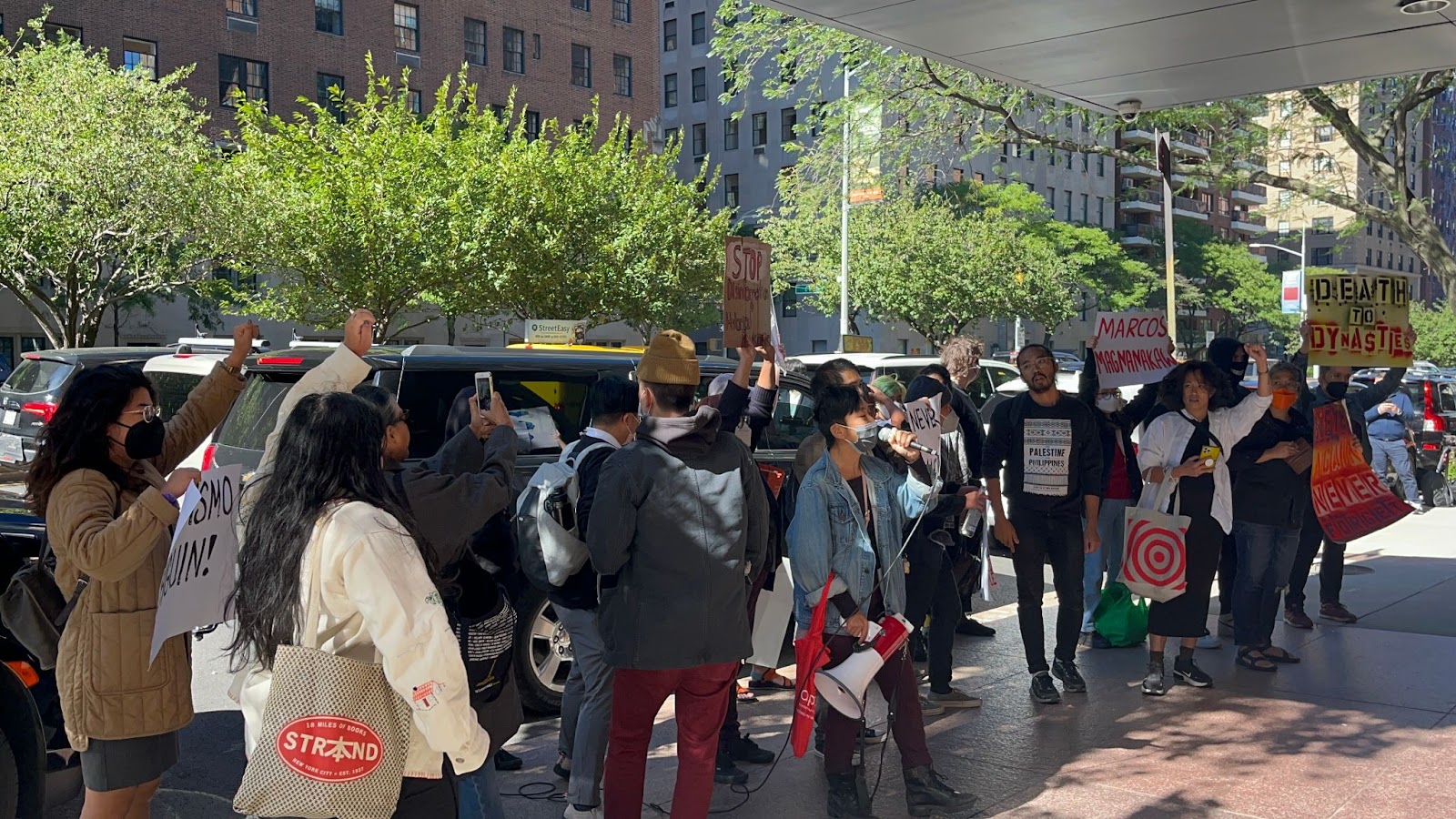
Filipino community & allies demand all charges dropped for #MakibekiNYC3, denounce police violence at anti-Marcos protest

NEW YORK CITY — Filipino pro-democracy activists denounce the security and police violence and arrests that occurred during a protest against Philippine President Ferdinand “Bongbong” Marcos, Jr. on Friday, September 23rd, where the New York City Police Department (NYPD) arrested three activists now known as the Makibeki NYC 3. Makibeki is a slang term used by LGBTQ Filipino activists that derives from the Filipino word “makibaka,” which means “dare to struggle.” All three activists who were arrested are non-binary transgender people.

The Friday protest, organized by BAYAN USA, was the last of a week-long series of actions condemning Marcos’s visit to the United States. Marcos’s trip coincided with the 50th anniversary of his father Ferdinand Marcos, Sr.’s declaration of martial law in the Philippines. The demonstration included a sit-in at the entrance of the Asia Society auditorium, where Marcos was invited to speak despite the stern disapproval of hundreds of Filipino and Asian American writers and artists, followed by a program outside the Asia Society building.

“We wanted to remind Marcos Jr. that we will never forget the crimes of his family,” stated Berna Ellorin of BAYAN USA. “The blood of those who died, either from the military and police or from debt and poverty, are on his and his family’s hands. We will never cease until there is justice and accountability for the over 100,000 victims of martial law.”

While conducting the sit-in, eleven demonstrators held a banner reading “Hold Marcos-Duterte Accountable – No to Fascist Dynasties” and chanted “Never Forget, Never Again, Never Again to Martial Law.” Asia Society security guards responded by aggressively dragging the demonstrators – most of whom were young women, queer, and transgender folks – one by one from the floor of the basement and throwing them forcefully into an elevator, onto the floor, and out of the front entrance onto the sidewalk. The guards grabbed demonstrators by their hair and limbs, in some cases so forcefully that they removed and/or damaged articles of clothing. Protestors were threatened with further violence, with one security guard stating he would break the activists’ arms, if they did not cooperate.

Several activists met Marcos’ motorcade as it left the Asia Society at the intersection of 70th St. and Lexington Ave with placards chanting, “Inutang na dugo ng pasistang rehimen, singilin, singilin, pagbayarin! (The blood debts of the fascist regime must be paid!)” One person was tackled by presumed agents of the Diplomatic Security Service (DSS). According to police reports, they were subsequently taken into police custody for having allegedly thrown a “red substance” at Marcos’s motorcade.

Following this arrest, the remaining group of activists questioned the DSS agents and NYPD, “Why do you protect fascists? Why aren’t you protecting the people?” Instead of de-escalating the crowd, a mob of DSS agents attacked the activists by pushing people to the ground, yanking people by the limbs and hair, and ultimately dragging two others from the crowd and arresting them as well. In the face of this physically aggressive response from law enforcement, community safety marshalls from the activists’ contingent stepped in to protect the people. More than a dozen people suffered physical injuries as a result of the attack.

The Makibeki NYC 3 were arrested, taken into police custody, and held overnight for over 24 hours, during which they were constantly misgendered by law enforcement agents. Collective action from BAYAN members and supporters ensured that the Makibeki NYC 3 were released as swiftly as possible the following evening on their own recognizance. “All of them work in service of our society as a scientist, a nurse, and an immigration lawyer respectively,” said Amanda Katapang, lead organizer for jail and court support. “They will go back to serving and supporting their community while they continue to fight their case.”

“BAYAN USA condemns the arrests of the Makibeki NYC 3,” said Ellorin. “Activism is not a crime. Exerting our democratic rights to genuine change should not be punished.” BAYAN USA calls for all charges against the three to be dropped.

Strugglelalucha256


Baltimore: No war on Russia, Donbass and China, Oct. 21

FRIDAY, OCTOBER 21, 2022 AT 5 PM
No War on Russia, Donbass & China
Martin Luther King Jr. Blvd and Howard Street, Baltimore

No War on Russia, Donbass, & China

Money for Food, Housing, Education & Healthcare, Not Billions for War

Bailout the Hurricane Victims, not War Profiteers & Banks

Friday, Oct 21, 5 pm to 6:30 pm @
MLK Blvd & Howard Streets

Protest is part of a national call for a week of “Back to the Streets” called by the United National Anti-war Committee

Strugglelalucha256
https://www.struggle-la-lucha.org/2022/10/page/9/