Brazilian democracy scores a victory against considerable odds
written by Struggle – La Lucha
October 31, 2022
President Lula da Silva
October 30 – Just a few minutes ago, Brazil’s Supreme Electoral Tribunal announced Lula da Silva’s victory by over 2 million votes or 1.5%. Undoubtedly it was a tight race with many obstacles for the progressive candidate, but in the end, the people’s will to leave behind 4 years of a disastrous government prevailed.
With over 99% of the voting stations counted, Lula won almost 51% of the votes, while his rival, the ultra-right-wing Jair Bolsonaro, achieved a concerning 49% of the votes. This runoff was similar to the first round’s turnout. In other words, neither of the two candidates managed to significantly mobilize those who did not take part in the political process in the first round.
Apparently, Bolsonaro achieved better results as his numbers shrank from the first round’s difference by almost three million votes. This will have to be analyzed because the third and fourth candidates of the first round presumably gave their support to Lula. However, if they did not join the campaign to mobilize it was just lip service to create a distance from Bolsonaro without giving real support to Lula.
Greater mobilization of Bolsonaro’s forces after the unexpected result of the first round and the unfair maneuvers of the neo-fascist candidate were key points in this result. Since the morning of election day, the federal police were on the streets obstructing the traffic instead of easing it on such an important day. They clearly had a mandate to stop buses bringing people to voting stations from rural areas.
Thousands of complaints have been posted on social media about long lines of public and private vehicles waiting to be checked by the police. Even the Uber app was out of service, and many drivers refused to give a ride to people who were clear Lula supporters. These occurrences were much more prevalent in the northeast region of the country. This area is considered the stronghold of Lula’s Workers’ Party (PT). In some places, Bolsonaro supporters went so far as to cut down trees to block roads for hours to prevent PT supporters from reaching polling stations.
In Brazil, public transportation is usually free on election day to ensure that lower-income people can vote. This time, many governors and mayors sympathetic to Bolsonaro refused to take such a measure. The right-wing is aware of the strong support Lula has in the poorest sectors of society and used this low blow in hopes of impacting the outcome. Maybe this would not be a relevant issue in another country, but in Brazil, public transportation is expensive for many people who have to spend an average of $US5 for a ride.
Despite all these fraudulent actions, neo-fascist forces could not stop the irrevocable will of a country to move forward, to have hope, and see a path to progress.
Lula’s victory is very positive for Brazil and Latin America and the world for that matter. It is the largest economy in the region and its support is essential for the left and anti-imperialist processes. At the same time, the right-wing lost its most important stronghold in Latin America, which substantially reduces its power to influence regional dynamics. However, this does not mean it is defeated.
Senate and governorship composition in the country is quite complex and is not to the advantage of the new government. This is a significant reality in a federalist country.
Today’s victory is significant not just in Brazil but it shifts the relationship of forces in the entire region. The narrow victory reflects how every progressive move by Lula will be met with resistance and dirty tricks. The threats of a coup d’état are still latent and will not be going away anytime soon. The frauds committed today, and Bolsonaro’s s statements about his intentions to try and organize a coup against Lula, show that the right-wing has a deep disdain for democracy and the people’s will. They will not miss an opportunity to reverse their huge defeat today as they did in Bolivia in 2019; as they are constantly trying to do in Peru, also in Argentina against Cristina Fernandez, and as they did before in Brazil against Dilma and Lula. The international right, neo-liberal forces, have been set back but Lula will need to consolidate quickly because they are not going to let such a valuable country as Brazil just slip away. The licking of their wounds will be momentary.
What: Puerto Ricans and allies will march in a contingent in The Village Halloween Parade to bring attention to the Terrors of Colonialism
When Monday, October 31, 2022, at 7 pm
Where: Canal St and 6th Avenue, New York, New York 10013
The Puerto Rico Not For Sale Campaign will be marching in costume in the annual Village Halloween Parade on Monday, October 31, 2022 at 7 PM. Representing some of the “terrors of colonialism,” participants in the contingent will be dressing as representations of the Fiscal Control Board, the vulture funds, crypto-colonizers like Brock Pierce, environmental destruction, and LUMA Energy.
Puerto Rico has been living in a state of terror under United States colonialism whose symptoms, grow worse by the day. Not even the legendary El Cuco or the chupacabra are scarier than the horrific austerity measures the Fiscal Control Board, imposed by the U.S. Government, has had on the archipelago. Most recently, the Fiscal Control Board agreed to a $23 increase on Puerto Ricans’ electricity bills for the next 50+ years to pay off the cost of the debt of the Electrical Energy Authority. This increase is in addition to the seven increases LUMA Energy has imposed since privatizing the electric grid in June 2021 and comes after over a month of power outages in some parts of the archipelago due to Hurricane Fiona. These power outages resulted in the deaths of multiple people through explosions of generators, fires from candles, lack of power to hospitals and nursing homes, and suicides. :
Now more than ever, we must confront these terrors head-on, shining a light on colonial shadows and exposing them for the monsters they truly are, so that we can defeat them. The only solution is independence and national sovereignty for Puerto Rico.
Los Terrores del Colonialismo El Desfile de Halloween por la Libertad de Puerto Rico
¿Qué?:Los puertorriqueños y sus aliados van a marchar en el Desfile de Halloween para resaltar los terrores del Colonialismo.
¿Cuando?: lunes 31 de octubre ,2022 ,a las 7 de la noche
¿Dónde?: calle Canal y la 6ta avenida, Nueva York, NY 10013
La campaña Puerto Rico No Se Vende va a marchar en disfraces en el Desfile de Halloween que se celebra en el Village de la ciudad de Nueva York el lunes 31 de octubre a las 7 de la noche. Resultando algunos de los“ terrores del colonialismo” participantes del contingente van a disfrazarse representando a la Junta de Control Fiscal, los buitres,y los colonizadores de la criptomoneda como Brock Pierce, la destrucción ambiental y la compañía de energía Luma.
Puerto Rico está viviendo bajo un estado de terror colonial cuyos síntomas empeoran con el paso de cada día . Ni siquiera El legendario Cuco o el chupacabras dan tanto miedo como las medidas de austeridad de la Junta de Control Fiscal, impuesta por el gobierno de los Estados Unidos, ha tenido sobre el archipiélago. Recientemente, La Junta de Control Fiscal acordó un aumento de $23 dólares en la factura de la luz por los próximos 50+ años para pagar la deuda de la Autoridad de Energía Eléctrica. Este aumento se añade a siete aumentos que la compañía de energía Luma ha impuesto desde que se privatizó la operación de la red eléctrica en junio de 2021 y viene después de un mes de apagones en algunas partes del archipiélago como resultado del huracán Fiona. Estos apagones han resultado en las muertes de personas a través de explosiones de generadores,fuegos a causa del uso de velas,falta de energía a hospitales y asilo de ancianos y suicidios.
Ahora más que nunca, debemos confrontar estos terrores de frente,iluminar las sombras coloniales y exponerlos como los monstruos que realmente son, para poder derrotarlos. La única solución es la independencia y soberanía nacional para Puerto Rico.
Demonstrations in New York, Los Angeles and other cities call for an end to the blockade on Cuba
written by Struggle – La Lucha
October 31, 2022
Large demonstrations on the East and West coasts of the US took place yesterday calling for the end of the Blockade of Cuba as the annual vote in the General Assembly of the UN approaches this week. This will mark the 30th occasion when the overwhelming majority of countries of the world will stand up together in solidarity with the people of Cuba in their defiant struggle and dignified struggle against US imperialism.
New York
In New York over 200 people marched from Times Square, across busy 42nd Street, to the US-UN office on 1st Avenue demanding that Cuba be taken off Washington’s list of state sponsors of terrorism, a measure designed to suffocate every aspect of Cuba’s ability to access the world market, to end all trade and travel restrictions and to end the over 62-year-old illegal blockade of the island. The march was led by a contingent of 20 Cuban-Americans who traveled from Miami for the protest.
Milagros Rivera traveling from her besieged island spoke representing the Puerto Rican Committee in Solidarity with Cuba at the NY rally. The FBI recently harassed Rivera and members of her group for traveling to Cuba to deliver humanitarian aid.
Los Angeles
According to Cuba News around 150 people protested in front of the Westwood Federal Building on Wilshire Boulevard in Los Angeles, the event had broad representation and was organized by the Los Angeles Hands off Cuba Committee. The protest also demanded that Biden overturn the 243 sanctions slapped on Cuba by the Trump Administration, something he could do with a stroke of the pen.
Many other US cities also held protests including Brunswick, Maine, Portland, Oregon, Duluth, Minnesota, and Laurel, Maryland.
This week more than 20 demonstrations will be taking place across the US to coincide with the vote in the UN to find the complete list with times and locations of the solidarity activities go to the web page of the National Network on Cuba.
In San Francisco the demonstration will take place on Thursday, November 3, at 4:30 pm at the Federal Building at Seventh and Mission followed by a march to UN Plaza. The event is being sponsored by the Bay Area Saving Lives, Answer Coalition, Code Pink, Venceremos Brigade, DSA, and Task Force on the Americas and endorsed by a number of other Bay Area organizations
Does the U.S. chip ban on China amount to a declaration of war in the computer age?
written by Struggle – La Lucha
October 31, 2022
The United States has gambled big in its latest across-the-board sanctions on Chinese companies in the semiconductor industry, believing it can kneecap China and retain its global dominance. From the slogans of globalization and “free trade” of the neoliberal 1990s, Washington has reverted to good old technology denial regimes that the U.S. and its allies followed during the Cold War. While it might work in the short run in slowing down the Chinese advances, the cost to the U.S. semiconductor industry of losing China—its biggest market—will have significant consequences in the long run. In the process, the semiconductor industries of Taiwan and South Korea and equipment manufacturers in Japan and the European Union are likely to become collateral damage. It reminds us again of what former U.S. Secretary of State Henry Kissinger once said: “It may be dangerous to be America’s enemy, but to be America’s friend is fatal.”
The purpose of the U.S. sanctions, the second generation of sanctions after the earlier one in August 2021, is to restrict China’s ability to import advanced computing chips, develop and maintain supercomputers, and manufacture advanced semiconductors. Though the U.S. sanctions are cloaked in military terms—denying China access to technology and products that can help China’s military—in reality, these sanctions target almost all leading semiconductor players in China and, therefore, its civilian sector as well. The fiction of ‘barring military use’ is only to provide the fig leaf of a cover under the World Trade Organization (WTO) exceptions on having to provide market access to all WTO members. Most military applications use older-generation chips and not the latest versions.
Advanced logic chips required for artificial intelligence and high-performance computing
Equipment for 16nm logic and other advanced chips such as FinFET and Gate-All-Around
The latest generations of memory chips: NAND with 128 layers or more and DRAM with 18nm half-pitch
Specific equipment bans in the rules go even further, including many older technologies as well. For example, one commentator pointed out that the prohibition of tools is so broad that it includes technologies used by IBM in the late 1990s.
The sanctions also encompass any company that uses U.S. technology or products in its supply chain. This is a provision in the U.S. laws: any company that ‘touches’ the United States while manufacturing its products is automatically brought under the U.S. sanctions regime. It is a unilateral extension of the United States’ national legal jurisdiction and can be used to punish and crush any entity—a company or any other institution—that is directly or indirectly linked to the United States. These sanctions are designed to completely decouple the supply chain of the United States and its allies—the European Union and East Asian countries—from China.
In addition to the latest U.S. sanctions against companies that are already on the list of sanctioned Chinese companies, a further 31 new companies have been added to an “unverified list.” These companies must provide complete information to the U.S. authorities within two months, or else they will be barred as well. Furthermore, no U.S. citizen or anyone domiciled in the United States can work for companies on the sanctioned or unverified lists, not even to maintain or repair equipment supplied earlier.
The global semiconductor industry’s size is currently more than $500 billion and is likely to double its size to $1 trillion by 2030. According to a Semiconductor Industry Association and Boston Consulting Group report of 2020—“Turning the Tide for Semiconductor Manufacturing in the U.S.”—China is expected to account for approximately 40 percent of the semiconductor industry growth by 2030, displacing the United States as the global leader. This is the immediate trigger for the U.S. sanctions and its attempt to halt China’s industry from taking over the lead from the United States and its allies.
While the above measures are intended to isolate China and limit its growth, there is a downside for the United States and its allies in sanctioning China.
The problem for the United States—more so for Taiwan and South Korea—is that China is their biggest trading partner. Imposing such sanctions on equipment and chips also means destroying a good part of their market with no prospect of an immediate replacement. This is true not only for China’s East Asian neighbors but also for equipment manufacturers like the Dutch company ASML, the world’s only supplier of extreme ultraviolet (EUV) lithography machines that produces the latest chips. For Taiwan and South Korea, China is not only the biggest export destination for their semiconductor industry as well as other industries, but also one of their biggest suppliers for a range of products. The forcible separation of China’s supply chain in the semiconductor industry is likely to be accompanied by separation in other sectors as well.
The U.S. companies are also likely to see a big hit to their bottom line—including equipment manufacturers such as Lam Research Corporation, Applied Materials, and KLA Corporation; the electronic design automation (EDA) tools such as Synopsys and Cadence; and advanced chip suppliers like Qualcomm, Nvidia, and AMD. China is the largest destination for all these companies. The problem for the United States is that China is not only the fastest-growing part of the world’s semiconductor industry but also the industry’s biggest market. So the latest sanctions will cripple not only the Chinese companies on the list but also the U.S. semiconductor firms, drying up a significant part of their profits and, therefore, their future research and development (R&D) investments in technology. While some of the resources for investments will come from the U.S. government—for example, the $52.7 billion chip manufacturing subsidy—they do not compare to the losses the U.S. semiconductor industry will suffer as a result of the China sanctions. This is why the semiconductor industry had suggested narrowly targeted sanctions on China’s defense and security industry, not the sweeping sanctions that the United States has now introduced; the scalpel and not the hammer.
The process of separating the sanctions regime and the global supply chain is not a new concept. The United States and its allies had a similar policy during and after the Cold War with the Soviet Union via the Coordinating Committee for Multilateral Export Controls (COCOM) (in 1996, it was replaced by the Wassenaar Arrangement), the Nuclear Suppliers Group, the Missile Control Regime, and other such groups. Their purpose is very similar to what the United States has now introduced for the semiconductor industry. In essence, they were technology denial regimes that applied to any country that the United States considered an “enemy,” with its allies following—then as now—what the United States dictated. The targets on the export ban list were not only the specific products but also the tools that could be used to manufacture them. Not only the socialist bloc countries but also countries such as India were barred from accessing advanced technology, including supercomputers, advanced materials, and precision machine tools. Under this policy, critical equipment required for India’s nuclear and space industries was placed under a complete ban. Though the Wassenaar Arrangement still exists, with countries like even Russia and India within the ambit of this arrangement now, it has no real teeth. The real threat comes from falling out with the U.S. sanctions regime and the U.S. interpretation of its laws superseding international laws, including the WTO rules.
The advantage the United States and its military allies—in the North Atlantic Treaty Organization, the Southeast Asia Treaty Organization, and the Central Treaty Organization—had before was that the United States and its European allies were the biggest manufacturers in the world. The United States also controlled West Asia’s hydrocarbon—oil and gas—a vital resource for all economic activities. The current chip war against China is being waged at a time when China has become the biggest manufacturing hub of the world and the largest trade partner for 70 percent of countries in the world. With the Organization of the Petroleum Exporting Countries no longer obeying the U.S. diktats, Washington has lost control of the global energy market.
So why has the United States started a chip war against China at a time that its ability to win such a war is limited? It can, at best, postpone China’s rise as a global peer military power and the world’s biggest economy. An explanation lies in what some military historians call the “Thucydides trap”: when a rising power rivals a dominant military power, most such cases lead to war. According to Athenian historian Thucydides, Athens’ rise led Sparta, the then-dominant military power, to go to war against it, in the process destroying both city-states; therefore, the trap. While such claims have been disputed by other historians, when a dominant military power confronts a rising one, it does increase the chance of either a physical or economic war. If the Thucydides trap between China and the United States restricts itself to only an economic war—the chip war—we should consider ourselves lucky!
With the new series of sanctions by the United States, one issue has been settled: the neoliberal world of free trade is officially over. The sooner other countries understand it, the better it will be for their people. And self-reliance means not simply the fake self-reliance of supporting local manufacturing, but instead means developing the technology and knowledge to sustain and grow it.
This article was produced in partnership by Newsclick and Globetrotter. Prabir Purkayastha is the founding editor of Newsclick.in, a digital media platform. He is an activist for science and the free software movement.
Haiti: U.S. disinformation campaign provides pretext as UN military intervention looms
written by Struggle – La Lucha
October 31, 2022
As a popular uprising engulfs Haiti and threatens to topple the U.S.-backed regime of de facto Prime Minister Ariel Henry, Washington is seeking to deploy a military force to target the figure at the storm’s center, Jimmy Cherizier, nicknamed “Barbecue.”
Cherizier is the leader of a federation of armed groups called the Revolutionary Forces of the G9 Family and Allies, or FRG9. Since September 19, Cherizier and the FRG9 have blockaded with trenches and empty truck containers the Varreux gas terminal, where Haiti receives some 70 percent of its fuel supplies. Haitian National Police (HNP) forces have attacked the FRG9 in attempts to dislodge its fighters but have failed. This barricade, which is only one of hundreds around the capital and Haiti generally, is today providing the excuse for Henry to request foreign military intervention.
While the masses of protesters demand Henry’s resignation and denounce his request, it is the G9’s blockade of the terminal that presents the most severe threat to Henry’s continued grip on the country.
On Oct. 21, the United Nations Security Council unanimously passed Resolution 2653, drafted by the United States and Mexico, leveling international sanctions against “gang” leaders and their financial and political sponsors. However, only one leader was named: Cherizier. This follows U.S. Magnitsky sanctions leveled against Cherizier in December 2020.
“This resolution is an initial answer to calls for help from the Haitian people,” U.S. ambassador to the UN Linda Thomas-Greenfield remarked. “Today’s adoption of this resolution is only the first step. We have much more work to do.”
Haiti is plagued by criminal armed groups like the 400 Mawozo and the Five Seconds Gang, all arrayed against the FRG9 in the G-Pèp confederation, which is connected to powerful oligarchs with close ties to the U.S.. Haitians have taken note that, Cherizier, an anti-crime crusader, is the only figure targeted by the resolution, which claims that he “has engaged in acts that threaten the peace, security and stability of Haiti” and that the fuel blockade has “directly contributed to the economic paralysis and humanitarian crisis in Haiti.”
“Ironically, the UN Security Council sanctions on Cherizier alone have boosted his image among the Haitian masses,” remarked a Cité Soleil community leader, who requested anonymity.
The resolution also activated the UN Charter’s armed intervention clause, outlined in Chapter 7, which was used to legitimize UN “peacekeeper” missions in Haiti from 1994 to 2000 and 2004 to 2019.
Indeed, Washington is pushing for UNSC approval to deputize a UN-member country to carry out a military intervention, which dovetails with the U.S. Global Fragility Act, a 2019 law that authorizes covert military operations in targeted countries, with Haiti being the test case.
Secretary-General António Guterres put forth an October 8 proposal for foreign military intervention in Haiti, calling for a “rapid action force” that would be “composed of special armed forces personnel provided by one or several Member States, with one Member State providing leadership to the effort, including in terms of the planning, start-up, command and direction of operations.”
This would be followed by a “multinational police task force” to either train and advise a HNP hit squad, or to establish a “special force” to operate alongside the HNP in “tackling gangs, including through joint strike, isolation and containment operations.”
Greenfield-Thompson, draft co-penholder, told the council in an October 17 debate that “This resolution will pose a limited, carefully-scoped, non-UN mission, led by a partner country, with a deep, necessary experience required for such an effort to be effective.”
Guterres’ proposal was reflected in an earlier draft of the resolution containing a section calling for “immediate deployment of a multinational rapid action force,” however it was struck from the resolution in negotiations.
Preparing for war
Cherizier is well aware of the possibility of the U.S. military attempting to assassinate him. “We know that U.S. troops are preparing to trample on sovereign Haitian soil,” he toldHaiti Liberté, “We are devising our strategies and tactics to deal with them.”
The U.S. and its allies’ crosshairs on Cherizier follow a multi-faceted disinformation campaign, alleging that Cherizier has committed multiple massacres in Port-au-Prince’s slums on behalf of the ruling Haitian Bald Headed Party (PHTK). These accusations have been listed in State Department annual human rights reports and were cited as justification for U.S. sanctions against Cherizier, who remains the only Haitian “gang leader” under such designation.
Indeed, the UNSC draft resolution contains similar language, claiming that Cherizier “planned and participated in the November 2018 deadly attack against civilians in a Port-au-Prince neighborhood known as La Saline.”
However, as this investigation, based on visits to La Saline, interviews with residents and local officials, a U.S. official, and careful examination of media and human rights reports, will show, there is no evidence of Cherizier’s involvement in a massacre in La Saline, or that a massacre even took place. The events of Nov. 1-13, 2018 have been mischaracterized as part of a disinformation campaign emanating from the State Department and National Endowment for Democracy (NED) that has paved the way for the current push for military intervention in Haiti. The allegations of massacres provide a patina of human rights concern for aggression against the burgeoning revolutionaries of the G9, and maintenance of Haiti as a neo-colony of the U.S. empire.
U.S. disinformation machine in action
According to multiple interviews we conducted in Haiti, on Nov. 1, 2018, two armed groups began fighting in the Croix des Bossales market (Slaves Market) in the Port-au-Prince shantytown of La Saline, the site where French slavers sold captive Africans until Haiti’s revolution (1791-1804) initiated the demise of the western slave economy. The conflict culminated in a fierce gun battle on Nov. 13, 2018.
By the time the fighting subsided, piles of dead bodies were strewn upon piles of garbage, gnawed on by wild pigs and left to rot under the Caribbean sun.
This outbreak of violence, and the Nov. 13 battle, would become the central plank in the disinformation campaign targeting Cherizier. Yet there are few established facts regarding what exactly happened in La Saline, and several narratives, often contradictory, exist among various political sectors and currents of those who allege a massacre took place.
There are a total of seven reports on the events of La Saline.
The most widely-cited report was published by the Haitian National Network for Human Rights (RNDDH), which is funded by the NED, Open Society Foundation, and American Jewish World Service (whose top donor is former Google CEO’s Eric Schmidt’s Schmidt Family Foundation). The RNDDH is headed by Pierre Espérance, a close collaborator of the U.S. State Department.
Espérance’s office in Port-au-Prince is adorned with an award from the U.S. Embassy dated 2002, the period when his prior employer, the National Coalition for Haitian Rights (NCHR), led a disinformation campaign in the lead-up to the 2004 U.S.-backed coup d’etat against President Jean Bertrand Aristide, accusing it of committing a “crime against humanity” and “genocide.”
Espérance and the NCHR maintained close ties to the coup government of Gérard Latortue as state and paramilitary forces rounded up and imprisoned without charges former Aristide government officials and imprisoned and killed 8,000 Lavalas activists. The NCHR report used to justify the persecution of former Aristide officials and Lavalas activists were later discredited. United Nations Special Rapporteur Thierry Faggart called the NCHR’s actions “a real failure” that demonstrated a “lack of responsibility.”
Espérance, now head of the RNDDH, has continued to develop ties to the U.S. and is backed by some of the world’s most powerful oligarchs.
According to one account in the RNDDH’s report on the November 2018 events of La Saline, Cherizier convened a meeting with government officials in his Delmas 6 neighborhood several days in advance to plan it and distribute weapons. The report claims that Cherizier and Serge “Ti Junior” Alectis, whose armed group would later become an original component of the FRG9, went on a rampage, murdering people, destroying homes, and feeding human remains to pigs.
Despite the report’s total lack of evidence, subsequent reports on the La Saline events would cite and draw on its version of events.
Another report written by Pierre Espérance’s former right-hand woman, Marie Yolène Gilles, who now heads the Open Eyes Foundation (FJKL), was released just two days after the La Saline incident. It primarily describes a conflict between formerly allied armed groups for control of the Croix de Bossales market, however, it tacks on the word “massacre” at the end, though provides no evidence for its claim.
A third report published by the California-based National Lawyers Guild and Haitian Action Committee insists, in sharp contrast to the RNDDH and FJKL reports, that the narrative of a clash between armed groups was a cover for a state-sponsored massacre that sought to “punish and destroy” La Saline because of its historic support for the Lavalas movement. Despite its opposite conclusion as the FJKL report, it too claims that Jimmy Cherizier partook in the violence, however it does not allege he oversaw or partook in a massacre as the RNDDH and FJKL do. Instead, it alleges that he blocked victims of the massacre from fleeing into his lower Delmas neighborhood. This allegation is based on an interview to a link that no longer works. However, Cherizier has stated publicly that he, along with residents and other police officers from his neighborhood, blocked alleyways to prevent criminals from the notorious “117 Gang,” which they had previously expelled, from returning. Cherizier’s clashes with this armed group have been reported by the RNDDH itself, whose May 3, 2019 report states that “Having learned that some members of base 117 have joined Pablo’s gang in Nan Tokyo, Jimmy CHERIZIER alias Barbecue has decided to make war on them.”
The report claims that Cherizier’s statement on blocking the alleyways “corroborates the testimony given by survivors in Lasalin accusing him and other police officers of participating in the massacre.” However, the testimonies contained in the report never mention Cherizier.
This sloppy and false claim is characteristic of the NLG/HAC report. It also states that Cherizier is a PHTK member, though provides no evidence for this claim. Presumably, it is based off of two photos circulating on social media of Cherizier wearing a PHTK bracelet. Cherizier has stated that he helped the campaign of Espwa candidate Jude Célestin and the photos were from an event several years ago in which bracelets were handed out where he and other police officers provided security. This was prior to his 2018 firing from the Haitian National Police and ideological transformation to revolutionary leader. Whether one believes Cherizier or not, photos that are several years old are insufficient evidence to prove that he is a member of the PHTK, and fly in the face of all circumstantial evidence.
Harvard Law School’s International Human Rights Clinic published a report deeming the incident a “state-sanctioned massacre.” Its authors relied heavily on the RNDDH and conducted no fieldwork.
The Port-au-Prince-based Center For Analysis and Research of Human Rights published a report portraying the La Saline incident as a massacre amid gang violence, but in contrast to other reports, it never mentions Jimmy Cherizier and accuses the state only of “complicit silence.”
A United Nations report is the most circumspect of all, repeatedly qualifying its claims against Cherizier. “The alleged presence of the departmental delegate and national police agents suggests a possible involvement of these state officials,” the report reads.
The Organization of American States (OAS) – notorious for its subversion of democracy in Haiti, issued a report on Dec. 31, 2019. The five-page document uses careful and qualified language. The words “alleged”, “suggests,” and “supposed” appear 25 times. The report makes no definitive claim, nor does it mention Cherizier. A body known as the Victims Committee on La Saline appealed to the OAS, but even this did not overcome the body’s circumspection.
Belying all the narratives is the wide disparity of death tolls, ranging from 15 to 71. The NLG/HAC report concedes that “it has been difficult to get an accurate number of those killed.”
Ultimately, none of the contradictory reports provide concrete evidence of Jimmy Cherizier’s involvement, or that a massacre even took place.
Cherry picking testimony and ignoring victims
According to Jean Renel Félix, director of the Croix des Bossales market, the La Saline incident was not a massacre, but a battle between two armed groups in which innocent civilians may have been killed in the crossfire.
“To have a massacre, you’d have to have peaceful, inoffensive citizens that another group attacks, there I could talk about a massacre. But when it’s two armed groups which lock horns on the same block, both sides had casualties. That meant that the civilian population was also victim.”
Félix’s description of a fight for control of the area is supported by the RNDDH, Open Eyes Foundation, CARDH and UN reports on the incident.
Cherizier maintains that he never left his Lower Delmas neighborhood during the events in La Saline and recalls that Ti Junior called him on November 1 ahead of the battle to inform him that the criminals he had previously expelled from his Lower Delmas neighborhood would attempt to return, thus prompting him and other neighborhood residents to block three alleyways.
“We, the area’s police officers, along with the local population, took measures so that these guys couldn’t return into lower Delmas,” Cherizier recalled. “In other words, it was the first time that I spoke to Ti Junior, on the telephone no less. But I had never met Ti Junior face-to-face, much less would I go fight for him, much less carry out a massacre.”
Haitian-born U.S. citizen and Delmas 6 resident Mario Brunache recalls hearing on the radio that Cherizier was carrying out a massacre in La Saline.
“It was about 6 or 7 o’clock at night, I heard over the radio that Barbecue was in La Saline shooting people,” Brunache said. “I was in my house and I said ‘Goddamn, what the hell is going on? What is he doing in La Saline?’
Brunache says he ran from his house to ask neighbors why Cherizier was in La Saline, and found him asleep on the floor.
“I woke him up, I said ‘They say you in La Saline shooting people.’ He said, ‘Huh?’”
Brunache said he gave testimony to the police and to a former law school colleague who is an investigator for the FJKL, which authored the first report on the La Saline incident. His version of events, however, does not appear in the report.
Haiti Liberté journalist Kim Ives contacted FJKL co-director Samuel Madistin to ask about his organization’s documentation of the La Saline events.
Madistin is the lawyer of Reginald Boulos, an oligarch who is a key supporter of Ariel Henry’s regime. U.S. diplomatic cables by Wikileaks and Haiti Libertérevealed that Boulos had been paying the Haitian National Police as a private security force. He also sat on former U.S. president Bill Clinton’s Interim Haiti Recovery Commission (IHRC), which decided to which projects to channel the $13 billion donated to rebuild Haiti after the 2010 earthquake.
Not only did the FJKL exclude Brunache’s version of events, but its authors made no attempt to obtain Cherizier’s testimony about his whereabouts during the La Saline incident. Madistin insisted that he both did not know which neighborhood Cherizier resided in, and that his neighborhood was too dangerous to visit.
“So they didn’t know where he was or they were afraid?” asked Ives.
“Both,” replied Madistin. “We didn’t know where to find him. Nor was it an area that was accessible for an investigator to make contact with him… There is no investigator who could enter the area saying they’re investigating and then find Barbecue. It’s a lawless neighborhood.”
Cherizier says these human rights groups have political agendas.
“The human rights organizations in Haiti, particularly the two most influential ones, have transformed themselves into political parties,” he said, referring to the RNDDH and FJKL. “They do not do their job with fairness. They have a lot of bias. They destroy one side and protect the other. They destroy me and they protect those that I’m up against.”
“Whether it’s RNDDH or FJKL, they have no tangible proof,” Félix commented. “I defy them, defy them, to prove what they say in their reports..”
Félix claims that these human rights groups described both people who had died long before and gang members killed in the fighting as innocent victims of a massacre in their reports.
“They put photos of people who died a long time ago and they never have the family of those victims to say that a given person was a victim. Many people whose pictures they put had guns and were fighting.”
The ‘political hand’ behind the massacre
“The reason they say there was a massacre is because there was a political hand behind the scene,” Félix continued. “There’s a political hand which is for, and [another] which is against. The political hand which is for, I will take an example.
The opposition, which they say there was, …because that opposition worked in concert with those people in the human rights organizations to destroy young people in the poor neighborhoods.”
Indeed, a former U.S. official told me that it is plausible that the opposition would fabricate allegations of massacres for political reasons.
“I can certainly see Jovenel’s opposition coming up with that narrative. Absolutely,” the official said.
In 2019, the IMF imposed fuel-price hikes, sparking a round of protest known as “Peyi Lòk”, or National Lockdown. For about two months, protesters and barricades shut down city streets. Protests turned to riots as businesses were burned and looted.
Cherizier, however, once again mobilized lower Delmas residents to stop the looting from entering their neighborhood. This earned him the attention of multiple opposition figures, who courted him, believing he would act as a hired gun.
“At that time, those guys offered me a lot of money,” Cherizier recalls. “Another militant named Fernando Duclerc offered to give me 80,000 Haitian gourdes ($1,114 USD) along with two Galil military firearms for me to fire on the motorcade of President Jovenel Moïse when he came to Point Rouge.”
With Cherizier reluctant, a prominent opposition leader and former schoolmate named Rony Timothée, visited him on November 18th, 2018, the day of a major demonstration against Jovenel Moïse.
Cherizier alleges that Timothée again attempted to convince him to join the opposition. This time, he communicated an offer from Pierre Espérance to have Cherizier’s name removed from the RNDDH’s upcoming report on La Saline in exchange for supporting their bid to overthrow Jovenel Moïse.
His success in protecting his neighborhood brought him the attention of oligarch Réginald Boulos.
Following protests against fuel price hikes in July 2018, Cherizier says that Boulos, whose Nissan car dealership was burned down in the uprising, began contributing money to his neighborhood association, and approached him to set fire to the rival Toyota dealership across the road from his Delmas 6 neighborhood.
“That’s something I would never agree to,” Cherizier says, explaining that he was initially perceived as a gun-for-hire.
“In the beginning, when people were talking about ‘Barbecue, Barbecue, Barbecue’, a lot of people thought that I was the head of a gang or of bandits who were going around killing people and burning businesses. That’s why Boulos proposed that to me.”
Having rejected Réginald Boulos and Pierre Espérance’s requests, Cherizier was at odds with both the Jovenel Moïse government and the bourgeois opposition. Thus he was named as the culprit of a massacre in La Saline.
The mainstream media’s promotion of the ‘massacre’ narrative
This narrative has been accepted by virtually all establishment political sectors and is found in news reports on the incident. A Jan. 14, 2019 Associated Pressarticle became the first to recycle the RNDDH’s claim of Cherizier’s involvement in a supposed massacre in La Saline. The same day, Voice of America published an article based on the AP’s report. The allegations went to appear in virtually every mainstream article, including the New York Times, Washington Post, Al Jazeera, Miami Herald, Vice, PBS, USAID-fundedInsight Crime, and the NED-fundedAyibo Post, though many qualify them as “alleged.”
Western governments and UN bodies have used these reports to bolster their calls to punish Cherizier.
On Nov. 13, 2019, the House Foreign Affairs Committee called for legislation to hold the “perpetrators of the La Saline massacre accountable.”
On Nov. 14, 2019, the U.S. embassy urged the Haitian government and Inter-American Commission on Human Rights to investigate what it called the “La Saline violence.” Notably, it did not deem the incident as a massacre.
In August 2020, United Nations Integrated Office in Haiti (BINUH), headed by longtime State Department official Helen La Lime, demanded Cherizier’s arrest, despite qualifying his involvement in massacres as “alleged.”
In November 2020, the U.S. embassy called to “accelerate and intensify efforts” to punish the revolutionary leader.
In February 2021, Nathalie Broadhurst, France’s Deputy Permanent Representative to the United Nations, called for Cherizier’s to be put behind bars. I ask this question straightforwardly: how is it possible today that Jimmy Cherizier is still walking free? Those responsible for the La Saline and Bel Air massacres must be brought to justice, she said.
In January 2022, the U.S. Senate, passed the Haiti Development, Accountability, and Institutional Transparency Initiative Act ( 1104), authored by Senators Ben Cardin (D-Maryland) and Marco Rubio (R-Florida), also calling for “holding perpetrators of the La Saline massacre accountable.”
In short, the demonization campaign against Jimmy Cherizier and the FRG9 began long ago in preparation for this precise historical moment. It aims to provide a clearly delineated and vilified straw-man to overcome anti-intervention sentiments and confuse influential sectors of the liberal and progressive “left,” both in Haiti and abroad. With the UNSC having passed international sanctions on Cherizier, another resolution calling for military action will soon circulate. Once again, Haiti finds itself in the crosshairs of the U.S. empire.
Guinea’s plight lays bare the greed of foreign mining companies in the Sahel
written by Struggle – La Lucha
October 31, 2022
On October 20, 2022, in Guinea, a protest organized by the National Front for the Defense of the Constitution (FNDC) took place. The protesters demanded the ruling military government (the National Committee of Reconciliation and Development, or CNRD) release political detainees and sought to establish a framework for a return to civilian rule. They were met with violent security forces, and in Guinea’s capital, Conakry, at least five people were injured and three died from gunshot wounds. The main violence was in Conakry’s commune of Ratoma, one of the poorest areas in the city.
In September 2021, the CNRD, led by Colonel Mamady Doumbouya, overthrew the government of Alpha Condé, which had been in power for more than a decade and was steeped in corruption. In 2020, then-President Alpha Condé’s son—Alpha Mohamed Condé—and his minister of defense—Mohamed Diané—were accused of bribery in a complaint that the Collective for the Transition in Guinea (CTG) filed with the French National Financial Prosecutor’s Office. The complaint alleges that these men received bribes from an international consortium in exchange for bauxite mining rights near the city of Boké.
Boké, in northwestern Guinea, is the epicenter of the country’s bauxite mining. Guinea has the world’s largest reserves of bauxite (estimated to be 7.4 billion metric tons) and is the second-largest producer (after Australia) of bauxite, an essential mineral for aluminum. All the mining in Guinea is controlled by multinational firms, such as Alcoa (U.S.), China Hongqiao, and Rio Tinto Alcan (Anglo-Australian), which operate in association with Guinean state entities.
When the CNRD under Colonel Doumbouya seized power, one of the main issues at stake was control over the bauxite revenues. In April 2022, Doumbouya assembled the major mining companies and told them that by the end of May they had to provide a road map for the creation of bauxite refineries in Guinea or else exit the country. Doumbouya said, “Despite the mining boom in the bauxite sector, it is clear that the expected revenues are below expectations. We can no longer continue this fool’s game that perpetuates great inequality” between Guinea and the international companies. The deadline was extended to June, and the ultimatum’s demands to cooperate or leave are ongoing.
Doumbouya’s CNRD in Guinea, like the military governments in Burkina Faso and Mali, came to power amid popular sentiment fed up with the oligarchies in their country and with French rule. Doumbouya’s 2017 comments in Paris reflect that latter sentiment. He said that French military officers who come to Guinea “underestimate the human and intellectual capacities of Africans… They have haughty attitudes and take themselves for the colonist who knows everything, who masters everything.” This coup government—formed out of an elite force created by Alpha Condé to fight terrorism—has captured the frustrations of the population, but is unable to construct a viable agenda to exit the country’s dependence on foreign mining companies. In the meantime, the protests for a return to democracy are unlikely to be quelled.
Protesters rallied in Philadelphia at a Pennsylvania court on Oct. 26, demanding the release of political prisoner Mumia Abu-Jamal. Protesters inside the court supported his lawyers, Judith Ritter and Samuel Spital.
The lawyers argued that six boxes, discovered in a storage room in the Philadelphia district attorney’s office in December 2018, and disclosed to his lawyers the following month, contained evidence that their client’s conviction was tainted. The discovery of this fresh “undisclosed evidence” provides the basis for a retrial.
The evidence buried in the Philadelphia district attorney’s office since the original trial in 1982 documented that key witnesses were receiving promises of money for their testimony and evidence of favorable treatment in pending criminal cases. The lawyers also documented the abhorrent and unconstitutional practice of striking Black jurors during Mumia’s original trial.
In the Common Pleas Court, Judge Lucretia Clemons proposed an order denying Mumia Abu-Jamal’s constitutional claims of jury bias and suppressed evidence. Clemons adopted the prosecution’s position that the defense had the opportunity to receive these notes by merely asking the district attorney for the files in prior court proceedings. This is a deliberate misreading of the record because Mumia’s defense did not know about the evidence until December 2018. The DA had not previously revealed the presence of the documents to his lawyers.
In Judge Lucretia Clemons’s oral statements from the bench, she adopted the Philadelphia District Attorney’s positions meant to preserve Mumia’s conviction. These arguments prevent the defense from putting on the record evidence of discrimination because the PCRA (Post Conviction Relief Act) allows the dismissal of critical evidence through procedural rules such as time bar, due diligence, waiver, and previously litigated, all to avoid a judicial review of the merits.
Mumia’s lawyers have 20 days to reply, and the prosecution was given ten additional days to respond before the court’s order dismissing Mumia’s request for a new trial becomes final and appealable.
All out on Dec. 16
The new court date for Mumia’s case is Dec. 16. The Oct. 26 protests for Mumia took place from coast to coast, in Mexico City and abroad. Speakers at the rally on Oct. 26 said it was urgent now for supporters to spread the word and build a powerful response for the Dec. 16 court date. Demands for Mumia’s freedom in the courtroom and on the street will bring to light the conduct of the court and DA.
Undisclosed evidence
Mumia was a young award-winning Black Panther journalist at the time of his incarceration. He was framed for the death of Philadelphia police officer Daniel Faulkner on Dec. 9, 1981. At age 68, he has spent 42 years in prison, now struggling with life-threatening health problems.
At around 4 a.m. on Dec. 9, 1981, Mumia’s younger brother, William Cook, was stopped in his car by the Philadelphia police. Mumia, then working as a taxi driver, coincidentally passed them and came to his brother’s assistance. Shots were fired. Mumia was shot in the stomach, and Faulkner was killed.
Mumia Abu-Jamal was put on trial in 1982, found guilty, and sentenced to death. Outrageous flaws and inconsistencies in the prosecution’s case were revealed. His case came to represent the blatant racist injustice in the U.S. courts and prisons. The case generated an international movement. Protests grew in cities around the world. In the Port of Oakland, members of the International Longshore and Warehouse Workers union shut down the port to save his life. After years of appeals and delays, Mumia was finally moved off death row in 2011. Since then, he has been held on life without parole.
Worldwide concern over his prolonged imprisonment led Amnesty International to investigate the case in 2000. They concluded that “numerous aspects of this case clearly failed to meet minimum international standards.”
The Oct. 26 court petition was prompted by six filing boxes marked with Mumia’s name found in a storage room in the Philadelphia district attorney’s office in December 2018. The most egregious parts of the evidence in the boxes presented to the judge were the following:
— A handwritten letter sent from the state’s star witness at trial, Robert Chobert, to the prosecutor, Joseph McGill. “I have been calling you to find out about the money own [sic] to me,” Chobert writes. “Do you need me to sign anything. How long will it take to get it.”
Chobert was one of only two witnesses at the trial who claimed to have seen Abu-Jamal shoot the police officer. No other evidence directly connected Mumia to the killing.
Mumia’s lawyers argue that the letter indicates that Chobert “understood there to be some prior agreement or understanding between himself and the prosecution, such that the prosecution ‘owed’ him money for his testimony.”
— The second witness who testified she had seen Mumia shoot Faulkner was Cynthia White, a prostitute with 38 previous arrests on her record. She was in prison in Massachusetts at the time of the trial and had five current criminal cases pending against her.
Among the documents in the boxes were letters from the DA’s office to prosecutors involved in the five pending criminal cases against White. Mumia’s lawyers argue that the letters “reveal a concerted effort by Mr. McGill and several Philadelphia DA unit chiefs to bring Ms. White back from Massachusetts, secure an early trial date in order to expedite her release, and ultimately allow her cases to be dismissed for lack of prosecution.”
Such favorable treatment, they said, was designed to make “life easier for her in exchange for her testimony against Abu-Jamal.”
— The issue of jury selection most clearly reveals the racism of the court. It is an issue that dominates the U.S. system of injustice. In Mumia’s case, it couldn’t be more obvious. In the boxes were the handwritten notes that the prosecutor, Joseph McGill, kept as he filtered out possible jurors for the trial during jury selection.
The notes show that the prosecutor placed a large letter “B” next to any prospective juror who was black. During jury selection, McGill struck 15 people from the pool – 10 were Black.
The prosecutor blocked 71% of all potential Black jurors from sitting on the final jury. It is a violation of federal law to strike potential members from the jury on the grounds of race. His reasons for seating some white jurors and not seating nonwhite jurors were not on the record; they were in his notes.
‘Voice of the Voiceless’
Mumia joined the Black liberation movement when he was a teen, in the late 1960s, after he came across the Black Panther party’s newspaper. “A sister gave me a copy of the Black Panther newspaper, and I was dazzled. I made up my mind to become one of them,” he told the Guardian in 2018.
“As part of his work with the Panthers, he was one of the first to visit the house in Chicago in December 1969, shortly after one of the movement’s leaders, Fred Hampton, was shot and killed by police as he was sleeping in bed. ‘We saw the bullet holes, which raked the walls. We saw the mattress swollen with Fred’s blood. I was 15,’ he told the Guardian.”
Young Mumia was soon a leading Black journalist in Philadelphia. He was a prominent supporter of the Black liberation group MOVE. His courageous reports on the police persecution of MOVE are now historical. It is not a long stretch to imagine why his case has been so viciously targeted by the Philadelphia Fraternal Order of Police over the years.
The widow of Philadelphia Police officer Daniel Faulkner became a spokesperson for FOP’s campaign against Mumia. Read the “Open Letter to Maureen Faulkner” from Julia Wright.
During his years in prison, Mumia Abu-Jamal has been outspoken on the side of other political prisoners like Leonard Peltier. He often realizes the needs of his oppressed sisters and brothers in and out of prison by writing and broadcasting their truths. Mumia has come to be known for speaking for “the voiceless.” When he was dangerously ill with hepatitis, he insisted that all the ill prisoners be treated with the life-saving medication they were denied before he was. You can listen to his brilliant commentaries and podcasts at PrisonRadio.org.
“Mumia Abu-Jamal is a broadcast journalist and internationally recognized author. Mr. Abu-Jamal is serving a life sentence at SCI Mahanoy in Pennsylvania. He is the author of 13 books, holds a Master’s degree in Comparative Literature, and is currently working on the requirements to complete a Ph.D. in the History of Consciousness Department at the University of California Santa Cruz,” Prison Radio, Oct 27, 2022.
Bolivia: Elitist coup attempt in Santa Cruz
written by Struggle – La Lucha
October 31, 2022
The ultra-right-wing governor of the department of Santa Cruz, Luis Fernando Camacho, and his separatist clique have been maintaining an elitist and bosses’ strike against the government of Bolivia since October 21, which has already cost one life and economic losses of tens of millions of dollars. Camacho and the leaders of the Civic Committee for Santa Cruz demand that the population and housing census, postponed for technical reasons for a year later, be brought forward to 2023 with the consensus of all the governors and only the opinion against the governor of Santa Cruz.
It is worth remembering that Camacho is one of the most reactionary, racist, pro-imperialist, and patriarchal politicians of the Altiplano country and one of the most prominent subjects in the organization of the coup against Evo Morales in 2019, initiated with a strike very similar to the current one, which dragged important sectors of the middle classes of Bolivia. But today the conditions are not the same as then, the Movement towards Socialism (MAS) gained experience and consciousness and it comes from a great electoral victory in which it defeated the right-wing coup with more than 55% of the votes while maintaining its combat morale is high.
On the other hand, the Santa Cruz demand on the census has not materialized in other departments. The strike does however have the capacity to damage the regional and national economy due to the extraordinary economic and commercial importance of Santa Cruz. The census is important, among other reasons, because it has to do by law with the allocation of resources by the national government and the number of representatives in the Chamber of Deputies, where Santa Cruz could increase by three seats, although at least one would be for MAS, the second political force in the department. But it is not understood that postponing it, for technically well-argued reasons, is a cause to create a national political conflict, with serious economic consequences, at a time when the economy is recovering well from the effects of the pandemic, the disastrous economic management of the coup perpetrators and the international crisis.
The government of La Paz, from the very beginning, set the position of maintaining the dialogue with the government of Santa Cruz, but it did not do more than initiate the talk between María Nela Prada Tejada, Minister of the Presidency, and Camacho, when the latter decided to leave the table and abandon it, furious because his demands were not being met. The national government even agreed to consider the possibility of advancing the census if the Santa Cruz government technicians could demonstrate that it could be anticipated. More than a strike, it is a road blockade and mandatory closure of businesses and establishments which has hardly any popular support.
The MAS called a Great People’s Council on October 23, which was attended by hundreds of thousands of Santa Cruz inhabitants, who rejected the measure of force. Many of them not only disagree politically with the measure, but it affects them economically, as is the case of the workers of the informal economy and the agricultural producers of the region. Those summoned pronounced themselves in this way: “before the announcement of an indefinite strike by the Civic Committee pro Santa Cruz, the Great National Council in Defense of Democracy and the Economy developed on October 21, 2022, at the foot of the monument of Chiriguano, in the city of Santa Cruz de la Sierra, with the participation of the people of Santa Cruz, workers, indigenous nations, natives, workers, peasants, intercultural organizations, economic and productive sectors of the countryside and the city, women’s organizations, trade unionists, transporters, students, university students, cooperatives, micro, small and medium entrepreneurs, artisans, artists, seniors, people with disabilities, youth and organized civil society; with the firm democratic conviction and within the framework of respect for the norms that govern the Plurinational State of Bolivia, the sectors of society demand that the intentions to destabilize the national government, which has democratically won the national elections of October 2020 with more than 55 percent, led by Lucho Arce and David Choquehuanca, be stopped”.
The United States and the Latin American oligarchies have resigned themselves to the existence of social transformation processes in Latin America and the Caribbean. Much less when at the head of them are successful, sovereign, and combative governments such as those presided over by Luis Arce and David Choquehuanca. That is why although the coup and all the maneuvers of the OAS Secretary General Luis Almagro to keep the dictator Jeanine Añez in government was defeated, and despite the fact that the MAS and its candidates Arce and Choquehuanca were legitimized with an overwhelming vote, the northern empire will continue to do everything possible to stifle the process of change in Bolivia.
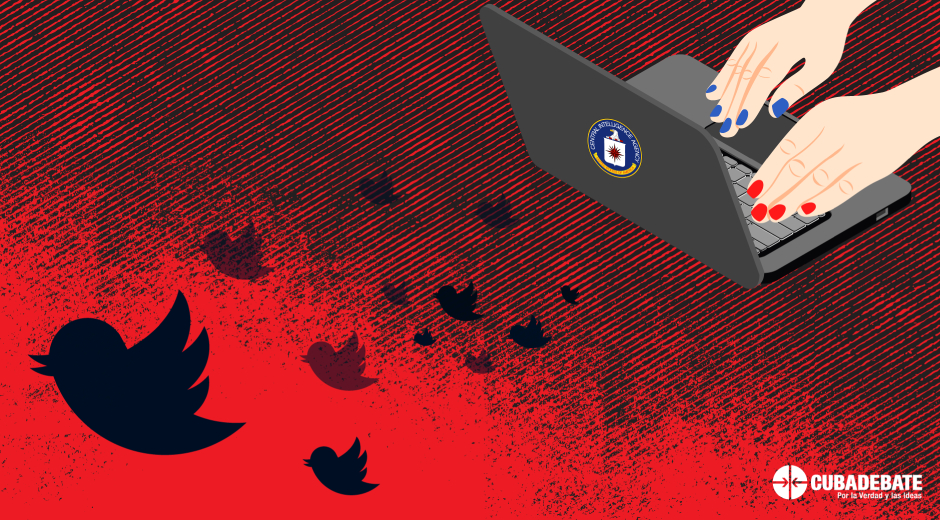
On Monday, Oct. 24, at noon Twitter users noticed a modification to the tagging policy. The social media platform began tagging a group of public media outlets as “affiliated with the Cuban government” and the tag would in turn appear on messages sent or shared from any individual account that linked to those publications’ websites. On Tuesday, Facebook shut down a score of profiles of supposed supporters of the Cuban Revolution but left hundreds that publish manuals for homemade bombs, call to burn police stations, announce armed expeditions, disclose private data for political assassination, threaten and insult generally from accounts abroad.
As if waging an online video game war, the U.S. platforms have decided this week to direct their laser sight into Cuba’s quadrant to mark and silence the “characters” of an enemy that has no way to defend itself.
Some might argue that it’s honorable to be labeled as a publicly funded government media outlet, and it certainly is. But Twitter does not intend to glorify Granma, Cubadebate, Radio Habana Cuba, Juventud Rebelde, and others, but to reduce the dissemination of their messages.
Without prior notice and in a beastly manner, the transnational has extended its control policies to the Caribbean, the rush to erase uncomfortable voices, the hypocritical correction of its community standards, and, once again, it exercises censorship on a global scale, simply by tweaking its algorithms and without the procedures that would allow justifying such decisions. To top it all, it considers private media to be impartial and more genuine than their publicly funded counterparts, so that on planet Twitter anything that smacks of private interest is off-label. In this biased view, users have no right to judge content on its merits.
But the biggest absurdity of all is that it is a U.S. government-linked corporation like Twitter that labels others as “media affiliated” with a state. It’s not hard to find evidence that the platform has worked in increasing intimacy with the White House ever since U.S. politicians began pressuring tech companies to regulate content. In a 2011 legal filing easy to find online, Twitter agreed with the Federal Trade Commission to “implement, monitor and adjust its security measures” under government observation and has since turned over thousands of users’ data to government agencies.
Forbes magazine reported in August that the U.S. tops the list of governments demanding data be handed over to tech platforms, with nearly two million user accounts handed over since 2013. In the election that brought Biden to the White House, Twitter was one of many Silicon Valley corporations that worked directly with U.S. government agencies to determine what content should be removed in order to “secure” the election contest.
Whenever Twitter reports that it has purged thousands of accounts suspected of inauthentic behavior and acting at the direction of foreign governments, it will never be accounts from NATO countries or other friends of the U.S. government, and it doesn’t take much imagination to explain the cause. The favorite sanctioned ones are Russia, China, Iran, Venezuela, and Cuba, of course.
On May 12, 2020, the platform blocked 526 profiles managed from the island. It did not explain its decision to the users who saw their accounts abruptly canceled, but the next day, on May 13, Michael Kozak, then Acting Assistant Secretary for Western Hemisphere Affairs, told the press that the State Department had identified “more than four dozen Cuban accounts” that violated Twitter’s policies – announced by the government agency, not the super and “independent” private company.
Almost simultaneously, The Miami Herald published statements from another official on the progress of relations with Twitter: “We have an ongoing dialogue with technology companies and are working with them to share our thoughts on attempts by state and non-state actors to leverage their platforms to spread disinformation and propaganda,” said Lea Gabrielle, director of the Global Engagement Center (GEC), also at the State Department.
Facebook’s track record as a U.S. government-affiliated media outlet is even darker and quite well-known. I cite as a sample the scandal starting in 2021 by the then White House spokeswoman, Jen Psaki, who told reporters that the executive compiled lists of people who publish on that platform “problematic” content so that Facebook “can remove them”.
Journalist Glenn Greenwald, of The Intercept, reacted angrily: “Union of corporate and state power, one of the classic hallmarks of fascism”. Greenwald was talking about Facebook, but this could be a great label to hang on Twitter as well.
The military-industrial media complex strikes again
written by Struggle – La Lucha
October 31, 2022
Tens of thousands protested against the skyrocketing cost of living and against Macron in France October 16, led by left-wing politician Jean Luc Melenchon, but there were few front page or top-of-the-hour headlines in the U.S. Huge protests occurred in Rome the same day to demand an end to Italy’s involvement in NATO, but no coverage on the west side of the Atlantic. Thousands protesting in Paris October 22 against NATO, but little notice in North America. Massive protests against NATO and inflation due to sanctions on Russian energy in France, Germany and Austria in September, but little news of it here in the heart of the empire. German police beat citizens protesting energy shortages and record-high inflation, both due to Russia sanctions, the week of October 17, but that was not covered in the USA. Seventy thousand Czechs protested in Prague September 3 against NATO involvement in Ukraine, demanding gas from Russia (before some mysterious imperial somebody with means and motive blew up Nordstream 1 and 2, probably to nip the political effects of those protests in the bud) and ending the war, but that got little coverage in U.S. corporate media.
Ever get the sense there are things our media hides from us? Hmm. Ever wonder why enormous protests against the policies of the Exceptional Empire and its attack dog, NATO, seem, um, to be downplayed? Ever think our corporate news outlets behave more like the propaganda arm of our neoconservative state department and military than a free press? Well, if so, you may be onto something.
Lots of Europeans are unhappy about NATO, the Ukraine war, sanctions on Russia and the wild inflation and deindustrialization – which will result in gargantuan unemployment – those sanctions caused. As their living standards sink like stones, Europeans know who is to blame, namely their supposedly great ally across the Atlantic, and many have soured on their so-called alliance with the hegemon. But Washington doesn’t seem to care. Let the Europeans go broke and protest. The important thing is not reporting this news to the American people, who, if they heard about it, might get a subversive inkling that their government had not behaved in an entirely honorable manner.
Meanwhile lies swarm everywhere. Some unintentional, others not. Most recently we have U.S. joint chiefs of staff chairman Mark Milley claiming that if Ukraine falls, the current world order will collapse. Sadly, this is hogwash. What will collapse are the tumescent egos of U.S. and European politicos and military men. Not surprisingly, they conflate that with the world order. But there are other, far more sinister reasons to make such garishly incendiary pronouncements, namely to prepare the American population for the unthinkable – and it is unthinkable because if the U.S. attacks Russia with nukes, both the U.S. and Russia will be annihilated. Will Biden and his generals get a nuclear war? Unclear. But what’s clear as day is that Americans travel like lemmings to their doom, thanks to the fibs of their rulers and media.
Somehow all the big news gets blacked out. Like China dumping $100 billion worth of U.S. treasuries and what that means if this becomes a trend (I’ll tell you what it means: we’re $30 trillion in debt and we can’t pay, so when we cart SUVs full of cash to the supermarket, we’ll make those Weimar wheelbarrows look petite). Or how sanctions on Russian energy backfired and caused ruinous inflation in Europe, pretty awful inflation here in the U.S. and pushed the whole west toward recession…or maybe ultimately depression. Or how Biden’s ever more reckless sanctions on China could wind up bankrupting us all. China is, after all the chief U.S. trading partner. Sanction China, as Biden recently did to its chip and semiconductor sector, and prices for everything explode upwards.
But money isn’t everything. What about Biden’s devil-may-care attitude toward continued human life on this planet, which he endangers every time he opens his mouth to bloviate that the U.S. will throw its military into the fray, should Taiwan and China go to war? True, Biden’s bellicose pronunciamentos do make the news – he is, after all, the ruler of one of the most violent empires in human history – but details of their global life-and-death implications, namely that they could kill us all? Not so much.
No, this news is not of interest to the editorial bigwigs who tell us what to think. They’re too busy stuffing our heads with bubble gum for the brain-like rubbish about Tik Tok, or celebrity drivel or anything else deeply stupid enough to cretinize viewers and readers, so they won’t notice that their utility bills doubled in recent months, or their grocery bills shot up many percentage points, or the world is closer to being incinerated in a nuclear apocalypse than it has ever been.
But they notice anyway. And even though they may lack the finely tuned mental framework to fit it all together, thanks to their news consumption habits, lots of people have begun to glimpse that Washington’s idiocy could get them blown up tout de suite and meanwhile is bleeding them dry and will very soon be bleeding them drier. Hence the public’s growing reluctance to keep handing Ukraine, the most corrupt country in Europe, blank checks. The GOP even climbed onto the bandwagon and announced it won’t fund this misbegotten war if it regains congress. I, for one, will be astonished if Republicans have the backbone to keep that promise. Anyway, Biden plans to preempt this oath by forking over more billions to Kiev now. This will not, ahem, help the Dems, which is probably what Republicans count on. But then Biden gets to look like he’s a man of principle (the show must go on), while the rest of us go broke and calculate our distance from atomic ground zero. Americans struggle with utility bills, grocery and gas prices, medical and educational debt. They don’t need to fund defense contractors to the tune of billions of dollars so Ukrainians and Russians can kill each other halfway around the world. And they certainly don’t need a war that has humanity teetering on the brink of nuclear Armageddon.
In an unexpected dribble of good news, on October 24 the Washington Post reported that some 30 members of the progressive caucus urged Biden to get diplomacy to end the war rolling. The next day, they sniveled and recanted. This was the first time any Dems had the guts not to cheerlead for more bloodshed and more war on Moscow. What caused this initial sea change, I don’t know. But it was good news. Better late than never, it seemed. It appeared to mean some on the so-called left in Washington had finally come to their senses and just might not behave as disgracefully as so many European socialists did once World War I started when they abandoned their erstwhile pacifism. For a long time, honestly, it has looked like that was the inheritance Dem progressives wanted to claim, an inheritance not just of shame and mass murder, but, were the Ukraine war to morph into World War III, human extinction.
For less than a day the sun of reason and goodness shone down. Briefly, the people who consider themselves of the left decided this danger of humanity’s mass execution was worth speaking out about and that diplomacy for peace is the only sane route out of the fiasco. But then, the next day they chickened out of bucking their party’s bloodlust. Even their timid gesture was too much to ask. These people are not leftists. They are cowards. They are a disgrace to the left. If anyone in the progressive caucus ever speaks out for diplomacy again, I’ll be very impressed.
Speaking of being impressed, how about that Washington Post actually playing this story big, about progressives calling for diplomacy, instead of burying it? That was unexpected, to say the least. Because it’s long been sickeningly obvious that our mainstream media show one side of the story: the NATO, Washington, imperial, war-mongering side. And it’s been doing that, shamelessly, for a generation. (It did that earlier too, but with a bit of actual embarrassment, whenever it got called out.) Remember Iraq’s infamous weapons of mass destruction? The editors who hyped that lie for months on end went on to bigger and better things, and so did the politicians – Biden even became president! – while an entire country, Iraq, was bombed to smithereens, based largely on mendacious reporting and political chicanery and now, decades later has simply swirled down the drain.
And who can forget the frenzy whipped up to justify NATO’s criminal 1999 bombing of Serbia? Nowadays Biden and NATO chief Jens Stoltenberg would have you believe NATO is a “defensive” organization. What it did to Serbia should have tossed that mistake in the trash long ago. Instead, the error persists (not accidentally). When Russia reacted to the chance of Ukraine joining NATO and thus the presence of a hostile bomb-happy axis on its borders, western rulers protested that NATO is “defensive.” So also clamor our media, prevaricating just as they do every time they mention the U.S. defense department, which should ditch that moniker and return to the previous, more honest “war department.”
You know things are bad when absurd chuckleheads like former Italian prime minister Silvio Berlusconi are the ones almost nailing reality on the head. He did that October 20 with his remarks that Ukraine provoked Russia into its invasion. It could be argued that Kiev did so by slaughtering 14,000 Russian speakers in the Donbass since 2014 and then, last winter, massing huge numbers of troops on that region’s border, in preparation for what Moscow took to be a genocide. But actually, Ukraine’s supposed instigation had lotsa help. It would have been more accurate for Berlusconi to say that Ukraine’s puppet master, the U.S., provoked Moscow with its nonstop incitement by expanding NATO eastward since the Soviet Union’s fall, as numerous American experts and diplomats – from cold war brain-trust luminary George Kennan to former ambassador to the USSR Jack Matlock to CIA chief William Burns to great powers expert John Mearsheimer, and others – had warned, and more recently egged Moscow to attack with a 2014 Kiev coup and the eight years of violent nonsense that followed, and that Washington did so with premeditation to rupture the economic relationship between Russia and Europe; but nonetheless Berlusconi landed his verbal dart on the board with the bullseye. And when you have to go to Berlusconi for informed commentary, you’re in trouble, because he recently chose his side in the Italian government and it was the fascist one. So now things are so bad that fascists are among the people objecting to imperial propaganda. Fun times.
But we have the same disastrous mess here in the U.S., where the next presidential election could shape up to be a choice between Trump’s fascism or Biden’s nuclear war. Choice? Ho, ho. That’s no choice. That’s death on the installment plan or instant death. Either way, it’s disastrous for ordinary people, because Trumpism either ends what civilization we have in America, which has a dire, global because imperial impact, or Bidenism directly ends civilization on earth.
At the start of the Ukraine war, Biden promised not to launch World War III. He broke that promise, by flooding Ukraine with weapons, CIA operatives and some special forces. To call this reckless is an understatement. Biden’s refusal to use his considerable weight to promote peace negotiations killed thousands of Ukrainians and Russians, will likely kill many more, and also endangers the lives of billions of other people, worldwide – 5.3 billion from nuclear-winter-induced starvation, who would suffer a slow, agonizing death. And I’m not talking about the canard that Russia may use a low-yield nuclear device on the battlefield. I’m talking about Moscow and Washington determining that they really are in a hot war and the long-range, high-yield nuclear missiles that could then begin to fly.
Biden’s sole task is to prevent this. His desire to be seen as the new FDR, as a friend of the unions, as some sort of social democrat, means nothing if he can’t de-escalate this war with Moscow. If Biden wants any legacy other than that of earth’s destroyer, leaving humanity a cold, charred, radioactive planet, he will stop his war-mongering garbage at once and throw his definitive, presidential heft behind peace negotiations with Moscow. And Washington must be an in-person party to those negotiations. Absent that, anything else he does goes down in history, if there even is a history, as a waste.
Eve Ottenberg is a novelist and journalist. Her latest book is Hope Deferred. She can be reached at her website.