Ecuador: An agreement reached and a crisis that continues
written by Struggle – La Lucha
July 10, 2022
18 days of resistance in the streets.
July 7 — On Thursday afternoon the Indigenous uprising in Ecuador ended. The trucks loaded with people began to leave Quito in caravans and under applause to their respective communities. They did it after 18 days of a national strike in which participated the different Indigenous organizations of the country, transporters, popular neighborhoods, all those who came out to protest against the government of Guillermo Lasso.
There were almost three weeks of roadblocks in the different provinces, mobilizations in the capital, daily repression, a balance of five protesters killed, a country in crisis.
The agreement between the Indigenous movement, in particular the Confederation of Indigenous Nationalities of Ecuador (CONAIE), and the government took several days to reach. The starting point was Monday, when the parties sat down after two weeks of protests, with the presence of the different branches of government. The government decided the following day not to return to the meeting, not to recognize the main leader Leonidas Iza, and thus to redouble a tension at the limit, crossed by the death of a military officer on Monday morning during a repression in Sucumbios, Amazon region.
On Wednesday, the possibility of the mediation of the Episcopal Conference appeared, which acted as the theater of the meeting on Thursday in the capital. Finally, an agreement was reached after midday. The main point highlighted in the agreement, the 15 cents reduction in gasoline and diesel, left at first the impression of little after 18 days of mobilization, a look that, however, did not seem predominant in the face of an atmosphere of victory.
It was not the only point achieved thanks to one of the longest and most massive displays of force of the Ecuadorian Indigenous movement, against a president with little social legitimacy, but with the support of the sectors of power.
The arm wrestling
Lasso’s government implemented several joint strategies in the face of the uprising that came after a year of his mandate and more than 80% of disapproval. On the one hand, a policy of direct confrontation with Iza, who was arrested at the beginning of the strike, released, and now has an open court case. This attack against the main leader was combined with a discourse to accuse him of being at the head of a coup attempt, and therefore justify a state of exception with militarization and daily and nightly repressive actions, as on Tuesday night, in the popular town of San Miguel de Común, in Quito.
The government sought to show itself in a position of strength in the face of its first major political crisis. That position adopted showed the support of different sectors of power, economic, police, military and political, particularly in one of its most difficult moments: the vote within the National Assembly (NA) to achieve the presidential dismissal promoted by Correismo, something that did not happen for lack of 12 votes.
The calculation of Lasso, the red circle, the factors of power, was that the Indigenous movement could not sustain the strike indefinitely and, consequently, would end up accepting a lower negotiation than the one originally proposed.
CONAIE began the strike with an agenda of ten points which included the reduction of the price of gasoline and diesel; economic relief for 4 million families with moratorium and renegotiation of debts; fair prices for agricultural products; moratorium on the expansion of the extractive mining and oil frontier; respect for the 21 Indigenous collective rights; and a halt to privatizations, among others. An agenda of sectoral demands and at the same time of economic model, with the flag of Ecuador having a central place in the mobilizations. Thus, the Indigenous movement put itself at the head of a national demand through its uprising.
The Conaie leadership’s calculation was, perhaps, that the government would give in before 18 days, as an effect of the crisis unleashed, the economic impacts, and the internal tensions. A re edition of the October 2019 uprising and its dialogue table, but now with real guarantees for the implementation of the agreements. However, the government showed support to be able to prolong the conflict, and the negotiation took place in a framework of attrition due to the days elapsed. What was signed was an expression of this correlation of forces, a crystallization point in a crisis that has been going on since before Lasso’s government and has no end in sight.
The crisis does not end
The national strike achieved several objectives: to double the budget for bilingual education; to strengthen price controls against speculation; to declare an emergency in the health sector; the end of decree 95 of oil policy, subsidy in inputs for small producers, among others.
There will be 90 days to carry out the agreements. How much of what has been agreed will be implemented? Some answers are yet to be seen within a crisis that closed one of its chapters on Thursday and remains latent.
The 2022 strike can be seen as a continuity of the 2019 uprising: massive protests against neoliberal policies and right-wing governments with centrally repressive responses. Lasso’s victory in 2021 meant a deepening of the model reinstalled by former president Lenin Moreno and, therefore, of its consequences and responses to them.
In both cases the Indigenous movement was at the forefront of the protests. Between 2019 and 2022 its presidency changed, now under the leadership of Iza, who became the main political target of the government, which initiated a process of judicialization of the protest. The movement is in turn heterogeneous, as was seen in the difference between the Conaie and its political instrument, Pachakutik. While the former led the uprising, the latter adopted a policy of backing the government in the NA. Many Indigenous congressmen were pressured in their communities to vote against Lasso in the impeachment process that finally did not reach the necessary majority, although it did achieve a simple majority.
The country is now in a moment of post-confrontational tranquility. It is uncertain to know when there will be new protests, surely led by the Indigenous movement that once again showed a capacity for national and massive mobilization, social legitimacy, and a leadership installed at national level in the figure of Iza.
In February 2023 regional elections will take place, which will show the force map at the polls for the government and its allies, Correism, and the Indigenous movement.
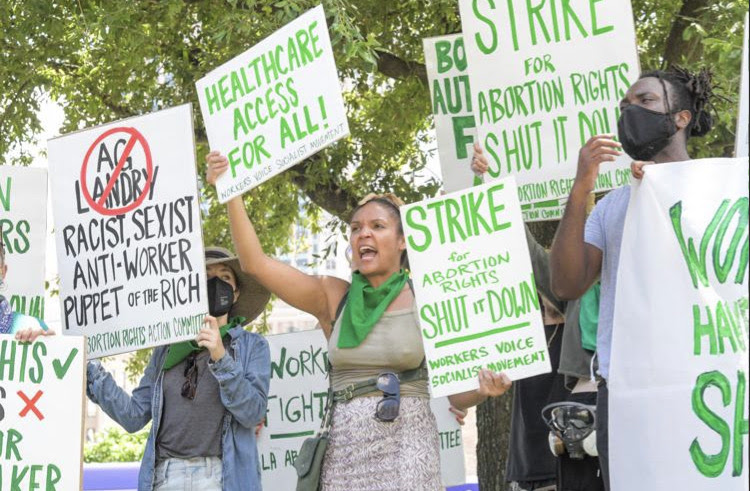
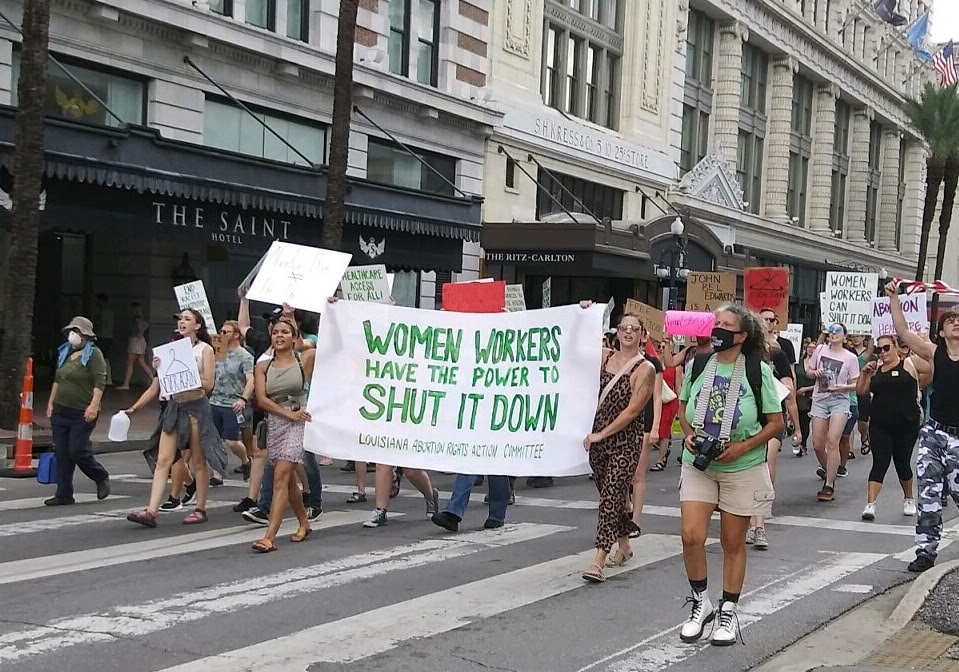
More than 150 people took the fight to restore abortion rights to the streets of New Orleans July 8. We rallied outside the courthouse to send a message to the oil industry-puppet AG Landry and his millionaire cronies: we will not let them go forward with their war on women, trans people, and all workers. We shut down both Canal St. and Loyola Ave. to tell them we’re done with business as usual.
As well as the fight for abortion rights, protesters also called for justice for Jayland Walker and Ronald Greene, murdered by racist police in Ohio and Louisiana, and for an end to attacks on LGBTQ people, immigrants, and other attacks on workers.
To no surprise, the billionaire-funded right-wing used the courts to overrule the will of the people and overturn the temporary injunction that was keeping Louisiana’s 3 clinics open. The judge moved the hearing to Baton Rouge, so AG Landry could shop for a judge as sexist, racist, and anti-worker as he is. But we are sending Landry and company notice: your legal tricks are no match for the power of an organized militant movement fighting for our lives. We are committed to building this movement.
Alongside others across the country, we have taken a step forward in the growing movement to push back the right wing and win back abortion rights and more. Dozens of protesters signed up to join the newly formed Louisiana Abortion Rights Action Committee. To get involved in organizing what’s next, email us here.
Cuba should be removed from the U.S. list of state sponsors of terrorism
written by Struggle – La Lucha
July 10, 2022
Cuba is not a state sponsor of terrorism but a state sponsor of global well-being.The United States maintains a list of countries that it considers as “state sponsors of terrorism.” There are currently four countries on that list: Cuba, North Korea, Iran and Syria. The basic idea behind this list is that the U.S. State Department determines that these countries have “provided support for acts of international terrorism.” Evidence about those “acts” are not provided by the U.S. government. For Cuba, there is not one shred of evidence that the government has offered any such support to terrorism activities, in fact, Cuba has—since 1959—been a victim of acts of terrorism by the United States, including an attempted invasion in 1961 (Bay of Pigs) and repeated assassination attempts against its leaders (638 times against Fidel Castro).
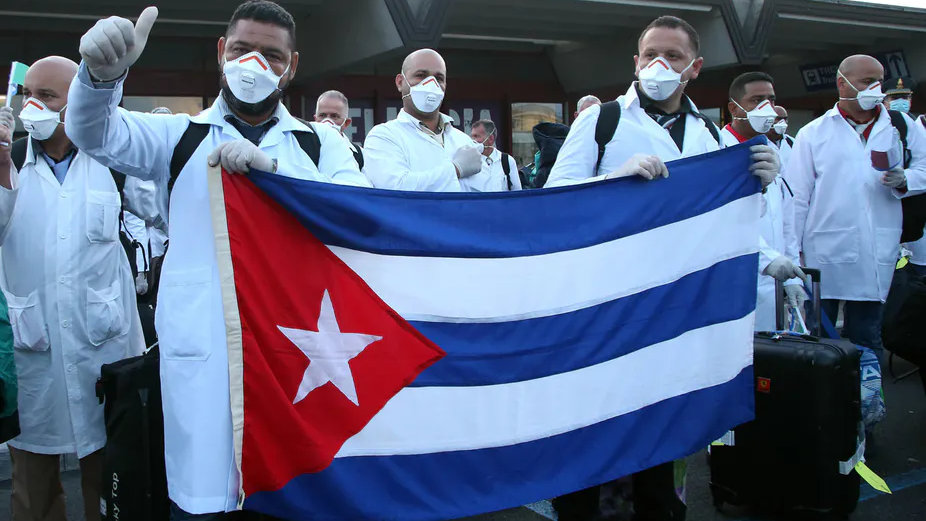
Cuba, rather than exporting weapons around the world, has a long history of medical internationalism with Cuban doctors and medicines being a familiar sight from Pakistan to Peru. In fact, there is an international campaign for Cuban doctors to win the Nobel Peace Prize. Why would a country that floods the world with health care be targeted as a state sponsor of terrorism?
Washington’s vindictiveness
Cuba was not on the state sponsor of terrorism list from 2015 onward, when President Barack Obama removed Cuba from that list (it was first added to the list in 1982 by President Ronald Reagan). In his last week in office, and days before Joe Biden was inaugurated to replace him, former President Donald Trump put Cuba back on the list on January 12, 2021. The comments made by then-U.S. Secretary of State Mike Pompeo provide a strange justification for this action: despite Cuba having been removed from the list in 2015, five years previously, Pompeo said that “[f]or decades, the Cuban government has fed, housed, and provided medical care for murderers, bombmakers, and hijackers.”
The phrase “for decades” suggests that the Trump administration went back beyond 2015, not assessing the situation in Cuba during the five years since it was removed from the list but going back to an era before Obama’s action. There was no new evidence of anything having changed since 2015, which showed that Trump’s actions were purely political (to curry favor with the hard-right wing that continues to want to conduct regime change in Cuba and to nullify as many of Obama’s policies as possible).
The United States has carried out a blockade against Cuba since 1959 when the Cuban Revolution began a process to transform the country that was ruled by gangsters (including the U.S. mafia) into a country that tended to the needs of its people. The revolution developed programs for literacy and health care and for building up the cultural confidence of the people long suppressed by Spanish and U.S. colonialism. The United States elite was eager to snuff out the example of Cuba, which showed that even a poor country could transcend the socioeconomic conditions of poverty. Each year since 1992, almost all the countries in the world — 184 out of 193 at last count — vote in the United Nations General Assembly to condemn the blockade of Cuba.
Remove Cuba from the list
The designation of Cuba as a state sponsor of terrorism by the United States deeply harms the ability of the Cuban government and its people from carrying on with the basic functions of life. The immense power of the United States government over the world financial system means that banks and traders refuse to do business with Cuba since they are afraid of retaliation by the United States government for breaking the blockade. It is stunning to learn that because of this blockade, and despite the murmurs from the U.S. government about medical exceptions, firms refuse to sell Cuba raw materials, reactive agents, diagnostic kits, pharmaceutical drugs and devices, and a range of other materials necessary for operating Cuba’s excellent but stressed public science and health care system.
U.S. President Joe Biden can remove Cuba from this list with a stroke of his pen. It’s as simple as that. When he was running for the presidency, Biden said he would even reverse the harsher of Trump’s sanctions and revert to the policies of the Obama administration. But he has not done so, which might be for reasons of political expediency. There is a streak of vindictiveness that runs through U.S. policies against Cuba, an island that proved during the pandemic that its revolutionary process cares for its people. The example of public health care in Cuba, despite being a small island nation, should be exported around the world. The country is not a state sponsor of terrorism but a state sponsor of global well-being.
How Cuba is eradicating child mortality and banishing the diseases of the poor
written by Struggle – La Lucha
July 10, 2022
To move from 59 infant deaths out of every 1,000 live births to no infant deaths in the matter of a few decades is an extraordinary feat.
Palpite, Cuba, is just a few miles away from Playa Girón, along the Bay of Pigs, where the United States attempted to overthrow the Cuban Revolution in 1961. Down a modest street in a small building with a Cuban flag and a large picture of Fidel Castro near the front door, Dr. Dayamis Gómez La Rosa sees patients from 8 AM to 5 PM. In fact, that is an inaccurate sentence. Dr. Dayamis, like most primary care doctors in Cuba, lives above the clinic that she runs. “I became a doctor,” she told us as we sat in the clinic’s waiting room, “because I wanted to make the world a better place.” Her father was a bartender, and her mother was a housecleaner, but “thanks to the Revolution,” she says, she is a primary care doctor, and her brother is a dentist. Patients come when they need care, even in the middle of the night.
Apart from the waiting room, the clinic only has three other rooms, all of them small and clean. The 1,970 people in Palpite come to see Dr. Dayamis, who emphasizes that she has in her care several pregnant women and infants. She wants to talk about pregnancy and children because she wants to let me know that over the past three years, not one infant has died in her town or in the municipality. “The last time an infant died,” she said, “was in 2008 when a child was born prematurely and had great difficulty breathing.” When we asked her how she remembered that death with such clarity, she said that for her as a doctor any death is terrible, but the death of a child must be avoided at all costs. “I wish I did not have to experience that,” she said.
Eradicate the diseases of the poor
The region of the Zapata Swamp, where the Bay of Pigs is located, before the Revolution, had an infant mortality rate of 59 per 1,000 live births. The population of the area, mostly engaged in subsistence fishing and in the charcoal trade, lived in great poverty. Fidel spent the first Christmas Eve after the Revolution of 1959 with the newly formed cooperative of charcoal producers, listening to them talk about their problems and working with them to find a way to exit the condition of hunger, illiteracy, and ill-health. A large-scale project of transformation had been set into motion a few months before, which drew in hundreds of very poor people into a process to lift themselves up from the wretched conditions that afflicted them. This is the reason why these people rose in large numbers to defend the Revolution against the attack by the United States and its mercenaries in 1961.
To move from 59 infant deaths out of every 1,000 live births to no infant deaths in the matter of a few decades is an extraordinary feat. It was done, Dr. Dayamis says, because the Cuban Revolution pays an enormous attention to the health of the population. Pregnant mothers are given regular care from primary care doctors and gynecologists and their infants are tended by pediatricians—all of it paid from the social wealth of the country. Small towns such as Palpite do not have specialists such as gynecologists and pediatricians, but within a short ride a few miles away, they can access these doctors in Playa Larga.
Walking through the Playa Giron museum earlier that day, the museum’s director Dulce María Limonta del Pozo tells us that the many of the captured mercenaries were returned to the United States in exchange for food and medicines for children; it is telling that this is what the Cuban Revolution demanded. From early into the Revolution, literacy campaigns and vaccination campaigns developed to address the facts of poverty. Now, Dr. Dayamis reports, each child gets between twelve and sixteen vaccinations for such ailments as smallpox and hepatitis.
In Havana’s Center for Genetic Engineering and Biotechnology (CIGB), Dr. Merardo Pujol Ferrer tells us that the country has almost eradicated hepatitis B using a vaccine developed by their Center. That vaccine—Heberbiovac HB—has been administered to 70 million people around the world. “We believe that this vaccine is safe and effective,” he said. “It could help to eradicate hepatitis around the world, particularly in poorer countries.” All the children in her town are vaccinated against hepatitis, Dr. Dayamis says. “The health care system ensures that not one person dies from diarrhea or malnutrition, and not one person dies from diseases of poverty.”
Public health
What ails the people of Palpite, Dr. Dayamis says, are now the diseases that one sees in richer countries. It is one of the paradoxes of Cuba, which remains a country of limited means—largely because of the U.S. government’s blockade of this island of 11 million people—and yet has transcended the diseases of poverty. The new illnesses that she says are hypertension and cardiovascular diseases as well as prostate and breast cancer. These problems, she points out, must be dealt with by public education, which is why she has a radio show on Radio Victoria de Girón, the local community station, each Thursday, called Education for Health.
If we invest in sports, says Raúl Fornés Valenciano, the vice president of the Institute of Physical Education and Recreation (INDER), then we will have less problems of health. Across the country, INDER focuses on getting the entire population active with a variety of sports and physical exercises. Over 70,000 sports health workers collaborate with the schools and the centers for the elderly to provide opportunities for leisure time to be spent in physical activity. This, along with the public education campaign that Dr. Dayamis told us about, are key mechanisms to prevent chronic diseases from harming the population.
If you take a boat out of the Bay of Pigs and land in other Caribbean countries, you will find yourself in a situation where healthcare is almost nonexistent. In the Dominican Republic, for example, infant mortality is at 34 per 1,000 live births. These countries—unlike Cuba—have not been able to harness the commitment and ingenuity of people such as Dr. Dayamis and Dr. Merardo. In these other countries, children die in conditions where no doctor is present to mourn their loss decades later.
SATURDAY, JULY 9, 2022 AT 3:00 PM – 5:00 PM EDT
Justice for Jayland Walker
247 N Dallas Ct, Baltimore
Come join us to demand justice for the brutal police murder of Jayland Walker.
at Douglass homes, 247 North Dallas Court (at Orleans and Dallas Ct
July 9th
Saturday
3.00pm
The war against Black people never stops. Akron, Ohio, police fired over 90 bullets at Jayland Walker, killing the 25-year-old Black man. Cops in New Haven, Connecticut, gave a “rough ride” to Richard “Randy” Cox Jr., paralyzing him.
Jayland Walker was a DoorDash driver who the cops chased shortly after midnight on June 27 for an alleged equipment violation.
Police use the excuse of a broken tail light to brutalize poor and working people. Minnesota cops stopped Teamsters union member Philandro Castile dozens of times before a St. Anthony, Minnesota, police officer killed Castille in front of his fiancee and 4-year-old daughter.
After Jayland Walker got out of his car and ran, eight police officers fired at him. Their bullets hit him over 60 times. Following Walker’s execution he was handcuffed by the cops.
“His body is just riddled with bullets, his face is shot with bullets …” said Bobby DiCello, a lawyer for Walker’s family who saw the police body-camera video.
On June 29, while the North Atlantic Treaty Organization met in Madrid, a “No to NATO” demonstration gathered and rallied in Detroit at the busy Nine Mile and Woodward intersection. The Michigan Peace Council initiative called on anti-imperialists to grow the movement against the U.S. provocative expansion of NATO and weapons deluge to fuel the anti-Russia war in Ukraine.
Organizations speaking at the rally in the grassy roadway median included the Michigan Peace Council, Young Communist League, Green Party, Struggle-La Lucha newspaper, League of Revolutionaries for a New America, Communist Workers League and Party for Socialism and Liberation, among others. Car horns were honked by supporters, with one driver stopped at a red light even donating cash. More united anti-imperialist actions are planned.
40 years is too long! Free Mumia Abu-Jamal!
written by Struggle – La Lucha
July 10, 2022
Demonstrators in Philadelphia on July 3 demanded freedom for Mumia Abu-Jamal. They carried colorful signs and banners under a blazing sun.
The rally was in front of the Municipal Services Building across from City Hall. Forty years before on the 4th of July weekend in 1982, the world-renowned political prisoner had been sentenced to death.
Abu-Jamal was framed for the death of police officer Daniel Faulkner. Abu-Jamal was really convicted for having been a member of the Black Panther Party.
Among the speakers was Mike Africa, Jr., who was born in prison. His parents―Debby Africa and Mike Africa, Sr.―were members of the MOVE 9 who spent 40 years in prison before being released.
Mike Africa Jr. reminded people of the illegal stunts that prosecutor Joseph McGill used in order to send Mumia Abu-Jamal to death row.
One of the “lost” items later found in the District Attorney’s office files was a letter written by a lying witness. The witness asked where was his money for testifying?
Demanding the death penalty, McGill read to the jury an interview with a 16-year old Mumia Abu-Jamal. The teenager quoted Mao Zedong that “political power grows out of the barrel of a gun.”
Judge Albert Sabo allowed McGill to inflame the jury. Sabo was overheard saying “I’m gonna help ’em fry the n—-r.”
It was only the power of the people that stopped Mumia from being executed, even though two death warrants had been signed by Pennsylvania’s Gov. Tom Ridge. Jamal was finally taken off death row in 2011, but the wealthy and powerful want him to die in prison.
People marched around City Hall demanding justice. Some drivers honked their horns in approval.
Mama Pam denounced the racism of the wealthy and powerful. Nearby used to be a statue of former Philadelphia Mayor Frank Rizzo who urged his supporters to “vote white.”
Authorities were forced to remove this obscene monument because of the Black Lives Matter movement.
Twenty-three prisoners have been exonerated while Philadelphia District Attorney Larry Krasner has been in office. They were convicted because of misconduct committed by cops, judges and prosecutors.
But Krassner is still trying to keep Mumia Abu-Jamal in jail, despite the same illegal practices having been used against the revolutionary political prisoner. Krasner needs to stop fighting Mumia’s release. Mumia Abu-Jamal must be set free.
Cuba, Haiti, the Helms-Burton and the crime of insubordination
written by Struggle – La Lucha
July 10, 2022
Haiti was the first free nation in Latin America and the Caribbean, the first nation in the modern world emerging from a slave revolt, and the second most long-standing republic in the Western Hemisphere. The Haitian people overthrew the French colonialists in 1804, abolished slavery, and declared independence.
Their revolution was worse nightmare of colonial powers with possessions in the Caribbean – the ghost of Saint-Domingue disturbed the sleep of slave holders for years.
The imperial powers imposed a rigorous cultural, economic and political blockade on the new Haiti, to prevent the extension of its example.
Two decades after independence was proclaimed, in 1825, French warships returned, blockaded the young nation and issued an ultimatum: pay compensation or prepare for war.
An emissary from King Charles X delivered the message. France demanded payment for properties confiscated by the Haitian Revolution: 150 million gold francs, some 21 billion dollars today, payable in five installments.
According to the colonial empire, the young nation was obliged to compensate French planters for the property and slaves they had lost.
On April 17, 1825, Haitian President Jean-Pierre Boyer signed the Royal Decree presented by Charles X, who promised French diplomatic recognition in exchange for a 50% reduction of tariffs on French imports and the outrageous compensation.
For Haiti the figure was impossible to pay, given the conditions of its economy, ravaged by the French naval blockade and a devastating war, but the “generous” colonialists made a proposal “they couldn’t turn down.”
A group of French banks offered Haiti a loan to cover the compensation, resulting in a double debt that, along with the interest, bled the small country to death, over the course of the 122 years required to pay off its “independence debt.”
What’s more, The New York Times recounts in a recent five-part series of articles, when the U.S. army invaded Haiti in the summer of 1915, a group of Marines entered the national bank and stole some 500,000 dollars in gold, that days later made its way to a Wall Street bank vault.
The United States, using the financial and political chaos the island was experiencing as a pretext, occupied the country militarily, continuing its longstanding policy in the region.
Haiti was to be governed by a U.S. military proconsul.
For more than ten years, a quarter of all Haitian income went to pay off debts to the National City Bank, incurred by the country to cover the expense of “assistance from the U.S. government,” according to The Times.
ANOTHER ISLAND DARES TO CHALLENGE THE EMPIRE
In January 1959, another small Caribbean island, Cuba, defying U.S. imperial power, declared itself the first free territory of the Americas and dared to announce its decision to build the first socialist nation in the hemisphere.
The “crime of insubordination” committed required immediate action by the “superpower.” Since then, all variants of war have been waged against the rebel island, including the economic, without success.
As an essential part of the plan to break the soul and subsequent extermination of the Cuban people, a monstrosity known as the Law for Cuban Democratic Freedom and Solidarity was concocted.
What similarities can be seen between this legal atrocity and the one foisted on Haiti by the French empire? Let’s skip some frightening sections of the Helms-Burton Act, as it is also known, and consider the plan it envisions.
Let’s imagine two hypothetical scenarios, totally impossible for those of us who have confidence in the capacity for resistance and courage of our people.
First: The imperialist enemy and his allies, making use of their military power, would manage to occupy most of the country and establish a transitional government, after proclaiming the end of the Revolution.
Second: Division, deception, and discouragement sown by the enemy would lead to betrayal, another Baraguá, and we would “let the sword fall,” as in 1878.
Would we then have “free and democratic” elections? No, the transitional government, handpicked by the occupying forces, would not call elections until the United States Congress approved such a move.
The U.S. President or his proconsul, appointed for this purpose, would prepare a report to Congress every six months outlining progress being made in the transition process on the occupied island.
How long would this process supposedly last, if they are requiring a report every six months? How long would Yankee troops remain in Cuba?
The answer to both questions is “Who knows?” (Reading the Bush Plan is recommended.)
Finally, after who knows how many years, the U.S. Congress would approve elections. What about the economic, commercial and financial blockade? Would it be lifted when the end of the Revolution was proclaimed?
No, this is not part of the plan; the blockade is to remain intact during the transition, as an ironclad mechanism to apply pressure.
Once the elections were held in U.S. occupied Cuba, with the Revolution removed from power, we would have a president and government, in the style of the imperialists and to their liking.
Insistent questions remain: Would the blockade be lifted? Would the economic war end? The answer is no, that’s not what the Helms Burton proposes.
The new Cuban “president” would verify to Congress that all U.S. citizens who were “former owners” had been compensated with the full value of all properties nationalized or confiscated in accordance with revolutionary laws and in line with international law, including those Cubans who, after 1959, became “Cuban-Americans.”
The “indemnity” or “compensation,” according to U.S. experts in 1997, would have an approximate value of 100 billion dollars.
The empire has a solution that would allow the Cuban government to pay for the legal procedures, compensation and debt: loans from U.S. banks, the IMF, etc., which would generate ever-increasing interest payments and create an endless spiral of plunder.
Cubans, like Haitians years ago, would spend decades paying off a practically impossible debt. How could a country devastated, depleted, impoverished by war and occupation, a country that had lost a good part of its population of working and productive age, afford to do so? It must be clear that they could never occupy our island, without defeating a
Cuban people determined to defend every inch of our homeland.
We would be left in the hands of our hangmen, ready and willing to drain every last drop of our national wealth.
Thomas Piketty, one of the economists consulted by The New York Times, in his work on Haiti, referred to this policy as “neo-colonialism by debt.”
The “crime of insubordination” is the greatest “sin” that a people can commit. Empires never forgive rebels. An insubordinate rebel plants a seed that can sprout many generations later.
The Haitian Revolution was a breeding ground of revolutions. The punishment, the viciousness of the colonial master, could not erase its example. Inspired, Our America rose up to fight for its independence, again and again, as tireless as the courageous Haitians who defeated Napoleon’s best generals, in the first years of the19th century.
UPDATE: Akron, Ohio, police threw tear gas canisters and stun grenades against people demanding justice for Jaylord Walker. Meanwhile the eight cops who killed Walker with dozens of bullets continue to get paid.
The war against Black people never stops. Akron, Ohio, police fired over 90 bullets at Jayland Walker, killing the 25-year-old Black man. Cops in New Haven, Connecticut, gave a “rough ride” to Richard “Randy” Cox Jr., paralyzing him.
Jayland Walker was a DoorDash driver who the cops chased shortly after midnight on June 27 for an alleged equipment violation.
Police use the excuse of a broken tail light to brutalize poor and working people. Minnesota cops stopped Teamsters union member Philandro Castile dozens of times before a St. Anthony, Minnesota, police officer killed Castille in front of his fiancee and 4-year-old daughter.
After Jayland Walker got out of his car and ran, eight police officers fired at him. Their bullets hit him over 60 times. Following Walker’s execution he was handcuffed by the cops.
“His body is just riddled with bullets, his face is shot with bullets …” said Bobby DiCello, a lawyer for Walker’s family who saw the police body-camera video.
The Rev. Roderick Pounds, pastor at Akron’s Second Baptist Church, also saw the video. According to Rev. Pounds, Jayland Walker’s “body was riddled from his face down to his knees.”
U.S. police go berserk with their guns. New York City cops fired 41 bullets at Amadou Diallo on Feb. 4, 1999, killing the unarmed African immigrant from Guinea. Seven years later, New York cops shot 50 times at Sean Bell, killing the unarmed Black man on what was supposed to be his wedding day.
Akron was known as the “tire capital of the world” before its tire factories fled south to run away from unions. Its last big tire factory shut down 40 years ago.
Instead of being able to find a union job, Jayland Walker worked for Amazon before being employed as a delivery driver for DoorDash.
Fearing people’s anger about Walker’s murder, Akron’s mayor cancelled the city’s Fourth of July festivities. Frederick Douglass condemned the United States in the most famous speech given about July 4th.
“There is not a nation on the earth guilty of practices more shocking and bloody,” said Douglass. The murder of Jayland Walker was certainly shocking and bloody. Since 2015, 210 people have been killed by Ohio police.
Ban rough rides!
New Haven police desecrated Juneteenth by paralyzing Richard “Randy” Cox Jr. on June 19. Cox was arrested that day by police on charges that included possessing a handgun.
The Second Amendment “right to bear arms” was never meant for Black people.
Cox was also arrested for “threatening in the first degree.” That charge sounds like something out of a slave code.
Police handcuffed Cox and put him in a patrol wagon without a seat belt. When the vehicle made a sudden stop, Cox slid into a metal wall, seriously injuring his neck and spine.
Cops ignored his pleas for help, just as George Floyd’s pleas of “I can’t breathe” were ignored. Police dragged Cox out of the vehicle, possibly further injuring him. They mocked Cox about his posture.
In 2015, Freddie Gray was given a “rough ride” by Baltimore police, killing the Black man. Baltimore exploded in righteous anger. Randy Cox may be paralyzed for the rest of his life.
New Haven is dominated by filthy rich Yale University with its $42.3 billion endowment. Despite its efforts to look liberal, Yale got those billions by being a training school for members of the ruling class, like the Bush family.
But many Yale students are outraged by this atrocity, as are the people of New Haven. Rough rides must be abolished and guns need to be taken away from the cops.
We need to demand that two groups of gangsters be abolished: the U.S. Supreme Court and the police.
“What to the slave is the 4th of July?” read by Danny Glover
written by Struggle – La Lucha
July 10, 2022
Actor Danny Glover reads abolitionist Frederick Douglass’s “Fourth of July Speech, 1852” on October 5, 2005 in Los Angeles, California. Part of a reading from Voices of a People’s History of the United States (Howard Zinn and Anthony Arnove.)
Full text:
ORATION, DELIVERED IN CORINTHIAN HALL, ROCHESTER, BY FREDERICK DOUGLASS, JULY 5TH, 1852.
Published by Request
ROCHESTER: PRINTED BY LEE, MANN & CO., AMERICAN BUILDING.
1852.
FREDERICK DOUGLASS ESQ.:
Dear Sir-The Ladies of the “Rochester Anti Slavery Sewing Society,” desire me to return you their most sincere thanks for the eloquent and able address delivered in Corinthian Hall, on the 5th of July. Anticipating its speedy publication in Pamphlet form, they request that you will furnish them with one hundred copies for distribution:
In behalf of the Society,
SUSAN F. PORTER, President.
ORATION.
Mr. President, Friends and Fellow Citizens :
HE who could address this audience without a quailing sensation, has stronger nerves than I have. I do not remember ever to have appeared as a speaker before any assembly more shrinkingly, nor with greater distrust of my ability, than I do this day. A feeling has crept over me, quite unfavorable to the exercise of my limited powers of speech. The task before me is one which requires much previous thought and study for its proper performance. I know that apologies of this sort are generally considered flat and unmeaning. I trust, however, that mine will not be so considered. Should I seem at ease, my appearance would much misrepresent me. The little experience I have had in addressing public meetings, in country school houses, avails me nothing on the present occasion.
The papers and placards say, that I am to deliver a 4th July oration. This certainly, sounds large, and out of the common way, for me. It is true that I have often had the privilege to speak in this beautiful Hall, and to address many who now honor me with their presence. But neither their familiar faces, nor the perfect gage I think I have of Corinthian Hall, seems to free me from embarrassment.
The fact is, ladies and gentlemen, the distance between this platform and the slave plantation, from which I escaped, is considerable – and the difficulties to be overcome in getting from the latter to the former, are by no means slight. That I am here today, is, to me, a matter of astonishment as well as of gratitude. You will not, therefore, be surprised, if in what I have to say, I evince no elaborate preparation, nor grace my speech with any high sounding exordium. With little experience and with less learning, I have been able to throw my thoughts hastily and imperfectly together; and trusting to your patient and generous indulgence, I will proceed to lay them before you.
This, for the purpose of this celebration, is the 4th of July. It is the birthday of your National Independence, and of your political freedom. This, to you, is what the Passover was to the emancipated people of God. It carries your minds back to the day, and to the act of your great deliverance; and to the signs, and to the wonders, associated with that act that day. This celebration also marks the beginning of another year of your national life; and reminds you that the Republic of America is now 76 years old. I am glad, fellow-citizens, that your nation is so young. Seventy-six years, though a good old age for a man, is but a mere speck in the life of a nation. ‘Three score years and ten is the allotted time for individual men; but nations number their years by thousands. According to this fact, you are, even now only in the beginning of you national career, still ling ering in the period of childhood. I repeat, I am glad this is so. There is hope in the thought, and hope is much needed, under the dark clouds which lower above the horizon. The eye of the reformer is met with angry flashes, portending disastrous times; but his heart may well beat lighter at the thought that America is young, and that she is still in the impressible stage of her existence. May he not hope that high lessons of wisdom, of justice and of truth, will yet give direction to her destiny? Were the nation older, the patriot’s heart might be sadder, and the reformer’s brow heavier. Its future might be shrouded in gloom, and the hope of its prophets go out in sorrow. There is consolation in the thought, that America is young.-Great streams are not easily turned from channels, worn deep in the course of ages. They may sometimes rise in quiet and stately majesty, and inundate the land, refreshing and fertilizing the earth with their mysterious properties. They may also rise in wrath and fury, and bear away, on their angry waves, the accumulated wealth of years of toil and hardship. They, however, gradually flow back to the same old channel, and flow on as serenely as ever. But, while the river may not be turned aside, it may dry up, and leave nothing behind but the withered branch, and the unsightly rock, to howl in the abyss-sweeping wind, the sad tale of departed glory. As with rivers so with nations.
Fellow-citizens, I shall not presume to dwell at length on the associations that cluster about this day. The simple story of it is, that, 76 years ago, the people of this country were British subjects. The style and title of your “sovereign people” (in which you now glory) was not then born. You were under the British Crown. Your fathers esteemed the English Government as the home government and England as the fatherland. This home government, you know, although a considerable distance from your home, did, in the exercise of its parental prerogatives, impose upon its colonial children, such restraints, burdens and limitations, as, in its mature judgment, it deemed wise, right and proper.
But, your fathers, who had not adopted the fashionable idea of this day, of the infallibility of government, and the absolute character of its acts, presumed to differ from the home government in respect to the wisdom and the justice of some of those burdens and restraints. They went so far in their excitement as to pronounce the measures of government unjust, unreasonable, and oppressive, and altogether such as ought not to be quietly submitted to. I scarcely need say, fellow-citizens, that my opinion of those measures fully accords with that of your fathers. Such a declaration of agreement on my part, would not be worth much to anybody. It would, certainly, prove nothing, as to what part I might have taken, had I lived during the great controversy of 1776. To say now that America was right, and England wrong, is exceedingly easy. Everybody can say it; the dastard, not less than the noble brave, can flippantly discant on the tyranny of England towards the American Colonies. It is fashionable to do so; but there was a time when, to pronounce against England, and in favor of the cause of the colonies, tried men’s souls. They who did so were accounted in their day, plotters of mischief, agitators and rebels, dangerous men. To side with the right, against the wrong, with the weak against the strong, and with the oppressed against the oppressor! here lies the merit, and the one which, of all others, seems un fashionable in our day. The cause of liberty may be stabbed by the men who glory in the deeds of your fathers. But, to proceed.
Feeling themselves harshly and unjustly treated, by the home government, your fathers, like men of honesty, and men of spirit, earnestly sought redress. They petitioned and remonstrated; they did so in a decorous, respectful, and loyal manner. Their conduct was wholly unexceptionable. This, however, did not answer the purpose. They saw themselves treated with sovereign indifference, coldness and scorn. Yet they persevered. They were not the men to look back.
As the sheet anchor takes a firmer hold, when the ship is tossed by the storm, so did the cause of your fathers grow stronger, as it breasted the chilling blasts of kingly displeasure. The greatest and best of British statesmen admitted its justice, and the loftiest eloquence of the British Senate came to its support. But, with that blindness which seems to be the unvarying characteristic of tyrants, since Pharoah and his hosts were drowned in the Red sea, the British Government persisted in the exactions complained of.
The madness of this course, we believe, is admitted now, even by England; but , we fear the lesson is wholly lost on our present rulers.
Oppression makes a wise man mad. Your fathers were wise men, and if they did not go mad, they became restive under this treatment. They felt themselves the victims of grievous wrongs, wholly incurable in their colonial capacity. With brave men there is always a remedy for oppression. Just here, the idea of a total separation of the colonies from the crown was born! It was a startling idea, much more so, than we, at this distance of time, regard it. The timid and the prudent (as has been intimated) of that day, were, of course, shocked and alarmed by it.
Such people lived then, had lived before, and will, probably, ever have a place on this planet; and their course, in respect to any great change, (no matter how great the good to be attained, or the wrong to be redressed by it,) may be calculated with as much precision as can be the course of the stars. They hate all changes, but silver, gold and copper change! Of this sort of change they are always strongly in favor.
These people were called tories in the days of your fathers; and the appellation, probably, conveyed the same idea that is meant by a more modern, though a somewhat less euphonious term, which we often find in our papers, applied to some of our old politicians.
Their opposition to the then dangerous thought was earnest and powerful; but, amid all their terror and affrighted vociferations against it, the alarming and revolutionary idea moved on, and the country with it.
On the 2d of July, 1776, the old Continental Congress, to the dismay of the lovers of ease, and the worshippers of property, clothed that dreadful idea with all the authority of national sanction. They did so in the form of a resolution; and as we seldom hit upon resolutions, drawn up in our day, whose transparency is at all equal to this, it may refresh your minds and help my story if I read it.
Resolved, That these united colonies are, and of right, ought to be free and Independent States; that they are absolved from all allegiance to the British Crown; and that all political connection between them and the State of Great Britain is, and ought to be, dissolved.
Citizens, your fathers Made good that resolution. They succeeded; and today you reap the fruits of their success. The freedom gained is yours; and you, therefore, may properly celebrate this anniversary. The 4th of July is the first great fact in your nation’s history-the very ring-bolt in the chain of your yet undeveloped destiny.
Pride and patriotism, not less than gratitude, prompt you to celebrate and to hold it in perpetual remembrance. I have said that the Declaration of Independence is the RINGBOLT to the chain of your nation’s destiny; so, indeed, I regard it. The principles contained in that instrument are saving principles. Stand by those principles, be true to them on all occasions, in. all places, against all foes, and at whatever cost.
From the round top of your ship of state, dark and threatening clouds may be seen. Heavy billows, like mountains in the distance, disclose to the leeward huge forms of flinty rocks! That bolt drawn, that chain, broken, and all is lost. Cling to this day-cling to it, and to its principles, with the grasp of a storm-tossed mariner to a spar at midnight.
The coining into being of a nation, in any circumstances, is an interesting event. But, besides general considerations, there were peculiar circumstances which make the advent of this republic an event of special attractiveness.
The whole scene, as I look back to it, was simple, dignified and sublime.
The population of the country, at the time, stood at the insignificant number of three millions. The country was poor in the munitions of war. The population was weak and scattered, and the country a wilderness unsubdued. There were then no means of concert and combination, such as exist now. Neither steam nor lightning had then been reduced to order and discipline. From the Potomac to the Delaware was a journey of many days. Under these, and innumerable other disadvantages, your fathers declared for liberty and independence and triumphed.
Fellow Citizens, I am not wanting in respect for the fathers of this republic. The signers of the Declaration of Independence were brave men. They were great men too-great enough to give fame to a great age. It does not often happen to a nation to raise, at one time, such a number of truly great men. The point from which I am compelled to view them is not, certainly the most favorable; and yet I cannot contemplate their great deeds with less than admiration. They were statesmen, patriots and heroes, and for the good they did, and the principles they contended for, I will unite with you to honor their memory.
They loved their country better than their own private interests; and, though this is not the highest form of human excellence, all will concede that it is a rare virtue, and that when it is exhibited, it ought to command respect. He who will, intelligently, lay down his life for his country, is a man whom it is not in human nature to despise. Your fathers staked their lives, their fortunes, and their sacred honor, on the cause of their country. In their admiration of liberty, they lost sight of all other interests.
They were peace men; but they preferred revolution to peaceful submission to bondage. They were quiet men; but they did not shrink from agitating against oppression. They showed forbearance; but that they knew its limits. They believed in order; but not in the order of tyranny. With them, nothing was “settled” that was not right. With them, justice, liberty and humanity were “final;” not slavery and oppression. You may well cherish the memory of such men. They were great in their day and generation. Their solid manhood stands out the more as we contrast it with these degenerate times.
How circumspect, exact and proportionate were all their movements! How unlike the politicians of an hour! Their statesmanship looked beyond the passing moment, and stretched away in strength into the distant future. They seized upon eternal principles, and set a glorious example in their defence. Mark them!
Fully appreciating the hardships to be encountered, firmly believing in the right of their cause, honorably inviting the scrutiny of an on-looking world, reverently appealing to heaven to attest their sincerity, soundly comprehending the solemn responsibility they were about to assume, wisely measuring the terrible odds against them, your fathers, the fathers of this republic, did, most deliberately, under the inspiration of a glorious patriotism, and with a sublime faith in the great principles of justice and freedom, lay deep, the corner-stone of the national super-structure, which has risen and still rises in grandeur around you.
Of this fundamental work, this day is the anniversary. Our eyes are met with demonstrations of joyous enthusiasm. Banners and penants wave exultingly on the breeze. The din of business, too, is hushed. Even mammon seems to have quitted his grasp on this day. The ear-piercing fife and the stirring drum unite their accents with the ascending peal of a thousand church bells. Prayers are made, hymns are sung, and sermons are preached in honor of this day; while the quick martial tramp of a great and multitudinous nation, echoed back by all the hills, valleys and mountains of a vast continent, bespeak the occasion one of thrilling and universal interest–a nation’s jubilee.
Friends and citizens, I need not enter further into the causes which led to this anniversary. Many of you understand them better than I do. You could instruct me in regard to them. That is a branch of knowledge in which you feel, perhaps, a much deeper interest than your speaker. The causes which led to the separation of the colonies from the British crown have never lacked for a tongue. They have all been taught in your common schools, narrated at your firesides, unfolded from your pulpits, and thundered from your legislative halls, and are as familiar to you as household words. They form the staple of your national poetry and eloquence.
I remember, also, that, as a people, Americans are remarkably familiar with all facts which make in in their own favor. This is esteemed by some as a national trait-perhaps a national weakness. It is a fact, that whatever makes for the wealth or for the reputation of Americans, and can be had cheap! will be found by Americans. I shall not be charged with slandering Americans, if I say I think the Americans can side of any question may be safely left in American hands.
I leave, therefore, the great deeds of your fathers to other gentlemen whose claim to have been regularly descended will be less likely to be disputed than mine!
THE PRESENT.
My business, if I have any here today, is with the present. The accepted time with God and his cause is the ever-living now.
“Trust no future, however pleasant, Let the dead past bury its dead; Act, act in the living present, Heart within, and God overhead.”
We have to do with the past only as we can make it useful to the present and to the future. To all inspiring motives, to noble deeds which can be gained from the past, we are welcome. But now is the time, the important time. Your fathers have lived, died, and have done their work, and have done much of it well. You live and must die, and you must do your work. You have no right to enjoy a child’s share in the labor of your fathers, unless your children are to be blest by your labors. You have no right to wear out and waste the hard-earned fame of your fathers to cover your indolence. Sydney Smith tells us that men seldom eulogize the wisdom and virtues of their fathers, but to excuse some folly or wickedness of their own. This truth is not a doubtful one. There are illustrations of it near and remote, ancient and modern. It was fashionable, hundreds of years ago, for the children of Jacob to boast, we have “Abraham to our father,” when they had long lost Abraham’s faith and spirit. That people contented themselves under the shadow of Abraham’s great name, while they repudiated the deeds which made his name great. Need I remind you that a similar thing is being done all over this country today? Need I tell you that the Jews are not the only people who built the tombs of the prophets, and garnished the sepulchres of the righteous? Washington could not die till he had broken the chains of his slaves. Yet his monument is built up by the price of human blood, and the traders in the bodies and souls of men, shout-” We have Washington to “ourfather.”-A las! that it should be so; yet so it is.
“The evil that men do, lives after them, The good is oft interred with their bones.”
Fellow-citizens, pardon me, allow me to ask, why am I called upon to speak here today? What have I, or those I represent, to do with your national independence? Are the great principles of political freedom and of natural justice, embodied in that Declaration of Independence, extended to us? and am I, therefore, called upon to bring our humble offering to the national altar, and to confess the benefits and express devout gratitude for the blessings resulting from your independence to us?
Would to God, both for your sakes and ours, that an affirmative answer could be truthfully returned to these questions! Then would my task be light, and my burden easy and delightful. For who is there so cold, that a nation’s sympathy could not warm him? Who so obdurate and dead to the claims of gratitude, that would not thankfully acknowledge such priceless benefits? Who so stolid and selfish, that would not give his voice to swell the hallelujahs of a nation’s jubilee, when the chains of servitude had been torn from his limbs? I am not that man. In a case like that, the dumb might eloquently speak, and the “lame man leap as an hart.”
But, such is not the state of the case. I say it with a sad sense of the disparity between us. I am not included within the pale of this glorious anniversary! Your high independence only reveals the immeasurable distance between us. The blessings in which you, this day, rejoice, are not enjoyed in common.-The rich inheritance of justice, liberty, prosperity and independence, bequeathed by your fathers, is shared by you, not by me. The sunlight that brought life and healing to you, has brought stripes and death to me. This Fourth July is yours, not mine. You may rejoice, I must mourn. To drag a man in fetters into the grand illuminated temple of liberty, and call upon him to join you in joyous anthems, were inhuman mockery and sacrilegious irony. Do you mean, citizens, to mock me, by asking me to speak today? If so, there is a parallel to your conduct. And let me warn you that it is dangerous to copy the example of a nation whose crimes, towering up to heaven, were thrown down by the breath of the Almighty, burying that nation in irrecoverable ruin! I can today take up the plaintive lament of a peeled and woe-smitten people!
” By the rivers of Babylon, there we sat down. Yea! we wept when we remembered Zion. We hanged our harps upon the willows in the midst thereof. For there, they that carried us away captive, required of us a song; and they who wasted us required of us mirth, saying, Sing us one of the songs of Zion. How can we sing the Lord’s song in a strange land? If I forget thee, 0 Jerusalem, let my right hand forget her cunning. If I do not remember thee, let my tongue cleave to the roof of my mouth.”
Fellow citizens; above your national, tumultuous joy, I hear the mournful wail of millions! whose chains, heavy and grievous yesterday, are, today, rendered more intolerable by the jubilee shouts that reach them. If I do forget, if I do not faithfully remember those bleeding children of sorrow this day, “may my right hand forget her cunning, and may my tongue cleave to the roof of my mouth!” To forget them, to pass lightly over their wrongs, and to chime in with the popular theme, would be treason most scandalous and shocking, and would make me a reproach before God and the world. My subject, then, fellow-citizens, is AMERICAN SLAVERY. I shall see, this day, and its popular characteristics, from the slave’s point of view. Standing, there, identified with the American bondman, making his wrongs mine, I do not hesitate to declare, with all my soul, that the character and conduct of this nation never looked blacker to me than on this 4th of July! Whether we turn to the declarations of the past, or to the profes sions of the present, the conduct of the nation seems equally hideous and revolting. America is false to the past, false to the present, and solemnly binds herself to be false to the future. Standing with God and the crushed and bleeding slave on this occasion, I will, in the name of humanity which is outraged, in the name of liberty which is fettered, in the name of the constitution and the Bible, which are disregarded and trampled upon, dare to call in question and to denounce, with all the emphasis I can command, everything that serves to perpetuate slavery–the great sin and shame of America! “I will not equivocate; I will not excuse;” I will use the severest language I can command; and yet not one word shall escape me that any man, whose judgment is not blinded by prejudice, or who is not at heart a slaveholder, shall not confess to be right and just.
But I fancy I hear some one of my audience say, it is just in this circumstance that you and your brother abo litionists fail to make a favorable impression on the public mind. Would you argue more, and denounce less, would you persuade more, and rebuke less, your cause would be much more likely to succeed. But, I submit, where all is plain there is nothing to be argued. What point in the anti-slavery creed would you have me argue? On what branch of the subject do the people of this country need light? Must I undertake to prove that the slave is a man? That point is conceded already. Nobody doubts it. The slave-holders themselves acknowledge it in the enactment of laws for their government. They acknowledge it when they punish disobedience on the part of the slave. There are seventy-two crimes in the State of Virginia, which, if committed by a black man, (no matter how ignorant he be,) subject him to the punishment of death; while only two of the same crimes will subject a white man to the like punishment.-What is this but the acknowledgement that the slave is a moral, intellectual and responsible being. The manhood of the slave is conceded. It is admitted in the fact that Southern statute books are covered with enactments forbidding, under severe fines and penalties, the teaching of the slave to read or to write.-When you can point to any such laws, in reference to the beasts of the field, then I may consent to argue the manhood of the slave. When the dogs in your streets, when the fowls of the air, when the cattle on your hills, when the fish of the sea, and the reptiles that crawl, shall be unable to distinguish the slave from a brute, then will I argue with you that the slave is a man
For the present, it is enough to affirm the equal manhood of the negro race. Is it not astonishing that, while we are ploughing, planting and reaping, using all kinds of mechanical tools, erecting houses, constructing bridges, building ships, working in metals of brass, iron, copper, silver and gold; that, while we are reading, writing and cyphering, acting as clerks, merchants and secretaries, having among us lawyers, doctors, ministers, poets, authors, editors, orators and teachers; that, while we are engaged in all manner of enterprises common to other men, digging gold in California, capturing the whale in the Pacific, feeding sheep and cattle on the hillside, living, moving, acting, thinking, planning, living in families as husbands, wives and children, and, above all, confessing and worshipping the Christian’s God, and looking hopefully for life and immortality beyond the grave, we are called upon to prove that we are men!
Would you have me argue that man is entitled to liberty? that he is the rightful owner of his own body? You have already declared it. Must I argue the wrongfulness of slavery? Is that a question for Republicans? Is it to be settled by the rules of logic and argumentation, as a matter beset with great difficulty, involving a doubtful application of the principle of justice, hard to be understood? How should I look today, in the presence of Americans, dividing, and subdividing a discourse, to show that men have a natural right to freedom? speaking of it relatively, and positively, negatively, and affirmatively. To do so, would be to make myself ridiculous, and to offer an insult to your understanding.-There is not a man beneath the canopy of heaven, that does not know that slavery is wrong for him.
What, am I to argue that it is wrong to make men brutes, to rob them of their liberty, to work them without wages, to keep them ignorant of their relations to their fellow men, to beat them with sticks, to flay their flesh with the lash, to load their limbs with irons, to hunt them with dogs, to sell them at auction, to sunder their families, to knock out their teeth, to burn their flesh, to starve them into obedience and submission to their masters? Must I argue that a system thus marked with blood, and stained with pollution, is wrong? No I will not. I have better employment for my time and strength, than such arguments would imply.
What, then, remains to be argued? Is it that slavery is not divine; that God did not establish it; that our doctors of divinity are mistaken? There is blasphemy in the thought. That which is inhuman, cannot be divine! Who can reason on such a proposition? They that can, may; I cannot. The time for such argument is past.
At a time like this, scorching irony, not convincing argument, is needed. O! had I the ability, and could I reach the nation’s ear, I would, to day, pour out a fiery stream of biting ridicule, blasting reproach, withering sarcasm, and stern rebuke. For it is not light that is needed, but fire; it is not the gentle shower, but thunder. We need the storm, the whirlwind, and the earthquake. The feeling of the nation must be quickened; the conscience of the nation must be roused; the propriety of the nation must be startled; the hypocrisy of the nation must be exposed; and its crimes against God and man must be proclaimed and denounced.
What, to the American slave, is your 4th of July? I answer; a day that reveals to him, more than. all other days in the year, the gross injustice and cruelty to which lie is the constant victim. To him, your celebration is a sham; your boasted liberty, an unholy license; your national greatness, swelling vanity; your sounds of rejoicing are empty and heartless; your denunciations of tyrants, brass fronted impudence; your shouts of liberty and equality, hollow mockery; your prayers and hymns, your sermons and thanksgivings, with all your religious parade, and solemnity, are, to him, mere bombast, fraud, deception, impiety, and hypocrisy-a thin veil to cover up crimes which would disgrace a nation of savages. There is not a nation on the earth guilty of practices, more shocking and bloody, than are the people of these United States, at this very hour.
Go where you may, search where you will, roam through all the monarchies and despotisms of the old world, travel through South America, search out every abuse, and when you have found the last, lay your facts by the side of the every day practices of this nation, and you will say with me, that, for revolting barbarity and shameless hypocrisy, America reigns without a rival.
THE INTERNAL SLAVE TRADE.
Take the American slave-trade, which we are told by the papers, is especially prosperous just now. Ex-Senator Benton tells us that the price of men was never higher than now. He mentions the fact to show that slavery is in no danger. This trade is one of the peculiarities of American institutions. It is carried on in all the large towns and cities in one half of this confederacy; and millions are pocketed every year, by dealers in this horrid traffic. In several states, this trade is a chief source of wealth. It is called (in contradistinction to the foreign slave-trade) “the internal slave-trade.” It is, probably, called so, too, in order to divert from it the horror with which the foreign slave-trade is contemplated. That trade has long since been denounced by this government, as piracy. It has been denounced with burning words, from the high places of the nation, as an execrable traffic. To arrest it, to put an end to it, this nation keeps a squadron, at immense cost, on the coast of Africa. Every-where, in this country, it is safe to speak of this foreign slave-trade, as a most inhuman traffic, opposed alike to the laws of God and of man. The duty to extirpate and destroy it, is admitted even by our DOCTORS OF DIVINITY. In order to put an. end to it, some of these last have consented that their colored brethren (nominally free) should leave this country, and establish themselves on the western coast of Africa! It is, however, a notable fact, that, while so much execration is poured out by Americans, upon those engaged in the foreign slave-trade, the men engaged in the slave-trade between the states pass without condemnation, and their business is deemed honorable.
Behold the practical operation of this internal slave-trade, the American slave-trade, sustained by American politics and American religion. Here you will see men and women, reared like swine, for the market. You know what is a swine-drover? I will show you a man-drover. They inhabit all our Southern States. They perambulate the country, and crowd the highways of the nation, with droves of human stock. You will see one of these human flesh jobbers, armed with pistol, whip and bowie-knife, driving a company of a hundred men, women, and children, from the Potomac to the slave market at New Orleans. These wretched people are to be sold singly, or in lots, to suit purchasers. They are food for the cotton-field, and the deadly sugar-mill. Mark the sad procession, as it moves wearily along, and the inhuman wretch who drives them. Hear his savage yells and his blood-chilling oaths, as he hurries on his affrighted captives! There, see the old man, with locks thinned and gray. Cast one glance, if you please, upon that young mother, whose shoulders are bare to the scorching sun, her briny tears falling on the brow of the babe in her arms. See, too, that girl of thirteen, weeping, yes! weeping, as she thinks of the mother from whom she has been torn! The drove moves tardily. Heat and sorrow have nearly consumed their strength; suddenly you hear a quick snap, like the discharge of a rifle; the fetters clank, and the chain rattles simultaneously; your ears are saluted with a scream, that seems to have torn its way to the center of your soul! The crack you heard, was the sound of the slave-whip; the scream you heard, was from the woman you saw with the babe. Her speed had faltered under the weight of her child and her chains! that gash on her shoulder tells her to move on. Follow this drove to New Orleans. Attend the auction; see men examined like horses; see the forms of women rudely and brutally exposed to the shocking gaze of American slave-buyers. See this drove sold and separated for ever; and never forget the deep, sad sobs that arose from that scattered multitude. Tell me citizens, WHERE, under the sun, you can witness a spectacle more fiendish and shocking. Yet this is but a. glance at the American slave-trade, as it exists, at this moment, in the ruling part of the United States.
I was born amid such sights and scenes. To me the American slave-trade is a terrible reality. When a child, my soul was often pierced with a sense of its horrors. I lived on Philpot Street, Fell’s Point, Baltimore, and have watched from the wharves, the slave ships in the Basin, anchored from the shore, with their cargoes of human flesh, waiting for favorable winds to waft them down the Chesapeake. There was, at that time, a grand slave mart kept at the head of Pratt Street, by Austin Woldfolk. His agents were sent into every town and county in Maryland, announcing their arrival, through the papers, and on flaming “hand-bills,” headed CASH FOR NEGROES. These men were generally well dressed men, and very captivating in their manners. Ever ready to drink, to treat, and to gamble. The fate of many a slave has depended upon the turn of a single card; and many a child has been snatched from the arms of its mother, by bargains arranged in a state of brutal drunkenness.
The flesh-mongers gather up their victims by dozens, and drive them, chained, to the general depot at Baltimore. When a sufficient number have been collected here, a ship is chartered, for the purpose of conveying the forlorn crew to Mobile, or to New Or-leans. From the slave prison to the ship, they are usually driven in the darkness of night; for since the anti-slavery agitation, a certain caution is observed.
In the deep still darkness of midnight, I have been often aroused by the dead heavy footsteps, and the pitious cries of the chained gangs that passed our door. The anguish of my boyish heart was intense; and I was often consoled, when speaking to my mistress in the morning, to hear her say that the custom was very wicked; that she hated to hear the rattle of the chains, and the heart-rending cries. I was glad to find one who sympathised with me in my horror.
Fellow-citizens, this murderous traffic is, to-day, in active operation in this boasted republic. In the solitude of my spirit, I see clouds of dust raised on the highways of the South; I see the bleeding footsteps; I hear the doleful wail of fettered humanity, on the way to the slave-markets, where the victims are to be sold like horses, sheep, and swine, knocked off to the highest bidder. There I see the tenderest ties ruthlessly broken, to gratify the lust, caprice and rapacity of the buyers and sellers of men. My soul sickens at the sight.
“Is this the land your Fathers loved, The freedom which they toiled to win? Is this the earth whereon they moved? Are these the graves they slumber in?”
But a still more inhuman, disgraceful, and scandalous state of things remains to be presented.
By an act of the American Congress, not yet two years old, slavery has been nationalized in its most horrible and revolting form. By that act, Mason & Dixon’s line has been obliterated; New York has be-come as Virginia; and the power to hold, hunt, and sell men, women and childreH, as slaves, remains no longer a mere state institution, but is now an institution of the whole United States. The power is co-extensive with the star-spangled banner, and American Christianity. Where these go, may also go the merciless slave-hunter. Where these are, man is not sacred. He is a bird for the sportsman’s gun./ By that most foul and fiendish of all human decrees, the liberty and person of every man are put in peril. Your broad republican domain is hunting ground for men.Not for thieves and robbers, enemies of society, merely, but for men guilty of no crime. Your law-makers have commanded all good citizens to engage in this hellish sport. Your President, your Secretary of State, your lords, nobles, and ecclesiastics, enforce, as a duty you owe to your free and glorious country, and to your God, that you do this accursed thing. Not fewer than forty Americans, have, within the past two years, been hunted down, and, without a moment’s warning, hurried away in chains, and consigned to slavery, and excruciating torture. Some of these have had wives and children, dependent on them for bread; but of this, no account was made. The right of the hunter to his prey, stands superior to the right of marriage, and to all rights in this republic, the rights of God included! For black men there are neither law, justice, humanity, nor religion.
The Fugitive Slave Law makes MERCY TO THEM, A CRIME; and bribes the judge who tries them. An American JUDGE GETS TEN DOLLARS FOR EVERY VICTIM HE CONSIGNS to slavery, and five, when he fails to do so. The oath of any two villains is sufficient, under this hell-black enactment, to send the most pious and exemplary black man into the remorseless jaws of slavery! His own testimony is nothing. He can bring no witnesses for himself. The minister of American justice is bound, by the law to hear but one side; and that side, is the side of the oppressor. Let this damning fact be perpetually told. Let it be thundered around the world, that, in tyrant-killing, king-hating, people-loving, democratic, Christian America, the seats of justice are filled with judges, who hold their offices under an open and palpable bribes, and are bound, in deciding in the case of a man’s liberty, to hear only his accusers!
In glaring violation of justice, in shameless disregard of the forms of administering law, in cunning arrangement to entrap the defenceless, and in diabolical intent, this Fugitive Slave Law stands alone in the annals of tyrannical legislation. I doubt if there be another nation on the globe, having the brass and the baseness to put such a law on the statute-book. If any man in this assembly thinks differently from me in this matter, and feels able to disprove my statements, I will gladly confront him at any suitable time and place he may select.
RELIGIOUS LIBERTY.
I take this law to be one of the grossest infringements of Christian Liberty, and, if the churches and ministers of our country were not stupidly blind, or most wickedly indifferent, they, too, would so regard it.
At the very moment that they are thanking God for the enjoyment of civil and religious liberty, and for the right to worship God according to the dictates of their own consciences, they are utterly silent in respect to a law which robs religion of its chief significance, and makes it utterly worthless to a world lying in wickedness. Did this law concern the “mint,anise and cummin,”-abridge the right to sing psalms, to partake of the sacrament, or to engage in any of the ceremonies of religion, it would be smitten by the thunder of a thousand pulpits. A general shout would go up from the church, demanding repeal, repeal, instant repeal!-And it would go hard with that politician who presumed to solicit the votes of the people without inscribing this motto on his banner. Further, if this demand were not complied with, another Scotland would be added to the history of religious liberty, and the stern old covenanters would be thrown into the shade. A John Knox would be seen at every church door, and heard from every pulpit, and Fillmore would have no more quarter than was shown by Knox, to the beautiful, but treacherous Queen Mary of Scotland.-The fact that the church of our country, (with fractional exceptions,) does not esteem “the Fugitive Slave Law” as a declaration of war against religious liberty, implies that that church regards religion simply as a form of worship, an empty ceremony, and not a vital principle, requiring active benevolence, justice, love and good will towards man. It esteems sacrifice above mercy; psalm-singing above right doing; solemn meetings above practical righteousness. A worship that can be conducted by persons who refuse to give shelter to the houseless, to give bread to the hungry, clothing to the naked, and who enjoin obedience to a law forbidding these acts of mercy, is a curse, not a blessing to mankind. The Bible addresses all such persons as “scribes, pharisees, hypocrites, who pay tithe of mint, anise, and cummin, and have omitted the weightier matters of the law, judgment, mercy and faith.”
THE CHURCH RESPONSIBLE.
But the church of this country is not only indifferent to the wrongs of the slave, it actually takes sides with the oppressors. It has made itself the bulwark of American slavery, and the shield of American slave-hunters. Many of its most eloquent Divines, who stand as the very lights of the church, have shamelessly given the sanction of religion, and the bible, to the whole slave system. – They have taught that man may, properly, be a slave; that the relation of master and slave is ordained of God; that to send back an escaped bondman to his master is clearly the duty of all the followers of the Lord Jesus Christ; and this horrible blasphemy is palmed off upon the world for christianity.
For my part, I would say, welcome infidelity! welcome atheism! welcome anything! in preference to the gospel, asp r eached by those Divines! They convert the very name of religion into an engine of tyranny, and barbarous cruelty, and serve to confirm more infidels, in this age, than all the infidel writings of Thomas Paine, Voltaire, and Bolingbroke, put together, have done? These ministers make religion a cold and flinty-hearted thing, having neither principles of right action, nor bowels of compassion. They strip the love of God of its beauty, and leave the throne of religion a huge, horrible, repulsive form. It is a religion for oppressors, tyrants, man-stealers, and thugs. It is not that “pare and undefiled religion” which is from above, and which is “first pure, then peaceable, easy to be entreated, full of mercy and good fruits, without partiality, and without hypocrisy.” But a religion which favors the rich against the poor; which exalts the proud above the humble; which divides mankind into two classes, tyrants and slaves; which says to the man in chains, stay there; and to the oppressor, oppress on; it is a religion which may be professed and enjoyed by all the robbers and enslavers of mankind; it makes God a respecter of persons, denies his fatherhood of the race, and tramples in the dust the great truth of the brotherhood of man. All this we affirm to be true of the popular church, and the popular worship of our land and nation-a religion, a church and a worship which, on the authority of inspired wisdom, we pronounce to be an abomination in the sight of God. In the language of Isaiah, the American church might be well addressed, “Bring no more vain oblations; incense is an abomination unto me : the new moons and Sabbaths, the calling of assemblies, I cannot away with it is iniquity, even the solemn meeting. Your new moons, and your appointed feasts my soul hatest. They are a trouble to me; I am weary to bear them; and when ye spread forth your hands I will hide mine eyes from you. Yea! when ye make many prayers, I will not hear. YOUR HANDS ARE FULL OF BLOOD; cease to do evil, learn to do well; seek judgment; relieve the oppressed; judge for the fatherless; plead for the widow.”
The American church is guilty, when viewed in connection with what it is doing to uphold slavery; but it is superlatively guilty when viewed in connection with its ability to abolish slavery.
The sin of which it is guilty is one of omission as well as of commission. Albert Barnes but uttered what the common sense of every man at all observant of the actual state of the case will receive as truth, when he declared that “There is no power out of the church that could sustain slavery an hour, if it were not sustained in it.”
Let the religious press, the pulpit, the sunday school, the conference meeting, the great ecclesiastical, missionary, bible and tract associations of the land array their immense powers against slavery, and slave-holding; and the whole system of crime and blood would be scattered to the winds, and that they do not do this involves them in the most awful responsibility of which the mind can conceive.
In prosecuting the anti-slavery enterprise, we have been asked to spare the church, to spare the ministry; but how, we ask, could such a thing be done? We are met on the threshold of our efforts for the redemption of the slave, by the church. and ministry of the country, in battle arrayed against us; and we are compelled to fight or flee. From what quarter, I beg to know, has proceeded a fire so deadly upon our ranks, during the last two years, as from the Northern pulpit? As the champions of oppressors, the chosen men of American theology have appeared-men, honored for their so called piety, and their real learning. The LORDS of Buffalo, the SPRINGS of New York, the LATHROPS of Auburn, the COXES and SPENCERS of Brooklyn, the GANNETS and SHARPS of Boston, the DEWEYS of Washington, and other great religious lights of the land, have, in utter denial of the authority of Him, by whom they professed to be called to the ministry, deliberately taught us, against the example of the Hebrews, and against the remonstrance of the Apostles, they teach that we ought to obey man’s law beforethe law of God.”
My spirit wearies of such blasphemy; and how such men can be supported, as the “standing types and representatives of Jesus Christ,” is a mystery which I leave others to penetrate. In speaking of the American church, however, let it be distinctly understood that I mean the great mass of the religious organizations of our land. There are exceptions, and I thank God that there are. Noble men may be found, scattered all over these Northern States, of whom Henry Ward Beecher, of Brooklyn, Samuel J. May, of Syracuse, and my esteemed friend* on the platform, are shining examples; and let me say further, that, upon these men lies the duty to inspire our ranks with high religious faith and zeal, and to cheer us on in the great mission of the slave’s redemption from his chains.
RELIGION IN ENGLAND AND RELIGION IN AMERICA.
One is struck with the difference between the attitude of the American church towards the anti-slavery movement, and that occupied by the churches in England towards a similar movement in that country. There, the church, true to its mission of ameliorating, elevating, and improving the condition of mankind, came forward promptly, bound up the wounds of the West Indian slave, and restored him to his liberty. There, the question of emancipation was a high religious question. It was demanded, in the name of humanity, and according to the law of the living God. The Sharps, the Clarksons, the Wilberforces, the Buxtons, the Burchells and the Knibbs, were alike famous for their piety, and for their philanthropy. The anti-slavery movement there, was not an anti-church movement, for the reason that the church took its full share in prosecuting that movement : and the anti-slavery movement in this country will cease to be an anti-church movement, when the church of this country shall assume a favorable, instead of a hostile position towards that movement.
Americans! your republican politics, not less than your republican religion, are flagrantly inconsistent. You boast of your love of liberty, your superior civilization, and your pure christianity, while the whole political power of the nation, (as embodied in the two great political parties, is solemnly pledged to support and perpetuate the enslavement of three millions of your countrymen. You hurl your anathemas at the crowned headed tyrants of Russia and Austria, and pride yourselves on your Democratic institutions, while you yourselves consent to be the mere tools and body-guards of the tyrants of Virginia and Carolina. You invite to your shores fugitives of oppression from abroad, honor them with banquets, greet them with ovations, cheer them, toast them, salute them, protect them, and pour out your money to them like water; but the fugitives from your own land, you advertise, hunt, arrest, shoot and kill. You glory in your refinement, and your universal education; yet you maintain a system as barbarous and dreadful, as ever stained the character of a nation-a system begun in avarice, supported in pride, and perpetuated in cruelty. You shed tears over fallen Hungary, and make the sad story of her wrongs the theme of your poets, statesmen and orators, till your gallant sons are ready to fly to arms to vindicate her cause against her oppressors; but, in regard to the ten thousand wrongs of the American slave, you would enforce the strictest silence, and would hail him as an enemy of the nation who dares to make those wrongs the subject of public discourse! You are all on fire at the mention of liberty for France or for Ireland; but are as cold as an iceberg at the thought of liberty for the enslaved of America.-You discourse eloquently on the dignity of labor; yet, you sustain a system which, in its very essence, casts a stigma upon labor. You can bare your bosom to the storm of British artillery, to throw off a three-penny tax on tea; and yet wring the last hard earned farthing from the grasp of the black laborers of your country. You profess to believe “that, of one blood, God made all nations of men to dwell on the face of all the earth,” and hath commanded all men, everywhere to love one another; yet you notoriously hate, (and glory in your hatred,) all men whose skins are not colored like your own. You declare, before the world, and are understood by the world to declare, that you “h old these truths to be self evident, that all men are created equal; and are endowed by their Creator with certain, inalienable rights; and that, among these are, life, liberty, and the pursuit of happiness; and yet, you hold securely, in a bondage, which according to your own Thomas Jefferson, “is worse than ages of that which your fathers rose in rebellion to oppose,” a seventh part of the inhabitants of your country.
Fellow-citizens! I will not enlarge further on your national inconsistencies. The existence of slavery in this country brands your republicanism as a sham, your humanity as a base pretense, and your christianity as a lie. It destroys your moral power abroad it corrupts your politicians at home. It saps the foundation of religion; it makes your name a hissing, and a bye-word to a mocking earth. It is the antagonistic force in your government, the only thing that seriously disturbs and endangers your Union. It fetters your progress; it is the enemy of improvement, the deadly foe of education; it fosters pride; it breeds insolence; it promotes vice; it shelters crime; it is a curse to the earth that supports it; and yet, you cling to it, as if it were the sheet anchor of all your hopes. Oh! be warned! be warned! a horrible reptile is coiled up in your nation’s bosom; the venomous creature is nursing at the tender breast of your youthful republic; for the love of God, tearaway, and fling from you the hideous monster, and let the weight of twenty millions, crush and destroy it forever!
THE CONSTITUTION.
But it is answered in reply to all this, that precisely what I have now denounced is, in fact, guaranteed and sanctioned by the Constitution of the United States; that, the right to hold, and to hunt slaves is a part of that Constitution framed by the illustrious Fathers of this Republic.
Then, I dare to affirm, notwithstanding all I have said before, your fathers stooped, basely stooped.
“To palter with us in a double sense : And keep the word of promise to the ear, But break it to the heart.”
And instead of being the honest men I have before declared them to be, they were the veriest imposters that ever practised on mankind. This is the inevitable conclusion, and from it there is no escape; but I differ from those who charge this baseness on the framers of the Constitution of the United States. It is a slander upon their memory, at least, so I believe. There is not time now to argue the constitutional question at length; nor have I the ability to discuss it as it ought to be discussed. The subject has been handled with masterly power by Lysander Spooner, Esq., by William Goodell, by Samuel E. Sewall, Esq., and last, though not least, by Gerritt Smith, Esq. These gentlemen have, as I think, fully and clearly vindicated the Constitution from any design to support slavery for an hour.
Fellow-citizens! there is no matter in respect to which, the people of the North have allowed themselves to be so ruinously imposed upon, as that of the pro-slavery character of the Constitution. In that instrument I hold there is neither warrant, license, nor sanction of the hateful thing; but interpreted, as it ought to be interpreted, the Constitution is a GLORIOUS LIBERTY DOCUMENT. Read its preamble, consider its purposes. Is slavery among them? Is it at the gateway? or is it in the temple? it is neither. While I do not intend to argue this question on the present occasion, let me ask, if it be not somewhat singular that, if the Constitution were intended to be, by its framers and adopters, a slave-holding instrument, why neither slavery, slaveholding, nor slave can anywhere be found in it. What would be thought of an instrument, drawn up, legally drawn up, for the purpose of entitling the city of Rochester to a track of land, in which no mention of land was made? Now, there are certain rules of interpretation, for the proper understanding of all legal instruments. These rules are well established. They are plain, common-sense rules, such as you and I, and all of us, can understand and apply, without having passed years in the study of law. I scout the idea that the question of the constitutionality, or un. constitutionality of slavery, is not a question for the people. I hold that every American citizen has a right to form an opinion of the constitution, and to propagate that opinion, and to use all honorable means to make his opinion the prevailing one. With out this right, the liberty of an American citizen would be as insecure as that of a Frenchman. Ex-Vice-President Dallas tells us that the constitution is an object to which no American mind can be too attentive, and no American heart too devoted. He further says, the constitution, in its words, is plain and intelligible, and is meant for the home-bred, unsophisticated understandings of our fellow-citizens. Senator Berrien tells us that the Constitution is the fundamental law, that which controls all others. The charter of our liberties, which every citizen has a personal interest in understanding thoroughly. The testimony of Senator Breese, Lewis Cass, and many others that might be named, who are everywhere esteemed as sound lawyers, so regard the constitution. I take it, therefore, that it is not presumption in a private citizen to form an opinion of that instrument.
Now, take the constitution according to its plain reading, and I defy the presentation of a single pro . slavery clause in it. On the other hand it will be found to contain principles and purposes, entirely hostile to the existence of slavery.
I have detained my audience entirely too long already. At some future period I will gladly avail myself of an opportunity to give this subject a full and fair discussion.
Allow me to say, in conclusion, notwithstanding the dark picture I have this day presented, of the state of the nation, I do not despair of this country. There are forces in operation, which must inevitably, work the downfall of slavery. “Thearm of the Lordisnot shortened,” and the doom of slavery is certain.
I, therefore, leave off where I began, with hope. While drawing encouragement from “the Declaration of Independence,” the great principles it contains, and the genius of American Institutions, my spirit is also cheered by the obvious tendencies of the age. Nations do not now stand in the same relation to each other that they did ages ago. No nation can now shut itself up, from the surrounding world, and trot round in the same old path of its fathers without interference. The time was when such could be done. Long established customs of hurtful character could formerly fence themselves in, and do their evil work with social impunity. Knowledge was then confined and enjoyed by the privileged few, and the multitude walked on in mental darkness. But a change has now come over the affairs of mankind. Walled cities and empires have become unfashionable. The arm of commerce has borne away the gates of the strong city. Intelligence is penetrating the darkest corners of the globe. It makes its pathway over and under the sea, as well as on the earth. Wind, steam, and lightning are its chartered agents. Oceans no longer divide, but link nations together. From Boston to London is now a holiday excursion. Space is comparatively annihilated.-Thoughts expressed on one side of the Atlantic, are distinctly heard on the other.
The far off and almost fabulous Pacific rolls in grandeur at our feet. The Celestial Empire, the mystery of ages, is being solved. The fiat of the Almighty, “Let there be Light,” has not yet spent its force. No abuse, no outrage whether in taste, sport or avarice, can now hide itself from the all-pervading light. The iron shoe, and crippled foot of China must be seen, in contrast with nature. Africa must rise and put on her yet unwoven garment. “Ethiopia shall stretch out her hand unto God.” In the fervent aspirations of William Lloyd Garrison, I say, and let every heart join in saying it :
God speed the year of jubilee
The wide world o’er!
When from their galling chains set free, Th’ oppress’d shall vilely bend the knee, And wear the yoke of tyranny
Like brutes no more.
That year will come, and freedom’s reign, To man his plundered rights again Restore.
God speed the day when human blood
Shall cease to flow!
In every clime be understood,
The claims of human brotherhood,
And each return for evil, good, Not blow for _blow;
That day will come all feuds to end,
And change into a faithful friend
Each foe.
God speed the hour, the glorious hour, When none on earth
Shall exercise a lordly power,
Nor in a tyrant’s presence cower; But all to manhood’s stature tower, By equal birth!
THAT HOUR WILL COME, to each, to all,
And from his prison-house, the thrall Go forth.
Until that year, day, hour, arrive,
With head, and heart, and hand I’ll strive, To break the rod, and rend the gyve, The spoiler of his prey deprive
So witness Heaven!
And never from my chosen post,
Whate’er the peril or the cost,
Be driven.