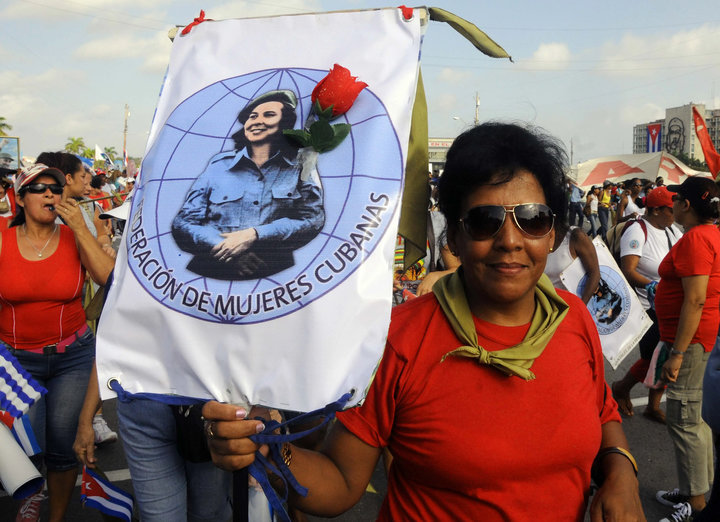
Havana, Cuba — When you have touched a woman you have struck a rock, says a South African proverb. It continues, you have dislodged a boulder, you will be crushed. The U.S. Supreme Court justices who penned the recently leaked draft majority opinion abolishing voluntary legal pregnancy termination, should take heed.
Although the current debate centers on the issue of the women’s right to make decisions over their own bodies, in fact much more is at the root. Today’s political flashpoint holds within it the urgent need to overturn patriarchal gender norms, class oppression and the capitalist economic system that perpetuates them. The fight is really for life for the majority, not just for the few.
This is not political jargon. The combat between the past and the future can be seen in real time when Cuba’s proposed Families Code and 2022 National Program for the Advancement of Women is compared with the hateful onslaught faced by women in the United States where the Equal Rights Amendment is still blocked.
In the United States, rights that were thought to have been won, at least in part, are now being slashed, eroded or reversed like the right to legal, safe abortion, or like universal voting rights. It must be noted that the U.S. is still the only industrialized country without a national health plan, so payment for medical procedures even where legal may not be covered by private insurance and require out of pocket payment. A poll published by CNBC.com reported that “66% of Americans fear they won’t be able to afford health care” in 2021.
All Cubans can afford health care
On the other hand, no Cuban need fear they won’t be able to afford health care in any year. Despite the undeniable fact that the U.S. economic, commercial, financial and media war against revolutionary socialist Cuba hurts every aspect of daily Cuban life, all health care from organ transplants to abortion is the right of every Cuban who needs it. Not Obama Care, not Medicare for All – free, universal, community-based preventive health care.
Revolutionary Cuba leaves no stone unturned to provide these rights even hampered by the laser-focused, intensified U.S. blockade. Somehow, through working together with solidarity, they do it: Witness the herculean COVID-19 vaccine development, now expanding to protect the six-month to two-year age group.
The right to health care and debate about abortion were settled in Cuba long before the recent green bandana advances in Argentina, Colombia and Chile. Nonetheless, the Cuban people, too, are in the midst of debating rights – but not the rights for capitalists and landlords to exploit and steal or Big Pharma extortion for medicines. The groundbreaking 1975 Family Code that codified gender equality in the home and in society is being updated, modernized, and strengthened with more equality and inclusion, more protection, not less. Significantly, even the title has been changed from Family Code to Families Code.
As presented by Federation of Cuban Women leader Teresa Amarelle Boué, Secretary General of the Federation of Cuban Women, at the March 2022 U.S.-Cuba Normalization Conference in New York City, the proposed revisions include the rights of children and seniors, as well as expanding benefits important to and sought by women workers such as in-workplace childcare. Even with resources severely stunted by the U.S. economic warfare, the code proposes to boost income 50% for working women with three or more children under 18. Six thousand one hundred and eleven of these women and their children already received a new home free of charge, fully resolving their housing needs. Even more could be done without the U.S. blockade, she said. Community laundries are a new win-win proposal that provides new jobs while alleviating some household labor.
Child poverty across the U.S.
Contrast this with the U.S. where a “right to life” banner is cynically used to restrict women’s reproductive autonomy. In the U.S., right to life is purported to begin at conception, but stops before birth, sending Black maternity and infant death rates to scandalous heights in the richest country on the globe. In 2020, 16% of children under 18 years of age, 11.6 million, live in poverty. Students graduate from university with unpayable student loans. Tickets to concerts and sporting events are out of reach for most. The right to health care, education, housing, sports and culture and a dignified life with the possibility of developing each human’s potential are all constitutionally guaranteed in Cuba.
Gender reassignment has notably been free in Cuba as part of medical care. Now free fertility assistance including surrogacy under certain conditions is included in the proposed Families Code, something unthinkably unaffordable to many in the U.S. who are unable to have children.
The Families Code provides legal rights for the various family formations that actually exist in Cuba today – officially married, or committed relationships without formality, same-sex relationships, grandparents or other close relatives raising children and more. Rights are expanded, not restricted so each family choice and need is respected. Amarelle explained the improvements this way:
“This is a code of opportunities and alternatives, of adding and multiplying, that recognizes and guarantees rights for those who didn’t have them. In no way does it affect or limit the rights already recognized for others.
“It does not establish molds nor does it require anyone to choose a family model that is not the one desired by each family.
“It is a broad and comprehensive code, revolutionary and modern.” (transcript of simultaneous translation by Martin Koppel, https://youtu.be/wJJfDeVi3gI)
Cuba expands rights of children
The rights of children are expanded. The term “patria potestar” or parental authority was replaced with parental responsibility meaning physically and psychologically capable to guarantee and protect the rights, well-being and the happiness of the daughters and sons, provide participation, to listen to them, protect them, bring them love, foster their growth and independence in an atmosphere of affection.
The discussions are not pro-forma to check off some abstract requirement, but take into consideration the comments, additions, suggestions and proposals gathered through multiple opportunities in 78,000 assemblies. As of the March conference, the version under discussion is the 24th draft. After approval by the National Assembly the final product of the consultations will then be voted on by the people in a national referendum, where as a result of the consultation processes, voters actually understand what they are voting on.
The secret weapon of socialist Cuba
Equality and development of the potential of each human being is the secret weapon of socialist Cuba. The current U.S. efforts to push women back into some past family form conflicts with development of technology and our globalized world.
This equality was fundamental in the revolutionary process itself, recognized and promoted by the historic leader of the 1959 Cuban revolution, Fidel Castro Ruz. Women clandestine leaders like Celia Sanchez, Heidi Santamaria, Melba Hernandez and Vilma Espin also joined Fidel and the July 26 Movement in the Sierra Maestra.
Fidel also supported the formation of a battalion of women combatants, the Marianas, named after Mariana Grajales, mother of five sons including Antonio Maceo who fought and died for an end to slavery and Cuban independence from Spain. Weapons were scarce, but Fidel prioritized arming the Marianas who were regarded as the best fighters. After the victory over the U.S.-backed Batista dictatorship Fidel and Vilma Espin founded the Federation of Cuban Women to erase the legacy of colonialism through education and job opportunities. Tradition’s chains were severed when thousands of young women joined Cuba’s historic Literacy Campaign teaching the country to read and write in a year. The success of this process is evident today where women scientists and technicians are integral leaders in the development and production of Cuba’s five COVID-19 vaccines.
The following statistics were presented by the FMC delegation to the Commission on the Status of Women (CSW66):
Women: 67.4% of workers in education, more than 70% of judges and attorneys general, 62% of doctors and 64.2% of those working in international collaboration in countries around the world. Participation in decision-making is increasing. As of the end of 2021, women held 51.6% of State and Government positions including 52.3% of the State Council, 52.7% of Municipal People’s Power Assemblies, 53.22% of parliamentary representatives, 54.35% of the Municipal Assembly presidents and vice-presidents.
So what are we fighting for? The Supreme Court has forced the question. Let’s answer it. Cuba represents our future.
Fact-finding trip to Donbass: A front-line shelter in Rubizhne
I had just left the Lugansk People’s Republic, making my way to an interview in Moscow, when I saw a May 11 CNN story claiming Russia had targeted civilians in the Ukrainian city of Odessa. This was after the bombing of a hotel and shopping center there. When such structures are bombed, one assumes that they were filled with civilians.
Odessa was also the location of a massacre that took place after the 2014 coup, funded for years prior by the United States. The fascist element that was part of that coup burned the Odessa House of Trade Unions on May 2, 2014, killing progressives, socialists, trade unionists and anti-fascists.
My friend and guide during the Lugansk portion of my trip was Alexey Albu, who was inside that burning building and one of the few who escaped. At the time, Alexey was an elected member of the Odessa Regional Council. He was a former member of the Central Committee of the Communist Party of Ukraine and at that time the local coordinator of Union Borotba (Struggle). He and others were working on solving the contradictions created in society by the coup in a peaceful way through the still-existing legislative processes.
However, by May 2, time had run out. The fascists who praised Nazi collaborators and pushed ultra-nationalism against the Russian population turned even more violent against any opposition. Political repression and jailings were on the rise by the coup government, and six days after the massacre, Alexey found out he was to be arrested. He and his family then fled to Crimea where they felt safe. He later went to Lugansk to continue his political work, but had to separate from his family for four years to do so.
As he is from Odessa and still has many connections there, I wanted to ask Alexey about the bombing on May 11. Alexey responded: “Yes, Russia attacked the luxury hotel Grande Pettine, because there were foreign mercenaries operating there. And the big shopping and entertainment center Riviera was attacked because they made it into a warehouse for NATO weapons.
“It’s also important to know that Russia used high-precision missiles, so as not to cause harm to civilians. And it is very interesting that CNN did not pay attention when more than 40 civilians were drowned in blood and burned in fire in the Trade Union building on the second of May 2014,” said Alexey.
Challenging U.S. narrative
The Russian intervention in Ukraine began Feb. 24 at the request of the Donetsk and Lugansk People’s Republics (DPR and LPR). About a month later, unlikely sources – analysts and advisers working for the Pentagon — became whistleblowers in an exposé published by Newsweek, “Putin’s Holding Back.”
The authors, many of whom were military officers, had to remain anonymous in order to be as truthful as possible, since they were still working as advisers. The article challenged the official narrative that Russian President Putin was targeting civilians.
Regarding a similar earlier accusation by the corporate media about a Russian bombing, said to have targeted “peacekeeping facilities” (as if belonging to the U.N.), one of the analysts responded: “And the so-called peacekeeper training ground [in Yavoriv] was hit because it was the place where the ‘international legion’ [Ukrainian military unit, training international mercenaries] was to have trained.”
This quote from one of the advisers sums up their motivation for becoming whistleblowers: “I’m frustrated by the current narrative — that Russia is intentionally targeting civilians, that it is demolishing cities, and that Putin doesn’t care. Such a distorted view stands in the way of finding an end before true disaster hits or the war spreads to the rest of Europe,” said this Pentagon adviser and U.S. Air Force officer.
It’s interesting that CNN reported that only one person died and five were hospitalized in the May 11 bombing. In a shopping center and hotel filled with people, as they implied, many more likely would have died.
One of the ways to determine whether someone is telling the truth when you have no access to events far away, under media whiteouts and the jailing of journalists, is to either catch the liar at other lies to bring their credibility into question, or find a way to get access to the location of the events.
We did both.
Fact-finding mission
On April 27, I began a trip to the LPR in the Donbass region as part of a fact-finding mission organized by Struggle-La Lucha newspaper in the U.S. to gather eyewitness observations and testimony of Lugansk residents, some of whom I found were living in shelters near the front lines of the war. The loud blasts are a constant reminder for them of the artillery of the Ukrainian military, targeting apartment buildings nearby and hopefully continuing to miss them.
This trip would not have been possible if not for our friends from Borotba, who we’ve been collaborating with for eight years. Borotba was founded in 2011 and in the process of becoming a political party, but the Maidan coup interrupted that process.
While passing through Russia on the way to Lugansk, I spoke to progressive, socialist and communist organizations at the Moscow May Day celebrations and a commemoration of the Odessa Massacre on May 2.
I also interviewed visiting journalists from Belarus who were covering the May 9 Victory Day parade, commemorating the defeat of Nazi Germany and honoring the 27 million Soviet people who died fighting fascism – a fact which everyone should consider as context in today’s vilification of Russia. Soviet Russia, along with the rest of the USSR, was essential in order to defeat Nazi Germany in World War II.
Although Russia is no longer socialist, that doesn’t change the fact that the parents and grandparents of most of the people in the country sacrificed for that victory. That deep understanding of the dangers of fascism did not go away with the counterrevolution. Nor did the targeting of this region by U.S. imperialism end.
The U.S. government says that the current Russian intervention was an uninvited “invasion,” that the justification of self-defense and concern over the growth of fascist forces in the Ukrainian government and military is just a smokescreen designed to facilitate the takeover of that country. They claim the Russian military is targeting civilians and the Ukrainian military is not.
The Biden administration also says that it would be better for all of the people in the region if the Russian military withdrew its troops, with no acknowledgment of the eight-year Ukrainian war against the people of the Donbass region.
Surprisingly, a significant portion of organizations here in the U.S. that consider themselves anti-imperialist and socialist agree with the assessment pushed by the U.S. State Department.
The celebration of victory against the Nazis, by the way, is illegal in Ukraine. President Zelensky will not allow it. I know, the irony is unbelievable, but the fact remains – celebrating Victory Day in Kiev and anywhere controlled by the Ukrainian regime is illegal.
In spite of Zelensky’s recent announcement giving lip service to the day for cover, the fact is that there was a curfew in place that day to discourage it. While in Lugansk, I asked someone what would happen if I were to have a sign celebrating Victory Day in Kiev. The answer was that in five minutes I would no longer be carrying that sign, and probably would be taken to prison.
But perhaps that’s just a quirky policy meant for public safety? Let’s dig deeper.
Rubizhne: Life on the front line
“Don’t step there!” a soldier from the LPR warned me as my foot was about to step into the grass, away from the established path of the soldier walking in front of me.
This trek began in the morning, hitching a ride with the Lugansk People’s Militia to an area in the north of Lugansk, close to the front line of war against the Ukrainian military, where the LPR with the help of Russian soldiers recently liberated a residential area in Rubizhne. This city in Lugansk was previously occupied by Kiev forces.
Here there was a shelter in an abandoned apartment complex. Unexploded armaments and even mines from the Ukrainian military littered the area, the soldier said.
Of course, I obliged and changed my path. I also immediately understood why no children were running around the grounds or using the playground. Instead, they mostly seemed to stay in the shelter or sometimes came out to play soccer in a small patch of land directly in front of it, under the watchful eye of a young LPR soldier.
At that moment my parental feelings kicked in and all I wanted to do was play with them, comfort them. But I had work to do.
This was once a lively apartment complex with a school and a beautiful playground. But now it looked like the backdrop to a “Walking Dead” episode.
Borotba’s Alexey Albu accompanied me and provided translation. The video clips linked here include some of these conversations and contain more footage from this portion of the trip.
We spoke with the woman in charge of the shelter, Larisa. She reluctantly took the position of caretaker for the shelter, voted in by the residents who trusted her. It definitely seemed like the right choice, because she keeps it in the best order that can be expected in these times. With all the work and responsibilities, she still manages to share compassion with those in need of comfort – war makes apparent the devils, but also the angels.
Basic foodstuffs and supplies – grains, water, and diapers – were neatly stored away. Getting food is especially a challenge for people who have nowhere else to go. Some residents who had alternative dwellings and were not disabled left Rubizhne, but the area is still not safe for travel. Many stayed to remain under the protection of the soldiers of both the LPR and Russia.
Russia provides humanitarian aid
Humanitarian aid arrives frequently in Rubizhne, delivered by Russian soldiers. (In the short time I was at the border entering Lugansk from Russia, I saw 10 large trucks full of humanitarian aid entering the LPR.)
While we were at the shelter, two shipments of aid were delivered in a van, which we helped bring into the shelter. The box I was carrying almost broke open, with utensils and napkins barely making it to the bench where other items, especially diapers, were being placed.
Larisa explained that fuel, which is now hard to come by, had been used as their primary source for electricity, refrigeration and water (running the generator and water pump). So the aid is essential in order that people do not starve or die of thirst.
“Because of the war, they had problems getting assistance to the shelter,” Alexey explained. The trade unions in charge of delivering food in Lugansk were not able to, due to the area becoming a war zone, meaning they had to hand over that task to the military.
Despite the danger and the fact that the Ukrainian military still controlled the area, the Russian and Lugansk soldiers, at great risk to their own lives, were able to get some aid to the residents of the shelter even before the area was liberated.
Recalling this moment, and the effect it had on her own child, brought Larisa to tears. She needed a minute to recover.
“Ukrainian soldiers did not help at all,” she said when she returned. “That is unacceptable. No one from the Ukrainian side asked us, visited us. I had supported Ukraine, but after I saw how they left these people I no longer supported them.”
Accompanying us was a journalist from an Italian media organization. He asked why people stayed here at the shelter, and if they were allowed to leave. Although Larisa made the facility as comfortable as possible, the conditions were hard and the constant thunder of bombings was heard during our entire time there.
Alexey explained that the roads here, although dangerous now, were even more dangerous during Ukrainian control, so leaving was not a safe option then. It became more possible after the area came under Russian control. “We tell people it is not safe, but if they want to leave, of course they can. No one will stop them,” explained Larisa.
Another issue Larisa wanted to address was the propaganda that has spread throughout Ukrainian society saying that the Russian soldiers rape and kill the people living in areas they’ve taken control of. She wanted to make it clear that this was not true.
“No, everything was very good, relations were very good and polite with the Russian soldiers. Even when we ask for some special foods like coffee or tea, they give it to us.”
Soldiers and civilians
To get a feel for the character of the relationship between the residents and the Russian and LPR soldiers, here’s one encounter that stuck with me. When we visited the school in the complex, which is now a shelter, I saw a woman reprimanding one of the soldiers for having the humanitarian aid truck remain too long at the entrance.
Alexey said she was complaining that if they had to evacuate the school quickly, the truck would be in the way. The soldier politely nodded and agreed to move it soon, as if she was in charge. From her tone it seemed like that to me, and it definitely didn’t reflect a repressive relationship – not for the residents anyway.
Both in the village of Krymskoye and here in Rubizhne, folks talked about living underground, in their basements, to avoid being hit by bombs. In this shelter we walked down the stairs into a dark hall where we had to use the light from our phones to navigate, leading to the basement. Everyone slept with cots on the concrete floors, with just a few feet of space between each other, to have some semblance of privacy and illusion of personal space. Paint chips were peeling from the green concrete walls. Most of those spaces contained many members of a family.
We interviewed a woman who looked like she was in her 80s. She was alone in her space. Unlike the majority in Lugansk, she spoke Ukrainian. She was bundled in layers of clothing, although the weather was nice around noon, in the 60s°F (18°C). At night temperatures drop into the 40s°F (7°C) this time of year. Given the situation with no heat and her age, the layers made sense.
With a handkerchief hiding her tears, she spoke to us. “I have no relatives, I have no family,” she cried. Right away the caregiver of the shelter answered her: “Don’t worry, don’t worry – we are your family now.” Alexey, knowing Ukrainian, was able to translate her words for us.
“Soldiers shot into my home and burned all my things. Everything that I own is right here,” she said, pointing to the bed she sleeps on. I could see nothing but blankets and pillows. Her age and situation makes leaving an even worse prospect.
After we were done, I tried to give her a hug, forgetting that we were required to wear bulletproof flak jackets and helmets the entire day. I accidentally head-bumped this 80-year-old woman. I panicked, thinking I’d hurt her, but it didn’t affect her a bit. Our compassion and willingness to listen to her story, however, did affect her.
If only the compassion for the images, sometimes real, sometimes manufactured, used to promote support for U.S. war escalation against people in Lugansk and Donetsk, would extend to actual people like this woman, with the added compassion to at least listen to their stories!
Can’t eat Biden’s weapons
We then heard from a family of three – a mother, son and grandson. The son and grandson were both adults. The mother and son were disabled and therefore unable to find any employment in this environment, let alone travel.
They, like many others, were dependent on the humanitarian aid given by Russia. They can’t eat Biden’s high-tech weaponry sent to the Kiev regime. So they remain here.
They shared a similar story of having to leave a building that was being shot at. Although they said they couldn’t say for sure who was shooting at them, they were sure the shells were coming from where the Ukrainian military brigades were stationed.
I then asked them if they felt safe here in the shelter. They all said they did and that they didn’t know what they would do without this place.
I also wanted to know how they felt about the Russian soldiers being at the shelter. Both Russian and Lugansk People’s Republic troops are present in this location, with the greatest number being LPR soldiers. But I wanted to specifically know how they felt about the Russian troops. So I asked them: “If the Russian soldiers left this shelter, how would that affect you?” The son and grandson answered immediately that they would not feel safe, and the mother nodded agreement.
The last interview we did in that basement was more detailed, regarding the circumstances of a family of four (five if you count the big gray cat held protectively by the teenage daughter).
The grandmother spoke to us about how they came to be there. She said that although this family was Russian, their neighbors were Ukrainian. When the Ukrainian soldiers came to their area, they told those soldiers that they didn’t have to worry because there were no Russian troops there. About a half hour later, the Ukrainian tanks came and began shooting into the houses.
“The dogs were very frightened and my neighbors were running out of burning houses,” said the grandmother. “They were shouting, ‘What are you doing, why are you shooting at us? We are Ukrainians.’ When they asked that, the soldiers just laughed and turned their faces away from the burning houses.”
She said: “I had to see who exactly was doing this, so I went outside and found some soldiers standing around and asked them, ‘Why are you shooting at my neighbors’ houses?’ No one answered me. But about 20 minutes later another Ukrainian tank came and shot directly into my house.”
When asked by another journalist how she felt about this situation, she recalled the hardship for her children and grandchildren after the 2014 coup. “They [the Ukrainian government] did not like that we used our native language [Russian]. So all schools, all kindergartens, changed their program to Ukrainian. But they are children who learned their language in homes that speak Russian. So we continued to teach our children in Russian.
“My granddaughter and great-granddaughter both pleaded with me: ‘Please, I want to change schools because I don’t understand.’ But we couldn’t do anything about it. And with exact sciences like mathematics they had bigger difficulties because they couldn’t understand what was written.
“This shows how the Nazis feel about us and why they killed us and harmed our homes and organized shellings against us – they don’t consider us as their people.”
The Italian journalist asked: “So they were not locals, these were western Ukrainians?”
“Yes,” she replied, “I think they were western Ukrainians.”
This is just a small reflection of the Ukrainian nationalist tendencies that grew out of the 2014 regime change and inspired the Donbass regions of Lugansk and Donetsk to become independent republics. Ukraine, instead of honoring Victory Day on May 9, now honors Nazi collaborators — like the notorious Stephan Bandera — with statues and street names.
Under Ukrainian bombs
It happened while we were there! Another apartment nearby got bombed by Ukrainian artillery while we were interviewing the families down in the shelter basement.
Another irony hit me (like the bomb attempted to do): my tax dollars were a portion of the billions spent on weapons like the one that just targeted the area where I and the people I was interviewing stood. Thanks for that, President Biden and all the Republicans and Democrats on board with escalating this proxy war against Russia.
Fortunately, that apartment building close to us was already abandoned, unlike the demolished homes of the 350 people who were using and had used this shelter.
The bombing is so constant that it almost fades away in the background. But reminders like the shelling of the nearby apartment bring them, and the fear, back up to the conscious mind.
The constant threat of bombings also makes cooking a challenge. Right outside the shelter are two areas for cooking. Since there are no gas stoves due to lack of fuel, the cooking has to be done outside in self-made fire pits – and as illustrated by the recent bombing, it has to be done fast so as not to be outside too long.
“We cook bread and a very tasty dessert specific to Lugansk here,” said Larisa. I asked her if she and the others who cook outside get worried about their safety. “Yes, of course we are afraid, but we need to cook because everyone needs to eat something.”
Today we find ourselves once again being sold a war by the U.S. government, this time against Russia. And – as in all U.S. imperialist wars – the corporate media follow along, dutifully reporting and publishing every video and “news story” they become aware of, with sources unknown at best and dubious at worst.
These hidden parts are the other side of that story, the more truthful side.
Next: School’s out for now; take a tour of the after-effects of two opposing camps separated by ideology; and more voices from Lugansk, in the once Ukrainian-occupied village of Krymskoye.
John Parker is the Socialist Unity Party candidate for U.S. Senate in California on the Peace and Freedom Party ticket and a member of the Black Alliance for Peace.
Stop lying about Zionist murder! Shireen Abu Akleh was assassinated
written by Struggle – La Lucha
May 17, 2022
Hundreds protested on short notice outside the headquarters of the New York Times on May 13, 2022. They came to protest the coverage by the capitalist media about the murder of Al Jazeera reporter Shireen Abu Akleh by an Israeli sniper.
The Times’ coverage was typical. Its headlines disguise the fact that the Palestinian journalist was assassinated.
The emergency memorial and protest was called by Al-Awda NY: The Palestine Right to Return Coalition. It called for “justice for honorable journalist Shireen Abu Akleh.”
During the rush-hour rally on Manhattan’s Eighth Avenue, news was received that Zionist cops attacked the pallbearers of Abu Akleh’s casket and tore Palestinian flags from it. Their viciousness underlined the desperation of the apartheid regime occupying Palestine.
Lamis Deek of Al-Awda described how Shireen Abu Akleh helped give a voice to the Palestinian people. Deek denounced the corporate media for covering-up Zionist war crimes. Deek, a human rights attorney, hailed Palestinian resistance groups.
Protesters marched from the Times building to the Zionist regime’s U.N. mission on Second Avenue. Forty-Second street was filled with Palestinian flags as protesters took to the streets.
People on the sidewalk greeted the marchers while many cars honked in approval.
Long live the memory of Shireen Abu Akleh! Palestine will win!
Baltimore commemorates 8-year anniversary of Odessa massacre
written by Struggle – La Lucha
May 17, 2022
On May 2, the 8-year anniversary of the Odessa House of Trade Unions massacre was commemorated in Baltimore.
The anniversary is particularly important this year as the U.S. corporate media continue to spread war lies about the situation in Ukraine.
On May 2, 2014 nearly 50 anti-fascists were massacred in Odessa, Ukraine. Activists were attacked by a racist neo-Nazi mob. Activists were driven into the House of Trade Unions, which was then set afire. Some anti-fascists were burned alive; others were shot or beaten to death as they tried to escape the blaze. The youngest victim was just 17.
Baltimore solidarity activists read the names of those who died, performed a rendition of Woody Guthrie’s “All You Fascists Bound to Lose,” and mounted a memorial on a fence next to the Harriet Tubman Solidarity Center. The commemoration was initiated by the Baltimore Socialist Unity Party.
How a century of political violence in Ukraine is linked to the atrocities of today
written by Struggle – La Lucha
May 17, 2022
Troops shot in the legs screaming in pain. Others dying from blood loss and shock. With no one around to provide medical assistance. A Russian soldier crucified on an anti-tank barrier, chained to a metal ‘hedgehog’ and then burned alive…
For many, graphic footage of Russian servicemen tortured and killed by the Ukrainian Armed Forces, and nationalist battalions, came as a real shock. But this did not surprise those who are familiar with the ‘traditions’ of Ukraine’s ‘fighters for national freedom’, as they have more than a century of history in this sort of thing.
Europe’s First Concentration Camps
The first concentration camps in Europe – Terezin and Thalerhof – were established in Austria-Hungary in the fall of 1914, not to hold prisoners of war, but the empire’s own citizens. This is how Vienna, then the ‘sick man of Europe’, tried to protect its eastern border areas from members of its population which sympathized with neighboring Russia. Fighting between the two countries had broken out just before the beginning of the First World War. Austria-Hungary’s last emperor, Charles I, confessed in his edict of May 7, 1917, “All the arrested Russians are innocent, but they were detained to prevent them becoming guilty.”
People from Galicia who did not want to call themselves Ukrainians, as the Austrian authorities insisted, and continued to use the name ‘Rusyns’, were arrested and incarcerated in two places – in a garrison fortress in Terezin and in a valley near Graz, the capital of Styria. While the prisoners in Terezin were held in the vaults and dungeons of the fortress, with the support of local Czechs, the concentration camp later known as Thalerhof was little more than a bare field fenced in with barbed wire.
Today, most of Galicia is in Western Ukraine and the largest city is Lviv, which was known as Lemberg by the Austrians and Lvov by the Soviets and Polish.
The initial prisoners were brought there in September of 1915, and the first barracks began to be built only at the beginning of the following year. Prior to that, the people were forced to lie in the open in the rain and cold. According to US Congressman Joseph McCormick, the prisoners were often beaten and tortured. (Terrorism in Bohemia; Medill McCormick Gets Details of Austrian Cruelty. ‘New York Times’, December 16, 1917)
According to the memoirs of those who survived the inhumane conditions (about 20,000 prisoners passed through the camp), 3,800 people were executed in the first half of 1915 alone, and 3,000 people died from the horrific conditions and diseases in a year and a half. Vasily Varvik, a writer, poet, literary critic, and historian who endured Thalerhof’s hell describes the atrocities in the internment camp as follows: “In order to intimidate people, to prove their power over us, the prison authorities drove poles into the ground all over Thalerhof Square, on which brutally beaten martyrs often hung in unspoken torment.”
What do the Ukrainians have to do with it? The fact is that Ukrainian nationalists were specially recruited to guard the Thalerhof camp. According to numerous testimonies, the arrested, which comprised nearly the entire Russian intelligentsia of Galicia and thousands of peasants, were also escorted to the camp by the Ukrainians.
Indeed, descriptions given in the Thalerhof Almanac detail how Ukrainian Sichoviki in the Carpathian village of Lavochnoye tried to bayonet the prisoners, among whom there was not a single Russian, but only their fellow Galicians.
It was the Ukrainian nationalists who were the concentration camp guards’ cruelest torturers and murderers. “In the end, the atrocities committed by the Germans do not equate to the victimization of your own people. A soulless German could not get his iron boots so deeply into the soul of a Slavonic Rusyn as well as a Rusyn who called himself a Ukrainian,” wrote Vasily Varvik.
From the Volyn Massacre to 1954
At the end of February 1943, the ‘revolutionary’ wing of the Organization of Ukrainian Nationalists (OUP), headed by the current idol of many Ukrainians, Stepan Bandera, decided to create the so-called ‘Ukrainian Insurgent Army’ (UPA) to ‘fight the advancing Red Army’, which was driving the Nazis from the country. But the first detachments that emerged in March and April, of the same year, began to fight not the Soviets, whose troops were still waiting for the Nazis to strike near Kursk, but Polish peasants in territory that had belonged to Warsaw up until 1939. These events, which lasted for more than six months, were called the ‘Volyn Massacre’. UPA detachments and units from the SS Galicia division, which was made up of locals from the eponymous area, killed from 40,000 to 200,000 people, according to various estimates. The Polish Sejm and Senate put the number of victims at approximately 100,000 people, and July 11 is recognized as a ‘National Day of Remembrance of the Victims of the Genocide of Polish Citizens by Ukrainian Nationalists’
The Polish ‘Association of Memory of Victims of Crimes of Ukrainian Nationalists’ (Stowarzyszenie Upamiętnienia Ofiar Zbrodni Ukraińskich Nacjonalistów (SUOZUN)) is engaged in reconstructing the course of events surrounding the Volyn Massacre. The materials collected by SUOZUN reveal shocking details with respect to the cruelty with which Ukrainian nationalists dealt with even babies and pregnant women. Polish researchers have uncovered 135 methods of torture and murder practiced by Ukrainian nationalists. Among them are:
Running children through with stakes
Cutting a person’s throat and pulling their tongue out through the hole
Sawing a person’s torso in half with a carpenter’s saw
Cutting open the belly of a woman in an advanced stage of pregnancy, removing the fetus, and replacing it with a live cat, before sewing up her abdomen.
Cutting open a pregnant women’s abdomen and pouring in broken glass
Nailing a small child to a door.
According to Polish historians, it came to the point that even the German butchers, having been shocked by these atrocities, began to protect the Poles from the Ukrainian Sokirniki (from the Ukrainian word sokira, meaning ‘axe’).
All this, including the ingenuity employed in conducting torture and executions, continued after the Nazis had been expelled from Ukraine. Only now the victims of the nationalists were citizens of Soviet Ukraine – specialists like agronomists, engineers, doctors, and teachers who had been sent from the eastern part of the republic to restore western Ukraine after the war. Though the vast majority of these were ethnic Ukrainians, the nationalists killed not only them, but even their own fellow villagers who had cooperated with the Soviets.
These acts were carried out in accordance with instructions given by the head of the UPA and former Wehrmacht hauptman Roman Shukhevich, who is now an idol for many Ukrainians: “The OUN should act so that all those who recognized the Soviet government are destroyed. Not intimidated, but physically destroyed! Do not be afraid that people will curse us for cruelty. Let half of the 40 million Ukrainian population remain – there is nothing terrible in this,” he wrote. (Tchaikovsky A., Nevidoma viina, K., 1994, p. 224). According to the KGB of the USSR, in 1944–1953, the irretrievable losses of the Soviet side were 30,676 people. Among them are 697 employees of state security agencies, 1,864 employees of the Ministry of Internal Affairs, 3,199 military personnel, 2,590 fighters of destruction battalions; 2,732 – representatives of authorities, 251 communists, 207 Komsomol workers, 314 – chairmen of collective farms, 15,355 collective farmers and peasants, 676 workers, 1,931 – representatives of the intelligentsia, 860 – children, old people and housewives.
Maidan of Hate
With the return of the nationalists to Ukraine’s political scene, after the Soviet collapse, the violence resumed as well. The existence of torture rooms in Kiev City Hall, which was seized by ‘peaceful protesters’ at the end of 2013, has been reported.
A lot of video footage from the ‘Revolution of Dignity’ has been preserved showing the bullying captured police officers suffered at the hands of ‘peaceful protesters’. Some doctors working on the Maidan had to protect wounded officers that had been captured from being massacred. Shots from the Hromadske.tv TV channel also captured a Maidan medic categorically prohibiting people from calling an ambulance for a policeman who had lost an eye on the grounds that he served in the Berkut special unit, which was trying to suppress the uprising.
Here is how Kiev journalist Sergey Rulev describes his experience in the torture chamber: “Four people beat me. There was a woman in a headscarf with them, who kicked me in the groin without saying a word. Then they dragged me to the occupied Ministry of Agriculture, where they searched me, took away my documents, a press pass, accreditation to the Verkhovna Rada, business cards, two phones, and two cameras. When they dragged me back to Khreshchatyk, I started screaming and calling for help. I fell to the ground and was kicked again, but no one reacted. At about 12:00, I was dragged into the burned-out House of Trade Unions. In the lobby, I was immediately beaten up. In the courtyard, unknown people in camouflage fatigues bound my hands, stripped me to my underwear, and continued to beat me… After that, the four of them pinned me to the floor, injected something into my arm again, and said, ‘Now you’re going to talk to us, bitch! Which special services do you work for?’”
Once he was tied up, an unknown woman began to rip out Sergey’s nails with pliers. Subsequently, he identified this sadist as Amina Okuyeva, a medic in the ‘8th hundred’ Maidan Self-Defense unit, who later fought in the ‘ATO (Anti-Terrorist Operation) Zone’ as part of the neo-Nazi Kiev-2 and Dzhokhar Dudayev Battalions. She was awarded the title People’s Hero of Ukraine for her efforts.
The Ukrainian State and the Nazis
It would be surprising if the Ukrainian nationalists, who were part of the troops operating in the so-called ‘Anti-Terrorist Operation’ (ATO) in the east of Ukraine, were to abandon their propensity for violence and stop bullying, torturing, and murdering their enemies, as this is the legacy of the totalitarian ideologies they have inherited from the last century. Andrei Ilyenko, a member of the neo-Nazi Svoboda party who is one of Ukrainian nationalism’s modern ideologists, admits, “Italian fascism, German nationalism, Croatian Ustashism, authentic Ukrainian nationalism, Spanish Falangism, and other integral movements doubtlessly share a single ideological basis.” (Patriot of Ukraine organization, Ukrainian Social Nationalism: a collection of ideological works and program documents, Kharkov – 2007).
And this has not happened. Literally from the first days of the ‘Anti-Terrorist Operation’, information began to arrive about atrocities committed by nationalist battalions in the Donbass. After all, in addition to radical nationalists brought up to hate everything Russian, many of the participants were criminals convicted of violent crimes. Usurper Oleksandr Turchynov, who does not hide the fact that he threatened MPs with physical violence if they did not vote for his appointment as acting president, recalled: “I remember one meeting at the front with volunteer units where one of those present, who was covered in tattoos, asked: ‘Boss, will there be amnesty or not? The guys are interested in us there.’ I asked, ‘What do they want with you?’ ‘Well, for stuff like… murder, robbery…’”
The crimes committed by nationalist battalion members went ‘unnoticed’ by the authorities for a long time, but when international human rights organizations began to scream about the most egregious cases, some facts regarding their atrocities finally reached the courts. Several leaders from the nationalist Aidar Battalion were convicted. For example, they created a prison in a sausage shop’s smokehouse and placed prisoners there in unheated cells measuring 80×150 cm, where people had to crouch for several months.
A lot of people got away with serious crimes on the grounds that they were ‘Patriots of Ukraine’, and this was shown to be a government policy in practice. For example, Sergey Sternenko, a nationalist from Maidan’s Right Sector, escaped punishment for protecting drug trafficking and murder on the basis of ‘patriotism’. Though Sternenko was sentenced to a prison term of 7 years and 3 months for abducting a pro-Russian deputy from Odessa named Sergey Shcherbich, his punishment was reduced to one year of probation after just three months. Given this policy, it is not surprising that none of the participants in burning 49 people alive in the Odessa House of Trade Unions on May 2, 2014, have yet been brought to justice.
Criminal cases have been initiated against Ukrainian nationalist Nikolay Kokhanovsky more than once. This ATO participant and OUN battalion commander is also a member of the Azov Regiment, which has been recognized by the US Congress as a neo-Nazi organization. He has been accused of attacking opposition TV channels, Moscow Patriarchate churches, Russian diplomatic missions, and Russian banks, as well as committing an armed assault on a nationalist like himself without a weapons permit. After his supporters smashed up the court, Kokhanovsky was set free.
Perhaps the most horrific crime committed by Ukrainian nationalists was the creation of a prison in the refrigerator at the airport in Mariupol in June of 2014, which the jailers called the ‘library’. There, Mariupol residents were subjected to beatings, death by torture, and rape for even the suspicion of harboring sympathies for Russia or the unrecognized eastern republics. The ‘library’ was headed by the Security Service of Ukraine (SBU), whose chief, Valentin Nalivaichenko, was a friend of the leader of the Right Sector, Dmitry Yarosh. And Nalivaichenko’s assistant, Yuri Mikhalchishin, a member of the nationalist Svoboda party who goes by the pseudonym ‘Nahtigal88’ (in honor of a sabotage battalion that was part of the Third Reich’s counterintelligence division and the letters ‘NN’ denoting Heil Hitler), was responsible for the ideology of the special service. Mikhalchishin openly asserts that Mein Kampfhas been his guidebook since the age of 16. After being dismissed from the SBU, he went to fight as part of the Azov Regiment.
***
The ideology of racial superiority has a long criminal history grounded in hate. When its bearers get their hands on power, national pride invariably turns into ruthless violence, and the radicals reveal their willingness to employ bestial cruelty and exterminate ‘outsiders’. The true foundations of their worldview will be seen more than once until this lesson in history is finally learned.
Why ‘Bolivia is the center of the world’ for people’s movements
written by Struggle – La Lucha
May 17, 2022
Humanity finds itself at a crucial moment. It’s not only war and climate change that threaten life on our planet. Ideologies and some people do too.
We know that money and the production of wealth and well-being have created an ever greater and more profound gap between people, neighborhoods, cities and countries—a gap that has been exacerbated by the pandemic.
So, I’d like us (my fellow Bolivians and Indigenous peoples) to stop thinking of ourselves as the poor periphery of a process of globalization that has been unequal, colonial and racist.
In Bolivia, since the beginning of this century, we have battled some of the most important and decisive questions for the future of the human race: water, our sacred coca leaf, the goods we have which we can share thanks to the generosity of the Pachamama and, of course, the right to make decisions collectively about our lives.
Each battle, each sacrifice made, from places like El Alto and Cochabamba, has repeatedly confronted us with the owners of power and money.
At the core of each one of our struggles is our overriding need to stay alive, to finally construct a world fit for all of us to live with dignity.
Not tomorrow, today. Bolivia is the center of the world, as is North Dakota or Chiapas, or the poor neighborhoods of Caracas.
Yes, we are poor and far from the powerful centers of economic and political decision-making. But at the same time, we live in the center of the most important battles—battles fought from our smallest trenches, communities, neighborhoods, cities, jungles and forests.
What I’m describing to you isn’t merely a simple change in discourse. We want to think about ourselves differently, because if we do that at the core of the true struggle for survival, we can look at the world and at our sisters and our brothers with new eyes. If we are condemned to be at the margins, we will not get far.
It is by constructing in this way, from the hundreds and thousands of centers in which life is defined, that we fight for what is most essential: water, food, shelter, education and dignity—perhaps from this we can construct a new horizon. Weaving together our needs, our achievements, and even our errors, it’s possible to dismantle centuries of colonialism, the brutal pillaging of our territories, and the forced subjugation of our people.
In Bolivia, we have had to draw on our millennia-old Aymara and Quechua traditions and knowledge, for example, peoples who define much of what this country is. But it’s not only Indigenous peoples who have fought against imperialism, nor is it the obligation of one people to be the vanguard or the moral reserve for the human race.
We are what we are. We know, among ourselves, what our grandparents passed down to us. For that reason, from our lived experience, I invite you to begin this journey, firstly by reestablishing what is important so that we can begin to view ourselves like the people in the streets of Cochabamba were viewed after the Water Wars, knowing that it is possible and that there is another life waiting beyond the barricades, beyond the strikes and the roadblocks, and that is our common heritage.
This also happened to us in October 2003, when El Alto (near the capital city of La Paz) was converted, for a few moments, into the center of the world. With sticks and with stones, with their will, the Aymara rejected the selling off of our riches—a death prescribed by a corrupt and foolish president.
There, in this burning epicenter, everything that matters was at stake. The centers of power and global decision-making were our periphery. Without a doubt, I do not think we are the periphery. This mini-census is not intended to be paralyzing. Quite the opposite.
As a Bolivian, as an Aymara, as someone who has lived within one of the most decisive battles to change everything, I know that we can’t ignore the daily catastrophe we saw in Sri Lanka, in the boats filled with refugees in the Mediterranean, in that wall that separates North America from the rest of the Americas, in the Aboriginal territories of Australia, or in the famine experienced by the girls and boys in La Guajira in Colombia.
To be able to view the immensity of our horizon, to be able to daydream when we look upon the Andean Altiplano and its peaks, perhaps we should give ourselves a different perspective, a new center.
In Bolivia, like in so many other places, what’s at stake is not a set of goods or a piece of land, not even a government. We have fought to defend life itself, to nourish it, and to watch it grow with dignity. We do not know of anything more important to do in these difficult times.
We are the center of the world.
Adapted from Rogelio Mayta’s speech to the Progressive International’s Summit at the End of the World on May 12, 2022.
This article was produced by Globetrotter. Rogelio Mayta is the foreign minister for the Plurinational State of Bolivia.
Bolivia: ‘somos el centro del mundo’
written by Struggle – La Lucha
May 17, 2022
La humanidad se encuentra en un momento crucial. No solamente la guerra y el cambio climático amenazan la vida en nuestro planeta. Las ideologías y algunas personas también.
Sabemos que el dinero y la producción de riqueza y de bienestar han creado una brecha cada vez más grande y profunda entre personas, barrios, ciudades y países que se ha exacerbado tras la pandemia.
Entonces quisiera dejar de pensarnos como la periferia pobre de una globalización desigual, colonial y racista.
En Bolivia, desde el inicio de este siglo, batallamos con algunas de las cuestiones más importantes y decisivas para el futuro de la especie humana: el agua, nuestra sagrada hoja de coca, los bienes que podemos repartir gracias a la generosidad de la Pachamama y – por supuesto – el derecho a decidir colectivamente sobre nuestras vidas.
Cada lucha, cada esfuerzo realizado desde lugares como el Alto Cochabamba nos enfrentaron y enfrentan no sólo con los dueños del poder y del dinero.
En el fondo de cada una de nuestras luchas está la imperiosa necesidad que tenemos de seguir con vida, de construir por fin un mundo a la medida de todos y todas para vivir con dignidad.
No mañana, hoy. Bolivia es el centro del mundo, como lo es Dakota del Norte o Chiapas, o los barrios pobres de Caracas.
Sí, somos pobres y estamos alejados de los omnipotentes centros de decisión política y económica. Pero al mismo tiempo vivimos en el centro de las más importantes batallas. Batallas que se libran desde nuestras pequeñas trincheras, comunidades, barrios, ciudades, selvas y bosques.
Lo que les digo no es para nosotros un simple cambio de discurso. Queremos pensarnos de manera diferente, porque así, en el centro de la verdadera lucha por la vida, podemos mirar al mundo y a nuestras hermanas y hermanos con ojos nuevos. Condenados a la marginalidad no vamos a llegar muy lejos.
Es así que construyendo desde los cientos y miles de centros en los que se define la vida, se pelea por lo más elemental: agua, comida, techo, educación y dignidad. Quizá podamos construir un horizonte nuevo. Tejiendo nuestras necesidades, nuestros logros y hasta nuestros errores, es posible ir desmantelando siglos de colonialismo, de brutal expolio de los territorios y de sometimiento forzado de la gente.
En Bolivia hemos tenido que echar mano de nuestras tradiciones y conocimientos milenarios aymaras y quechuas, por ejemplo, pueblos que definen mucho de lo que este país es. Pero no es solamente indígena originario, que hemos luchado contra el capital, ni es tampoco obligación de ningún pueblo ser la vanguardia o la reserva moral para la especie humana.
Somos lo que hay, sabemos entre nosotros lo que nos legaron nuestros abuelos y abuelas. Por eso, desde nuestra experiencia vivida les invito a iniciar este camino primero, resignificando lo que importa, para luego mirarnos así, como se miraba la gente en las calles de Cochabamba luego de la Guerra del Agua, sabiendo que se puede, que hay otra vida esperando detrás de las barricadas, de las huelgas y de los bloqueos de caminos y que es nuestro patrimonio común.
También nos ocurrió en octubre de 2003, cuando el Alto se convirtió por unos instantes en el Centro del mundo. Con palos y con piedras, con voluntad, los aymaras rechazaron la venta de nuestra riqueza. La muerte recetada por un presidente corrupto e insensato.
Ahí, en ese epicentro ardiendo, todo lo que es vital estaba en juego. Los centros de poder y de decisión mundial eran nuestra periferia. Definitivamente, no pienso que seamos la periferia. Este mini censo no pretende ser paralizador. Todo lo contrario.
Como boliviano, como aymara, como alguien que ha vivido dentro de las más decisivas batallas para cambiarlo todo, sé que no podemos ignorar la catástrofe cotidiana que vivimos en Sri Lanka, en los botes llenos de refugiados en el Mediterráneo, en ese muro que separa Norteamérica de toda América, en los territorios aborígenes de Australia, o en la hambruna de niñas y niños en La Guajira colombiana.
Para mirar la inmensidad de nuestro horizonte, para soñar despiertos como miramos el altiplano andino y sus cumbres, quizá debiéramos darnos una perspectiva distinta, una centralidad nueva.
En Bolivia, como en tantos otros lugares, lo que ha estado en juego no es un conjunto de bienes o un pedazo de tierra, ni un Gobierno. Hemos peleado para defender la vida, para alimentarla y verla crecer con dignidad. No conocemos nada más importante que hacer en estos tiempos difíciles.
Somos el centro del mundo.
Adaptación del discurso de Rogelio Mayta del 12 de mayo de 2022, durante la Cumbre del Fin del Mundo, de la Internacional Progresista.
Rogelio Mayta es el ministro de Asuntos Exteriores del Estado Plurinacional de Bolivia.
Los héroes del Saratoga
written by Struggle – La Lucha
May 17, 2022
Primero, la explosión. El edificio, de seis pisos, vibró, se saltaron unos cables después, con la fuerza de un latigazo. Acto seguido, se desplomó más de la mitad de la fachada sin dar tiempo, sin anunciar nada, cada pedazo de piso tragándose al de arriba, aplastados techo contra piso y piso contra techo, en medio de un estrépito y una nube de polvo que ocultaba todo, menos los gritos desesperados. Parecía como si acabara de abrirse y cerrarse la tierra, cuando otros dos edificios se vinieron abajo.
De inmediato se conocieron las causas del siniestro del seis de mayo en el Hotel Saratoga, de La Habana Vieja, aunque está abierta la investigación: fue un escape de gas, mientras un camión cisterna habilitaba al edificio que se preparaba para reabrir esta semana. Sin huéspedes, las habitaciones permanecían cerradas a cal y canto, y puede que un simple clic del interruptor de la luz fuera suficiente para que la masa de gas acumulado provocara la onda expansiva que hizo añicos los cristales, la marquetería y la fachada ligera con adornos de estuco verde y blanco, original del siglo XIX.
No es la primera vez que Cuba se enluta. Podría parecer hasta menor un accidente como este en un país que ha padecido en medio siglo más de treinta huracanes de gran magnitud, decenas de muertos durante el sabotaje de la CIA al vapor La Coubre en el puerto de La Habana en 1960, la voladura de un avión civil con 73 pasajeros en 1976, una cadena de bombas en hoteles y restaurantes en la década de los 90, el bloqueo sempiterno del Gobierno de Estados Unidos – “acción canallesca”, lo llama el Presidente Andrés Manuel López Obrador – que ha naturalizado la escasez de casi todo y que hizo más desesperante la pandemia, por citar algunos ejemplos dramáticos.
Pero no. La explosión en el Hotel Saratoga, con casi un centenar de lesionados – de ellos 43 muertes hasta el 11 de mayo –, es otra cosa. Lo que hizo de esta historia en particular la Gran Historia no fue la explosión que se sintió en La Habana, ni el humo denso que se podía ver desde las zonas altas, ni la sensación de vulnerabilidad que nos dejó a todos, sino la solidaridad de la ciudadanía que se apiñaba en los alrededores exigiendo un lugar para rescatar a las víctimas de los escombros, donar su sangre para los heridos o aliviar la angustia de los damnificados. Dos horas después del accidente, la fila de voluntarios y voluntarias frente a los bancos de sangre, los policlínicos y los hospitales superaban los miles, y la mayoría eran jóvenes, esos mismos que la propaganda de Miami dice que se están yendo en masa de Cuba.
Mientras el Gobierno actúa y la prensa pública da lecciones de inmediatez y sensibilidad, personas de la calle, con todo tipo de profesiones, siguen ayudando a sus compatriotas. No sabemos los nombres de todos los rescatistas – muchos de ellos bomberos voluntarios –, de los maestros de la escuela “Concepción Arenal” que colinda con el hotel y protegieron a sus alumnos, de los niños que salvaron a otros niños, de los transeúntes que socorrieron a los trabajadores del Saratoga y a las familias de los dos edificios que implosionaron en la vecindad, ni de los perros rastreadores que todavía buscan las huellas de al menos dos desaparecidos entre los escombros.
Al romperse, los edificios mostraron sus vísceras, sus arterias, sus nervios y su fragilidad, que es la nuestra. Pero también expusieron a esa especie de sentimentales decentes que no está en peligro de extinción y que son los mejores de todos nosotros, los héroes que se lanzaron a salvar a los demás, sin reparar en que otra explosión y otro derrumbe habrían podido convertirlos en víctimas. Y, a la par, hay un ejército anónimo de trabajadores de la salud que no ha descansado en más de cien horas desde el accidente.
En Los soldados de Salamina, el novelista español Javier Cercas nos recuerda que “en el comportamiento de un héroe hay casi siempre algo ciego, irracional, instintivo, algo que está en su naturaleza y a lo que no puede escapar”. Es el que mira de frente el absurdo y la crueldad de la vida para hacernos más humanos, el que nos advierte que de la desesperación nace la lucha.
Rosa Miriam Elizalde es una periodista cubana y fundadora de Cubadebate. Es vicepresidenta de la Unión de Periodistas de Cuba (UPEC) y de la Federación Latinoamericana de Periodistas (FELAP). Es autora y coautora de varios libros, incluyendo Jineteros en La Habana y Chávez Nuestro. Por su destacada labor, ha sido merecedora en varias ocasiones del Premio Nacional de Periodismo Juan Gualberto Gómez. Es columnista semanal de La Jornada, México.
Never forget the MOVE bombing
written by Struggle – La Lucha
May 17, 2022
“Let the fire burn.” That was the order that Philadelphia police commissioner Gregore Sambor gave to firefighters as a residential home blazed on May 13, 1985.
Philadelphia police, with assistance from the Pentagon and FBI, had dropped a bomb from a helicopter on the home.
Inside the house at 6221 Osage Avenue were 13 members of the MOVE organization including its founder John Africa. Only two people survived: Ramona Africa and nine-year-old Birdie Africa.
Six adults and five children were burned to death. They were nine-year-old Tomaso Africa; 12-year-olds Little Phil Africa and Netta Africa; 13-year-old Delisha Africa and 14-year-old Tree Africa. And adults Conrad Africa, Frank Africa, John Africa, Raymond Africa, Rhoda Africa and Theresa Africa.
The Philadelphia Special Investigation Commission found that police fired “over 10,000 rounds of ammunition in under 90 minutes at a row house containing children.” The cops fired so many bullets that they had to get more ammunition from their armory.
According to author John L. Puckett, “Police were outfitted with M16 semi-automatic rifles, Uzis, shotguns, 30.06 and .22-250 sharpshooter rifles, a Browning automatic rifle, and a Thompson submachine gun.”
Tear gas canisters were used as well as high pressure water hoses. Ramona Africa reported that police shot at people trying to flee from the house.
This was a terrorist crime like the Ku Klux Klan bombing of the 16th Street Baptist Church in Birmingham, Alabama. Four little girls were killed there on Sept. 15, 1963. They were 14-year-olds Addie Mae Collins, Denise McNair, Carole Robertson, and 11-year-old Cynthia Wesley.
Not one official was ever prosecuted for the Philadelphia atrocity that killed 11 people, burned 61 homes and left 253 people homeless. Instead it was Ramona Africa who escaped from the inferno with serious burns who was sent to jail for seven years.
Not satisfied with killing MOVE members, Philadelphia also tried to rob their dignity. Bones of the MOVE children were stolen and used in anthropology classes at the University of Pennsylvania and Princeton University.
The MOVE 9
The capitalist government can’t tolerate independent organizations of oppressed people.
Los Angeles police attacked the Nation of Islam’s Mosque No. 27 on April 27, 1962. Mosque secretary Ronald X Stokes was shot in the heart and killed. Six other NOI members were wounded, including William X Rogers, who was left paralysed.
More than 25 members of the Black Panther Party were murdered by police, including Fred Hampton and Mark Clark in Chicago on Dec. 4, 1969. Former Black Panther Mumia Abu-Jamal has now spent over 40 years in prison after being framed in the killing of Philadelphia police officer Daniel Faulkner.
Twice a death warrant was signed by Pennsylvania’s governor to execute Mumia. It was the people’s struggle that saved his life.
“When I began covering MOVE as part of my work as a reporter for a radio station in the seventies,” wrote Mumia Abu-Jamal, “what I found were idealistic, committed, strong, unshakable men and women, who had a deep spirit-level aversion to everything this system represents. … To them everything this system radiated was poison.”
The Philadelphia establishment hated MOVE and its founder John Africa. The wealthy and powerful put super racist Frank Rizzo in Philadelphia’s city hall during the 1970s.
Mayor Rizzo staged a police raid upon the MOVE house in the Powelton Village neighborhood on Aug. 8, 1978. The cops were so reckless that they killed fellow police officer James Ramp with a bullet to the back of his head.
Rizzo had the MOVE house destroyed so it couldn’t be proven that it was impossible to fire the shot from there. Nine MOVE members were framed for killing Ramp.
Chuck Africa, Debbie Africa, Delbert Africa, Eddie Africa, Janet Africa, Janine Africa, Merle Africa, Michael Africa and Phil Africa were sentenced to between 30 and 100 years in jail.
Merle Africa died in prison in 1998 and Phil Africa died while incarcerated in 2015. After 40 or more years in jail, Chuck Africa, Debbie Africa, Delbert Africa, Eddie Africa, Janet Africa, Janine Africa and Michael Africa were finally released between October 2018 and February 2020.
From Philadelphia to Odessa
After being released from prison on Feb. 7, 2020, Chuck Africa died of cancer on Sept. 20, 2021.
Delbert Africa lived less than five months after being released on Jan. 13, 2020. His daughter Yvonne Orr-El said he died on June 15, 2020 because of inadequate care by prison officials for a kidney condition.
When Delbert Africa was arrested in 1978 with his arms raised, three cops viciously kicked and beat him. This brutality was captured on film and seen worldwide.
Yet none of these police officers were convicted. Then police commissioner Joseph O’Neill defended their assault by testifying “Delbert Africa wasn’t a man, he was a savage.”
This racist violence is exported to the rest of the world. Just as it helped drop the bomb on the MOVE family, the Pentagon is shipping billions of dollars of bombs to Ukraine.
The CIA and other U.S. spy shops spent $5 billion in Ukraine during the years up to the 2014 coup that overthrew the then Ukrainian government. On May 2, 2014, Ukrainian fascists set fire to the House of Trade Unions in Odessa, Ukraine.
Like the Philadelphia cops, these neo-Nazis refused to let people escape from the building. At least 46 people died.
Congress has approved $40 billion in more weapons for a Ukrainian regime that has banned every opposition party. This money could be used for childcare subsidies or to fix-up public housing instead.
Don’t believe the war lies against the Donbass republics and the Russian Federation. Our struggle is at home for jobs and justice.
We need to free all political prisoners including Mumia Abu-Jamal and Leonard Peltier. Two million prisoners need to come home to their families.
Always remember the MOVE bombing. Long live John Africa!
The heroes of Hotel Saratoga
written by Struggle – La Lucha
May 17, 2022
At first, there was an explosion. The six-story building vibrated, and a few wires snapped with the force of a whiplash. Immediately afterward, more than half of the facade collapsed without any warning, with each floor swallowing the one above as the ceiling crushed against the floor and the floor against the ceiling during the explosion, and a cloud of dust hid everything except the desperate screams of people. It seemed as if the ground had just opened and closed when two other buildings collapsed in the vicinity.
The causes of the incident at the Hotel Saratoga in Old Havana on May 6 were immediately known, although the investigation is still ongoing: it was a gas leak from a tanker truck servicing the hotel building, which was preparing to reopen during the second week of May. With no guests, the rooms were locked tight, and a simple click of the light switch would have been enough for the mass of accumulated gas to cause the shock wave that shattered the glass, marquetry and ornately decorated facade of green and white stucco, which was originally from the 19th century.
It is not the first time that Cuba has mourned tragedies like this. An accident like this might seem even minor in a country that has suffered more than 30 major hurricanes in half a century, dozens of deaths during the CIA sabotage of the steamship La Coubre in the port of Havana in 1960, the blowing up of a commercial airliner with 73 passengers in 1976, a chain of bombs in hotels and restaurants in the 1990s, the eternal blockade imposed by the United States government, a “rogue action,” as Mexican President Andrés Manuel López Obrador calls it—that has naturalized the shortage of almost everything and made the pandemic more desperate, just to cite a few dramatic examples.
But no. The explosion at the Saratoga Hotel, with almost 100 injured victims—including 43 deaths as of May 11—is something else. What made this story in particular the big news story was not the explosion that was felt in Havana, nor the dense smoke that could be seen overhead, nor the feeling of vulnerability that it left us all experiencing, but rather it was the solidarity of the citizens who crowded around the area demanding a place to rescue the victims from the rubble, and donated their blood for the wounded or helped alleviate the anguish of the victims. Two hours after the accident, the line of volunteers in front of blood banks, polyclinics and hospitals exceeded thousands, and most of them were young people, the same ones who Miami’s propaganda says are leaving Cuba en masse.
While the government acts and the public press teaches immediacy and sensitivity, people from the streets, from all kinds of professions, continue to help their compatriots. We do not know the names of all those who were part of the rescue teams—many of them are volunteer firefighters—or of the teachers of the “Concepción Arenal” school that is right next to the hotel who protected their students, of the children who saved other children, of the passersby who helped the Saratoga workers and the families residing in the other two buildings that imploded in the neighborhood, nor the sniffer dogs that are still looking for the traces of at least two missing persons in the rubble.
When crashing, the buildings showed their viscera, their arteries, their nerves and their fragility, similar to ours. But they also exposed that kind of decent sentimentalists who are not in danger of extinction and who are the best of us all, the heroes who went out to save others, not realizing that another explosion and another collapse could have made them victims. And, at the same time, there is an anonymous army of health workers who have not rested for more than 100 hours since the accident.
In Soldiers of Salamis, the Spanish novelist Javier Cercas reminds us that “in the behavior of a hero there is almost always something blind, irrational, instinctive, something that is in their nature and from which they cannot escape.” They are the ones who look squarely at the absurdity and cruelty of life to make us more human, and they are the ones who warn us that struggle is born from despair.
And once again, death does not prevail.
This article was produced by Globetrotter. Rosa Miriam Elizalde is a Cuban journalist and founder of the site Cubadebate. She is vice president of both the Union of Cuban Journalists (UPEC) and the Latin American Federation of Journalists (FELAP). She has written and co-written several books including Jineteros en la Habana and Our Chavez. She has received the Juan Gualberto Gómez National Prize for Journalism on multiple occasions for her outstanding work. She is currently a weekly columnist for La Jornada of Mexico City.