A Ukrainian missile attack on downtown Donetsk, capital of the Donetsk People’s Republic, killed more than 20 civilians on March 14.
The Emergency Campaign to Stop the War Lies is a grassroots effort to stop the lies and tell the truth about the U.S./NATO war on Russia and Donbass. It will kick off on March 20, the anniversary of the Iraq War, and culminate on the weekend of April 2 to 4, the anniversary of Dr. Martin Luther King Jr.’s assassination.
March 20 to 27 – Local outreach to communities, students and workers, including protests and picket lines, distributions of flyers and posters, street corner speak-outs, tabling in busy areas and banner drops.
We have a general fact sheet to get the truth out. You can add your local information.
March 27 – “Expose the Lies” National Webinar featuring Alexey Albu from Borotba in Lugansk, Katya A. from Aurora Women’s group in Donetsk, and Kristina Melnikova, a journalist who has covered Ukraine’s war on Donbass for several years.Hear directly from the independent Donbass republics under fire from Ukraine and NATO.
Weekend of Sat. April 2 to Mon. April 4 – National protests on the anniversary of the assassination of Dr. King, who stood against war and racism. Join us in demanding:
No U.S./NATO war on Russia and Donbass!
Jobs, education, housing, and healthcare, not war!
Disband NATO, AFRICOM & AUKUS!
Close Guantanamo and all U.S. military bases – bring the troops home!
Feed the people, not the Pentagon! No to U.S. sanctions!
Initiated by Solidarity with Donbass & Antifascists in Ukraine and Socialist Unity Party / Partido de Socialismo Unido
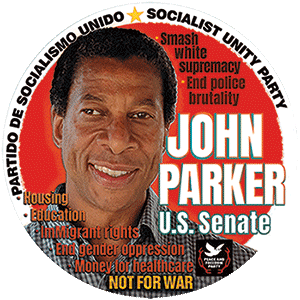
Partial list of endorsers: John Parker, Socialist Unity Party candidate for U.S. Senate in California; Youth Against War & Racism; Mujeres En Lucha / Women In Struggle; Struggle-La Lucha newspaper; Communist Workers League; Workers Voice Socialist Movement; LA Black and Brown Unity – Los Angeles; Harriet Tubman Center for Social Justice – Los Angeles; Peoples Power Assembly – Baltimore; Odessa Solidarity Campaign; Unemployed Workers Union; Anti-War West Sydney; Rhode Island Against White Nationalism – Providence.
Call for solidarity with Ukrainian leftists under repression
written by Struggle – La Lucha
March 19, 2022
Since the Russian intervention in Ukraine, representatives of the far-right and liberal milieu have been spreading calls for violence and even for the killing of those who had previously publicly advocated the implementation of the Minsk agreements, against “decommunisation” and for a peaceful resolution of the conflict in Donbass. Activists of left-wing groups were the first to be threatened.
Lists of unreliables have emerged. Some “left-wing activists” also started compiling lists of “wrong leftists.”
On March 3, officers of the Security Service of Ukraine (SBU), with the participation of neo-Nazis from the Azov group, detained leftist activist Alexander Matyushenko from the Levitsa association in Dnipropetrovsk (Dnipro).
He was charged under Article 437 of the Ukrainian Criminal Code – “waging aggressive war.” And, as the courts in Ukraine do not work now, he was arrested for 30 days without trial – on the prosecutor’s order.
The details of the criminal case are not known because the SBU refuses to introduce it to anyone but his lawyer. But most lawyers refuse to defend him or demand U.S. $3,000 for their services, a rather large sum for Ukrainians.
On the same day, 12 people were detained in Dnipro on similar charges. On March 4, 14 people were detained. On March 5, 11 people were detained.
In Kiev, arrests had begun even earlier. On Feb. 27, brothers Mikhail and Aleksandr Kononovich, leaders of the Ukrainian Communist Youth, ethnic Belarusians, were detained.
It is not known where they are and what they are accused of, as there is no contact with them.
On March 4, Vladimir Ivanov, a left-wing activist from Zaporozhye, disappeared. His whereabouts are unknown. Posts that are uncharacteristic for him are appearing in his Telegram account.
On March 7, journalist Dmitriy Dzhangirov, a member of the New Socialism party, Vasyl Volha, a former leader of the Union of Left Forces, journalist Yury Dudkin and publicist Aleksandr Karevin were detained in Kiev. Karevin managed to write on his Facebook page: “The SBU has come.”
Where all of them are now and what they are accused of is also unknown. Dzhangirov’s Facebook page posted a video of him, possibly under physical duress, saying things that are not typical of him.
On March 11, left-wing activist Spartak Golovachev disappeared in Kharkov. “The door is being broken down by armed men in Ukrainian uniforms. Goodbye,” he managed to write on social media.
It should be noted that there is fighting for Kharkov, but in general it is under the control of the Ukrainian Armed Forces.
On March 11, in Odessa, the SBU detained Elena Vyacheslavova, the daughter of Mikhail Vyacheslavov, who died on May 2, 2014, in the fire at the Odessa House of Trade Unions.
On March 12, the SBU detained Olena Lysenko, the wife of Andriy Lysenko, a volunteer from Donetsk. On March 13, she was released, having previously recorded a video in which she slanders her husband.
On March 13, in a village near Odessa, neighbors with nationalist sentiments burned down the house of left-wing activist Dmitry Lazarev.
The whereabouts of several members of the left-wing New Socialism and Derzhava parties are also unknown. They have stopped making contact or writing anything on social media. They may be in hiding, but they may also have been detained.
All indications are that as the fighting continues, the repression of dissenters and leftists will continue. Our capacity to defend the rights of the politically repressed in Ukraine is now very limited. And solidarity with Ukrainian political prisoners by the left and human rights defenders in all countries is very important to us.
NATO, not China, is to blame for the Ukraine crisis
written by Struggle – La Lucha
March 19, 2022
The Ukraine crisis was largely triggered by NATO’s aggressive eastward expansion. The bloc is the culprit. Instead of reflecting on itself, NATO piles pressure on other countries to stand with it against Russia. This is unreasonable and quite sinister.
“China should join the rest of the world in condemning strongly the brutal invasion of Ukraine by Russia,” NATO Secretary General Jens Stoltenberg said on Tuesday, “The Russian invasion of Ukraine is a blatant violation of international law so we call on [China] to clearly condemn the invasion and of course not support Russia. And we are closely monitoring any signs of support from China to Russia.”
NATO is a puppet of the US, a Cold War military bloc manipulated by the US. The obsolete military organization has launched many ruthless military aggressions and triggered corresponding disasters in which local people underwent great suffering. NATO’s aerial bombing campaign against the Federal Republic of Yugoslavia in 1999 during the Kosovo War is one example.
NATO’s hands are stained with blood and the bloc itself has been a major threat to global and local security. Is NATO qualified to criticize other countries? This organization should have been dismantled long ago.
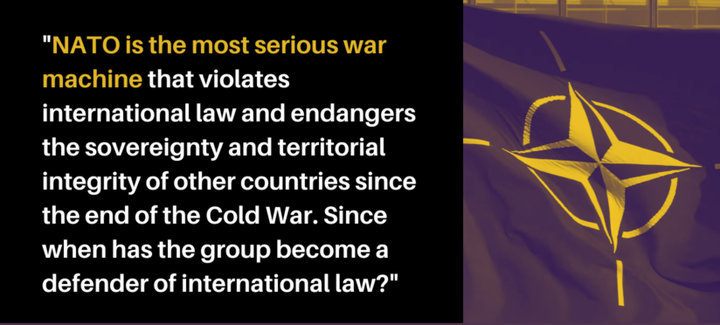
“NATO is the most serious war machine that violates international law and endangers the sovereignty and territorial integrity of other countries since the end of the Cold War. Since when has the group become a defender of international law? If it is a defender of international law, could you please first apologize for their bombing of Yugoslavia? Could you first compensate for bombing the Chinese Embassy in Yugoslavia in 1999, which left three journalists dead, and more than 20 people injured? Stoltenberg is not qualified and has no right or moral basis to make such remarks,” Shen Yi, a professor at the School of International Relations and Public Affairs of Fudan University, told the Global Times.
The West has fallen into extreme insanity, and this is quite sick. This is also a symptom of the growing abnormality of the international community under the coercion of the US and its allies. Stoltenberg’s rhetoric sounds like he attempted to label China as Russia’s “accomplice.” In terms of tensions between Russia and Ukraine, there is no absolute right and wrong, as the geopolitics, history and culture between them are too complicated. Their tensions are a difficult problem to solve. In this context, portraying their military conflict as good versus evil is not rational and detrimental to address it.
The Chinese ambassador to US Qin Gang said in an opinion piece in The Washington Post that rumors like “Russia was seeking military assistance from China” are “purely disinformation.” All this is information war initiated by the US. NATO is trying to use this kind of information war to intimidate China, and to coordinate Washington, in an attempt to occupy the moral high ground over the Ukraine crisis.
“By making such statements, NATO is trying to distort the focus of the international community from criticizing its eastward expansion to China’s so-called coordination with Russia,” Zhang Tengjun, Deputy Director of the Department for Asia-Pacific Studies at the China Institute of International Studies, said. “NATO is deliberately circumventing its role and responsibility. It is trying to shift the blame and confuse the public. This is very sinister.”
Many Africans reject Washington’s position on Ukraine crisis
written by Struggle – La Lucha
March 19, 2022
Since the post-World War II period national liberation movements and independent countries in Africa have developed solid diplomatic and economic relations with the former Soviet Union and today’s Russian Federation.
It is this history which underlines the refusal of numerous African governments and mass organizations to side with the United States and the North Atlantic Treaty Organization (NATO) in its efforts to encircle Russia in order to leave it as a diminished state dependent upon the dominant imperialist nations globally.
In the immediate aftermath of the beginning of Russia’s special military operation in Ukraine, the racist treatment of approximately 16,000 African students as well as thousands of others from Asia gained international news coverage. Africans were denied admission onto trains, refused food provided to Ukrainians, while attempting to seek refuge in neighboring countries such as Poland.
These incidents should not have been surprising considering the expansion and institutionalization of fascist and nazi ideology among those governing the Ukrainian state since the U.S.-backed Euromaidan coup of February 2014. Washington, under the administration of former President Barack Obama, sought to subvert any efforts by ousted President Viktor Yanukovych to walk a middle-line between the U.S., European Union on the one side and Russia on the other.
The first-person accounts of the African students who were more than willing to speak about what had been done to them in Ukraine, had to be swiftly suppressed in the western media. Although any keen observer of the unfolding crisis in Ukraine would know of the role of groupings such as the Right Sector and the Azov Brigades in creating an atmosphere of reaction against Russian-speaking Ukrainians because their worldview encompasses many of the assumptions which fostered the philosophical underpinnings of the rationale for the initiation of World War II (1939-1945).
United Nations, African States and the Ukraine War
A debate on March 2 over a resolution to essentially condemn and apportion exclusive blame on Moscow for the current military situation, was voted on by 141 UN representatives out of 191. 35 countries abstained from the vote including 17 member-states of the African Union (AU). Cameroon, Ethiopia, Guinea, Guinea-Bissau, Burkina Faso, Togo, Eswatini and Morocco were absent. Algeria, Uganda, Burundi, Central African Republic, Mali, Senegal, Equatorial Guinea, Congo Brazzaville, Sudan, South Sudan, Madagascar, Mozambique, Angola, Namibia, Zimbabwe and South Africa abstained on the resolution.
Although the resolution passed, it has not brought about an end to the fighting in Ukraine which has prompted over two million people to leave the Eastern European country. The only African state to vote against the resolution was Eritrea. In recent months, the government of Eritrea has been in discussions with Russia about the utilization of Red Sea ports inside the country. A similar situation is developing in neighboring Republic of Sudan where Port Sudan, also on the Red Sea, has been the subject of talks between Moscow and the military regime now controlling Khartoum.
Another leading African state, the Republic of South Africa, abstained from the March 2 UN General Assembly vote noting that the resolution did not emphasize the need for a negotiated diplomatic settlement to the crisis. The ruling party in South Africa, the African National Congress (ANC) has maintained close ties to Moscow since the period of national liberation from the 1960s to the 1990s. The former Soviet Union provided diplomatic, educational and military support to the ANC and many other liberation movements turned independent governments such as the South-West African People’s Organization (SWAPO) of Namibia, the Popular Movement for the Liberation of Angola (MPLA), the Mozambique Liberation Front (FRELIMO), just to mention a few.
South African President Cyril Ramaphosa who has been under tremendous pressure by the U.S. State Department over its position on Ukraine was quoted as saying:
“South Africa expected that the UN resolution would foremost welcome the commencement of dialogue between the parties and seek to create the conditions for these talks to succeed. Instead, the call for peaceful resolution through political dialogue is relegated to a single sentence close to the conclusion of the final text. This does not provide the encouragement and international backing that the parties need to continue with their efforts.”
A clear indication of the uneasiness and disapproval of the U.S. role in Ukraine was voiced by several African journalists during a briefing webinar on March 3 with Assistant Secretary of State for African Affairs, Molly Phee. Several journalists asked critical questions related to the U.S. position in Ukraine probing Phee in regard to the demands by the White House and State Department that every country around the world denounce Russia and its President Vladimir Putin.
Journalists raised the issue of racism against Africans attempting to flee Ukraine into Poland along with unreasonable demands being placed on AU member-states. The transcript of the webinar read in part:
“This is Simon Ateba with Today News Africa in Washington, D.C. You just mentioned reporting about Africans facing racism in Ukraine and Poland, being denied entry into trains in Kyiv, and being turned back at the border with Poland. Is there any reason why the State Department has not publicly condemned racism against Africans in Ukraine and Poland?’…. ‘Yes, this is Katlego Isaacs from Mmegi News. I wanted to ask, why should African countries support the position of the U.S. to condemn Russia’s invasion of Ukraine when the U.S. supports the aggression in Israel against Palestinians?’…. My name is Swift from Gabz FM in Botswana. I wanted to ask, what is the position of the U.S. on censoring of social media and the complete wipeout of the other party, in this case obviously Russia, since free speech and free press is the cornerstone not only of democracy but a tool that can create a counterculture or counternarrative?’”
Within the streets of countries such as Mali, Central African Republic (CAR) and Ethiopia there have been pro-Russian demonstrations. Mali recently called for the departure of the French ambassador and military forces after Paris objected to the involvement of the Wagner Group, a Russian-based defense services company working to curtail rebel attacks in the northern and central regions of the West African state.
Ethiopia in early March commemorated “Victory Day” which celebrates the defeat of Italian colonialism in 1896 at the Battle of Adwa. Photographs were released of Ethiopians carrying their own national flag while some others waved the flag of Russia in solidarity with the military operation in Ukraine.
The German newspaper DW reported on the military ties between AU member-states and Moscow noting:
“In recent years, Russia has increasingly used this historic Soviet connection to expand its political, economic and, above all, military relations with African nations. In 2019, Vladimir Putin hosted a Russia-Africa Summit attended by 43 African leaders. Just one year later, Russia became Africa’s biggest arms supplier. According to a 2020 analysis by the peace research institute SIPRI, between 2016 and 2020 around 30% of all arms exported to sub-Saharan Africa countries came from Russia. This vastly overshadows weapon supplies from other nations such as China (20%), France (9.5%) and the USA (5.4%). This increased the volume of Russian arms shipments by 23% over the previous five-year period.”
These and other factors have frustrated the U.S. in its diplomatic efforts to win unconditional support for its war against Russia in Ukraine. The existence of the U.S. Africa Command (AFRICOM) since 2008 under the guise of enhancing the security capacity of AU member-states in their struggles against what is described as “Islamic Jihadism”, has proved to be an utter failure. Despite the existence of a military base housing thousands of Pentagon troops in the Horn of Africa state of Djibouti and the building of other makeshift installations, along with joint military operations and training opportunities for African military officers, the overall stability and security of many states has worsened.
Ending Imperialist War Requires a Rejection of U.S. Foreign Policy
Several countries within Latin America have maintained their trade and diplomatic relations with Russia. These states include Cuba and the Bolivarian Republic of Venezuela.
Caracas has been under siege by successive administrations in Washington, both Democratic and Republican. In recent years, the White House has attempted to install a puppet regime in Venezuela while denying recognition of the government of President Nicolas Maduro. Billions of Venezuelan assets have been frozen in U.S. banks along with the expulsion of high-level employees of embassies and other outlets for Caracas.
Yet during the first weekend of March, the U.S. deployed a delegation to Venezuela to discuss the possibility of replacing banned Russian oil shipments with supplies from the Maduro administration which has been under a blockade by Washington at least since 2017. The move illustrates the illogical foreign policy positions under which President Joe Biden finds himself. Moreover, the opposition to the talks has forced Biden to publicly move away from this latest energy strategy.
Energy, transportation and food prices are skyrocketing in the U.S. compounding the already 40-year high inflation rate. Although the corporate and government-controlled media agencies are proclaiming the dire straits that Russia is undergoing since the withdrawal of several banking services, McDonalds, Coca-Cola and other corporations, it is the Biden administration and the Democratic Party politicians who must face the U.S. electorate in 2022 and 2024.
Attitudes towards U.S. military policy among Africans and people in Latin America reveals the unsustainability of this approach to international affairs. These peoples know that the reckless approach by Washington and Wall Street will have a negative social impact on billions around the globe.
The inability of the Biden White House to pass legislation in Congress which would address the social crisis unfolding in the U.S. portends much for the political landscape in Washington. A U.S.-inspired war in Eastern Europe will not solve the economic stagnation and hyperinflation faced by the majority of working people and nationally oppressed.
These forces must unite to overturn the war program of the White House and Pentagon which only robs the people of their rights to decent housing, education, food, water, environmental justice and all other necessities of modern life. A new foreign policy must be developed which defunds the defense department and dismantles the U.S. bases which are waging war around the globe.
On the 19th anniversary of the Iraq War: The U.S. government lied about Iraq – it’s lying about Russia & Ukraine EXPOSE THE LIES
March 20 marks 19 years since the U.S. invasion of Iraq, based on a lie about “weapons of mass destruction.” The U.S. always lies about its wars. Here’s how Washington and NATO provoked the conflict between Ukraine and Russia.
Lie #1: Russia is the aggressor against Ukraine
Russia didn’t start the war. Ukraine has been at war for eight years against the Donbass republics, Donetsk and Lugansk. Ukraine’s war has cost over 14,000 lives in Donbass. Like Yemen, U.S. media ignored the human toll and U.S. role in the conflict. For months, Washington pushed Ukraine to invade Donbass again. Russia only intervened to stop a bloodbath and end the war, as well as to ensure the neutrality of its neighbor. Ukraine continues to commit daily war crimes in Donbass, including a March 14 missile attack that killed more than 20 people in Donetsk.
Lie #2: Ukraine is a democracy that must be defended
In 2014 a violent coup overthrew the legally elected government of Ukraine, which tried to maintain friendly relations with both the West and Russia. The coup was supported by U.S. officials and both Republican and Democratic politicians. The new government banned political parties, kept national minorities from using their languages, and engaged in repression against journalists and oppositionists. Neo-Nazi groups played a major role in the coup. Today they infest the Ukrainian state from top to bottom. These groups work with white supremacists in the U.S. and Europe and pose a danger to people everywhere.
Lie #3: The U.S. is an innocent bystander
The U.S. poured the gasoline, lit the match and fans the flames of war. Biden sent hundreds of tons of weapons to Ukraine and pushed Russia into a corner. Why? To justify further expansion of NATO, undermine Russia’s sovereignty and increase profits by sanctioning Russian exports. Washington ignored Russia’s serious concerns about Ukraine’s neutrality and NATO expansion for decades. The U.S. sabotaged the Minsk agreements meant to make peace in the region. It pressured its EU “partners” to sink a pipeline agreement with Russia for the benefit of U.S. Big Oil and Wall Street banks.
Lie #4: Poor and working people should sacrifice
House Speaker Nancy Pelosi justified torpedoing money to fight COVID from the budget because “We’ve got a war going on in Ukraine.” Congress agrees: There’s plenty of money for war. Meanwhile prices of gas, food and rents are skyrocketing. Public schools are in crisis. Millions face eviction with the end of pandemic protections, while money continues to fund state-sponsored white supremacy. Police brutality and repression against immigrants continues unabated, while President Biden pushes racist violence with calls to “Fund the police,” in the same breath as he funds Nazi-led armed forces in Ukraine. We reject the bipartisan policy of war against people at home and abroad.
Help expose the lies. Build a movement for people’s needs, not war!
Food, gas, rents soaring – never mind, Congress hikes U.S./NATO war dollars
written by Struggle – La Lucha
March 19, 2022
The chant “money for war, can’t feed the poor” best describes the $1.5 trillion spending package passed by Congress and signed by President Biden on March 10.
An astounding $782 billion went to the Pentagon and military spending, while $715 billion will go to “domestic” spending areas. Domestic is in quotes because that doesn’t always mean spending on people’s needs.
Billions in extra aid to US/NATO war in Ukraine
Congress added $13.6 billion in aid to Ukraine. This is not part of the Pentagon budget; it is above and beyond.
It includes $3.5 billion in military equipment and $3 billion for deploying U.S. troops to the region. This aid also gives $2.65 billion to the U.S. Agency for International Development (USAID), of which $120 million is slated for so-called activists, journalists, and so-called independent media to promote anti-Russia messaging.
The extra $13.6 billion is in addition to the $300 million for allies and partners in the region. This $300 million includes $180 million for the Baltic Security Initiative, $30 million for Poland, $30 million for Romania, $20 million for Bulgaria, and $40 million for Georgia.
$23 billion to ICE and CBP
While the State Department will spend $1.4 billion to fund migration and refugee assistance to Ukrainian immigrants, Immigration and Customs Enforcement (ICE) treatment of Haitian refugees on the southern border is starkly different. There was also no mention of African students and refugees trying to get out of Ukraine.
In this $23 billion, $1.06 billion will go toward Customs and Border Protection (CBP) processing facilities and transportation to immigrant detention camps — a boondoggle for the private prison industries. In addition, $72.4 million is being allocated in new aircraft and aircraft sensors to hunt down Black and Brown refugees.
$15.6 billion COVID relief fund cut
Those communities still languishing from the COVID pandemic will not see funds. It was stripped from the budget!
In addition, if you thought that working and poor people were getting any relief from staggering price increases at grocery stores and the gas pump. Think again.
Yes, “Money for War, Can’t Feed the Poor!” is real.
How socialist Cuba helped Ukrainian children
written by Struggle – La Lucha
March 19, 2022
The United States Congress just cut $15.6 billion in coronavirus aid from a budget bill. It did so to ship nearly $14 billion in weapons and other war supplies to Ukraine. Other NATO countries have also sent billions of dollars in deadly arms.
But where was the U.S. government and its NATO allies when Ukrainians desperately needed medical help following the 1986 Chernobyl nuclear reactor disaster?
These capitalist regimes didn’t do much as Ukrainians suffered and died from radiation poisoning. It was like President Bush letting Black and poor people drown and starve in New Orleans after Hurricane Katrina hit in 2005.
The April 26, 1986, Chernobyl tragedy occured as the Soviet Union was under increasing threat from the Reagan administration. In 1983 NATO staged the “Able Archer” exercises that ended with a simulated nuclear attack on the Soviet Union.
The year before Chernobyl, in a sharp turn to the right, Mikhail Gorbachev was elected General Secretary of the Communist Party. The country of 280 million people that defeated Hitler was starting to go down a swift slope towards the overthrow of its socialist system.
The year after Chernobyl, Gosplan ― the agency that guided the Soviet Union’s planned socialist economy ― was dissolved. So was the socialist state’s control of its foreign trade that kept the capitalist world market at bay.
These reactionary measures unraveled the socialist economy that had been built by the working class through a dozen five-year plans. The first victim was the solidarity between different nationalities and peoples.
This friendship was forged by the 1917 socialist revolution that led to the world’s first and largest affirmative action program. It was further strengthened during World War II when 27 million Soviet people of a hundred ethnicities died saving the world from the Nazis.
Now it was everyone for themselves. Health care suffered as sectors became privatized.
Hundreds of thousands of Ukrainians, as well as Belarusians and Russians, fell ill from the Chernobyl meltdown and explosion. Many died. Most heartbreaking were the children who developed cancers and other diseases.
Fidel welcomes the children
Socialist Cuba stepped up to help. The small country treated 26,000 children from the former Soviet republics between 1990 and 2011. A large majority were Ukrainian.
The first planeload of children arrived at Havana airport from the then existing Soviet Union on March 29, 1990. Even though it was late at night, Cuban President Fidel Castro Ruz was there. He sympathetically greeted each of the 139 children who came.
Fidel, the historical leader of the Cuban Revolution, described how this vast program came about: “This was a request from the Leninist Youth of Ukraine and later coordination with the authorities of Ukraine and the Soviet Union. We said ‘yes’ immediately and took all the necessary steps in the shortest time.
“I believe that we can give optimum attention to these children here. We have the necessary conditions and I hope that we can be as successful as possible.”
Tarará, a beautiful resort village on the eastern edge of Havana, was taken over to treat the children. The program lasted until Nov. 24, 2011.
During these 21 years, 26,114 children received care. The vast majority of children were saved. Over 21,000 were under 15 years old.
Thousands of surgeries were performed. The 170,000 clinical studies became an invaluable database on radiation-caused diseases in children. It was shared with the rest of the world.
No one was asked if they had insurance. In socialist Cuba health care is considered a human right ― not a commodity to make profits from like in the capitalist United States.
Soon after the first children arrived Cuba was thrust into what it called a “special period.” More than two-thirds of the island country’s foreign trade was cut off as counter revolutions swept the Soviet Union and the socialist countries of Eastern Europe.
The U.S. continued trying to strangle the Cuban Revolution. It tightened its economic blockade with Congress passing the Helms-Burton bill.
Yet not a single Cuban hospital or school was closed. Cuba continued to treat Chernobyl survivors at no cost to their families.
Sacha’s story
Many of the sick children stayed at Tarará for 45 days. Others stayed longer, sometimes a year or more. That was the case of Olexandr Savchenko, nicknamed Sacha.
The young boy was from the Ukrainian village of Chernigov near Chernobyl. About a year after the explosion Sacha became sick.
In Cuba it was discovered he had a cancerous tumor. Chemotherapy is particularly rough for kids but Sacha pulled through. When the test results came back normal, meaning the cancer had disappeared, everyone around Sacha clapped.
Not every child won their battle with cancer. But the Cubans did everything they could.
Many of the children had skin diseases including alopecia, which results in the loss of all body hair. Here psychologists played a key role.
Children learned not to be ashamed of themselves. The friendships formed along with the beautiful beach were part of the remedy.
Young women survivors would hold joint quinceañera celebrations of their fifteenth birthdays. Cuban translators became a vital connection between health workers and children.
A wonderful film about this humanitarian program is “Sacha, A Child of Chernobyl.” It can be seen on YouTube.
The film was directed by Cuban film-makers Roberto Chile and Maribel Acosta Damas and produced by the Argentine news agency Resumen Latinoamericano. Included are remarks by Her Excellency, Lianys Torres Rivera, the Cuban Ambassador to the United States.
The late Pan-African teacher and organizer Elombe Brath, a founder of the December 12th Movement, declared “When Africa called, Cuba answered.”
Over 2,000 Cuban soldiers died fighting alongside their African comrades in Angola. Together they defeated the Nazi armies of apartheid South Africa.
Socialist Cuba also answered when Ukrainian children needed help. Many Ukrainians haven’t forgotten.
What does Yoon Seok-yeol’s presidency mean for South Korea?
written by Struggle – La Lucha
March 19, 2022
Last week’s presidential elections in South Korea saw 77% of the country’s 44 million eligible voters mobilize to the polls. The race remained too close to call until 98% of votes had been counted early the next day. With a lead of less than one percent of the vote, the narrowest margin in Korean history, Yoon Seok-Yeol of the right-wing People Power Party bested his liberal opponent from the ruling Democratic Party, Lee Jae-Myeong.
Yoon’s victory marks a return to power for the South Korean right, which was ousted in 2017 by the impeachment of then President Park Geun-hye. With Yoon’s inauguration just two months away, many are bracing for the coming assault on progressive politics, and a possible return to South Korea’s autocratic past.
Sliding back to autocracy?
Buoyed by support from young men in their 20s and 30s, Yoon has pledged to abolish the Ministry of Gender Equality, which since its founding in 1998 has guided national gender equality policies while providing services to marginalized women and children, including single mothers and survivors of domestic and sexual violence. As in other patriarchal societies, South Korean women face the devaluation of their productive labor and an uneven burden of reproductive labor. According to the Organization for Economic Co-operation and Development (OECD), women accounted for 63.5% of all part-time workers in 2020. 20.8% of all employment for women was part-time, compared to just 8.9% for men. Correspondingly, about 28% of women workers earned below the minimum wage in 2018, compared to 12.8% of male workers. The OECD further found that South Korea had the highest gender pay gap among its 38 member countries, and that South Korean women spend roughly 215 minutes a day performing unpaid labor, compared to just 49 minutes a day for men.
Many commentators have pointed to the intensity of South Korea’s culture wars over gender equality as an explanation for Yoon’s anti-feminist politics. As the #MeToo movement swept the globe, several high profile sexual assault and harassment cases involving South Korean celebrities and politicians became the subject of intense media scrutiny. The Moon administration’s attempts to implement greater protections and punishments against sexual violence have provoked backlash and charges of “reverse discrimination.”
While Yoon’s appeals to misogyny do strike a chord with a considerable swath of the electorate, his anti-feminist politics also complement his anti-labor politics. As a self-described proponent of small government and private sector-led growth, the President-elect proposed to slash the minimum wage and raise the ceiling on working hours, which were lowered last year from 68 to 52 hours a week. Housing emerged as a key issue in the election after a surge in real estate prices, with the city of Seoul seeing a 52% increase in apartment prices in under five years. Yoon has eschewed calls to expand the public housing system, and instead offered to lower taxes on property owners as a way to stimulate development. As rising healthcare costs and privatization place additional strain on working people, Yoon has pledged to remove foreigners, particularly Chinese immigrants, from the national health insurance system. When considered comprehensively, Yoon’s misogyny and xenophobia are entirely consistent with a broader capitalist agenda to make all working people more vulnerable to exploitation.
How successfully Yoon will manage to implement his domestic agenda remains to be seen. More than half the seats in South Korea’s National Assembly remain under Democratic Party control, and legislative elections won’t be held again until 2024. Yoon’s People Power Party simply lacks the votes to pass anything without serious compromise, Whether the opposition will hold the line or capitulate in an attempt to broaden their appeal with conservative voters remains to be seen.
While Yoon may not have control of the legislature, he can still inflict considerable damage on South Korea’s progressive movements. In a country that experienced a democratic transition from military dictatorship within living memory, this threat is not taken lightly. The most recent period in which a conservative party held power from 2008-2017 saw heightened restrictions on press freedoms, blacklisting of thousands of artists and brutal crackdowns on working people’s movements.
The anti-communist National Security Law, first implemented in 1948 to facilitate the massacre of an estimated 60,000 people on Jeju island, is still on the books in South Korea. The law, which broadly criminalizes “anti-state activity,” has been applied to varying degrees under different administrations. Under President Park Geun-hye, it was used to outlaw the minor Unified Progressive Party and jail its leader, a member of the National Assembly at the time, for nearly a decade. More recently in 2021, a small publisher was charged under the National Security Law for reprinting deceased North Korean leader Kim Il-Sung’s autobiography. Only time will tell how the Yoon administration deploys the National Security Law. In the meantime, those who see in Yoon a troubling return to South Korea’s autocratic past take no comfort in knowing the legal tools that enabled past reigns of terror remain intact.
Scrapping rapprochement, siding with Washington
The geostrategic significance of the Korean peninsula at the crossroads of the Pacific and continental Northeast Asia has made it a battleground for clashing great powers since the 19th century. As the U.S. steps up its belligerence against China, Korea’s significance as a potential flashpoint in a wider regional conflict also rises. The stakes of South Korea’s handling of its relationships with China, North Korea and the U.S. were clearly demonstrated during the Moon administration. After South Korea agreed to host the U.S. THAAD missile defense shield, China retaliated with sanctions in 2017 that dealt a severe blow to South Korea’s economy. That same year, Korea veered dangerously close to the return of open hostilities as the Trump administration ramped up its infamous “fire and fury” rhetoric against North Korea. The Moon administration responded to these pressures by seeking greater rapprochement with North Korea, advocating for an end to the Korean War, and avoiding Washington’s more explicit anti-China alliances without abandoning the U.S. military alliance.
The President-elect’s foreign policy agenda seeks to upend Moon’s balancing act. While Yoon outwardly supports “normalizing inter-Korean relations,” the substance of his proposals present a clear departure from the past administration’s approach. In a recent essay for Foreign Affairs, Yoon rejected the importance of denuclearization as a peninsular rather than a North Korea-only issue, and stated that inter-Korean cooperation should only proceed if North Korea makes the “bold decision” to denuclearize. Such a position denies Pyongyang’s legitimate security concerns (the U.S. stationed nearly 1,000 nuclear warheads in South Korea from 1958-1991), and essentially amounts to a refusal to negotiate. Past conservative administrations’ attempts at similar strategies did not succeed, and Yoon seems likely to repeat this history, albeit in a much more volatile international context.
In the same piece, Yoon also criticized the “three no’s” the Moon administration acknowledged as necessary to respect China’s security concerns: no new THAAD missile defense batteries, no joining a U.S. missile defense network, and no trilateral military alliance with South Korea, Japan, and the U.S. Yoon not only called for new THAAD battery deployments on the campaign trail, but even went as far as to declare his intent to request the return of U.S. tactical nukes to the peninsula (the Biden administration quickly rebuffed him). He has supported Seoul’s participation in working groups hosted by the Quadrilateral Security Dialogue, a military alliance between the U.S., India, Japan, and Australia aimed at containing China. Yoon has also campaigned on improving bilateral relations with Japan, with an eye towards enhancing trilateral security cooperation with the U.S. These signals could lead to South Korea’s membership in the Quadrilateral Security Dialogue, as well as the creation of a possible trilateral military alliance with Japan and the U.S. Both outcomes long sought-after by Washington, and that would drastically raise the stakes in any potential regional dispute.
With 28,000 U.S. troops and the largest U.S. military base outside North America, South Korea has already been a battleground against expanding militarization for decades. The coming of new THAAD batteries and possible other military hardware will only inflame existing struggles and open new fronts in resistance to U.S. occupation. Yet new military installations could be the least of South Koreans’ worries. Yoon’s brash endorsement of a preemptive strike on North Korea under certain conditions alarmed many observers on the campaign trail. While such antics might appeal to some voters, any attempt to follow through on such threats would have obviously catastrophic consequences.
What may prove a more pertinent question is what South Korea’s deepened economic and military alignment with the U.S. could mean for the regional balance of power, particularly as U.S. antagonism against China escalates. With 600,000 active-duty troops, South Korea has one of the largest armies on earth, and plays a crucial role as a “force multiplier” for U.S. security interests. While the current U.S.-South Korea Treaty of Mutual Defense only obliges South Korea to engage its military within the peninsula, South Korea’s potential entrance into new military pacts could change the conditions under which South Korean troops could be deployed elsewhere. As the Yoon era dawns, the shifts in South Korea’s political winds may well set the course for the region and the wider world.
Ju-Hyun Park is a writer and member of Nodutdol for Korean Community Development.
Ukrainian leftist criticizes Western war drive with Russia: U.S. is using Ukraine as ‘cannon fodder’
written by Struggle – La Lucha
March 19, 2022
I am a Ukrainian-American. I grew up and spent over half of my life in Ukraine, although now I live in the United States. I wanted to explain my thoughts on the ongoing crisis with Russia, because mainstream corporate media outlets don’t ever share perspectives like mine.
It is definitely a stressful time, for obvious reasons. Fortunately, my family and friends in the country are alive and are doing well enough under the circumstances. Unfortunately, in the past decade this isn’t the first time I have had to check in on my loved ones there, and for basically the same reasons. This is what I wanted to talk about.
You see, the U.S. government has meddled in Ukraine for decades. And the Ukrainian people have suffered because of this.
The overwhelming support that Western governments and media outlets have poured out for Ukraine since Russia invaded on February 24 is not actually motivated by concern for the Ukrainian people. They are using us to advance their political and economic interests.
We know this because Washington overthrew our government twice in the past two decades, and has fueled an eight-year civil war that has taken the lives of tens of thousands of Ukrainians and wounded and displaced many more.
The following facts don’t get mentioned by the media, as they contradict the foreign-policy goals of the U.S. government. So unless you are actively engaged in the anti-war movement, the info below is probably new to you. That is why I wanted to write this article.
U.S. government backed two coups in Ukraine in one decade, and fueled a civil war that killed thousands
The first U.S.-backed soft coup in Ukraine occurred in 2004, when Ukraine’s Western-backed presidential candidate Viktor Yushchenko lost the election.
The winner of the November 2004 vote, Viktor Yanukovych, was portrayed as being pro-Russian, so Western governments refused to recognize his victory and declared electoral fraud.
Western-backed forces in Ukraine then mobilized and carried out a textbook color revolution, called the “Orange Revolution.” They forced another run-off vote that December, in which their candidate Yushchenko was declared president.
In a shockingly honest 2004 report titled “U.S. campaign behind the turmoil in Kiev,” Britain’s establishment newspaper The Guardian admitted that the “Orange Revolution” was “an American creation, a sophisticated and brilliantly conceived exercise in western branding and mass marketing,” bankrolled with at least $14 million by the U.S. government.
“Funded and organised by the U.S. government, deploying U.S. consultancies, pollsters, diplomats, the two big American parties and U.S. non-government organisations, the campaign” attempted to topple governments “in four countries in four years,” The Guardian boasted, targeting Serbia, Georgia, Belarus, and Ukraine.
Much like in the United States, Ukrainian presidents are appointed and govern in the interest of wealthy oligarchs, so no Ukrainian president ends his tenure with a particularly high rating. The U.S.-backed Yushchenko, however, set a new record for the lowest popular support in history.
In the next presidential election, in 2010, Yushchenko got just 5% of the vote, which should give you an insight into how popular he actually was.
During his first term Yushchenko implemented a program of austerity, reduced social spending, bailed out large banks, deregulated agriculture, advocated for NATO membership, and repressed the rights of language minorities like Russian speakers.
The second U.S.-backed coup in Ukraine was launched in late 2013, just a decade after the first one, and consolidated power in 2014.
Viktor Yanukovych, who was frequently called pro-Russian by Western media but in reality was just neutral, won the 2010 presidential election fair and square.
But in 2013, Yanukovych refused to sign a European Union Association Agreement that would have been a step toward integrating Ukraine with the EU. In order to be part of this program, Brussels had demanded that Kiev impose neoliberal structural adjustment, selling off government assets and giving the Washington-led International Monetary Fund (IMF) even more control over Ukrainian state spending.
Yanukovych rejected this for a more favorable offer from Russia. So, once again, Western-backed organizations brought out their supporters into the Maidan Square in Kiev to overthrow the government.
As was the case during the “Orange Revolution” in 2004, the United States sent politicians to meet with the leaders of the demonstrations, and later coup leaders, in late 2013 and early 2014. U.S. Senators John McCain, Chris Murphy, and others spoke in front of large crowds in Maidan.
At some point the control of the stage and leadership of the protests was overtaken by far-right forces. Leaders of such organizations as Svoboda (a neo-Nazi party) and Right Sector (a coalition of fascist organizations) spoke to the protesters, sometimes standing side-by-side with their American backers like McCain.
Later their organizations acted as the spear of attack against the Ukrainian police in the violent February 2014 coup d’etat, and they were the first to storm government buildings.
With the success of the U.S.-backed forces and fascists, President Yanukovich fled the country to Russia.
U.S. government officials met with coup leaders and appointed a right-wing neoliberal, Arseniy Yatsenyuk, to lead the new regime, because they recognized they couldn’t appoint the fascists and maintain legitimacy.
A leaked recording of a phone call between Victoria Nuland, the assistant secretary of state for European and Eurasian affairs, and the U.S. ambassador in Kiev, Geoffrey Pyatt, showed that Washington chose who the leaders of the new coup regime would be.
Nuland referred to Yatsenyuk affectionately as “Yats,” saying, “Yats is the guy.”
The first actions of the post-2014 coup government were to ban left-wing parties in the country and reduce language-minority rights even further. Then Ukrainian fascists attacked anti-coup demonstrations in the streets all over the country.
As the anti-coup protests were being violently broken up by the far-right, two areas in the east of the country, Donetsk and Luhansk, rose up and declared independence from Ukraine.
The people of Crimea also voted to leave Ukraine and join Russia. Crimea has a Russian military base, and under their protection they were able to vote safely.
The people in Donetsk and Luhansk were less lucky. The coup government dispatched the military to suppress their insurrections.
At first many Ukrainian soldiers refused to shoot at their own countrymen, in this civil war that their U.S.-backed government started.
Seeing the hesitation of the Ukrainian military, far-right groups (and the oligarchs that were backing them) formed so-called “territorial defense battalions,” with names like Azov, Aidar, Dnipro, Tornado, etc.
Much like in Latin America, where U.S.-backed death-squads kill left-wing politicians, socialists, and labor organizers, these Ukrainian fascist battalions were deployed to lead the offensive against the militias of Donetsk and Luhansk, killing Russian-speaking Ukrainians.
In May 2014, neo-Nazis and other far-right forces assaulted an anti-coup demonstration in the major city of Odessa. 48 people were burned alive in a union hall.
This massacre added more fuel to the civil war. The Ukrainian government promised to investigate what happened, but never really did.
My point: Without understanding the Maidan massacre and bringing to justice its perpetrators, it is impossible to understand and resolve peacefully the internal and international conflicts involving Ukraine and the dangerously escalating war in the Donbas. https://t.co/Hxyq0L4sA8
After the 2014 coup, Ukraine held an election without any serious opposition candidates, and Western-backed billionaire Petro Poroshenko won.
Poroshenko was seen as the most “moderate” of the right-wing coup coalition. But that didn’t mean much, considering many opposition parties were banned or assaulted by the far-right when they tried to organize.
Additionally, the areas that would have heavier support for the voices who wanted peace with Russia, such as Crimea and the Donbas, had seceded from Ukraine.
The new president had the impossible task of trying to appear sufficiently patriotic for the far-right while at the same time sufficiently “respectable” for the West to continue backing him publicly.
To appease the far-right, Poroshenko gave out awards to World War Two veterans “on both sides,” including the ones that fought in Nazi Germany-aligned militias like the fascist Organization of Ukrainian Nationalists and Ukrainian Insurgent Army.
The Ukrainian government officially honored the leaders of these organizations, Stepan Bandera and Roman Shukevych, who organized massacres of many thousands of Poles, Jews, Russians, and other minorities during World War Two, and who willingly participated in the Holocaust.
The holiday Defenders of Ukraine Day, or Day of Ukrainian Armed Forces, was changed to October 14, to match the date of founding of the Nazi-backed Ukrainian Insurgent Army.
This is why you sometimes see red-and-black badges on Ukrainian soldiers. This symbol shows support for the fascist Ukrainian forces during World War Two.
Canada’s Deputy Prime Minister, Chrystia Freeland, shared of photo of herself holding a fascist symbol at a rally where the same fascist flag was everywhere. And yet, Canadian media has ignored it completely.
(Also I have to make a separate but important point here: Ukraine was previously part of the Soviet Union, and the majority of the Ukrainian population during World War Two supported the Red Army and actively resisted Nazi occupation of their country. The Ukrainian fascist collaborationists and parties did not have as broad support as the anti-fascist resistance did, and were mostly active during the period of Nazi occupation.)
A large portion of the civil war that broke out in Ukraine after the 2014 coup was waged under Poroshenko.
From 2014 to 2019, in five years of civil war in Donbas, the geographic region that encompasses the Luhansk and Donetsk republics, more than 13,000 people were killed, and at least 28,000 were wounded, according to official Ukrainian government statistics. This was years before Russia invaded.
The Ukrainian army and its far-right paramilitary allies were responsible for the vast majority of civilian casualties, with the United Nations reporting in January 2022 that, between 2018 and 2021, 81.4% of all civilian casualties caused by active hostilities were in Donetsk and Luhansk.
These are Russian-speaking Ukrainians being killed their own government. They are not secret Russian forces.
Researchers at the U.S. government-sponsored RAND Corporation acknowledged in a January 2022 report in Foreign Policy magazine that, “even by Kyiv’s own estimates, the vast majority of rebel forces consist of locals—not soldiers of the regular Russian military.”
Meanwhile, millions of Ukrainians fled the country due to the conflict, especially from the eastern regions that saw most of the fighting.
The United States strongly supported Poroshenko and the Ukrainian government as it was waging this brutal war that killed thousands, injured tens of thousands, and displaced millions.
This is why I say the U.S. government doesn’t actually care about Ukraine.
In 2019, the Ukrainian people clearly showed that they opposed this war by overwhelmingly voting against Poroshenko at the ballot box. Current Ukrainian president Zelensky got 73% of the vote, compared to just 24% for Poroshenko.
Zelensky ran on a platform of peace. He even addressed the Russian-speaking eastern parts of the country in Russian.
Very quickly after entering office, however, Zelensky changed his tone. Much like the supposedly “moderate” Poroshenko, Zelensky was told that he was risking losing Western backing, and the loyalty of the far-right, which could threaten to kill him.
So Zelensky did a 180 on his peaceful rhetoric, and he continued to support the civil war.
Neo-Nazis have a significant influence in Ukraine’s state security services
Here it is important to address another important point: The Ukrainian government is not directly run by fascists, but in Ukraine fascist forces do have significant influence in the state.
After the 2014 U.S.-backed coup, neo-Nazis were absorbed by Ukraine’s military, police, and security apparatus.
So while the parliamentary representation of fascist parties is not large (they often get just a few percentage points of the vote in elections), these extremists continue to be supported by taxpayers’ money through unelected state institutions.
Additionally, these neo-Nazis have the street muscle to terrorize political opponents. They can quickly mobilize dozens or hundreds of people on a moment’s notice to attack opponents.
Moreover, these fascists are highly motivated combatants that ensure the loyalty of the Ukrainian military. They represent a powerful faction of the Ukrainian political spectrum, and one of the forces in Ukrainian society that pushes for escalating war with the separatists regions and Russia.
I sometimes see people try to reject this fact by saying, “How can Ukraine have all these Nazis if their president is Jewish?” Here is the answer: the Nazis are not appointed by Zelensky.
These fascists have a major influence in the unelected state security apparatus. The have systematically infiltrated the military and police. And they even enjoy support and training from Western governments and NATO.
NATO is sending weapons and trainers to help neo-Nazis in Ukraine’s white-supremacist Azov movement fight Russia, as the US floods the country with weapons.
This follows numerous reports of Western government support for Ukrainian far-right extremists.https://t.co/5gYgmU8PFo
The position of fascists grew substantially stronger in Ukraine in the eight years of the civil war, from 2014 to 2022.
For those reasons Ukrainian presidents (Jewish or not) have to take the position of the far-right into consideration. (Not to mention the possibility that far-right gangs could threaten to kill the president or other politicians if they defy them.)
Furthermore, all forces that normally oppose fascism or would oppose the civil war have not existed en masse for eight years in Ukraine: following the 2014 coup, many left-wing parties and socialists got banned by the Ukrainian government, and were assaulted in the streets by the fascists.
Any Ukrainian president, especially since the coup, is highly dependent on the support of the U.S. government as well. So Zelensky is very much a hostage of the situation.
When Washington tells Zelensky he must continue the civil war in Ukraine against his own electoral promises, support NATO membership, ignore the Minsk II agreement of 2015, or even ask for nuclear weapons, he does everything he is told.
Like any other U.S. puppet regime, Ukraine doesn’t have any real independence. Kiev has been actively pushed to confront Russia by every U.S. administration, against the will of the majority of Ukrainian people.
The fact that most Ukrainians wanted peace with Russia was reflected by the fact that they voted for the peace candidate Zelensky in such overwhelming numbers, 73%. And the fact that Zelensky did a total 180 on that promise shows how little political power he actually has.
Western sanctions will only hurt working-class Russians (and average people in the U.S. too)
Now to circle back to the present moment and what to do now. I don’t support the invasion Russia is carrying out. But the only government I can influence by the virtue of living in the United States is the U.S. government. Luckily, the that is extremely relevant, because Washington is one of the root causes of what is happening in Ukraine now.
For the past eight years, I spoke out against the coup and the civil war in Ukraine that the United States supported, promoted, and funded.
While I never thought a war with Russia was possible, I and many other Ukrainians are against Ukraine joining NATO and escalating tensions with the separatist republics and Moscow.
Any further escalation by the U.S. right now can only lead to a larger war.
I even hear some U.S. politicians playing around with the idea of a “no-fly zone,” which means they are calling for NATO to shoot down Russian planes. This is the quickest way to World War Three.
The support for Ukraine that fills the Western media now is not out of real solidarity with the people of Ukraine. If that were the case, the U.S. wouldn’t have overthrown our government twice in a decade; it wouldn’t have supported the policies that made us the poorest country in Europe; it wouldn’t have supported a brutal civil war for the past eight years.
The reason U.S. media outlets and politicians are all backing Ukraine now is because they want to use the Ukrainian military and civilian population as cannon fodder in a proxy war with a political adversary.
Washington is willing to fight until the last Ukrainian to weaken Russia.
For that reason, I am absolutely against U.S. sanctions in general, and this round of U.S. sanctions against Russia in particular.
The harsh Western sanctions imposed on Russia target the civilian population.
Sanctions don’t affect ruling elites, and all U.S. sanctions ever do is collectively punish working-class people of a country where Washington doesn’t like their government.
Devaluing the Russian currency, the ruble, is effectively a form of shrinking workers’ wages, cutting the pensions of retirees, and preventing regular people from being able to access food or medicine.
This isn’t to mention the cost that these sanctions are now also having on the people in the United States itself, with gas prices as high as $6 a gallon and even $7 in parts of California.
The skyrocketing oil prices caused by this crisis will lead to more inflation. And while the official U.S. inflation figure is 7.5%, the real number is probably in the double digits.
All of this makes life harder for average working people, in Ukraine, Russia, the U.S., and around the world.
Russiagate and anti-Russian xenophobia has made the crisis even worse
Another factor in the Ukraine crisis is the rampant surge of russophobia.
Since Hillary Clinton lost the 2016 presidential election, Democrats have blamed Donald Trump’s victory on Russian hacking without any solid proof. All of the supposed evidence they presented fell apart when investigated.
Many U.S. politicians demonized Russia as much as they could, just to push the blame for their candidate losing on someone else.
Now Russia’s February invasion of Ukraine has made it okay to be openly xenophobic. I have even seen some people call for killing all Russians, boycotting all Russian businesses, revoking student visas for Russians, etc.
Even in the more “respectable” media, you see talking heads speaking about Russian people as if they’re not human.
Under Donald Trump, many of these same people demonized China, and then acted surprised when there was a wave of hate crimes in the U.S. against East Asians.
During the U.S. invasion of Iraq, the press demonized Arabs and Muslims, leading to hate crimes against their communities.
My point is that demonizing nationalities is never acceptable, and people can see through the flimsy excuses of hiding one’s own xenophobia behind the declarations of “solidarity” with my country.
In conclusion, I wanted to say that, if you live in the United States, the only government you can actually influence through demonstrations and other forms of protest is our own.
I absolutely think it is a crime right now to support the U.S. government’s drive for war, sanctions, or further escalation of tensions in Ukraine.
The U.S. government has been fueling this conflict for decades. Washington has funded coups and fueled a civil war in Ukraine.
Now, U.S. corporations stand to greatly benefit from what is happening.
The government doesn’t care about the people here in the U.S., and the only reason it says it cares about people abroad is so it can justify further military spending and advance its foreign-policy goals – which aren’t good for anyone except for a handful of rich American oligarchs.
War drives present avalanches of biased information, making difficult the discernment of reality vs what is simply war propaganda. Our corporate media, as in all war drives, switched gears from seemingly objective reporting to robotic allegiance to one narrative of the U.S. No person or organization wants to lose friends and support taking stands for truth in such an environment.
But if we don’t, who will highlight the alternative media sources in Ukraine reporting a totally different story? Corporate media reruns lies of the Gulf of Tonkin, babies thrown from incubators, etc., to allow, this time, the most dangerous threat to humanity: NATO’s continued expansion. This expansion has nearly doubled NATO in 20 years.
In that time, we’ve seen its aggressive nation-destroying power cause the death of millions, a worldwide refugee crisis and the creation and enabling of terrorist organizations from ISIS to the rise of neo-Nazis now officially in the Ukrainian government. Neo-Nazi military organizations, funded with billions of dollars and training from the U.S. government, led the war crimes against the people of Donbass for the last eight years, killing 14,000.
Last November’s appointment by President Zelensky of Nazi leader Dmitro Yarosh as adviser to Commander of Ukrainian Armies explains why Luhansk and Donetsk, now independent republics, had every right to ask for Russia’s help. And it was also Russia’s right to stop an existential threat on its borders – including the real possibility of a Nazi-led, white supremacist military possessing NATO weaponry.
This war will only stop and not escalate when the U.S. is forced to end the expansion. We must target the root cause of this war – U.S. imperialism – and expose the rise of fascism, not cower and promote excuses they so desperately need to justify their proxy war. We must remain on the correct side of history.
–written by John Parker
John Parker is a leading member of the Socialist Unity Party and alongtime member of PFP. He is the PFP candidate for U.S. Senate in Election 2022.