
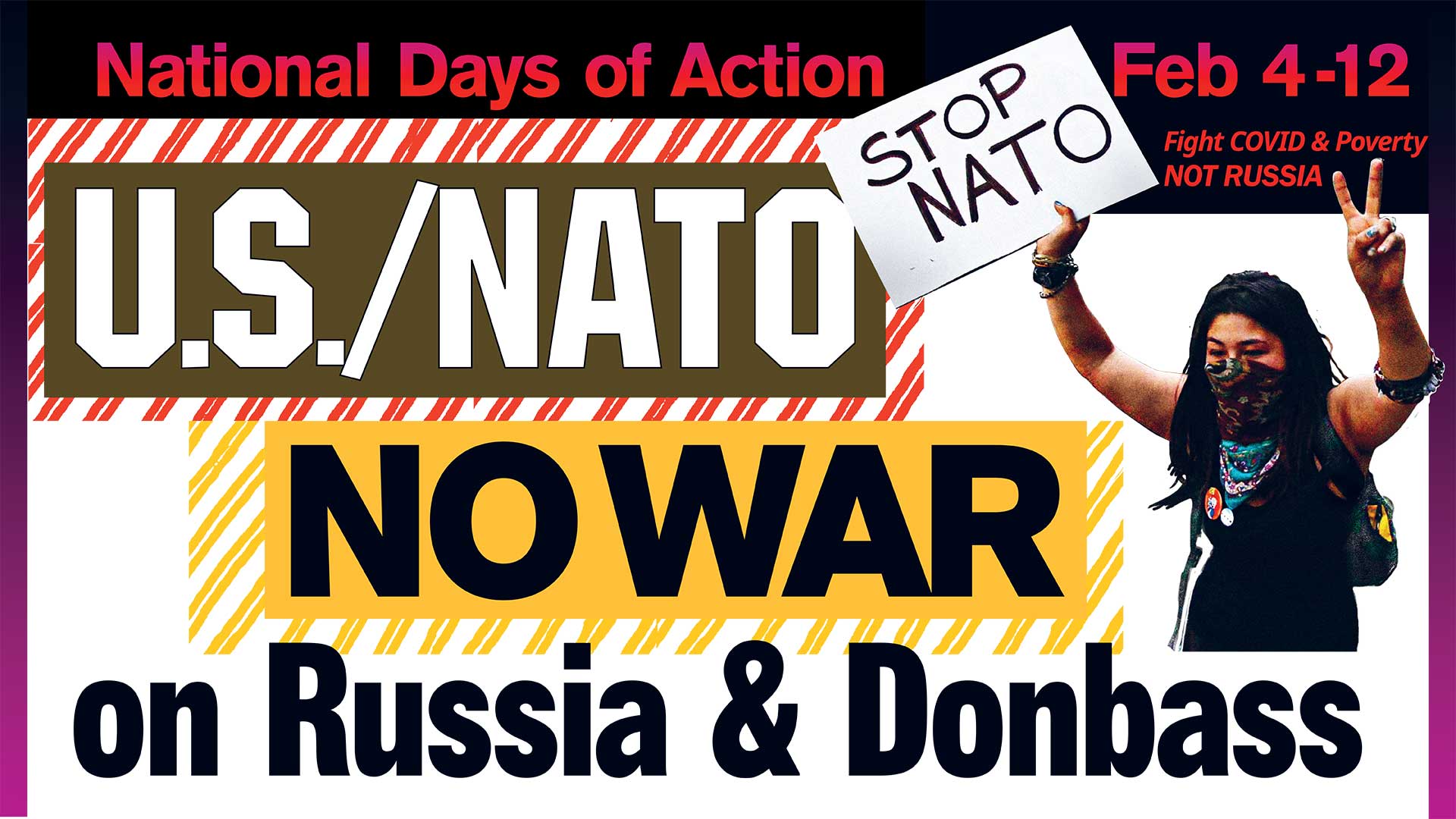
In Los Angeles – Saturday, February 5, 3:00 pm at Westwood Federal Bldg, 11000 Wilshire Blvd. Join the Harriet Tubman Center, Socialist Unity Party and many more organizations to say NO US/NATO War on Russia & Donbass!
In Los Angeles – Saturday, February 5, 3:00 pm at Westwood Federal Bldg, 11000 Wilshire Blvd. Join the Harriet Tubman Center, Socialist Unity Party and many more organizations to say NO US/NATO War on Russia & Donbass!

The phone call between President Biden and Ukrainian President Zelensky “did not go well“, CNN headlines: while “Biden warned that the Russian invasion in February is practically certain when the frozen ground makes it possible for tanks to pass through,” Zelensky “asked Biden to tone down, arguing that the Russian threat is still ambiguous”. While the Ukrainian president himself takes a more cautious stance, the Ukrainian armed forces are massing in Donbass close to the Donetsk and Lugansk area inhabited by Russian populations. According to reports from the OSCE Special Monitoring Mission in Ukraine, units of the Ukrainian Army and National Guard amounting to about 150,000 men are positioned there, the news is overshadowed by our mainstream which speaks only of the Russian deployment. They are armed and trained, and so effectively commanded by U.S.-NATO military advisers and instructors.
From 1991 to 2014, according to the U.S. Congress Research Service, the United States provided Ukraine with $4 billion in military assistance, plus over $2.5 billion after 2014. The NATO Trust Fund provided over a billion dollars in which Italy also participated. This is only a part of the military investments made by the major NATO powers in Ukraine. Great Britain, for example, has concluded various military agreements with Kyiv investing, among other things, 1.7 billion pounds in upgrading Ukraine’s naval capabilities: this program provides for the arming of Ukrainian ships with British missiles, the production of joint 8 fast missile units, the construction of naval bases on the Black Sea and also on the Azov Sea between Ukraine, Crimea, and Russia. In this context, Ukrainian military spending, which was equivalent to 3% of GDP ( Gross Domestic Product) in 2014, rose to 6% in 2022 corresponding to over 11 billion dollars.
In addition to the U.S.-NATO military investments in Ukraine, there is the $10 billion investment foreseen by the plan that is being carried out by Erik Prince, founder of the U.S. private military company Blackwater – now it is renamed Academy – which has supplied mercenaries to the CIA, the Pentagon, and the State Department for covert operations (including torture and murder), gaining billions of dollars. Erik Prince’s plan, revealed by an investigation of Time magazine, consists in creating a private army in Ukraine through a partnership between the Lancaster 6 Company, and the main CIA-controlled Ukrainian intelligence office. Through them, Prince has supplied mercenaries in the Middle East and Africa. It is not known, of course, what would be the task of the private army created in Ukraine by the founder of Blackwater certainly with CIA funding. However, it can be expected that it would conduct covert operations in Europe, Russia, and other regions from its Ukraine base.
Against this background, the exposure made by the Russian Defense Minister Shoigu that in the Donetsk region there are “U.S. private military companies that are preparing a provocation with the use of unknown chemicals” is particularly alarming. It could be the spark causing the detonation of war in the heart of Europe: a chemical attack on Ukrainian civilians in Donbass would immediately be attributed to the Donetsk and Lugansk Russians, who would be attacked by the preponderant Ukrainian forces already deployed in the region to force Russia to militarily intervene in their defense. At the forefront, ready to massacre the Russians of Donbass there is the Azov battalion, which trained and armed by the U.S. and NATO has been promoted to a special forces regiment. It distinguished by its ferocity in its attacks on the Russian populations of Ukraine. The Azov battalion recruits neo-Nazis from all over Europe under its flag similar to that of the SS Das Reich, it is commanded by its founder Andrey Biletsky who was promoted to colonel. It is not just a military unit but an ideological and political movement, and Biletsky is the charismatic leader in particular for the youth organization that is educated to hate Russians by his book “The words of the white Führer.“
Source: worldbeyondwar.org

Se dice fácil, pero han sido seis décadas durísimas que comenzaron con una ligereza desconcertante y la creencia de que el bloqueo del Gobierno de Estados Unidos a Cuba no duraría demasiado. Un par de años, quizás.
El 2 de febrero de 1962 John F. Kennedy llamó a su secretario de Prensa, Pierre Salinger y le dio una tarea urgente: “Necesito muchos puros cubanos, Pierre”. “¿Cuántos, presidente?”. “Unos mil”. El funcionario visitó las tiendas mejor surtidas de Washington y consiguió 1.200 cigarros H. Upmann Petit Corona enrollados a mano en las vegas de Pinar del Río, en el extremo occidental de la Isla.
“A la mañana siguiente, cuando llegué a mi despacho, el teléfono directo al Presidente ya estaba sonando. ‘¿Qué tal te fue?’, dijo, mientras yo cruzaba el umbral. ‘Muy bien’, respondí. Kennedy sonrió y abrió un cajón de su escritorio. Tomó un gran papel y lo firmó inmediatamente. Era el decreto que prohibía todos los productos cubanos en nuestro país. Los puros cubanos eran a partir de ese momento ilegales en Estados Unidos”, contó años después Salinger a la revista Cigars Aficionado.
Los periódicos de la época relataron con bastante exactitud lo que significaba aquella decisión. The Nation escribió: “La economía de Cuba dependía de los Estados Unidos para artículos esenciales como camiones, autobuses, excavadoras, equipos telefónicos y eléctricos, productos químicos industriales, medicinas, algodón crudo, detergentes, manteca de cerdo, papas, aves, mantequilla, una gran variedad de productos enlatados y la mitad de los alimentos básicos en la dieta cubana como el arroz y los frijoles negros. … Una nación que había sido un apéndice económico de los Estados Unidos quedó repentinamente a la deriva; era como si Florida hubiera quedado aislada del resto del país, incapaz de vender naranjas y ganado o de traer turistas, gasolina, repuestos de automóviles o cohetes de Cabo Cañaveral”.
Entre el 3 de febrero de 1962 y el 22 de noviembre de 1963 mediaron 657 días. Kennedy fue asesinado antes de que pudiera quemar uno a uno su arsenal de tabacos cubanos y antes de que se concretara la agenda de la negociación para tal vez revertir o suavizar el bloqueo, un proceso que estaba en curso cuando el magnicidio de Dallas.
Las consecuencias del fracaso de la invasión de Cuba por Playa Girón, en abril de 1961 – los invasores habían sido cambiados por compotas y tractores – y la llamada crisis de Octubre que involucró a EE.UU., la URSS y Cuba, en 1962, fueron dos de los factores que habían determinado el arranque del intento negociador. Un memorando remitido por Gordon Chase, especialista del Consejo de Seguridad Nacional para asuntos de América Latina, a McGeorge Bundy, Consejero de Seguridad Nacional del presidente Kennedy, el 11 de abril de 1963, recomendó con cinismo: “Si una suave aproximación negociadora a Castro es factible y exitosa, los beneficios podrían ser sustanciales”.
De nada valieron los intentos de rectificación de Kennedy ni los llamados no ya a la elemental justicia, sino al pragmatismo. Decenas de analistas, funcionarios y hasta ex presidentes estadounidenses han reclamado cordura para evitar que el castigo impuesto al pueblo cubano siga basado en la pulsión sádica, la inercia o simplemente en la arrogancia de un cogollo de politiqueros. Pero Washington ha seguido moviéndose en unas constantes vitales perversas. Wayne Smith, quien fuera jefe de la Sección de Intereses de Estados Unidos en La Habana y una de las voces más firmes contra el bloqueo impuesto unilateralmente por su país, llegó a la conclusión de que Cuba parece tener “el mismo efecto en las administraciones estadounidenses que la luna llena tiene en los hombres lobo”.
Tienen nietos y hasta bisnietos los que nacieron cuando Kennedy, con sus razones oscuras y su trastienda de tabacos, firmó la Orden Ejecutiva 3447 que decretó un bloqueo total sobre Cuba, incluyendo las medicinas y los productos alimenticios, y la amenaza a cualquier país que decidiera aliviar las sanciones. Algunos de esos cubanos han muerto y muchos morirán sin saber cómo funciona un país en condiciones de normalidad, la vieja o la nueva con Covid, da igual. Sin entender cómo se ha podido actuar contra millones de personas por tanto tiempo y con tanto odio, un odio sin límite ni explicación racional.
Este artículo fue producido para Globetrotter y publicado primero en La Jornada.
Rosa Miriam Elizalde es una periodista cubana y fundadora de Cubadebate. Es vicepresidenta de la Unión de Periodistas de Cuba (UPEC) y de la Federación Latinoamericana de Periodistas (FELAP). Es autora y coautora de varios libros, incluyendo Jineteros en La Habana y Chávez Nuestro. Por su destacada labor, ha sido merecedora en varias ocasiones del Premio Nacional de Periodismo Juan Gualberto Gómez. Es columnista semanal de La Jornada, México.
It’s easy to say, but it’s been six very hard decades that began with disconcerting lightness and the belief that the United States government’s blockade of Cuba would not last long—a couple of years, maybe.
On February 2, 1962, U.S. President John F. Kennedy called his press secretary, Pierre Salinger, and gave him an urgent task: “I need a lot of [Cuban] cigars.” “How many, Mr. President?” “About a thousand,” Kennedy replied. Salinger visited the best-stocked stores in Washington and got 1,200 H. Upmann Petit Corona cigars rolled by hand in the fertile plains of Pinar del Río, at the western end of the island.
“The next morning, I walked into my White House office at about 8 a.m., and the direct line from the President’s office was already ringing,” Salinger told Cigar Aficionado magazine years later. “‘How did you do, Pierre?’ he asked, as I walked through the door. ‘Very well,’ I answered. … Kennedy smiled, and opened up his desk. He took out a long paper which he immediately signed. It was the decree banning all Cuban products from the United States. Cuban cigars were now illegal in our country.”
The media outlets of the time reported quite accurately what that decision meant. The Nation wrote: “Cuba’s economy… depended on the United States for such essential items as trucks, buses, bulldozers, telephone and electrical equipment, industrial chemicals, medicine, raw cotton, detergents, lard, potatoes, poultry, butter, a large assortment of canned goods, and half of such staple items in the Cuban diet as rice and black beans. … A nation which had been an economic appendage of the United States was suddenly cut adrift; it was as if Florida had been isolated from the rest of the country, unable to sell oranges and cattle or to bring in tourists, gasoline, automobile parts, or Cape Canaveral rockets.”
There were 657 days between February 3, 1962—when Kennedy issued a blockade on trade between the U.S. and Cuba—and November 22, 1963, when he was assassinated.
Kennedy was killed before he could burn his arsenal of Cuban cigars one by one and before the negotiation agenda was finalized to perhaps reverse or ease the blockade, a process that was underway at the time of the Dallas assassination.
Two key factors that determined the start of negotiations were the failure of the Bay of Pigs invasion of Cuba in April 1961—the invaders had to be exchanged for food and tractors—and the 1962 October missile crisis that involved the U.S., the USSR and Cuba. A memorandum sent by Gordon Chase, National Security Council specialist for Latin American affairs, to McGeorge Bundy, national security adviser to President Kennedy, on April 11, 1963, cynically recommended: “If the sweet approach [to Castro] turned out to be feasible and, in turn, successful, the benefits would be substantial.”
Kennedy’s attempts at rectification were of no use, nor were the calls, not just for elementary justice, but for pragmatism. Dozens of analysts, officials and even former U.S. presidents have since demanded sanity to prevail in order to prevent the punishment imposed on the Cuban people from these continuing embargoes, which are based on the sadistic drive, inertia or simply on the arrogance of a bunch of politicians. But Washington has continued to show vital signs of not backing down. Wayne Smith, who was head of the U.S. Interests Section in Havana and one of the strongest voices against the blockade imposed unilaterally by his country, concluded that Cuba seems to have “the same effect on American administrations that the full moon has on werewolves.”
Those who were born when Kennedy, with his hidden reasons and a secret stash of cigars, signed Executive Order 3447, which decreed a total blockade on Cuba, now have grandchildren and even great-grandchildren. Some of those Cubans have died and many will die without knowing how a country works under normal conditions—the old one or the new one with COVID-19, it no longer matters. They will never understand how it has been possible for the U.S. to act against millions of people for so long and with so much hatred, a hatred without limits or rational explanation.
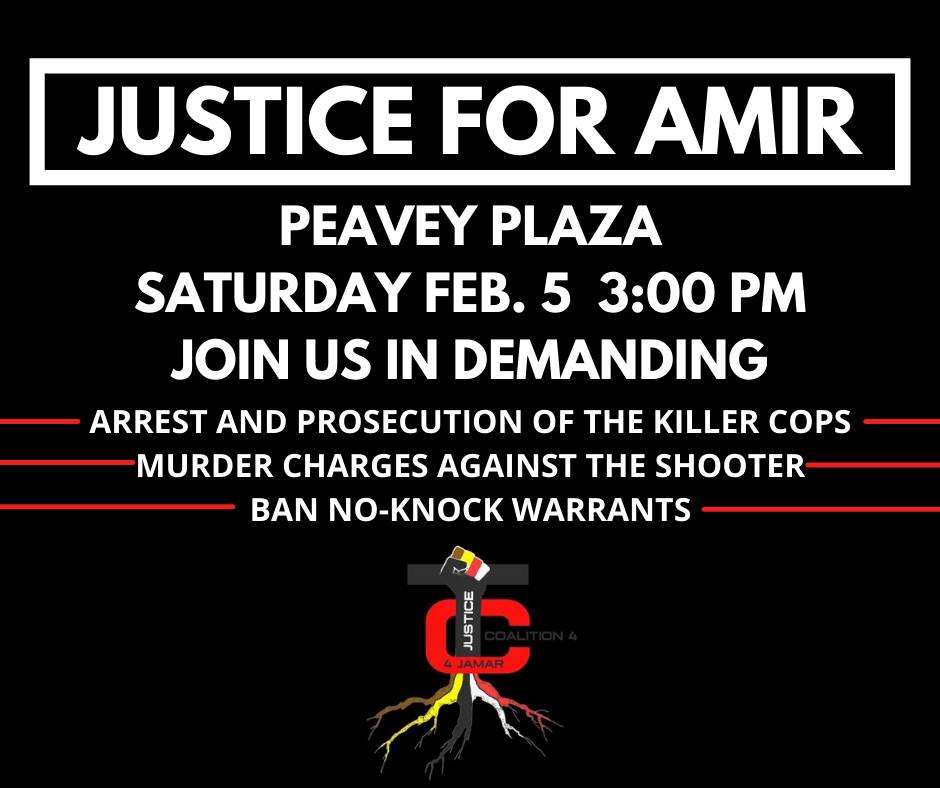
SATURDAY, FEBRUARY 5, 2022 AT 4 PM – 6 PM EST
Protest – Justice for Amir Locke. Rally @ Peavey Plaza
1101 Nicollet Mall, Minneapolis
MPD shot and killed Amir Locke on Feb. 2nd. Within 9 seconds of executing a search warrant, they executed a human being.
Join us in demanding:
— Fire, arrest and prosecute the killer cops and those who planned the raid.
— Immediate moratorium on no-knock warrants


[su_row][su_column size=”1/4″ center=”no” class=”] [/su_column][su_column size=”1/4″ center=”no” class=”]
 [/su_column][su_column size=”1/4″ center=”no” class=”]
 [/su_column][su_column size=”1/4″ center=”no” class=”]
 [/su_column][/su_row]
[su_row][su_column size=”1/4″ center=”no” class=”] [/su_column][su_column size=”1/4″ center=”no” class=”]
 [/su_column][su_column size=”1/4″ center=”no” class=”] [/su_column][su_column size=”1/4″ center=”no” class=”] [/su_column][/su_row]
[pdf-embedder url=”https://struggle-la-lucha.org/wp-content/uploads/2022/02/SLL_lettersize_7placards.pdf”]
[pdf-embedder url=”https://struggle-la-lucha.org/wp-content/uploads/2022/02/SLL_11x17_2up-7placards-1.pdf” title=”SLL_11x17_2up-7placards”]


Minneapolis – A SWAT officer from the Minneapolis Police Department killed a man after busting into a downtown Minneapolis apartment at 7 a.m. on February 2. The victim has been identified by the community as Amir Locke. He’s become the third Black man killed by Minnesota police in 66 days. In each case, the victim is demonized by the police and the press.
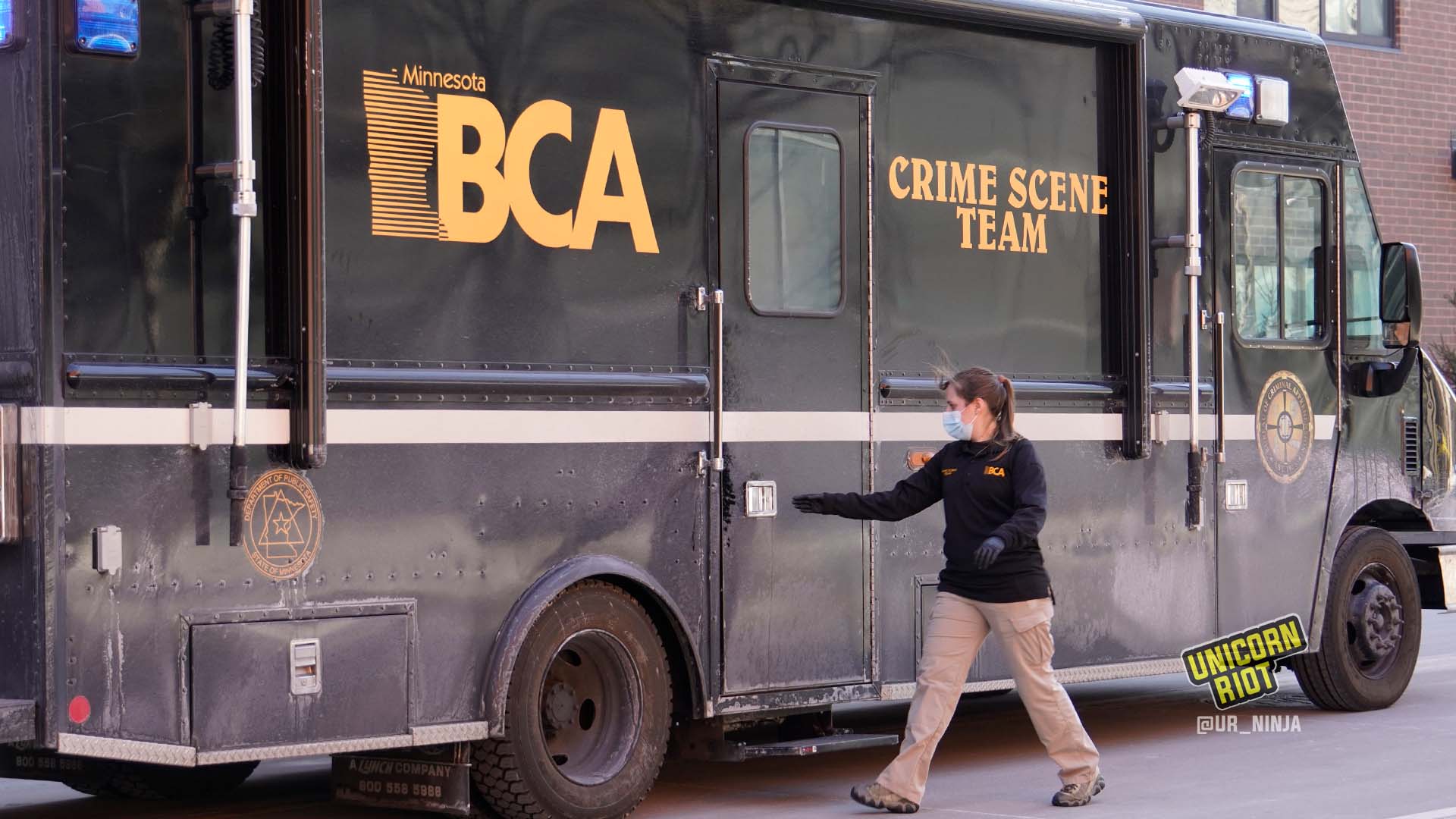
Minnesota’s Bureau of Criminal Apprehension is in charge of all the investigations into each of the three deaths: Amir Locke, Kokou Christopher Fianfonou in Austin, and Noah Kelley in Mounds View. Protests have called for transparency and accountability in each of the cases.
Amir Locke, who is said to be around 24 years old, was killed by Mark Hanneman, a SWAT officer with the Minneapolis Police Department (MPD) while they were executing an early morning search warrant on February 2. The killing occurred at the Bolero Flats Apartment Homes on the 7th floor.
The police narrative, which contradicts what Locke’s family says, is that Minneapolis Police were assisting St. Paul Police in executing a search warrant on a homicide suspect when the suspect brandished a weapon, and in fear of their lives, they shot and killed him.
Locke hasn’t officially been named but according to activist Nekima Levy Armstrong, Locke’s family has identified him as the one killed. Armstrong also posted on Facebook that MPD’s Interim Chief Amelia Huffman called her in the morning after the shooting to tell her that it happened.
The family says that Amir was sleeping on the couch of a family member’s apartment when the police busted in the door executing a search warrant seeking three people, none of whom were Locke.
His family said that he was a licensed gun owner with a conceal and carry permit. He was startled from the pre-dawn police actions and sought to protect himself when he was shot and killed by the police, his family says.

According to reporting by Georgia Fort, at least three apartments were raided during the operation that killed Locke. Two on the 14th floor and the one on the seventh, where Amir was killed.
During a press conference hours after the killing, Minneapolis Mayor Jacob Frey and Interim Chief Huffman expressed condolences from the tragedy of the loss of life and provided their explanation for yet another violent police killing in the City of Minneapolis.
Interim Police Chief Huffman stated that SWAT officers were “serving search warrants to assist the St. Paul Police Department’s homicide unit … related to an ongoing murder investigation.” She said officers gained entry using a key fob and “loudly and repeatedly announced police search warrant” before entering. Then, nine seconds into the 7th floor apartment “the officers encountered a male who was armed with a handgun. He was holding that gun in his hand. At the time that shots were fired.”
The City of Minneapolis swiftly revealed Locke was killed by Minneapolis Police Department Officer Mark Hanneman (002654) and released documents related to the shooting, with some redactions: Incident Detail Report, Fire Incident Detail Report, and Fire Incident Report, along with a news release, and two photos of the gun (1, 2).
The documents reveal that Hanneman was part of Unit 1280 that initially entered the apartment and that Locke was killed by two gunshot wounds to the chest and one to the wrist.
Hanneman was previously a police officer in Hutchinson and was involved in a statewide intra-agency scheme to offer illicit drugs to protesters in the Occupy movement and the unhoused as part of Minnesota State Patrol’s Drug Recognition Evaluator (DRE) program. The program was briefly halted during the controversy and a lawsuit but continues to operate. Hanneman had since become an officer with MPD after serving a minor reprimand for his participation in DRE and recently graduating with a masters degree in criminal justice.
Other officers assigned to Unit 1280 according to MPD’s Incident Detail Report were John K Biederman (000548); Ryan J Carrero (001003); Conan D Hickey (002997); Dominic Manelli (123219); Aaron Pearson (005504); Nathan J Sundberg (007011); John Sysaath (007026).
Providing cover to Unit 1280 was 1281 and involved in that unit was MPD offficer Kyle Mader, who was filmed violently slamming an advocate for the houseless to the ground at George Floyd Square in late 2020.
In a controversial pattern, Locke was named a homicide suspect in the initial reports by the police that were widely published by the press. In her short press conference, Interim Chief Huffman referred to the “homicide” investigation from which the warrant was based, three times. Similar inaccurate homicide allegations were spread about Winston Smith after he was killed by a federal task force last year in Uptown Minneapolis. Corporate news reports were later retracted that initially called Smith a murder suspect.
If what the family says is true and that Locke was not named on the warrant, he was then not a suspect in the investigation – yet he was still killed.
The pattern of criminalizing victims is clearly seen in each of the last three police killings in Minnesota.
38-year-old Kokou “Christopher” Fianfonou was killed by Austin Police Department Officer Zachary Gast in the parking lot of a gas station in Austin, Minnesota around 9:30 p.m. on December 23. Police say Fianfonou was threatening officers with a knife.
Fianfonou, originally from Togo, was reportedly stuck in an extended standoff with Austin PD starting on December 22 from a report of a man walking in traffic with a knife.
During the standoff that lasted over 24 hours, Austin Police shot tear gas, foam marker rounds, and deployed Tasers into Fianfonou’s cousin’s house (where he was staying) in an attempt to clear him out. On the evening of December 23, officers left the sight of the house and a few hours later, they say Fianfonou then confronted them, armed, and they shot and killed him.
Fianfonou’s family disputes official narratives that Fianfonou was threatening anyone. They say he was unarmed when he was killed and that he had bags of groceries in his hands. Friends and family say he was going through a mental crisis the day before being killed.

A GoFundMe has been created by his family to help support his wife and children. Activists have called for all video footage to be released, cops fired and prosecuted and Christopher’s family to be compensated.
21-year-old Noah Kelley was killed by Mounds View Police Department Sergeant Michael Hanson and New Brighton Police Officer John Thomas inside a Mounds View liquor store around 7 p.m. on November 28. Police say Kelley was armed with a handgun and alone in the liquor store when officers arrived and killed Kelley. According to the Department of Public Safety, body cameras captured “portions of the incident.”
On January 10 protesters rallied at the Mounds View City Hall before a City Council meeting and spoke during (video).
Brian Kelley, Noah’s father, addressed City Council members during the meeting and insisted the videos be released, and requested a meeting with the mayor and police chief. Kelley said that he had been left in the dark as to what happened to his son with no information besides the police report.
“I’ve spent the last month and a half in extra grief because I’m completely unaware of what took place – and that’s the reason why the taxpayers provide things like the body cameras. In addition, Gov. Walz, in June of 2021 insisted that those types of footage be available to family members within five days of an incident that resulted in death.”
Brian Kelley addressing the Mounds View City Council on January 10, 2022
Kelley’s requests seem to have been granted and a meeting with the family and authorities is scheduled for the first Friday in February.
Brian Kelley has spent nearly two decades building families through a ministry called All About Family and teaching youth about designing and building with the Young Builders and Designers Program. Noah worked alongside him and Brian said “he was going to become a carpenter or in a similar labor trade.”
Kelley leaves behind a young daughter and a wife. His family has created a GoFundMe to help support his family.
Source: Unicorn Riot
1