What are the reasons why Nicaragua switched from Taiwan to China?

This past Thursday, Nicaragua’s Ministry of Foreign Affairs announced its decision to rescind diplomatic ties with the Republic of China, also known as Taiwan. Immediately after, the People’s Republic of China announced the re-establishment of diplomatic relations with President Daniel Ortega’s government.

The switch did not come out of the blue since a delegation from the Central American country had already traveled to China to take on negotiations on the representation agreement. The Statement released by the Nicaraguan government did not mention any reason except the acknowledgment of the One-China Principle, which holds that Taiwan is a province of the People’s Republic of China.

The Taiwanese side said it was sad and disappointed and put an end to the 27 bilateral cooperation agreements, comprising of between 30 and 50 million dollars. The Ministry of Foreign Affairs issued a declaration, announcing the evacuation of the diplomatic personnel from its mission in Managua and the cut of diplomatic ties to safeguard its national sovereignty and pride. Taiwan was Nicaragua’s main donor from the Asian region, and it was deeply involved in the house-building and agricultural development of Nicaragua. The Taiwanese President visited Nicaragua in 2017, and shortly after, the Latin American country got a $100 million loan, which was a signal of mutual trust and the robustness of the bilateral cooperation. However, the bilateral relationship has had its ups and downs for a long time.

After winning the elections in 1985, Daniel Ortega ended diplomatic links with Taiwan, which was kicked out of the United Nations in favor of the People’s Republic of China in 1971. Immediately after he finished his presidential term in 1990, then-President Violeta Chamorro resumed the diplomatic ties. She played a key part in the US plan to keep a thorn in the Chinese side. The United States broke up with Taiwan in 1978 in order to normalize its relationship with China, even though it kept the pressure on its allies, especially the Latin American ones, to impede Taiwan’s international isolation.

With this new blow to Taiwan’s international recognition, only 14 countries are harboring diplomatic representation of the island: San Kits and Nevis, Saint Lucia, Saint Vincent and the Grenadines, Palau, Marshall Islands, Tuvalu, Nauru, Swaziland, the Vatican State, Paraguay, and Honduras, which recently elected President Xiomara Castro indicated her sympathy to the One-China principle during her presidential campaign. This is not a good sign for Taiwan, which has lost seven international allies (including Nicaragua) since 2017.

During his presidency Donald Trump promoted the international role of Taiwan as one of its strategies to counter China’s power in the international arena. This, alongside the commercial war, was Trump’s warhorses against China. This is precisely one of the underlying reasons of the movement from the Nicaraguan government.

During the last four years, Washington has strengthened its aggressive stance towards Nicaragua, using economic sanctions, destabilization attempts in 2018, and a campaign to undermine the legitimacy of Daniel Ortega’s re-election. Nicaragua has stood firm to its anti-imperialist position and has done everything possible to limit the reach of US actions against its sovereignty, leaving the Organization of American States recently is  clear proof of that. In that line, switching its position towards Taiwan is a broader reach action with a double purpose.

On the one hand, it is a blow to US strategy to use Taiwan’s international recognition as a spearhead against China. On the other hand, it places Nicaragua closer to the biggest US geostrategic enemy, giving it a bigger share in the regional financial and economic landscape, which in itself increases the threat to US prominence.

However, countering the US is not the only profit that Nicaragua is getting with this turn of position. Nicaragua is the third poorest country in Latin America, and the COVID-19 has weakened the national economy, and consequently the ability of Ortega’s government to improve the living conditions of its people. Moreover, the United States, the natural economic partner of the region, is doing everything possible to undermine Nicaragua’s development strategy for political and geostrategic reasons. What is clear is that China, the second-largest economy in the world has a clear strategy to increase its presence in Latin America.

The re-establishment agreement was signed by China’s Deputy Foreign Affairs Minister Ma Zhaoxu and Nicaragua’s presidential adviser Laureano Ortega Murillo. The Nicaraguan official is also a national investments promoter, which put some light on some other reasons behind this switch.

Nicaragua is aware of China’s intentions to invest over $250 billion in the region and this move can put it in a better position to access these funds. Getting closer to China has always brought economic benefits for the countries of the region. In 2017, Panama made the same move that Nicaragua just did and the Chinese investment flew to the isthmus. Panama also was able to issue the Panda Bonds to increase its financial portfolio, which are $500 million-worth of debt bonds aimed at the Chinese market and sold in yuan.

Moreover, Nicaragua is very interested in becoming the true inter-oceanic maritime canal planned since 2013, a project granted to the Chinese enterprise HK Nicaragua Development Investment (HKND). The maritime route is a cornerstone of the economic and social development strategy of the Central American country, and just the fact of starting it will bring immediate benefits to the well-being of the Nicaraguan people by generating over 50,000 jobs.

Taking all these into account, the switch was a strategic move that could only bring benefits to Nicaragua. Besides that, the People’s Republic of China shows right now as a more reliable ally than Taiwan, since it is way too docile and subservient to Washington’s desires and schemes, and bringing Nicaragua down is one of its most urgent goals.

Politics aside, from a human level, why wouldn’t Nicaragua align with China? Who would they rather deal with, a country that treats them with mutual respect and benefit or one that goes out of its way to destroy it.

Source: Resumen Latinoamericano – English

Strugglelalucha256


Organizers against police crimes meet: ‘We have nothing to lose but our chains’

Chicago — Two years after the refounding of the National Alliance Against Racist and Political Repression (NAARPR) in November 2019, over 125 NAARPR members and affiliates from around the country convened for the second NAARPR conference in Chicago starting on Saturday, December 4. They shared updates about their work fighting against police crimes and for community control of the police, among other areas of struggle, then voted on resolutions and new leadership for the next two years.

Due to the ongoing COVID-19 pandemic the conference was attended only by delegates from NAARPR chapters and affiliated organizations. The plenary sessions on the first day of the conference were livestreamed on the Chicago AARPR Facebook page so people who could not be there in person could participate virtually.

Saturday morning began with an opening plenary on the purpose of the conference and the work of NAARPR. The meeting was facilitated by NAARPR co-chair Michael Sampson. Delegates heard speeches from SEIU HCII President Greg Kelly and NAARPR executive director Frank Chapman, as well as a video statement from Angela Davis, a leader of the original NAARPR. Davis stressed that the fight to free political prisoners is an ongoing part of the struggle against systemic racism.

SEIU HCII played a key role in this fight by putting the strength of their 90,000 members behind the Empowering Communities for Public Safety legislation in Chicago, the most progressive police accountability ordinance in the country, and a step towards community control of the police. Kelly cited the murders of Michael Brown and Laquan McDonald as reasons why his union was motivated to get involved in the fight for police accountability.

Chapman spoke on the necessity of the alliance between community organizations like NAARPR and unions like SEIU, saying “the objective is to build the biggest, baddest mass movement this country has seen in a long time.”

The floor was then opened for delegates to report on the work their chapters have done over the past two years. Many spoke about the uprising in the wake of the murders of George Floyd and Breonna Taylor, the most massive uprising in U.S. history. NAARPR affiliates organized protests of tens of thousands of people in various cities around the country, including cities like Jacksonville, Florida which had never seen protests of that size before. Other initiatives described by delegates included fighting for justice with the families of people killed by the police, successful efforts to cut police budgets, actions in solidarity with anti-imperialist movements, campaigns to free survivors of police torture and wrongful conviction, defenses of protesters against political repression, and struggles for community control of the police.

The rest of the first day consisted of a plenary on community control of the police, one breakout session discussing the fight against political repression, one breakout focusing on the importance of the families of those killed or harmed by the police in the struggle, and a final plenary session summing up the lessons learned during the opening day of the conference.

The wide variety of speakers demonstrated the progress NAARPR has already made towards building the mass movement.

Sunday’s sessions focused on electing new leadership and voting on the actions NAARPR would resolve to take over the next two years. Delegates voted on seven resolutions: to defend and expand voting rights, to free political prisoners, to defend the right of immigrant families to stay together by fighting deportations, to free Alex Saab from the political repression of the U.S. empire, to continue to stand in solidarity with the Palestinian liberation struggle, to support the Filipino people’s fight against U.S.-backed terror, and to build class struggle unionism. Delegates then ratified the NAARPR bylaws and formally elected the officers and executive board of the National Alliance. The leadership reflects the Black led, multigenerational character of the organization.

Delegates left the conference expressing feelings of pride in the work done since NAARPR’ s refounding two years ago, as well as optimism and excitement for the years ahead building the movement for community control of the police across the U.S. Monique Sampson, co-founder of the Jacksonville Community Action Committee and newly elected NAARPR national desk secretary, led the delegates in a chant written by freedom fighter and former political prisoner Assata Shakur: “It is our duty to fight for our freedom. It is our duty to win. We must love and protect one another. We have nothing to lose but our chains.”

Source: FightBack! News

Strugglelalucha256


Labor leader calls for action to free Mumia Abu-Jamal

On Dec. 9, the Free Mumia webinar began with a message from political prisoner Mumia Abu-Jamal, who has been unjustly imprisoned in the U.S. for 40 years. Mumia, a journalist who was Minister of Information for the Black Panther Party in Philadelphia before he was framed-up, spoke about the U.S. military-industrial complex. The call was moderated by Gabriel Bryant and Sophia Williams.

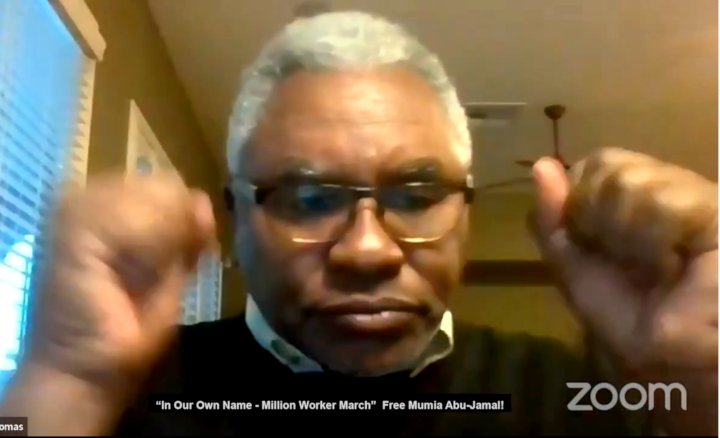
Clarence Thomas is a retired rank-and-file union leader who was part ot the International Longshore and Warehouse Union Local 10’s effort to free Mumia for over 30 years. He is also author of the anthology “Mobilizing in Our Own Name: Million Worker March.” As the first speaker, Thomas established the historic roots and breadth of the worldwide campaign to free Mumia and all U.S. political prisoners. There will be a protest in Philadelphia to “Free Mumia!” on Dec. 11.

Call to Action: For international workers’ action – Free Mumia Abu-Jamal and all anti-racist and anti-imperialist freedom fighters!
Statement by Clarence Thomas

Dec. 9, 2021

The International Longshore Warehouse Union (ILWU) has a long tradition of defending oppressed nationalities and political prisoners such as Angela Davis in the 1970s. As a retired member and officer of ILWU Local 10, I have been a part of the Local’s efforts to free Mumia Abu-Jamal and all political prisoners. For more than 30 years, the ILWU has been in the vanguard of the labor movement to free the award-winning journalist, ‘the voice of the voiceless’ and former Black Panther Party member, Mumia Abu-Jamal.

In my recent anthology, “Mobilizing in Our Own Name: Million Worker March,” there are many articles by Mumia that are featured, documenting his support of all labor (organized and unorganized), including ILWU Local 10 and the Million Worker March. Mumia describes himself as “a proud card-carrying member of the National Writers Union which affiliated with the United Auto Workers.” During his forty years of imprisonment, his support for labor and the working class has been unwavering.

During the 1960s, the Black Liberation Movement awakened my political and social consciousness along with countless other Afro-American youth. I joined the Black Panther Party which facilitated my anti-racist, anti-capitalist, and anti-imperialist activism and the need for Afro-Americans to have “self-determination.”
Declaring the Black Panther Party “public enemy number one,” the U.S. government sanctioned the murder of its leaders, vilified the organization in the press, and falsely imprisoned Party members, Mumia Abu-Jamal has always maintained his innocence of the murder of Philadelphia police officer Daniel Faulkner.

There are Black Panther Party members that were a part of the Black Liberation movement who have been languishing in prison for more than half a century. Native American political prisoner Leonard Peltier has been imprisoned since 1977. The horrific imprisonment and the abuse of these political prisoners represent the long legacy of slavery, Jim Crow, apartheid, and racial violence perpetrated against African Americans.

The labor movement can and must play a vital role in the release of all political prisoners. The ILWU recognizes that the prosecution of radical labor leaders such as Tom Mooney and Harry Bridges is directly connected to efforts by the U.S. government to use lies and frame-ups to put away these fighters for freedom and justice that was promised yet denied to African Americans and people of color in the U.S.

The ILWU Longshore Division shut down the entire West Coast in 1999 to demand: “Stop the Execution and Free Mumia!” On June 19 (Juneteenth), 2020, the ILWU shut down all 29 ports on the West Coast including Vancouver, Canada, to commemorate Juneteenth, to End Systemic Racism, and to Stop Police Terror. No maritime cargo was moved for 8 hours on the entire West Coast. This solidarity action on the part of West Coast dockworkers represents the power of labor at the point of production. It is this type of action that labor must find the courage to exercise on a global level to bring home Mumia Abu-Jamal and all political prisoners.

“An Injury to One is an Injury to All”

“Free Mumia Abu-Jamal”

Clarence Thomas
ILWU Local 10 retired
Co-founder Million Worker March
Author of Mobilizing in Our Own Name: Million Worker March
MillionWorkerMarch.com


www.MillionWorkerMarch.com

“Mobilizing in Our Own Name’” documents struggles in news articles, interviews, letters, posters, photos, speeches and video transcripts.

Danny Glover who was a part of the MWM, wrote, “‘Those of us that are activists in the struggle and are contemporaries of my brother and comrade Clarence ‘Buzz’ Thomas, whom I’ve known since our days at San Francisco State, he has done what many of us have talked about but refused to do; write a book! This anthology captures the Million Worker March and so many subsequent struggles that really underscores how ILWU Local 10 continues its long radical history and tradition of struggle. To quote sister Angela Davis, when we both spoke at the Juneteenth 2020 rally at the Port of Oakland, “Whenever the ILWU takes a stand, the world feels the reverberation.”

Strugglelalucha256


Baltimore: The Grinch that Stole Christmas for Unemployed Workers, Dec. 18

SATURDAY, DECEMBER 18, 2021 AT 2 PM – 3:30 PM
Protest at Tiffany Robinson’s
Seton High School, 2800 N. Charles Street Baltimore

Protest at Tiffany Robinson’s House

“The Grinch that Stole Christmas for Unemployed Workers”
“Singing Christmas Carols” at Robinson’s House

Saturday, December 18,
Gathering at 2 pm from 2011 N. Charles Street, Baltimore, MD 21218 to car caravan to her home.

We have tried continuously to reach Secretary of Labor, Tiffany Robinson at her office, but with no luck. She is either not in her office or refusing to meet with us or even acknowledge unemployed workers’ grievances. It’s time we go to her house.

We don’t like to do this, but Tiffany Robinson hasn’t given us a choice, and besides, let’s bring the holiday spirit to her with some carols reflecting our feeling

Strugglelalucha256


No support for Ukrainian Rittenhouses! Hands off Donbass, Belarus and Russia

Why is President Joe Biden’s administration laser-focused on threatening war on the other side of the world, when the people of the United States are beset with life-threatening crises here at home?

Racist killer Kyle Rittenhouse was just acquitted, emboldening violent white supremacists across the U.S. Women’s reproductive rights are under attack in many states and at the highest summit of the Supreme Court, which may soon overturn Roe v. Wade.

The COVID-19 pandemic is surging again, with the Delta and Omicron variants threatening new waves of death and further taxing the country’s awful, mismanaged private healthcare system. Workers’ rights are under attack from Amazon, Kellogg’s and bosses across the board. The climate crisis continues to wreak havoc coast-to-coast. 

These are a few of the life-and-death problems Biden needs to address. Workers and oppressed people did not give him their votes to start a war with Russia. 

Biden’s administration claims that 70,000 Russian troops guarding their country’s Western border are a great threat to neighboring Ukraine. Seventy thousand Russian troops, that is, stationed on Russia’s own territory. 

On Dec. 3, Jeff Bezos’ Washington Post, long an unofficial Pentagon mouthpiece, promoted a “declassified assessment” by national security officials claiming that Russia plans to invade Ukraine with 175,000 troops by the end of January. 

This is at least the third time this year that Ukrainian and Western officials have made such a claim about an alleged Russian invasion. What sets this time apart is that the story started in Washington, not Kiev. 

Last spring, NATO held its largest-ever war games in Europe, in regions bordering Russia, acting out scenarios that are now being promoted on computer and TV screens around the world.

The U.S. military has at least 750 military bases in 80 countries and hundreds of thousands of personnel stationed around the world. The U.S. spends more on its military than the next 10 countries combined. The Pentagon kills with impunity whenever and wherever it claims to see a threat to “U.S. national security” – whether in Africa or Western Asia or Latin America – destabilizing countries, often taking civilian lives intentionally or as “collateral damage.”

Over the last 30 years, the U.S.-dominated NATO military alliance has steadily expanded eastward, swallowing 14 countries in Central and Eastern Europe, including several on Russia’s Western borders. This despite a promise by the U.S. to Russia that NATO would not expand after the Cold War. 

Ukraine is among three countries in the running to join NATO next. The U.S. first promised Ukraine NATO membership in 2008 if its government would join the anti-Russia crusade. Russia has made it clear that a NATO takeover of Ukraine is a “red line” that threatens its sovereignty and security which must not be crossed.

Ukraine threatens Donetsk, Lugansk

Biden’s spokespersons don’t mention that up to 125,000 Ukrainian troops – half its total military! – are massed on the borders of the independent Donetsk and Lugansk People’s Republics, small countries sandwiched between Ukraine and Russia. Ukraine has been at war with them since 2014.

Ukraine claims these countries as its own territory, despite an overwhelming popular vote in a democratic referendum in favor of independence.

Ukraine is a party to the internationally-negotiated Minsk II agreements, which prohibit it from targeting civilians, using heavy weapons against the Donetsk and Lugansk republics or invading. Yet Ukraine shells and shoots at the 140,000 inhabitants of frontline areas constantly, causing daily deaths, injury and destruction. Washington and Kiev deliberately block any progress toward a negotiated settlement.

Ukraine’s war on the Donbass republics has gone on for seven and a half years, and has cost more than 14,000 lives.

The real danger of invasion is from Ukraine against Donetsk and Lugansk. Since 2014, Ukraine’s military has been trained, armed and reorganized by the U.S., Britain, Canada and other NATO countries. That includes the neo-Nazi “volunteer battalions” integrated into its official military structure. 

The people of Donbass suffer under a complete economic blockade by Ukraine and its Western allies. Russia has provided humanitarian aid and trade to Donetsk and Lugansk at great cost, supplemented by support from antifascist organizations in the former Soviet countries and the rest of the world.

A Ukrainian invasion of Donetsk and Lugansk would aim for maximum damage to infrastructure and civilian casualties – in hopes of provoking a military response from Russia. Then NATO would claim a “Russian invasion” to justify its war moves.

Antifascist resistance

Why did people in eastern Ukraine’s Donbass mining region choose independence? It happened after a U.S.-engineered coup brought a far-right-wing government to power in Kiev in 2014. 

The coup was carried out by fascist gangs that were then set loose on the people of Donetsk and Lugansk and integrated into Ukraine’s military and security forces.

The U.S. wanted to bring NATO to Russia’s border then and there. Most of all, Washington wanted to seize the strategic military base on the Crimean peninsula, which would give NATO control of the Black Sea. The people of Crimea rejected that. So did the Russian government. 

In Soviet times, Russia ceded Crimea to Ukraine, with a long-term Russian lease on the military base. In 2014, the Crimean people voted to return to Russia, and Russia agreed, thwarting the U.S. takeover of this strategic area.

Over 26 million Soviet people died fighting the Nazis in World War II. Seventy years later, they were not willing to live under neo-Nazi rule.

All of this happened during the Democratic Obama administration. Both Democrats and Republicans supported the far-right takeover of Ukraine and lied about a “Russian invasion” when the people of Donbass and Crimea asserted their right to separate. 

And who was the Obama administration’s point person on Ukraine? Who was calling the shots and handing out profitable favors to family members and business associates?

It was none other than Vice President Joe Biden.

Biden-Putin call

Biden held a widely-publicized two-hour secure video call with Russian President Vladimir Putin on Dec. 7. Biden threatened harsh economic sanctions, including cutting off Russia from the global banking system, as the U.S. has done to punish Iran. 

Putin reiterated the Russian government’s consistent position that NATO expansion into Ukraine is a “red line” for Russia’s security. He said he hoped for further negotiations.

Why is Washington taking such a provocative stance toward Russia and making these threats now?

Big U.S. energy companies and banks want to stop the international Nord Stream II project that is set to bring Russian natural gas to Western Europe. U.S. capitalists are desperate to control energy profits and suppress any energy-supplying countries that defy Wall Street control – like Iran, Venezuela and Russia. U.S. companies want their European junior partners to buy energy from them and them alone.

That’s the immediate play. But the U.S. has had its eyes on carving up the Russian Federation since the fall of the Soviet Union 30 years ago. A Pentagon document leaked in 1992 laid out a long-term plan to rip apart Russia, destroy its sovereignty and make it a docile market and supplier of raw materials and skilled labor for Western big business. That’s still the goal.

And then there’s the fact that Biden and the Democrats are deeply mired in political crisis at home – unable to meet the basic needs and demands of the workers and oppressed people who they claim to represent, because they are beholden to the very capitalist system that thrives on racism, poverty and war.

Provoking a war is a time-honored U.S. method of distracting the masses of people in a time of great crisis.

Belarus, then Ukraine, next … ?

The U.S. “warnings” (really, war propaganda) about a Russian invasion of Ukraine followed immediately on the heels of the November border crisis between Belarus and Poland.

Thousands of refugees from Western and Central Asia and North Africa, fleeing the wreckage of U.S.-European wars in their homelands, went to Belarus, seeking to enter the European Union through Poland. The U.S.-dominated Polish government refused to let them through. The EU countries supported Poland in this gross violation of international human rights.

Polish troops mobilized at the border and abused refugees. The right-wing regimes in Lithuania and Ukraine also sent troops to the border with Belarus. None of this could have happened without NATO’s (and therefore, Washington’s) express consent and encouragement.

Belarus is an ally of Russia. The countries recently strengthened their military ties after an attempted Ukraine-style coup failed in Belarus. The events on the Polish border had all the earmarks of NATO trying to provoke a war crisis. 

The EU countries refused to even hold a conversation about the refugees. Finally, Belarus President Alexander Lukashenko put his foot down. He said that if Poland and its allies provoked a war, Belarus would stop the flow of fuel oil to Western Europe. 

That got a quick response. Angela Merkel, the German chancellor whose term has just ended, got on the phone to Lukashenko and agreed to cool things down.

Washington wasn’t happy with that outcome. And it immediately switched gears to the “Russian invasion of Ukraine” fairy tale – even though Ukraine had just made threatening moves toward Belarus on NATO’s behalf!

Let’s stop new imperialist war

A day before the Biden-Putin call, an unnamed U.S. official told The Guardian that Washington could send troops to eastern Europe. “It would certainly be the case that if Putin moved in, there would be an increasing request from eastern flank allies, and a positive response from the United States, for additional forces and capabilities and exercises to take place there to ensure the safety and security of our eastern flank allies in the face of that kind of aggression in Ukraine.” 

This threat didn’t come up explicitly during the official conversation, but hung over it.

Then, shortly after the presidential call, CNN filed a report that preparations were underway at the Pentagon for a possible evacuation of U.S. civilians from Ukraine in the event of war.

These stories aren’t objective journalism. They are thinly veiled and very public threats.

If the situation at the Ukraine-Russia border cools, it will only be temporary. 

That’s the real message behind NATO’s one-two punch in Belarus and Ukraine. The antiwar movement, anti-imperialists and the whole working class must stay alert and get ready to stop a war that could quickly expand to engulf the whole world.

The U.S. keeps pushing harder and harder. Officials in Russia, Belarus and Donbass have so far managed to skillfully deflect and blunt NATO provocations. But Washington does not let up.

And whatever Biden, the Pentagon generals and big capitalists behind them desire at this moment, they are playing with fire. The Ukrainian, Polish and Baltic fascists are just as volatile as the white supremacist who killed two Black Lives protesters and wounded another in Kenosha. And they are far better trained and armed than Rittenhouse – thanks to Washington. 

There are no guarantees that they will continue to follow their bosses’ orders if they grow impatient. And that could set off an international conflagration with tragic consequences for workers all over the world.

Now is the time to organize, educate and get ready to take the streets against the next U.S. war – whether it begins in Europe, Asia, Latin America or Africa.

Strugglelalucha256


Ten contradictions that plague Biden’s Democracy Summit

President Biden’s virtual Summit for Democracy on December 9-10 is part of a campaign to restore the United States’ standing in the world, which took such a beating under President Trump’s erratic foreign policies. Biden hopes to secure his place at the head of the “Free World” table by coming out as a champion for human rights and democratic practices worldwide.

The greater possible value of this gathering of 111 countries is that it could instead serve as an “intervention,” or an opportunity for people and governments around the world to express their concerns about the flaws in U.S. democracy and the undemocratic way the United States deals with the rest of the world. Here are just a few issues that should be considered:

1. The U.S. claims to be a leader in global democracy at a time when its own already deeply flawed democracy is crumbling, as evidenced by the shocking January 6 assault on the nation’s Capitol. On top of the systemic problem of a duopoly that keeps other political parties locked out and the obscene influence of money in politics, the U.S. electoral system is being further eroded by the increasing tendency to contest credible election results and widespread efforts to suppress voter participation (19 states have enacted 33 laws that make it more difficult for citizens to vote).

A broad global ranking of countries by various measures of democracy puts the U.S. at # 33, while the U.S. government-funded Freedom House ranks the United States a # 61 in the world for political freedom and civil liberties, on a par with Mongolia, Panama and Romania.

2. The unspoken U.S. agenda at this “summit” is to demonize and isolate China and Russia. But if we agree that democracies should be judged by how they treat their people, then why is the U.S. Congress failing to pass a bill to provide basic services like health care, child care, housing and education, which are guaranteed to most Chinese citizens for free or at minimal cost?

And consider China’s extraordinary success in relieving poverty. As UN Secretary General Antonio Guterres said, “Every time I visit China, I am stunned by the speed of change and progress. You have created one of the most dynamic economies in the world, while helping more than 800 million people to lift themselves out of poverty – the greatest anti-poverty achievement in history.”

China has also far surpassed the U.S. in dealing with the pandemic. Little wonder a Harvard University report found that over 90% of the Chinese people like their government. One would think that China’s extraordinary domestic achievements would make the Biden administration a bit more humble about its “one-size-fits-all” concept of democracy.

3. The climate crisis and the pandemic are a wake-up call for global cooperation, but this Summit is transparently designed to exacerbate divisions. The Chinese and Russian ambassadors to Washington have publicly accused the United States of staging the summit to stoke ideological confrontation and divide the world into hostile camps, while China held a competing International Democracy Forum with 120 countries the weekend before the U.S. summit.

Inviting the government of Taiwan to the U.S. summit further erodes the 1972 Shanghai Communiqué, in which the United States acknowledged the One-China policy and agreed to cut back military installations on Taiwan.

Also invited is the corrupt anti-Russian government installed by the 2014 U.S.-backed coup in Ukraine, which reportedly has half its military forces poised to invade the self-declared People’s Republics of Donetsk and Luhansk in Eastern Ukraine, who declared independence in response to the 2014 coup. The U.S. and NATO have so far supported this major escalation of a civil war that already killed 14,000 people.

4. The U.S. and its Western allies—the self-anointed leaders of human rights—just happen to be the major suppliers of weapons and training to some of the world’s most vicious dictators. Despite its verbal commitment to human rights, the Biden administration and Congress recently approved a $650 million weapons deal for Saudi Arabia at a time when this repressive kingdom is bombing and starving the people of Yemen.

Heck, the administration even uses U.S. tax dollars to “donate” weapons to dictators, like General Sisi in Egypt, who oversees a regime with thousands of political prisoners, many of whom have been tortured. Of course, these U.S. allies were not invited to the Democracy Summit—that would be too embarrassing.

5. Perhaps someone should inform Biden that the right to survive is a basic human right. The right to food is recognized in the 1948 Universal Declaration of Human Rights as part of the right to an adequate standard of living, and is enshrined in the 1966 International Covenant on Economic, Social and Cultural Rights.

So why is the U.S. imposing brutal sanctions on countries from Venezuela to North Korea that are causing inflation, scarcity, and malnutrition among children? Former UN special rapporteur Alfred de Zayas has blasted the United States for engaging in “economic warfare” and compared its illegal unilateral sanctions to medieval sieges. No country that purposely denies children the right to food and starves them to death can call itself a champion of democracy.

6. Since the United States was defeated by the Taliban and withdrew its occupation forces from Afghanistan, it is acting as a very sore loser and reneging on basic international and humanitarian commitments. Certainly Taliban rule in Afghanistan is a setback for human rights, especially for women, but pulling the plug on Afghanistan’s economy is catastrophic for the entire nation.

The United States is denying the new government access to billions of dollars in Afghanistan’s foreign currency reserves held in U.S. banks, causing a collapse in the banking system. Hundreds of thousands of public servants have not been paid. The UN is warning that millions of Afghans are at risk of starving to death this winter as the result of these coercive measures by the United States and its allies.

7. It’s telling that the Biden administration had such a difficult time finding Middle Eastern countries to invite to the summit. The United States just spent 20 years and $8 trillion trying to impose its brand of democracy on the Middle East and Afghanistan, so you’d think it would have a few proteges to showcase.

But no. In the end, they could only agree to invite the state of Israel, an apartheid regime that enforces Jewish supremacy over all the land it occupies, legally or otherwise. Embarrassed to have no Arab states attending, the Biden administration added Iraq, whose unstable government has been racked by corruption and sectarian divisions ever since the U.S. invasion in 2003. Its brutal security forces have killed over 600 demonstrators since huge anti-government protests began in 2019.

8. What, pray tell, is democratic about the U.S. gulag at Guantánamo Bay? The U.S. Government opened the Guantanamo detention center in January 2002 as a way to circumvent the rule of law as it kidnapped and jailed people without trial after the crimes of September 11, 2001. Since then, 780 men have been detained there. Very few were charged with any crime or confirmed as combatants, but still they were tortured, held for years without charges, and never tried.

This gross violation of human rights continues, with most of the 39 remaining detainees never even charged with a crime. Yet this country that has locked up hundreds of innocent men with no due process for up to 20 years still claims the authority to pass judgment on the legal processes of other countries, in particular on China’s efforts to cope with Islamist radicalism and terrorism among its Uighur minority.

9. With the recent investigations into the March 2019 U.S. bombing in Syria that left 70 civilians dead and the drone strike that killed an Afghan family of ten in August 2021, the truth of massive civilian casualties in U.S. drone strikes and airstrikes is gradually emerging, as well as how these war crimes have perpetuated and fueled the “war on terror,” instead of winning or ending it.

If this was a real democracy summit, whistleblowers like Daniel Hale, Chelsea Manning and Julian Assange, who have risked so much to expose the reality of U.S. war crimes to the world, would be honored guests at the summit instead of political prisoners in the American gulag.

10. The United States picks and chooses countries as “democracies” on an entirely self-serving basis. But in the case of Venezuela, it has gone even farther and invited an imaginary U.S.-appointed “president” instead of the country’s actual government.

The Trump administration anointed Juan Guaidó as “president” of Venezuela, and Biden invited him to the summit, but Guaidó is neither a president nor a democrat, and he boycotted parliamentary elections in 2020 and regional elections in 2021. But Guaido did come tops in one recent opinion poll, with the highest public disapproval of any opposition figure in Venezuela at 83%, and the lowest approval rating at 13%.

Guaidó named himself “interim president” (without any legal mandate) in 2019, and launched a failed coup against the elected government of Venezuela. When all his U.S.-backed efforts to overthrow the government failed, Guaidó signed off on a mercenary invasion which failed even more spectacularly. The European Union no longer recognizes Guaido’s claim to the presidency, and his “interim foreign minister” recently resigned, accusing Guaidó of corruption.

Conclusion

Just as the people of Venezuela have not elected or appointed Juan Guaidó as their president, the people of the world have not elected or appointed the United States as the president or leader of all Earthlings.

When the United States emerged from the Second World War as the strongest economic and military power in the world, its leaders had the wisdom not to claim such a role. Instead they brought the whole world together to form the United Nations, on the principles of sovereign equality, non-interference in each other’s internal affairs, a universal commitment to the peaceful resolution of disputes and a prohibition on the threat or use of force against each other.

The United States enjoyed great wealth and international power under the UN system it devised. But in the post-Cold War era, power-hungry U.S. leaders came to see the UN Charter and the rule of international law as obstacles to their insatiable ambitions. They belatedly staked a claim to universal global leadership and dominance, relying on the threat and use of force that the UN Charter prohibits. The results have been catastrophic for millions of people in many countries, including Americans.

Since the United States has invited its friends from around the world to this ”democracy summit,” maybe they can use the occasion to try to persuade their bomb-toting friend to recognize that its bid for unilateral global power has failed, and that it should instead make a real commitment to peace, cooperation and international democracy under the rules-based order of the UN Charter.

Medea Benjamin is cofounder of CODEPINK for Peace, and author of several books, including Inside Iran: The Real History and Politics of the Islamic Republic of Iran

Nicolas J. S. Davies is an independent journalist, a researcher with CODEPINK and the author of  Blood on Our Hands: The American Invasion and Destruction of Iraq.

Strugglelalucha256


La absurda campaña contra las inversiones de China en Uganda

El 25 de noviembre de 2021, fue publicado en Daily Monitor (el periódico nacional de Uganda) un artículo titulado “Uganda entrega aeropuerto por dinero chino”. El artículo señalaba “cláusulas tóxicas” en el acuerdo de préstamo firmado el 31 de marzo de 2015 entre el Gobierno de Uganda y el Banco de Exportación e Importación de China (Exim). El préstamo – por un valor de 207 millones de dólares a un interés del 2% – fue destinado a la ampliación del Aeropuerto Internacional Entebbe, un proyecto enmarcado en la Iniciativa de la Franja y la Ruta (BRI). Los trabajos de ampliación del aeropuerto empezaron en mayo de 2016.

El artículo en Daily Monitor, escrito por Yasiin Mugerwa, afirmaba que las autoridades chinas tomarían el control del aeropuerto porque Uganda ha incumplido los pagos del préstamo. Unos días después de esta publicación, la compañía estadounidense de comunicaciones, Bloomberg, también circuló – el 28 de noviembre – un artículo parecido, sin dar mayores detalles sobre la noticia. Lo mismo hicieron otros medios estadounidenses e internacionales. Mientras tanto, el artículo publicado en Daily Monitor, se hizo viral en Twitter, WhatsApp y otros medios.

La historia no es nueva. Según NTV Uganda, el Comité de Comisiones, Autoridades Estatutarias y Empresas Estatales (COSASE) del Parlamento ugandés celebró, el 28 de octubre, una audiencia sobre el préstamo, a la que asistió el ministro de Finanzas, Matia Kasaija (miembro del parlamento [MP] por el condado de Buyanja). Varios miembros del Parlamento interrogaron a Kasaija sobre el préstamo. Nathan Itungo (diputado de Kashari Sur) le preguntó si él y su equipo habían actuado “con la respectiva diligencia” en el marco de la negociación. Respondiendo a esta pregunta, Kasaija dijo: “Creo que lo hemos hecho, fijándonos en otros acuerdos que se han suscrito en la misma dirección”. Al explicar por qué el Gobierno siguió adelante con el acuerdo del préstamo para el Aeropuerto Internacional Entebbe, el ministro de Finanzas dijo que Uganda estaba buscando la “alternativa más barata, y saltamos sobre ella”.

Joel Ssenyonyi, presidente de COSASE, dijo que muchas de las cláusulas del préstamo entre Uganda y el banco Exim de China podrían causar problemas, ya que la cancelación del contrato, basándose en las cláusulas, podría tener “un enorme costo”. Kasaija se disculpó con los parlamentarios y dijo “no deberíamos haber aceptado algunas de las cláusulas”. Sobre el punto fundamental de la propiedad del aeropuerto, Dan Kimosho (diputado del condado de Kazo) preguntó, “¿qué pasará con la Autoridad de Aviación Civil de Uganda (UCAA) y el aeropuerto de Uganda si no pagamos este dinero?”, a lo que Kasaija respondió: “No creo que corran ningún riesgo” agregando que si hubiera algún problema y la UCAA no es capaz de generar los ingresos necesarios para pagar el préstamo, “entonces el Gobierno central intervendrá”.

En ningún punto Kasaija o alguno de los parlamentarios dijo que China pasaría a hacerse cargo del Aeropuerto Internacional Entebbe. Los responsables de la UCAA habían señalado 13 cláusulas que consideraban onerosas. Entre ellas se incluía una cláusula que daba el derecho a Exim de inspeccionar las cuentas de la UCAA y otra que prevé que cualquier resolución de conflictos pase por la Comisión de Arbitraje Económico y Comercial Internacional de China (CIETAC).

Ni estos dos ejemplos, ni ninguna otra de las cláusulas, están fuera de los límites de las prácticas comerciales normales. En cuanto a la cláusula que permite que la CIETAC sea el principal órgano de mediación para el contrato de préstamo, esto no habría ocurrido si se permitiera el funcionamiento del Órgano de Solución de Diferencias (OSD) de la Organización Mundial del Comercio.

Los países del Sur Global llevan mucho tiempo quejándose de la eficiencia de utilizar los mecanismos de resolución de disputas de la Organización Mundial del Comercio – cuya función se ha visto afectada por el bloqueo estadounidense a la renovación de su Órgano de Resolución –. Mientras tanto, las empresas estadounidenses siguen refugiándose en el Representante de Comercio de los Estados Unidos y en los poderes que se derivan de la Sección 301 de la Ley de Comercio estadounidense, de 1974, “que permitía a Estados Unidos tomar medidas de represalia contra las naciones cuyas prácticas comerciales considerara injustas o discriminatorias”.

Negaciones

El 27 de noviembre, dos días después de que Daily Monitor publicara el artículo, Vianney Luggya, vocero de la UCAA, escribió en su cuenta oficial de Twitter: “quiero dejar categóricamente claro que la acusación de que el aeropuerto de Entebbe ha sido entregado por dinero es falsa”. El Gobierno de Uganda, escribió, “no puede regalar un activo nacional como éste”, el único aeropuerto internacional del país. “No hay ni una pizca de verdad” en la historia, agregó, desestimando los rumores sobre la toma de control del aeropuerto por parte de China. Además, Luggya tuiteó que UCAA controla los fondos que depositó en el Banco Stanbic de Uganda como parte del acuerdo y que la UCAA se mantiene dentro del período de gracia del préstamo (de siete años). En su Twitter personal, Luggya aclaró, además, que “el período de gracia termina en diciembre de 2022”.

Inundada en acusaciones, la embajada china en Kampala, Uganda, publicó, el 28 de noviembre, un comunicado en su cuenta oficial de Twitter. La embajada dijo que el artículo del Daily Monitor “no tiene ninguna base fáctica y es malintencionado, sólo busca distorsionar las buenas relaciones que China disfruta con los países en desarrollo, incluida Uganda. Ni un solo proyecto en África ha sido ‘confiscado’ por China por no haber pagado los préstamos. Por el contrario, China apoya firmemente y está dispuesta a continuar nuestros esfuerzos para mejorar la capacidad de África para el desarrollo impulsado por el país”. El día siguiente, 29 de noviembre, Wang Wenbin, vocero del Ministerio de Relaciones Exteriores de China, repitió la palabra “confiscado”, al refutar las acusaciones de que China se había apoderado del aeropuerto internacional de Entebbe y subrayando el hecho de que China no se ha “apoderado” de ningún “proyecto de cooperación China-África” en el continente africano por no haber pagado los préstamos.

Un estudio del Centro para el Desarrollo Global de Washington, D.C., muestra que ninguno de los proyectos de la Iniciativa de la Franja y la Ruta han sido responsables de las dificultades de endeudamiento; de los 68 proyectos de la BRI, sólo ocho se encuentran en países con problemas de endeudamiento, pero esta situación es anterior a las inversiones chinas. Estudios detallados de las inversiones chinas en el puerto de Hambantota, en Sri Lanka (publicados en el Atlantic), y en el país africano de Yibuti (publicados en el Globe and Mail) muestran que no hay pruebas de confiscación de activos en ninguno de estos casos.

Mi millones de dosis

En el 2020, el jefe de misión adjunto de Uganda en la embajada en China, el embajador Henry Mayega, dijo “China ha sido un muy buen socio de desarrollo para muchos países africanos, especialmente para Uganda, y por eso nos da préstamos cada vez que los necesitamos”. El comentario de Mayega se produjo en un momento de gran tensión en el continente africano y sus alrededores con respecto a las inversiones y relaciones de China con los países de África. En el 2000, el Gobierno Chino, en colaboración con varios Estados africanos, crearon el Foro de Cooperación China-África (FOCAC). Unos días después de que Daily Monitor publicara su artículo, entre el 29 y el 30 de noviembre, el FOCAC se reunió en Dakar, Senegal, para celebrar su octava conferencia ministerial. Las noticias de Uganda amenazaban con eclipsar los acontecimientos en todo el continente africano.

Sin embargo, el presidente de China, Xi Jinping hizo dos anuncios que captaron toda la atención: China proporcionará 1.000 millones de dosis de la vacuna COVID-19 al continente (600 millones como donaciones y 400 millones producidas en empresas conjuntas con determinados países africanos), e invertirá 40.000 millones de dólares en el continente africano. El anuncio de las vacunas se produce justo cuando Europa, Estados Unidos y varios otros países cierran sus puertas a África tras los temores y rumores de que la variante Omicron de COVID-19 (declarada preocupante por la OMS) procedía de Botsuana. Esta decisión de iniciar restricciones de viaje contra ciertos países del sur de África fue duramente criticada por su racismo por el Dr. Ayoade Olatunbosun-Alakija, de la Alianza Africana de Distribución de Vacunas de la Unión Africana.

El falso reportaje sobre Uganda no descarriló la reunión del FOCAC, pero incendió la opinión pública – sobre todo en Twitter – sobre las inversiones chinas.

Este artículo fue producido para Globetrotter.

Vijay Prashad es un historiador, editor y periodista indio. Es miembro de la redacción y corresponsal en jefe de Globetrotter. Es editor en jefe de LeftWord Books y director del Instituto Tricontinental de Investigación Social. También es miembro senior no-residente del Instituto Chongyang de Estudios Financieros de la Universidad Renmin de China. Ha escrito más de 20 libros, entre ellos The Darker Nations y The Poorer Nations. Su último libro es Washington Bullets, con una introducción de Evo Morales Ayma.

Strugglelalucha256


There’s a nonsensical propaganda campaign to make China look bad in Uganda

On November 25, 2021, an article appeared in Uganda’s national newspaper the Daily Monitor with the headline: “Uganda surrenders airport for China cash.” The article pointed to “toxic clauses” in the loan agreement signed by the Ugandan government with the Export-Import (Exim) Bank of China on March 31, 2015. The loan—worth $207 million at 2 percent interest—was for the expansion of the Entebbe International Airport—a project under the Chinese Belt and Road Initiative (BRI). Work on the expansion of the airport began in May 2016.

The article in the Daily Monitor, which was written by Yasiin Mugerwa, said that the Chinese authorities were going to take control of the airport because of the failure of Uganda to pay off the loan. A few days after the Daily Monitor article, U.S. media company Bloomberg also ran a similar article on November 28 without providing any further details on this news development, as did other U.S. and international outlets. The story by the Daily Monitor, meanwhile, went viral on Twitter, WhatsApp, and beyond.

The story is not new. On October 28, the Ugandan Parliament Committee on Commissions, Statutory Authority and State Enterprises (COSASE) held a hearing on the loan with the Minister of Finance Matia Kasaija (member of parliament [MP] for Buyanja County) in attendance, according to NTV Uganda. Several members of parliament grilled Kasaija about the loan, with Nathan Itungo (MP from Kashari South) asking him if he and his department had been “doing due diligence” within the negotiating framework. Answering this question, Kasaija said, “I think we did, by looking at other agreements that have been signed along the same lines.” While explaining why the government went ahead with the loan agreement for the Entebbe International Airport, the finance minister said of the agreement that Uganda was looking at the “cheapest alternative, and we jumped on it.”

Joel Ssenyonyi, the chair of COSASE, said that many of the clauses in the loan agreement between Uganda and China’s Exim Bank would cause problems, since the termination of the contract based on the clauses would come “at a huge cost.” Kasaija apologized to the parliamentarians and said, “We should not have accepted some of the clauses.” On the fundamental point of the ownership of the airport, Dan Kimosho (MP, Kazo County) asked, “What happens to the Uganda Civil Aviation Authority [UCAA] and the Ugandan Airport if we fail to pay this money?” “I don’t think it’s at risk,” Kasaija said, adding that if there is a problem and the UCAA was unable to generate the revenue required to pay for the loan, “then the central government will step in.”

At no point did Kasaija or any of the other parliamentarians say that China would take over the Entebbe International Airport. The UCAA managers had pointed to 13 clauses that they said were onerous. These included the clauses that give the right to China’s Exim Bank to inspect the accounts of the UCAA and provide for any dispute resolution to go through the China International Economic and Trade Arbitration Commission (CIETAC).

Neither of these two examples, nor the other clauses, are outside the bounds of normal trade practices. In terms of the clause allowing for CIETAC to be the main arbitration panel for the loan agreement, this would not have happened if the World Trade Organization’s Dispute Settlement Body (DSB) was allowed to operate.

Countries of the Global South have long complained about the effectiveness of using the dispute resolution mechanisms of the World Trade Organization—whose function has been compromised by the U.S. blocking of appointments to its appellate body. Meanwhile, U.S. firms continue to take refuge in the U.S. Trade Representative and the powers that stem from Section 301 of the U.S. Trade Act of 1974, “which allowed the United States to take retaliatory action against nations whose trade practices it deemed unfair or discriminatory.”

Denials

On November 27, two days after the story was reported by the Daily Monitor, Vianney Luggya, spokesperson for the UCAA, wrote on his official Twitter account, “I wish to make it categorically clear that the allegation that Entebbe Airport has been given away for cash is false.” The government of Uganda, he wrote, “can’t give away such a national asset,” the country’s only international airport. “There isn’t an ounce of truth” in the story, he wrote, dismissing rumors regarding China taking over control of the airport. Luggya further tweeted that the UCAA controls the funds it deposited in the Stanbic Bank Uganda as part of the agreement and that the UCAA remains within the loan grace period of seven years. On his own personal Twitter account, Luggya further clarified that the seven-year “grace period ends in December 2022.”

Flooded with accusations, the Chinese Embassy in Kampala, Uganda, posted a statement on its Twitter account on November 28. The embassy said that the story in the Daily Monitor “has no factual basis and is ill-intended only to distort the good relations that China enjoys with developing countries including Uganda. Not a single project in Africa has ever been ‘confiscated’ by China because of failing to pay Chinese loans. On the contrary, China firmly supports and is willing to continue our efforts to improve Africa’s capacity for home driven development.” The next day, on November 29, China’s Foreign Ministry spokesperson Wang Wenbin repeated the word “confiscated,” refuting allegations of China’s takeover of Entebbe International Airport and underlining the fact that China has not “taken over” any “China-Africa cooperation project” on the African continent due to nonpayment of loans.

A study by the Center for Global Development in Washington, D.C., shows that none of the Chinese Belt and Road Initiative projects have been the author of debt distress; of the 68 BRI projects, only eight are in countries struggling with debt, but this struggle predates Chinese investment. Close studies of Chinese investment in the Sri Lankan port of Hambantota (published in the Atlantic) and in the African country of Djibouti (published in the Globe and Mail) show that there is no evidence of asset seizure in either of these cases.

Billion doses

In 2020, Uganda’s deputy head of mission to the embassy in China, Ambassador Henry Mayega, said, “China has been a very good development partner to many African countries especially Uganda and that’s why it gives us loans every time we are in need.” Mayega’s comment came at a time of great tension on and around the African continent regarding Chinese investments and relations with African countries. In 2000, the Chinese government, in partnership with several African states, set up the Forum on China-Africa Cooperation (FOCAC). A few days after the Daily Monitor ran its story, FOCAC gathered in Dakar, Senegal, for its Eighth Ministerial Conference from November 29 to November 30. The news from Uganda threatened to overshadow the events across the African continent.

Nonetheless, China’s President Xi Jinping made two announcements that caught the eye: China will provide 1 billion doses of the COVID-19 vaccine to the continent (600 million as donations and 400 million produced in joint ventures with certain African countries), and China will invest $40 billion in the African continent. The announcement of the vaccines comes just as Europe, the U.S. and several other nations shut their doors to Africa after fears and rumors that the COVID-19 variant Omicron—which was declared a variant of concern by WHO—originated from Botswana. This decision to initiate travel curbs against certain southern African countries was harshly criticized for its racism by Dr. Ayoade Olatunbosun-Alakija of the African Union’s African Vaccine Delivery Alliance.

The false story from Uganda did not derail the FOCAC meeting, but it has inflamed public opinion—particularly on Twitter—about Chinese investments.

This article was produced by Globetrotter.

Vijay Prashad is an Indian historian, editor and journalist. He is a writing fellow and chief correspondent at Globetrotter. He is the chief editor of LeftWord Books and the director of Tricontinental: Institute for Social Research. He is a senior non-resident fellow at Chongyang Institute for Financial Studies, Renmin University of China. He has written more than 20 books, including The Darker Nations and The Poorer Nations. His latest book is Washington Bullets, with an introduction by Evo Morales Ayma.

Strugglelalucha256


Antimperialist Forum in Defense of the Peoples – Dec. 9-10

Members of the Cuban Chapter of Social and Popular Movement (CTC, ANAP, FMC, ICAP, CDR, UJC, Martin Luther King Center and the Network of Intellectuals and Artists in the Defense of Humanity) calling for the Anti-Imperialist Virtual Forum in a challenging way among the peoples.

The Forum will meet between 09:00 and 11:00, Cuba time, on December 9 and 10, 2021, in order to share a space of articulation, unity, solidarity and condemnation of imperialism, the main responsible for violations of the rights of the law Man in the world.

Humanity is still suffering from the effects of the COVID-19 pandemic that has exacerbated inequality, exclusion and poverty. In today’s world, the logic of capital is taking a step on the life and health of the planet. The environment is attacked by unsustainable production and consumption modes, which cause damage to the ecosystem. Peace is threatened by wars and conflicts that destroy peoples and civilizations.

We live in an era of unilateral coercive measures and interference policies that attack sovereignty, self-determination and human rights. Western models are imposed to erase national identities. Humanity suffers from a cultural and media war, which subvert realities and distance people from their historical claims.

In this context, it is necessary to unite to face involvement, colonialism, foreign occupation, discrimination in all its forms and manifestations. Let’s fight tirelessly for a better world. Our people must live in peace, equality and social justice.

Let us preserve what is most precious: human life and dignity.

The virtual anti-imperialist Forum for Peoples Defense will be broadcast live on facebook.com/siempreconcuba

Strugglelalucha256


What right does the Supreme Court have to rule?

On Dec. 1, the U.S. Supreme Court heard the arguments from U.S. state attorneys supporting Mississippi’s 15-week abortion ban.

A state law was passed in Mississippi in 2018 that would make most abortions illegal after the first 15 weeks of pregnancy — including those caused by rape. The Mississippi law hasn’t yet been enforced due to a legal challenge by Mississippi’s only abortion provider, the Jackson Women’s Health Organization.

The Supreme Court is now considering the case.

The most conservative judges — including Donald Trump-­appointed anti-woman bigot and serial abuser Brett Kavanaugh — pressed forward to raise the stakes to possibly overturning Roe v. Wade, the 1973 decision that established a constitutional right to abortion.

Another Trump appointee, Justice Amy Coney Barrett, stated her position during the hearing: Why was abortion necessary, when women who do not want to be mothers can simply give their babies up for adoption? Thereby, Barrett was arguing for cruel legislation that bans abortion for those who have been raped, whose health or the baby’s health is at risk or a myriad of other legitimate issues, the most primary being control over one’s own body.

As a member of the Indiana religious organization, People of Praise, Barrett has served as a lay pastoral women’s leader known as a “handmaid.” Barrett is a millionaire — among the richest of rich justices, with a lush income from the Catholic Church’s Notre Dame Law School—and this removes her from the concerns plaguing most peoples’ lives.

One of three judges in the minority supporting women’s constitutional rights, Justice Sonia Sotomayor asked whether the court would survive the stench of being considered a political institution, a point echoed by Justice Elena Kagan. Their attempt to defend a critical right to healthcare also implied support for the legitimacy of the Supreme Court.

What right does the Supreme Court have?

The U.S. Supreme Court was established 232 years ago by the U.S. Constitution with the passage of the Judiciary Act of 1789. At that time the U.S. Constitution did not extend equal rights to people kidnapped from Africa, the Indigenous population, oppressed genders or those without property — only white men with property.

The Court was set up as one of three branches of the emerging capitalist government, which included a president and a Congress made up of a House of Representatives and the Senate, reputed to be a balance of powers. However, during a dispute in 1805 it was determined that six appointed judges held supreme authority over the elected members of Congress and the president. (The U.S. Constitution grants Congress the power to determine how many “justices” sit on the Court. The Court started with six, but the number has been between 5 and 10. Since 1869 the number has been set at 9.)

Fifty years later, in 1853, the Court affirmed slavery with the Dred Scott decision. If there was any doubt as to where the real power was, it was right there in affirming the rights of the slave owners as against a majority of the people opposed to slavery.

In the years following the Civil War to end slavery, there was a gradual democratization of the political process. The right to vote had previously been denied to the Native people, to Black people, to women, to the youth. But these groups have won voting rights through years of struggle. (See Sam Marcy’s “A Marxist View of the Supreme Court.”)

Supreme Court erodes rights

In the 2000 presidential election, the Supreme Court exercised its authority by selecting George W. Bush to be president. Bush appointed the conservative John Roberts who is currently Chief Justice.

Last June, the Court released a wave of decisions, as it does every year at the end of its session. Among them was a ruling giving the responsibility for decisions on partisan gerrymandering to state governments — a big attack on voting rights for Black and other oppressed peoples and all workers.

Along with reproductive rights other decisions currently on the courts docket include:

Gun control. The political arguments surrounding this issue never take into account official U.S. policy of militarization or the violence of other armed wings of the state against Black people and other workers, employed and unemployed.

Religious freedom. Under the guise of religious freedom the court is attacking public education by allocating funds to private institutions. This further infringes on the separation between church and state—an issue, we were taught, that laid the basis for the American Revolution.

State secrets. This year, two lawsuits concern the kind of information the U.S. government can withhold in the interest of national security.

The first involves Guantanamo Bay detainee Abu Zubaydah, who is seeking information about U.S.-run interrogation torture sites and the Central Intelligence Agency contractors he is suing for allegedly torturing him.

The second is related to a suit from a group of Muslim men in California who allege the Federal Bureau of Investigation engaged in religious discrimination when it monitored members of their community for possible terrorism connections.

An area of concern: the Shadow Docket

The court has increasingly relied on what’s been called an emergency “shadow docket” — these are short, frequently unsigned, opinions issued without full briefing and argument — used to take significant steps in a conservative direction with less opportunity for scrutiny.

Three recent examples of the “shadow docket” trend involve Supreme Court action on (1) the extremely restrictive Texas abortion law, (2) a Trump-era policy requiring asylum-seekers to stay in Mexico and (3) throwing out a presidential-ordered temporary moratorium on home evictions.

While the court’s traditional rulings take months of work — from legal briefs to oral arguments to a decision — and this term’s big cases probably won’t be announced until May or June of 2022 — the shadow docket can unfold quickly and move in unpredictable directions.

In an article titled, “Texas lawmakers: Why you gotta be so cruel?” Gloria Verdieu writes about the Texas abortion law that the Supreme Court supported through the shadow docket: “‘The Heartbeat Law’ bans abortion after five-and-a-half to six weeks of pregnancy, before most women are aware that they are pregnant. The law threatens any individual or entity who ‘knowingly engages in conduct that aids or abets,’ including paying for or reimbursing the costs of an abortion through insurance or otherwise, with a civil lawsuit. Any civilian who sues that person will be awarded $10,000 plus court costs and attorney fees.” 

Invalidating the rights the people

A clear majority of people in the U.S. support upholding Roe v. Wade, guaranteeing a constitutional right to abortion. According to an ABC News/Washington Post poll, some 60% say Roe v. Wade should be upheld. Three out of four Americans say that the decision of whether or not a woman can have an abortion should be left to the woman and her doctor.

It’s no accident that the power to make a legal decision on reproductive rights is ultimately exercised by the Supreme Court. It’s the most reliably conservative, anti-democratic arm of the government, responsive only to those who have appointed them.

During the Depression the Roosevelt administration was forced to institute the National Recovery Act in order to save capitalism. It granted workers the right to organize — union rights — and established some forms of social insurance including social security and unemployment benefits, all under pressure from the working class actions countrywide.

As soon as it became clear that the capitalist recession was slowly ending, in one day the Supreme Court nullified this whole mass of legislation in the infamous Schechter case of 1935 and began to roll back the progressive legislation. To this day the Supreme Court has upheld the anti-labor strike-breaking policies of the National Association of Manufacturers, of the multinational corporations and of the banks. The plight of labor today, at least from the point of view of legality, can be shown to come from this — that in the last resort the ruling class relies on the Supreme Court, an instrumentality that is as undemocratic as it is reactionary.

Concerning the court ‘s decision in the 1989 to upheld a Missouri law prohibiting the use of public facilities to provide abortion services and to restrict physicians who provided abortions, Sam Marcy wrote: “The abortion decision confirms that whenever the bourgeoisie is in a crisis, they will let nine people, unelected, appointed for life, decide the most critical issues concerning life in the United States.”

Strugglelalucha256
https://www.struggle-la-lucha.org/2021/12/page/3/