Cuba defends socialism in peace, says President Diaz-Canel

President Miguel Díaz-Canel addressed participants in the Red Neckerchiefs Sit-In, in Havana’s Central Park, November 14,2021.

Havana, November 14 (RHC)– President Miguel Díaz-Canel affirmed Sunday that Cuba is perfecting its society in peace, defending socialism and emancipation.

He made those statements while accompanying young people in an anti-imperialist sit-in in Havana’s Central Park.

“I am very grateful to be able to spend this Sunday with you,” said the president to representatives of the Cuban civil society who since last Friday and until Sunday have been holding concerts, poetry readings, speeches, documentary screenings, and book presentations.

The head of state stressed that the Caribbean island condemns the campaigns to subvert the internal order and the economic, commercial, and financial blockade imposed by the United States. “Cuba is going to live in peace, and living in peace, we are going to perfect ourselves,” he ratified.

Díaz-Canel participated in the Sit-in of the Red Neckerchiefs initiative, which opposes the unconventional warfare practices against the Caribbean nation.

In the voices of those present, phrases such as ‘The homeland is not alone’ and ‘Put your heart into Cuba’ greeted the president, who also listened to songs by Cuban troubadour Tony Avila.

Students, workers, homemakers, and members of the LGBTIQ+ community participated in the anti-imperialist sit-in to voice their

support of the emancipation struggles and the commitment of its members to perfectible socialism.

At the same time, Cuba is receiving the support of supportive friends and Cubans living in more than 80 cities around the world, who are celebrating the country’s return to normality tomorrow, Monday, after months of the COVID-19 pandemic.

Source: Radio Habana Cuba

Strugglelalucha256


Solidarity with refugees at Poland/Belarus border! Stop U.S.-NATO military threats and sanctions!

The U.S. and its European allies are deliberately inflaming a dangerous situation on the border of Poland and Belarus. Thousands of refugees fleeing U.S./European-instigated wars in West Asia and North Africa have gathered at the border in Belarus demanding entry to the European Union and respect for their international human rights. But the far-right-wing government of Poland, backed by Washington and the EU, refuses to let them in. 

NATO member Poland is building up its military and police forces on the border. Refugees attempting to cross have been gassed and beaten by Polish security forces. Western governments and media lay the blame on Belarus, which is struggling to provide humanitarian aid to the refugees despite suffering under Western sanctions. 

Belarus and its ally Russia have called on Poland and the EU to hold high-level consultations to peacefully resolve the growing humanitarian crisis. Instead, NATO — the U.S./West European-dominated military alliance — has launched snap war games in the Black Sea. British military advisors were dispatched to aid Polish troops at the border. Right-wing governments in Lithuania, Ukraine, Latvia and Estonia are further militarizing their borders.

What is the U.S. interest in this crisis? Besides its long-term military aims against Russia, Washington has an immediate interest in a regional war to disrupt the flow of Russian gas to Western Europe as cold weather sets in. This would drive up fuel prices and fatten the bottom line of U.S. Big Energy companies.

The U.S. and EU often brandish charges of “human rights violations” against any government that refuses to bend to their will, while they blatantly violate the human rights of refugees and migrants. This is true in Europe, just as it is in the U.S. with the racist Trump-Biden policies toward migrants and refugees from Central America, Haiti and elsewhere. The recent exposure of the horrific whippings of Haitian refugees by U.S. border agents show the depths of U.S. immigration policies.

Belarus, recently the target of a failed “color revolution,” is being demonized like Cuba, Venezuela and other governments under U.S.-EU sanctions. Yet the corporate media buries the Polish government’s horrendous attacks on women’s reproductive rights and the promotion of fascism by Poland and other regional regimes.

Sanctions are an act of war. Now the EU is using the threat of “secondary sanctions” against businesses and third countries, of the kind that have done so much damage to Cuba and Venezuela during the pandemic, to force airlines to ban residents of Afghanistan, Iraq, Syria, Yemen and other countries from flying to Belarus.

The U.S. and EU are playing with the lives of refugees, the people of Belarus and the whole region, as well as working people in Europe who need access to affordable heat. A regional military conflict could quickly escalate into a full-blown international war between the U.S./NATO and Russia and its allies.

We call on anti-war activists, advocates for refugees and migrant rights, and all progressive people to join us to demand:

  • Solidarity with refugees! 
  • From the European Union to the U.S.: LET THEM ALL IN!
  • U.S./NATO, stop playing with people’s lives!
  • Stop provocative NATO war games in the Black Sea! 
  • Hands off Belarus!

Initiated by Socialist Unity Party (U.S.) and Struggle-La Lucha newspaper 

Signers (list in formation):
Prof. Jose Maria Sison, chairperson emeritus, International League of Peoples’ Struggle
Berta Joubert-Ceci, initiator, International Tribunal on U.S. Colonial Crimes against Puerto Rico
Jesus Rodriguez-Espinoza, editor, Orinoco Tribune, Venezuela
Federico Guillermo Bonthuis Abogado, Coordinadora Revolucionaria Simon Bolivar, Argentina
Darya Mitina, secretary for international affairs, Central Committee of the United Communist Party, Russia
Massimiliano Ay, general secretary of the Communist Party (Switzerland) and MP of the Republic and Canton of Ticino, Switzerland
Jürgen Geppert, deputy chairman, Communist Party of Germany (KPD)
Sergei Kirichuk, coordinator, Borotba (Struggle), Ukraine/Donbass
Alexey Albu, coordinator, Borotba (Struggle), Ukraine/Donbass
Panagiotis Papadomanolakis, journalist, co-organizer of Panhellenic Antiwar Kinematic Coordination (PAKC), Greece
Stanislav Retinsky, secretary, Central Committee of the Communist Party of the Donetsk People’s Republic
John Parker and Sharon Black, coordinators, Socialist Unity Party, U.S.
Phil Wilayto, coordinator, Odessa Solidarity Campaign, U.S.
Dr. Balwinder Singh Tiwana, former professor, Punjabi University, India
Milos Raickovich, composer and activist, Brooklyn, NY
Lamprini Thoma, journalist, Greece
Dr. Dimitrios S. Patelis, professor of philosophy, Technical University of Crete, Greece
Galina Tishchenko, Lugansk People’s Republic
Bistra Staykova, Bulgaria
Ruby Arnone, Minneapolis, U.S.
Boris Ikhlov, Russia
Women In Struggle / Mujeres En Lucha, U.S.
Communist Party (Switzerland)
Communist Revolutionary Action, Greece
Communist Workers League, U.S.
Harriet Tubman Center for Social Justice, Los Angeles
Peoples Power Assembly, Baltimore
Solidarity with Novorossiya & Antifascists in Ukraine

To sign the statement, email refugeesolidarityvsnato@gmail.com

Strugglelalucha256


Miami: Free Alex Saab now, Nov. 15

Miami: Free Alex Saab now! Libertad para Alex Saab!

Monday, November 15 – 9:30 a.m.

Miami Federal Courthouse, 400 N. Miami Ave., Miami, FL  33128

Strugglelalucha256


Why is the U.S. fueling the November 15 Cuba protests?

On September 20, letters began to arrive at eight Cuban municipal or provincial government headquarters announcing the holding of “peaceful” marches on November 15 by a group called Archipiélago. The motivation for these marches was a call for change. The letter was not a formal request to occupy the busiest streets of some cities in Cuba, but rather a notification by the group that they would do so and they also demanded that the authorities provide them with security for these marches. By virtue of Cuban laws and obsessive American support for the marches, the Cuban government denied permission for holding the protests.

Almost two months have passed since these letters were sent, but there are few indications that the march will take place in Cuba. Florida’s propaganda machine assures the opposite and adds that similar marches will take place across more than a hundred cities in the world, a third of them in the United States.

On November 10, Cuban Foreign Minister Bruno Rodríguez warned the diplomatic corps accredited in Havana that the Cuban government “will not tolerate an opposition march” and further said that “Cuba will never allow actions of a foreign government in our territory, trying to destabilize the country,” while referring to the U.S.’s support of these marches. The provocation follows the plot seen many times before. Meanwhile, this march, which has been scheduled for November 15, is not what many hope it will be: a movement for change in Cuba.

The march is not autonomous

Two days after the delivery of the first letter to the authorities, a string of statements by the U.S. officials and members of Congress began pouring in on September 22. Until November 10, there had been several public interventions from Washington or Florida with all kinds of demands and threats to the island’s authorities. No other issue in the U.S. domestic politics, in recent weeks, has received so much attention or been the case of such obsession before these marches.

The spokesman for the U.S. State Department Ned Price issued a statement on October 16 condemning the denial of permission by the Cuban government to hold the march. Meanwhile, U.S. Senator Marco Rubio (R-FL) extended his support for these anti-government protests soon after the news about these marches began circulating, while a couple of top advisers from the Biden administration have threatened more sanctions on the Cuban government for denying permission to hold the march on November 15.

As if that were not enough, more money has been raining in for such efforts against the Cuban government. In September 2021, the Biden administration gave almost 7 million dollars to 12 organizations that almost daily publicize the “civic march for change” in Cuba. Many analysts see the hidden hand of the “color revolutions” in this, which were exported by the West to the Russian periphery.

In addition to “moral,” political and financial support, the U.S. diplomats offer support in many ways to the anti-government movement in Cuba and occasionally serve as chauffeurs to the opposition. The only thing missing in terms of interference is a show like that of the U.S. Under Secretary of State Victoria Nuland, who distributed food to anti-government protesters in Independence Square, in the capital of Ukraine, Kiev, in 2013.

The march is not disconnected from other processes

The march is just another episode in a more comprehensive strategy. The Biden administration has interpreted the combined effect of the pandemic, the global crisis and the economic blockade—plus the 243 additional measures imposed by the former U.S. President Donald Trump—as exceptional conditions that have hit Cuba even harder. No spies are required to realize that there are more queues, inflation and shortages in a country that has been managing shortages for 60 years, but it is also important to understand that the march does not have popular support within the country. Cuba is returning to normalcy with the opening of flights, families reuniting after being separated for two years, the return of students to schools and the revival of the national economy.

The group organizing the march is not peaceful

The private Facebook group listed as the march organizer, Archipiélago, is anything but moderate. A large number of publications by the group support symbolic violence and political disqualification of those who defend the socialist project or celebrate some social achievements in Cuba. The debate in these spaces is not to modify opinions, but to stir up prejudices, instill hatred among Cubans as an exclusive source of legitimacy for a government that has led the country under very difficult conditions.

The repertoire is an unbridled McCarthyism and an inordinate impulse to indulge in stigmatization that are very common communicative practices in the current political climate of the United States, but alien to the political, cultural and idiosyncratic character of Cubans. Cuba’s Foreign Minister Bruno Rodríguez, on November 10, assured that Facebook could be sued for supporting the “dissident movement “ in Cuba, according to Reuters.

The marches are not synchronous

There is talk of the synchronization of the marches inside and outside of Cuba to promote change. But there is no such thing. In Cuba, there is definitely no atmosphere to support these marches, while the organizers of Florida speak of the participation of people from a hundred cities in the world on November 15, they have not specified the number of people who will do so.

In reality, those willing to participate in this type of anti-Castro chaos are usually few, but that does not matter. On April 30, 2020, an individual opened fire at the Cuban Embassy in Washington with an assault weapon, which led to the recalling of the foreign minister. On the night of July 27, two individuals threw a Molotov cocktail at the Cuban Embassy in Paris.

It’s not what they say

The conservative ghost of the far-right that travels the world and arrives in Cuba is not what it seems or what is visible to the naked eye. Behind the “non-violent march” mantra is the long shadow of the life-long reactionaries who now combine economic ultra-liberalism, conservative morality, empty concepts, and creative use of social media. They dream of ending the Cuban Revolution no later than November 15, while leaving a moral question unanswered: How is it possible to talk of a civil, peaceful and independent protest, if Washington is lubricating the route plan of the protest with threats and dollars?

This article was produced by Globetrotter. Rosa Miriam Elizalde is a Cuban journalist and founder of the site Cubadebate. She is vice president of both the Union of Cuban Journalists (UPEC) and the Latin American Federation of Journalists (FELAP). She has written and co-written several books including Jineteros en la Habana and Our Chavez. She has received the Juan Gualberto Gómez National Prize for Journalism on multiple occasions for her outstanding work. She is currently a weekly columnist for La Jornada of Mexico City.

Strugglelalucha256


Cuba: Nothing will tarnish our celebration

Havana — Cuba is getting ready to make a transition toward normalcy after more than one year of struggle against the pandemic. On Monday, thousands of children from first to fifth grade will return to classrooms as the country’s borders will be open to receive international travelers and all Cubans who have been unable to return home due to international health restrictions.

November 15 will be a symbolic day; the country will gradually begin the reactivation of its economy, battered by the impact of the COVID-19 and the blockade imposed by the United States on the island for almost 60 years. On the 15th, we will also celebrate that these two realities were successfully overcome, thanks to the diligence of the Cuban authorities and the people’s capacity to make the impossible possible.

However, Washington, the right-wing in the region, the international media emporiums, and a small opposition group on the island, which calls itself Archipelago in social networks, insist on turning this date into a day of protest, hatred, and fear. It is no coincidence that these reactionaries and their masters chose this date because they would like nothing better than to sabotage the launching of our recovery that is based on hard work, patriotism and humanism.

“They seek to spoil our party, but they will not succeed. Nothing will take away Cuba’s enthusiasm after a year of achievements and challenges,” Cuban Foreign Minister Bruno Rodriguez Parrilla told a group of diplomats and the press accredited on the island on Wednesday.

“The constant attempts to generate destabilization conditions in the country have worsened in recent months. But we will not allow organized aggression from abroad to spoil our people’s joyful moment,” the minister added.

There is no doubt about who is orchestrating this operation, which involves U.S. high-ranking officials, lawmakers, and senators who feel an unjustified hatred against Cuba and its people. The attempt at this type of destabilization has had irreparable consequences in other countries.

No one I know supports the day of protests that the Archipelago insists on holding on Monday, even when the Cuban authorities did not authorize it. My closest friends, neighbors, and the people I hear talking on the street are afraid to even go out on the street that day, lest they be branded as government opponents. Much less will they hang white sheets on their balconies, nor will they wear white t-shirts on November 15.

The “powerful communicational machinery,” as Rodriguez called the destabilizing attempts that seek to turn a non-existent scenario into a supposed reality, has not managed to permeate the Cuban population, as they want to make it seem.

“You can walk through our streets, and you will see the joy of Cubans at this moment when our country is opening up to world travelers and a new year is approaching,” the minister said to the diplomats gathered at the Havana Convention Palace on Wednesday.

“The US government knows perfectly well that its campaigns try to provoke suffering, a suffering that causes the so-called social explosion,” Rodriguez clarified and said that this attitude violates our sovereignty and seeks to force a change of regime by strictly political decisions.

The script followed by Washington is not new. Sixty years have shown that this policy is destined to fail.

“The obstinate desire to see the end of the Revolution founded by Fidel will never come true. They need to wake up from that dream. It is not going to happen. Nothing is going to tarnish our celebration,” Cuban President Miguel Diaz-Canel reaffirmed.

Source: Resumen Latinoamericano – English

Strugglelalucha256


Letter to the international community: End the blockade and the destabilizing actions against Cuba

Letter signed by hundreds of world leaders and personalities in solidarity with the Cuban people and government up against the full-fledged destabilization attempts planned for November 15.

The United States has maintained a blockade against Cuba for more than sixty years. Since the nineties of the last century, Washington issued a series of laws that tightened it even more, trying to close off possibilities for the purchase of food, seeking to crush its people by hunger.

Donald Trump’s government alone issued 243 measures that affect Cuba’s economy much more, many of them during the Covid-19 pandemic. They are still in effect under the Joe Biden administration.

The objective has not changed: to suffocate the Cuban economy and cause suffering to its population so that it revolts against the revolutionary government.

Washington has arrogantly disregarded the annual condemnation of the United Nations General Assembly, which demands an end to this inhumane procedure.

At the same time, for decades the US government has been investing millions of dollars in the creation of “dissidents”, of “opponents”, of all kinds, irrelevant inside Cuba but extolled by the international press with the purpose of damaging the image of the revolution and thus justifying the application of the criminal blockade.

With this, it also seeks the isolation of Cuba, one of the main objectives being that the European Union should break off relations with Cuba.

Without hiding it, it allocates millions of dollars to promote internal subversion, calling for civil disobedience, anarchy and chaos, with the sole purpose of putting an end to the current political system and installing one that only responds to its interests.

Washington cares nothing about the immense scientific achievements of the revolution which, among other things, will make Cuba the first country in the world to have its entire population vaccinated against Covid-19 in a few weeks, and with its own vaccines. Although Washington went to great lengths to prevent Cuba from acquiring even syringes with which to administer the vaccines.

Washington, in addition to counting on the complicity of the great corporate press, also relies on individuals who, mainly from Florida, set up campaigns calling for violent protests in the streets in order to overthrow the government.

Inside the country, individuals who feel supported and protected by Washington, using as a banner the difficult economic situation due to the blockade (a situation that is exacerbated by Covid, as in all other nations), call for subversive demonstrations. They do so regardless of the laws in force which prohibit

any attack on the political system in force, as is logical political system in force, as is logical in all the states of the world. And even more so when it is incited by a foreign power.

We, the undersigned, once again call upon the government of the United States to cease the inhumane blockade against Cuba, and to stop its attempts to destabilize a nation that at no time has carried out actions against its security; much less has it interfered in its internal affairs, nor has it called upon the U.S. citizenry to subvert the Cuban government.

U.S. citizens to subvert the established order, in spite of the multiple and serious internal social problems of this world power.

On the initiative of Ignacio Ramonet, journalist, Spain; Hernando Calvo Ospina, writer, France; Atilio Borón, sociologist, Argentina and Fernando Buen Abad, philosopher, Mexico,

We the under signed :

Dilma Roussef, former president of Brazil.

Rafael Correa, former president of Ecuador.

José Manuel Zelaya, former president of Honduras.

Ernesto Samper Pizano, former president of Colombia.

Adolfo Pérez Esquivel, Nobel Peace Prize, Argentina.

Martín Almada, Alternative Nobel Prize, Paraguay.

Pablo González Casanova, UNESCO Prize, Mexico.

Alfred de Zayas, UN independent expert, USA.

Jean Ziegler, former Special Rapporteur, UN, Switzerland.

César Luis Menotti, former coach of Argentina’s national soccer team.

Monsignor Jacques Gaillot, France.

Leonardo Boff, liberation theologian, Brazil.

Marcelo Barros, Benedictine monk, Brazil.

Heinz Bierbaum, member of the European Parliament, president of the Party of the European Left,Germany.

Maite Mola, MEP, vice-president of the Party of the European Left, Spain.

European Left Party, Spain.

Manu Pineda, MEP, Spain.

Yeidckol Polevnsky, Chamber of Deputies, Mexico.

Héctor Díaz-Polanco, Deputy, Mexico City, Mexico.

Bert Anciaux, Senator, Belgium.

Carlo Sommaruga, Senator, Switzerland.

María de Lourdes Santiago, senator, Puerto Rico.

François-Michel Lambert, deputy, France.

André Chassaigne, deputy, France.

Miguel Mejía, minister, Dominican Republic.

Juan E. Romero, deputy, National Assembly, Venezuela.

Michele de Col, Councilman of Venice, Italy.

Dmitrij Palagi, Councilman of Florence, Italy.

Thanasis Petrakos, Regional Councilor, Greece.

José Agualsaca, Legislator, Ecuador.

Costas Isychos, former Alternate Minister of Defense, former MP, Greece.

Dimitris Stratoulis, former MP, former minister, Greece.

Nandia Valavani, former Deputy Minister of Finance and former MP, Greece.

Olivio Dutra, former minister, Brazil.

Paulo Vanucchi, former minister, Brazil.

Juan Ramón Quintana, former minister, Bolivia.

Paolo Ferrero, former minister, Italy.

Ricardo Patiño, former minister, Ecuador.

Galo Chiriboga, former prosecutor, Ecuador.

Gabriela Rivadeneira, former president of the National Assembly, Ecuador.

Piedad Córdoba, former senator, Colombia.

Giovanni Russo Spena, former senator, Italy.

Leonardo Caponi, former senator, Italy.

Eleonora Forenza, former Member of the European Parliament, Italy.

Juliana Isabel Marino, former ambassador, Argentina.

Rosa Rinaldi, former vice-president, Province of Rome, Italy.

Blanca Flor Bonilla, former congresswoman, El Salvador.

Kenarik Boujikian, former TJ-SP judge, Brazil.

Carlos Viteri, former congressman, Ecuador.

Fidel Narváez, diplomat, Ecuador.

Juan Carlos Monedero, Podemos Party, Spain.

Joao Pedro Stedile, Landless Movement, Brazil.

Tania Díaz González, Deputy and Vice-President of Communication of the PSUV, Venezuela.

Mauricio Acerbo, National Secretary of the Communist Refoundation, Italy.

Marco Consolo, International Relations, Communist Refoundation, Italy,

Andrea Ferroni, national coordinator Communist Youth, Italy.

Izquierda Unida, Spain.

Communist Party of Spain.

Communist Party of the Peoples of Spain.

Communist Party of Spain (m-l).

Ruben Suarez Ciria, Frente Amplio, Uruguay.

Lois López Leoira, Anti-imperialist International of the Peoples,

Ana Valentino, Movimiento Octubres, Argentina.

Manuel Bertoldi, Frente Patria Grande, Argentina.

Franco Zunino, President ARCI, Savona, Italy.

José Escoda, Frente Socialista, Puerto Rico.

Oscar Bonilla, Acción Política, Ecuador.

Cristian Armando, Fundación Sueños Colectivos, Argentina.

Ricardo Ulcuango, Indigenous leader, Ecuador.

Kanelis Giorgos, Deputy Secretary, Kalamata Labor Center, Greece.

Pratis Dimitris, DOY Mesinias Union, Greece.

Fernando Cardozo, CTA Autónoma, Argentina.

Mariano Ciafardini, Solidarity Party, Argentina.

Chico Buarque, musician, Brazil.

Willie Toledo, actor, Spain.

Norman Briski, actor, Argentina.

Chabela Rodríguez, singer, Puerto Rico.

Daniel Devita, musician, Argentina.

Chico Diaz, actor, Brazil.

Takis Vamvakidis, actor, Greece.

Pierre Carles, filmmaker, France.

Adorno Martín, film director, Argentina.

Tania Hermida, filmmaker, Ecuador.

Ricardo Kiko Cerone, theater director, Argentina.

Enrique Dacal, theater director, Argentina.

Jorge Falcone, documentary filmmaker, Argentina.

Paula Ferré, troubadour. Argentina.

Fabián Bertero, musician, Argentina.

Facundo Jofre, troubadour, Argentina.

Solimar Ortíz Jusino, poet, Puerto Rico.

William Pérez Vega, Poetas en Marcha, Puerto Rico.

Juan Camacho, poet, Puerto Rico.

Francis Combes, poet, France.

Raúl Zurita, poet, Chile.

Jaime Svart, poet, Chile/Greece.

Mauricio Vidales, poet, Colombia.

Manuel Santos Iñurrieta, playwright, Argentina.

Cachito Vera, cultural manager, Ecuador.

Pablo Guayasamin, cultural manager, Ecuador.

Techi Cusmanich, cultural manager, Paraguay.

Javier Etayo, humorist, Basque Country.

Pilar Bustos, artist, Ecuador.

María Centeno, artist, Venezuela.

Martha Moreleon, artist, Mexico/Greece.

Pavel Eguez, painter, Ecuador.

Ilonka Vargas, artist, Ecuador.

Loukia Konstantinou, Cultural Center “Our America,” Greece.

Fernando Morais, writer, Brazil.

Frei Betto, writer, Brazil.

Luis Britto García, writer, Venezuela.

Michel Collon, writer, Belgium.

Panagiotis Maniatis, writer, Greece.

Argentina Chiriboga, writer, Ecuador.

Vicente Battista, writer, Argentina.

Τasos Kantaras, writer, Greece.

Galo Mora, writer, Ecuador.

José Regato, writer, Ecuador.

Jenny Londoño, writer, Ecuador.

Patricia Villegas, President Telesur, Venezuela.

Wafi Ibrahim, journalist, Lebanon.

Manuel Cabieses, journalist, Chile.

Stella Calloni, journalist, Argentina.

Mario Silva, journalist, Venezuela.

Gustavo Veiga, journalist, Argentina.

Maxime Vivas, journalist, France.

Cathy Dos Santos, journalist, France.

Pascual Serrano, journalist. Spain.

Geraldina Colotti, journalist, Italy.

Orlando Pérez, journalist, Ecuador.

Carlos Aznárez, journalist, Argentina.

Ivano Iogna Prat, journalist, Luxembourg.

Mery Kampouraki, journalist, Greece.

Maria Kaliva, journalist, Greece.

Daniele Biacchessi, journalist, Italy.

Juan Carlos Espinal, journalist, Dominican Republic.

Ascanio Bernardeschi, journalist, Italy.

Kintto Lucas, journalist, Ecuador.

Telma Luzzani, journalist, Argentina.

José Manzaneda, Cuba Información, Spain.

Jorge Elbaum, journalist, Argentina.

Fabrizio Casari, journalist, Italy.

Sandra Russo, journalist, Argentina.

Omar Ospina, journalist, Ecuador.

Sally Burch, journalist, Ecuador.

Xavier Lasso, journalist, Ecuador.

Elaine Tavares, journalist, Brazil.

Mabel Elina Cury, journalist, Argentina.

Horacio Finoli, journalist, Argentina.

Patricia Latour, journalist, France.

Fernando Arellano Ortiz, journalist, Colombia.

Vaquelis Gonatas, Red Solid@ria, Greece.

Beinusz Smukler, American Association of Jurists, USA.

Carol Proner, jurist, Brazil.

Eduardo “Tuto” Villanueva, lawyer, Puerto Rico.

Wilma Reverón Collazo, lawyer, Puerto Rico.

Paul-Emile Dupret, lawyer, Belgium.

Carmen Diniz, lawyer, Brazil.

Yiannis Rachiotis, lawyer, Greece.

Geovy Jaramillo, lawyer, Ecuador.

Gianluca Schiavon, lawyer, Italy.

Héctor Ortega, lawyer, Spain.

Karla Díaz Martínez, lawyer, Chile.

Glenna Cabello, political scientist, Venezuela.

Gianni Vattimo, philosopher, Italy.

Graciela Ramirez, activist, Argentina.

Alicia Jrapko, activist, United States

Bill Hackwell, activist, United States

Milagros Rivera, social leader, Puerto Rico.

Irene León, sociologist, Ecuador.

Paul Estrade, professor, France.

Paula Klachko, sociologist, Argentina.

Arantxa Tirado, political scientist, Spain.

Pasquale Voza, professor, Italy.

Angelo Baracca, professor, Italy.

Francisco Sierra Caballero, professor, Spain.

Ana Esther Ceceña, professor, Mexico.

Waldir Rampinelli, Professor, Brazil.

Nildo Domingos, professor, Brazil.

Emilio H. Taddei, Professor, Argentina.

Ioannis Kouzis, Professor, Greece.

Juan Torres López, professor, Spain.

Andrea Vento, Professor, Italy.

Themis Tzimas , professor, Greece.

Dimitris Katsonis, professor, Greece.

Gonzalo Perera, mathematician, Uruguay.

Rosella Franconi, biotechnologist, Italy.

Fabrizio Chiodo, scientist, Italy.

Clóvis Cavalcanti, ecological economist, Brazil.

Rosella Franconi, researcher, Italy.

Gilberto López y Rivas, anthropologist, Mexico.

Alicia Castellanos, anthropologist, Mexico.

Tiziano Tussi, CESPI Scientific Committee, Italy.

Giovanna Di Matteo, geographer, Italy.

Luis E. Wainer, sociologist, Argentina.

David Chávez, sociologist, Ecuador.

Juan Paz y Miño, historian, Ecuador.

Eirini Nedelkou, architect, Greece.

Mario Della Rocca, researcher, Argentina.

Erika Silva, sociologist, Ecuador.

Julio Peña y Lillo, sociologist, Ecuador.

María Fernanda Barreto, researcher, Venezuela.

Nelson Rolim de Moura, editor, Brazil.

Pedro Páez, economist, Ecuador.

Miguel Ruiz, economist, Ecuador.

Ricardo Sánchez, economist, Ecuador.

Melania Mora, economist, Ecuador.

Cristian Orosco, economist, Ecuador.

Mario Ramos, sociologist, Ecuador.

Alessandro Fanetti, researcher, Italy.

Rafael Quintero, sociologist, Ecuador.

Movimiento Estatal de Solidaridad con Cuba, Spain.

MediCuba, Spain.

Sodepaz, Spain.

Samuel Wanitsch, coordination Switzerland-Cuba Association.

Marco Papacci, president Italy-Cuba Association.

Didier Philippe, President of the France-Cuba Association.

Victor Fernández, President Cuba Cooperación, France.

Didier Lalande, president Cuba Linda Association, France.

Charly Bouhana, president Asociación Cuba Sí Francia.

Roberto Casella, Circulo Granma Italy-Cuba.

Anna Serena Bartolucci, president AsiCuba, Italy.

Source: Network in Defense of Humanity / Resumen

Strugglelalucha256


How China is addressing education inequality

In China, the educational pressure on children is intense, and it begins when they are very young. A mother living in Shanghai describes the demands of her six-year-old child’s education, saying, “In kindergarten, children already need to spend the whole weekend learning pinyin.” Pinyin is the system of romanization of the characters based on their tones and pronunciations of Standard Chinese. “Then there’s mathematics, which includes addition and subtraction up to 20, and English,” she adds. Without this preparation, there is little hope that a student will be able to “catch up” to other students and the next grade’s curriculum, she says.

“Catch[ing] up” with the school curriculum, however, may not be enough. To “get ahead,” as the mother puts it, these children also attend weekly after-school classes in piano, computer programming, Mathematical Olympiad, and chess—both Chinese and international varieties.

Waking up at 6:40 a.m. and going to bed at 10:30 p.m. six days a week has become common practice among Chinese children today, with 67 percent of primary and middle school students not meeting the national sleep requirements—which are “nine hours per night for primary school students and eight [hours] for middle school students”—according to responses to a Chinese Ministry of Education questionnaire that was filled out by teachers, parents and students in June 2021.

China is a country that has long placed high value on learning, steeped in the Confucian belief that education develops individual moral character and contributes to social good. This prioritization of education, especially since the establishment of the People’s Republic of China, has also contributed to the country’s rapid development. With roots in the imperial-era civil exams, China’s education system is highly competitive, meritocratic, and exam-based. The annual university entrance exam, gaokaoconsidered one of the world’s most difficult tests—represents the culmination of the generational hope of 11 million families of students for them to reach the country’s top-tier universities. Few, however, get in. Families therefore opt for extracurricular after-school tutoring services to try to “get ahead.”

The boom of the after-school tutoring industry

What began as home-based supplementary tutoring in China grew into a commercial industry pumped with international capital by the 1990s. In this period of liberalization, New Oriental became the first Chinese educational institution to get listed on the New York Stock Exchange in 2006. By 2019, the after-school private tutoring industry grew to a $120 billion industry, according to market researcher Qianzhan. Meanwhile, the “nationwide student enrollments in K-12” are projected to grow from 325.3 million in 2019 to 659.5 million by 2024, according to the South China Morning Post. No longer a supplementary resource for students in need, the private tutoring sector in China has become highly capitalized and profit-driven over the years. Education had become, in the words of the Ministry of Education, “hijacked by capital.” That is, until the July 24 announcement by the Chinese government to regulate the after-school tutoring, which shook the industry.

‘Double reduction’ policy

With what is called the “double reduction” policy, the government is now aiming to simultaneously reduce the financial pressure on parents and the burden on students. The guidelines regulate extracurricular education, prevent startup platforms from being listed on stock exchanges and from receiving foreign funding, and require existing platforms to register as nonprofit entities. Firms cannot profit from teaching core curriculum material and cannot teach during holidays or on weekends. The focus on profits is an important one. In 2018, President Xi Jinping had criticized private education companies, emphasizing that—as a “sector of the conscience”—education “should not turn into a profit-driven industry.”

China’s private tutoring industry, which has been making profits off the anxieties of parents, has come under greater scrutiny for its malpractices recently. In June, 15 tutoring institutions were fined approximately $5.73 million after spikes in consumer complaints. An inspection by government authorities revealed several illegal practices, including fabricated teacher qualifications, training results and user evaluations. According to the Ministry of Education, the de facto “two-track system” expanded “educational unfairness” in China, with free and compulsory education on one side and private tutoring schools charging high fees on the other side.

“The most important issue for common prosperity is first to achieve educational fairness,” said Yao Yang, dean of the National School of Development at Peking University. Yao pointed to the country’s high wealth concentration—according to a survey by the People’s Bank of China, the central bank of the country, in 2019, “the lowest 20 percent” of urban households in China “accounted for only 2.3 percent of net assets of all sample households,” while the “highest 20 percent of households accounted for 64.5 percent” of the net assets. As a symptom of social inequality, Yao sees the elevating of education—rather than income distribution alone—as a key mechanism to expanding the middle class and building common prosperity.

While the term dates back to the eras of Chinese leaders Mao Zedong and Deng Xiaoping, “common prosperity” refers to both a vision and a cycle of reforms initiated by the government that aim to reconcile economic efficiency with the strengthening of welfare mechanisms. It is also part of the effort to combat the “three mountains” of high education, housing and health care costs faced by Chinese people today. The goal is to address the growing inequality between the countryside and the city, social classes and regions through development and income distribution, tax and social welfare reforms, and philanthropy—encouraging the country’s rich to give back to society. Since the announcement of these reforms by the government, major Chinese companies and wealthy individuals have offered donations, including tech giant Alibaba’s pledge of $15.5 billion by 2025 “to help narrow the country’s wealth gap”—this comes after the firm was fined $2.8 billion for monopolistic practices.

Meanwhile, the private tutoring overhaul rocked the stock markets, as 24 companies listed on Chinese and U.S. stock exchanges now face an uncertain future and “may need to delist or divest their academic assets.” Zhang Bangxin, the billionaire chairman of TAL Education Group, saw his personal wealth drop almost 90 percent to $1.4 billion between April and July, according to Forbes. Yu Minhong, the founder of New Oriental, who saw his personal wealth fall by 70 percent, recently announced that he will redirect his company toward selling agricultural products after the crackdown on private tutoring by the government. Closing nearly 1,500 branches of New Oriental schools, the teachers of these schools will now “participate” in selling these agricultural products via livestreams and will help “support rural revitalization.”

According to Gu Mingyuan, senior professor at Beijing Normal University, regulating private tutoring is not just a “one-off” measure, but it is necessary to “strengthen the supply of public education.” On the heels of the double reduction policy, several moves to strengthen the public education system have been made. On August 31, the Ministry of Education issued a notice criticizing the high frequency and difficulty of exams and emphasis placed on test results, which “harms the body and minds of students.” The amount of testing and homework has since been reduced in primary and middle schools, while measures have been taken to prevent test scores from being published and ranked. After-school services in public schools are being extended to support working parents, non-curriculum training sectors such as in the arts and sports are expanding, and new commitments to increase teachers’ salaries in public schools have been made. Beijing is implementing a pilot program to rotate the top teachers and principals across the city’s public schools. This will also help to cool down real estate speculation driven by elite schools. Meanwhile, the government is expected to announce price regulations for private tutoring.

The double reduction policy can be seen as the government’s affirmation that the minds and health of students and families come before the pockets of investors and billionaires. Some results are starting to show—a survey of more than 57 million parents found that 97.5 percent of them were satisfied with the double reduction policy. As stated in the official announcement, children are, after all, the “builders and successors of socialism,” and the construction of socialism is a multigenerational project.

This article was produced by Globetrotter. Tings Chak is a researcher and coordinator of the art department of Tricontinental: Institute for Social Research. She is also an editor of Dongsheng, an international collective of researchers interested in Chinese politics and society.

Strugglelalucha256


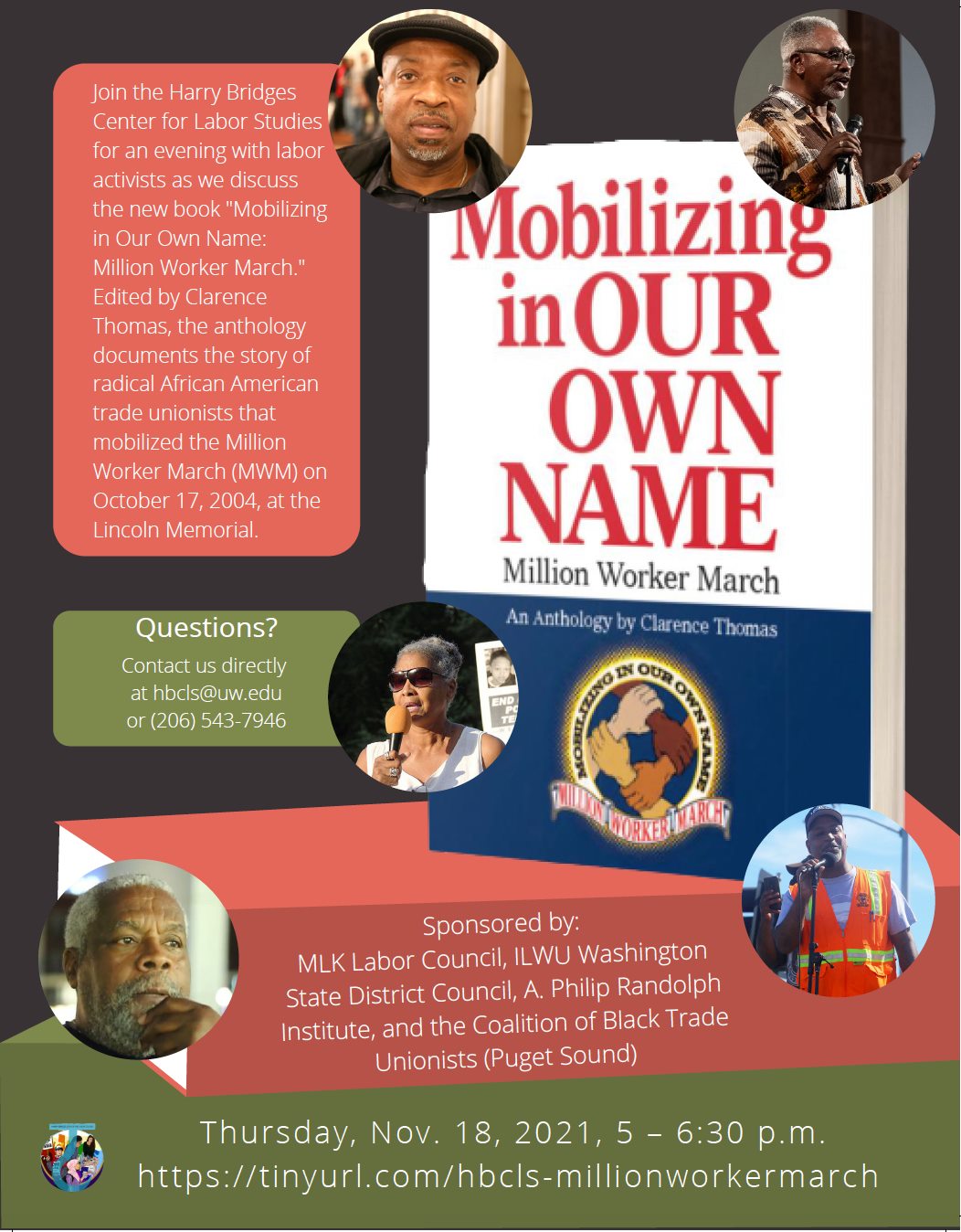
Mobilizing in Our Own Name – Webinar Nov. 18

tinyurl.com/hbcls-millionworkermarch

Join the Harry Bridges Center for Labor Studies for an evening with labor activists Gabriel Prawl, Chris Silvera, Clarence Thomas, Brenda Stokely, and Trent Willis, as we discuss the new book “Mobilizing in Our Own Name: Million Worker March.” The event will be moderated by Professor Peter Cole (Western Illinois University).

Edited by Clarence Thomas, “Mobilizing in Our Own Name” documents the story of radical African American trade unionists from one of the most renowned radical labor organizations in the world, the International Longshore and Warehouse Union (ILWU) Local 10, that defied the Democratic Party and the AFL-CIO and mobilized the Million Worker March (MWM) on October 17, 2004, at the Lincoln Memorial.

The MWM called for an independent mobilization of working people, with a workers’ agenda to address the unrestrained class warfare by the captains of capital. This historic event, which was viewed on C-Span, attracted thousands of workers (organized and unorganized), immigrant rights groups, anti-war activists, community organizations, social movements, youth, and trade unionists from around the world.

This anthology captures radical workers’ actions and struggles written by activists as those events were happening through news articles, interviews, photos, posters, leaflets, and video transcripts.

For more information about the book, visit https://millionworkermarch.com

This event is sponsored by the Harry Bridges Center for Labor Studies, MLK Labor Council, ILWU Washington State District Council, A. Philip Randolph Institute, and the Coalition of Black Trade Unionists (Puget Sound).

Nov 18, 2021 05:00 PM in Pacific Time (US and Canada)

tinyurl.com/hbcls-millionworkermarch

Strugglelalucha256


NATO abuses refugees, threatens to ignite war on Poland/Belarus border

Nov. 11 — The U.S. and its European allies are staging a dangerous provocation at the border between Poland and Belarus, which threatens both a humanitarian catastrophe and a military conflict that could quickly explode into a wider war.

Thousands of refugees, fleeing imperialist-fueled wars in West Asia and beyond, have gathered on the Belarusian side of the border, demanding entry into the European Union. Poland’s far-right government — a NATO member, acting on behalf of Germany and other EU powers where the refugees wish to go — has responded with a massive buildup of military forces. 

Polish border guards and troops have violently abused refugees who attempted to cross into the country. In one case, on Nov. 10, four Kurdish men were found beaten by Polish security forces. They were treated by Belarusian doctors. The same day, a young boy was pepper-sprayed by Polish border guards.

The Border Committee of Belarus stated: “All these people, including women and children, do not pose a threat to security and do not behave aggressively. According to the stories of the refugees themselves, they organized themselves into such a large group in order to prevent forcible displacement by the Polish side, as well as to draw the attention of the international community to the actions of Poland in terms of non-observance of human rights. 

“Taking into account the statements of Polish officials about the concentration of armed forces and equipment near the border, we do not exclude provocative actions by the Polish side aimed at justifying the use of physical force and special equipment against refugees,” the statement concluded. 

The government of Belarus has called for high-level consultations to defuse the situation and resolve the crisis. So far, Poland has refused — with strong backing from its powerful U.S. and European sponsors.

Meanwhile, the Biden administration, other Western governments and corporate media are spreading wild rumors about supposed Belarusian government “trafficking” of migrants and refugees, reporting this as fact. 

They claim this is a plot by President Alexander Lukashenko of Belarus to pressure Europe to lift brutal economic sanctions imposed by the West, rather than the all-too predictable outcome of Western military and economic interference in Syria, Iraq, Yemen, Afghanistan and North Africa.

Polish gov’t vs. the people

While presenting a one-sided, hostile view of the Belarusian government and the refugees, these same governments and media actively cover up the behavior of the U.S. puppet regime in Poland, including its pro-fascist policies and its war on women’s reproductive rights, LGBTQ2S people, workers and communists.

In fact, while Western media were completely focused on presenting the Polish side of the border crisis, on Nov. 6 tens of thousands of women and supporters were protesting in the streets of Poland’s capital Warsaw after a woman died of pregnancy complications as a result of the country’s Draconian abortion ban, similar to the one imposed recently in Texas. Last year millions of people across Poland protested the abortion ban.

And buried amidst the anti-Belarus propaganda, the Associated Press noted that Poland’s government is supporting a fascist demonstration planned in Warsaw on Nov. 11, the country’s independence day — much like those held annually in the neighboring Baltic republics.

The far-right regimes of Lithuania, Estonia and Latvia — also NATO members that dance to Washington’s tune — claim Belarus “posed serious threats to European security by deliberately escalating its ‘hybrid attack; using migrants to retaliate for EU sanctions,” Reuters reported Nov. 11.

This latest U.S.-sponsored information war combines the crude racism of Donald Trump’s anti-immigrant rhetoric with the vicious smear campaigns used against so many countries that suffer brutal U.S./European sanctions, like Venezuela and Cuba, into a toxic stew meant to justify acts of racist brutality and regime change.

Belarus aids refugees

Estimates of the number of refugees at the border vary widely, between 3,000 and 8,000. But the number continues to grow daily. 

Correspondents for Minsk Pravda have been documenting the situation with interviews and photos. On Nov. 8, Minsk Pravda reported: “Most of them, the migrants said, are Kurds. … There are many children in the crowd. They are not allowed into Poland.

“‘We are being sprayed with gas [by the Polish side]. See what happens,’ an elderly man shouts emotionally. His son was brought on an impromptu stretcher from the side of the border. In a mixture of languages, he explains: the young man’s legs are lost, he can no longer walk.

“‘Many of us are with families. I have six children. All are small. No food, no milk for them, no diapers. We have no firewood to keep warm, no tents to shelter from the rain, and we are not allowed into Europe,’ says another man. He says that he and his family have already made several unsuccessful attempts to get into the EU.”

Hard hit by Western sanctions, Belarus is ill-equipped to provide the necessary humanitarian support but is doing what it can. Border guards and soldiers are trying to maintain order and protect the refugees while attempts to negotiate with the Polish regime and the EU continue. 

The government and people’s organizations, including the Belarusian Women’s Union and Communist Party of Belarus, have expressed solidarity with the refugees and are helping to provide them with food, water, shelter and health care.

At a meeting of government ministers Nov. 10, Belarus declared that priority must be given to the needs of children and pregnant women at the border. Education Minister Igor Karpenko said Nov. 11 that children’s health camps and other facilities, established during Soviet times and still maintained in Belarus, would be organized to provide safe havens for them, including teachers for the children.

On Nov. 9, dozens of people protested outside the Polish Embassy in Minsk, the capital of Belarus. Signs and banners read: “Leopards [Polish tanks] against women and children?”, “Stop genocide at the border!”, and “Stop torturing women and children.”

Organized on just three hours’ notice and in bitter cold, the action included members of the Belarusian Republican Youth Union, Belaya Rus and the Communist Party, and ordinary workers.

One woman interviewed on the picket line condemned the hypocrisy of the Western powers: “Those people who say that some human rights are being violated in the world are violating them themselves, not allowing migrants to enter the EU. We are ordinary peaceful Belarusians who came out in support of ordinary people who do not deserve such an attitude.”

West escalates tensions

A new European Union threat to ban flights between West Asia and Belarus won’t just harm those countries’ economies, but may force thousands of refugees to make the dangerous journey to Europe across the Mediterranean, which has already cost so many lives in recent years. It is also, of course, an egregious violation of those countries’ independence, just like all U.S.-EU sanctions.

Responding to the threat of a fifth round of sanctions, President Lukashkenko pointed out Nov. 11 that Europe’s main transnational gas pipeline, Yamal-Europe, goes through Belarus, and recently Russia has significantly increased the volume of gas transit to the West. 

“We provide heat to Europe, and they are threatening us with the border closure. What if we block natural gas transit? Therefore, I would recommend the leadership of Poland, Lithuanians and others to think hard before opening their mouths. But it is up to them. They are welcome to close the border. The Ministry of Foreign Affairs should warn everyone in Europe that if they impose additional sanctions, ‘indigestible’ and ‘unacceptable’ for us, we will hit back.” 

Struggle-La Lucha spoke with Nadezhda Sablina, a Minsk Pravda journalist and Belarusian representative of the Anti-Imperialist Front. She explained: “We saw last year, against the background of protests in Belarus after the presidential elections, Poland brought soldiers and military equipment to its eastern borders. The troops stood ready to ‘come to the rescue’ of those who intended to overthrow Lukashenko here. 

“The slightest manifestation of weakness by the Belarusian authorities could serve as a signal for NATO’s military invasion of Belarus,” Sablina warned. “The Belarusian authorities and Belarusian military survived, including by strengthening the concentration of troops on the western border. At that time, half of the armed forces of Belarus were transferred to the west.

“Now, against the background of the growing migration crisis, Poland is again bringing its troops and armored vehicles to the border. The formal reason for this, according to the Polish side, is the protection of the Polish border. However, the number of military personnel already exceeds the number of migrants at the border by 3-4 times! 

“This suggests that Poland intends to fight not with migrants,” Sablina said, “but with Belarus, as well as with Russia, since we are united in the Union State and the military bloc (CSTO). It is clear that Poland does not act independently, but is subordinate to the stronger countries in the EU and the United States. So it cannot be ruled out that the imperialist forces of the West may start an armed conflict with Belarus at the hands of the Poles, staging some kind of provocation as a pretext to start an attack.”

Sablina added: “Poland is suitable for a military conflict with Belarus like no other country. After the counter-revolutionary coup in the late 1980s, the Poles were actively instilled with nationalism and Russophobia. And now a lot of Poles are hostile to Russia and sincerely believe that in 1939 it took away part of their territory, which they call the East Cresses (Western Belarus). Therefore, if, for example, Poland invades Belarus and occupies its western cities (Grodno, Brest), then ordinary Poles may well consider this step to be fair, because, in their opinion, the lands taken from them will return to them.”

Both the anti-war and immigrant rights movements need to be on full alert and get ready to take to the streets to demand: “Let them all in! No war, no repression! Hands off Belarus!” 

Strugglelalucha256


Bill Dores: Wall Street and the Pentagon, not China, pose the largest climate threat

Press TV

Political analyst and activist Bill Dores says Washington’s “attempt to frame China for the world climate crisis is one of the most hypocritical acts in history,” as the United States is the source of the deadliest corporate and military assault on the planet in history, not China.

Dores, a writer for Struggle-La Lucha and longtime antiwar activist, made the remarks in an interview with Press TV on Thursday after Democrats in the United States House of Representatives and Senate called on U.S. President Joe Biden to use targeted sanctions to punish individuals and companies that are worsening the global climate crisis.

In a letter to U.S. Secretary of State Antony Blinken and Treasury Secretary Janet Yellen last week, Democratic lawmakers particularly targeted China and its companies despite the fact that studies show that the U.S. military is the largest consumer of hydrocarbons on the planet and one of the largest polluters in history.

According to the New York Times, the United States has contributed more than any other country to the atmospheric carbon dioxide that is scorching the planet.

Senators Ed Markey (D-Mass), Elizabeth Warren (D-Mass.), Bernie Sanders (I-VT) and Rep. Veronica Escobar (D-Texas), who signed on the letter, called on the Biden administration to target individuals and companies “that are perpetrating the worst climate damage.”

Following is the complete text of Dores’s comment to Press TV:

U.S. hypocrisy on looming climate disaster

Washington’s attempt to frame China for the world climate crisis is one of the most hypocritical acts in history. It is also one of the most dangerous. It is a deliberate effort to sabotage the international cooperation needed to prevent looming climate disaster. And it is a step toward war, the ultimate environmental destroyer.

Fracking industry agent Donald Trump claimed that climate change is a “hoax created by and for the Chinese.” Joe Biden admits the climate crisis is real but seeks to blame it on China. Some U.S. senators even say China should be sanctioned for its alleged environmental misdeeds.

What mendacity! China leads the world in renewable energy production, reforestation, electric vehicles, high-speed rail and solar panel manufacture.

In recent years, China has surpassed the U.S. in overall carbon emissions. But China is the largest country in the world. It has nearly five times the population of the United States. Its per capita emissions are less than half those of the U.S.. And it has a concrete strategy to seriously reduce them.

Meanwhile, the watered-down infrastructure bill passed by Congress gifts tens of billions of dollars to the U.S. fossil fuel industry. That’s not surprising considering 28 U.S. senators are directly invested in fossil fuel companies. And that 11 lawyers for ExxonMobil helped to write the bill.

The Trump regime imposed tariffs on Chinese-made solar panels at the behest of his oil company bosses. Biden has outright banned the import of Chinese-made solar panels.

The White House claims Chinese solar panels are made with forced labor. Yet the racist U.S. prison-industrial complex is the biggest exploiter of forced labor in the world. Imagine how many jobs installing those panels could create for workers here.

If Washington were really concerned about human rights, it could stop sending cops and marshals to attack the Water Protectors, Native activists and their allies defending their land against fracking and pipelines. They have been gassed, clubbed, shot and jailed by federal and state agents in the U.S. and Canada. Under HR1374, a law now before Congress, state agents would be authorized to murder anti-pipeline protesters.

Biden seeks to weaponize the climate crisis

Trump denied the climate crisis. Biden seeks to weaponize it. Though their tactics be different, they share one object: To try and restore the stranglehold the U.S. corporate ruling class once had on the world economy.

For decades, Washington and Wall Street used their power to strangle economic development in Africa, Asia and Latin America.  They kept themselves at the center of the world economy by keeping most of the world impoverished. Meanwhile, U.S. companies poisoned the air with abandon.

Greenhouse gases don’t go away. At least 25 percent of those that now fill the atmosphere are made in the U.S. That doesn’t count the output of the offshore operations of U.S.-owned corporations.

For decades after World War II, U.S. corporations owned most of the world’s known oil reserves. That was key to U.S. global power. They purposely kept oil-rich countries “underdeveloped” and dependent on selling oil. Today Washington tries to achieve that with war and sanctions.

In the 1970s and 1980s, oil-producing countries began to take back ownership of their own resources. The Libyan Revolution of 1969, the Iraqi nationalizations of 1972 and the especially the Iranian Revolution of 1979 were catalysts in this process.

In 1991, as soon as the Cold War ended, the U.S. went to war against oil-producing countries. Under different names and pretexts, that imperialist war has raged for 30 years. It has destroyed millions of lives and cost trillions of dollars. The climate is also a victim.

U.S. war machine is the most polluting institution on earth

From 2001 to 2017, the U.S. military poured 1.6 billion metric tons of carbon into the atmosphere. At least 400 million tons of that came from U.S. military operations in Afghanistan, Iraq, Pakistan and Syria.

The U.S. war machine, with its massive global operations, is the most polluting institution on earth. In 2017, it unleashed 60 billion metric tons of carbon dioxide into the air. That was more than the individual output of 140 countries. Every year it dumps 750,000 tons of toxic waste-depleted uranium, oil, jet fuels, pesticides, defoliants, lead and other chemicals into our air, water and soil.

The U.S. Army’s M1 Abrams Main Battle Tank uses nearly 4 gallons of fuel per mile. An Air Force B2 bomber burns at least 4.2 gallons of jet fuel per mile and has to be refueled every six hours. In the so-called “war on terror,” B2 bombers flew 44 hours from Missouri and Nebraska to rain bombs on people in Iraq and Afghanistan. But the biggest waste of energy is the constant transport of troops, weapons and supplies around the world.

When the Clinton administration signed the Kyoto climate agreement in 1997, it insisted the U.S. military be exempt from the treaty’s restrictions.

Washington’s 30-year oil war had another devastating impact on our planet’s climate. It unleashed the “shale oil revolution” that has made the U.S. the world’s No. 1 fossil fuel producer.

U.S. fracking industry poisons the earth

After the U.S. invaded Iraq, Corporate America pumped hundreds of billions of dollars into fracking-the hydraulic fracturing of oil and gas from shale rock. War and sanctions against oil-producing countries created a triple-digit energy price bubble that made these huge investments seem profitable. They stimulated the plunder of Canada’s tar sands, the DAPL and Enbridge 3 pipelines and mountaintop removal projects in Appalachia.

Fracking not only poisons the earth and water, it unleashes much more methane than conventional drilling. The collapse of the fracking boom has left many of these wells abandoned. There are over 3 million abandoned oil and gas wells across the United States. At least 2 million are unplugged and gushing out methane and other chemicals.

Plugging those wells and reclaiming the land around them would create a lot more jobs than fracking and pipelines do. So would investing in renewable energy, reforestation, mass transit and high-speed rail instead of war.

Attacking China over climate change is a red herring. If Washington is serious about preventing environmental disaster, it should end the U.S. corporate and military assault on the planet. To make that happen will take a people’s struggle against corporate power.

End the wars and sanctions. Bring home all the troops, war fleets and warplanes. Invest that money in renewable energy, expanding mass transit systems, affordable high-speed rail and reforestation. And to help poorer countries do the same. Those things could create millions of high-paying jobs. Ban fracking and shut down the DAPL and Enbridge pipelines. The sky is the limit when the needs of humanity are put before corporate profit.

Source: Press TV

Strugglelalucha256
https://www.struggle-la-lucha.org/2021/11/page/4/