In service of a racist system: Police killings undercounted by more than 50%

Protesters in Baton Rouge, La., demand justice for Ronald Greene, who was killed by Louisiana State Police in 2019. His death was one of the many misreported by official sources.

The New York Times recently published an article entitled “More Than Half of Police Killings Are Mislabeled.” It reported the results of a study conducted by researchers at the University of Washington and published in The Lancet, a world-renowned medical journal that publishes articles that address urgent topics to initiate debate, put science into context and influence decision makers around the world.

The study compared the U.S. National Vital Statistics System (NVSS) to open-sourced, non-governmental databases, and scientifically analyzed tens of thousands of entries. It confirmed that police violence has been grossly underreported for at least four decades. 

The findings present evidence that deaths at the hands of the police disproportionately impact people of color in general, and Black people in particular, due to systemic racism.

This study is a follow-up to an earlier study by Boston University’s School of Health and the University of Pennsylvania in June 2018, also published in The Lancet. That study argued that policing should be treated as a public health issue, forcing the entire system of recruitment and training to change. 

Now some three years later, this extensive research shows again that police killings — whether in pursuit, in transit or in custody — continue to be a national public health crisis.

This has had devastating effects on Black communities, resulting in more violent clashes with police and other law enforcement agencies, as noted in a presentation made by this author at the “Ending Police Violence” shadow session at the 2018 American Public Health Association meeting in San Diego.

17,100 missing deaths

The University of Washington study dives deeper into the issue of recording the names, ages, gender, race and ethnicity, location, date, year and time of death, various details leading up to death, and medical examiners’ and coroners’ reports on the cause of death. After retrieving data from the NVSS and three open-sourced, non-government data sources — the Guardian’s “The Counted,” the Washington Post’s “Fatal Force” and the “Mapping Police Violence” project — researchers estimate 30,800 deaths from police violence between 1980 and 2018. This represents 17,100 more deaths than reported by the NVSS. 

During this period, the mortality rate due to police violence was highest among Black, non-Hispanic people, followed by Hispanic people of any race. Many of those deaths were either misclassified or not reported.

The New York Times gave examples of misclassified, improperly coded death certificates on NVSS reports, noting that pathologists have complained that law enforcement does not provide all relevant information and they are at times pressured to change their opinion. 

The examples cited included Ronald Greene, who arrived dead at the hospital in 2019, bruised and bloodied, with two stun-gun prongs in his back. His death was ruled accidental and attributed to cardiac arrest. Louisiana State Police initially said Greene died on impact after crashing into a tree. The Union Parish coroner attributed Greene’s death to a car crash and made no reference to police conflict.

Two years later, the 46-minute body cam video was released, showing that Greene was stunned, punched and placed in a chokehold by police. Greene’s grieving mother said, “How he died is evil.” The family filed an unlawful death lawsuit. This is reflected in the Fatal Encounters open-source database.

Sickle cell trait excuse

“Sickle cell trait: an unsound cause of death,” published in the Lancet in August 2021, states, “Physicians deny justice to communities by providing medical cover for death at the hands of law enforcement officers and by perpetuating medical falsehoods to justify this practice.” The article cites the recent case of George Floyd.

On May 25, 2020, an initial autopsy report about Floyd read, “Man dies after medical incident during police interaction.” The report attributed his death to Floyd’s history of heart disease, substance use, and the sickle cell trait. 

The sickle cell trait is a genetic disorder that disproportionately affects African Americans. While it can cause serious health issues, the trait is often passed from parent to child with no symptoms.

It was the bravery of Darnella Frazier, the teen who filmed the incident with her cell phone for 10 minutes and uploaded it to Facebook, that got a murder conviction against Minneapolis Police Officer Derek Chauvin and a small measure of justice for George Floyd’s family. Frazier’s video showed that despite any underlying health issues, Floyd really died because Chauvin kneeled on his neck for 9 minutes and 29 seconds.

In a May 2021 article, “How a Genetic Trait in Black People Can Give the Police Cover,” the New York Times cited 47 cases where the sickle cell trait was referenced in autopsy reports, court filings and other public records in police custody deaths. 

It details several cases where Black people were forcefully restrained, pepper sprayed or shocked with stun guns, and yet the presence of sickle cell was used to justify their deaths.

Underreporting masks racism

Black people were killed at a higher rate than white people every year from 1980 to 2018. In 2019, Black people were killed at a rate 3.5 times higher than white people. Latinx and Indigenous people are killed disproportionately as well.

Of the three open-source data collection methods cited by the University of Washington study, The Guardian’s “The Counted” had the lowest percentage of cases missing race or ethnic information and covered people killed by other law enforcement agencies besides police.

The Bureau of Justice and Statistics, a division of the U.S. Justice Department, actually considers open-source data collection methods preferable to government reporting systems due to underreporting by the NVSS. 

Reporting fatal police violence accurately and creating a database that is transparent and open to the public is one way to expose the system for what it is and a step forward in gaining accountability for the crimes committed on a daily basis. This is just a step because, as the study acknowledges, the real solution is to eliminate the burden of police violence on Black and Brown people.

Police are not held accountable and their actions lack transparency. “Mapping Police Violence” reported that in 1,147 deaths, only 13 officers were charged with a crime.

The Lancet report states, “Police forces should exist to enforce laws that protect public safety, but throughout the USA’s history, police have been used to enforce racist and exploitative social orders that endanger the safety of the most marginalized groups in society.”  

Some of the earliest examples of policing include the capture of runaway slaves, dismantling labor strikes and movements, and stopping riots, protests and other expressions of social outrage.

The police are highly militarized and escalate situations that could be resolved without violent interactions. They are trained to believe that any interaction can turn deadly, particularly in Black, Brown and other oppressed communities, and they react as such.

Capitalism relies on police violence

But the fundamental issue goes much deeper than training. The role of police in capitalist society is to protect the property of the wealthy and enforce the rule of the rich over the workers and oppressed. Ultimately, the only way to root out police violence is to do away with the racist, for-profit system that relies on it.

There have been some trends that have decreased police killings temporarily in some cities, such as banning the shooting of non-violent offenders who are fleeing, high-speed chases in residential areas and shooting into moving cars.

But recent reform efforts to cut down fatal police violence, like banning chokeholds, mandating body cameras, training in de-escalation, diversifying police forces, and civilian police review and advisory boards have all failed. We know these efforts have failed because fatal police violence has remained the same or increased since 1990.

We need community control of the police, with the power to hire and fire. We need immediate practical measures like disarming and demilitarizing the police. Some may see this as too radical, but is it? 

There are 19 countries where the regular police are unarmed, including Norway and Britain, where only select officers are armed. In 2019, no one died from police violence in Norway, and three people were recorded to have died from police violence in England and Wales between 2018 and 2019.

A better way of protecting, supporting and keeping our communities safe is possible. Disarming the police is an urgent step that must be considered — otherwise you must realize that calling the police could result in the death of you or someone you care deeply about.

Strugglelalucha256


How capitalism shackles the fight against climate change

Journalists from the U.S. and Europe have warned that the summer of 2021 should be a wakeup call on climate catastrophe. Rightfully so. A slew of recent studies and the Intergovernmental Panel on Climate Change (IPCC) had already issued dire assessments even before the wildfires, droughts, floods, Hurricane Ida and extreme heat waves shocked the world. 

Everything points to the same reality – the efforts of climatologists to predict the timing and impact of global warming have been too conservative. The events of summer 2021 rendered the newest scientific pronouncements almost unnecessary. Deaths in the thousands and destruction in the billions of dollars, widespread and all in a matter of a few weeks, spelled it out clearly. 

You don’t have to be a scientist to understand that climate change’s terrible effects are worsening sooner than expected. The situation is urgent. 

What the mainstream journalists and scientific studies omit is the weakness of capitalist government responses, the conspiracy of sabotage by big corporations and banks, and the meticulously concealed contribution of the imperialist U.S. military to pollution and climate change.

The fight against global warming is shackled by capitalists chasing down profits at all costs. That planet-threatening quest for markets and money isn’t a policy that can be changed by electoral politics. It’s an inherent trait of the capitalist system. The fight against climate change must be a revolutionary struggle against capitalism and imperialism.

Damning admission, toothless response

Just before the 2021 disasters began raining death and destruction in June and July, a Greenpeace investigation – a climate activists’ sting operation — tricked a top ExxonMobil lobbyist into revealing company efforts to promote climate change denial. It’s egregious and normally kept under wraps, yet all perfectly legal under capitalism. 

ExxonMobil’s senior director for federal relations talked about working with “shadow groups,” supporting a carbon tax that had no chance of getting through Congress just for the sake of climate change PR, all the while influencing senators to weaken climate elements of Biden’s infrastructure bill. 

“Joe Manchin, I talk to his office every week,” the Big Oil flack bragged. “We look for the moderates on these issues.” 

The “shadow groups” are a huge network of think tanks and pressure groups like Heartland Institute, Competitive Enterprise Institute and the Heritage Foundation. The oil giants have been using them to spread disinformation and downplay the dangers of global warming for decades. ExxonMobil alone spent more than $30 million doing that between 1998 and 2014.

The sting resulted in a congressional investigation, which is still going on, but is predictably toothless. Letters to ExxonMobil, BP America, Chevron Corporation and Shell Oil ask them to testify about their disinformation campaigns and commit to stopping them so that future legislation to mitigate climate change might stand a chance of getting through Congress. 

Essentially, the investigation demands that they admit their guilt and promise to be better, but nothing will happen to them if they don’t abide.

Imperialism is the culprit

A bill proposed by two members of the congressional group known as “The Squad” aims to choke off Federal Reserve financing for projects that contribute to the climate change disaster. 

It has little chance of getting past the corporate-backed politicians in either party, but it revealed the extent to which the major institutions of capitalism add to the crisis, even as their politicians feign concern. The Federal Reserve is supposed to supervise and regulate bank operations, but is financing the continued extraction of fossil fuels.

There is also a concerted push to shift the onus of climate change efforts onto the backs of those countries that have been exploited and underdeveloped in the age of imperialism. The biggest factor in the existential threat of global warming is still the global dominance of the capitalist system, even as the development of the Chinese economy is affecting that balance. 

The narrative of the U.S. major media places the blame on poor countries and China’s rising economy for greenhouse gases while touting the “greening” of U.S. capitalism. This marketing subterfuge conceals the efforts by giant energy companies and multi-trillion-dollar banks to maintain their profits at all costs. 

It’s made easier by the successful U.S. pressure to leave massive Pentagon pollution out of international calculations.

Blaming the Global South is a purposeful distraction. Placing the blame where it belongs — on the big imperialist powers and the profit system — is an essential part of being able to leave the planet in inhabitable condition for future generations.

As a result of the Paris Accords, wealthier countries were obliged to contribute $100 billion to impoverished countries to help finance clean energy projects before the next major international climate talks, scheduled to take place in November in Copenhagen. 

In an international pre-meeting that concluded in early October in Milan, Italy, the fact that the rich capitalist economies still haven’t met that obligation became a contentious issue — not only inside the meeting hall, but outside, too, as hundreds of youth, led by activist Greta Thurnberg, lambasted their foot-dragging.

Next: Carbon removal, cap and trade carbon credit markets, and geoengineering: how they’re viewed by the capitalist class and how they affect the Global South and the poorest communities in the U.S.

Strugglelalucha256


Cada haitiano tiene en Cuba un hermano

6 de octubre: Gilbert Joseph quería conocer Cuba en otras circunstancias. Venir a estudiar Medicina era su sueño, pero la situación en su natal Haití le obligó a posponer los planes y salir en busca de un cambio.

Con el riesgo de nunca volver, de truncar su vida y proyectos futuros, se lanzó a la mar junto a otros de sus compatriotas rumbo a la supuesta tierra de las oportunidades: Estados Unidos, pero el Paso de los Vientos pudo más que las ganas de arrancarse la miseria de sí, y terminaron aquí, en la Mayor de las Antillas, una tierra distinta a la suya, que les abrió las puertas para cuidarlos antes de facilitarles el regreso a casa.

Nuestro archipiélago no era lo que esperaban ver los 212 haitianos, que desde el pasado 17 de septiembre recalaron por Maisí, Guantánamo; sin embargo, la atención ha sido mucho más de lo que alguna vez tuvieron.

«Al momento de la llegada les brindamos lo mejor de nosotros, afirma Roel Estévez Matos, administrador del campamento de refugiados, que desde 1976 habilitó la Revolución Cubana para atender las constantes oleadas migratorias provenientes de Haití. El objetivo es que se sientan a gusto, aún después de pasar por la terrible experiencia del naufragio.

«Acá se les brinda servicio de hospedaje, entre naves con capacidad para 236 personas, y se les garantiza la alimentación (desayuno, merienda, almuerzo, merienda y comida), de acuerdo con las posibilidades del país. Además, tenemos un puesto médico con dos enfermeros y un doctor, pendientes las 24 horas de las patologías y enfermedades que se presenten».

Estévez Matos explica que todos los años sucede el fenómeno, los haitianos salen de su nación con destino a lugares más desarrollados: EE. UU., Islas Nassau, Bahamas, pero el mal tiempo los redirige hacia territorio cubano. Desde 2001 se han reportado 76 embarcaciones, con más de 4 000 migrantes; de julio a diciembre suelen concentrarse las mayores oleadas.

«Al arribar a nuestra patria, enseguida se moviliza un equipo integral de especialistas, responsables de la atención y pesquisaje general, para conocer el estado de salud de todos y en correspondencia con ello se actúa», agrega.

Diolkis Samón Domínguez es uno de los médicos responsables del bienestar de los migrantes, entre ellos 18 menores de edad con escabiosis y otras enfermedades en la piel, debido a la insolación por el largo tiempo que estuvieron en altamar, pero los demás mantienen condiciones de salud aceptables.

A todos se les tomó muestras para descartar vih/sida, el paludismo, hepatitis, y previniendo el contagio por la COVID-19 se les realizó una prueba de pcr en tiempo real, de la que resultaron cuatro positivos. A estos último se les aisló, medicó y ya negativizaron, pero siguen en vigilancia, de hecho, a todos se les repitió el pcr al menos dos veces.

«Igualmente, como medida preventiva se les suministra el tratamiento antipalúdico por 14 días, se vela por el cumplimiento de las medidas higiénico-sanitarias y se les entregó nasobucos, pues no tienen costumbre de usarlos», apunta el doctor Samón Domínguez.

Según el joven galeno, hoy no hay ni sospechosos ni confirmados con el SARS-COV-2 en el campamento de refugiados haitianos, pero siguen alertas, pues tienen a una gestante de ocho semanas y a una señora, con un fibroma que le causó sangramiento, bajo cuidados antianémicos.

«Enseguida las remitimos al Hospital General Octavio de la Concepción y la Pedraja, en Baracoa, donde fueron examinadas y tratadas; pero acá tenemos la mayoría de los recursos para actuar ante cualquier cuadro clínico. Igualmente contamos con el sistema de ambulancias para emergencias», asegura el doctor.

Cuba tiene alma de hermano

Gilbert Joseph, el migrante haitiano que desea estudiar Medicina en Cuba, tiene 30 años. Sabe que debe volver a casa, pero espera que, a más tardar en 2023, pueda volver a esta Isla hospitalaria para cursar la carrera de sus sueños.

Ese también es la ilusión de Itson Taylor, quien con solo 14 años se embarcó con los padres, tíos y primos en busca de un futuro mejor y descubrió a este pequeño país del Caribe.

Itson, en un lenguaje que mezcla el francés y el español, asevera sentirse bien, aunque su familia insiste en irse, pero él quisiera quedarse para vestir la bata blanca o verde que porta el doctor Diolkis, quien les calmó las fiebres y malestares que agobiaban a todos luego de estar días a la deriva en el mar.

Eric Dormezil, el capitán del navío haitiano, también se siente agradecido por todo y todos, «los haitianos sabemos que en el pueblo cubano tenemos nuestros hermanos, pues históricamente nos cuidan bien».

De esa hermandad entre pueblos caribeños habla emocionado Benisoi Joan Baforte, migrante residente en Maisí desde 1989. Él ayuda siempre como traductor cuando sus compatriotas arriban al archipiélago. Adora a Maisí, donde tiene dos hijos, y a Cuba la lleva en el pecho grabada como la mejor nación del mundo, «no hay mejor lugar para estar a salvo».

Fuente: Granma

Strugglelalucha256


AFRICOM: An extension of U.S.-European colonialism and genocide

In 2007, the George W. Bush administration inaugurated the United States Africa Command (AFRICOM) to further the influence of the U.S. and extend its military reach directly into Africa. AFRICOM, however, wasn’t officially established in Africa, with its expanded troop presence and unprecedented use of drones on the continent, until Barack Obama was elected president in 2008.

This Oct. 1, the Black Alliance for Peace (BAP) hosted a webinar titled “AFRICOM at 13: Building the Popular Movement for Demilitarization and Anti-Imperialism in Africa.” The event featured voices rarely heard in the U.S., from countries most affected by AFRICOM, including internationally-known activists for liberation and those representing the growing movement on the continent against AFRICOM.

The program started with a film by BAP exposing the imperialist aims of AFRICOM and its yearly price tag of $2 billion in Africa alone.

Guest speakers exposed the other resources required for AFRICOM’s maintenance: the cost of peoples’ sovereignty and right to self-government, in addition to the cost of inflaming humanitarian crises.

This webinar was part of a month-long effort by the Black Alliance for Peace to educate and advocate for these demands: the complete withdrawal of U.S. forces from Africa; the demilitarization of the African continent; the closure of U.S. bases throughout the world; and that the Congressional Black Caucus (CBC) oppose AFRICOM and support hearings on AFRICOM’s impact on the African continent.

‘To dominate and exploit us’

Imani Na Umoja is a member of the Central Committee of the African Party of Independence of Guinea and Cape Verde, the largest political party in Guinea-Bissau, which participated in its armed struggle for independence from Portugal. Umoja spoke about AFRICOM’s major role in the recent coups on the continent to ensure resources for U.S. imperialism and deny its peoples’ right to self-determination.

U.S. claims of promoting democracy are the exact opposite in its deeds.

“The agreements are so horrendous it makes me sick, and should make anyone sick,” said Kwesi Pratt Jr., a journalist and general secretary of the Socialist Movement of Ghana. He was referring to the establishment of U.S. bases in Ghana and agreements signed by the government that allow U.S. forces more immunity, freedom of movement and secrecy than its own citizens, diplomats or even the president of the country, “simply by showing their U.S. ID cards.”

Pratt said that the agreements do not allow anyone to question what the U.S. forces bring into or take out of the country. “The U.S. Army can use our resources for free … the agreement was signed to dominate and exploit us.”

Irene Asuwa of the Revolutionary Socialist League of Kenya spoke further on AFRICOM’s domestic cost to her people. “The war on terror is an excuse to kidnap people,” she said, explaining the heightened profiling of Somali peoples in Kenya. “In less than 12 hours they are taken into court and sentenced as terrorists with no lawyer, then taken away.”

Asuwa also spoke about the refugee crisis that was exacerbated by AFRICOM’s insistence that refugee camps be closed. This reality belies the false claim that AFRICOM is involved in solving humanitarian crises on the continent, rather than being one of the major causes of those crises — in spite of the well-polished public relations efforts touted on the organization’s official website.

The speakers helped bring to life what award-winning journalist Nick Turse, who exposed the unreported buildup of AFRICOM in 2008, wrote for the Intercept in February 2020: “Since 9/11, the U.S. military has built a sprawling network of outposts in more than a dozen African countries. … During testimony before the Senate Armed Services Committee late last month, Stephen Townsend, the commander of AFRICOM, echoed a line favored by his predecessors that AFRICOM maintains a ‘light and relatively low-cost footprint’ on the continent. 

“This ‘light’ footprint consists of a constellation of more than two dozen outposts that stretch from one side of Africa to the other. The 2019 planning documents provide locations for 29 bases located in 15 different countries or territories, with the highest concentrations in the Sahelian states on the west side of the continent, as well as the Horn of Africa in the east.”

That so-called “light footprint” has had the effect of increasing, not decreasing terrorist activity. 

U.S. presence promotes terrorism

The result: Turse goes on to explain that the number of extremist groups went up 400 percent, according to the Defense Department’s Africa Center for Strategic Studies. In 2019, there were 3,471 reported violent events linked to these groups, a 1,105% increase since 2009.

Said Turse: ¨The situation has become so grim that U.S. military aims in West Africa have recently been scaled back from a strategy of degrading the strength and reach of terror groups to nothing more than ‘containment.’”

This also echoes a 2017 United Nations report called “Journey to Extremism in Africa,” which states that government actions of repression, including increased drone killings, killings of family members, jailings and repression are the main motivation for recruitment into extremist organizations.

Many studies have also correlated the lack of food and basic necessities of life as the greatest cause of internal conflict. The U.N. report makes that point with a quote from Secretary-General António Guterres: “I am convinced that the creation of open, equitable, inclusive and pluralist societies, based on the full respect of human rights and with economic opportunities for all, represents the most tangible and meaningful alternative to violent extremism.”

In 2018 the U.N. also reported that it would take just $175 billion per year for 20 years to eradicate poverty, not only on the entire continent of Africa, but the entire world. That’s just 17% of the U.S. yearly military spending of nearly $1 trillion (the total expense is more than the defense budget).

So the money supposedly spent on fighting terrorism — which actually acts as a recruitment agent for folks joining extremist organizations — could be spent to actually end the conditions that create these extremist organizations. And it would have the added benefit of removing the greatest source of terrorism on the continent, the U.S. military.

So why isn’t that happening?

Profits before people

The fact is that AFRICOM’s “war on terror,” in addition to being a vital tool for U.S. imperialism, is also a self-perpetuating money machine for the ruling class – a huge bonanza for the military-industrial complex and the politicians and corporations who directly or indirectly benefit from it.

As Turse stated in his article on AFRICOM expansion, “The U.S. has been building up its network of bases, providing billions of dollars in security assistance to local partners.”

As many of the webinar speakers pointed out, the primary goal of AFRICOM is to ensure the continued theft of resources by the U.S. and its allies and to maintain U.S. military dominance on the continent.

“In 2007 to 2009, a discovery of oil on the Congo and Uganda border of 1.7 billion barrels brought heavy militarization and oil conglomerates and then, in 2012, Obama announces troops [being dispatched] to capture Joseph Kony (leader of a small rebel grouping), although he hadn’t been in Uganda for almost six years,” said Salome Ayuak, a member of BAP and Horn of Africa Pan-Africans for Liberation and Solidarity.

Ayuak also explained that one-third of permanent and semi-permanent AFRICOM bases reside in the Horn of Africa, reflecting the strategic importance of its waterways for trade and oil exploration. “We must look at AFRICOM through a materialist lens to see the long history of its policing in African states,” she stated.

“AFRICOM is linked with the history of exploitation and slavery and is part of NATO. It must [also] be seen as part of British, French and other imperialist countries’ armed forces,” stated Kwesi Pratt Jr. 

He mentioned that this history and the military backing of imperialism created the situation where Ghana’s currency drops despite the country’s position as fifth in the world in gold production. The country receives only 3% of the interest and 2% of the revenue produced from gold mining.

Militarism or mutual assistance?

Kambale Musavuli, a native of the Democratic Republic of Congo and national spokesperson for Friends of the Congo, stated: “The U.S. has been engaged in the DRC since 1885. It was the first country to recognize the Congo as the personal property of King Leopold [Belgian monarch who committed the most horrendous atrocities against the native population, killing more than 10 million, in the exploitation of their labor for rubber production and export]. The U.S. used the relationship built with Leopold to get the uranium from the DRC used to bomb Hiroshima in 1945.”

And in a further example of war crimes and genocide, Musavuli explained the role of the U.S. and its AFRICOM partners in the 1996 and 1998 invasions of the Congo by Rwanda and Uganda — causing the deaths of over 6 million Congolese. 

This was followed by a huge extraction of mineral wealth essential for phones and computers. “Most of us have devices that use those minerals,” he noted.

Musavuli also contrasted the approach of U.S. militarism to China’s mutual assistance in the race for cobalt and coltan, minerals primarily found in the Congo. “While the Chinese sent foreign ministers in the middle of the pandemic to forgive loans and discuss needed development programs, two weeks later [U.S.] soldiers showed up to meet local officials and sign military agreements. 

“Then, this past summer, we see a group of American special forces in the Congo after leaving Afghanistan, supposedly going after ISIS … The U.S. today says the DRC has ISIS, when every local person knows we don’t.”

What is to be done? Maybe Kwesi Pratt Jr. of Ghana should answer that:

“All of these atrocities would not be possible if the power was in the hands of working people in Africa. So our task first and foremost is to make sure power resides in the hands of working people, to make sure that the revolutionary forces control power, that neocolonial regimes are defeated, and we move away from neocolonialist capitalism … 

“Only under the banner of socialism can we stop all these enemy forces – we are in danger otherwise.”

Which means we in the U.S. have to work towards exposing and dismantling AFRICOM, the Pentagon and capitalism here in the belly of the beast – which requires principled unity, solidarity and struggle – just as our comrades in Africa are determined to keep pushing forward.

You can reach the Black Alliance for Peace at blackallianceforpeace.com.

https://www.facebook.com/1120955981347159/videos/387810739637129

Strugglelalucha256


Women coast to coast demand: Bans off our bodies!

Washington, D.C., Oct. 2 — Hundreds of thousands of people came out across the U.S. to protest not only the reactionary Texas “heartbeat law,” but growing attacks on reproductive rights in many other states. 

Women marched not only in large cities, but in towns and rural areas in every single state. The national Women’s March announced more than 650 marches and protests in all 50 states.

Here in Washington, where Women’s March tweeted that more than 20,000 people marched, the group targeted the U.S. Supreme Court, which allowed the Texas law to go forward. The court was scheduled to open its new session two days after.

The Texas law encourages a witchhunt to enforce the ban, which prohibits abortions after six weeks — before most women even know they are pregnant. It promises to reward individuals with a $10,000 bounty if they successfully sue anyone who helps a woman get an abortion.

At the Supreme Court building, bigoted rightwing groups advocating to take away the rights of women and oppressed-gendered people marshalled less than 100 counter-demonstrators. They were protected by a phalanx of riot police.

In Austin, Texas, women and supporters flooded the grounds of the State Capitol, demanding “Our bodies, our choice, our right!” Thousands more marched in cities throughout the state.

Los Angeles hosted the largest of California’s many marches for reproductive rights. In New York City, thousands marched across the Brooklyn Bridge and converged with thousands more in lower Manhattan, chanting “Bans off our bodies!”

Who will be most impacted?  

Women In Struggle/Mujeres En Lucha and the Socialist Unity Party distributed thousands of flyers from the West to East coasts, pointing out that “it is Black, Brown and Indigenous people, the poor and youth who rely on reproductive rights centers for basic healthcare, including contraception, general checkups and cancer screenings. Texas law SB8 will shut down care for transgender people who will no longer be able to access needed hormone replacement therapy.”

“Many women will be forced to flee to other states just to obtain the basic right to control one’s own body. But even this will not be possible for many poor, working-class and very young women, who will be forced to risk their lives or health in back-alley abortions.

“The same reactionary forces responsible for this measure, and those who do nothing about it, care little about children and less about all women, regardless of who they love and their gender identity, including transgender women.  

“A box full of diapers and a carseat is of little help when families are facing joblessness and homelessness. Where is the fight to stop unemployment benefits from being cut? Where is the moratorium and cancellation of rents, foreclosures and utility shutoffs?

“Where is the fight to stop forced sterilization of poor and oppressed women from Puerto Rico to Mississippi; or the fight to make sure that every person and all children have free healthcare; or for paid maternity leave for working families?  What about the lack of affordable, safe daycare that has forced women and all genders out of the workplace?” 

Concern for most oppressed

In Orlando, Fla., these sentiments were echoed by protesters who expressed concerns that poor, Black and Brown women, along with trans women, would be disproportionately impacted. 

Over a thousand people took over the streets, reflecting the urgency felt since a bill similar to SB8 was introduced this September in Florida, which would ban abortions and allow lawsuits against doctors who perform the procedure.   

The power of protest had an immediate effect.

On Oct. 6, just three days after the historic mobilization, U.S. District Court Judge Robert Pitman temporarily blocked enforcement of SB8, declaring that “This Court will not sanction one more day of this offensive deprivation of such an important right.”

“We’re celebrating today, but our fight isn’t over,” Women’s March tweeted. “Texas will appeal. Which means the law could be put back into place soon. But we know this: hundreds of thousands of us showed up last weekend for abortion justice and we’re not done yet.”

Strugglelalucha256


So long, Columbus: Boston proclaims Indigenous Peoples Day

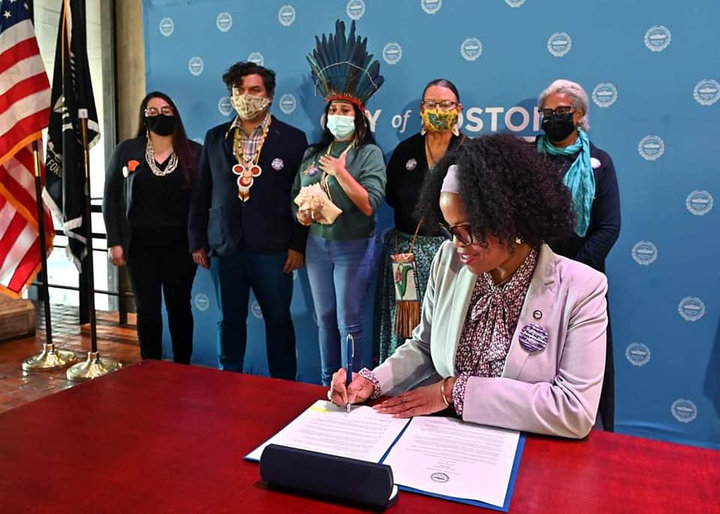
Oct. 6 — The Acting Mayor of Boston, Kim Janey, has today signed an Executive Order declaring that the second Monday in October will be Indigenous Peoples Day in the City of Boston, replacing Columbus Day and setting out a roadmap for future administrations to improve relations with Indigenous tribes and organizations.

Boston Mayor Janey has listened to Indigenous people and taken action today. Recognition of Indigenous Peoples Day on the second Monday in October is necessary to bring awareness of the true history of Columbus and to honor the Indigenous history of the Americas and Boston as well as the Indigenous Peoples who continue to live and work in and contribute to the City of Boston.

Elizabeth Solomon of the Massachusett Tribe at Ponkapoag remarked: “The people of the Massachusett Tribe have been a part of what is now called Boston for over 10,000 years. For far too long, the Indigenous history of this place has been obscured, and frequently erased, by the histories, myths and priorities of the dominant culture. 

“We are happy to see the City of Boston take the important step of recognizing and celebrating Indigenous peoples in Boston, the Americas and around the world. Many thanks to Mayor Janey and the many members of her administration who worked with the Indigenous community to make this happen.”

Kimimilasha James, an Aquinnah Wampanoag youth leader with United American Indians of New England (UAINE), said: “As someone who was born in Boston but never felt that Indigenous people were welcomed by the city government, I am very happy about Mayor Janey’s actions today. Indigenous Peoples Day brings a positive message about Indigenous survival and resilience in the face of genocidal actions directed against Indigenous peoples since 1492. It’s a day to learn about and celebrate Indigenous history and contemporary Indigenous peoples and cultures. 

“And it is just a first step for the city to begin to build relationships with Indigenous people and begin to address the many injustices faced by Indigenous people here in Boston and elsewhere. It is time for us to stop being largely ignored and erased.”

Gloria Colon, outreach coordinator for the North American Indian Center of Boston (NAICOB), said: “As a First Nation Migmaw mother, I am pleased that the city of Boston is honoring Indigenous Peoples Day. Growing up in Dorchester I experienced racism, I was targeted just for being Indigenous. While our city still has work to do to make all people safe, it is important that Indigenous children are appreciated and included.”

Mahtowin Munro (Lakota) from United American Indians of New England and the statewide Indigenous Peoples Day campaign (IndigenousPeoplesDayMA.org) said, “We have been working for several years to get Boston to properly acknowledge and be in relationship with Indigenous nations and people here.” 

She continued: “We wish to thank Mayor Janey and her staff for listening to the concerns of Indigenous people in the city and for her expressed commitment to Indigenous sovereignty and racial justice for Indigenous peoples in the Boston area. She and her staff have set an example as well by thoughtfully consulting and considering future steps that need to be taken by the city. We are elated that she has declared Oct. 11, 2021, to be Indigenous Peoples Day in the City of Boston.”

Raquel Halsey, member of the Mandan, Hidatsa and Arikara Nation and executive director of NAICOB, said: “I’m so proud to have a mayor who listens to the community and works to make Boston an inclusive city. As a service provider, we have heard countless stories of Indigenous people feeling unwelcome in Boston, and they have felt the lasting consequences of genocide and colonialism every day. 

“Recognizing Indigenous Peoples Day is an important step toward addressing the lived experiences of many residents and building trust between municipalities and Indigenous nations.”

Jean-Luc Pierite, member of the Tunica-Biloxi Tribe, president of NAICOB and member of the executive committee of the Black Mass. Coalition, said: “We must commend the tribal leaders, Indigenous activists and the City of Boston’s internal working group for their dedication towards the action steps to enable the health and wellness of our community members. NAICOB, following our over 50-year tradition and commitment to the New England Native American community, looks forward to being a partner in ensuring improved government-to-government relationships.”

For decades, Indigenous people have been calling for an end to the public celebration of Christopher Columbus. They have also asked that Indigenous Peoples Day, a day to honor Indigenous peoples from throughout the Americas, replace Columbus Day on the second Monday in October because of the date’s significance. They consider it a first step toward recognizing the genocide of millions of Indigenous people and the theft of their lands that began with the arrival of Columbus. It is a meaningful symbolic gesture in addressing the pain caused to Native Peoples by the many years of public celebrations of Columbus as a hero. 

An increasing number of towns, cities and states around the U.S. are now celebrating Indigenous peoples instead of Columbus on this day.

Mayor Janey also acknowledged that Boston is located on the land of the Massachusett Tribe.

Strugglelalucha256


Russian communists face repression after Duma elections

Oct. 6 — Since late September, a wave of arrests and detentions has hit communists, socialists and other progressive forces across Russia. The repression has primarily targeted the Communist Party of the Russian Federation (KPRF), but has swept up members of other parties and movements as well.

The arrests come in the wake of the Sept. 17-19 Russian Duma elections. While President Vladimir Putin’s United Russia party won the most seats in parliament, its share of votes fell nearly 5% from the last election, while the KPRF’s grew by more than 5%, according to official figures. KPRF candidates had an especially strong showing in Siberia and other eastern regions.

Overall, the KPRF gained 15 additional seats in the 450-seat Duma.

There were widespread charges of vote fraud to the benefit of the ruling United Russia and its allies. This includes the introduction of a new online voting system which opposition groups say does not have the necessary safeguards built-in to prevent fraud and government tampering. 

In several cities and regions, KPRF and other opposition candidates had been projected to win races and even announced as winners in the media, until the online vote count was belatedly released by the government, swinging many races in favor of United Russia. In Moscow, KPRF chapters issued statements denouncing the vote theft and demanding a rerun of the election.

Spontaneous protests

On Sept. 20, a spontaneous protest against the perceived vote fraud in Moscow frightened the authorities. Protests have been banned throughout the pandemic, and the left says the government has continued to extend these restrictions indefinitely to stifle its ability to mobilize. 

Pickets, car caravans and meetings were organized by left forces across the country, from Rostov-On-Don in the west to Vladivostok in the east.

In Moscow and other cities, KPRF members were detained, including elected Duma members and candidates, who are supposed to have immunity during the post-election period.

Then, on Sept. 25, several KPRF elected officials held a mass meeting with thousands of voters at Pushkin Square in Moscow. Although this type of event is constitutionally and legally sanctioned, the authorities treated it as an illegal demonstration. KPRF activists were arrested before the event. Police also attempted to block people from joining the meeting and blasted music to drown out the speakers.

The authorities targeted the KPRF Moscow City Committee headquarters, detaining Moscow City Duma Deputy Elena Yanchuk. The building remains under police occupation. Another local KPRF deputy, Yekaterina Engalycheva, was trapped inside the City Duma building. She was later arrested.

In St. Petersburg, where a similar mass meeting was planned, the KPRF City Committee was also surrounded by police. A deputy reported: “Our activists were arrested at night and in the morning. They came to those who organized this meeting, pasted leaflets. Now many are behind bars. The authorities are terrified of their own people, who were once again deceived in the elections. Today’s meeting is being held legally, in compliance with all legal and sanitary norms.”

In the days since, a wide swath of the left in Moscow has been hit with arrests and detentions, including Sergei Udaltsov and other members of the Left Front; Olga Rusakova of the Labor Russia movement and United Communist Party; well-known socialist intellectual Boris Kagarlitsky; International Marxist Tendency spokesperson Oleg Bulaev; and other leftists unaffiliated with the KPRF.

While Russian left groups have many differences among themselves, they agree that the repression shows the government is increasingly fearful of its declining popularity as austerity measures pushed by Russia’s capitalist oligarchy deepen social misery. 

Russia’s contradictions

The modern Russian state is a contradictory phenomenon. It emerged from the ruins of the counterrevolution against the socialist Soviet Union in the early 1990s, which culminated in the Yeltsin-Clinton coup of Oct. 3-4, 1993, and the shelling of the Supreme Soviet in Moscow.

After a massive sell-off of workers’ state property in the 1990s, plummeting living standards and falling life expectancy for the masses, the rapacious new Russian capitalist class was reined in somewhat under Putin’s leadership. 

Putin’s early success was based on the booming oil market of the late 1990s and early 2000s, which allowed the Russian government to keep in place some of the basic social gains of the Soviet period. 

At that time, Putin and the Russian bourgeoisie hoped the U.S. and European imperialists would give them a “seat at the table” as an ally and equal. The oil boom fed the illusion among the Russian capitalists that this was possible.

However, that was never the plan of the imperialist ruling classes. It was always the goal of Wall Street, Washington, the Pentagon and Big Oil to parcel up Russia and make it a vassal state, as they did with many former Soviet republics and eastern European countries. 

When the oil market crashed in tandem with the “Great Recession” of 2008-2009, the West began to target Putin as its “evil dictator” super-villain du jour, including bogus allegations of tampering with U.S. presidential elections — the very thing that Washington did to Russia in 1996!

Russia is a large country with a nuclear arsenal and strong military inherited from the USSR. It is a regional power, certainly, but it is not an imperialist country in the Marxist sense. To the U.S., Russia is not a peer to be negotiated with but an errant colony to be conquered and brought to heel.

To survive, the dominant section of the Russian capitalist class — which has its own aspirations and does not wish to be a mere local caretaker for the U.S. and European Union — was forced to ally with other countries targeted by imperialism, including socialist and bourgeois nationalist governments, from Cuba, China and Venezuela to Iran and Syria. 

To defend itself against the far-right takeover of neighboring Ukraine, Russia reincorporated Crimea and has supported and defended the antifascist republics of Donetsk and Lugansk.

In this way, Russia has played and continues to play a largely progressive role on the world stage, even as its domestic policies retreat into greater austerity and repression.

Nature of the KPRF

The Communist Party of the Russian Federation is itself a contradictory entity. It is the primary inheritor of the apparatus and, in the eyes of many Russians, the legacy of the Communist Party of the Soviet Union. This has given it enormous social weight and resilience.

The top leadership of the KPRF, headed by Gennady Zyuganov, is reformist and oriented only toward parliamentary politics. Left critics charge the KPRF leaders with being a “loyal opposition,” often echoing Putin’s talking points, even some of the most reactionary ones.

However, the party is also the main legal opposition entity in the vast country. Unlike many smaller left parties, it has managed to remain on the ballot despite increasingly restrictive election laws. It has organizational means in every city, town and region; in many ways, it is the only real mass political party in Russia with any life beyond elections. 

The political complexion of the KPRF’s local and regional groups also varies widely — with many being far more radical than the national leadership. At the level of membership, too, the KPRF includes many sincere working-class militants who see the organization as the legitimate heir of the Bolshevik Revolution and the Soviet Union.

This has created great challenges and difficulties for Russian communists — some of whom came from the ranks of the KPRF themselves — who seek to build a new revolutionary party and movement in the Bolshevik tradition.

The fear driving the Russian government’s current attacks is that the KPRF might become a hotbed of left resistance with mass support, in spite of the party leadership’s best efforts to prevent this.

The Western imperialists share this apprehension. Compared to the wall-to-wall coverage of pro-U.S. oppositionist Alexey Navalny’s arrest earlier this year, the U.S. government and corporate media have had virtually nothing to say about the crackdown on the Russian left.

One thing is for certain: the surge in electoral support for the KPRF, which is almost certainly greater than the official figures indicate, the wave of government repression against the left, and the deepening social crisis of world capitalism, are bound to spur a realignment of the left and a radicalization of the masses in the coming period. 

Defend Russia against imperialism — Defend the left!

What should communists, socialists and anti-imperialists in the West do?

Our first and most important duty continues to be to demand: Hands off Russia!

U.S. sanctions and economic sabotage increase the suffering of the Russian people. 

U.S./NATO war games and military threats not only endanger Russian lives, but make it easier for those who would repress the left movement to justify their actions in the eyes of the masses.

Russia is not our enemy. Our job is to dethrone the greedy bosses, bankers and landlords here at home, who are trying to drive down wages and working conditions, throw tenants and homeowners onto the streets, and deny safe, accessible education and healthcare for all.

The Russian people made one of the most profound revolutions in human history in 1917 — one that continues to inspire people all over the world with hope for a better future. They are more than capable of sorting out their own affairs if freed from constant threat of war and sanctions.

And we also say: a strong working class and a revolutionary, anti-imperialist left are the best guarantees of Russia’s sovereignty. 

We stand with the communists, socialists and progressives of Russia. We demand the release of the prisoners and respect for their basic democratic right to organize the working class to fight in its own interests!

Strugglelalucha256


Congress will do nothing for us without struggle

Eighty-one million people voted last year against Trump and racism. For nearly 50 years, poor and working people have suffered from frozen wages and cutbacks.

People want action now. Yet Congress is failing to pass the modest “Build Back Better” bill. Here’s some of what it includes:

  • Two years of free community college.

All education should be free. Even in capitalist France and Germany students don’t pay college tuition. A trillion dollars that’s owed for student loans should be wiped off the books, too.

  • Expand Medicare to include dental care, vision and hearing. Increase Medicaid coverage. 

Healthcare is a human right! Who wants their grandparents to be unable to go to the dentist and get their teeth fixed? Or not able to get glasses or hearing aids?

Nobody has to pay to go to a hospital or clinic in socialist Cuba.

Rev. Martin Luther King declared that “of all the forms of inequality, injustice in healthcare is the most shocking and inhumane.” Medicaid would cover more poor people in a dozen states where they have been excluded from the program by reactionary state legislatures. 

  • Cut prescription prices.

The pharmaceutical outfits are thieves. Pfizer and Moderna made billions from their COVID-19 vaccines, which were subsidized by the U.S. government.

No one should have to choose between paying their rent and buying food or purchasing medicines. Alec Smith died in Minnesota on June 27, 2017, because he couldn’t afford insulin anymore.

The price of insulin in the U.S. costs ten times more than what it sells for in other countries. When the Minnesota legislature passed the “Alec Smith Act” to guarantee emergency access to insulin, the Pharmaceutical Research and Manufacturers of America tried to get it thrown out in federal court. 

Big Pharma spent a million dollars a day in the first three months of 2021 to lobby Congress. 

One result is that Medicare is prohibited from negotiating with drug companies. So it pays nearly twice as much for medicines as the Veterans Administration does. 

Child poverty is obscene

  • Expand the child tax credit to pay families $300 per month for children under 6 years old and $250 per month for children ages 6 to 18.

Over 10 million children in the United States live in dire poverty. That includes more than one out of four Black children. 

While 22,000 children live in New York City homeless shelters, there’s not a single homeless child in Cuba.

  • Help subsidize childcare for children under five. Universal pre-kindergarten for children aged 3 and 4 years old.

Free child care should be guaranteed to every family that needs it. It was the Bolshevik Alexandra Kollontai that helped establish universal childcare in the socialist Soviet Union. 

  • Paid family and medical leave.

Of the 41 countries belonging to the Organization for Economic Cooperation and Development, the United States is the only one that doesn’t allow working parents time with their newborn or sick children. Japan offers more than a year of paid leave for new parents, while Canada offers six months. 

While the media says this bill will cost $3.5 trillion, that’s spread over 10 years. So the real annual cost is $350 billion.

Compare that to the trillion-dollar annual war budget, which includes not just the Pentagon but also the spy agencies and other government departments. The U.S. spent $6 trillion in building nuclear weapons that, if used, would kill every human being on the planet. 

No struggle, no progress

The only reason why this legislation is being considered by Congress is that 26 million people marched last year to declare Black Lives Matter!

The provisions of “Build Back Better” may seem meager to those familiar with social conditions in other countries with stronger labor movements. But socialists shouldn’t sneer at workers who hope this legislation is enacted.

These simple measures mean a lot to people who desperately need them. Revolutionaries are the best fighters for reform.

Sen. Bernie Sanders originally wanted a $6 trillion bill. Now there’s talk of reducing the cost of this bill to $2.3 trillion by either cutting out items or making its measures last for just five or six years instead of a decade. 

Passing “Build Back Better” should have been twinned with pushing for a big increase in the federal minimum wage. One of the demands of the 1963 March for Jobs and Freedom―where Dr. King gave his “I Have a Dream” speech ― was for a $2-per-hour minimum wage.

That’s worth $17.82 today, according to the Bureau of Labor Statistics inflation calculator. Fighting to raise the minimum wage will win the support of millions.

Frederick Douglass declared that “without struggle there is no progress.” U.S. Rep. Cori Bush from Missouri knows that. She forced President Biden to extend the moratorium on evictions by leading a sit-in on the steps of the Capitol.

The AFL-CIO should follow Cori Bush’s example and call for a new Solidarity Day to march on Washington and demand that Congress help the people, not the billionaires.

Strugglelalucha256


Puerto Rico: Resistance against Luma

A people responds when its tolerance level is exhausted in the face of injustice and abuse. That is precisely what is happening here in Puerto Rico.

So the struggle is not united? It’s not energetic enough? It doesn’t matter; what really matters is that pockets of resistance have begun throughout the archipelago and that progressive organizations, independence movements and people’s struggles in other sectors are inserted to direct it towards a goal that advances independence and sovereignty.

Today the most crucial struggle, because it touches the entire population and the economic future of the country, is against the privatization of the energy sector. 

On June 1, the U.S.-Canadian company Luma took control of the transmission and distribution of electricity. Since then the nation has suffered two rate hikes and growing blackouts that sometimes reach three a day, with dire consequences for the health, economy and even the mental health of the people.

But resistance is also rising, with calls against the government and Luma. Also against the U.S.-imposed Fiscal Control Board that has promoted privatizations since it began in 2016.

There have been spontaneous demonstrations called on social networks, cacerolazos [banging pots and pans] at 8 o’clock at night, multiple protests around the country, and now there are several calls by organizations and left-wing parties that will surely lead to mass events that will finally end the dictatorship of the privatizing entities.

We will continue to report on the development of this struggle.

From Puerto Rico, for Radio Clarín de Colombia, this is Berta Joubert-Ceci.

Strugglelalucha256


Moldovan political prisoners exonerated after six-year battle


An important people’s victory has been won in the small but strategic eastern European country of Moldova. After six long years, a group of socialist and anti-fascist activists known as the Petrenko Group have finally been exonerated of trumped-up charges. 

On Sept. 6, 2015, these activists and their comrades organized a militant but peaceful protest of thousands in Chisinau, the capital, against the dictatorship of capitalist oligarch Vlad Plahotniuc.

Outside the General Prosecutor’s Office, police viciously attacked the protest. Seven people were arrested: Grigory Petrenko, Alexander Roshko, Mikhail Amerberg, Pavel Grigorchuk, Andrey Druz, Oleg Buznya and Vladimir Zhurat.

The Petrenko Group’s journey included police brutality on the streets and in the courtroom; months of imprisonment in harsh winter conditions in a literal 19th-century dungeon, followed by house arrest with electronic ankle bracelets; unconstitutional restrictions on their rights to travel and protest; and, in the case of former Member of Parliament Petrenko and the group’s original attorney, Ana Ursachi, threats to their lives and families that forced them to flee the country.

On June 28, 2017, Petrenko was sentenced to four-and-a-half years of suspended imprisonment and a fine of 20,000 lei for “organizing mass riots.” Amerberg, Grigorchuk, Roshko, Zhurat, Druz and Buznya received suspended sentences ranging from three to four-and-a-half years and fines. All were forbidden to leave Moldova or participate in protests.

Unable to achieve any justice in Moldovan courts, the Petrenko Group took their case to the European Parliament and European Court of Human Rights (ECHR). On Sept. 14, 2021, the ECHR ruled in favor of the Petrenko Group, finding that their rights had been violated and ordering the Moldovan government to pay more than 67,500 euros in damages to the victims. 

Three days later, the General Prosecutor’s Office finally dropped all charges against the activists and formally apologized.

Remove frame-up collaborators

Throughout their long fight, the Petrenko Group always emphasized that their persecution was meant to intimidate others from speaking out against austerity, state repression and anti-communist measures. 

Their supporters kept up a presence in the streets and at their court hearings. They organized on behalf of other political prisoners. They held news conferences and built international support.

In 2016, this writer visited Chisinau and attended a court hearing of the Petrenko Group. I saw first-hand the arbitrary and harsh treatment of the defendants and their attorneys by the judges and prosecutor — right down to forbidding a willing and otherwise unoccupied court translator from interpreting for a foreign observer. (As a resident of the U.S., I also immediately noticed how all the computer equipment in the courtroom sported stickers reading “provided by USAID.”)

Oligarch Vlad Plahotniuc was a big fish in a small pond. After piling up too many outrageous scandals for the comfort of his Western sponsors, the oligarch fled Moldova in 2019. He now resides in Turkey.

But while the top oligarch fled, Moldova’s capitalist oligarchy remained. And the persecution of the Petrenko group continued in Plahotniuc’s absence, through the state institutions loyal to him and his class — first under the government headed by social democratic President Igor Dodon, and then under current pro-Western President Maia Sandu.

After the charges were formally dropped, Petrenko Group members held a news conference Sept. 17 where they called for the exposure and removal of those who knowingly collaborated in the frame-up. Alexander Roshko read out the list of dozens of judges and prosecutors, police and prison officers, and high political officials.

Pavel Grigorchuk said that the money awarded by the ECHR as compensation should be paid by the judges “who carried out Plahotniuc’s decrees.”

Speaking by video link, Grigory Petrenko said: “The statement of the General Prosecutor’s Office is a delayed one. Of course, it’s better later than ever, but I’m sorry it took six years to understand that all the allegations in this case were fabricated.

“I hope that this case will be an impetus for the whole society to start a lustration [removal] procedure of all those who dealt with political prisoners in recent years, during the Plahotniuc regime. It is about many specific people, about prosecutors, executors, judges, people from Plahotniuc’s entourage. We would like this case to be continued as a civic lustration by society and to follow very concrete actions. 

“And it’s not just about our case. All those guilty in the investigation of political cases should be made public, cases should be opened against them,” said Petrenko.

Strugglelalucha256
https://www.struggle-la-lucha.org/2021/10/page/6/