Saturday, October 9, 2021 at 11:30 AM – 1:45 PM EDT
Boston Common by Park Street Station
Rally and March for Indigenous Peoples Day in Boston!
Hosted by IndigenousPeoplesDayMA, UAINE (United American Indians of New England), NAICOB (North American Indian Center of Boston), & Cultural Survival
Indigenous People of Brazil fight for their future
written by Struggle – La Lucha
September 19, 2021
Brazilian President Jair Bolsonaro has given new license to the killing of Indigenous people in Brazil. Before he came to power in 2019, it wasn’t clear what he wanted to build, but he knew exactly who and what he wanted to destroy: the Indigenous people and the Amazon rainforest, respectively.
“Bolsonaro attacked a woman first, the land, our mother,” the Indigenous leader Célia Xakriabá told me. “We have no choice but to fight back.”
Since becoming president, the former Army captain, who served under the country’s last military dictator, has led an unprecedented war against the environment and the people protecting it. A slew of anti-Indigenous legislation, escalated violence against and assassinations of Indigenous land defenders, and the COVID-19 pandemic have threatened the existence of Brazil’s original people, the Amazon rainforest, and the future of the planet.
Under Bolsonaro’s oversight, about 7,700 square miles (20,000 square kilometers) of the Amazon has been deforested, mostly by fires caused by the cattle and logging industries. The destruction of the Amazon rainforest is pushing the biome toward an irreversible tipping point where it won’t be able to renew itself and making the Amazon uninhabitable for Indigenous people.
Meanwhile, in 2021, scientists found that for the first time the Amazon has been emitting more CO2 than it has been absorbing. The Amazon—often touted as the “lungs of the planet” for the oxygen it creates—seems to be dying faster than it is growing.
But Indigenous people, who call this forest their home, refuse to disappear.
At the end of August 2021, red dust rose like smoke from the pounding feet of some 6,000 Indigenous people marching on the main promenade surrounded by Brazil’s Supreme Court, Congress, and presidential palace in the country’s capital city of Brasilia. One hundred and seventy-six different Indigenous groups from every region of the country arrived at the encampment of Luta pela Vida (the Struggle for Life movement) to protest against their own erasure. This Indigenous mobilization, which is the largest in history, broke a spell of inviolability surrounding the institutions of power that have for centuries excluded Indigenous people or sought their demise.
They have a champion in Joênia Wapichana, the first Indigenous female lawyer and member of Congress. She’s calling for a “political renewal” of Brazilian and Indigenous rights. And she has helped spearhead the Indigenous movement at a national and international level with APIB.
APIB is a powerful unifying tool for the Indigenous peoples of the country. Indigenous Brazilians comprise a small fraction of Brazil’s population—about 900,000 Indigenous people survive today in a country of 211 million—yet they possess a profound human diversity in language and culture not seen in most modern countries. And they are now united in a common cause against Bolsonaro’s belligerence and the powerful forces that brought him into power.
On August 9, APIB filed a lawsuit in the International Criminal Court charging Bolsonaro with genocide. It’s the first time in the history of the ICC that the Indigenous people of the Western Hemisphere have defended themselves, with the help of Indigenous lawyers, against crimes against humanity in the Hague.
“We have been fighting every day for hundreds of years to ensure our existence and today our fight for rights is global,” APIB’s executive director Sonia Guajajara said in a statement.
A coalition of right-wing forces ranging from agribusinesses, the gun lobby, and evangelicals—collectively known as the “bull, bullet, and bible” bloc in parliament—is backing Bolsonaro’s project of destruction of the Amazon and its people.
Soy fields (mostly for animal feed) and cattle herds have replaced lush forestlands and traditional rural communities. Most of Brazil’s food is exported, largely feeding U.S. and European markets. And many Indigenous people blame multinational corporations like Cargill, the United States’ largest privately held company, for their role in driving environmental destruction to produce soy.
Rural landowners, loggers, and miners terrorize and evict Indigenous and traditional communities from their lands at the barrel of a gun. Relaxed firearm and ammunition laws have led to a sharp rise in gun ownership, especially among rural landowners, which has led to a subsequent rise in gun violence. Bolsonaro’s signature finger gun gestures signal support for arming his base.
Much of this influence, including ties to evangelical churches, comes from the United States, a country Bolsonaro and his supporters look to for inspiration.
“It’s a shame that the Brazilian cavalry wasn’t as efficient as the Americans, who exterminated the Indians,” Bolsonaro once lamented.
“Indigenous extermination has already happened in your country [the United States],” Munduruku told me. She sees a similar process unfolding in Brazil. But the connection doesn’t end there.
“At the rate [at which] your country [the United States] consumes soy, it contributes to the destruction of my land,” she added.
The final front of this onslaught is the very legal and political framework protecting Indigenous territories—the 1988 Brazilian Constitution. The Brazilian Congress has been voting on a series of bills that would undo hard-won rights such as protecting Indigenous territories, granting immunity to illegal land-grabbing, and sacrificing Indigenous lands for infrastructure, mining, and energy projects. One of the bills would authorize the president to leave the International Labor Organization Convention’s 1989 Indigenous and Tribal Peoples Convention 169, a major international treaty protecting Indigenous and tribal peoples.
At minimum, APIB and Luta pela Vida are asking the government to respect its own laws and constitution. That’s why a group of 150 Indigenous people burned an effigy of a large black coffin at the steps of Brazil’s Congress on August 27. Scrawled on its sides were the names of the bills aimed at their destruction. The message was clear: Indigenous people refuse to be burned.
On September 1, the Supreme Court began hearing arguments in a case that could lead to either enabling or preventing the usurping of ancestral lands from Indigenous people who were removed from their territories after the ratification of the 1988 Constitution. On September 15, the Supreme Court suspended the case without setting a date to revisit it. APIB claims a positive ruling for Indigenous people would immediately resolve hundreds of land conflicts in the country, and warns a negative ruling could accelerate violence.
What is important to consider is that Brazilian democracy is fragile. As Bolsonaro’s chances for reelection in 2022 dwindle, his supporters called for street mobilizations on September 7 to “begin a general cleansing process in Brazil.” The targets of the rally were the Congress, the Supreme Court, and the Chinese Embassy—and Bolsonaro supporters seemed to take their cues from their U.S. counterparts who stormed the U.S. Capitol on January 6.
On August 10, Bolsonaro’s son Eduardo Bolsonaro shared a stage with Trump supporters in my rural home state of South Dakota, hoping to cast doubt on the 2022 elections and draw international right-wing support. He was joined by Steve Bannon, who called Brazil’s former leftist leader Luiz Inácio Lula da Silva “the most dangerous leftist in the world” because his presidential candidacy poses a great threat of undoing what Bolsonaro has done during his presidential term over the last four years.
The following week, in an Indigenous ceremony, Sonia Guajajara designated Lula the “guardian of territories,” a reminder of his obligations to Indigenous people and the Amazon should he become president.
The Indigenous movement goes beyond Brazil and its constitution. “Our [Indigenous] history doesn’t begin in 1988,” was one popular slogan at the Luta pela Vida camp. And the Indigenous struggle is more than recuperating imagined halcyon days that never entirely existed for Indigenous people.
“The future is ancestral,” Guajajara told me. And she’s calling on the entire world to take leadership from Indigenous movements in this time of terrible danger.
Peruvian communist leader dies after three decades in prison
written by Struggle – La Lucha
September 19, 2021
Peruvian authorities reported Sept. 11 the death of Dr. Abimael Guzmán Reynoso, better known by his nom de guerre Presidente Gonzalo. The leader of the Communist Party of Peru-Sendero Luminoso (PCP-SL) had been imprisoned in near-total isolation for almost three decades since his capture in 1992. He was 86.
From 1980 until the mid-1990s, the Maoist PCP-SL, better known as the Shining Path in the U.S., waged a revolutionary guerrilla war against the Peruvian capitalist oligarchy and its imperialist masters in Washington and Wall Street. A parallel guerrilla struggle was fought by the Tupac Amaru Revolutionary Movement (MRTA), a pro-Cuba Marxist-Leninist movement.
Hundreds of PCP-SL and MRTA supporters have spent decades behind bars in harsh conditions, often subject to torture, after being convicted on charges of “terrorism” in secret military courts under far-right dictator Alberto Fujimori in the 1990s.
A handful of “high-profile” political prisoners — including Guzman and MRTA leader Victory Polay — are jailed in the military fortress at Callao naval base, known for its brutal conditions, especially in the winter months.
In 1992, then-President Fujimori, with the full and enthusiastic backing of the CIA and the U.S. political establishment, carried out an “auto-coup” to consolidate power and suppress the guerrilla movements which had amassed enormous support among the rural masses and in the shanty towns surrounding the capital, Lima.
The guerrillas drew their main support from the Indigenous peasantry of the Andes, especially women, who played leading roles in the movement; 50% of the guerrilla fighters and 40% of the commanders were women. The facts are documented in the work of revolutionary anthropologist Carol Andreas, including her book, “When Women Rebel: The Rise of Popular Feminism in Peru.”
Alarmed by the scope of the uprising and its popularity, the U.S. sent Pentagon “advisers,” assassination squads, weapons and millions of dollars in military aid to dictator Fujimori under the George H.W. Bush and Bill Clinton administrations.
Refusal to turn over body
Saluting Guzman’s contributions, the National Democratic Front of the Philippines stated: “In the course of attacking the revolutionary struggle of the Peruvian workers and people, U.S. imperialism and the Peruvian ruling classes waged a massive campaign of demonization against PCP-SL and Comrade Gonzalo. When he was captured in 1992, he was presented to the big capitalist media in a cage, wearing a black-and-white striped prisoner’s uniform. Like the lion that he is, he roared loudly in that cage, calling on the PCP-SL and the Peruvian workers and people to continue the struggle.
“The campaign of demonization against him and the PCP-SL has continued throughout Comrade Gonzalo’s 29 years of cruel imprisonment and is reaching crescendo in the wake of his death. The workers and peoples of the world are called upon to be critical-minded and discerning in evaluating the widespread black propaganda against the said party and revolutionary leader.”
Peruvian prison authorities have refused repeated requests from Guzmán’s wife, comrade and fellow political prisoner Elena Yparraguirre to allow her to see his body and make final arrangements. On Aug. 24, Yparraguirre wrote a letter appealing for treatment for his failing health.
Resumen Latinoamericano reported Sept. 14: “What is happening in Peru with the remains of the Senderista leader Abimael Guzmán has surpassed all the limits of infamy. Not satisfied with having kept him 29 years in prison in total isolation, now the political class, the oligarchy, the narcofujimorismo [right-wing forces that profit from illegal drug trafficking] and not a few ‘leftists’ fan the fire of the public lynching of the corpse, and applaud the decision of the prosecution not to hand him over to his wife and make it disappear by cremating it. All in the name of ‘peace and security.’
“The remains of the PCP-SL leader will be declared in legal abandonment, so that the State can incinerate it and disappear the ashes. ‘This will prevent them from paying tribute to him,’ said an official spokesman. … The Public Ministry, through the Institute of Legal Medicine, will determine the final destination of Guzmán’s remains, in accordance with current regulations ‘that allow for the preservation of social peace.’”
Yparraguirre and other political prisoners have gone on a hunger strike to press this demand.
The real terrorists: Fujimori and U.S.
During his presidency from 1990 to 2000, Alberto Fujimori directed a reign of terror against leftists, students, labor union members, Indigenous communities, women and the poor — as he carried out vicious austerity measures ordered by Wall Street and the International Monetary Fund.
In early 1992, Fujimori and his military/police allies carried out a so-called auto-coup, suspending the constitution, dismissing congress and the courts, and implementing martial law throughout the country.
Little more than a month later, he ordered the massacre of more than 400 political prisoners at Canto Grande prison outside Lima.
U.S. military special forces intervened directly in the civil war under the guise of the “war on drugs.” Washington’s intelligence agencies participated in the capture of revolutionary leaders.
Peruvian industries nationalized under left-leaning military governments in the 1960s and 1970s were sold off at cut-rate prices to Western and Japanese monopolies in exchange for massive military aid from both Republican and Democratic U.S. administrations.
Thousands of political activists and suspected sympathizers were imprisoned. They were convicted by military courts where judges wore hoods to hide their identities and where defendants had no right to defend themselves. Many prisoners were tortured. Thousands more were simply “disappeared.”
Death squads targeted Indigenous villages in the Andes and impoverished shanty towns around Lima from which the guerrilla movements drew support. Mass graves are still being uncovered today.
Fujimori also enacted a forced sterilization program against 300,000 Indigenous and poor women between 1996 and 2000, based on an earlier U.S. program in Puerto Rico.
In April 1997, Fujimori ordered the massacre of MRTA guerrillas who had occupied the Japanese Embassy in Lima to draw attention to the plight of political prisoners.
Kid-gloves for dictator
Nearly a decade after leaving office, in 2009, Fujimori was finally sentenced to 25 years in prison for crimes against humanity for ordering two death squad massacres. He served less than half his sentence before being given a presidential pardon on Christmas Eve 2018. This was done in exchange for his supporters in Congress blocking then-President Pedro Pablo Kuczynski’s impeachment for corruption.
The pardon set off a wave of outraged protests in Peru and around the world, and soon forced the withdrawal of the pardon and re-imprisonment of Fujimori. This was an important antecedent to the movement that swept trade union leader Pedro Castillo into the presidency of Peru this year.
It goes without saying that dictator Fujimori, even in prison, is treated with kid gloves compared with the revolutionaries who fought his regime. He remains politically powerful and influential.
His daughter Keiko Fujimori, a leader of the Peruvian right wing, was Castillo’s main challenger in the presidential elections, and attempted for months afterward to prevent his taking office. Had she succeeded, her father would be free and residing in the presidential palace once more.
Fujimori and his imperialist backers are truly genocidal figures. The outcry casting Guzman and his supporters — who led an uprising against oppression — as even worse than Fujimori is beyond hypocritical.
Contradictions and struggle
It’s true that Gonzalo and the PCP-SL leadership were extremely sectarian. They refused to work with the legally recognized left movements and often acted hostile to them, even violently so. They refused to form a united front with the MRTA in their military struggle against the Fujimori dictatorship. They also were openly hostile to Cuba and other socialist countries.
These were very real shortcomings of the strategy, tactics and ideology of the PCP-SL and soured many Peruvian and Latin American leftists on their struggle to this day.
But meeting sectarianism with sectarianism in the midst of a mass revolutionary movement is no solution. And certainly, abandoning class-war prisoners to the tender mercies of the ruling class after a defeat is inexcusable.
As Marxist leader Sam Marcy wrote, “In a revolution, just as in a workers’ strike, the first and most important element to consider is the determination of which side to support. In the course of a strike there may be any number of formal violations of the democratic rights of those who promote crossing of the picket line, but as long as the strike is on, every worker is duty bound to support it.”
Marco Valbuena, writing for the Communist Party of the Philippines (CPP), noted: “Comrade Gonzalo was emphatic about the indispensable role of the Communist Party, the people’s army and the united front, especially with the peasantry and the most progressive elements of the intelligentsia. He, however, made an overestimation by 1990 of the strength of the people’s army and the potential for urban uprisings.
“The PCP was also unable to use the united front to split the ranks of the middle bourgeoisie and reactionaries. It was only after Comrade Gonzalo’s capture that his party tried to avail of the full scale of the united front policy and tactics.”
Swimming against the tide
However great were Guzman’s errors, two objective factors were much more responsible for the defeat of the movement.
First, the guerrilla struggle of the PCP-SL and MRTA took place at a most difficult moment for the international class struggle.
These movements reached their height during the early 1990s, just as the world communist movement was suffering its worst-ever setbacks due to the counterrevolution in the USSR and Eastern Europe.
The Peruvian guerrillas were truly swimming against the tide. They boldly raised the red flag of revolution and communism at a time when many others were hauling it down. Their refusal to give up was an inspiration to many workers and oppressed peoples around the world.
Nevertheless, they were unable to overcome the global counterrevolutionary tidal wave that damaged and dispersed class-struggle movements everywhere. What was important, in the long run, was that they resisted.
The second factor in the defeat was the massive intervention of U.S. imperialism, and to a lesser extent Japan and other imperialist powers, to prop up Fujimori’s dictatorship and aid in suppressing the guerrilla movement and all left forces.
The real fear Washington, the Peruvian oligarchy and state apparatus have today over the movement in support of Pedro Castillo is its potential to go beyond electoral politics and develop into a new revolutionary uprising of the workers and oppressed.
Is Sirhan guilty? Unanswered questions about RFK’s assassination
written by Struggle – La Lucha
September 19, 2021
Senator Robert Francis Kennedy had just won California’s Democratic presidential primary when he was shot in Los Angeles shortly after midnight on June 5, 1968. He died early the next morning, less than five years after his brother ― President John F. Kennedy ― was gunned down in Dallas.
Sirhan Bishara Sirhan, a Palestinian immigrant who was convicted of killing Bobby Kennedy, has now been recommended for release by a parole board. California Gov. Gavin Newsom can either approve or deny his freedom.
Sirhan Sirhan has spent 53 years in jail. Some members of Robert Kennedy’s family favor Sirhan’s release while others ― including RFK’s widow, Ethel Kennedy ― are opposed.
In most countries a 53-year-long prison sentence is considered barbaric. As noted by the parole board, the 77-year-old Sirhan poses no threat to society.
A bigger question is whether Sirhan Sirhan was actually guilty of killing Bobby Kennedy. Paul Schrade, who was wounded by Sirhan, doesn’t think so.
Schrade, a 93-year old former United Auto Workers union official, points out that all of Bobby Kennedy’s three wounds came from behind. But almost every witness in the Ambassador Hotel where Kennedy was killed said that Sirhan was always in front of RFK.
There are many problems with the official story of Robert Kennedy’s assassination. Evidence points to a second shooter.
Los Angeles coroner Dr. Thomas Noguchi testified that the mortal wound was fired behind Kennedy’s right ear at point blank range.
None of the witnesses described Sirhan as being that close. Some said that Sirhan was three or more feet away.
Hotel maître d’ Karl Uecker insisted: “There was a distance of at least one-and-one-half feet between the muzzle of Sirhan’s gun and Senator Kennedy’s head. … Sirhan never got close enough for a point-blank shot, never.”
How many bullets?
Then there’s the path or trajectory of the three bullets that struck Kennedy and the one that went through his suit coat. While the fatal bullet fired behind his ear went upwards at a 15-degree angle, the other bullet paths rose at steep angles of 59, 67 and 80 degrees.
As described in “Shadow Play” by William Klaber and Philip Melanson, this was “as though a gun had been pressed to the senator’s back and pointed up so as not to protrude.”
However, according to Edward Minasian’s grand jury testimony, Uecker slammed Sirhan’s shooting hand down onto a steam table after two shots were fired. The remaining shots fired by Sirhan were diverted away from Kennedy.
The greatest challenge to the police single-shooter theory is the number of bullets fired in the hotel pantry. Sirhan used a .22-caliber Iver and Johnson Cadet eight-shot revolver. All bullets were fired and Sirhan never reloaded the weapon.
Two bullets, including the fatal shot in Robert Kennedy’s head, were recovered from his body. One bullet went through RFK’s body while another bullet went through his suit.
That leaves four bullets. But five people were wounded: Elizabeth Evans, Ira Goldstein, Paul Schrade, Irwin Stroll and William Weisel.
The police solved this arithmetic problem by claiming the bullet that went through Kennedy’s suit from behind without wounding him then struck Schrade. But Schrade was always four to five feet behind Bobby Kennedy.
As Paul Schrade asked LA Police Chief Daryl Gates in 1986, “How [can] a bullet traveling up and away from me can make a 90-degree turn and end up in my head?”
This is reminiscent of the “magic bullet” that the Warren Commission claimed to have struck both President Kennedy and Texas Gov. Connally in Dallas. This bullet supposedly went through both men before landing in Connally’s thigh, making impossible turns to do so.
Nina Rhodes, a witness to the assassination of Robert Kennedy, told the FBI that she estimated that 10 to 14 shots were fired. The FBI later falsified Rhodes’ statement, claiming that she only heard “eight distinct shots.”
Several reporters were recording when RFK was shot. According to Dr. Michael Hecker of the Stanford Research Institute, who analysed a tape, “No fewer than 10 gunshots [were fired].”
Destroying evidence and intimidating witnesses
Dr. Noguchi was photographed pointing with his fingers at two apparent bullet holes in the doorframe of the pantry doorway. The FBI later took a photo of these holes with the caption, “close up view of two bullet holes.”
LA police officers Charles Wright and Sgt. Robert Rozzi were photographed pointing at another apparent bullet hole in a pantry hallway door frame. Wright later said he was almost certain that it was a bullet.
FBI agent William Bailey was in the pantry a few hours after the shooting and saw two bullet holes in a door frame. “These were clearly bullet holes,” he told authors Klaber and Melanson, “the wood around them was freshly broken away and I could see the base of a bullet in each one.”
Lia Urso was in the hotel pantry three hours after RFK was shot. She told author Philip Melanson that she saw what she thought were bullet holes in the ceiling tiles. If these holes did contain bullets it would mean more than eight bullets were fired and that there was a second shooter. Yet these door frames and ceiling tiles were illegally destroyed by police while Sirhan’s initial appeal was pending.
The police claimed that they didn’t have room for these items from what the media were calling “the trial of the century.” Los Angeles City Attorney Dion Morrow told the LA City Council that “you can’t fit ceiling panels into a card file.”
The LAPD also destroyed 2,410 photographs that presumably could fit in filing cabinets.
The prosecution badgered one of its own witnesses, Larry Arnot, a retired Pasadena, Calif., firefighter. He was working the counter of the Lock, Stock ‘n’ Barrel gun store on June 1, 1968, when Sirhan Sirhan purchased .22 caliber ammunition.
Arnot identified the sales receipt for the ammunition that was found in Sirhan’s car and said there were two other individuals with Sirhan.
Who were these two people? An honest investigation would want to know if they were associates of Sirhan and if they were manipulating him.
Arnot’s truthful testimony angered prosecutor David Fitts. He reminded Arnot of a lie detector test given to him by police Lieutenant Enrique Hernandez. The cop intimidated Arnot into saying he didn’t remember Sirhan even though he did.
The browbeating given to Larry Arnot angered the gun store’s owners, Donna and Ben Herrick. Donna Herrick had seen Sirhan in the store previously with two companions.
But she wasn’t called as a witness. “They didn’t want her to testify, because she wouldn’t change her story,” said Ben Herrick.
Disappearing polka dots
Sandra Serrano was a 20-year-old office worker who was a volunteer with the Kennedy campaign. She was sitting on a stairway outside the hotel ballroom.
Around 11:30 p.m. three people pushed by Serrano to go up the stairs. They were a young woman in a polka dot dress accompanied by two men, one of whom Serrano later identified as Sirhan.
After RFK was shot, two of the people ran down the stairs. The woman in the polka dot dress shouted: “We shot him! We shot him!”
Sandra Serrano told what she saw and heard to NBC reporter Sander Vanocur.
Vincent DiPierro, a part-time hotel waiter, had his glasses splattered with blood by the shooting. He observed the woman in the polka dot dress with Sirhan inside the pantry.
Police Officer Paul Scharaga drove to the Ambassador Hotel’s parking lot after a radio report of trouble. The Bernsteins, who were an older couple, told Scharaga they had seen a woman wearing a polka dot dress and a young man. They were laughing and shouting: “We shot him! We shot him!”
Many other people observed the woman in the polka dot dress. An all-points bulletin went out to police departments across the country describing her.
It was soon withdrawn. Why?
Sandra Serrano was given the same third-degree treatment by Lt. Hernandez and his lie detector that Larry Arnot got. She was threatened by Hernandez into saying she was mistaken.
“I don’t ever want to have to go through that again,” said Serrano in 1988. “I said what they wanted me to say.”
Show trial
Capitalist politicians in California insisted they didn’t want “another Dallas.” Lee Harvey Oswald, JFK’s accused assassin, never got a trial. Police allowed the most important witness in U.S. history to be killed by Jack Ruby, a strip club operator with ties to organized crime.
Sirhan Bishara Sirhan did get a trial, but it was a show trial. His defense attorneys―Emil Berman, Grant Cooper and Russell Parsons―admitted that Sirhan had shot Bobby Kennedy. They hoped to save Sirhan from the state’s gas chamber by pleading “diminished capacity.”
The prosecution initially agreed to a plea bargain that would have spared Sirhan’s life. In a rare move, Judge Herbert Walker rejected it. Prosecutors later double-crossed defense counsel by demanding a death sentence at the penalty phase of the trial.
Ballistics testimony was given by De Wayne Wolfer, who worked in the LAPD’s crime lab. Grant Cooper barely cross-examined Wolfer, who was later exposed as incompetent.
William C. Harper, a real ballistics expert, warned Cooper about Woofer. The defense lawyer turned down Harper’s offer of assistance because Cooper didn’t question the police story of the shooting.
Sirhan’s defense attorneys instead put a parade of psychiatrists and psychologists on the stand who only confused the jury.
The Warren Commission never came up with a motive for Oswald to kill JFK. The Los Angeles prosecutors claimed that Palestinian Sirhan Sirhan killed RFK because of the senator’s support for sending 50 Phantom jets to the apatheid state of Israel.
The result was that the jury convicted Sirhan and voted to kill him. Fortunately the California Supreme Court overturned the state’s death penalty, although it was later reinstated.
Dallas vs. Los Angeles
The real difference between the assassinations in Dallas and Los Angeles were in the different aims of the U.S. military-industrial complex.
President John F. Kennedy was killed in a coup d’etat that put Lyndon Johnson in the White House. It occurred 13 months after the Cuban missile crisis when the Pentagon wanted to invade Cuba and possibly launch a nuclear first strike against the Soviet Union.
Having JFK assassinated gave the military brass a second chance by falsely portraying the patsy Lee Harvey Oswald as an agent of Cuba and the Soviet Union. But the coup didn’t gel.
Many capitalists didn’t trust their fallout shelters. A huge escalation in the Vietnam War was LBJ’s consolation prize to the Pentagon.
The Tet offensive by Vietnamese liberation forces that began Jan. 31, 1968, shattered any illusions that the U.S. could win. Senator Gene McCarthy challenged Lyndon Johnson and nearly defeated him in the New Hampshire primary.
Johnson dropped out of the race while remaining in the White House. Bobby Kennedy began his presidential campaign.
A big split occurred within the ruling class. This wasn’t between pro-war and anti-war forces.
Many on Wall Street felt that the U.S. was being “bogged down” in Vietnam. They thought a bigger threat to their rule was in western Asia where Rockefeller’s and Mellon’s oil fields were.
Meanwhile the Black liberation struggle was surging forward and so was a growing anti-war movement. Dr. Martin Luther King’s assassination on April 4, 1968, led to rebellions against racism in dozens of cities.
Washington, D.C., was on fire six blocks from the White House. A hundred Black communities had revolted in 1967.
The four month period when it looked like the U.S. would soon withdraw from Vietnam was terminated with Bobby Kennedy’s assassination. A coup wasn’t needed.
Those who plotted RFK’s death knew the rub-out had to be done cleaner than the Dallas nightmare. Sirhan had to be brought to trial. A string of witnesses didn’t have to be bumped off.
There was one possible exception. Former Congressperson Allard Lowenstein, who led efforts to reopen an investigation into Robert Kennedy’s assassination, was murdered in his law office on March 14, 1980.
A Palestinian political prisoner
Over and over again, the prosecution and media brought up Sirhan’s alleged notebooks with their bizzare writings. “RFK must die” would be written repeatedly. They point to this as proof of Sirhan’s murderous intent.
Dr. Eduard Simson examined Sirhan 20 times when he was on San Quentin’s death row. Simson was the prison’s senior psychologist.
Simson noted that Sirhan’s handwriting in these notebooks often differed drastically from his handwriting at San Quentin. Did someone else write these notebooks? Or did Sirhan write them under hypnosis?
To this day Sirhan Sirhan says that he doesn’t remember shooting anyone in the Ambassador Hotel, which was torn down in 2006. How is that possible? Was Sirhan being programmed?
That’s not an impossible concept. Naomi Klein wrote in “The Shock Doctrine” about MK-Ultra and other CIA mind control experiments.
Sirhan Bishara Sirhan was four years old when his Palestinian Christian family was driven out of their Jerusalem (Al-Quds) home by the Nakba. This was the catastrophe of Palestinians being driven out of their homeland by the creation of the Zionist settler state. Sirhan’s family eventually moved to the United States.
Sirhan was learning to be a jockey when his horse ran into the railing during foggy conditions. Although Sirhan wasn’t seriously hurt, he continued to have headaches and fuzzy vision.
He consulted at least eight doctors but none could help relieve his pain. Sirhan turned instead to books and groups promoting mysticism and hypnosis. Some have asked if these conditions could be used to have him manipulated, even to the point of shooting people.
It was physically impossible for Sirhan to have shot Bobby Kennedy from behind. The more likely shooter was Eugene Cesar, who was employed part-time by the Ace Guard Service and was with Bobby Kennedy when he was assassinated.
Cesar, who died in 2019, hated the Kennedys and was a supporter of the super-racist George Wallace. He can be seen in Ted Charach’s documentary “The Second Gun.”
Cesar told Charach that “John [Kennedy] sold the country down the road. He gave it to the commies. … He literally gave it to the minority.” He said that “the Black man . ..has been cramming this integrated idea down our throats, so you learn to hate him.”
Don Schulman, who was a runner for a Los Angeles TV station, told radio reporter Jeff Brent that he saw a security guard fire his gun three times. Cesar was right behind Kennedy with an unholstered gun.
Schulman’s account was carried on radio, TV and some newspapers. Yet the police were uncurious about Cesar. They didn’t check his gun to see if it was fired or even check its caliber.
The arrest and conviction of Sirhan Sirhan led to an outpouring of anti-Arab racism. This was a forerunner to the tidal wave of anti-Muslim hate following the 9/11 attacks.
The plotters who had Bobby Kennedy killed also stole 53 years of life from Sirhan Sirhan. He should be pardoned and allowed to come home to his family.
Sept. 18: National Summit for Human Rights and Democracy in the Philippines
written by Struggle – La Lucha
September 19, 2021
National Summit for Human Rights and Democracy in the Philippines
Hosted by Malaya Movement
Saturday, September 18, 2021 at 10:00 AM – 3:00 PM EDT
RSVP Now! http://tinyurl.com/RSVPmalayasummit
Sliding scale $5-$20
We would like to invite you to the National Summit for Human Rights and Democracy in the Philippines this September 18, 10am-3pm PT / 1pm-6pm ET via zoom. The National Summit aims to bring together all individuals and organizations who care about human rights, democracy and sovereignty in the Philippines together and build unities towards ensuring the end of the Duterte regime.
With less than one year left in office, the fascist Duterte regime is growing even more desperate to cling to power. Duterte is actively maneuvering to circumvent the constitutional limitations on presidential term by running for Vice President. Meanwhile, human rights violations continue and attacks against activists escalate. The Philippines is at its worst economic situation since World War 2. Persistent attacks on progressive groups with the Anti-Terror Law. Growing number of political prisoners. Assassination of human rights defenders, activists, and peace panel members. The list of Duterte’s crimes against the Filipino people goes on.
We’ve witnessed the rise of a fascist dictator over the past 5 years, and with one year left in Duterte’s term, it is necessary that we come together as concerned overseas Filipinos and allies. As a dedicated defender of human rights and democracy in the Philippines, we invite you to attend the virtual Malaya Movement National Summit on September 18. The National Summit will be an opportunity to learn about the worsening situation in the Philippines, and to unite on ways to collectively take action in this critical election year from abroad.
The National Summit will feature keynote speakers and messages from the Philippines and the United States, as well panels and workshops covering a variety of issues and campaigns from different organizations. It will be held via ZOOM. Register today and invite your friends and family!
If your organization would like to co-sponsor the National Summit, please send malayamovement@gmail.com an email! If you are unable to attend the National Summit but would still like to support, you can donate here: tinyurl.com/donatemalayasummit
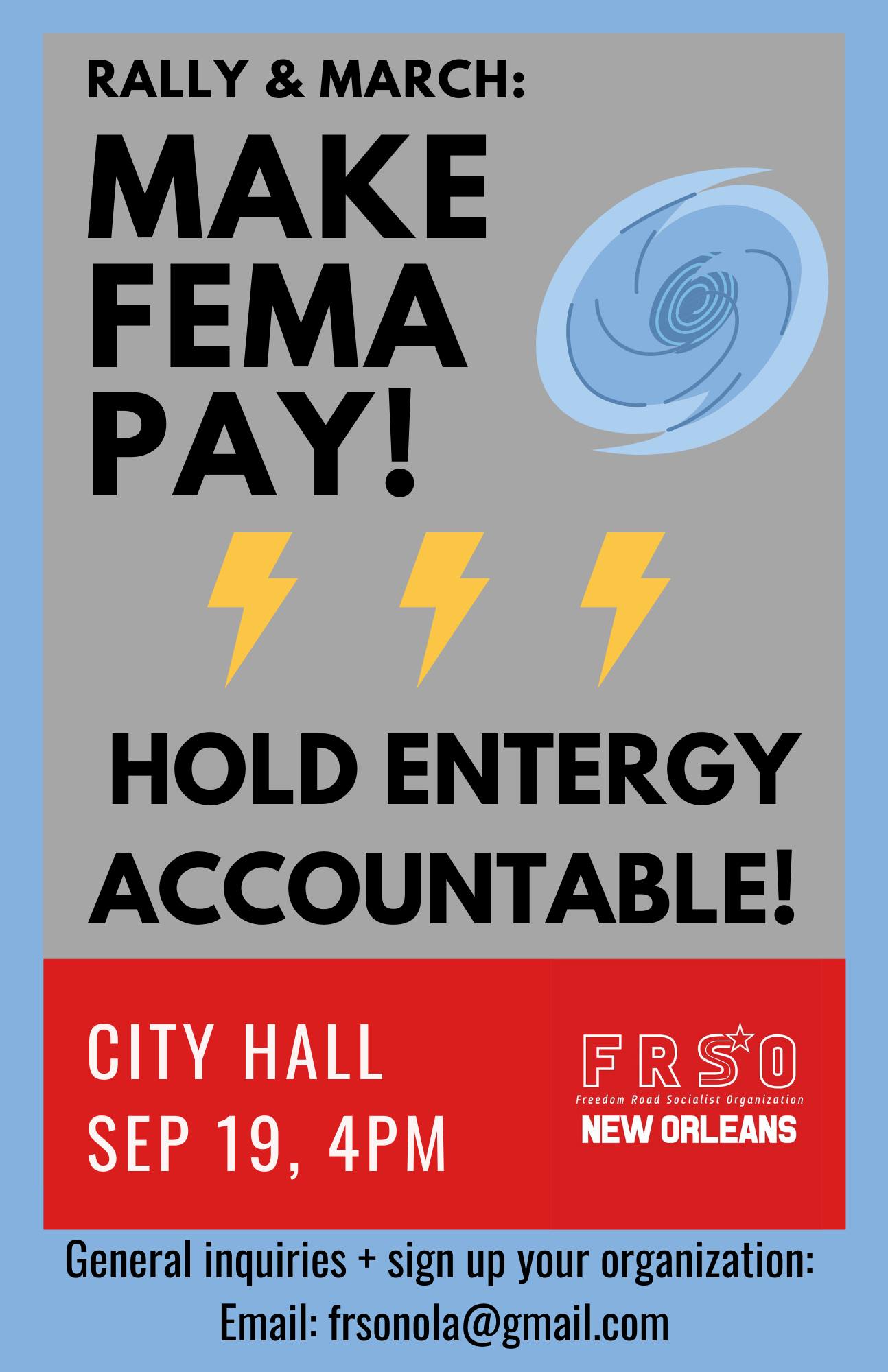
March for Real Hurricane Relief! Sept. 19, New Orleans City Hall
written by Struggle – La Lucha
September 19, 2021
SUNDAY, SEPTEMBER 19, 2021 AT 5 PM EDT – 7 PM EDT
March for Real Hurricane Relief!
New Orleans City Hall
New Orleans Hospitality Workers Alliance
New Orleans Renters Rights Assembly
Socialist Unity Party, Struggle-La-Lucha
Join us as we demand a fair recovery from Hurricane Ida!
–> We need the people’s control and oversight of Entergy. The company lied about being prepared, and now it wants ratepayers to foot the repair bill. This is costing more than money: most Ida deaths have been from heat exhaustion.
–> We need a rapid pre- and post-storm evacuation. After the storm, Cantrell spent 4 days cracking down on “looting” when she could’ve been mobilizing to get people out of the city.
–> We need real and accessible FEMA aid. FEMA discriminates against low-income, Black applicants. It doesn’t have enough staff to respond to aid requests. It excludes many trans and gender non-conforming people because of their name changes.
We need a hurricane response by and for the people of this city.
Hold Entergy accountable!
Make FEMA pay!
Real relief NOW!
Salute to the Attica Uprising, Sept. 18
written by Struggle – La Lucha
September 19, 2021
SATURDAY, SEPTEMBER 18, 2021 AT 1 PM EDT – 3 PM EDT
Salute Attica Uprising “Prisoners Paris Commune”
Please register here: https://us02web.zoom.us/…/reg…/WN_jfGVlDeiQIuTrPp77BfyDA
Salute to the Attica Uprising
50th Anniversary of the Prisoners Paris Commune
video, speakers, poetry
Video Tom Soto, Attica observer
Webinar Saturday, Sept 18
5 pm East Coast, 4 pm Central, 2 pm West Coast
New York City: Globalize the Intifada, Sept. 17
written by Struggle – La Lucha
September 19, 2021
FRIDAY, SEPT. 17, AT 5 PM EDT
Globalize The Intifada
Columbus Circle, New York City
ALL OUT Friday September 17th 5 PM at “Columbus Circle” in Manhattan!
Globalize the Intifada
Return our children
Free all Palestinian prisoners
Defend the hunger strikers
Honor the martyrs
Defund settler nonprofits
End all US aid to Israel
End the siege on Gaza
New York City: Rally for Zimbabwe at the United Nations, Sept. 18
written by Struggle – La Lucha
September 19, 2021
Rally for Zimbabwe at the United Nations!
Sat., September 18, 2021,
11 am sharp,
United Nations,
Dag Hammarskjold Plaza,
1st Avenue & 47th St., NYC. – See map.
(4, 5, 6, 7, S to Grand Central Terminal stop)
“Lift Illegal Sanctions Off Zimbabwe Now!” – “Zimbabwe Will Never Be a Colony Again!”
Sponsored by December 12th Movement. Join Us. 718-398-1766.
Struggle ★ La Lucha PDF – September 13, 2021
written by Struggle – La Lucha
September 19, 2021
Get PDF here
We won’t go back! Texas & Supreme Court attack on women must be defeated
Hurricane Ida blows away illusions
Crowd cheers removal of racist monument
50 years since Attica Rebellion
Happy Labor Day — now drop dead
Never forget the Hamlet fire: Capitalist greed killed 25 workers
In Puerto Rico, the people’s struggle continues
Los Angeles protest: Peru’s will must be respected!
‘Woke’ imperialism, women’s liberation and Afghanistan
No end in sight to U.S. war crimes in Afghanistan
The real story of Korean Air Lines Flight 007
Vietnam resists Washington’s anti-China campaign
Palestinan prisoners resist as Freedom Tunnel heroes seized