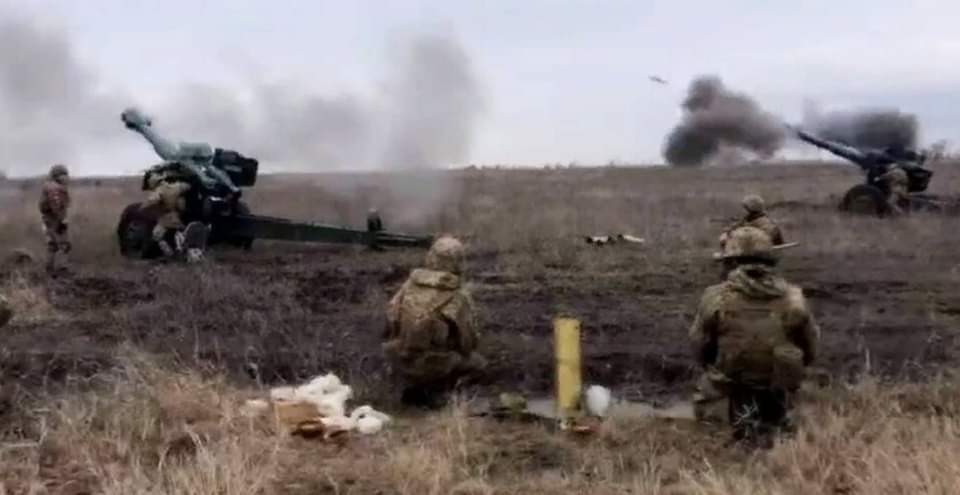
The right-wing government of Ukraine, supported by the U.S., has been at war with the people of the independent Donetsk and Lugansk republics in the Donbass region of eastern Europe for 7 years. 14,000 people have been killed, according to the United Nations. The people of Donetsk and Lugansk live under a blockade by Ukraine and its Western allies. Workers in Ukraine suffer repression, joblessness and price hikes while their government sells off the country to Wall Street.
On April 3, a Ukrainian military drone strike killed 5-year-old Vladik Shikhov and wounded his 66-year-old grandmother in Aleksandrovskoye, Donetsk. On April 4, another Ukrainian drone strike wounded a civilian in Nikolaevka, Lugansk. On March 22, a 71-year-old pensioner was killed by sniper fire near the capital of Donetsk. Many members of the anti-fascist People’s Militia have also been killed while defending residents.
Since January, Ukraine has been building up its military forces on the front line of the conflict. It uses prohibited weapons, targets civilians, schools and homes in violation of international law and regional ceasefire agreements. Battalions of troops affiliated with neo-Nazi groups have been sent to the region, replacing regular Ukrainian Army troops. But the Ukrainian and U.S. governments and mainstream media blame Donetsk and Lugansk for taking steps to defend themselves, and threaten Russia for pledging to protect the people there if Ukraine invades.
Both the Trump and Biden administrations desperately want to stop the Nord Stream 2 pipeline project that would allow Germany and other Western European countries to purchase Russian gas. Children, elders and other civilians in Donetsk and Lugansk are considered expendable targets by Kiev and Washington as they try to provoke a crisis to give them an excuse to further NATO military expansion and punish Russia.
In recent days, the U.S. and NATO have been warning of a Russian military build-up near the Ukrainian border, but never mention that one of the largest U.S. Army-led military exercises in decades has begun and will run until June: Defender Europe 2021, with 28,000 troops from 27 countries operating in a dozen countries from the Balkans to the Black Sea. This is where the real danger of war is coming from.
We say no! People in the U.S. don’t want war with Russia to protect the profits of Big Oil and U.S. banks. We don’t want the U.S. proxy regime in Ukraine to kill our sisters and brothers in Donetsk and Lugansk. We don’t want U.S. troops to be sent to fight and die in another needless conflict. We need an end to racist police brutality and anti-Asian violence. We need money for jobs, housing, healthcare and schools, not war.
End U.S. aid to the Kiev regime! End all U.S. wars and sanctions! Shut down NATO and bring the troops home!
Initiated by Solidarity with Novorossiya & Antifascist in Ukraine
Endorsers (list in formation):
Phil Wilayto, Coordinator, Odessa Solidarity Campaign; Socialist Unity Party (U.S.); Struggle-La Lucha newspaper
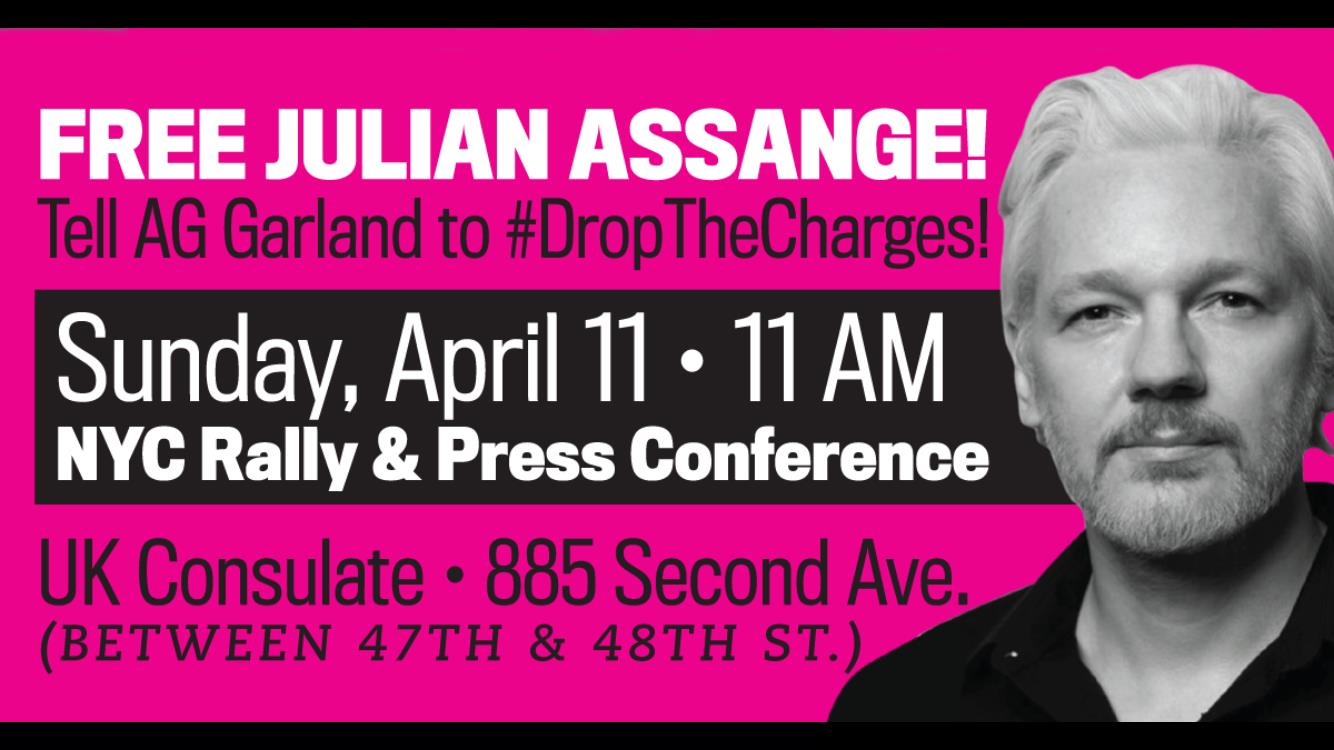
New York: Drop the Charges Against Julian Assange, April 11
written by Struggle – La Lucha
April 6, 2021
SUNDAY AT 11 AM EDT
Rally & Press Conference: Drop the Charges Against Julian Assange
UK Consulate 885 2nd Ave. @ 47th Street, NYC
Rally & Press Conference to mark the 2nd anniversary since Julian Assange was forcibly removed from the Ecuadorian Embassy and taken to Belmarsh prison. We are demanding that Attorney General Merrick Garland Drop the Charges and Free Julian Assange. Speakers will include Randy Credico, Kim Ives, Cliff D. Conner, Chris Silvera, Nellie Bailey, Joe Lombardo, Marty Goodman. For more info write to nycfreeassange@gmail.com
Why There Are No George Floyds in Cuba – Webinar, April 11
written by Struggle – La Lucha
April 6, 2021
SUNDAY, APRIL 11, 2021 AT 4 PM EDT
Why There Are No George Floyds in Cuba – Webinar
Online Event
On May 25, 2020 video of George Floyd being tortured to death by Minneapolis police outraged the world leading to protests by millions of people around the world. Today even as people like Breonna Taylor are being killed with impunity by police, Derek Chauvin is on trial for the murder of George Floyd as the world watches.
62 years ago the people of Cuba made a revolution, showing that a better world is possible. While a big percentage of people in Cuba are Afro-Cubans, they are not gunned down or strangled to death by police.
SPEAKERS –
> AISLINN PULLEY – Co-founder of Chicago Black Lives Matter
> KIMBERLEY WASHINGTON – Long-time Black rights activist, member of 2019 Venceremos Brigade to Cuba
> PEDRO LUIS PEDROSO CUESTA – Ambassador, Permanent Representative of Cuba to the United Nations
> AUGUST NIMTZ – Co-chair of the Minnesota Cuba Committee, professor of Political Science, University of Minnesota
> SOFFIYAH ELIJAH – Executive Director of the Alliance of Families for Justice (AFJ)
Co-moderated by:
SANDI SHERMAN – Minnesota Cuba Committee
AZZA ROJBI – US-Cuba Normalization Committee, member of the Editorial Board of the Fire This Time Newspaper
*This program will be broadcast in English and in Spanish*
Sponsored by the Minnesota Cuba Committee, US-Cuba Normalization Committee, and the Mass Action Coalition to Jail Killer Cops
ALL OUT FOR MUMIA! Mobilize to Shut Down Philly, April 23-25
written by Struggle – La Lucha
April 6, 2021
APR 23 AT 6 PM EDT – APR 25 AT 6 PM EDT
ALL OUT FOR MUMIA! We Free Him Or He Dies. Mobilize to Shut Down Philly 4/23-25 SAVE THE DATES!!!
The State is slowly killing Mumia Abu-Jamal (unfairly convicted and imprisoned since 1981) through medical neglect. He’s still recovering from COVID. He has Congenital Heart Disease. He has Cirrhosis of the Liver & a severe skin ailment. They want him to die in prison. WE SAY NO!!!! Join us in Philly this year, as Mumia turns 67 on Saturday, April 24th. Let Mumia know that we will fight against the state’s attempt to murder him! In spite of a pandemic, we were thousands in the street against the murders of George Floyd, Breonna Taylor and Walter Wallace Jr. Come out now to stop the murder of Mumia – before it’s too late!
This weekend will feature a series of events that uplift the things he fights for. We will honor other freedom fighters, and remember Walter Wallace Jr, who was murdered just six months ago – as we let the state know, WE WANT MUMIA HOME!
——————
Friday – The People For Mumia!
6pm
Virtual Fundraiser & Speak Out: Activists, Youth, Writers, Musicians express what Mumia means to the Movement today.
——————
Saturday – Taking the Streets for Mumia!
2pm
Rally & March Demanding Mumia’s Immediate Release – It’s Mumia’s Birthday!!!
——————
Sunday – In the Spirit of Maroon! Long Live Walter Wallace!
8am
Community Clean up, Prayer & Celebration at Maroon Garden in honor of Russell Maroon Shoatz, 58th & Spruce
then we TAKE TO THE STREETS!
2pm
Arrive together at Malcolm X Park to remember Walter Wallace, Jr, & continue to honor Maroon, Mumia & all Freedom Fighters
——————-
Save the dates & check back for updates! On Facebook
How police preserve inequality in Los Angeles — and everywhere else
written by Struggle – La Lucha
April 6, 2021
The 1974 classic Hollywood film “Chinatown” features a scene set on a picturesque lake in Los Angeles where J.J. “Jake” Gittes, played by Jack Nicholson, spies on two characters, Hollis Mulwray and Katherine Cross, snapping photos of them as he leans back in a boat. The iconic location where this and many other Hollywood movie scenes were filmed was near the site of a violent confrontation by hundreds of Los Angeles Police Department (LAPD) officers against protesters on March 24. Riot gear-clad law enforcement faced off against protesters and bystanders, including residents of the surrounding neighborhood, legal observers and journalists, and violently beat some of them and arrested nearly 200 people. The police officers were following the orders of City Councilman Mitch O’Farrell to dismantle a large encampment of unhoused people living by the lake.
The clash between police and protesters in Echo Park is a microcosm of our nation’s current economic system and the role that law enforcement plays to preserve it. A decades-long housing crisis in Los Angeles has steadily pushed growing numbers of people into the streets. According to the Los Angeles Homeless Services Authority, there were 41,290 experiencing homelessness within city limits in 2020—a 16.1 percent increase from the year before. Over the past year, with the pandemic-related mass layoffs, resulting overdue rents and other bills, and a tenuous barely there safety net, that number has likely risen even more this year.
Krithika Santhanam is an attorney and mass protest defense coordinator at the National Lawyers Guild of Los Angeles, which sent legal observers to the Echo Park protest to document any resulting police brutality. She explained to me in an interview that the police response on March 24 was “no different than the same sort of violent, militant response we continue to see over and over when it comes to large-scale, predominantly progressive protests demanding social justice.” Indeed, as this past year has demonstrated, regardless of location and issue, American law enforcement has applied violent police power against expressions of progressive dissent while openly tolerating or even abetting the preservation of a white supremacist capitalist order. The Echo Park sweep, taking place just as the high-profile trial of Minneapolis police officer Derek Chauvin for the killing of George Floyd began, is disappointingly typical of law enforcement’s role in policing the poor.
Like many other police departments that were found to have engaged in serious misconduct during last year’s Black Lives Matter protests, the LAPD, according to a report authored by former law enforcement and commissioned by the city council, was found to have performed poorly. The report’s authors lamented, “It is unfortunate that the same issues have arisen again and again, with the Department being unable or unwilling to rectify the problem.” According to Santhanam, the same impunity that has led to the department paying out millions of tax dollars to settle misconduct lawsuits was on full display at the raid on Echo Park. The police have been “emboldened in some ways to execute this form of policing,” she said. Ultimately the role of the police is, according to Santhanam, “managing inequality under capitalism.”
Among the hundred or so people living at Echo Park Lake before the encampment was destroyed was CC Luce, an organizer with Lotus Collective and Street Watch LA who told me that she has now lost her home and the sense of community and family that the camp’s residents had built up. For Luce, “the question of housing goes way beyond a structure or affordability.” “A house is not a home; a house is just an object,” she said. But to elected officials and state and local authorities, individuals and shelters are simply pieces of a puzzle that can be moved around to fit one inside the other in order to claim success at solving the crisis of homelessness.
Luce has no idea where her friends and neighbors have now been moved. She told me that as far as she knows, they were moved into transitional housing through Project Roomkey (PRK), part of a statewide program that the LA Homeless Services Authority describes as “a coordinated effort to secure hotel and motel rooms in L.A. County as temporary shelters for people experiencing homelessness who are at high-risk for hospitalization if they contract Coronavirus (COVID-19).”
As of last fall, the $100 million program ended up housing only a small fraction of the city’s unhoused population. Seen as an innovative solution to the problem of homelessness in a city where the cost of living displaces people from their homes faster than authorities can provide them shelter, the project is simply a band-aid, and a deeply flawed one at that. One journalist who interviewed people placed in temporary housing through the program pointed out that “punitive policies and practices are causing residents to leave PRK or act in ways that get them kicked out,” and that strict curfews and other harsh policies are “tools used by PRK’s service providers to discipline their residents.”
The Centers for Disease Control and Prevention (CDC) released a set of guidelines for cities to tackle homeless encampments during the pandemic and warned that “Clearing encampments can cause people to disperse throughout the community and break connections with service providers. This increases the potential for infectious disease spread.” Councilman O’Farrell’s justification for destroying the encampment was to conduct repairs to the park, as if that could not be done while people were living in the area. O’Farrell told the Hollywood Reporter, “my non-negotiable was that we would have housing solutions for everyone before we closed the parks for repairs. We were able to do just that.” And yet, a handful of those who remained in their tents at Echo Park Lake were ultimately arrested before the repairs commenced. Perhaps O’Farrell sees jail and housing as interchangeable locations for the unhoused.
The councilman claimed that razing the encampment had nothing to do with Hollywood production companies’ use of the area for film shoots. He said, “Filming at the lake is nothing that even entered my mind.” And yet he added, “I’m very aware that filming was really popular there, to film movies, commercials, you name it. It’ll be, I think, available again, but the primary focus is to get people back to enjoy the park.” By “people,” he clearly meant those other than the inhabitants of the encampment.
Santhanam pointed out that the sweep was an indication of how we “continue to prioritize and privilege the viewpoints, opinions, and preferences of those who have access to housing and who have the financial means to thrive under this system.” In other words, the wealthier residents of Echo Park’s surrounding and gentrifying neighborhoods have made clear that they will no longer tolerate the sight of unhoused people at the edge of the lake. A petition signed by 4,000 people warned, “WE — THE CITIZENS OF ECHO PARK — WILL NO LONGER TOLERATE OUR LAKE BEING DESTROYED!” One person living at the encampment countered that sentiment, telling the Los Angeles Times, “Until you find and address the actual problems and actual solutions, I’m sorry, but we’re going to be here.”
And therein lies the problem that the Echo Park Lake encampment and its dismantling has symbolized so heartbreakingly well: our society would rather spend money to violently clamp down on protesters who are protecting an unhoused community than fund long-term solutions to the housing crisis. It would rather displace those who created their own community in the vacuum of affordable housing options and pour resources into temporary and sterile solutions for transitional housing than foster conditions where people can actually afford to live in the places where they create their own communities. “Right now all of us who lived at Echo Park Lake, we might have roofs over our heads, but we’re unsheltered because we can’t see each other,” said Luce.
This article was produced by Economy for All, a project of the Independent Media Institute.
Sonali Kolhatkar is the founder, host and executive producer of “Rising Up With Sonali,” a television and radio show that airs on Free Speech TV and Pacifica stations. She is a writing fellow for the Economy for All project at the Independent Media Institute.
Struggle ★ La Lucha PDF – April 5, 2021
written by Struggle – La Lucha
April 6, 2021
Get PDF here
Stop stealing Black votes
We want justice: Free all political prisoners!
Axe handles and voting rights
Mumia update: The new Krasner brief
Community defends Echo Park homeless camp against police attack
National and local organizations demand Kroger stop closing stores over hero pay
GABRIELA activist: Class analysis and anti-imperialism necessary for the women’s movement
Emergency rally responds to anti-Asian murders
Project Sunlight: Podcast on epidemic of missing and murdered Filipinas in U.S.
People v. Derek Chauvin opening arguments protest
Long live the Paris Commune!
Baltimore supports Bessemer Amazon workers
Haiti demands freedom
Protest marks 18th anniversary of U.S. invasion of Iraq
Ukraine, U.S. drum up war threats against Donbass and Russia
Puerto Rico: Organizaciones de base desafían al gobierno
Sobre el proyecto de autodeterminación de Puerto Rico
Protests reject genocidal U.S. blockade on Cuba
1948 Jeju uprising in Korea: Anti-imperialist resistance drowned in blood by U.S. military regime
written by Struggle – La Lucha
April 6, 2021
Seventy-three years ago, in April 1948, the people of the Korean island of Jeju rose up. The uprising — one of many that took place in the five years between the end of the Second World War in 1945 and the beginning of the Korean War in 1950 — was to become one of the most important chapters in a pre-war struggle for self-determination by Koreans south of the 38th parallel.
During World War II, Kim Il Sung, the great Korean communist leader and strategist, led a guerrilla army that chased Japanese colonizers south to the 38th parallel. The U.S. military, after dropping atomic bombs on the Japanese cities of Nagasaki and Hiroshima, exacted the surrender of Japan and occupied Korea south of the 38th parallel.
Japan was already on the verge of surrender at that time. There was no military need for the atomic bombing, the worst atrocity in the history of modern warfare. But Washington strategists wanted to use the circumstances as a way to send a warning to the USSR.
The Korean people of the south were in no mood to be recolonized after 35 years of terrible cruelty at the hands of their former Japanese occupiers. But that was the plan that had been hatched by the administration of U.S. President Franklin Roosevelt and then carried out by his successor, Harry Truman.
Nor was there a desire on the part of Koreans in the south to be separated from Koreans in the north. Korean society was unified for thousands of years, with no differences in language, customs or otherwise. The division was also part of Washington’s machinations.
In fact, at the close of World War II, there was widespread support for socialism, admiration for Kim Il Sung and a great desire to rebuild all of Korean society along socialist lines among Koreans living south of the 38th parallel.
People’s Republic of Korea
Immediately after Japan’s defeat and retreat, while Kim Il Sung and other socialist leaders were beginning to reorganize society in the north, a provisional government was formed by movement leaders in the south. The People’s Republic of Korea (PRK), as it was called, set up People’s Committees all over the south.
They called for land held by Japanese owners and collaborators to be seized and redistributed to peasants. They set out to establish equality for women, strong labor laws, an end to child labor, an eight-hour workday, and above all, independence and self-determination.
But the U.S. refused to acknowledge the PRK, and set up a U.S. military government, whose true goal was to crush the Korean people’s movement. Within a couple of months the U.S. had banned and forcibly dissolved the PRK. But that didn’t slow down resistance or quell the hunger for self-determination throughout the south.
Widespread and constant rebellions and strikes by workers, peasants and students were a huge challenge to the U.S. occupation government. As months and then years wore on, they were barely — and only through terrible, brutal repression — holding back a revolution that inevitably would have led to the reunification of Korea and an end to capitalist ownership and exploitation.
While trying to contain the movement, the U.S. military began to cobble together repressive forces made up of those Koreans who had collaborated with the Japanese — right-wing paramilitaries — and began to put together a South Korean army and put in place a pro-U.S. South Korean government.
Under cover of the United Nations, they set up an election that resulted in Syngman Rhee being “elected” in 1948. Rhee had lived in the U.S. for years and was selected as figurehead of the Korean government.
The Jeju Rebellion
It was this sham of an election that was the tinder for the Jeju Rebellion. The island was populated by about 300,000 people and was known to be a stronghold of communist and socialist sentiment. The organization and ideas put forth by the progressive PRK government had taken root on Jeju more than anyplace.
People’s movement leaders knew months before the scheduled election that a Rhee victory was inevitable and that it would mean the division of north and south. In April 1948, a series of events, in which protesters on Jeju Island were attacked and killed by police aligned with the U.S. occupation forces, led to an island-wide insurrection.
With hunting rifles and sometimes bows and arrows, the Jeju islanders’ insurrection lasted more than a year. Police buildings and other government institutions were all attacked and burned. Even though they were outgunned, the revolutionary side shook the U.S.-backed Korean forces.
It took the combined fire power of right-wing Korean gangs called the Northwest Youth League that had been recruited by U.S. operatives, and an army quickly cobbled together by the United States Army Military Government of Korea with Syngman Rhee as the nominal head, primarily made up of forces from Japan.
Though the U.S. occupation troops refrained from frontline battles, the occupiers provided aerial surveillance and were in fact the organizers of the counter-insurrection.
In early 1949, a division of the new U.S.-backed Republic of Korea army was ordered by Syngman Rhee and the U.S. military to attack the Jeju guerillas, but they mutinied instead. Mutineers fought against Syngman Rhee’s forces on the mainland and killed most of their commanders. Many were believed to have fought their way all the way to the north and remained there.
The Jeju insurrection was ultimately drowned in blood. The death toll was terrible — at least 10% of the island’s population, that is, some 30,000 people, were killed.
Jeju was not the last of Korean resistance to U.S. occupation. The Korean people’s struggle for self-determination and reunification is long, inspired and heroic. Like many chapters of Korean history, Jeju is seared in the memories of Koreans everywhere.
The entire history of the role of U.S. imperialism in dividing Korea, the grave threat that the presence of U.S. troops and weapons are to all Korean people, the deaths of millions of North Korean people at the hands of the U.S. military during the war — all of it flies in the face of the phony U.S. narrative of the Pentagon being needed to protect South Korea from North Korea.
Long live the heroic memory of Jeju! Korea is one!
After 31 years, Gerald Reed is free!
written by Struggle – La Lucha
April 6, 2021
Statement from the Chicago Alliance Against Racist and Political Repression.
The Chicago Alliance Against Racist and Political Repression (CAARPR) greets the commutation of Gerald Reed’s life sentence today by Governor J. B. Pritzker as a courageous act to set right a terrible crime against a Black man committed 31 years ago. Now we need to finish the job of freeing all survivors of police torture who were convicted by confessions coerced by police and dismantling the prison industrial complex as a whole.
Reed was convicted of a double murder in 1990 after he was tortured by detectives working under the notorious Jon Burge and falsely confessed. He won a new trial after his case was referred to the court for review by the Torture Inquiry and Relief Commission (TIRC), only to have another judge in the same court resentence him to life in prison without a trial.
Led by Gerald’s mother, Armanda Schackelford, the Alliance and many organizations have been campaigning for clemency for Reed for years. The campaign took off when Jennifer Soble of the Illinois Prison Project and Sheila Bedi of the Community Justice clinic at the Northwestern Pritzker School of Law filed an emergency petition last year in the face of the COVID-19 pandemic that is raging through Illinois prisons. Reed is confined to a wheelchair, has suffered a heart attack, and has other serious medical issues resulting from the torture he endured, which broke his thigh and a steel rod that had been put in his leg.
The Campaign to Free Incarcerated Survivors of Police Torture (CFIST), initiated by the Alliance, is urging Governor Pritzker to grant mass pardons to all those that have been found to have credible cases of police torture by the TIRC as the first step toward freeing all police torture survivors and wrongfully convicted. CFIST will continue fighting until we see all our loved ones home.
Finally, Gerald Reed’s case and the terrible injustice he has had to endure at the hands of the Chicago Police Department show only too clearly why the Alliance has helped form the broadest and most representative coalition in the city pushing for a People’s Ordinance – the Empowering Communities for Public Safety ordinance – to give communities in Chicago the voice they deserve in police accountability and make sure cases like Gerald’s never happen again.
Presentation by the Socialist Unity Party and the Prisoners Solidarity Committee to the Anti-Imperialist Symposium in Paris April 2-4, an annual event sponsored by the Anti-Imperialist Front. For a complete description of the event go to Anti-ImperialistFront.org.
‘We want justice’
Freeing all political prisoners, prisoners of conscience and prisoners of war is on the top of the list in the struggle for social justice, because the capitalist state continues to use the criminal justice system to lock up those who sacrifice their livelihood for freedom and justice for the masses.
We join the National Alliance Against Racist and Political Repression, the Campaign to Release Aging People in Prison, Mobilization 4 Mumia, International Concerned Family and Friends of Mumia Abu-Jamal and many others calling for the U.S. government to take immediate steps to depopulate jails, prisons, immigrant detention centers and juvenile facilities that are genocidal hotbeds for COVID-19 infections and death camps for millions.
It is an honor to speak to you so close to the 67th birthday of Mumia Abu-Jamal on April 24, 2021.
Internationally-known U.S. political prisoner Abu-Jamal is an award-winning journalist and author of ten books and over 2,500 written essays and audio commentaries from prison. His writings are uncompromising, factual and searing indictments of racism and political bias in the U.S. judicial system. His call for justice and defiance has not dimmed, despite decades of being shackled and caged. He is one of our most courageous revolutionary intellectuals, who says what is on his mind without fear of consequences. His book “Live from Death Row” has been translated into seven languages.
It is clear to the movement that he remains in prison for telling the truth about capitalism, imperialism, the prison-industrial complex, and the entire U.S. criminal justice system.
Mumia Abu-Jamal was on Pennsylvania’s death row for 30 years. His death warrant was signed twice by the state. He came dangerously close to execution on August 17, 1995, and again on December 2, 1999. It was the mobilization of a mass international movement that saved his life.
In 2011, his sentence was commuted to life imprisonment without the possibility of parole.
After Abu-Jamal was taken off death row, prison officials tried to kill him through medical neglect — by denying him treatment for hepatitis C. Eventually he received treatment, because of a lawsuit; but since treatment was delayed, he developed cirrhosis of the liver.
The U.S. government claims there are no political prisoners in the United States. When, in fact, political prisoners make up the majority of the over 2.3 million people locked up in prisons, jails and ICE detention centers throughout the United States, because prisons are concentration camps for the poor.
Abu-Jamal is over 50 years old, has recently tested positive for COVID-19, has congestive heart failure and other pre-existing medical conditions that place him at a high risk of dying from this deadly disease.
Over 20% of U.S. prison inmates are over 50 years old and a large percentage of those have pre-existing medical conditions. It was reported in December 2020 that one in five prisoners (20%) in the U.S. have had COVID-19, and 1,700 have died.
This is a vast undercount, because there are many prisons where, when people get sick, they do not get tested or receive the needed care, so they get much sicker than need be. Today, there is no sign that the spread of the virus is slowing.
This is a crisis for all prisoners, but especially for our elders who are behind bars because of their involvement in political activity. They are not going to be considered for prison releases recommended by public health experts to scale back prison populations.
Prisoners such as 66-year-old Mumia Abu-Jamal.
84-year-old Sundiata Acoli, 50 years incarcerated, has tested positive for COVID-19.
82-year-old Ruchell Magee, 57 years incarcerated.
77-year-old Native American Leonard Peltier, 43 years incarcerated.
77-year-old Russell Maroon Shoatz, 48 years incarcerated, has tested positive for COVID-19 and has pre-existing medical conditions.
77-year-old Ed Poindexter, 48 years incarcerated.
77-year-old Jamil Abdullah Al-Amin (H. Rap Brown), 19 years incarcerated.
71-year-old Mutulu Shakur, 33 years incarcerated.
These are just a few. There are hundreds more.
The collective call is to release all prisoners, especially those over 50 years old, who have tested positive for COVID-19 or have been exposed to COVID-19, and with pre-existing medical conditions that place them at high risk of dying if infected.
This message was echoed by Abu-Jamal’s medical consultant, Dr. Ricardo Alvarez.
‘The only treatment is freedom!’
Before preparing this talk, I read about the mother of political prisoner Helin Bölek in Turkey, who stood by her daughter, held her up and supported her in her fight for justice and freedom. Helin Bölek and three others (Ebru Timtik, Mustafa Koçak and Ibrahim Gökçek) sacrificed their lives in the worldwide struggle for justice, demanding a fair trial, to be judged justly, and to stop the state terror against the musical band Grup Yorum.
Bolek was on a hunger strike for 288 days under the care of her mother and supporters, who loved her, nurtured her and provided her the strength to sustain. She was kidnaped by the state and forced into a stressful situation where she did not have the care and nurturing that she needed.
It does not surprise any of us that our struggles are connected. We are fighting the same enemy.
Grup Yorum was targeted because they played revolutionary, uplifting music, provided free music lessons and free concerts, and were embraced by the community.
The Black Panther Party was targeted because they were revolutionary, provided free breakfast for children, free medical clinics, free schooling and many programs that the community embraced.
The families and friends of incarcerated freedom fighters do not want any of them to die locked down in prisons, jails and detention centers.
They want them to be home where they can be properly taken care of, loved, touched and nurtured with human kindness.
We want them to be energized and ready to continue the song, the dance, the struggle, the fight for justice and freedom. We want them out here fighting with us.
This is why the only treatment is freedom.
So, please, everyone who hears these words: do something, but quickly.
Release all prisoners now! Because it is the right thing to do.
In closing, we must acknowledge that prisons are concentration camps for the poor.
The only way we are going to end mass incarceration and abolish the prison-industrial complex is through revolution — a worldwide socialist revolution.
On YouTube:
National and local organizations demand Kroger stop closing stores over hero pay
written by Struggle – La Lucha
April 6, 2021
FOR IMMEDIATE RELEASE
March 31, 2021
Media Contacts:
Pastor William D. Smart Jr. (SCLC – SoCa)
213-268-3082
wsmart50@yahoo.com
John Parker (HTC)
323-899-2003
johnthompsonparker@gmail.com
Los Angeles — On April 3rd, community organizations will unite to protest against Kroger closing 3 stores in the LA county and 2 in Long Beach over the City Council’s emergency ordinance, which provides all national retail and drug store employees a $5 raise, expiring in July. The two Ralphs and a Food 4 Less in LA will be closing on May 15th, impacting 250 workers, their families and the surrounding communities. The lack of accountability in grocery chains negligence towards their employees have resulted in thousands of workers being infected by COVID and hundreds of deaths.
Kroger has stated the small raise to the workers will somehow end their ability to operate, yet Kroger’s profits have increased by 56% to $2.6 billion and its sales by 14% to $120.8 billion during the pandemic.
Essential frontline workers across the globe have risked their lives during the pandemic, with many national grocers gaining all time profit margins. “After 32 yrs working in this store, I see It’s all about greed, it’s never enough! Kroger keep this store going! Don’t shut it down, people need jobs! Hazard pay is a blessing for me!” stated Ronald Ford, a UFCW local 770 worker.
The rally will be held at one of the Ralphs stores set to close on 3300 Slauson Ave, Los Angeles, CA, demanding Kroger take back their announcement to close these crucial stores that supply fresh and accessible food to low income communities including the elderly and those who rely on public transportation. With the community outraged, many worry if the store locations will be replaced with an affordable grocer or at all. An already 12% increase in homelessness as of 2020 has also raised concerns that these locations will become hotspots for food deserts that are sweeping across LA county. These communities have struggled in the past with finding affordable prices and costs that can be covered from food stamps.
Commencement of the rally will begin at 12pm PST, with organization leaders and workers of Kroger speaking out against this attack and calling for solidarity at 1pm PST. The chosen date for the demonstration also sheds light to its historic significance in Dr. Martin Luther King Jr.’s final speech “I’ve Been to the Mountaintop” to a crowd of 25,000 work, igniting the sanitation workers strike and expanding the civil rights movement. King affirmed the value of the sanitation workers’ labor, saying, “Secondly, let us keep the issues where they are. The issue is injustice. The issue is the refusal of Memphis to be fair and honest in its dealings with its public servants, who happen to be sanitation workers.” The coalition organizations consist of the following and demand all frontline workers be paid a living wage NOW: Harriet Tubman Center for Social Justice, Southern Christian Leadership Conference of SoCal, UFCW Local 770, Baptist Ministers Conference of SoCal, Union Del Barrio, Community Coalition, National Action Network, United Workers Assembly, Families of Park Mesa Heights, and Harvard Boulevard Block Club.