The COVID-19 catastrophe in India keeps growing

COVID-19 tests being administered. On April 21, 2021, India registered 315,000 cases in a 24-hour period. Photo: Newsclick

For Ashish Yechury (1986-2021), journalist.

It is difficult to overstate the grip of COVID-19 on India. WhatsApp bristles with messages about this or that friend and family member with the virus, while there are angry posts about how the central government has utterly failed its citizenry. This hospital is running out of beds and that hospital has no more oxygen, while there is evasion from Prime Minister Narendra Modi and his Cabinet.

Thirteen months after the World Health Organization (WHO) announced that the world was in the midst of a pandemic, the Indian government looks into the headlights like a transfixed animal, unable to move. While other countries are well advanced on their vaccination programs, the Indian government sits back and watches a second wave or a third wave land heavily on the Indian people.

On April 21, 2021, the country registered 315,000 cases in a 24-hour period. This is an extraordinarily high number. Bear in mind that in China, where the virus was first detected in late 2019, the total number of detected cases stands at less than 100,000. This spike has raised eyebrows: is this a new variant, or is this a result of failure to manage social interactions (including the 3 million pilgrims who gathered at this year’s Kumbh Mela) and to vaccinate enough people.

At the core is the total failure of the Indian government, led by PM Modi, to take this pandemic seriously.

Disregard

A glance around the world shows those governments that disregarded the WHO warnings suffered the worst ravages of COVID-19. From January 2020, the WHO had asked governments to insist on basic hygiene rules—washing hands, physical distance, mask wearing—and then later had suggested testing for COVID-19, contact tracing and social isolation. The first set of recommendations do not require immense resources. Vietnam’s government, for instance, took those recommendations very seriously and slowed the spread of the disease immediately.

India’s government moved slowly despite evidence of the dangerousness of the disease. By March 10, 2020, before the WHO declared a pandemic, the Indian government reported about 50 COVID-19 cases in India, with infections doubled in 14 days. The first major act from India’s prime minister was a 14-hour Janata Curfew, which was dramatic but not in line with the WHO recommendations. This ruthless lockdown, with four hours’ notice, sent hundreds of thousands of workers on the road to their homes, penniless, some dying by the wayside, many carrying the virus to their towns and villages. Prime Minister Modi executed this lockdown without checking with his own departments, whose advice might have warned him against such a precipitous and unnecessary act.

Prime Minister Modi took the entire pandemic lightly. He urged people to light candles and bang pots, to make noise to scare away the virus. The lockdown kept being extended, but there was nothing systematic, no national policy that one can find anywhere on the government’s websites. In May and June of 2020, the lockdown kept getting extended, although this was meaningless to the millions of working-class Indians who had to go to work to survive on their daily wages. A year into the pandemic, there are now 16 million people in India with detected infections, with 185,000 people confirmed dead from the pandemic. One has to write words like “detected” and “confirmed” because mortality data from India during this pandemic has been totally unreliable.

Consequences of privatization

The consequences of turning over health care to the private sector and underfunding public health have been diabolical. For years now, advocates of public health care, such as the Jan Swasthya Abhiyan, have called for more government spending on public health and less reliance upon profit-driven health care. These calls fell on deaf ears.

India’s governments have spent very low amounts on health—3.5 percent of GDP in 2018, a figure that has remained the same for decades. India’s current health expenditure per capita, by purchasing power parity, was 275.13 in 2018, around the figures of Kiribati, Myanmar and Sierra Leone. This is a very low number for a country with the kind of industrial capacity and wealth of India.

In late 2020, the Indian government admitted that it has 0.8 medical doctors for every 1,000 Indians, and it has 1.7 nurses for every 1,000 Indians. No country of India’s size and wealth has such a low medical staff. It gets worse. India has only 5.3 beds for every 10,000 people, while China—for example—has 43.1 beds for the same number. India has only 2.3 critical care beds for 100,000 people (compared to 3.6 in China) and it has only 48,000 ventilators (China had 70,000 ventilators in Wuhan alone).

The weakness of medical infrastructure is wholly due to privatization, where private sector hospitals run their system on the principle of maximum capacity and have no ability to handle peak loads. The theory of optimization does not permit the system to tackle surges, since in normal times it would mean that the hospitals would have surplus capacity. No private sector is going to voluntarily develop any surplus beds or surplus ventilators. It is this that inevitably causes the crisis in a pandemic.

Low health spending means low expenditure on medical infrastructure and low wages for medical workers. This is a poor way to run a modern society.

Vaccines and oxygen

Shortages are a normal problem in any society. But the shortages of basic medical goods in India during the pandemic have been scandalous.

India has long been known as the “pharmacy of the world,” since India’s pharmaceutical industry sector has been skillful at reverse-engineering a range of generic drugs. It is the third-largest pharmaceutical industry manufacturer. India accounts for 60 percent of global vaccine production, including 90 percent of the WHO use of measles vaccine, and India has become the largest producer of pills for the U.S. market. But none of this helped during the crisis.

Vaccines for COVID-19 are not available for Indians at the pace necessary. Vaccinations for Indians will not be complete before November 2022. The government’s new policy will allow vaccine makers to hike up prices, but not produce fast enough to cover needs (India’s public sector vaccine factories are sitting idle). No large-scale rapid procurement is on the cards. Nor is there enough medical oxygen, and promises to build capacity have been unfulfilled by the ruling party. India’s government has been exporting oxygen, even when it became clear that domestic reserves were depleted (it has also exported precious Remdesivir injections).

On March 25, 2020, Modi said that he would win this Mahabharat—this epic battle—against COVID-19 in 18 days. Now, more than 56 weeks after that promise, India looks more like the blood-soaked fields of Kurukshetra, where thousands lay dead, with the war not even at halftime.

This article was produced by Globetrotter. Vijay Prashad is an Indian historian, editor and journalist. He is a writing fellow and chief correspondent at Globetrotter. He is the chief editor of LeftWord Books and the director of Tricontinental: Institute for Social Research. He is a senior non-resident fellow at Chongyang Institute for Financial Studies, Renmin University of China. He has written more than 20 books, including The Darker Nations and The Poorer Nations. His latest book is Washington Bullets, with an introduction by Evo Morales Ayma.

Strugglelalucha256


Zimbabwe celebrates 41 years of independence


Forty-one years ago the people of Zimbabwe won independence on April 18, 1980. Thousands of Africans died for it. For decades Zimbabwe’s people fought for freedom.

As a young man, Zimbabwe’s President Emmerson Mnangagwa was sentenced to death for being a freedom fighter. He was tortured and spent years in prison after being reprieved from the gallows. 

Great Zimbabwe is the country’s most famous monument. Tall stone walls protected the ancient city that was nearly three square miles in size.

Capitalist robber barons lusted after the country’s 150,000 square miles of fertile land and mineral wealth. The fantastically wealthy diamond and gold mine owner Cecil Rhodes invaded Zimbabwe with British mercenaries in the 1890s.

They used an early machine gun, named the Maxim gun after its U.S. inventor, to murder Africans. This didn’t stop people from fighting back during the first “Chimurenga” or freedom struggle.

One of the Chimurenga’s leaders, Chingaira, was shot by a firing squad on Sept. 4, 1896. Facing his executioners, he declared, “It is all very well to call me a rebel but the country belonged to me and my forefathers long before you came here.” 

The British called Zimbabwe “Southern Rhodesia” after moneybags Rhodes, while they called neighboring Zambia “Northern Rhodesia.” White settlers stole most of the land while Africans were forced by a “hut tax” and systematic violence to work for them.

This led to more than 15 years of a Chimurenga against the white settler regime of Ian Smith during the 1960s and 1970s. Guerrilla warfare was launched. Smith responded with wholesale terror that included using the biological weapon anthrax against liberation fighters.

Smith was propped up by support from Britain. Big Oil outfits BP and Shell supplied petroleum to the Smith regime in violation of U.N. sanctions. 

The U.S. allowed imports of chrome from occupied Zimbabwe, which also violated U.N. sanctions. None of this prevented the white settler regime from being forced to surrender to Zimbabwe’s people.

Celebration in Brooklyn, N.Y.

The December 12th Movement held a rally in the Bedford-Stuyvesant community of Brooklyn, N.Y., on April 18 to celebrate Zimbabwe’s independence. The revolutionary organization has always defended the African country. Its leaders supported Zimbabwe’s liberation struggle for decades.

One of the D12 leaders, Field Marshal Coltrane Chimurenga, who passed away in 2019, is buried in Harare, Zimbabwe’s capital. He was interred in the Harare Provincial Heroes’ Acre and given a 21-gun salute by the Zimbabwean military. 

Speaking in front of Sistas’ Place on Nostrand Avenue at Frederick Douglass Square, D12 Chairperson Viola Plummer talked about the liberation struggle in Zimbabwe.

She stressed the need for unity and praised two leaders of the Chimurenga: Robert Mugabe, leader of the Zimbabwe African National Union (ZANU), and Joshua Nkomo, who led the Zimbabwe African People’s Union (ZAPU).

These freedom fighters, both of whom have joined the ancestors, came together to form the Patriotic Front. Cuban leader Fidel Castro supported this effort and the military struggle. 

After achieving independence, ZANU and ZAPU merged their organizations to form ZANU-PF (Patriotic Front) in the late 1980s.

For big capitalists in the U.S. and Europe — who’ve enslaved and exploited Africans for over 500 years — Zimbabwe’s unforgivable sin was taking back the land. Starting in 2000, President Robert Mugabe led the restoration of the land to Africans that had been stolen by white farm owners and ranchers.

That’s what should have been done in the United States in 1865. The plantations should have been given to the Africans who worked on them — from “no see” in the morning to “no see” at night — and to Indigenous nations that the land was stolen from. 

Fighting COVID and sanctions

The U.S. government, which openly violated U.N. sanctions to help Ian Smith, has imposed sanctions on Zimbabwe for 20 years for liberating their land. According to a D12 leaflet, Zimbabwe lost $42 billion because of this cruel economic blockade. 

Importing medical supplies and agricultural implements has been hindered. The African Union’s 54 nations have demanded the lifting of sanctions. So has AU Chair and South African President Cyril Ramaphosa, and the U.N. Secretary General.

Despite these sanctions, the country’s economy is expected to grow 7.4% in 2021. In his Independence Day speech, His Excellency President  Mnangagwa reported on the new roads, bridges, dams and electrical plants being built. The country’s “look East” policy has encouraged trade with the People’s Republic of China, Iran and the Russian Federation. 

Zimbabwe has the highest literacy rate in Africa. Before independence, there was only one high school for Africans. Now there are many and every province has a college.  

At the Brooklyn rally, Colette Pean, a D12 leader, explained how Zimbabwe was able to beat back the coronavirus pandemic. With ZANU-PF party members rooted in the countryside, as well as in the cities, the country was able to mobilize against the virus.

Zimbabwe shut down to stop the spread. As of April 17, the country of 14 million people had 37,980 cases of COVID-19 with 1,555 deaths.

In contrast, the nearly 13 million people in Pennsylvania have had over 1.1 million cases and suffered nearly 26,000 deaths.

President Emmerson Mnangagwa reported that Zimbabwe launched a national vaccination program to contain the virus. Vaccines have been obtained from China, the Russian Federation and India.

Despite the slander in the corporate media, Zimbabwe is moving forward. Forty-one is a prime number. Lift the sanctions on Zimbabwe!   

Strugglelalucha256


How Venezuela is rebuilding its industrial base, one volunteer at a time

“We don’t just repair machines; we repair consciences,” says Sergio Requena of the Productive Workers Army (EPO by its Spanish-language initials) in Venezuela. The EPO is a group of 2,270 volunteers with a broad range of technical expertise. They go from factory to factory repairing broken machinery. Their mission is to recover Venezuela’s industrial production by empowering workers to take matters into their own hands.

Venezuela’s productive capacity has declined precipitously due to U.S. sanctions. The country is impeded from accessing the international financial system, leading to a fall in investment. Even importing spare parts or industrial equipment is next to impossible. As a result of this, factories have trouble completing regular maintenance and repairs.

In 2016, Requena and others were invited to help La Gaviota, a fish meal plant and sardine cannery that was paralyzed due to a broken oven. They traveled 500 kilometers, spent five days sleeping and working inside the factory, and successfully repaired not just the oven, but five other pieces of damaged machinery as well. After their visit, the factory went from producing nothing to producing 260 tons of fish meal.

This might seem like a small achievement, but it is a strategically important one, with powerful symbolism. Fish meal is used in animal feed, and when La Gaviota’s production stopped, it was replaced by more expensive soybean meal imports paid for in dollars. The U.S. sanctions have caused Venezuela’s foreign currency earnings to drop by 99 percent. The impact of these sanctions goes well beyond mere economics; they have had a “devastating effect on the whole population of Venezuela,” according to a report by a United Nations special rapporteur.

“The biggest impact sanctions have had on my life [and that of my family is] the destruction of normality, of our daily reality, the routine we had as a family,” Requena explains. He describes spending days in a queue to purchase gasoline in 2019. Much of his wife’s family has left the country in search of better opportunities. “This has been caused by the sanctions,” he adds.

The EPO organized formally after the experience at La Gaviota, but its roots go further back. Between 2008 and 2014, workers took control of three companies in the remote state of Bolívar, where much of Venezuela’s manufacturing capacity is located. These plants stopped producing as the owners began divesting and planned to liquidate assets and carry out massive layoffs. In response, workers occupied the factories, restarted production and were eventually granted legal recognition as worker-managed companies after protracted court battles.

Having emerged victorious from this struggle, Requena and others from these three companies sought to help workers across the country do the same. He sees the work being done by EPO as a step toward offsetting the impact of what he identifies as a U.S.-led hybrid war on Venezuela aimed at destabilizing the state and polarizing society.

“The role of the EPO in this hybrid war is to contribute to organizing the Venezuelan people to neutralize these attempts and destabilization [of the state]… and to strengthen the productive infrastructure of communes,” he says. They are strategic in their efforts and have prioritized three sectors to work in: food production, natural gas distribution and hydrocarbon refining.

To date, EPO has carried out 14 of what it calls “productive battles,” which is “a direct intervention in the production process of a paralyzed or semi-paralyzed work unit by teams of workers.” Nine of the 14 have been in their priority sectors. This includes the Paraguaná Refinery Complex, the third-largest oil refinery complex in the world, where it helped to increase the processing capacity of crude oil and gasoline additives. Another company is Nutrivida, which produces a beverage for children fortified with vitamins and minerals. This drink is provided to a government-run school meal plan that feeds 4.6 million children. “These sectors are intimately linked to [ensuring] the living-well of Venezuelans, and that’s what the hybrid war is trying to break,” Requena explains.

He also emphasizes the work done at El Maizal, one of Venezuela’s largest communes, where 3,200 families participate in direct democracy to make decisions about their community and its businesses. This includes the largest worker-controlled industrial farm in the country. There, the EPO fixed freezers for storing pork and increased the farm’s capacity to plant and harvest.

“If they [the U.S.] want to fragment our industries, we must strengthen them. If they won’t let us import, we must produce here, create here, design here, manufacture here,” Requena notes. He’s convinced that U.S. sanctions and threats will continue, while expressing confidence that the Venezuelan people can overcome the difficulties they face.

For him, the bigger victory at La Gaviota was not the restarting of production, but the impact on the company’s workers. “People have been touched by their experiences with us because they understand that society can be transformed,” he notes.

After two years of showing up to work and not being able to produce, workers at La Gaviota were demoralized and skeptical of Requena and his colleagues. By the third day, after seeing all that was being done through self-management and despite scant resources, the workers began to buy into the EPO’s vision of winning the “productive battles” in Venezuela. Once the EPO repaired the fish meal equipment, the workers took it upon themselves to fix the sardine mincer and canning machine.

As the hybrid war on Venezuela continues, it will be up to ordinary people — working together — to mitigate its worst impacts.

This article was produced by Globetrotter. Leonardo Flores is a Venezuelan political analyst and peace activist with CODEPINK. He is a Globetrotter/Peoples Dispatch fellow.

Strugglelalucha256


Cuban Foreign Minister Bruno Rodriguez Parilla speaks about the U.S. blockade against Cuba

National Network on Cuba

The United Nations General Assembly will vote against the U.S. unilateral economic war on Cuba, June 23, 2021.

Strugglelalucha256


Brooklyn, NY: Within Our Lifetime Annual Iftar Fundraiser, April 30

FRIDAY, APRIL 30, 2021 AT 6 PM EDT

Within Our Lifetime Annual Iftar Fundraiser
Owls Head Ct, Brooklyn, NY

SAVE THE DATE: Friday, April 30th

Within Our Lifetime invites you to join us for our Annual Iftar Fundraiser next Friday, April 30th at 6:00 pm in Owls Head Park in Brooklyn.

This will be a family-friendly event with food, games, art, WOL merch for sale. and a raffle featuring one of a kind prizes.

All donations will help WOL build the movement for Palestinian liberation in NYC. Sliding scale: None will be turned away for lack of funds!

If you can’t make it in person on the 30th, stay tuned for information about how you can donate online.

Help us spread the word by inviting your friends on Facebook and sharing the event flyer on Instagram.

Location:
Owls Head Park, Brooklyn, NY 11220
Entrance @ 67th St. + Colonial Road
Closest train stations: R train to Bay Ridge Ave, N train to 59th St

#FreePalestine #WithinOurLifetime

Strugglelalucha256


New York City: Rally to Expand Eviction Moratorium, April 26

Evictions = Death
Rally to Expand the Eviction Moratorium
April 26 at 11am
Meet at Foley Square, Manhattan
Actions will continue and escalate throughout the week, until we expand the eviction ban (currently due to expire on May 1) and ban courts from ever accepting a case for rent or eviction from the pandemic years. #EndEvictions #CancelRent #RentStrike
Strugglelalucha256


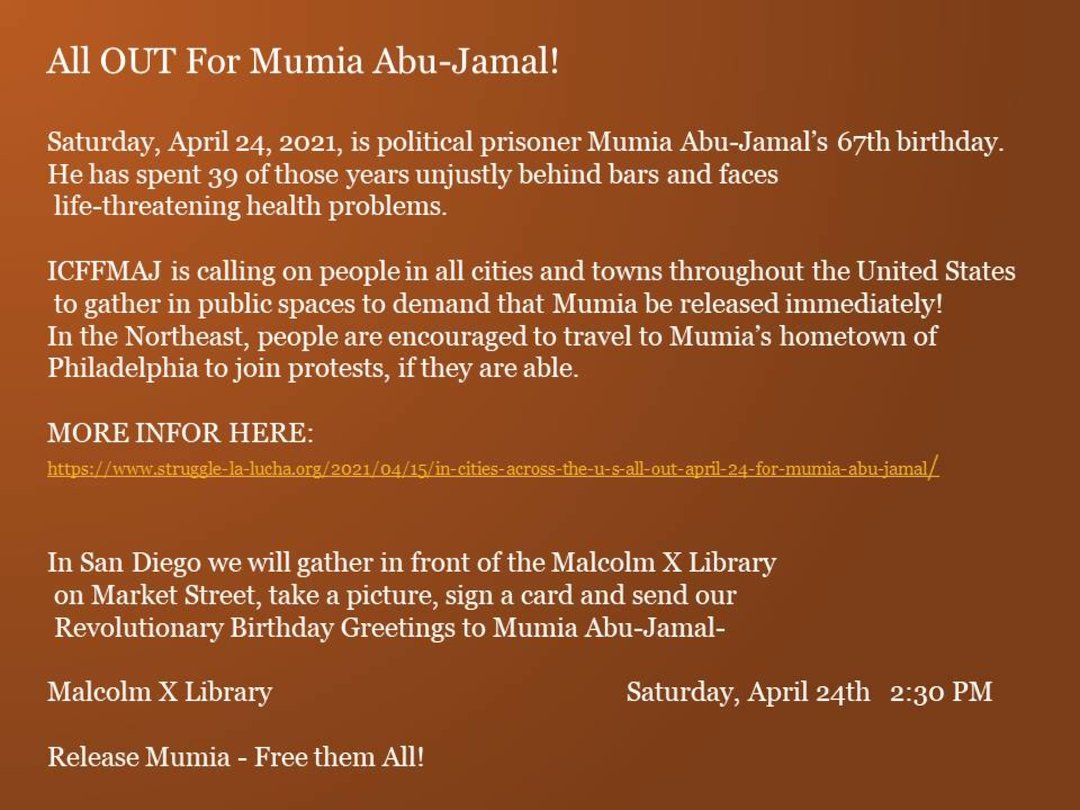
San Diego: All out for Mumia Abu-Jamal, April 24

In San Diego we will gather in front of the Malcolm X Library on Market Street, take a picture, sign a card and send our revolutionary birthday greetings to Mumia Abu-Jamal.

Saturday, April 24 – 2:30 p.m.
Malcolm X Library, 5148 Market Street, San Diego, CA 92114
Release Mumia – Free Them All!

Called by San Diego Coalition to Free Mumia

Strugglelalucha256


International actions demand: End U.S.-Ukraine war in Donbass

Protests were held in at least seven cities across Europe from April 16-20 against the escalation of Ukraine’s war crimes in the Donbass region and the danger of a U.S.-NATO war with the Russian Federation.  

The Anti-Imperialist Front (AIF), an alliance of revolutionary organizations including groups from Turkey, Europe and the former Soviet republics, called for an International Day of Solidarity with Donbass on April 17. Their call was joined by others, including the Red Square-Molotov Club and the Communist Party of the Donetsk People’s Republic.

AIF was inspired by the April 10 protest in New York, initiated by the U.S.-based Solidarity with Novorossiya & Antifascists in Ukraine, and the statement “No U.S.-Ukraine war on Donbass and Russia,” which has gathered numerous endorsements and been reprinted in several languages. 

Borotba, a Marxist organization banned by the U.S.-backed Ukrainian government and a member of the AIF, emphasized the importance of international solidarity with people in the independent Donbass republics of Donetsk and Lugansk. People there face an escalation of the 7-year-long war waged by Ukraine with U.S.-NATO support. 

On April 3, 5-year-old Vladik Shikhov was killed by a Ukrainian drone in the yard of his home in a Donetsk village. He is the youngest of several civilians killed and wounded since Ukraine’s military buildup began in January.

‘Peace to children of Donbass’

Actions kicked off April 16 in Košice, Slovakia. “Communists, anti-fascists and peace fighters held a protest on Main Street in Košice,” reported the organizers. “Residents … expressed their disagreement with war and anti-Russian propaganda in the main media of Slovakia and Europe.

“They expressed solidarity with the persecuted citizens of Ukraine, with wounded and killed citizens of Donbass, with all the people in eastern Ukraine who are victims of the current fascist regime.”

Signs and banners declared, “Stop the U.S. war in Donbass” and “We don’t need NATO bases in Slovakia.” A hand-drawn poster made by students at a local primary school said, “Peace to the children of Donbass.”

In Vienna, Austria, anti-fascists and left activists rallied at the Red Army Memorial on April 17 “For Peace in Ukraine.” “In addition to the red flags of anti-fascism, a poster with the national flowers of Ukraine with the inscription ‘Fascism — never again’ and several posters with slogans against war and fascism were displayed during the rally,” reported the AIF.

Speakers noted that the Western media ignores Ukraine and NATO military threats to the region, only accusing Russia for concentrating its armed forces within its own borders. 

“No one asks about the Ukrainian Army that attacks daily and just killed a 5-year-old boy and other civilians in violation of the Minsk ceasefire agreements,” explained one speaker. “And no one mentions that it was not Russia that moved all its warships to the U.S. borders, while U.S.-NATO troops continue their maneuvers in the Black Sea, which clearly increases tensions.”

Anti-Fascist Action and International League of Peoples Struggle (ILPS) joined AIF at the protest.

NATO bases out!

April 17 was the day of an important protest in Athens, Greece, against NATO military bases. A contingent organized by AIF-Greece carried a banner in the 500-strong march which declared “From Turkey to Greece, from Palestine to Donbass, unite to defeat imperialism!”

A statement from one of the participating groups, Communist Revolutionary Action, quoted U.S. President Joe Biden’s pontifical declaration that “America is back.” The group explained: “The war on the part of Kiev and its imperialist patrons is an unjust, imperialist war. 

“It was Western imperialism that started the unrest, that financed and orchestrated the 2014 coup [in Ukraine] spearheaded by fascists. The coup d’état and the rise to power of the American-backed reactionaries degraded the Russian-speaking population to second-class citizens, directly threatening their very existence and forcing them to take up arms.

“The war on the part of the People’s Republics is just and anti-imperialist. A possible Russian involvement will not change the nature of this war at all.

“The fundamental global task for all who take a stand against oppression and exploitation, and a prerequisite for any positive world development, is the defeat of Western imperialism on all fronts in which it is involved. For those living in the West, this task is even more imperative – as it is the bloc of ‘their’ bourgeoisie which is embroiled in an unjust war.”

On that day in Rome, Italy, a solemn commemoration and march was held to mark 100 years since the first units of anti-fascist partisans were formed to combat the ultra-right. The event was initiated by Patria Socialista (Socialist Homeland) and attended by several communist and anti-fascist organizations. 

Among the featured speakers at the Partisans Monument in Verano Cemetery was Alberto Fazolo of the Donbass Anti-Nazi Committee, who spoke about the current Ukrainian escalation and the important role of internationalists who traveled to Donbass to join the anti-fascist militias. 

In Berlin, Germany, several hundred people gathered to honor the 135th birthday of Ernst Thälmann, a German communist leader murdered in 1944 by the Nazis in the Buchenwald concentration camp. Supporters of the German Communist Party (DKP) called for solidarity with the people of Donbass, and a banner was displayed from organizers of the movement “No Staging Area Against Russia,” which opposes NATO’s war buildup.

The DKP said: “Ukraine’s aggressive policy is openly supported by the USA and NATO. The Federal Republic of Germany, which together with the Russian Federation and France is one of the guarantor states of the Minsk agreements between Ukraine and Donbass, sides with the Ukrainian government; instead of condemning the artillery attacks on the civilian population, it blames the Russian Federation, as it has done so often. 

“In the eyes of the German government, Russia should not station its troops in its own country, while at the same time NATO troops are stationed in ever greater numbers on the Russian border. The danger of war in Europe is increasing considerably as a result of this policy.”

‘The war must stop’

On April 18 in Sofia, Bulgaria, the organization Bulgaria Stronghold held a protest against the war in Donbass outside the U.S. Embassy. Protesters delivered an appeal to the U.S. ambassador, which was read aloud during the demonstration. It said in part:

“The people of Bulgaria disagree in their vast majority with the decisions and laws adopted by your government. Thus, we do not share the recently-signed military minister Karakachanov’s ‘military cooperation road map,’ which marks the continuous development of military preparedness and military capacity of Bulgaria. This is aimed at engaging the Republic of Bulgaria in the war against its alleged and already-designated opponent — Russia, and with it both China and Iran.

“Unfortunately, Bulgaria also contributes [to Ukraine’s war in Donbass] — weapons and ammunition are transferred there. The war must stop!”

In Zagreb, Croatia — part of Yugoslavia before that country’s NATO-instigated breakup — an action in solidarity with Donbass was held on April 20, organized by the Socialist Workers’ Party of Croatia and the Young Socialists of Croatia. Participants demanded an end to NATO military aggression.

Solidarity with Odessa and Donbass

More actions are being planned. May 2 will mark the seventh anniversary of the Odessa massacre. On that day in 2014, in the multinational Ukrainian port city, at least 48 anti-fascists and labor activists were killed when neo-Nazis set fire to the House of Trade Unions and butchered people trying to escape the blaze.

At the initiative of the U.S.-based Odessa Solidarity Campaign, the Red Square-Molotov Club has initiated an international call for actions on May 2 to demand justice for the victims of the Odessa massacre and an end to the U.S.-Ukraine war in Donbass. 

In the U.S., actions are planned in Richmond, Va., and New York City. To endorse or hold an event in your city or town, contact DefendersFJE [at] hotmail [dot] com.

Strugglelalucha256


Why China’s vaccine internationalism matters

As rich nations stockpile COVID-19 vaccines, China is providing a lifeline to Global South nations spurned by Western pharmaceuticals and excluded by the West’s neocolonial vaccine nationalism. So why is China being smeared for its efforts?

United Nations Secretary-General António Guterres called it “the biggest moral test” facing the world today. World Health Organization Director General Tedros Adhanom warned of a “catastrophic moral failure” whose price would be paid with the lives of those in the world’s poorest countries.

Such cautionings of inequitable global vaccine distribution have been shunted to the margins; instead, optimistic chatter of “returning to normal” is circulating once again as Global North citizens line up for their long-awaited COVID-19 vaccine. But normal, as ever, is relative: public health advocates warn that some countries may not be able to even begin their vaccination campaigns until 2024.

Vaccine apartheid is here, and it is revealing once more the ways our world continues to be structured by the geopolitical binaries of colonialism, capitalism, and racism. The People’s Vaccine Alliance reports that rich countries have bought enough doses to vaccinate their populations three times over. Canada alone has ordered enough vaccines to cover each Canadian five times over. Until March, the United States was hoarding tens of millions of AstraZeneca vaccines—not yet approved for domestic use—and refusing to share them with other countries (only under immense pressure did the Biden administration announce it would send doses to Mexico and Canada). Israeli officials, lauded for delivering a first dose to more than half of its citizens, have likened their responsibility to vaccinate Palestinians living under apartheid to Palestinians’ obligation to “take care of dolphins in the Mediterranean.” The European Union has extended controversial “ban options” which allow member states to block vaccine exports to non-EU nations. Meanwhile, countries like South Africa and Uganda are paying two to three times more for vaccines than the EU.

As of March 2021, China had shared 48% of domestically-manufactured vaccines with other countries through donations and exports. By contrast, the United States and United Kingdom had shared zero.

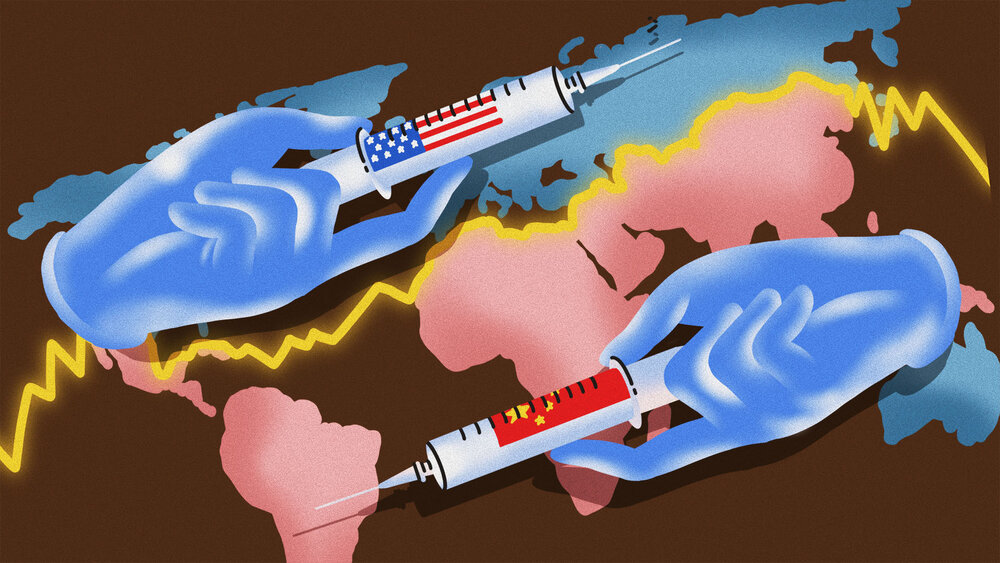
While the Global North hoards global vaccine stockpiles, China—alongside other much-maligned states such as Russia and Cuba—is modeling a very different practice of vaccine internationalism. As of April 5th, the Foreign Ministry reported that China had donated vaccines to more than 80 countries and exported vaccines to more than 40 countries. Science analytics firm Airfinity reported that as of March 2021, China had shared 48% of domestically-manufactured vaccines with other countries through donations and exports. By contrast, the United States and United Kingdom had shared zero. China has also partnered with more than 10 countries on vaccine research, development, and production, including a joint vaccine in collaboration with Cuba.

Crucially, China’s vaccine sharing has provided a lifeline to low-income Global South nations who have been out-bidded by rich nations racing to stockpile Western-made vaccines. Donations to African nations including Zimbabwe and Republic of Guinea, which both received 200,000 Sinopharm doses in February, have allowed those countries to begin vaccine rollouts for medical workers and the elderly rather than wait months or even years for access to vaccines through other channels. Just a week after Joe Biden ruled out sharing vaccines with Mexico in the short term, the country finalized an order for 22 million doses of China’s Sinovac vaccine to fill critical shortages.

Even more, Chinese vaccine aid has reached countries isolated from global markets by sanctions and embargoes enforced by the United States and its allies. In March, China donated 100,000 vaccines to Palestine, a move praised by the Palestinian health ministry for enabling the inoculation of 50,000 health workers and eldery in Gaza and the West Bank who have been cut off from accessing Israeli vaccine rollouts. Venezuela, with many of its overseas assets frozen by U.S. sanctions, received 500,000 vaccines donated by China in a gesture praised by Nicolás Maduro as a sign of the Chinese people’s “spirit of cooperation and solidarity.” China’s international vaccine policy follows the broad pattern of China’s early pandemic aid, which similarly equipped low-income and sanctions-starved nations with the tools to combat the pandemic at home.

From Venezuela to Palestine, Chinese vaccine aid has reached countries isolated from global markets by sanctions and embargoes enforced by the United States and its allies.

In the face of a global pandemic that the U.S. alliance has used as a political cudgel against China, China’s vaccine internationalism has been a natural outgrowth of its philosophy of mutual cooperation and solidarity. From rapidly sequencing the viral genome and making it immediately publicly accessible to world researchers, to sending medical delegations to dozens of nations around the world, China’s pandemic response has been guided by a simple axiom of global solidarity. Xi Jinping made China the first nation to commit to making a COVID-19 vaccine a global public good in May 2020, meaning any Chinese vaccine would be produced and distributed on a non-rivalrous, non-excludable basis. In a telling contrast, that commitment came just as President Donald Trump threatened to permanently freeze U.S. funding to the World Health Organization in an attempt to punish the organization for daring to work cooperatively with Chinese health officials. Chinese Foreign Minister Wang Yi has similarly emphasized vaccine solidarity, urging his colleagues at the United Nations Human Rights Council in February that “solidarity and cooperation is our only option.” Wang chastised countries that he noted are “obsessed with politicizing the virus and stigmatizing other nations” and implored that global vaccine distribution be made “accessible and affordable to developing countries.” China’s record to date shows it is working to follow through on the lofty rhetoric its officials have used to implore global solidarity to defeat the pandemic.

Because China’s vaccine internationalism models a form of multilateral cooperation beyond the scope of U.S. hegemony, it has been met with relentless media propaganda designed to cast China’s vaccination efforts as shady, manipulative, and unsafe. In November 2020, the Wall Street Journal gleefully announced that Brazil had suspended trials of the Sinovac vaccine following an “severe adverse event.” Jair Bolsonaro, the right-wing Brazilian president and Trump ally, declared it a “victory.” Casual observers would reasonably assume that there were serious safety issues with the Chinese vaccine; only closer reading would fill in the crucial context, that the cause of death of the participant was in fact suicide. A similar ruse was exploited in January, as headlines blasted that a Peruvian volunteer had died in the midst of a Sinopharm vaccine trial. Again, behind the salacious headlines was a crucial detail: the volunteer, who died of COVID-19 complications, had received the placebo rather than the vaccine.

Because China’s vaccine internationalism models a form of multilateral cooperation beyond the scope of U.S. hegemony, it has been met with relentless media propaganda designed to cast China’s vaccination efforts as shady, manipulative, and unsafe.

As study after study shows the efficacy of Chinese and Russian vaccines, the media has turned to painting vaccine aid and exports as a dangerous form of “vaccine diplomacy.” Human Rights Watch nonsensically described China’s vaccine aid as a “dangerous game,” citing conspiracies about the research development of Chinese-made vaccines. The New York Times wondered if China had “done too well” against COVID-19, claiming that the government was “over-exporting vaccines made in China in a bid to expand its influence internationally.” Headline after headline bemoaned that China was “winning” at vaccine diplomacy, making clear that Western pundits view the lives of Global South peoples as pawns in a zero-sum game valued only insofar as they further the interests of Western hegemony.

Some advocates say the bias against Chinese vaccines is based both on geopolitics and racist notions of scientific expertise. Achal Prabhala, coordinator of the AccessIBSA project, which coordinates medical access in India, Brazil and South Africa, said “the entire world—not just the West—is incredulous at the idea that you could have useful science in this pandemic come out of places not in the West.” Yet he emphasized the importance of Chinese and Indian vaccines as a “lifeline” to low and middle-income countries, both in addressing vaccine gaps in the developing world and as a “useful cudgel” for negotiations with Western pharmaceuticals.

Despite mainstream media tropes of Chinese “vaccine diplomacy,” it is the United States—not China—whose pharmaceutical companies are employing exploitative tactics to profit from vaccine sales. Pfizer, for instance, has been accused of “intimidating” Latin American governments in their vaccine sale negotiations, asking countries to put up embassy buildings and military bases as collateral to reimburse any future litigation costs—leading countries like Argentina and Brazil to reject the vaccine outright. One can only imagine the media hysteria which would ensue were Sinopharm to be caught demanding overseas military bases as collateral for its vaccine exports. But because it is a U.S. company, Pfizer’s medical neocolonialism has been absolved and flown under the radar.

Despite allegations of Chinese vaccine opportunism, it is the United States which has politicized its recent foray into vaccine exports. During his first meeting with leaders of the “Quad,” an anti-China alliance likened to NATO and consisting of the United States, Australia, India, and Japan, Joe Biden announced his intention to use the alliance to produce one billion vaccines for distribution in Asia in an explicit bid to “counter” China. It is telling that while China stresses global cooperation through channels such as COVAX (to which it has donated 10 million doses) the WHO, and the UN peacekeeper’s vaccination program, the United States is pursuing vaccine diplomacy through a highly-politicized military alliance designed to contain China. Likewise, despite the Biden administration’s lofty rhetoric about its leadership over a global “rules-based order,” it is the United States which has violated a UN Security Council resolution demanding a global military ceasefire to facilitate pandemic cooperation with recent airstrikes in Syria.

Perhaps most egregiously, the United States and other rich nations have blocked a proposed World Trade Organization waiver on intellectual property restrictions which would enable Global South countries to manufacture generic versions of COVID-19 vaccines. Proposed by South Africa and India with the backing of China, Russia, and the majority of Global South nations, Global North obstruction of vaccine IP waivers in the WTO makes clear that the status quo of vaccine apartheid is not an accident, but a product of deliberate policy by Western nations to put the profits of their pharmaceutical companies above the lives of the world’s poor.

Obstruction of vaccine IP waivers in the WTO makes clear that the status quo of vaccine apartheid is not an accident, but a product of deliberate policy by Western nations to put the profits of their pharmaceutical companies above the lives of the world’s poor.

With Global North nations stockpiling vaccines and experts warning that new rounds of vaccinations may be necessary to combat COVID-19 variants, critical vaccine shortages are here to stay. China’s manufacturing power and macroeconomic policy puts it in a position to continue to be the world leader in vaccine production. As of April, China’s Sinovac announced it had reached the capacity to produce a whopping 2 billion doses of CoronaVac per year, thanks in part to Beijing district government efforts to secure the company additional land for vaccine production. China’s vaccine production builds on the successful model of state intervention and coordination through which state-owned enterprises and private companies rallied to construct hospitals, manufacture PPE, and coordinate food supplies during China’s February 2020 outbreak.

The vaccine policies forwarded by China versus the U.S. and its allies serves as a microcosm for two very different worldviews: where China has insisted on global solidarity to defeat the pandemic, the Western world has refused to ease the pressures of its neocolonial regime. While China supports bids for vaccine equity in the WTO and UN, the Global North is bolstering vaccine apartheid for the sake of corporate profits. These differences alone ought to be enough to put to rest vacuous assertions that render U.S.-China conflict as a matter of “competing imperialisms.”

Xi Jinping stressed at the beginning of the COVID-19 pandemic a commitment to “protect people’s lives and health at all costs.” Not when it is profitable, not when it is geopolitically expedient—at all costs. Western obstruction of efforts towards vaccine equity forwarded by China, Cuba, South Africa, and other Global South nations only reveals the very different calculus which governs the West’s continuing neocolonial regime.

Strugglelalucha256


The West is practicing vaccine apartheid at a global level

For rich countries, the billions of dollars of vaccine market for Big Pharma far outweigh the benefits of saving millions of lives.

More than an eighth of the world’s population living in rich countries—the United States, Canada, the UK, and the EU—have access to more than 50 percent of the world’s vaccine doses. According to Our World in Data, about 112 million people in the United States alone received at least a single vaccine jab by April 8. This is more than 12 times higher than the total number of people vaccinated in the entire continent of Africa—which has four times the population of the United States. On April 8, the World Health Organization said that “nearly 13 million of the 31.6 million doses delivered so far [to 45 African countries] have been administered.”

And if we do not count the vaccine doses that have been administered in Morocco—truly an outlier in Africa—as of April 8, the United States has received almost 35 times the vaccine doses that Africa has. No wonder Dr. Tedros Ghebreyesus, the WHO’s director-general, called the distribution of vaccines “grotesque” and “a catastrophic moral failure.” Let us not call reserving the bulk of vaccines for a handful of rich ex-colonial or settler-colonial states “vaccine nationalism.” Let us call it what it is: vaccine apartheid at a global level.

How much of the vaccines manufactured in the rich countries have gone to the rest of the world? The brutal answer is that the rich countries have kept their supplies almost entirely to themselves. Moderna’s vaccine production has mostly been used to inoculate the population in the United States besides supplying it to some countries in Europe and to Canada. Pfizer has supplied its vaccines to the United States from its U.S. facilities, and to Europe and the UK from its European plants. It has also supplied vaccines to Israel and the Gulf monarchies and (begrudgingly) parts of Latin America, but that makes up a small fraction of its total production.

The rich countries have had some squabbles with each other over vaccine supplies—an example of this is the clash between the EU and the pharmaceutical company AstraZeneca and the UK. Perhaps this is why they have had no time to think about the rest of the world.

A comparison of the number of doses manufactured by the rich countries with the number of doses used by them in their own countries provides a clear picture of the extent of vaccine apartheid practiced by these countries. An article in the New York Times in late March reveals how “Residents of wealthy and middle-income countries have received about 90 percent of the nearly 400 million vaccines delivered so far.”

Where has the rest of the world gotten its vaccines from? It appears that the only other sources of vaccines for low- and middle-income countries are the ones being produced by China and India, with Russia providing smaller amounts of vaccines. This is substantiated by various press sources that recount how countries in Latin America, Eastern Europe, Africa, and Southeast Asia are receiving supplies from China, India, or Russia.

How much of the vaccine supplies from Sinovac, a Beijing-based biopharmaceutical company, and Sinopharm, a Chinese state-owned company, was administered locally in China, and how much has been provided to the rest of the world? About 115 million doses have been used in China, and the same amount has gone to the rest of the world, according to an April 5 article in Nikkei Asia, which relied on data provided by Airfinity, an analytics company. Similarly, based on the figures released by India’s Ministry of External Affairs website on April 15, 2021, more than 65 million doses of the Serum Institute’s Covishield vaccine—licensed from AstraZeneca—have been exported to other countries. With the surge in the rate of infection in India recently, the doses exported from India have fallen in comparison to the number of doses it has administered to its own population. According to an April 13 article in Deutsche Welle, “more than 104.5 million people in the country have received at least one dose of the inoculation,” while “India has shipped more than 60 million doses to 76 nations.” China and India are the only two major countries that have been willing to export vaccines while also vaccinating their own people.

To curtail the sharp rise of COVID-19 cases in India, the country is currently prioritizing its supplies and has temporarily halted exports of vaccines from India. This has slowed down vaccine supplies to other countries significantly in March and April and will impact the COVAX program, particularly in Africa, which is heavily dependent on the WHO’s Access to COVID-19 Tools (ACT)-Accelerator program and its vaccines pillar of COVAX.

Sputnik V, developed by the highly respected Gamaleya National Center of Epidemiology, has shown its efficacy in clinical trials. Ramping up its production, however, has been slow. Russia’s production capacity of vaccines is not on the scale of Indian and Chinese manufacturers. While many Indian and South Korean companies have expressed interest in manufacturing Sputnik V, they have yet to start doing so. Only one South Korean company—Hankook Korus Pharm—has started production of Sputnik V, and a large consortium of South Korean companies have signed up to manufacture 500 million doses. Five Indian companies—Hetero Biopharma, Gland Pharma, Stelis Biopharma, Virchow Biotech, and Panacea Biotec—have inked deals with the Russian Direct Investment Fund (RDIF) for setting up a combined production capacity of 850 million doses.

Meanwhile, even as India looks to ramp up its current vaccine production to meet the worldwide demand for vaccines, it has not been able to do so. The Serum Institute of India, the largest vaccine manufacturer in the world, can produce up to 100 million Covishield doses per month and can add to that capacity with additional investments. Similarly, Biological E—which is expected to produce 600 million doses of Johnson & Johnson’s single jab vaccine after recent approvals by the United States Food and Drug Administration—has not been able to begin production. This raises questions about what is preventing these companies from expanding and producing vaccines.

This is where the global media—read: the dominant Western media—fails to inform the people about the bottlenecks in ramping up production around the world. Apart from the intellectual property rights issue, the major roadblock to quickly ramping up global vaccine production is that the rich countries—the United States, the EU, and the UK—have been refusing to export not only vaccines but also the supplies of intermediate products and raw materials required for vaccine production in other countries.

The United States is using a 1950 Korean War-vintage Defense Production Act to curb exports of vaccines as well as raw materials and other inputs vital for vaccine production elsewhere. In a letter to India’s commerce secretary Anup Wadhawan and foreign secretary Harsh Vardhan Shringla, Prakash Kumar Singh of the Serum Institute wrote that by invoking the Defense Production Act, the United States is making it difficult to “[import] necessary products like cell culture medias, raw material, single-use tubing assemblies and some specialty chemicals” to India, according to an article in Mint. The U.S. restrictions, which prioritize Moderna and Pfizer’s vaccine production, harm not only the Serum Institute’s Covishield production but also its efforts to produce another 1 billion doses of Novavax vaccine. Adar Poonawalla, the chief executive of the Serum Institute of India, told a World Bank panel recently, “The Novavax vaccine, which we’re a major manufacturer for, needs these items from the U.S. We are talking about having free global access to vaccines but if we can’t get the raw materials out of the U.S.—that’s going to be a serious limiting factor,” according to an article in the Financial Times.

Similarly, Mahima Datla, managing director of Biological E, which is committed to making Johnson & Johnson’s single-dose vaccine in India, voiced her concern about the U.S. embargo on vital intermediate products and supplies. In an interview with the Financial Times, she said that materials that are a vital part of vaccine production are made only by a limited number of companies that are under the U.S. embargo. Unless the global supply chain is viewed in its entirety, and not with the me-first approach of the United States and the rich countries, we will not be able to control the pandemic.

The Indian government, which looked quite willing to be the Quadrilateral Security Dialogue’s COVID-19 vaccine supplier—as also seen from the joint statement by Quad leaders, “The Spirit of the Quad”—seems to have backed off from any public engagement with the U.S. government on this count. There has been no public response by the government of India relating to the plea of the Indian big generic manufacturers on how to facilitate both capital and the much-needed supplies for rapidly increasing production. Instead, the Indian government has slowed down its export of vaccines to other countries, worsening the global crisis.

The other part of the ugly picture of vaccine apartheid is the vicious campaign mounted against the Chinese and Russian vaccines. It is bad enough that the United States and its allies are not willing to share the vaccine they produce with the rest of the world. Moderna and Pfizer vaccines are not available to most low- and middle-income countries, and even if they were available there, these countries would not be able to provide the ultra-cold chain infrastructure required by these mRNA vaccines. An anti-China and anti-Russia campaign by Western media means that they are willing to deny the global population of any vaccine—even if this means taking on the risk of new variants emerging and the permanent threat of COVID-19 looming large across the world.

The latest in this anti-China campaign is twisting the statement of Gao Fu, the head of the Chinese Center for Disease Control and Prevention, who suggested improving the efficacy of the vaccines being produced by China by mixing them. This is being touted as a “rare admission of weakness” and proof of the poor quality of Chinese vaccines. How are similar statements by AstraZeneca of using Sputnik V as the second dose along with a first dose of AstraZeneca not viewed in the same light?

The figures to show more than 90 percent efficacy for Moderna and Pfizer, and above 62 percent for Oxford-AstraZeneca, compared to supposedly only about 50 percent efficacy for the Sinovac vaccine do not reflect a true comparison. In clinical trials in Turkey and Indonesia, the figures for Sinovac’s vaccine were 83.5 percent and 65.3 percent, respectively. The low figure of 50.4 percent in the Brazilian trial was the result of counting very mild symptoms as positive cases, which other vaccine trials did not count. Data of Brazil’s Sinovac’s CoronaVac trials showed that it provided 78 percent protection in mild cases and 100 percent protection in moderate and severe cases, according to an article in Bloomberg. Esper Kallas from the School of Medicine, University of São Paulo, Brazil, pointed out in an article in Science Magazine, “If you can prevent someone being seen by a doctor by 78 percent and prevent hospital admissions by 100 percent, let’s give a toast and celebrate.”

The good news is that Sinovac’s vaccine is maintaining its efficacy against the more transmissible and dangerous Brazilian P1 variant at more than 50 percent. AstraZeneca’s vaccine has low efficacy (10.4 percent) against the B.1.351 prevalent currently in South Africa, although it was more effective against the B.1.1.7 variant, otherwise known as the UK variant.

I have earlier reported about the World Trade Organization rules and the rich countries’ unwillingness to temporarily suspend intellectual property rights rules so that all the vaccine producers can re-engineer their facilities very quickly to produce COVID-19 vaccines. In the books of the rich countries, the tens of billions of dollars to be earned as profits in the vaccine market by Big Pharma far outweigh the benefits of saving millions of lives. This also explains the vicious campaign against Chinese and Russian vaccines. For Big Pharma and the rich countries, it is profit over lives every time, whether it was during the AIDS epidemic earlier or with the COVID-19 pandemic now.

Vaccine apartheid and support for Big Pharma are driving the policies of the rich countries. It does not matter that these policies will perpetuate the continuation of the global pandemic and the emergence of new variants along with the economic crisis being faced by most nations. Only a powerful movement for people’s health and universal vaccines can beat back the offensive by Big Pharma coupled with the ongoing vaccine apartheid by the rich countries.

This article was produced in partnership by Newsclick and Globetrotter. Prabir Purkayastha is the founding editor of Newsclick.in, a digital media platform. He is an activist for science and the free software movement.

Strugglelalucha256
https://www.struggle-la-lucha.org/2021/04/page/3/