Condemn spate of state terrorist crimes in Southern Tagalog and Bicol regions in the Philippines

The Communist Party of the Philippines and all revolutionary forces condemn in the strongest terms the spate of extrajudicial killings and arrests carried out by the Armed Forces of the Philippines (AFP) and Philippine National Police (PNP) across the Southern Tagalog and Bicol regions. At least 11 people, mostly peasant activists, have been murdered in cold blood by police and military forces since March 1.

Early morning today, at least six activists and prominent leaders of the mass movement were killed and nine others arrested in operations carried out by police and military forces against various democratic mass organizations in Southern Tagalog.

These coordinated attacks in Southern Tagalog come at the heels of successive and coordinated murders by military and police forces in Camarines Norte and Camarines Sur provinces in the Bicol region since March 1 where at least five were killed.

The CPP holds Rodrigo Duterte himself, and his minions in the Armed Forces of the Philippines (AFP) and Philippine National Police (PNP) for these fascist crimes. We single out Gen. Antonio Parlade, commander of the Southern Luzon Command (SolCom), as among the key masterminds behind these crimes. Gen. Parlade has repeatedly red-tagged and threatened various mass organizations.

The murders and mass arrest of activists mark a heightening of the Duterte tyrannical regime’s dirty war against all patriotic and democratic forces in Southern Tagalog, Bicol and across the country. It follows the pattern of coordinated attacks carried out by the military and police against legal mass organizations in Panay, Negros, NCR, NEM, and other regions over the past years.

These attacks confirm that Duterte is the number one terrorist in the country today. He employs the armed forces and police to instill fear among the people in the hope of making them bow to his power. In killing unarmed people, Duterte continues to prove himself a big fascist coward.

The brutal crackdown confirms that the country is under undeclared martial law, after the enactment of the Anti-Terror Law. The attacks are clearly a frenzied response to Duterte’s marching orders two days ago where he told the AFP and PNP to “forget about human rights” and ordered them to “kill, kill, kill” members of the New People’s Army (NPA). Duterte’s counterinsurgency drive, however, continues to expand its scope targetting the peasants masses and legal democratic forces in the cities. To justify the extrajudicial killings, the military and police have resorted to their trite claims that the victims were armed and that they “fought back.”

In his desperation to silence the people and perpetuate his oppressive political dynasty of corruption, fascism and national treachery, more and more attacks are likely to be carried out soon.

We call on the Filipino people to manifest their indignation and protest these atrocious crimes of state terrorism and gross violations of human rights. We urge the friends of the Filipino people abroad to condemn and help expose the brutal attacks and the Duterte regime’s growing list of fascist crimes.

The New People’s Army (NPA) must mobilize its units to help secure the people being persecuted and hunted down by the fascist regime. Targets of Duterte’s state terrorism can be absorbed by NPA units or provided safe haven within the NPA’s guerrilla base areas. NPA commands must take the initiative to carry out tactical offensives to punish the perpetrators and masterminds of these crimes.

Marco Valbuena is the Chief Information Officer of the Communist Party Of The Philippines

Source: Philippine Revolution Web Central

Strugglelalucha256


On International Women’s Day, Palestinian women are on the front lines of liberation struggle

“To our colleagues, to Palestinian students and those around the world, from the heart of the Zionist prisons. On the occasion of 8th of March, we long for freedom, justice and equality for all women of the world, including students, inside and outside the prison cells. Our battle is united, as we are all fighting oppression on the basis of gender, fighting class exploitation and fascist colonialism and foremost among which is the occupation on our land. To our female university colleagues, who are at the front lines of the battle for change, our confidence is in your struggle and resistance that illuminates the sky of our homeland and lights the road for freedom. For all Palestinian women, we believe that our social struggle is an inherent part of the struggle of our people, and for the liberation of land and people, we sacrifice, struggle and bring forth strugglers.” – Bir Zeit University student prisoners, Layan Kayed, Elia Abu Hijleh, Ruba Assi, Shatha Tawil, Damon prison, Mount Carmel, 8 March 2021

“On this 8 March, humanity exposed to the devastation of the Corona pandemic on the one hand, and the regime of tyranny, racism and colonialism on the other hand. A thousand greetings to every voice that resists injustice and oppression. May women remain at the forefront of this resistance, and 8 March stand as a symbol of liberation!” – Khalida Jarrar, imprisoned Palestinian leader, feminist and rights advocate, Damon prison, Mount Carmel 7 March 2021

As we commemorate International Working Women’s Day around the world this 8 March, there are 35 Palestinian women in Israeli jails, representing all facets of Palestinian society: students, activists, organizers, parliamentarians, journalists, health workers, mothers, sisters, daughters, aunts, strugglers, freedom fighters. Palestinian women have always been at the center of the liberation movement through all aspects of struggle and have led within the prisoners’ movement, organizing hunger strikes and standing on the front lines of struggle even behind bars. On International Working Women’s Day, Samidoun Palestinian Prisoner Solidarity Network salutes the leading role of Palestinian women in struggle and urges the immediate release of all Palestinian women prisoners in Israeli occupation prisons.

Palestinian women prisoners include 11 mothers, six injured women and three jailed without charge or trial under administrative detention. They include Khalida Jarrar, Palestinian parliamentarian, feminist, leftist and advocate for Palestinian political prisoners, sentenced to two years in Israeli prison for her public political activities just days prior to International Women’s Day; Khitam Saafin, President of the Union of Palestinian Women’s Committees, jailed without charge or trial, her administrative detention renewed for another four months; Bushra al-Tawil, Palestinian journalist and activist whose detention without charge or trial was also renewed for another four months on 7 March 2021.

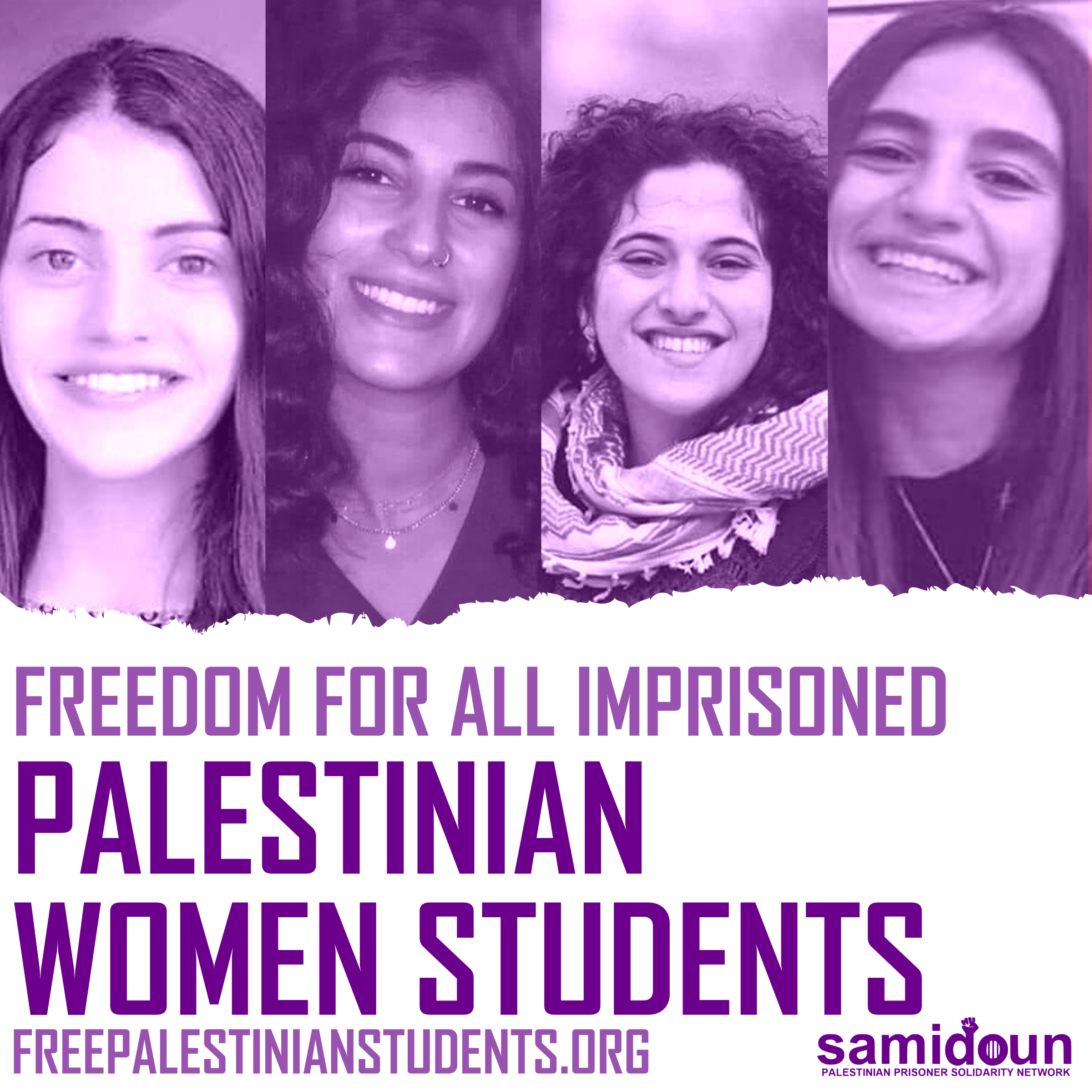
They include Palestinian students, like Layan Kayed, Elia Abu Hijleh, Ruba Assi and Shata Tawil of Bir Zeit University. Hundreds of Palestinian students are routinely detained by the Israeli occupation, especially those who are part of student organizations involved with campus political life. At Bir Zeit University alone, approximately 74 students were detained by occupation soldiers during the 2019-2020 academic year.

Palestinian women prisoners are among 5,000 total political prisoners, but Palestinian women are broadly affected by the mass incarceration of Palestinian men as well. Palestinian women are the mothers, wives, daughters, sisters, lovers and friends of Palestinian male prisoners. They make homes for themselves and their children, denied access to their husbands and fathers. They lead the movement outside prison to highlight the names, faces, voices and stories of all Palestinian prisoners struggling for liberation.

Since 1948 and before, from the earliest days of the Palestinian national liberation movement, Palestinian women have been expelled from their homes and targeted for repression on multiple levels, their very capacity to reproduce and raise their children labeled as an unacceptable threat to the racist settler-colonial project of Zionism. Since 1967 alone, around 10,000 Palestinian women have been jailed by the Israeli occupation for their political activity and involvement in the Palestinian resistance, including Palestinian women in Jerusalem, the West Bank, the Gaza Strip, and Palestinian women holding Israeli citizenship in occupied Palestine ’48. Palestinian women in exile and diaspora have been denied their right to return to Palestine for over 72 years yet continue to struggle, facing political repression, criminalization, deportation and imprisonment.

Palestinian women prisoners are routinely subjected to torture and ill-treatment by Israeli occupation forces, from the moment they are detained — often in violent night raids — and throughout the interrogation process, including beatings, insults, threats, aggressive body searches and sexually explicit harassment. Within Israeli prisons, the official state policy of “worsening the conditions” of Palestinian prisoners has particularly targeted Palestinian women, denied family visits or even phone calls, subjected to intense surveillance that violates their privacy, denied education and held in dangerous and unhealthy conditions. They are transported in the “bosta,” a metal vehicle where women are shackled on a long, circituous trip that takes hours longer than a direct route and often denied access to sanitary facilities.

Damon prison, itself formerly a stable for animals, is located in occupied Palestine ’48 — in violation of the Fourth Geneva Convention, and making it even more difficult for Palestinian women’s family members to visit them. All visits are subjected to an arbitrary permit regime which is often obstructed by the Israeli occupation regime.

However, Palestinian women behind bars continue to resist and to lead. In April 1970, Palestinian women prisoners at Neve Tirza prison launched one of the first collective hunger strikes of the Palestinian prisoners’ movement when they refused food for nine days. They demanded access to women’s sanitary supplies as well as an end to beatings and solitary confinement. Palestinian women have been consistently involved in general hunger strikes and protest actions, including strikes led by women prisoners in 1985, 2004 and 2019 that inspired global women’s solidarity. Despite the denial of formal education by the Israeli colonial regime, Palestinian women prisoners have developed revolutionary education for all prisoners, expanding their knowledge and commitment to struggle.

Palestinian women prisoners are not alone; they struggle alongside fellow women political prisoners in the Philippines, Turkey, India, Egypt and around the world. And their imprisonment is also international: it is funded, backed and supported by the diplomatic, military, economic and political backing given to Israel by the imperialist powers, including the United States, Britain, Canada, Australia and the European Union states. Palestinian women also confront the role of the Palestinian Authority’s “security cooperation” regime under Oslo and the normalization politics and repressive attacks of reactionary Arab regimes.

Despite all attempts of the Zionist regime to isolate them from the global movement for the liberation of women and humanity through imprisonment and repression, Palestinian women continue to organize and struggle from behind bars, in the streets and fields of occupied Palestine, and everywhere in exile in diaspora, seeking return and liberation. On International Women’s Day 2021, Samidoun Palestinian Prisoner Solidarity Network salutes the movement of Palestinian women and their leadership in the ongoing and daily struggle for national and social liberation.

We urge women’s organizations, student organizations and people of conscience everywhere to raise their voices and act in solidarity with Palestinian women, and Palestinian women prisoners, targeted by the Israeli occupation – including by building the movement for the boycott of Israel, its institutions and complicit corporations like HP, Puma, Teva Pharmaceuticals and G4S. The Israeli occupation wants to continue its colonization of Palestine unchecked by isolating and detaining the leaders of the Palestinian people’s movement. Now is the time to act and urge their immediate release and the liberation of all Palestinian prisoners, and of Palestine, from the river to the sea.

Take Action!

1. Join the Campaign to Free Palestinian Students! Over 325 organizations have already signed on to the campaign to take action to free imprisoned Palestinian students. Get involved at freepalestinianstudents.org.

2. Organize protests, demonstrations creative actions. Ad hacks, postering and other outdoor actions – especially near an Israeli embassy or consulate – can draw a significant amount of attention to the Palestinian women prisoners and the Palestinian cause at this critical time.

3. Build the boycott of Israel! Join the movement for boycott, divestment and sanctions against Israel. Highlight the complicity of corporations like Hewlett-Packard and the continuing involvement of G4S in Israeli policing and prisons. Build a campaign to boycott Israeli goods, impose a military embargo on Israel, or organize around the academic and cultural boycott of Israel.

Resources on Palestinian women prisoners

We recommend the following resources for more information on Palestinian women prisoners:

Strugglelalucha256


International Women’s Day founder Clara Zetkin on fascism, a lesson for today

On many holidays recognizing people’s struggles and their leaders — for example, the civil rights movement and Dr. Martin Luther King Jr. — the present-day celebrations are both sweet and sour. 

The only reason for formal recognition is that protests and struggle made it so — and this is a victory. But the other, “give it the side-eye” part is that the actual history of how they originated is covered up in pink ribbons. 

The blood, sweat and tears that were shed have been washed away. 

International Women’s Day is like that. So much has been done to sterilize it, package it, market it, capitalism-it (my made up word) — foremost in the capitalist West, of which the U.S. is the capital. 

But the beating heart behind all of the fancy images and representations is still strong, red and has the potential to change the world. Its red tail pokes out from under all of the corporate debris. 

The courage of the Black women workers at Amazon’s Bessemer, Ala., warehouse standing up to Jeff Bezos, one of the richest men in the world — Indigenous women resisting gender violence, murder and plunderous oil pipelines — immigrant/migrant women fighting for their survival — teachers and nurses resisting COVID-19 — are the continuing heartbeat of International Women’s Day.

So too are the women in Haiti taking to the streets despite rightwing violence; the women in India resisting Modi and fighting for the rights of poor farmers; and the women of Brazil, Argentina, Ireland and Poland fighting for control of their bodies — they are its heartbeat. 

And no amount of praise can be spared for the women of Cuba, China, Zimbabwe, Iran, North Korea, Yemen and so many countries’ women who are resisting sanctions and U.S. imperialism. 

After all, International Women’s Day was founded on the idea of international solidarity of working and poor women around the globe, and recognized first by the world socialist movement on March 19, 1911.

International Women’s Day is 110 years old

Clara Zetkin was its original heartbeat, and she definitely had a red heart. 

While advances in human history are never the product of one person or leader, but rather the result of social and material conditions that compel the intervention of masses of people, leaders and their organizations are an indispensable product of that process. 

They can’t be separated from these earthquakes, placed above or below it, but rather play an indispensable role in guaranteeing its success. Intense struggle, in the form of huge strikes, protests in the streets, sit-downs at the workplace, occupations and ultimately insurrections and uprisings, are the engine of change. 

In the case of International Women’s Day, you could call Clara Zetkin the tireless driver of that engine. 

During this period, women in Europe and other parts of the world were emerging from feudalism and slave-like conditions, where they were subjugated to sexual abuse, isolated in their homes and villages as serfs and peasants; only to be forced into a new kind of slavery, toiling alongside their children in the brutal sweatshops of capitalism.

In these new conditions, revolutionary socialist and communist women agitated and organized women workers to resist even when this meant doing so under illegal conditions, subjecting them to jail and exile.

The First World War compounded suffering in unimaginable ways. It brought death and starvation, but it also brought resistance, especially by women.

While the declaration of International Women’s Day was made in Europe, Zetkin’s aim as a revolutionary socialist and communist was that it would be international in scope, uniting women across all boundaries. 

Inspiration from New York City

One of the earliest of women’s protests that helped fuel the movement took place in the United States on March 8, 1908. Thousands of women garment workers, mainly immigrants, took to the streets demanding their rights. 

This was followed a year later with the 1909 “Uprising of the 20,000,” also called the New York shirtwaist strike, a three-month garment workers’ strike. 

Women kick off a revolution

But the unforgettable turning point that sealed the deal was when the women of Russia touched off a revolution. 

On March 8, 1917, striking women textile workers joined other women attacking bakeries over high bread prices in Petrograd, Russia. They implored soldiers to put down their rifles. 

Some 90,000 protesters took to the streets demanding “peace, land and bread.”

This was the opening salvo that toppled Russia’s hated czar and in less than a year, the workers, peasants and the poor led by the Bolshevik Party took power in November 1917. 

While encircled and under attack by the imperialist powers, they formed the first socialist workers’ state. One of the very first things the new Soviet revolution did was codify women’s equality.

Zetkin the theoretician, organizer and doer

While Clara Zetkin dedicated much of her time and effort to the cause of working class women, she was simultaneously a thinker and writer, what we call a theoretician, and as a revolutionary, a doer, organizer and participant. 

Sometimes there were painful splits and conflict. Zetkin left the Socialist Party of Germany in 1916 because of its imperialist pro-war position and, along with Rosa Luxemburg, helped pave the way for the founding of the Communist Party of Germany. 

She was jailed repeatedly for opposing World War I. Remarkably, Lenin met with her to strategize on the question of women. 

Another part of Clara Zetkin’s story — fighting racism

Zetkin was fiercely opposed to Jim Crow and lynching in the U.S. South. 

She played a major role in building international support for the Scottsboro Case (1932) of nine Black teenagers falsely accused of raping two white women. They were found guilty and Alabama sought the death penalty for 8 members (the ninth member was only 12 years old). While they were eventually freed, it took years before the teenagers were released.

You can find Zetkin’s call, “Save the Scottsboro Black Youth,” in “Clara Zetkin: Selected Writings” edited by Philip Foner with a foreword by Angela Davis. 

Zetkin and right-wing putsch at U.S. Capitol

As we continue to discuss the January 6, 2021, events at the U.S. Capitol, we can evaluate and learn from Clara Zetkin.

Zetkin understood the causes of fascism, connecting it to the decay of capitalism, urging socialist and working class unity. Rather than poorly summarize it for you, you should read and study Zetkin’s report given on June 20, 1923, to the Communist International: “The Struggle Against Fascism.” 

Zetkin’s writings, presentations and polemics were not abstract. She did not have the luxury of looking back but rather had to write in the middle of the maelstrom. This makes her contributions sharp and even more remarkable.

At the age of 75, gravely ill and nearly blind, she spoke for an hour in the German Parliament (Reichstag) on August 30, 1932, as Nazis yelled death threats at her. 

When Hitler came to power, Zetkin was forced into exile and lived her last days in the Soviet Union. She was 76 when she died on June 20, 1933.

Clara Zetkin lived an amazing life, filled with hardship and struggle. She endured the murder of her close friends and comrades Rosa Luxemburg and Karl Liebknecht, but she also witnessed the birth of the Soviet Union and saw genuine advancements for women. 

This real history cannot be shoveled underground. 

Zetkin’s red heart will remain with us.

Strugglelalucha256


Minnesota activist coalition to protest on March 8 for justice for George Floyd

Minneapolis — A coalition of 20-plus Minnesota activist organizations plan to protest outside the Hennepin County Government Center in downtown Minneapolis at 8 a.m. on Monday, March 8, the first day of the trial of Derek Chauvin. Chauvin killed George Floyd in May 2020.

Family members who are enduring the aftermath of police murder will speak at Monday’s protest. Toshira Garraway of Families Supporting Families Against Police Violence states, “Justice delayed is justice denied. An injustice to one of us is an injustice done to all of us.”

The government is barricading downtown Minneapolis. “Hennepin County thought they could stop our protest by posting notices prohibiting protest signs, noise and ‘offensive slogans.’ We made it clear that we would take them to court if necessary, to defend our First Amendment rights. A few hours later, those signs were down,” said Michelle Gross with Communities United Against Police Brutality, another coalition member.

Cities around the country will protest on March 8, and on key dates of the trial — including verdict day.

This past Friday, March 5, the MN courts ruled that Chauvin could also be tried for third-degree murder.

The Twin Cities Coalition 4 Justice 4 Jamar is the coordinating the March 8 protest.

The coalition also includes the Anti-War Committee, Bikers Riding Against Police Brutality, Black Lives Matter MN, CAIR-MN, CAIR-MN, Climate Justice Committee, Communities United Against Police Brutality, Families Supporting Families Against Police Violence, Freedom Road Socialist Organization – Twin Cities, Good Trouble for Justice, MN Immigrant Rights Action Committee, MN Uprising Arrestee Support, MN Workers United, MN Youth for Justice, NAACP – Minneapolis, National Alliance Against Racist & Political Repression, Native Lives Matter, On Site Public Media, Racial Justice Network, Student Movement Activists at South High (SMASH), Students for Democratic Society at UMN, and Women Against Military Madness (WAMM).

Source: FightBack! News

Strugglelalucha256


It’s not your fault

New York Gov. Andrew Cuomo may be forced to resign. Several women have come forward to say he’s a serial sexual harasser and all around creep.

Meanwhile 15,000 people have died of Covid-19 in New York nursing homes. Many were warehoused there to free up space in hospitals. 

New York State Attorney General Letitia James estimates that nursing home deaths were deliberately undercounted by much as 50 percent. Cuomo’s aides started to fudge the figures last June. 

Before Cuomo went into free fall, the capitalist media treated him as a superhero for his supposed leadership during the pandemic. He was even awarded an Emmy for his news conferences.

During one of these presentations last November, the governor and moral philosopher offered these words of wisdom: “If you socially distance and you wore a mask and you were smart, none of this would be a problem. It’s all self-imposed. … If you didn’t eat the cheesecake, you wouldn’t have a weight problem. It’s all self-imposed.” 

It’s obscene for Cuomo to talk about cheesecake when hungry people line up at food banks.  

Was it “self-imposed” for 151 New York City transit workers to die of the coronavirus? These absolutely essential workers who keep the buses and subways running were initially told by the Metropolitan Transportation Authority not to wear masks. 

The safety measure was considered a violation of the MTA’s dress code. Cuomo runs the MTA.

How are poor and working people supposed to socially distance themselves in overcrowded housing? Death rates for Black and Latinx people from COVID-19 are double the U.S. average.

It was Andrew Cuomo’s daddy ― Gov. Mario Cuomo ― who stole $8 billion that was supposed to be used to build affordable housing and spent it to build 30 prisons instead.

The myth of “free to choose”

There’s nothing new about Cuomo’s awful remarks. For centuries, the ruling class has told poor people that their misery was their own fault.  

The economists Milton Friedman and Rose Friedman wrote “Free to Choose” in 1980. The book and television series claim that under capitalism people are free to choose their life.

The peoples of Africa and the Americas didn’t choose enslavement and genocide. The capitalist world market was jump-started by the enslavement of African peoples and the genocide of Indigenous peoples throughout the Americas.

The peoples of Asia didn’t choose to be pillaged for centuries by European and U.S. imperialists. 

Even during periods of capitalist “prosperity” millions are jobless. People didn’t choose to be fired when thousands of factories and other workplaces shut down.

The army of people who collect bottles and cans for the deposit don’t choose to go through garbage bags. They do it in order to eat.

Apologists for capitalism tell the unemployed to start their own business. Millions of street merchants have done so only to be harassed by cops.

Trump wanted veterans who were selling merchandise in front of Trump Tower to be arrested. New York City police shot 41 times at Amadou Diallo, killing the street merchant in front of his home on Feb. 4, 1999.

It was in order to start a career that 45 million people in the United States own $1.71 trillion in student loans. That’s an average debt of $38,000 they owe to legal loan sharks.

What the Friedmans really meant by “freedom to choose” can be seen in Chile. On September 11, 1973, the CIA and Chilean Gen. Augusto Pinochet overthrew the democratically elected president Salvador Allende.

Thousands were murdered and tens of thousands were tortured. Milton Friedman visited his pal Pinochet twice and called his bloody regime the “Miracle of Chile.”

Choose socialism

Revolutionaries want people to make choices, too. We want Amazon workers in Bessemer, Ala,. to vote for union wages and protection.

We want poor and working people to choose to make a socialist revolution. That’s the only answer to a decaying capitalist that’s cooking the earth.

Socialists want our class to read more and in many cases to learn to read. A growing socialist movement will open up its own schools.

We want people to better themselves. That includes personal struggles, like losing weight. That’s why we call our newspaper Struggle-La Lucha. 

Only after capitalist exploitation is swept away can billions of people can really choose to control their own lives.


Strugglelalucha256


Struggle ★ La Lucha PDF – March 8, 2021

Get PDF here

  • Amazon workers fighting for a union
  • Union rights are human rights
  • Clara Zetkin on fascism
  • Demand for hazard pay spreads
  • Black elevator operator helped forge the SEIU
  • My experience with COVID-19 in Los Angeles
  • Begging for a vaccine
  • Judas and the Black Messiah
  • Mumia must have COVID care
  • Another side of Black History
  • End Haiti dictatorship
  • Two victories in Cuba shape the world today
  • Youth Against War & Racism condemns Biden-ordered airstrike on Syria
  • Puerto Rico es un estado fallido
Strugglelalucha256


I live proud to be a woman and to be Cuban

Adriana Pérez Oconor has been a chemical engineer since 1995. She currently works at the Food Industry Research Institute and holds a master’s degree in that specialty. But it is not precisely her professional performance, nor her outstanding work as a member of the National Assembly of People’s Power, in the period between 2013 and 2018, that is the main purpose of this interview.

This woman, with whom we spoke just a few days before International Women’s Day on  March 8, went from despair to the absolute happiness she lives today, in the company of her three children – Gema, Ámbar, and Gerardito – and her husband Gerardo Hernández Nordelo. This happiness, however, was preceded by an anguished road, which she only managed to travel by clinging to the courage inherited from Mariana, Celia, Haydée, and Vilma, among many other courageous Cuban women.

What was your reaction when you learned of Gerardo’s real mission in the United States?

When Gerardo left Cuba for the United States, we were already married, and when he was arrested in 1998, we had been married for ten years. I was finishing the last year of my degree through a course for workers, as I was working at the Tenería Habana company at the time.

The knowledge of Gerardo’s real mission was a real shock for me, a big surprise. As far as I knew he was in a Latin American country doing a master’s degree linked to his diplomatic career and I never knew about his mission until the whole network was discovered and its members arrested. When he was arrested, he had been in the United States for about four years. When I heard of his arrest, I learned of something that I never even suspected, nor did I imagine that he could be linked to this type of activity, being arrested for espionage, as was initially mentioned in the news reports broadcast by radio stations in Florida and that was the only public information that was given at the time. It was actually a mixture of emotions because first I had to assimilate the news. And second, how I would face a future that was totally uncertain and not at all promising.

On the other hand, there was the family situation. Gerardo’s mother was alive and completely unaware of the activities of her youngest and only son. In that same year, she had lost a daughter, and for her, this news would be too much of a blow, much harder still. In other words, the news not only had a personal impact but also had an impact from a family point of view. This meant that I had to prepare myself psychologically for the role I would have to play from that moment on. Information that to make matters worse, had to be kept secret and assumed in silence, which demanded all my efforts, all my creativity, and all the sentimental resources I could summon.

From that moment on I was obliged to impose myself on a world that I knew from the beginning was very difficult to cope with. I have often been asked how I managed to do it and I have never been able to give an answer because I still don’t know how I did it. But I think that as time goes by, you gather strength, willpower, resources, and energy to face the new challenges that life imposes on you. And to face those challenges with emotional balance, I began to create a kind of armor that would allow me to live in tune with what was happening and at the same time take on what was coming. I was always convinced that it would be a very complicated road to walk, especially if we take into account how relations between Cuba and the United States have historically been.

At no time, however, did I stop working and, on the contrary, I looked for things to occupy my mind, to keep me from thinking. I finished my master’s degree and began to study language, studies in which, although I never prospered, kept me mentally busy. At that stage, the most difficult thing for me as a person, as a human being, was the role I had to assume with respect to Gerardo’s family. He always had a very close relationship with his mother. He had inherited her nobility, her sense of humor. It was a great responsibility for me to try to cover for his absence. And I had to lie, lie a lot, something that is an element that had never been part of my personality before, that I had never even conceived of in my behavior before. I lied to everybody, I had to evade comments, I had to remain silent all the time and it was terrible. In fact, I was never able to do it and, albeit half-heartedly, I was revealing some parts of the truth that I kept hidden from people close to me, like my mother, who from the beginning of our relationship felt great affection for Gerardo.

Of course, all our dreams, illusions, plans, were shattered, shattered. I was left with only two options: either I let the knowledge of Gerardo’s activities crush me, or I could start from the new conditions. Either I threw myself to die, renouncing everything I had lived, everything I had, everything that had made me happy and that I admired, or I began to walk this new path, dragging the sack in which I had thrown everything that had been broken, except love, which was the only thing that remained intact. I decided on the second option and began to adapt my plans to coincide with the great challenges that the new circumstances brought with them.

And from that decision, I set myself goals. The most important thing was to reach the end, even though I never knew when it would be. But I set out to reach that end with the necessary emotional balance to keep me strong and at the same time, to take care of all the fronts I had open, which were to attend to my work responsibilities and to give emotional support to the two families, especially Gerardo’s. I also tried to remain socially active and to maintain good physical and mental health.

During the relentless struggle for the release of the Five, did you ever feel alone?

I always had the extraordinary support of all these people. I also had the valuable support of my family, of the families of the Five, who became one. I had the same support from my friends – who are many and very valuable – and from my work colleagues, who, when Gerardo’s situation became public, helped me even more. It was my colleagues who took up my absences when I participated in the solidarity campaigns in favor of the Five, in the meetings held inside and outside Cuba. They worked hard to keep the work going, taking care of my image as head of the production department. We became a great team.

Of great importance was also the support I received from Dr. Jesús Llanes Querejeta, who was my boss at the time. Professionally I learned a lot from him, as well as from his intelligence, discipline and optimism.

I cannot hide the fact that I had several moments of weakness. In that first stage of silence, which in my opinion was the most difficult, I experienced very hard, sad and painful moments. This is not to say that when our government released the information publicly and officially, my mood was better, but the situation became a little more bearable. There were days, for example, when I didn’t know how I was going to get up and if I did get up I didn’t know how to walk. In public, I always showed great strength, but when I got home and closed the door, that strength left me, and again I saw before me the sky joined to the earth. All the armour I had forged, which I kept outside, disappeared. At those moments, loneliness, nostalgia, uncertainty and longing took hold of me. However, I quickly thought: if out there, in the streets of Cuba and not a few countries in the world, there are thousands of people who are not related to the Five, who probably don’t even know them and are demanding their freedom, how can I, as the wife of one of them, be weak.

That thought forced me to get up, to get going again. And so day after day I searched for resources to cling to when I was alone. Publicly I could not, it was not fair for me to show the slightest sign of weakness, when there was, I repeat, an entire people who, moved by their patriotism, humanism, solidarity, demanded the right of their children to be in their homeland. In reality, I lived through very, very difficult, very sad times, even in some international events, which became repetitive and I almost never saw a light that could be taken as a sign of progress. Many people participating in those events did not understand that we were not telling a story, but that we were living that story, that we were part of it.

How did you deal with the two life sentences unjustly and arbitrarily imposed on Gerardo?

I knew Gerardo’s sentence immediately because kind people present at the trial informed me of it. I think it was a problem of temperament, of character, or that it was already difficult for me to be surprised by something, that could make me collapse, but the truth is that the judge’s verdict did not alarm me. The trial took place in 2001 and the conviction was announced at the end of that year. I already knew, from the guilty verdict on all charges that had initially been handed down, that the sentence would be far from lenient and I prepared myself for life imprisonment, but never for the death penalty. And as I always kept that sentence in mind, I began to analyze what could happen next. Without writing it down, I made a kind of mental timeline, or goal, where I had programmed: I have the strength to get to the sentence, and after that I have to create new handles for myself again. I also had six months between the trial and the final sentence which allowed me to draw up a strategy and the steps I had to follow.

During that time, a few things also happened: between June and December we prepared a video that we respectfully sent to the judge. In that recording we referred, from a humanitarian point of view, to who they were, highlighting their values. During that period, the terrorist attack on the Twin Towers also took place. And a letter to the Americans had also been made public, acknowledging that the Five had never harmed the people of the United States. There were two possibilities: one that they tried to prevent acts like the one that happened in the Twin Towers, or two, that people like them could prepare actions of this kind. In the end, we think that the judge leaned towards the second possibility because of the very strict, harsh and arbitrary verdict she issued. The judge’s behavior allowed me to prepare myself for the tougher, more complex scenario. For me it meant one life sentence or two life sentences because we always agreed that until the last one came out, we would continue our battles, our campaigns.

The conviction did not come as a surprise to me, it was not as shocking as the first news I had received when Gerardo was arrested. In fact, I did not cry that day. I had already prepared myself emotionally to bear it. I was fully aware that both Gerardo and his comrades were innocent of the charges against them; but the sentences were not for them, they were simply aimed at punishing the people of Cuba. It was demonstrated that in every conviction, particularly Gerardo’s, there was a political rather than a legal component.

Sustained by the resolve that I had to go all the way, I adapted my approach to the new reality I was facing. The situation was much more complex and to live up to it our struggle had to be political and public. That would be the way forward. I remember that one day I said to my mother-in-law: it doesn’t matter if I’m 80 years old, I’m going to wait for him, I’m going to receive him mentally healthy. And that’s what I did after the sentence. There was no way and no matter what happened I could weaken, and I started to be stricter with myself, I had to make demands on myself to correspond with the new reality that arose after the trial and I think that was what hurt me the most. My life strategy was to prepare for the future day by day, even though I had no idea when it was going to come. But I still did what I could every day. Gerardo always taught me that: live each day as if it were your last. And that’s what I did, even though I felt that all the sentimental burden I was carrying was hardening me. I got so hard that I reached the last stage of the campaign terribly exhausted from a sentimental point of view. Despite this exhaustion, I found the strength to welcome Gerardo, Ramón and Tony when they finally arrived in their homeland on December 17, 2014.

Despite the fact that Gerardo’s case was the most difficult and tangled to resolve judicially, you decided to become a mother. Why?

The truth is that I had no plans to have a child. Within the life strategy that I had drawn up for myself from 2001 onwards, with the arrest of Gerardo and his companions, and subsequently his two life sentences, with no possibility of visits in our case, of meetings, of the reinforced intention of the U.S. government to keep us separated, I totally dismissed the idea of being a mother, because in addition to all this, there was my biological clock that had to be taken into account.

Gerardo was the one who supported this dream of parenthood the most. So out of respect, because I thought he really deserved it, I changed my mind. Although in reality, it was more of a mutual agreement. He thought that for me as a woman it would be very sad not to become a mother and he felt responsible for it. Whereas I was thinking about the happiness it would bring him, in the midst of his confinement, to have a child.

Also, many people who were part of the campaign urged us to have a child, we were a young couple and therefore we had that right. Several people were sensitized to the idea, in Cuba and abroad. Among those who supported us the most were Vilma and Raúl, creators of a beautiful family. Also Olguita, René’s wife, a very sensitive person and mother. In the meantime, my biological clock was ticking.

It was in those days that Gerardo wrote his letter “To the children yet to be born”. That made me so sensitive that I decided to undergo the process of vitro insemination, which was not even widely performed in Cuba. My eggs were saved so that one day they could be inseminated. In a conversation with U.S. Senator Patrick Leahy, who was visiting Havana with his wife, I mentioned to him that Gerardo and I had been deprived of so many rights that we could not even have a child, which is the greatest aspiration of a married couple. He, however, was the father of four children, as well as having grandchildren and even great-grandchildren. Apparently, my words touched him deeply and he became one of the most supportive foreigners. When I was told later that everything was ready to begin the process of assisted reproduction, I thought it was a trick, another mockery of the U.S. government. But no, there she is, our first daughter, our Gema.

From what you have lived, from your own experiences, what do you think of Cuban women?

In that sense, the first thing I need to say is that I feel tremendously proud to be a woman and a Cuban. Very, very proud. In our campaigns for the Cuban Five, both in Cuba and abroad, we have always had the immense support of precisely the women’s umbrella organization. The Federation of Cuban Women, through its eternal president Vilma Espín, opened the doors so that we could proclaim our truth on any stage, even the most complex. In those events and meetings, through our voices, Cuban women spoke.

I believe that women are the backbone of the family and we have achieved this through our lineage. We are strong-willed, unbreakable, courageous and determined to face and overcome any obstacle in order to reach the proposed goal. It is precisely because of the perseverance that characterizes Cuban women that I have managed to reach this point with all my dreams turned into a beautiful reality.

When I speak of Cuban women, the example that comes to mind is that of the world record holder athlete Ana Fidelia Quirot, who was able to overcome her accident and return to competition. In the same way, I think of those women scientists, in general of all those women in the health sector, who remain in the danger zones in the confrontation with COVID. They constantly risk their lives to save the lives of others. A very important role is also played by housewives, who, like all women, with their daily work, with a simple smile, with that healthy and spontaneous vanity, beautify everything around us.

The first Latin American woman to be awarded the Paloma de Plata trophy by the Russian Federation, Adriana Pérez is also the recipient, like the other wives of the Five Heroes of the Republic of Cuba, of the 23 de Agosto Medal and the Order Ana Betancourt. Today, she says with emotion, she is immensely happy because “I have Gerardo and my children by my side. But I would never have been able to reach this moment, which I could not even have dreamed of years ago, if I had not had the support, the great and selfless support of hundreds of thousands of people, who came from the most remote corners of Cuba and the world, fought, as much as we did, for the release and return of the Five. To them, to those who are sadly no longer with us, to my family, friends, neighbors, and work colleagues, my sincere and eternal thanks.

Source: La Jiribilla, translation Resumen Latinoamericano, North America bureau

Strugglelalucha256


Open letter to Facebook denouncing the censorship of anti-imperialist activists

March 1, 2021

Facebook has recently waged a war on the accounts of progressive organizations and progressive individuals. Subsequently, a litany of progressive organizations has released statements and taken actions condemning Facebook’s censorship of anti-racist and working-class groups.

Zheila Ommani is an Iranian anti-imperialist activist and Ph.D. candidate in southern California. She hails from a long line of anti-imperialist activists, including her mother, Ellie. For over a decade, Zheila has used her Facebook account to promote her positions and establish a professional network. On January 27, 2021, Facebook permanently disabled her account.

Facebook’s attacks on Zheila are a product of her progressive views. Zheila consistently employed Facebook to not only criticize the Trump Administration’s war mongering but also President Biden’s positions towards Iran and other oppressed nations. Her concerns were vindicated when the Biden Administration bombed Iranian installations in Syria, as thousands of Texans froze and starved.

The deactivation of Zheila’s account comes amidst an abundance of similar actions against the Socialist Unity Party, the Peoples Power Assembly, other progressive organizations, and the publication Struggle for Socialism. Facebook appears to be determined to sustain these attacks even in the face of public outcry. Facebook’s actions violate free speech, free expression, and free assembly.

Furthermore, Facebook demonstrates a double standard regarding left-leaning organizers versus reactionary organizers.  While Facebook allows racists and fascists to spread hateful bile, it silences anti-war activists, such as Zheila.

Because Facebook’s actions are baseless, unethical, and illegal, the undersigned attorneys, activists, and organizations demand the immediate reinstatement of Zheila’s account and an end to its attacks on anti-racist and anti-war organizers.

If Facebook is unwilling to do this, legitimate reasons for the deactivation of Zheila’s account must be provided.

Signed,

Alec Summerfield, Community Attorney, Harriet Tubman Solidarity Center Baltimore
Baltimore Peoples Power Assembly

Strugglelalucha256


The Los Angeles police gangs you should know

Spartans, Regulators, Grim Reapers and the Banditos. These are just some of the names of the gangs that run the largest sheriff’s department in the world. 

The first publicly-reported case of a “neo-Nazi, white supremacist gang” within the Lynwood station of the Los Angeles County Sheriff’s Department occurred in just 1971, with a totaled $9 million lawsuit involving the Vikings, whose members were eventually fired or resigned. Though LA County is familiar with these secret societies and the continual acts of murder, perjury, blackmail and other forms of police brutality, newly-elected District Attorney George Gascón denied the existence of gangs within his department.

In February 2021, a Superior Court judge dismissed the latest lawsuit from a deputy and veteran in the Compton Sheriff’s Station who called out the Executioners and their criminal activity, illegal arrest quotas and unlawful punishments. Another 63-page lawsuit in October exposed the Banditos, one of the most notorious gangs currently taking over the county, as promoting violence and criminal behavior towards local residents. 

Along with retaliation and battery claims from other officers, Black and women deputies are reportedly not allowed in these cliques (though a gang consisting of Black officers has also been discovered). Los Angeles County Sheriff Alex Villanueva has denied the existence of gangs, yet allegations say he is one of the prominent ringleaders of the Banditos. The group of 90 deputies mark themselves with matching tattoos of a skeleton with mustache, sombrero, and pistols control the East LA station. 

The police murders of Anthony Vargas and Andres Guardado were victims of the police gang “initiation” process. Despite the composition of a few notorious LA police gangs, they all uphold racism and white supremacy. It’s why they are allowed to exist. Police gangs, predominantly white, are primarily responsible for the 900 killings by police since 2000. Almost all of them being men and nearly 80% Black or Latinx. Within Los Angeles alone, reporters, journalists and whistleblowers have accounted for more than a dozen gangs currently present in the sheriff’s department, yet time and time again we see lawsuits overturned, internal investigations coming back with no findings, and county officials denying any existence of historical claims. 

The truth lies beyond the LASD’s farce and seems nearly untouchable from the latest findings that shootings in Los Angeles have more than doubled this year alone, while overall crime has dropped 26%. A federal grand jury investigation has opened its own probe into the Banditos, though it is still unclear what their findings were from the 2011 investigation into reports of inmate abuse from deputies working in county jails and countless episodes of corruption and mismanagement in the sheriff’s department.

Strugglelalucha256


The attack that never happened: Cuba and the U.S. fantasy of sonic attacks

They called it “sonic attacks,” “health incidents,” and “Havana syndrome.” In September 2017, the United States government decided to withdraw all nonessential personnel and their families from their country’s embassy in Cuba. This decision was based on alleged inexplicable noises whose causes were unclear. Word spread that about 20 diplomats reported symptoms as varied as dizziness, vertigo, mental confusion, partial deafness, sleep deprivation, and gaps in basic vocabulary, supposedly caused by exposure to persistent sounds of unknown origin in their homes or hotel rooms.

The Cuban government denied over and over again that it was responsible for this strange disease that neither the laws of physics nor dozens of scientists from a wide variety of disciplines could explain. If, according to various versions by Trump’s State Department, the cause were a sonic or microwave weapon, how could the waves have been perceived by certain people gathered in the same place and not others? How could a strong energy emission have had a selective effect? Did someone have James Bond’s magic ray gun? Was it SPECTRE (Special Executive for Counterintelligence, Terrorism, Revenge, and Extortion), the secret organization that the most famous spy in British films fought against?

The National Security Archive, an independent nongovernmental research institute, based at George Washington University, recently released the executive summary of a 2018 report from the State Department’s Accountability Review Board (ARB) after a four-month investigation. The strange attacks against U.S. diplomats in Havana served as a pretext to initiate the Trump administration’s sanctions against Cuba—242 measures in four years applied against a single country, an unprecedented record in U.S. foreign policy.

The report states that CIA agents in Havana were the first to raise the alarm about the strange symptoms. We do not know what these spies were doing. Still, considering the long history of more than 60 years of a dirty war against Cuba, assassination attempts, and fanciful plans against Fidel Castro, such as putting explosives in the Cuban leader’s cigars and poison in his diving suits, the agency surely did not pay for their stay so that they could take daiquiris under a palm tree at the Hotel Nacional de Cuba.

Although exceptional, that is not the most relevant piece of information in the ARB’s investigation, which blames the State Department for “a lack of senior leadership, ineffective communications, and systemic disorganization.” What is remarkable is the recognition that they cannot explain what happened in Havana and could not identify a culprit. The report, delivered on June 7, 2018, to then-Secretary of State Mike Pompeo, states, “We do not know the motive behind these incidents, when they actually commenced, or who did it.”

The oversized dimension of the alleged attacks in Havana was and continues to be the great problem of this saga. Those who believe that something happened because the State Department says so or who maintain that there is a mystery yet to unravel face the enormous difficulty of proving something that did not happen. In science, as in jurisprudence, you can prove what it is, but it is metaphysically impossible to certify what it is not. If someone tries to convince us that 10 angels fit on the tip of a pin, at least one should be documented. Pure and simple logic, except when the intention is to provide “diabolical proof,” that resource from the Inquisition when victims were forced to prove their innocence.

The other great problem with this fantasy is the terrible relationship the Trump administration had with the truth. This president’s lies surpassed a list of more than 20,000 false facts, which ended with the assault on the Capitol building in Washington because he and his followers opposed the verifiable reality of an election that Joe Biden won.

Dr. Robert Bartholomew, professor emeritus of the Department of Psychological Medicine at the University of Auckland in New Zealand, told the Cuban television program “Mesa Redonda” on February 16 that with the so-called “Havana syndrome,” politics have been mixed in an interesting way with science and that the U.S. government covered up this fact to turn it into political football against the Cubans. He added: “This case can be summed up in a single phrase: ‘when you hear the sound of hooves at night, you think they are horses, not zebras.’ But the State Department doctors opted for the most exotic hypothesis from the start: claiming they were unicorns.”

This article was produced by Globetrotter. Rosa Miriam Elizalde is a Cuban journalist and founder of the site Cubadebate. She is vice president of both the Union of Cuban Journalists (UPEC) and the Latin American Federation of Journalists (FELAP). She has written and co-written several books including Jineteros en la Habana and Our Chavez. She has received the Juan Gualberto Gómez National Prize for Journalism on multiple occasions for her outstanding work. She is currently a weekly columnist for La Jornada of Mexico City.

Strugglelalucha256
https://www.struggle-la-lucha.org/2021/03/page/7/