Condemn terrorist attack and murder of Iranian scientist Mohsen Fakriadeh!

Funeral of slain Iranian scientist Mohsen Fakhrizadeh in Tehran, Nov. 30.

Statement by Struggle-La Lucha newspaper and the Socialist Unity Party

The Socialist Unity Party and the publication Struggle-La Lucha send our deepest condolences to the Iranian people, the government of the Islamic Republic of Iran and to the family and loved ones of scientist Mohsen Fakrizadeh Mahabadi, murdered in a terrorist attack by agents of the Israeli government. The regime in Tel Aviv is a tool of U.S. imperialism, which provides billions of dollars in financial and military aid to keep the Israeli occupation of Palestine afloat.

Fakhrizadeh served as the head of the Research and Innovation Organization of the Defense Ministry.  This made him a major target for Israeli’s intelligence services, who have a track record of killing Iranian scientists. His murder comes on the heels of the illegal assassination of beloved Islamic Revolutionary Guard Corps Commander Qassem Soleimani in January, ordered by U.S. President Donald Trump.

What hasn’t been publicized widely by the U.S. media is that Dr. Fakhrizadeh helped to develop a homegrown COVID-19 test kit, a fact that the United Nations recognized and applauded. 

This is of incredible importance. Iran has suffered under harsh U.S. sanctions that have prevented it from getting crucial medical aid and other necessities during the global pandemic. As a result, children are dying and people are unable to get the medical care that was once taken for granted. Sanctions are another form of war meant to subjugate and destroy sovereign countries. 

What is taking place is not about Iran’s peaceful nuclear energy program. The continuing war on Iran is part of a broader strategy to protect U.S. oil and energy profits at the expense of the people, both at home and abroad. At this moment, the oil, gas and fracking industry is desperate to stave off collapse.

What is needed now is not to continue this war on the people of Iran, but rather to build global solidarity to fight a health crisis that has left nearly 1.5 million people dead so far. In the United States alone, which leads the world in COVID cases, at least 267,000 people have perished. 

The shameful and cowardly attack on Iran’s scientist Fakhrizadeh and other war provocations come at a time when the fight to end the scourge of racism and police violence in the U.S. is far from finished and when workers throughout the capitalist world are facing mass evictions, hunger and joblessness.

We call on the anti-imperialist and anti-war movement, on workers and community organizations in the U.S., to join us in demanding:   

  • Stop the U.S./Israeli war on Iran
  • End all sanctions — Reparations for damages 
  • End all aid to the racist state of Israel — Boycott-Divestment-Sanctions now 
  • All U.S. troops, ships, planes and spies out of the ‘Middle East’
  • Bring home the Fifth and Sixth Fleets. Shut down the U.S. Central Command 
  • End all arms sales to Saudi Arabia 
  • Fight COVID and racism, not wars for oil profits
  • Money for stimulus and people’s needs, not war! 

Dec. 1, 2020

Strugglelalucha256


Indian workers and farmers unite for historic strike, besiege far-right gov’t

Nov. 30 — A political and class struggle of historic proportions is taking place in India, the world’s second most populous country. U.S. corporate media have treated it as invisible.

For the second time in less than a year, more than 250 million Indian workers joined a general strike on Nov. 26, shutting down much of this huge, multinational Asian country. According to the alliance of 10 trade union centers that called the strike, it was even larger than the one on Jan. 8, 2020 — the largest strike in human history.

Of tremendous significance for an oppressed country that combines giant industrial cities and huge swaths of agricultural land, this new workers’ action linked arms with India’s poor farmers — who today are besieging the capital of Delhi from all sides to demand that the far-right, U.S.-backed government of Prime Minister Narendra Modi withdraw three new laws aimed at speeding up the privatization of agriculture and eroding the rights of peasants and agricultural workers.

The fear instilled in the Modi government by the emergence of this worker-peasant alliance was reflected in the brutal repression deployed against strikers across the country — especially the farmers and allies who marched on the capital. Riot police dug trenches, fired tear gas and other chemical agents, sprayed water cannons and beat protesters with truncheons.

But to no avail. The marchers broke through each police blockade until they reached the borders of the Delhi Union Territory. (Like Washington, D.C., the Indian capital has a separate status from the surrounding states.) And there the farmers have remained, for five days and counting.

In other states, workers and farmers blockaded highways and railways. They shut down scab operations that tried to defy the strike call. Though peaceful, in many areas they fought back when attacked by the cops.

The strike even reached the majority Muslim region of Jammu and Kashmir, which has spent more than a year under veritable martial law imposed by the chauvinist regime in Delhi.

Strikers’ demands

India’s impoverished workers and farmers have been hard hit by the global capitalist economic crisis and COVID-19 pandemic. Unemployment has soared to 27 percent, while the gross domestic product has collapsed by nearly 24 percent.

As reported by Proletarian Era on Nov. 1, “India has ranked 94 among 107 nations in the Global  Hunger Index 2020 and is in the ‘serious’ hunger category. Experts have blamed poor implementation processes, lack of effective monitoring, a siloed approach in tackling malnutrition and poor performance by large states.” The conclusion: “Malnutrition is endemic in India.”

Since Modi’s Bharatiya Janata Party took control of India’s national government in 2014, it has imposed a growing list of austerity and privatization measures while slamming civil rights, especially targeting women, Muslims, migrants and Indigenous communities. Modi is part of the global far-right trend that includes figures like Brazil’s President Jair Bolsanaro and, of course, U.S. President Donald Trump.

“It was the tens of millions of migrant workers who had to suffer as the Modi government announced the [COVID] lockdown abruptly. In the name of the pandemic and lockdown almost all the employers have cut the number of workers drastically. In spite of court orders against it, a 12-hour working day is imposed by most managements,” according to a statement by the Communist Party of India (Marxist-Leninist) Red Star.

For the Nov. 26 all-India strike, the alliance of union centers — many affiliated with the country’s diverse leftist parties — issued seven main demands:

  1. Cash aid of Rs7,500 per month (roughly $100) for all unemployed households;
  2. 10 kg of free food monthly to all needy people;
  3. Expansion of the National Rural Employment Act to provide 200 days’ work per year in rural areas at enhanced wages; extension of employment guarantee to urban areas;
  4. Withdraw all anti-farmer laws and anti-worker labor codes;
  5. Stop privatization of the public sector, including the financial sector, and stop corporatization of government-run manufacturing and service entities like railways, ordnance factories and ports; 
  6. Withdraw the circular on forced early retirement of government and public sector employees;
  7. Scrap the current privatized National Pension Service and provide adequate pensions for all.

“Hundreds of our party workers have been arrested in different states along with workers of other organizations,” said Provash Ghosh, general secretary of the Socialist Unity Centre of India (Communist). “We demand their immediate release.”

96,000 tractors, 12 million farmers

Some 12 million farmers began marching early in the week from northern Indian states near the capital. They were joined by delegations of farmers throughout the country, as well as workers, students, and women’s and other people’s organizations. An estimated 96,000 tractors provided symbolic strength to the massive march.

The All India Kisan Sangharsh (Farmers’ Struggle) Coordination Committee (AIKSCC), a coalition of over 200 farmers’ groups, declared it “the longest march in the history of Planet Earth.”

It included a convoy of 10,000 women farmers from the state of Punjab. Its leader, Harinder Bindu from Bhatinda, has been a farmer for 30 years. She was interviewed by the Indian web publication The Wire:

“The large number of women protesters has been a noteworthy aspect of the farmers’ march to Delhi. Bindu feels that the time is ripe for women to come out in large numbers now. She, like others, has brought along cooking essentials and rations to last them for the length of the protest.

“‘The three laws brought by the Modi government will impact women in a very different way,’ said Bindu. She says that even though all Indians will be affected adversely by these three laws, women need to raise their voices more because the kitchen, which is considered their department, will come to a ‘halt with this law.’

“‘If the farmers are affected, they will not be able to earn enough money to sustain their households. This will impact women as they will have to control the portions of meals that they cook,’ she says, adding that children will also be affected ultimately.

“This is not all. She says that when farms stop generating enough income, women will have to go out to work in areas where there are no guarantees for their safety.”

During a Nov. 30 press conference, farmers’ union leaders vowed that protesters will keep sitting at the borders of Delhi until the government revokes the farm laws.

Two representatives of the transport workers’ unions joined the news conference. They announced: “All taxis, buses, trucks will be put on halt. We will go on strike and let nothing run in Delhi.”

“The workers and peasants will not rest till the disastrous and disruptive policies of the BJP government are reversed,” said Tapan Sen, general secretary of the Centre of Indian Trade Unions. “The strike today is only a beginning. Much more intense struggles will be following.”

Strugglelalucha256


San Isidro, the latest episode of the imperial reality show

Donald Trump is leaving. But some Cubans, who arouse only shame in others, are claiming him as their president. “Trump 2020,” they shout.  As president, he’s done almost everything to choke the people of Cuba, and now he has the cynicism to say that this is to help them.  When he blocked, delayed, or increased the cost of the arrival of petroleum shipments, when he blocked commerce or transfers of funds to the country, he said sarcastically that they don’t know how to manage their economy. Cuba, nevertheless, managed the pandemic and the international economic crisis in an exemplary fashion, and – in an outpouring of humanism – sent 53 medical brigades to poor countries and rich countries alike; Cuba created its medications and vaccines, absorbed the extensive damages of the intense tropical rainstorms … and left no one behind without help.

These Trump-fanciers born in Cuba are “deserters that ask for arms in the armies of North America, who drown their Indigenous peoples (and Black people) in blood and who go from bad to worse!” in the words of José Martí.  After more than 150 years of struggles, does anyone doubt that US imperialism wants something other than the freedom or the well-being of Cuba?

There exists a controversial historical figure, La Malinche, a Nahuatl slave woman who was the lover and translator for Cortez, and with her advice contributed to the conquest of Mexico.  According to the dictionary of the Royal Spanish Academy, Malinche or malinchista today refers to any “person, institution or movement that commits treason” regardless of whether man or woman. The so-called San Isidro Movement is an episode from the reality show that Trump has made of his presidency. Those gathered there are called colleagues in a tweet by the officer in charge of the Embassy of the United States in Cuba.

I am not avoiding the facts. A uniformed police officer took a citation to Cuban citizen Denis Solis.  Solis insulted him, using words I cannot repeat here, and threatened him.  The police did not handcuff him nor hit him, nor place his knee on Solis’s neck. There is a video, taken by the supposed victim, which proves this. Denis was detained for contempt.  He had already previously received several administrative fines for disturbing the peace and two official warnings for harassing tourists. The crime of contempt is provided by law in Article 144.1 of the Penal Code.  Denis accepted the charges and did not appeal. But before this, he yelled that Trump is his president and he became a “dissident.” The San Isisdro strikers demand his release. They then declared a hunger and thirst strike, but on the seventh day Alcantara, the leader of the provocation, who has dishonored the national flag in other episodes of this strange theatrical play, appeared in a video taken by his colleagues (to use the same term as the imperialist diplomat) impetuously blocking the functioning of the health authorities, rather than prostrate in his bed, as medical logic would indicate should be the case after a lack of food.

There will always be gullible people and those sincerely concerned for the health of the “strikers.”  And also those who suggest that it does not suit us to let them die, as if the Revolution does not fight daily and hourly for the lives of all our citizens, whether or not they are with the Revolution, in the face of the attempts of the empire to defeat them with hunger and disease. If Denis is a prisoner, and not hospitalized or dead, it is because in Cuba there are no disappeared people, and the police, who keep order as they should, do not kill or torture.

Protest is so unthreatening – for Cubans, as I have said – that there are many people who are “neither for one side nor the other. “I’m not in agreement with those of San Isidro, but I’m not for what the government is doing either,” they say. If we are serious about this analysis, we should leave Denis (the pretext) aside for a moment and look for the real reasons.  Here I shall pass over any suppositions about money – although Denis confessed to receiving money from a person associated with attacks carried out in Cuba – but I prefer to discuss ideas.  And I do not know the motives of the writer-journalist who had to pass through the United States in order to go from Mexico to Cuba. But our actions give clues about who we really are; this is not about a decree or a decision that they claim to be mistaken, and, in their declarations, all are mixed up together and if the government decides something else tomorrow they will just add this to their sack of complaints. This is not about freedom of speech, much less freedom of artistic expression, but rather of the creation of a political opposition clearly already sponsored by imperialism, about the restoration of a bourgeois democracy and the death of any trace of people’s democracy.  Although perhaps many of those making these demands do not know it, the true purpose of all this is the restoration of a neocolonial Cuba. So that no doubt remains, high officials of the Trump government have immediately rushed to defend their supporting actors.  They know they are on the way out and they have to inflict as many knife wounds as they go.

This is why it is so outrageous to read some articles by mercenaries who compare the heroic combatants of the clandestine struggle during the Batista dictatorship with these deserters who are asking for rifles in the invading army, to paraphrase Martí.  Yes, some voices of certain trans-national media outlets are joining in this, attentive to the last Trumpish death-rattle. They say that we are living in the post-truth era, “a situation in which objective facts have less influence than emotions or beliefs when it comes to defining public opinion” according to one dictionary  But the Cuban Revolution is not accustomed to lie or to disguise the truth. To never lie is what we were taught by Fidel, who lives on in every revolutionary Cuban.

Source: Granma, translation Resumen Latinoamricano, North America bureau

Strugglelalucha256


‘This blockade is the largest economic war against any country’

Ambassador Jose Ramon Cabañas, Cuba’s ambassador to the United States, opened the first session of the U.S.-Cuba Normalization International Conference: “After the U.S. Elections: For Normalization! Why We Must End the Blockade on Cuba!” More coverage will follow on this important conference. Although the U.S. blockade has never been harsher, the possibility for ending this cruel injustice has never been closer. Let’s make 2021 the year to end the blockade. The transcription is by Gloria Verdieu.

We understand the many efforts you must have undertaken to organize something like this. You have people coming from Havana, you have technical issues, but the common will among ourselves is simply to continue the fight against the blockade.

This conference is especially useful to educate and share knowledge about what the blockade is all about and that it impacts not only Cuba but the United States and third countries all over the world.

This blockade is the largest, most comprehensive economic war, not only in economic terms, against any country. Its main purpose is basically to overthrow the Cuban revolution.

We can start our arguments with why this was established. It has many pieces. It is a Frankenstein monster in its legislations, norms, sanctions and executive decisions. 

We always like to quote from what we call the Mallory Memorandum. Lester Mallory was a bureaucrat in the State Department back in 1960. He wrote a memo saying in essence that the Cuban revolution has large support among the Cuban population. There was basically no opposition domestically speaking in Cuba, and to overthrow the Cuban revolution the United States needed to make the Cuban people surrender by hunger and imposing economic pressure. 

That memo was before the presidential proclamation by President Kennedy imposing the embargo on Cuba in 1962. And if we read from that Proclamation 3447, the main argument to impose an embargo on Cuba was about the relationship between Cuba, the Peoples Republic of China and the former Soviet Union. The Soviet Union is not there anymore, and China is the largest economic trade partner with the United States.

Since that moment on, we have been through a series of arguments to keep in place this policy. It is a state policy. Sometimes people relate the blockade against Cuba with one particular president. The fact is that we have had 12 presidents that have been living with these subjects and enforcing many of them.

It is important to understand the complexity of the whole structure of the blockade to know who we are fighting. We have to mention that several pieces of it are related to the Trade with the Enemy Act of 1917, the Foreign Assistance Act that was passed in 1961, and I mentioned Proclamation 3447 in 1962 by President Kennedy, and Cuban Assets and Control Regulations (CACR) of the Department of the Treasury, passed in 1963.

The Export Administration Act of 1979, Export Administrations Relations of 1979, and the so-called Cuban Democracy Act or Torricelli Act of 1992. Torricelli limits U.S. companies in third countries from dealing with Cuba, proving the blockade is more than a bilateral issue.

In 1996, the so-called Helms-Burton Act or Cuban Liberty and Democratic Solidarity Act, whose name is a bad joke, which is probably the most comprehensive piece of legislation, where you have integrated all elements in regards to the embargo. 

Still, you have Section 211 of the Emergency Supplemental Appropriations Act of 1999 that is something unique. It prohibits recognizing Cuban brand names in the United States. It was never discussed in Congress, but added in handwriting by a Cuban American lawyer.

And finally, the Trade Sanctions and Export Enhancement Act of 2000 with new regulations about the blockade.

The blockade has been in place for 60 years. We have to say that several senators and representatives in the U.S. Congress have been trying to change the whole thing, at least some parts of it. So far, they haven’t been successful.

The blockade was there during the Obama administration years, although we established bilateral ties, although we signed 22 MOU’s (memoranda of understanding) covering different areas of agriculture, the environment, public health and other issues. But the blockade, which is the core subject in the United States policy against Cuba, continued to be implemented.

During the Obama administration, we had several sanctions and measures and fines imposed on foreign banks to limit financial transactions with Cuba. It is important to remember that, even though the Obama administration years are probably the most positive moments we have had on bilateral relations with the United States in the last thirty years, the blockade was still actively enforced and implemented. From time to time, you heard people in the United States say that the agreements between Cuba and the United States at the time were one sided, and that is true because the embargo was still there and was a burden on the possibility of expanding further bilateral cooperation in many ways.

What has happened during the last four years under Trump rule is that we have had roughly over 235 new decisions: actions implemented against Cuba in a variety of sectors, including financial transactions.

It’s a policy that has been more or less used to force the Cuban people to surrender by economic pressure, limiting the supply of oil and other commodities to Cuba. We have to say that the blockade is something that impacts every single sector of Cuban life, from education, to quality health care, to agriculture, to trade, every sector, including the cultural sector. If you meet an artist and you ask them how the blockade impacts, they will say that it impacts every part of Cuban life.

It also limits possibilities for people in the United States. They don’t benefit from Cuban services and products. Just to mention one example: Cuba is a natural market for the export of agriculture commodities from the United States. You have seen how travel expanded quite easily during those years. Roughly five-and-a-half million people from the United States, including many Cuban Americans, have visited Cuba since 2015. That was basically up to early 2019. 

I don’t need to mention the family connections. There is a large community of Cuban Americans in the United States. They have also suffered the impact of these regulations, the way they were implemented under Trump in the last two years. One hundred and twenty-one decisions were implemented to limit travel, to limit remittances, and other kinds of exchange. The impact of the blockade is all over. 

The other day we were referring to the support we received from the solidarity movements during the Elián González campaign and to free the Cuban 5, when the solidarity movement made it possible to return the Cuban 5 to Havana. During those campaigns we heard many arguments. Why did we need to do that? Because it was fair that they should be sent back. They were fighting terrorism. In the end, we had an argument that everyone could understand: it is too much, it is enough. Sixteen years is too much time to incarcerate these people. 

I would say 60 years of the blockade is too much. If some people don’t understand the technicalities of the blockade, if some people haven’t read this year’s Cuban report to the United Nations to support our resolution that was presented a few days ago by our foreign minister, Bruno Rodríguez Parrilla, if people are not sensitive to the details (but many people are by the way), it’s a good argument is that it is simply too much.

Sixty years of a failed policy, a fiasco. It is a moment to try something else. In that regard, it is important to remember that under the Obama administration we were able to engage in discussions — by the way, Ambassador Vidal was the head of our delegation for those negotiations — on many subjects. We delivered. There were important outcomes for both countries. People in the United States understood by a large majority the advantage of having a normal relationship with Cuba the same way we have with Canada, the United Kingdom, Spain, France and other countries all over the world.

Now, after the outcome of the last elections in the United States, there is new hope among people in the United States that a new kind of relationship can be built with Cuba. You have heard the statement that we feel that people in the United States have a sense that this is an opportunity for change, and we have to say that we remain open to any kind of talks or conversations if the principles of mutual respect and reciprocity are adhered to. Those are the two keys for any future relationship between Cuba and the United States with the upcoming president or any other administration into the future.

We have heard positive statements from the candidates, we have heard statements from other people that probably will be related to the new government, but Cuba doesn’t tailor a policy because someone is elected. We don’t tailor policies addressed to specific people. The principles of our foreign policies are consistent and we understand that we have and will have differences with the United States — we listed them by the way in 2015 and 2016 — but we do believe that we need for the benefit of our population and for the benefit of the world and region to find common ground on several subjects.

I will leave you this initial comment, with the idea that if the blockade against Cuba was always an act of war, it is a crime these days to keep and enforce that blockade on the conditions of the pandemic under COVID. Not once during the last year has the current president in the United States lifted any measures but, on the contrary, the government has implemented and enforced several limits that ordinary Cubans have to face because of the blockade.

Anyone supporting the blockade these days is as criminal as the essence of the blockade. Hopefully COVID, the common cause to fight COVID in the United States and in this hemisphere, will be an opportunity for all our countries to cooperate and to fight not only to find a cure but also a better future for our people.


Strugglelalucha256


Revolutionary feminism

Following is a talk prepared by Lizz Toledo of Mujeres en Lucha/Women in Struggle and the Socialist Unity Party/Partido de Socialismo Unido for the Women’s Assembly at the European Forum, Nov. 24, 2020. 

Dear Comrades: Revolutionary greetings from Mujeres en Lucha/Women in Struggle and the Socialist Unity Party/Partido de Socialismo Unido in the USA.

It is difficult to separate the women’s struggle from any other struggle since all the struggles are intricately connected because our oppression, whether it is racism, homophobia, transphobia or sexism, stems from the class struggle, or the fight to end capitalism and imperialism.

Anti-racist work is women’s work, The leaders of the Black Lives Matter movement are women. Women have been in the frontlines fighting for an end to police brutality by demanding the abolition of police and U.S. Immigration and Customs Enforcement, because it is precisely our Black, Brown and Indigenous children that are being murdered by these racist systems. It is our children who are being held in cages by ICE and separated from their mothers even as their mothers breast feed them. It is our Indigenous children everywhere in the world that are being murdered for defending their land. 

Fighting for the rights of LGBTQ2S people is women’s work. Homophobia and transphobia are the tools of the capitalist system to keep us in our place. By forcing us to accept labels and rules that say, “This is the only normal way to be a woman” or “This is the only normal way to be a man”. This also works to keep us divided and fighting each other, while the bankers and the bosses line their pockets with the profits from our blood and sweat. 

And, of course, the fight against the oppression of women is not only women’s work but it is the work of all revolutionaries no matter the gender. 

Revolutionary feminism is the struggle against sexual and domestic gender violence. It is the fight against forced sterilization and forced birth control or abortion for poor women of color. It is a continuous struggle for women and trans women to have dominion over our bodies and our lives. 

We all have been raised with many backward ideas about race, gender and sexual identity. We all have to continue to check ourselves and each other when any of these evils rears its ugly head.

I think one of the biggest gains in the fight for the liberation of women today is the unity in the movement. Women, men, young, old, gay, straight, trans, Black, Brown, Indigenous and white, all standing with each other, protecting and defending each other, fighting for the liberation of the proletariat. If we are to achieve this goal we must continue to stay united. Keeping our eye on the true enemy: capitalism and imperialism. 

COVID-19 and gender disparities

Comrades: I want to now focus on how COVID-19 has worsened long-standing gender inequalities. Women are more likely than men to work in service occupations, including domestic work, restaurant service, retail, tourism, and hospitality, that require face-to-face interactions and have been hard-hit by layoffs. For these jobs, teleworking is not an option. Women workers are largely represented in frontline jobs, which are the ones most often deemed “essential” and require people to work in-person. 

In addition women have been harder hit by pandemic-related job losses than men. 

The pandemic recession has hit women especially hard for three reasons: 

  1. Massive job losses in service industries and other occupations where we are disproportionately represented;
  2. Sex discrimination that makes us more likely to be laid off; and 
  3. We tend to bear more responsibility for pandemic-related challenges to family health, school closures, and other disruptions. 

These pressures have resulted in many women leaving the workforce altogether. The drop was particularly steep for Latina women, whose participation rate fell by 5.1%, and Black women, whose rate dropped by 4.0%. 

Transgender women are always in a precarious position, but the COVID-19 pandemic has made them particularly vulnerable. According to research from University of California-Los Angeles, transgender women are at a higher risk for COVID-19 for several reasons. They are more likely to be low-income, with 47.7% of transgender people living below 200% of the official U.S. poverty line. They are also significantly more likely to suffer from asthma and HIV, conditions that put people at higher risk of mortality if they contract COVID-19. And they experience high barriers to receiving health care.

The pandemic has also hit transgender people especially hard economically. A poll from the Human Rights Campaign shows that as of June 2020, some 54% of transgender people had experienced reduced work hours — more than double the 23% of the total U.S. workforce. Twenty-seven percent of transgender people had experienced pay cuts, compared to just 7% of the U.S. workforce. And 19% had become unemployed due to the pandemic, a significantly larger share than the general population.

The gender poverty Line

The gender poverty gap has widened over the past 50 years. But COVID has made poverty a particularly acute problem for women of color, affecting 21.4% of Black women, 18.7% of Latinas, and 22.8% of Native American women, compared to the national poverty rate for white women of 7.0%.

Transgender economic gaps

Transgender people experience poverty at double the rate of the general population, and transgender people of color experience even higher rates. The unemployment rate triples among transgender people in comparison to that of the general population. The unemployment rate is even higher for Indigenous, Black, Latinx, Middle Eastern and multi-racial transgender people.

Black, Latinx and Indigenous people infected with Covid-19 are about four times more likely to be hospitalized than others, according to data from the Centers for Disease Control(CDC) 

People of color have been hit hard by the coronavirus pandemic. The number of COVID-19 cases among Black and Latinx children and across all ages is higher than other groups. Black and Latinx people infected with the virus also died at disproportionately higher rates over the summer. In addition, due to poverty and healthcare disparities communities of color, including Latinx, African Americans and Indigenous peoples, are often uninsured and have higher rates of conditions like hypertension, heart disease, diabetes, obesity, which can lead to more severe reactions to COVID-19. 

The fight continues

While workers and specifically women and trans workers made some gains prior to the pandemic, gender based economic oppression and sexual and domestic gender violence has worsened. COVID-19 has set us back years. But we must continue to push forward, demanding an end to a system that puts profits before people. A system that has allowed a pandemic to kill over 250,000 people in the U.S. alone. Revolutionary feminism is the fight for poor women and poor trans people of color to have a livable wage or an income. It is defending our right to make decisions about our lives and our bodies, whether this means keeping our babies and having the resources to raise healthy children or having full access to health care, including medications and surgery to transition if that’s what we choose. We choose when and if we have babies, we choose in what body we want to live our lives, we choose a life free of sexual and domestic violence, we choose who we love, we choose liberation for all. This is what true choice is about and this is true revolutionary feminism. 

Women and trans people living in the belly of the capitalist imperialist beast will be in the frontlines, led, of course, by women and trans people of color. United we will give the final blow to this decaying system and build a world where every life is valued and protected. Where people are more important than profits.

Strugglelalucha256


Feminismo revolucionario

Queridas Compañeras: saludos revolucionarios de Mujeres en Lucha y Partido de Socialismo Unido de los EUA.

Es difícil separar la lucha de las mujeres de otras luchas ya que todas las luchas están intrínsecamente conectadas porque nuestra opresión, ya sea racismo, homofobia, transfobia o sexismo, proviene de la lucha de clases o de la lucha para acabar con el capitalismo y el imperialismo.

El trabajo antirracista es trabajo de mujeres. Las líderes del movimiento Black Lives Matter son mujeres.  Las mujeres han estado en primera línea luchando por el fin de la brutalidad policial exigiendo la abolición de la policía y del ICE [la Migra], porque son precisamente nuestras niñas y niños negros, morenos e indígenas quienes están siendo asesinados por estos sistemas racistas. Son nuestras/os niños quienes están siendo retenidas/os en jaulas por ICE y separadas/os de sus madres incluso mientras les amamantan.  Son nuestras/os hijos indígenas en todo el mundo quienes están siendo asesinados por defender su patria.

Luchar por los derechos de las personas LGBTQ2S es trabajo de mujeres.  La homofobia y la transfobia son las herramientas del sistema capitalista para mantenernos en inmóviles.  Obligándonos a aceptar etiquetas y reglas que dicen “esta es la única forma normal de ser mujer” o “esta es la única forma normal de ser un hombre”.  Esto también sirve para mantenernos divididas/os y peleando entre nosotras/os, mientras los banqueros y los patronos se llenan los bolsillos con las ganancias de nuestra sangre y sudor.

Y por supuesto, la lucha contra la opresión de las mujeres no solo es el trabajo de las mujeres sino que es el trabajo de toda persona revolucionaria no importa el género. 

El Feminismo Revolucionario es la lucha contra la violencia de género sexual y doméstica. Es la lucha contra la esterilización forzada, el control de la natalidad o el aborto para mujeres pobres de color. Es la lucha continua para que las mujeres y las mujeres trans tengamos control sobre nuestras vidas y nuestros cuerpos.

Todas hemos sido creadas  con muchas ideas atrasadas sobre raza, género e identidad sexual. Tenemos que continuar examinándonos a nosotras mismas y a los demás cuando alguna de estas ideas asoma su fea cabeza. Uno de los mayores logros en la lucha por la liberación de la mujer hoy es la unidad en el movimiento.  Mujeres, hombres, jóvenes, viejos, gays, heterosexuales, trans, negros, morenos, indígenas y blancos, todas y todos juntos, protegiéndose y defendiéndose, luchando por la liberación del proletariado.  Si queremos lograr este objetivo, debemos seguir unidas/os.  Manteniendo fija nuestra vista en el verdadero enemigo, el capitalismo y el imperialismo.

Covid-19 y las disparidades de género

Compañeras: Quiero centrarme ahora en cómo el Covid-19 ha empeorado las continuas desigualdades de género. Las mujeres tienen más probabilidades que los hombres de trabajar en ocupaciones de servicios, incluyendo el trabajo doméstico, el servicio de restaurante, el comercio minorista, el turismo y la hostelería, que requieren interacciones cara a cara y se han visto muy afectadas por los despidos.  Para estos trabajos, el teletrabajo no es una opción.  Las trabajadoras están representadas en gran medida en los trabajos de primera línea, que son los que con mayor frecuencia se consideran “esenciales” y requieren que las personas trabajen en persona.

Las mujeres también han sufrido más pérdidas de trabajo relacionada con la pandemia que los hombres.

La recesión pandémica ha afectado especialmente a las mujeres por tres razones: 1) pérdida de trabajo masivo en las industrias de servicio y otros oficios donde estamos desproporcionadamente representadas 2) discriminación por género que hace que seamos las que tenemos más probabilidades de ser despedidas y 3) somos las que cargamos la mayor responsabilidad por los desafíos relacionados con la pandemia a la salud familiar, a los cierres de escuela y otras disrupciones. Estas presiones han resultado en que muchas mujeres dejen la fuerza laboral por completo. La caída fue particularmente pronunciada para las mujeres latinas, cuya tasa de participación cayó un 5.1 por ciento, y las mujeres negras, cuya tasa cayó un 4,0 por ciento.

Las mujeres transgénero siempre están en una posición precaria, pero la pandemia del Covid-19 las ha vuelto particularmente vulnerables.  Según una investigación de la UCLA [Universidad de California, recinto de Los Ángeles], las mujeres transgénero tienen un mayor riesgo de contraer Covid-19 por varias razones.  Es más probable que tengan bajos ingresos, ya que el 47,7 por ciento de las personas transgénero viven por debajo del 200 por ciento de la línea de pobreza oficial de EUA.  También son significativamente más propensas a sufrir asma y VIH, condiciones que ponen a las personas en mayor riesgo de mortalidad si contraen Covid-19.  Y experimentan grandes obstáculos para recibir atención médica.

La pandemia también ha afectado especialmente a las personas transgénero desde el punto de vista económico.  Una encuesta del Human Rights Campaign muestra que, en junio de 2020, el 54 por ciento de las personas transgénero habían experimentado una reducción de las horas de trabajo, más del doble del 23 por ciento de la fuerza laboral total de los EUA.  El veintisiete por ciento de las personas transgénero habían experimentado recortes salariales, en comparación con solo el 7 por ciento de la fuerza laboral de EUA.  Y el 19 por ciento se había quedado desempleada debido a la pandemia, una proporción significativamente mayor que la de la población en general.

La línea de pobreza de género

La brecha de pobreza de género se ha ampliado en los últimos 50 años.  Pero el Covid ha hecho de la pobreza un problema particularmente agudo para las mujeres de color, que afecta al 21,4 por ciento de las mujeres negras, el 18,7 por ciento de las latinas y el 22,8 por ciento de las mujeres nativas americanas, en comparación con la tasa nacional de pobreza de las mujeres blancas del 7,0 por ciento.

Brechas económicas transgénero

Las personas transgénero experimentan la pobreza al doble de la población en general, y las personas transgénero de color experimentan tasas aún más altas.  La tasa de desempleo se triplica entre las personas transgénero en comparación con

la de la población en general.  La tasa de desempleo es aún más alta para las personas transgénero indígenas, negras, latinas, del Medio Oriente y multirraciales.

Infección y muerte

Las personas negras, latinas e indígenas infectadas con Covid-19 tienen cuatro veces más probabilidades de ser hospitalizadas que otras, según datos de los Centros para el Control de Enfermedades (CDC, por sus siglas en inglés)

Las personas de color se han visto muy afectadas por la pandemia de coronavirus.  El número de casos de Covid-19 entre las/os niños negros y latinos y en todas las edades es mayor que en otros grupos.  Las personas negras y latinas infectadas con el virus también murieron en tasas desproporcionadamente más altas durante el verano.  Además, debido a la pobreza y las disparidades en la atención médica, las comunidades de color, incluidos las latinas, afroamericanas e indígenas, a menudo no tienen seguro y tienen tasas más altas de afecciones como hipertensión, enfermedades cardíacas, diabetes y obesidad, que pueden provocar reacciones más graves al Covid-19.

La Lucha Continúa

Si bien los trabajadores y específicamente las mujeres y las mujeres trans lograron algunos avances antes de la pandemia, la opresión económica basada en el género y la violencia de género sexual y doméstica ha empeorado.  Covid 19 nos ha hecho retroceder años.  Pero debemos seguir avanzando, exigiendo el fin de un sistema que antepone las ganancias a las personas. Un sistema que ha permitido que la pandemia mate más de 250,000 personas solo en los Estados Unidos.

El feminismo revolucionario es la lucha para que las mujeres pobres, las mujeres trans pobres y las personas de color tengan un salario o un ingreso digno.  Es defender nuestro derecho a tomar decisiones sobre nuestras vidas y nuestros cuerpos, ya sea que esto signifique mantener a nuestros bebés y tener los recursos para criar niñas/os sanos, o tener acceso completo a la atención médica, incluidos los medicamentos y la cirugía para la transición, si eso es lo que elegimos.  Somos nosotras quienes elegimos cuándo y si tenemos bebés, elegimos con qué cuerpo queremos vivir nuestras vidas, elegimos una vida libre de violencia sexual y doméstica, elegimos a quienes amamos, elegimos la liberación para todas y todos.  De esto se trata la verdadera elección y esto es el verdadero feminismo revolucionario.

Las mujeres y las mujeres trans que viven en el vientre de la bestia capitalista imperialista estarán en la primera línea, lideradas por supuesto por mujeres y personas trans de color.  Unidas daremos el golpe final a este sistema en descomposición y construiremos un mundo donde cada vida sea valorada y protegida.  Donde las personas son más importante que las ganancias.

Strugglelalucha256


Three sons of Boriquén: Taso, Atabal and Benito, ¡Presentes!

Within days, the people of Puerto Rico received the sad news of the passing of three of their beloved revolutionaries: Carlos “Taso” Zenón, Héctor “Atabal” Rodríguez and Benito Reinosa Burgos.

The last time this writer met Taso Zenón was in Rafael Cancel Miranda’s living room, recording his testimony for the International Tribunal on U.S. Colonial Crimes Against Puerto Rico, held in 2018. His strong voice brought vividly to life the terrible experience of the forced displacement of Viequense people to make room for the U.S. military’s rape of that tiny island. That displacement was in the 1940s and soon two-thirds of the island was occupied by the U.S. Navy, completely disturbing the lives of the residents.

Vieques would be used then as a military depot and a bombing range. The almost constant shooting and bombing in the pristine waters surrounding the island wreaked havoc on the livelihood of the fisherfolk, including Zenón’s.

But it also was the fuel that nurtured Zenón’s activism against the U.S. Navy. The fierce determination to end the abuse and the presence of the invader led to one of Puerto Rico’s most admirable chapters of struggle. Zenón organized his coworkers and with an amazing control of tactics, small fisher boats would surround the mammoth U.S. war vessels, with stones and magnificent tenacity as their only weapons.

In his 2018 book, “Memorias de un pueblo pobre en lucha” (“Memories of a Poor People in Struggle”), Zenón describes this struggle from the perspective of the fishers, the women and the youth of Vieques. As a master strategist, he wanted to make sure this experience was documented on behalf of the new generations. In fact, the book’s subtitle is “Manual de lucha para los jóvenes que quieren transformar a Puerto Rico” (“Fighting Manual for the Young People Who Want to Transform Puerto Rico”).

Zenón died of a stroke on Nov. 20, at 84 years of age.

Hours later, another fighter died — Héctor “Atabal” Rodríguez, founder in 1983 of the Afro Puerto Rican musical group Atabal. He had been battling cancer for the last few years.

His battlefield was the Puerto Rican culture, which has been under attack by the U.S.-imposed anti-Boricua assault in the hope of eradicating Puerto Rican nationalist expression. Atabal was a fierce defender of the culture and as such was a constant presence at pro-independence events.

But his solidarity extended far from his beloved nation. Cuba, the Dominican Republic, Haiti and Venezuela are just some of the countries that were the object of his group’s musical offerings.

Shortly thereafter, Benito Reinosa Burgos, the gentle yet fierce activist with a long white beard and perennial smile on his thin and wrinkled, sun-kissed face, passed too.

In his late eighties, Benito, as he was known, was a noble and tireless activist seen in each and every action that defended Puerto Rican liberation and justice. His own words perfectly illustrate it: “I always want to defend all just causes; that is being an activist. It could be for Vieques, for the University of PR, for the Federation of Teachers, for Paseo Caribe, for the beach.”

But the most moving homage is the lasting impression on the people who met him. Comments like “He always made me feel good,” “a loving person,” “always gave you a hug and said I love you,” “always helping,” “trying to bring peace and love to all of us,” “trying to make every demonstration he could,” “Benito, the indispensable one” and “Benito, the most loved.”

Taso, Atabal and Benito, ¡Presentes!

Strugglelalucha256


Struggle ★ La Lucha PDF – Nov. 30, 2020

Get PDF here

  • Socialist countries beat back COVID-19
  • Get ready to fight
  • Indigenous student speaks out
  • Capitalism’s viral catastrophe
  • Kaepernick: FREE MUMIA
  • Vets call to soldiers
  • Black votes matter
  • Giuliani, thug-in-charge
  • Philippines: Typhoons and student strikes
  • Puerto Rican elections
  • Revolutionary feminism
  • Engels at 200
Strugglelalucha256


Message to National Day of Mourning 2020 from Leonard Peltier

Greetings my relatives, friends, loved ones, and supporters.

First of all, I want to thank you for the privilege of being allowed to express my feelings about this “Day of Mourning” as we call it, and “Day of Thanksgiving” as the rest of the U.S. calls it. Sometimes I’m at a loss for words to express all the thoughts I have going on in my head after 45 years of imprisonment.

I do want to express my appreciation for our ancestors before us, who fought so hard that we would live today. I want to express my feelings of remembrance for the ones who were overpowered by the weapons of war coming from Europe and the pandemics they faced. Though we have been attacked by the invaders from Europe, over and over in every way possible, and everything that has been done to destroy us, our culture, and traditions, we still survived until today because we are an expression of the Creator’s Will and an expression of the Creator’s Truth. We are a manifestation of that truth, that all mankind should live within the boundaries of those laws.

There is nothing that came from Europe that has made this portion of the Earth a better place to live, but like all nature, we have survived, and nature continues to survive, though mankind is on the edge of destroying itself. The truths that our people spoke of, the need to live in harmony with each other, the Creator, the Mother Earth, and respect one another’s’ approach to spirituality, when expressed by non-Indians becomes a sensation around the world. We must continue to speak our truth, to live our truth, and to support one another, for there lies our survival. The most powerful weapons that we can obtain is knowledge of truth and love for one another, and the practice of that truth and love.

We must unite and work together every chance we can and embrace all others who are of like-mind and willing to work to correct this worldwide pandemic of greed and selfishness that has infected the whole earth and mankind.

On this Day of Mourning, let us again remember our relatives before us, who fought every challenge imaginable that we might survive, and in our prayers say “Thanks for not giving up. Thanks for giving your lives that we might live.” And to all of you out there, I want to say thanks for not giving up on me and my quest for freedom. May the Creator bless you in every way. You brother always, in all ways.

In the Spirit of Crazy Horse and Resistance,
Mitakuye Oyasin,
Doksha,
Leonard Peltier

For more information about the case of Native political prisoner Leonard Peltier, and to find out how you can support, please go to www.whoisleonardpeltier.info

Strugglelalucha256


Black votes matter

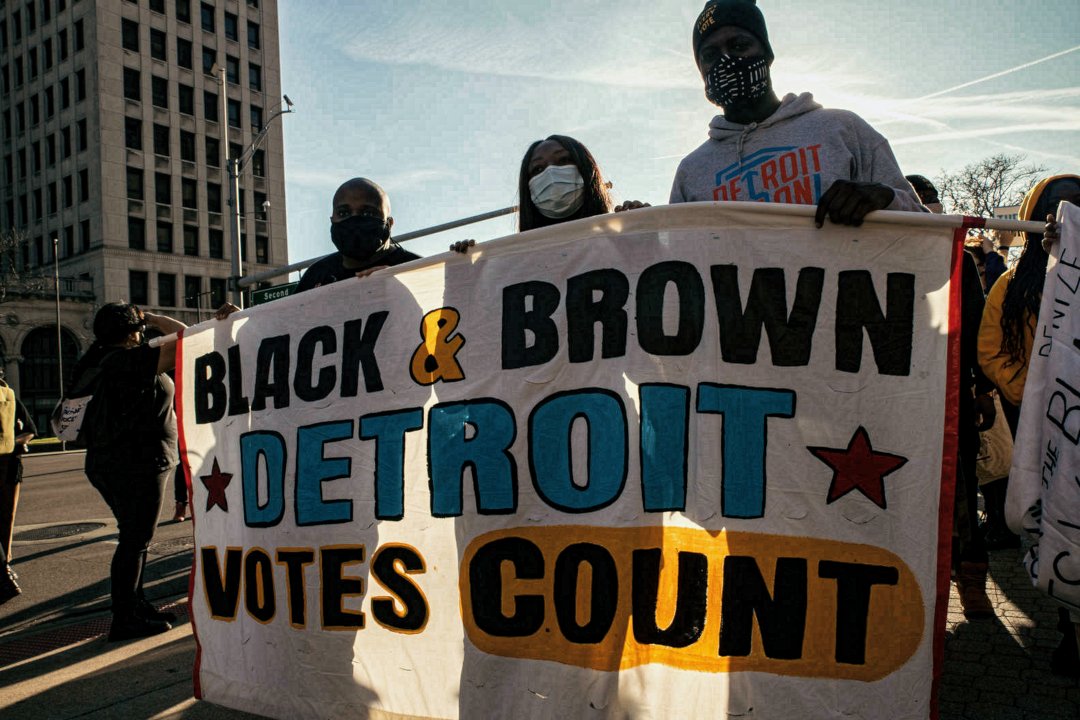
Trump’s campaign to steal the election hasn’t stopped. It still depends on stealing Black votes. His No. 1 thug Rudy Giuliani wants the votes in Atlanta, Detroit, Milwaukee and Philadelphia thrown out.

[Trump backtracked on his statement that he would leave the White House if the Electoral College seated Joe Biden. Trump tweeted Nov. 28: “Biden can only enter the White House as President if he can prove that his ridiculous ‘80,000,000 votes’ were not fraudulently or illegally obtained. When you see what happened in Detroit, Atlanta, Philadelphia & Milwaukee, massive voter fraud, he’s got a big unsolvable problem!” – Editor]

All these cities have large Black communities with Atlanta and Detroit having Black majorities. If Trump is able to ditch the votes in these cities, he can overturn the results in Georgia, Michigan, Wisconsin and Pennsylvania and win the Electoral College.

That’s what Trump supporter Monica Palmer tried to do In Michigan’s Wayne County, which includes Detroit. Sitting on the county election board, Palmer wanted to certify just the votes of Detroit’s suburbs but not those of Detroit itself.

That’s despite the suburb of Livonia having the second highest number of county precincts with irregularities. While Detroit is nearly 80% Black, Livonia is less than 5% African American. Detroit also has large Arab and Latinx communities whose votes would have been thrown away.

It was the power of the people that stopped this outrage. Hundreds mobilized to stop the steal. Local congressperson Rep. Rashida Tlaib — a Palestinian member of “the squad” — denounced the racist attempt to disenfranchise Detroit’s voters.

In Milwaukee, racist Trump supporters are harassing election workers, many of whom are Black, during a recount. “It looks like [Trump is] looking to do pretty much everything he can to disenfranchise voters of color,” said Milwaukee County Executive David Crowley, the first Black person elected to that post. 

That’s nothing new. After the 1976 presidential election, former Wisconsin Gov. Warren Knowles claimed Black people were being driven around Milwaukee in a school bus and voting a zillion times. 

Then there’s North Carolina. Peaceful marchers, most of whom were Black, going to polls on Halloween in Alamance County were pepper-sprayed and 23 were arrested by Sheriff’s deputies. The Reverend Greg Drumwright and two others are now facing frame-up felony charges.  

Sheriff Terry Johnson, who ordered the attack, is also a notorious anti-immigrant and anti-Latinx bigot. 

Black voting power under attack

It was Black voters who prevented David Duke from being elected Louisiana’s governor in 1991. While 55% of white voters cast their ballots for the neo-Nazi, the Black community, with support from progressive whites, mobilized to stop Duke.

A Black shield stopped the deluge of anti-Jewish racism and fascist violence that would have followed Duke’s election. 

Ollie North wasn’t elected a U.S. senator in 1994 from Virginia because of the Black vote. North helped flood the U.S. with crack cocaine while Ronald Reagan was in the White House. Drug sales financed the contra terrorists trying to overthrow Nicaragua’s Sandinista government.

And it was the Black vote that blocked the super bigot sexual predator Roy Moore from becoming a U.S. senator from Alabama in 2018.

The Black vote was won by Black soldiers during the U.S. Civil War and by bloody struggles during the Reconstruction period that followed. The Fifteenth Amendment, passed in 1870, was supposed to guarantee the right to vote.

That right was swept away by the overthrow of Reconstruction by Ku Klux Klan terror. Black people fought for decades to defend their right to vote without any support from the federal government.

In 1898, the city government of Wilmington, N.C., was overthrown by a white racist mob. Sixty Black people were massacred in the coup. Within two years the right to vote was stolen from virtually all African Americans in North Carolina. 

People died for the 1965 Voting Rights Act. Harriette Moore and Harry T. Moore were bombed in their home on Christmas Day 1951. They were murdered by the Klan for registering Black voters. 

NAACP leader Medgar Evers fought for voting rights in Mississippi and was assassinated on June 12, 1963. The attack on demonstrators in Selma, Ala., in 1965, in which future Congressperson John Lewis was nearly beaten to death by George Wallace’s state troopers, shocked the world.

More than 40 years of political reaction in the U.S. have included vicious attacks on Black voting rights. The voter ID laws passed by over 30 states are deliberately crafted to limit voting by Asian, Black, Indigenous, Latinx and poor people in general.

The 24th Amendment, enacted in 1964, banned poll taxes. Since photo identification usually costs money, isn’t that a poll tax? Yet the U.S. Supreme Court has upheld almost all these discriminatory state ID laws.

Six judges on that capitalist court threw out the vital enforcement provisions of the Voting Rights Act in the 2013 Shelby v. Moore decision.

‘We’re not a democracy’

The struggle for Black voting rights empowers all poor and working people. Literacy tests were used to stop Indigenous people from voting in Arizona until 1970. 

One of the enforcers in Arizona who tried to prevent Black, Indigenous and Latinx people from voting in the 1964 election was William Rehnquist. The thug was rewarded for his strong-arming by being made chief justice of the U.S. Supreme Court.

Millions of white workers benefited when Harlem’s Adam Clayton Powell Jr. was chair of the Education and Labor Committee in the House of Representatives. The Black congressperson pushed through increases in the minimum wage and extended coverage to millions of low paid workers.

The Trump and Giuliani attack on Black votes is aimed at overturning the vote of 80 million people who voted against Trump. Among them were Asian voters who helped defeat Trump in Georgia.

While the super rich, like Michael Bloomberg, are willing to spend billions to buy elections, they sneer at democracy. Even cockroach capitalists consider it intolerable that the vote of poor and working people should count as much as theirs.

That was Robert L. Bartley’s attitude when he was the Wall Street Journal’s editorial page editor. He justified George W. Bush becoming president in 2000 despite getting half-a-million fewer votes than Al Gore.

Bartley did so on the basis that many of the Democratic votes came from union households” and “Blacks while Republican voters were allegedly “producers of wealth.” 

Listen up Wall Street Journal: if an election was held of only the essential workers who kept society together during the coronavirus pandemic, Trump would have lost in a landslide. 

Attacks on the idea of democracy used to come from the wingnuts of the John Birch Society. In an Oct. 7 tweet, Utah Sen. Mike Lee declared “We’re not a democracy.”

Lee wasn’t admitting that money talks during capitalist elections. He wants to get rid of any notion of democracy.

Poor and working people will show all the Trumps what real democracy looks like. That includes over two million workers in prison. Evicting Trump from the White House is just the first step.

Only by taking real democracy to the streets will we stop evictions and win compensation for all the jobless. We need to organize and fight more than before.

Strugglelalucha256
https://www.struggle-la-lucha.org/2020/page/5/