Estados Unidos celebra elecciones en condiciones que condenaría en otros países

Los agentes del alguacil atacan una marcha de votantes liderada por negros frente al palacio de justicia en Graham, Carolina del Norte, el 31 de octubre.

La siguiente entrevista con Greg Butterfield de Struggle-La Lucha fue realizada en octubre por miembros del Comité Editorial Colectivo, una red de sitios de noticias comunistas en Rusia y Donbass, y publicada en ruso e inglés por la Universidad de los Trabajadores en Moscú.

Comité Editorial Colectivo: ¿La institución de las elecciones sigue funcionando en el “bastión de la democracia” o es solo un gran espectáculo?

Greg Butterfield: Lo caracterizaría como un espectáculo grande y costoso, presentado para los pueblos del mundo y especialmente para los trabajadores y la gente común de los Estados Unidos, para crear una fachada de democracia y desinflar la lucha de clases. Lo que existe en los Estados Unidos es esencialmente una dictadura capitalista de partido único con dos facciones en competencia. Julius Nyerere, el líder anticolonial de Tanzania, lo dijo mejor: “Estados Unidos también es un estado de partido único pero, con la típica extravagancia estadounidense, tienen dos”.

Durante varias décadas, los partidos republicano y demócrata han ido asemejándose más, intensificando la explotación económica, la austeridad y la guerra para defender su imperio en declive. Ambos partidos se han movido constantemente hacia la derecha.

Este año es interesante porque este gran y costoso espectáculo electoral no se realiza según lo planeado. En particular, la administración Trump y el Partido Republicano no están jugando según las reglas aceptadas de la democracia capitalista en los Estados Unidos que en el pasado han permitido que esta actuación se lleve a cabo con éxito y de manera pacífica. Este es un síntoma de la enorme crisis económica y política que se ha apoderado del sistema capitalista junto con la pandemia global.

Trump está incitando al movimiento fascista supremacista blanco en los Estados Unidos, que es su base de apoyo más fuerte, para que amenacen y aterroricen a sus oponentes, especialmente a los negros y otras minorías nacionales. En muchos lugares, los funcionarios estatales y locales, la policía y otras ramas del estado capitalista, que tienen vínculos estrechos y, a menudo, se superponen con las bandas fascistas, están siendo arrastrados a estos esfuerzos de supresión de votantes. Desde finales de septiembre, los partidarios de Trump han estado interrumpiendo la votación por correo y la votación anticipada con tácticas de intimidación. Existe un temor real de que las bandas armadas puedan acudir a las urnas el día de las elecciones en algunos estados, de la misma manera que han salido a amenazar las protestas contra los asesinatos policiales.

Si cualquier país señalado por Washington como “indeseable” celebrara una elección en tales condiciones, los funcionarios estadounidenses y los medios occidentales desatarían un torrente de llamados a un cambio de régimen, sanciones o intervención militar.

Los demócratas no están exentos de culpa, por supuesto. Nuevamente este año, al igual que en 2016, los demócratas hicieron todo lo posible para sabotear la campaña de Bernie Sanders y sus jóvenes partidarios, que en realidad habían logrado hacer del socialismo un tema de conversación popular en Estados Unidos por primera vez en generaciones. No es el tipo de socialismo que los comunistas queremos, pero aun así, fue una apertura significativa para elevar la conciencia de la clase trabajadora.

Ahora se supone que todo el mundo debe respaldar al racista de derecha Joe Biden como la única alternativa viable al racista de derecha Donald Trump. Sanders ha capitulado nuevamente ante los demócratas, pero muchos de los que hicieron campaña por él han rechazado esta mala elección.

CEB: ¿Los estadounidenses de a pie creen en la eficacia de las elecciones y en qué medida participan activamente en ellas? Después de todo, ¿el sistema electoral en sí es indirecto, mientras que la elección se fija en solo dos partidos?

GB: La participación en las elecciones de la clase trabajadora y la gente pobre siempre ha sido bastante baja en Estados Unidos en comparación con otros países. En las últimas cuatro elecciones presidenciales ha promediado alrededor del 55 por ciento de los votantes elegibles. Eso se debe a que los gobernantes capitalistas nunca han permitido que se desarrolle una verdadera democracia multipartidista en Estados Unidos como existe en la mayoría de los demás países occidentales. Aquí no hay ningún partido socialdemócrata de masas, mucho menos comunista. A la clase trabajadora no se le permite tener ni siquiera un partido electoral reformista que pueda identificar como propio, que levante sus intereses y demandas. Se supone que los trabajadores siempre deben conformarse con el “mal menor”. Esto genera mucha apatía y desinterés en las elecciones y en la vida política en general.

Todo esfuerzo por desarrollar un tercer partido progresista ha sido aplastado por una combinación de factores. Primero, el complicado y costoso proceso de llegar a las urnas en los 50 estados, cada uno de los cuales tiene sus propias reglas, a menudo completamente arbitrarias y ridículas. En segundo lugar, si un partido aparece en la boleta electoral, los demócratas y los republicanos plantearán desafíos legales para que se inicien si creen que esta alternativa puede generar muchos votos. Y finalmente, después de sentirse frustrados por estos desafíos, la maquinaria demócrata es muy hábil coaptando e incorporando a los movimientos progresistas o a los políticos a sus propias filas.

Este sistema ha existido más o menos intacto desde 1876, cuando el “gran compromiso” entre demócratas y republicanos puso fin a la era de la Reconstrucción revolucionaria después de la Guerra Civil estadounidense y reprimió la lucha por la libertad y la igualdad de los negros. Ha funcionado muy bien para los patronos.

A la hora de elegir presidente, como dijiste, no hay elecciones directas. Muchas personas en todo el mundo e incluso aquí no se dan cuenta de esto. El presidente es elegido por el Colegio Electoral, que fue creado por los fundadores de los Estados Unidos para proteger los intereses de los dueños de esclavos del sur. Aunque finalmente se abolió la esclavitud, el Colegio Electoral no lo fue. Sigue existiendo como una válvula de escape para la clase capitalista, para asegurarse de que tengan la última palabra.

El día de las elecciones, aunque la gente piensa que está votando por un candidato presidencial, en realidad está votando por los delegados del Colegio Electoral. El Colegio Electoral se inclina a favor de estados que son más pequeños, más blancos y más de derecha. Esencialmente, es una forma de privar de sus derechos a la clase trabajadora, especialmente a las minorías nacionales, que se concentran en estados con grandes poblaciones. Solo en los últimos 20 años, dos de cada cinco elecciones presidenciales las han ganado candidatos que perdieron el voto popular: George W. Bush en 2000 y Donald Trump en 2016.

Pero en la última década ha habido un cambio genuino en el número de personas que rechazan este juego. Este sentimiento alimentó las campañas de Bernie Sanders en 2016 y 2020, con muchos partidarios exigiendo que Sanders se separe de los demócratas y se postule de forma independiente, o incluso que forme un nuevo partido progresista. Y considerando el alto nivel de presión en la sociedad para votar por “cualquiera menos Trump” (es decir, por Joe Biden), es significativo que muchas personas se mantengan firmes y rechacen la falsa elección.

CEB: ¿Quién nomina a los candidatos, de quién son sus representantes y hay alguno entre ellos a quien los comunistas deban apoyar?

GB: Cada estado tiene su propio sistema para seleccionar delegados a las convenciones nacionales de los dos partidos capitalistas grandes. En teoría, el candidato que tenga más delegados en la convención se convertirá en el nominado del partido. Pero en la práctica, la decisión siempre la toman de arriba hacia abajo los líderes del partido y sus patrocinadores. Las elecciones primarias estatales y los votos de los delegados en las convenciones de los partidos se manipulan de muchas formas, fuera de la vista de los votantes. No es nominado como candidato nacional de los demócratas o republicanos sin demostrar su lealtad a la clase capitalista y sin el apoyo de una parte importante de los capitalistas. Y ciertamente no se puede competir seriamente en una elección presidencial que cuesta millones o incluso miles de millones de dólares sin su apoyo.

A veces es posible que los candidatos progresistas o incluso revolucionarios compitan a nivel local y estatal, aunque se enfrentan a grandes desafíos y hostigamiento. En Nueva York, tenemos a un ex Pantera Negra y activista revolucionario, Charles Barron, quien es miembro de la Asamblea del Estado de Nueva York. Los votantes de su distrito en la comunidad negra de Brooklyn le son muy leales. Es un ejemplo de alguien que trata la arena electoral en la forma prescrita por Lenin, actuando como una “tribuna del pueblo” sin inducirlos a pensar que votar resolverá todos sus problemas. Pero tiene que luchar para ser escuchado y a menudo es objeto de burlas racistas por parte de los medios corporativos.

En la carrera presidencial, hay dos alternativas progresistas en la boleta electoral en algunos estados: el Partido por el Socialismo y la Liberación y el Partido Verde. Algunos comunistas y socialistas fuera de sus propios miembros votarán por estos candidatos como un voto de protesta. Esperamos que en el futuro sea posible construir un frente unido para montar una campaña electoral de izquierda a mayor escala.

CEB: ¿Cómo afectaron las protestas de primavera-verano a la carrera electoral? ¿Afectaron la retórica y los programas de los candidatos?

GB: El levantamiento masivo y las protestas contra el terror policial racista han tenido un efecto enorme en la carrera presidencial y otras campañas electorales. Por primera vez, los candidatos de ambos partidos capitalistas han tenido que enfrentarse a preguntas sobre la brutalidad policial, el control comunitario, el racismo sistémico y su posición sobre los grupos supremacistas blancos en los debates oficiales. Esto ciertamente no hubiera sucedido sin las poderosas protestas en todo el país que unieron a millones de trabajadores y jóvenes negros, marrones y blancos contra los abusos policiales.

Es irónico que el candidato presidencial demócrata Joe Biden y la candidata a la vicepresidencia Kamala Harris se vean obligados a hacerse pasar por candidatos simpatizantes del movimiento Black Lives Matter. Ambos políticos conservadores de carrera ayudaron a crear y hacer cumplir las políticas que llevaron a la militarización de la policía y al encarcelamiento masivo de negros. Solo pueden salirse con la suya con esta mascarada debido al temor causado por los llamamientos abiertos de Trump a la supremacía blanca violenta y a una mayor represión estatal. Pero muchas personas, especialmente las que participaron en el levantamiento de masas de este verano, no se dejan engañar por ellas. Creo que eso es cierto incluso en el caso de muchas personas que se taparán la nariz y votarán por los demócratas por miedo a Trump.

Nuestro mensaje a la clase trabajadora es que, si bien Trump es un enemigo peligroso, Biden y Harris no tienen soluciones a la crisis del terrorismo policial en las comunidades negras y marrones. La única forma de acabar con el terror policial es que la gente se quede en las calles, que continúe organizando y construyendo el movimiento en nuestros lugares de trabajo, escuelas y comunidades, y creando nuestros propios cuerpos de autodefensa en el espíritu del Partido Panteras Negras.

CEB: ¿Las elecciones de este año se llevarán a cabo pacíficamente o es posible una turbulencia masiva?

GB: Nos estamos preparando para la posibilidad de violencia en las urnas y luego por parte de grupos fascistas y el estado, y para protestas masivas si Trump intenta permanecer en el cargo incluso si pierde la votación.

Trump ha dicho muchas veces que puede rechazar los resultados de las elecciones si no le gusta el resultado. Trump ha puesto en duda la legitimidad de votar por correo a pesar de la pandemia y ha intentado manipular el funcionamiento interno del servicio postal para retrasar los votos por correo en estados clave. Los republicanos están presentando demandas en muchos estados para intentar descartar las boletas electorales por correo. La Corte Suprema de Estados Unidos está dominada por una mayoría de extrema derecha que podría tener la última palabra en estos casos.

No hay duda de que las masas populares, y la clase trabajadora en particular, quieren que Trump salga. Están hartas de sus llamados al racismo y la represión de las personas que protestan por la justicia racial. Están agotadas por su negativa a tomar medidas serias para detener la pandemia de COVID-19, que ha matado a más personas en Estados Unidos que en cualquier otro lugar. Y están sufriendo por su negativa a hacer que los ricos paguen impuestos mientras millones quedan desempleados y desamparados por la crisis económica. Sin mencionar sus amenazas de anular los derechos reproductivos de las mujeres y tantos otros logros obtenidos por las luchas de los trabajadores.

Actualmente, existe una tremenda tensión en la sociedad estadounidense. Todos están nerviosos esperando a ver qué sucederá. Los medios de comunicación han advertido que puede haber una demora en la determinación de los resultados de las elecciones, debido a la gran cantidad de boletas electorales por correo y los desafíos legales en su contra. Si ese es el caso, la olla puede hervir.

Con el gran ejemplo del levantamiento liderado por negros contra los asesinatos policiales a principios de este año, ciertamente existe la posibilidad de protestas masivas si la gente siente que las elecciones le han sido robadas. Al mismo tiempo, las bandas fascistas leales a Trump pueden arremeter con violencia incluso si Trump está claramente derrotado.

Nuestra posición es que la clase trabajadora y su vanguardia no pueden quedarse al margen en esta situación. No apoyamos a los demócratas ni llamamos a los trabajadores a votar por ellos, como han hecho algunos de la izquierda. Pero los comunistas tenemos la responsabilidad de defender los derechos democráticos de la clase trabajadora, especialmente los miembros más oprimidos de nuestra clase, el pueblo negro y otras minorías nacionales, cuyo derecho al voto ha sido negado con tanta frecuencia. Tampoco podemos negar el peligro urgente de los llamados de Trump para volver a las violentas bandas fascistas y agencias policiales en contra del pueblo.

Nos estamos uniendo con otros grupos revolucionarios y progresistas en torno a un llamado para “Ocupar las calles si se roban las elecciones de noviembre”. Esta coalición y muchos otros grupos ya están planeando protestas que comenzarán el día después de las elecciones, el 4 de noviembre.

Si resulta que Trump está claramente derrotado y él lo admite, llamaremos a la gente a protestar por las exigencias de los trabajadores a Biden, ya que sabemos que los demócratas no tienen una solución a la crisis capitalista y tampoco tienen la intención de aliviar la represión.

Quien sea que finalmente se siente en la Casa Blanca el próximo año, estamos convencidos de que la lucha de clases puede, debe y seguirá creciendo.

CEB: ¿Hay alguna diferencia entre los candidatos sobre la guerra y la paz, y cómo afectará la victoria de uno u otro al futuro de la política exterior de Estados Unidos y Washington?

GB: Cuando se trata de política internacional, hay menos diferencias entre los candidatos que en cualquier otro lugar. Trump y Biden representan el imperialismo, las sanciones y la guerra. Ambos son campeones de la dominación estadounidense sobre otros países, con solo ligeras diferencias de énfasis y tácticas.

Biden representa una continuación de la era Clinton-Obama, con su especial énfasis en la expansión y subversión de la OTAN dirigida a la Federación de Rusia y otros países postsoviéticos. Ciertamente, no hemos olvidado el papel que Biden desempeñó como ejecutor de Washington en Ucrania después del golpe de Maidan, o cómo alentó la privatización y la austeridad y el uso de bandas fascistas militarizadas contra la gente de Donbass.

El apoyo de Trump en la clase dominante proviene especialmente de los oligarcas del petróleo y el gas, lo que explica su enfoque especial en demonizar a Irán, robar petróleo sirio e intentar múltiples golpes de Estado contra Venezuela.

Ambos candidatos coinciden en mantener una postura bélica contra Cuba, Venezuela, China y la República Popular Democrática de Corea. Ambos son enemigos jurados del pueblo palestino. La mayoría de los comentarios sobre política exterior de Biden van dirigidos a superar a Trump en el anticomunismo y la beligerancia.

CEB: ¿Cuán populares son las ideas comunistas en los Estados Unidos hoy? ¿Qué grupos simpatizan más con estas ideas (indígenas, negros, latinos, asiáticos, etc.)?

GB: El interés en el socialismo como alternativa a la explotación capitalista ha crecido enormemente en los Estados Unidos. Yo fecharía el comienzo de este cambio en el movimiento Occupy Wall Street en 2011. En ese momento, muchos jóvenes pudieron probar por primera vez la protesta masiva y perspectiva de clase. Algunos de los organizadores más enérgicos de la actualidad se iniciaron en el movimiento Occupy. La lucha Black Lives Matter, que despegó por primera vez en 2014 y resurgió este año, y las campañas de Bernie Sanders en 2016 y 2020, profundizaron esa conciencia entre una nueva generación.

Las ideas comunistas siempre han tenido la audiencia más comprensiva de los sectores más oprimidos de la clase trabajadora, incluidos los trabajadores negros, latinos, asiáticos, árabes, indígenas y blancos pobres, así como las mujeres y las personas LGBTQ2S. Pero hoy en día hay una capa pequeña pero mensurable de jóvenes entre estos trabajadores que están abrazando más plenamente el comunismo.

Ahora mismo no hay mucha cohesión ideológica u organizativa entre ellos. Gran parte del sentimiento procomunista se limita a los debates en las redes sociales. Pero a diferencia de la década de 1990 y principios de la de 2000, ahora hay un mar en el que los comunistas pueden nadar. Nuestro desafío en el próximo período es consolidar el creciente sentimiento pro comunista y pro socialista y darle forma organizativa. Y dependiendo de lo que ocurra en las próximas semanas y meses, este trabajo puede tener que realizarse en condiciones semi-legales o en algunos casos incluso clandestinas.

CEB: Las protestas en los Estados Unidos se han convertido en una ocasión habitual. ¿Influyen en la conciencia de los ciudadanos la idea de que es imposible cambiar la situación de la forma “democrática” aprobada? Mientras que el camino de la “lucha militante” de las masas organizadas parece ser mucho más efectivo.

GB: Las personas que se unieron al levantamiento militante contra los asesinatos policiales de este año vieron cómo sus acciones en las calles sembraron el miedo en el corazón de sus enemigos y obligaron al Estado a hacer concesiones, aunque muchas de ellas ya están siendo revertidas. El verano pasado, una encuesta mostró que el incendio de la estación de policía de Minneapolis tuvo más apoyo que cualquiera de los candidatos presidenciales.

La única razón del gran “espectáculo” electoral es empujar a la gente hacia la idea de que pueden obtener lo que quieren siguiendo las reglas del sistema manipulado. Pero mucha gente ahora está consciente de que éste, está totalmente quebrado. Trump, con su comportamiento maníaco y egoísta y su indiferencia ante el sufrimiento de la gente, ha arrancado la máscara del capitalismo. Los patronos no quieren hacer concesiones al pueblo; solo quieren quitarles más y más para proteger sus ganancias.

Los comunistas en los Estados Unidos tenemos días difíciles por delante. Pero si podemos perseverar y comenzar a encontrar formas de unirnos nosotros mismos y a nuestra clase contra nuestro enemigo común, también tendremos grandes oportunidades por delante.

Strugglelalucha256


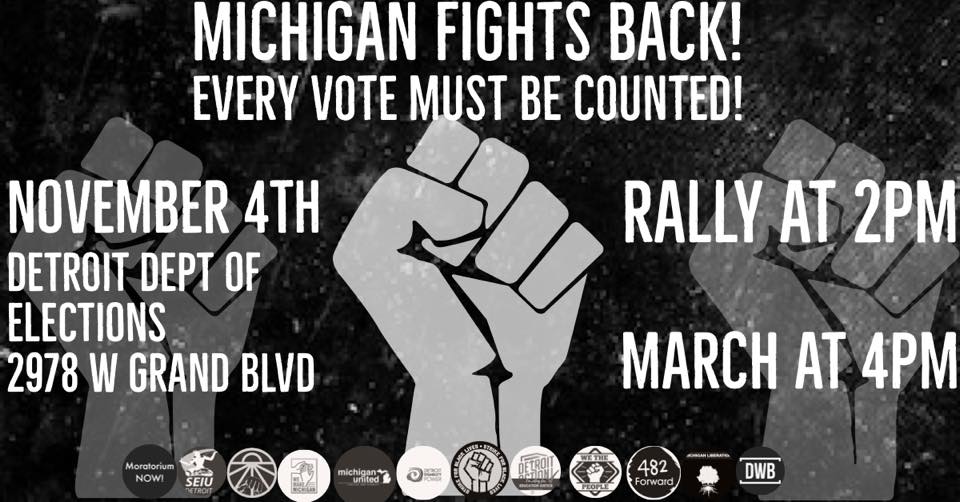
Detroit Nov. 4: Stop Trump From Stealing the Election! Every Vote Must Be Counted!

Wednesday at 2 PM EST

Detroit Department of Elections

Hosted by Detroit Will Breathe, Moratorium NOW! Coalition and Sunrise Movement Detroit

Strugglelalucha256


Minneapolis Day after elections: National Day of Protest for a People’s Mandate, Nov. 4

Wednesday, November 4, 2020 at 7 PM EST – 9 PM EST

301 Cedar Ave S, Minneapolis

Day after the elections – Get ready to fight!

No matter the outcome, we need a People’s Mandate to address the triple pandemic of racism, COVID-19, and recession. We want Trump out. But even if that happens, we cannot stop the fight. Our response on November 4 can set the tone for struggle for the next four years.
We don’t know the outcome. But we are READY to say EITHER,

1. “Don’t let Trump steal the election!” or

2. “Fight Trump and everything he stands for!” or

3. “A Biden win will not give the freedom we demand!”

Trump out! Power to the people!

The Twin Cities Coalition for Justice for Jamar (TCC4J) is uniting the National Alliance Against Racist and Political Repression for a U.S.-wide day of protest Nov. 4 around the following demands.

–Stop Police Crimes! Community Control of the Police
–Extend and Expand Economic Relief for the Unemployed
–Stop Evictions and Utility Shut-offs
–Health Care for All
–Stop the Racist Attacks on Immigrants and Harassment of Asian Americans
–Fight the Pandemic!
–Don’t let Trump steal the election!

On Nov. 4, join TCC4J and a growing list of BLM, anti-police crime, labor, immigrant rights, environmental, youth, student and anti-war groups to demand a People’s Mandate!

Local endorsers include:
AFSCME Local 2822
AFSCME Local 3800
AFSCME Local 3937
Anti-War Committee
Black Lives Matter Twin Cities Metro
Blue LIES Matter
CAIR-MN
Climate Justice Committee
Coalition to Advance a People’s Agenda
Communities United Against Police Brutality
Families Supporting Families Against Police Violence
Freedom Road Socialist Organization – Twin Cities
Justice 4 Cordale Handy
Justice 4 Marcus Golden
Justice for Isak Aden
Justice for Travis Jordan
Labor for Justice for Jamar Clark
MN Disability Justice Network
MN Immigrant Rights Action Committee
MN Workers United
MN Youth for Justice
Native Lives Matter
OA Strategy Community Solutions
On Site Public Media
Racial Justice Network
Revolutionary Sound
St Paul Federation of Educators
Students for Democratic Society at UMN
Twin Cities Coalition 4 Justice 4 Jamar
Women Against Military Madness
Women’s March MN

——
Here is the national NAARPR call:

After the election, the peoples mandate for change must be carried out.

In this triple pandemic of racism, COVID-19, and recession our National Alliance Against Racist and Political Repression is issuing a call to all the democratic forces presently engaged in the struggle against racist injustice, the economic slaughter of our communities and the utterly unspeakable failure at all levels to use its full capacity to stop the death march of the corona virus across the land.

We, as a country, have a greater capacity in terms of wealth and technology than most other countries to stop the spread of infections and death but unmitigated, capitalist greed, putting profits before people, has made us the leading country in COVID-19 infections and death. The pandemic has hit African American and other oppressed communities the hardest.

We are going all out in this election to defeat Trump because it is unequivocally clear that this administration’s racist, anti-people and anti-working class policies have already eroded every semblance of democracy and brought us to the brink of the worst economic disaster in U.S. history with no plan whatsoever to provide relief for our suffering people. This recession has hit women, and in particular Black women the hardest, snatching away years of progress.

Win or lose in the elections we are calling for mass protests the day after the election to highlight the fact that Trump’s scorched earth policies have left the political landscape almost as barren and bleak as COVID-19 and the police-state style racist repression used against tens of thousands of protesters, leaving thousands injured and jailed and some dead. Trump has openly sided with racist, right-wing, violent elements to attack the movement against police crimes.
Trump losing the elections will create greater organizing space for turning this page of history writ large with sickness, death and mass rebellion to embark upon the road for freedom, justice and equality and ending the plundering of the monopoly capitalist bosses.

Biden’s victory is important in this moment of history we do not deny that in the least. Yet we must face the sober reality that his victory will not necessarily provide the path to freedom, justice and equality for our people, for the 140 million poor, for the homeless, the sick, hungry and working class masses. We, the people’s movement is the vehicle we must drive up freedom’s road.

We are also well aware that Trump has said that he would not leave power. His administration has already tried to disrupt the election by undermining the Post Office and attacks on mail-in voting. Trump could try many things during and after the election such as trying to stop the vote count (a tactic that pro-U.S. forces in other countries have done to fix elections) or call out right-wing shock troops.

The fundamental truth at the core of this national call for protests the day after the November Presidential election is that the great historical lesson of the moment we are in is best characterized by the fact that over 22 million rebelled against racist injustice in response to the brutal murder of George Floyd. The social energy of this great rebellion is the same energy propelling us to call this protest. Join us and let us, the people united, open a new era of struggle for our liberation dedicate to never returning our country to like it was. We are fighting for a new day to dance with great jubilee in the sunlight of freedom.

Strugglelalucha256


Facebook bans Cuba solidarity conference

Facebook bans the event page for a conference featuring ambassadors, doctors, scholars, elected officials, labor and religious figures.

What is Facebook afraid of?

Even in the time of a COVID pandemic, when Cuba has been recognized for its leading humanitarian role, apparently in some circles discussion of U.S.-Cuba relations is unacceptable. Unfortunately, Facebook joined a politically motivated disinformation campaign when it removed the National Network on Cuba’s event page for the Nov. 14-15 conference. 

From Friday, Nov. 13 through Sunday, Nov. 15, 2020, hundreds from across the U.S., Canada and around the world will join together for a virtual concert and conference for the full normalization of U.S.-Cuba relations. Under President Trump, the embargo against Cuba has been tightened, leading to many day-to-day challenges for the Cuban people. Trump has also restricted U.S. travel to Cuba, undermining the ability of people in the U.S. to see Cuba with their own eyes.  

“We know that whether the next president of the United States is Donald Trump or Joe Biden, we will need to strengthen our campaign to push Washington to end the over 60 years of the cruel embargo against Cuba,” explains conference spokesperson Cheryl LaBash. “This dynamic 3-day event combining arts, culture, speakers and discussion will remind us that while the U.S. economic blockade has reached unprecedented levels, never has the possibility of ending it been closer.”

The weekend will kick off with a colorful and vibrant concert on Friday, Nov. 13, at 8 p.m. Eastern time. “We will bring together artists of all ages and backgrounds from Cuba, the U.S. and Canada,” explains conference spokesperson Tamara Hansen. “We are honored to be featuring the talents of two-time Grammy winners El Septeto Santiaguero and the U.S.-Cuba collaboration of jazz, afro, rock and salsa of Pablo Menéndez and Mezcla.”

On Saturday, Nov. 14, the first session at 2 p.m. Eastern time will feature José Ramón Cabañas, Cuba’s ambassador to the United States, and Josefina Vidal, Cuba’s ambassador to Canada. They will speak alongside politicians from the U.S. and Canada to discuss the importance of the full normalization of U.S.-Cuba relations.

The second session, at 7 p.m. Eastern time, will discuss Cuba’s leading role in combating the global COVID-19 pandemic both within Cuba and internationally with the Henry Reeve International Medical Brigade. It will feature Dr. Andy Coates, a physician in Albany, N.Y., on the frontline of treating COVID-19 patients, and Dr. Samira Addrey, a graduate of Cuba’s Latin American School of Medicine, along with other prominent panelists.  

The final session, on Sunday, Nov. 15, at 2 p.m. Eastern time, will be dedicated to planning and building a campaign to effectively end the U.S. embargo against Cuba in 2021. This will feature a variety of speakers from across the U.S. and Canada, including Cuban Americans and speakers from Puerto Rico and Quebec.  

This campaign is a united effort between the U.S.-based National Network on Cuba, Table de concertation et de solidarité Québec–Cuba and the Canadian Network on Cuba

Find registration and full conference details on our website:

us-cubanormalization.org

Media contacts for interviews or more information:

  • Cheryl LaBash (US) +1 313-999-1376
  • Tamara Hansen (Canada) +1 778-882-5223
  • Sean O’Donoghue (Quebec/French) +1 514-721-4527
  • Email: info@us-cubanormalization.org

Additional supporters of US-Cuba Normalization:

Alison Bodine, Fire This Time, Movement for Social Justice, Vancouver

Alicia Jrapko, co-chair of the Cuba Nobel Prize Committee

Bob Schwartz, vice president, Global Health Partners

Catherine Murphy, founder, The Literacy Project

Cheryl LaBash, co-chair, National Network on Cuba 

Chuck Kaufman, Alliance for Global Justice

Cindy Domingo, chair, U.S. Women and Cuba Collaboration

Clever Banganayi, Friends of Cuba Society (South Africa)

Danny Glover, actor and activist

Diane Stradling, delegation coordinator, Witness for Peace

Don Rojas, director of Communications and International Relations, Institute of the Black World

Erin Feely-Nahem, LMSW, domestic violence advocate

Frank Velgara, Call to Action on Puerto Rico

Gail Walker, executive director, IFCO/Pastors for Peace  

Ike Nahem, organizer, U.S.-Cuba International and 2nd National Cuba conferences

Isaac Saney, Canadian Network on Cuba

James Early, assistant secretary for Education and Public Service, Smithsonian Institution, retired

Joe Lombardo co-coordinator, United National Antiwar Coalition (UNAC)

Rev. Jim Winkler, president and general secretary, National Council of Churches

Joan P Gibbs, attorney at law, NY-NJ CubaSí

Jocelyn Velázquez, Jornada, Se Acabaron Las Promesas, Puerto Rico

John Waller, Seattle Cuba Friendship Committee

Jon Flanders, Railroad Workers United

Michelle Ellner, Latin America campaign coordinator, CODEPINK 

Medea Benjamin, co-chair of the Cuba Nobel Prize Committee

Malcolm Sacks, Venceremos Brigade

Margaret Gilpin, LCSW,

U.S.-Cuba Health Exchange (former president), producer, Cuba In Focus, WBAI Radio

Mark Friedman, organizer, U.S. delegation to MarCuba, Cubambiente International Environmental Conferences

Milagros Rivera, presidenta, Comité de Solidaridad con Cuba en Puerto Rico

Natasha Lycia Ora Bannan, former president, National Lawyers Guild

Robert Miller, Cuba Solidarity Campaign UK

Dr. Rosemari Mealy, author, “Fidel and Malcolm X: Memories of a Meeting”

Sharon Wrobel, board president, ProximityCuba

Shepard McDaniel, executive director of Universal Zulu Nation–World Department Of Community Affairs

Tamara Hansen, coordinator, Vancouver Communities in Solidarity With Cuba

Rev. Tom Warren, United Church of Christ, North Carolina

Wayne Smith, Former chief, U.S. Interests Section in Havana


Plus solidarity and U.S.-Cuba normalization coalitions in

Albany, N.Y.; Boston; Chicago; Detroit; Halifax; Hartford, Conn.; Houston; Los Angeles; Miami; Minnesota; Montreal; New York-New Jersey; San Francisco; Seattle; Toronto; Washington, D.C.; Wisconsin; and Vancouver.

Strugglelalucha256


U.S. holds elections in conditions it would condemn in other countries

The following interview with Struggle-La Lucha’s Greg Butterfield was conducted in October by members of the Collective Editorial Board, a network of communist news sites in Russia and Donbass, and published in Russian and English by the Workers’ University in Moscow. 

Collective Editorial Board: Is the institution of elections still working in the “stronghold of democracy,” or it is just a big show?

Greg Butterfield: I would characterize it as a big, expensive show, put on for the people of the world and especially for the workers and common people of the United States, to create the façade of democracy and deflate the class struggle. What exists in the United States is essentially a one-party capitalist dictatorship with two competing factions. Julius Nyerere, the Tanzanian anti-colonial leader, said it best: “The United States is also a one-party state but, with typical American extravagance, they have two of them.”

For several decades, the Republican and Democratic parties have drawn closer together, intensifying economic exploitation, austerity and war to defend their declining empire. Both parties have moved steadily to the right.

This year is interesting because this big, expensive election show is not being performed as planned. In particular, the Trump administration and the Republican Party are not playing by the accepted rules of capitalist democracy in the U.S. that in the past have allowed this performance to be staged successfully and peacefully. This is a symptom of the enormous economic and political crisis that has engulfed the capitalist system in tandem with the global pandemic.

Trump is inciting the fascist, white supremacist movement in the U.S., which is his strongest base of support, to threaten and terrorize his opponents, especially Black people and other national minorities. In many places, state and local officials, the police and other arms of the capitalist state, who have close ties to and often overlap with the fascist gangs, are being pulled into these voter suppression efforts. Since late September, Trump supporters have been disrupting mail-in voting and early voting with intimidation tactics. There is a real fear that the armed gangs may come out to the polls on election day in some states, the same way they have come out to threaten the protests against police killings.

If any country targeted by Washington as “undesirable” held an election under such conditions, U.S. officials and the Western media would unleash a torrent of calls for regime change, sanctions or military intervention.

The Democrats are not exempt from blame, of course. Again this year, as in 2016, the Democrats did everything in their power to sabotage the Bernie Sanders campaign and his youthful supporters, who had actually succeeded in making socialism a topic of popular conversation in the U.S. for the first time in generations. Not the kind of socialism we communists mean, but still, it was a significant opening for raising working-class consciousness.

Now everyone is supposed to back right-wing, racist Joe Biden as the only viable alternative to right-wing, racist Donald Trump. Sanders has capitulated to the Democrats again, but many of those who campaigned for him have rejected this bad choice.

CEB: Do ordinary Americans believe in the effectiveness of the elections, and how actively do they participate in them? After all, the election system itself is indirect, while the choice is fixed on just two parties?

GB: Participation in the elections by working-class and poor people has always been pretty low in the U.S. compared with other countries. In the last four presidential elections it has averaged around 55 percent of eligible voters. That’s because the capitalist rulers have never allowed a real multiparty democracy to develop in the U.S. as it exists in most other Western countries. There is no mass social-democratic party here, much less a communist one. The working class is not allowed to have even a reformist electoral party that it can identify as its own, that raises its interests and demands. The workers are always supposed to settle for the “lesser evil.” This creates a lot of apathy and disinterest in elections, and in political life generally.

Every effort to develop a progressive third party has been smashed by a combination of factors. First, the complicated, expensive process of getting on the ballot in all 50 states, which each have their own rules, often completely arbitrary and ridiculous. Second, if a party does get on the ballot, the Democrats and Republicans will mount legal challenges to get them kicked off if they feel this alternative may draw a lot of votes. And finally, after they are frustrated by these challenges, the Democratic machine is very skilled at co-opting progressive movements or politicians into its own ranks.

This system has existed more or less intact since 1876, when the “great compromise” between the Democrats and Republicans ended the era of revolutionary Reconstruction after the U.S. Civil War and repressed the struggle for Black freedom and equality. It has worked very well for the bosses.

When it comes to choosing the president, as you said, there are no direct elections. Many people around the world and even here don’t realize this. The president is chosen by the Electoral College, which was set up by the founders of the U.S. to protect the interests of the Southern slave owners. Although slavery was eventually abolished, the Electoral College was not. It continues to exist as a safety valve for the capitalist class, to make sure they have the final say.

On election day, although people think they are casting their vote for a presidential candidate, they are actually voting for delegates to the Electoral College. The Electoral College is weighted in favor of states that are smaller, whiter and more right-wing. Essentially, it is a way to disenfranchise the working class, especially national minorities, who are concentrated in states with large populations. In just the last 20 years, two out of five presidential elections have been won by candidates who lost the popular vote: George W. Bush in 2000 and Donald Trump in 2016.

But in the past decade there has been a genuine change in the number of people who reject this game. This sentiment fueled the Bernie Sanders campaigns in 2016 and 2020, with many supporters demanding that Sanders break from the Democrats and run independently, or even form a new progressive party. And considering the high level of pressure in society to vote for “anybody but Trump” (that is, for Joe Biden), it’s significant that many people are sticking to their guns and rejecting the false choice.

CEB: Who nominates the candidates, whose representatives are they, and are there any among them whom communists need to support?

GB: Each state has its own system for selecting delegates to the national conventions of the two big capitalist parties. In theory, whichever candidate has the most delegates at the convention will become the party’s nominee. But in practice, the decision is always made from the top down by the leaders of the party and their funders. The state primary elections and delegates’ votes at the party conventions are manipulated in many ways, out of sight of the voters. You don’t get nominated as the national candidate of the Democrats or Republicans without proving your loyalty to the capitalist class and without the support of a significant section of the capitalists. And you certainly can’t compete seriously in a presidential election that costs millions or even billions of dollars without their support.

It is sometimes possible for progressive or even revolutionary candidates to compete at the local and state level, though they face great challenges and red-baiting. In New York, we have a former Black Panther and revolutionary activist, Charles Barron, who is a member of the New York State Assembly. The voters in his district in Brooklyn’s Black community are very loyal to him. He is an example of someone who treats the electoral arena in the way Lenin prescribed, acting as a “tribune of the people” without misleading them into thinking that voting will solve all their problems. But he has to struggle to be heard and is often subject to racist hazing by the corporate media.

In the presidential race, there are two progressive alternatives on the ballot in some states: the Party for Socialism and Liberation and the Green Party. Some communists and socialists outside their own members will vote for these candidates as a protest vote. We hope that in the future it will be possible to build a united front to mount a larger-scale leftist electoral campaign.

CEB: How did the spring-summer protests affect the election race? Did they affect the rhetoric and programs of the candidates?

GB: The mass uprising and protests against racist police terror have had an enormous effect on the presidential race and other electoral campaigns. For the first time, the candidates of both capitalist parties have had to face questions about police brutality, community control, systemic racism and their position on white supremacist groups at official debates. This certainly would not have happened without the powerful protests across the country that united millions of Black, Brown and white workers and youth against police abuses.

It’s ironic that Democratic presidential candidate Joe Biden and vice presidential candidate Kamala Harris are forced to pose as the candidates sympathetic to the Black Lives Matter movement. Both of these conservative career politicians helped to create and enforce the policies that led to the militarization of the police and mass incarceration of Black people. They can only get away with this masquerade because of the fear caused by Trump’s open appeals to violent white supremacy and for more state repression. But many people, especially those who participated in the mass uprising this summer, are not fooled by them. I think that’s true even of many people who will “hold their nose” and vote for the Democrats out of fear of Trump.

Our message to the working class is that, while Trump is a dangerous enemy, Biden and Harris have no solutions to the crisis of police terrorism in Black and Brown communities. The only way to end police terror is for the people to stay in the streets, to continue organizing and building the movement in our workplaces, schools and communities, and to create our own bodies of self-defense in the spirit of the Black Panther Party.

CEB: Will this year’s elections be held peacefully, or is mass turbulence possible?

GB: We are preparing for the possibility of violence at the polls and afterward by fascist groups and the state, and for mass protests if Trump tries to stay in office even if he loses the vote.

Trump has said many times that he may reject the election results if he doesn’t like the outcome. Trump has cast doubt on the legitimacy of voting by mail despite the pandemic and has attempted to manipulate the inner workings of the postal service to delay mail votes in key states. The Republicans are filing lawsuits in many states to try to throw out mail ballots. The U.S. Supreme Court is dominated by a far-right majority that could have the final say in these cases.

There is no doubt that the masses of the people, and the working class in particular, want Trump out. They are fed up with his appeals to racism and repression of people protesting for racial justice. They are exhausted by his refusal to take serious measures to stem the COVID-19 pandemic, which has killed more people in the U.S. than anywhere else. And they are hurting from his refusing to make the rich pay taxes while millions are left unemployed and destitute by the economic crisis. Not to mention his threats to overturn women’s reproductive rights and so many other gains won by the workers’ struggles.

There’s tremendous tension in U.S. society today. Everyone is on edge waiting to see what will happen. The media have cautioned that there may be a delay in determining the election results, because of the large number of mail-in ballots and the legal challenges against them. If that’s the case, the pot may boil over.

With the great example of the Black-led uprising against police killings earlier this year, there is certainly the possibility of mass protests if the people feel that the election has been stolen from them. At the same time, the fascist gangs loyal to Trump may lash out with violence even if Trump is clearly beaten.

Our position is that the working class and its vanguard can’t stand aside in this situation. We don’t support the Democrats or call on workers to vote for them, as some on the left have done. But communists have a responsibility to defend the democratic rights of the working class, especially the most oppressed members of our class, the Black people and other national minorities, whose right to vote has so often been denied. Nor can we deny the urgent danger of Trump’s appeals to turn violent fascist gangs and police agencies against the people.

We are uniting with other revolutionary and progressive groups around a call to Occupy the streets if the November election is stolen.” This coalition and many other groups are already planning for protests starting on the day after the elections, Nov. 4.

If it turns out that Trump is clearly defeated and he concedes, we will call people out to protest for the workers’ demands on Biden, since we know the Democrats have no solution to the capitalist crisis and no intention of easing the repression either.

Whoever ultimately sits in the White House next year, we are convinced that the class struggle can, must and will continue to grow.

CEB: Is there any difference at all between the candidates on war and peace, and how will the victory of one or the other affect the future of the United States and Washington’s foreign policy?

GB: When it comes to international policy, there is less difference between the candidates than anywhere else. Trump and Biden both represent imperialism, sanctions and war. Both are champions of U.S. domination over other countries, with only slight differences of emphasis and tactics.

Biden represents a continuation of the Clinton-Obama era, with its special emphasis on NATO expansion and subversion aimed at the Russian Federation and other post-Soviet countries. We certainly haven’t forgotten the role Biden played as Washington’s enforcer in Ukraine after the Maidan coup, or how he encouraged privatization and austerity and the use of militarized fascist gangs against the people of Donbass.

Trump’s support in the ruling class comes especially from the oil and gas oligarchs, which accounts for his special focus on demonizing Iran, stealing Syrian oil and attempting multiple coups against Venezuela.

Both candidates agree on maintaining a war-like posture against Cuba, Venezuela, China and the Democratic People’s Republic of Korea. Both are sworn enemies of the Palestinian people. Most of Biden’s foreign policy comments have aimed at out-doing Trump at anti-communism and belligerence.

CEB: How popular are communist ideas in the United States today? Which groups are more sympathetic to these ideas (Indigenous, Blacks, Latinx, Asians, etc.)?

GB: Interest in socialism as an alternative to capitalist exploitation has grown tremendously in the U.S. I would date the beginning of this change to the Occupy Wall Street movement in 2011. At that time, many young people got their first taste of mass protest and a class perspective. Some of the most energetic organizers today got their start in the Occupy movement. The Black Lives Matter struggle, which first took off in 2014 and reemerged this year, and the Bernie Sanders campaigns in 2016 and 2020, deep-end that consciousness among a new generation.

Communist ideas have always had the most sympathetic hearing from the most oppressed sectors of the working class, including Black, Latinx, Asian, Arab, Indigneous and poor white workers, as well as women and the LGBTQ2S people. But today there is a small but measurable layer of young people from among these workers who are more fully embracing communism.

Right now there is not much ideological or organizational cohesion among them. Much of the pro-communist sentiment is confined to social media debates. But unlike the 1990s and early 2000s, there is now a sea for communists to swim in. Our challenge in the next period is to consolidate the growing pro-communist and pro-socialist sentiment and give it organizational form. And depending on what happens in the coming weeks and months, this work may have to be carried out under semilegal or in some cases even underground conditions.

CEB: Protests in the United States have become a regular occasion. Do they influence citizens’ awareness of the idea that it is impossible to change the situation in the approved “democratic” way? While the path of “militant struggle” of the organized masses seems to be much more effective.

GB: People who joined in the militant uprising against police killings this year saw how their actions in the streets sowed fear in the hearts of their enemies and forced the state to make concessions, although many of those are already being stolen back. Last summer, a poll showed that the burning of the Minneapolis police station had more support than either of the presidential candidates!

The whole reason for the big election “show” is to push people back toward the idea that they can get what they want by following the rules of the rigged system. But so many people are now aware that it is totally bankrupt. Trump, with his maniacal and egotistical behavior and indifference to people’s suffering, has torn the mask off capitalism. The bosses don’t want to grant concessions to the people; they only want to take more and more from them to protect their profits.

Communists in the U.S. have difficult days ahead of us. But if we can persevere, and start finding ways to unite ourselves and our class against our common foe, there are great opportunities ahead as well.

Russian version

Source: Workers’ University

Strugglelalucha256


Seventy years later: Remember Chinese solidarity against U.S. invasion of Korea

Seventy years ago, beginning on Oct. 25, 1950, the Chinese People’s Volunteer Army (PVA) crossed the Yalu River into the Korean Peninsula in defense of the Korean Revolution. Earlier that month, a coalition of United States and United Nations forces had invaded the Democratic People’s Republic of Korea (socialist north Korea) and engaged in a vicious scorched-earth campaign against Korean revolutionary forces led by Kim Il Sung. 

The imperialist occupiers, led by war criminal Douglas MacArthur, killed tens of thousands of innocent people and committed countless atrocities as they marched north through the Korean countryside. Fearing that the imperialist forces would not stop at the Chinese border, Mao Zedong ordered the army to reorganize and plan an offensive against the U.S. and U.N. forces occupying Korea. 

The united Chinese and north Korean forces started their counteroffensive with a victory at the Battle of Unsan in late October 1950 and pushed the imperialist forces as far south as the 38th parallel, the current location of the border between the DPRK and the U.S. puppet state of south Korea. 

The first and second wave offensives, as they were called, were a stunning victory by the global working class against imperialist aggression. The Korean-Chinese offensive in the fall of 1950 was a great victory that came at a great sacrifice. Among the many soldiers and workers who were killed was Mao Zedong’s son, Mao Anying, who was killed in a U.S. bombing run. 

Less than five years earlier, revolutionaries in both China and Korea had been fighting brutal, defensive wars against Japanese invaders. Both nations were recovering from the resulting devastation. Furthermore, both countries were relatively poor economically on the global scale. Yet, the united working-class revolutionary forces of China and north Korea repelled the combined armies of multiple, wealthy, industrialized, imperialist nations.

Strugglelalucha256


Against the right-wing disinformation campaign on Bolivian elections!

Statement from Colectivo Kawsay, an organization of Bolivian diaspora and descendants in the District of Columbia/Maryland/Virginia in solidarity with Indigenous peoples, campesinos and working-class peoples. 

Following the news of the overwhelming victory of Bolivian presidential candidate and leader of the Movement Towards Socialism, Luis Arce, right-wing extremist, fascist paramilitary groups and their supporters are attempting to destabilize the Bolivian government and the transition of power. They are currently demanding an annulment of the election results and military intervention and are citing unfounded accusations of fraud and spreading misinformation from the 2019 election process.

Colectivo Kawsay denounces these efforts, led by groups like Comité Cívico Pro Santa Cruz, Resistencia Juvenil Cochala, Unión Juvenil Cruceñista, Luis Fernando Camacho’s party CREEMOS and others. Their efforts to destabilize and divide have even reached Bolivia’s diaspora in the U.S. This includes misinformation campaigns on social media networks with unreliable sources, false news, falsely dated photographs and misinformation spreading confusion and further division across the community. We denounce groups like Dark Horse Political, a far-right consultation firm based in Washington, D.C., that played a part in the coup d’etat of 2019, and its leaders, who are now attempting to cause unrest and doubt by misinforming the Bolivian population in the Washington area.

These far-right groups are attempting to discredit the 2020 elections, which had 88 percent voter turnout, one of the biggest in Bolivian history, and resulted in Luis Acre winning the presidency with 55.1 percent of the popular vote, positioning his party at 26 points ahead of Comunidad Ciudadana, which only obtained 28.8 percent of the vote. 

The recent official election results have been internationally recognized, verified by international observers, acknowledged by the fascist Trump administration and, surprisingly, even by the Organization of American States (OAS). The maximum electoral authority in Bolivia has publicly acknowledged that these fake news and misinformation campaigns by right-wing groups claiming fraud are a threat to Bolivian democracy. 

The protests led by these groups that are emerging in Bolivia and the Washington area do not represent the will of the Bolivian people. These extremist right-wing groups do not and have never represented the interests of the Bolivian people, but rather those of the neocolonial Bolivian oligarchs, racist and fascist civic associations, and agro-industry business.

These groups pose an extreme threat to our community. We call on our friends, allies and community to join us in denouncing these far-right groups, respect the outcome of the elections and demand a peaceful transition of power. 

Oct. 28, 2020

Strugglelalucha256


¡Contra la campaña de desinformación de la derecha en las elecciones bolivianas!

Declaración del Colectivo Kawsay, una organización de la diáspora boliviana y descendientes en DC / MD / VA en solidaridad con los pueblos indígenas, campesinos y pueblos de la clase trabajadora.

Apenas salieron las noticias de la contundente victoria, del Movimiento al Socialismo (MAS) y de Luis Arce y David Choquehuanca respectivamente candidatos electos a presidente y vicepresidente, partidarios de la extrema derecha y de grupos fascistas paramilitares empezaron a tratar de desestabilizar el reciente gobierno electo. Están demandando la anulación de los resultados electorales de Octubre 18, 2020 y piden al ejército que intervenga, haciendo un llamado a un golpe de Estado militar.   

Colectivo Kawsay denuncia los intentos de desestabilización liderados por grupos como Comité Pro Santa Cruz, Resistencia Juvenil Cochala, Unión Juvenil Cruceñista, Creemos, el partido de Luis Fernando Camacho entre otros.

Estos intentos divisivos han llegado hasta la diáspora Boliviana en Estados Unidos. Se han visto campañas de desinformación por medios sociales, con fuentes poco confiables, noticias falsas y fotos alteradas, las que están contribuyendo al esparcimiento de la confusión y está llevando a la extrema polarización de la comunidad.

Denunciamos grupos como Dark Horse Political, una empresa de consultoría de extrema derecha basada en Washington, DC, la cual  jugó un papel protagónico con la realización del golpe de estado de Noviembre 2019, y ahora, aun después de los resultados de las elecciones de noviembre 2020, sigue con sus esfuerzos para sembrar dudas y agitar a la población Boliviana en el área de Washington,DC.

Estos grupos de extrema derecha están intentando desacreditar los resultados de las elecciones del 2020, las cuales tuvieron una de las mayores participaciones electorales en la historia de Bolivia con un 88%, y que resultaron en la victoria de Luis Arce con el 55.1% del voto popular, situando a su partido con más de 26 puntos sobre el segundo lugar Comunidad Ciudada,  que obtuvo apenas el 28.8% del voto. 

Estos resultados oficiales recientes han sido reconocidos internacionalmente por varios países, verificados por observadores internacionales, reconocidos por la administración facista de Trump, y sorprendentemente, también por la O.E.A.   La máxima autoridad electoral en Bolivia, reconoció públicamente que las noticias falsas y campañas de desinformación, propagadas por los grupos de extrema derecha, en las cuales reclaman fraude, son una amenaza a la democracia Boliviana.

Las protestas que surgieron en Bolivia y en Washington, DC lideradas por estos grupos no representan la voluntad de la mayoría del pueblo Boliviano, solo representan a los fanáticos religiosos, la oligarquía neo-colonial, a las asociaciones cívicas fascistas y racistas, y a los empresarios de la agroindustria. 

Estos grupos representan una amenaza a nuestra comunidad.  

Convocamos a nuestros amigos, aliados y comunidad a que nos ayuden a denunciar a estos grupos de extrema derecha.  Demandamos que se respeten los resultados de las elecciones y que se concluya una transición de mandato presidencial pacífica. 


28 de Octubre 2020

Strugglelalucha256


Plymouth, Mass. and Online: 2020 National Day of Mourning, Nov. 26

Thursday, November 26, 2020 at 1 PM EST
Cole’s Hill

50th anniversary National Day of Mourning 11.26.20 12 noon Cole’s Hill, Plymouth, MA (hill above Plymouth Rock)
E-mail: info@uaine.org Website: http://www.uaine.org
ORIENTATION FOR 50th ANNIVERSARY NATIONAL DAY OF MOURNING 11.26.20
Masks Up!
WHAT IS NATIONAL DAY OF MOURNING?
An annual tradition since 1970, Day of Mourning is a solemn, spiritual and highly political day. Many of us fast from sundown the day before through the afternoon of that day. We are mourning our ancestors and the genocide of our peoples and the theft of our lands. NDOM is a day when we mourn, but we also feel our strength in action. Over the years, participants in Day of Mourning have buried Plymouth Rock a number of times, boarded the Mayflower replica, and placed ku klux klan sheets on the statue of William Bradford, etc.
WHEN AND WHERE IS DAY OF MOURNING?
Thursday, November 26, 2020 (U.S. “thanksgiving” day) at Cole’s Hill, Plymouth, Massachusetts, 12 noon SHARP. Cole’s Hill is the hill above Plymouth Rock in the Plymouth historic waterfront area.
WILL THERE BE A MARCH?
Yes, there will be a march through the historic district of Plymouth. Plymouth agreed, as part of the settlement of 10/19/98, that UAINE may march on National Day of Mourning without the need for a permit as long as we give the town advance notice.
PROGRAM: Although we very much welcome our non-Native supporters to stand with us, it is a day when only Indigenous people speak about our history and the struggles that are taking place throughout the Americas. Speakers will be by invitation only. This year’s NDOM will have livestreaming from Plymouth as well as messages from Indigenous struggles in many homelands!
Please note that NDOM is not a commercial event, so we ask that people do not sell merchandise or distribute leaflets at the outdoor program. Also, we ask that you do not eat (unless you must do so for medical reasons) at the outdoor speak-out and march out of respect for the participants who are fasting. Finally, dress for the weather!
SOCIAL: There will be NO pot-luck social this year due to COVID-19.
TRANSPORTATION: We have discouraged buses and carpooling this year due to COVID. If you cannot get to Plymouth, you can watch online!
DONATIONS: Monetary donations are gratefully accepted to help defray the costs of the day and of UAINE’s many other efforts during the year: https://www.gofundme.com/f/uaine-20202021-fundraiser
FOR UPDATES: Please join and check the UAINE Facebook group
https://www.facebook.com/groups/UAINE for updates on National Day of Mourning this year. Our website uaine.org will be updated, but not as quickly or frequently.
COVID-19 has hit Indigenous communities very hard, and we want to ensure that no one gets sick from attending National Day of Mourning. Everyone must wear a mask covering their mouth and nose – no exceptions!
Strugglelalucha256
https://www.struggle-la-lucha.org/2020/11/page/6/