Revolutionary feminism

Lizz Toledo at rally against police brutality and racist murders in Atlanta on May 29.

Following is a talk prepared by Lizz Toledo of Mujeres en Lucha/Women in Struggle and the Socialist Unity Party/Partido de Socialismo Unido for the Women’s Assembly at the European Forum, Nov. 24, 2020. 

Dear Comrades: Revolutionary greetings from Mujeres en Lucha/Women in Struggle and the Socialist Unity Party/Partido de Socialismo Unido in the USA.

It is difficult to separate the women’s struggle from any other struggle since all the struggles are intricately connected because our oppression, whether it is racism, homophobia, transphobia or sexism, stems from the class struggle, or the fight to end capitalism and imperialism.

Anti-racist work is women’s work, The leaders of the Black Lives Matter movement are women. Women have been in the frontlines fighting for an end to police brutality by demanding the abolition of police and U.S. Immigration and Customs Enforcement, because it is precisely our Black, Brown and Indigenous children that are being murdered by these racist systems. It is our children who are being held in cages by ICE and separated from their mothers even as their mothers breast feed them. It is our Indigenous children everywhere in the world that are being murdered for defending their land. 

Fighting for the rights of LGBTQ2S people is women’s work. Homophobia and transphobia are the tools of the capitalist system to keep us in our place. By forcing us to accept labels and rules that say, “This is the only normal way to be a woman” or “This is the only normal way to be a man”. This also works to keep us divided and fighting each other, while the bankers and the bosses line their pockets with the profits from our blood and sweat. 

And, of course, the fight against the oppression of women is not only women’s work but it is the work of all revolutionaries no matter the gender. 

Revolutionary feminism is the struggle against sexual and domestic gender violence. It is the fight against forced sterilization and forced birth control or abortion for poor women of color. It is a continuous struggle for women and trans women to have dominion over our bodies and our lives. 

We all have been raised with many backward ideas about race, gender and sexual identity. We all have to continue to check ourselves and each other when any of these evils rears its ugly head.

I think one of the biggest gains in the fight for the liberation of women today is the unity in the movement. Women, men, young, old, gay, straight, trans, Black, Brown, Indigenous and white, all standing with each other, protecting and defending each other, fighting for the liberation of the proletariat. If we are to achieve this goal we must continue to stay united. Keeping our eye on the true enemy: capitalism and imperialism. 

COVID-19 and gender disparities

Comrades: I want to now focus on how COVID-19 has worsened long-standing gender inequalities. Women are more likely than men to work in service occupations, including domestic work, restaurant service, retail, tourism, and hospitality, that require face-to-face interactions and have been hard-hit by layoffs. For these jobs, teleworking is not an option. Women workers are largely represented in frontline jobs, which are the ones most often deemed “essential” and require people to work in-person. 

In addition women have been harder hit by pandemic-related job losses than men. 

The pandemic recession has hit women especially hard for three reasons: 

  1. Massive job losses in service industries and other occupations where we are disproportionately represented;
  2. Sex discrimination that makes us more likely to be laid off; and 
  3. We tend to bear more responsibility for pandemic-related challenges to family health, school closures, and other disruptions. 

These pressures have resulted in many women leaving the workforce altogether. The drop was particularly steep for Latina women, whose participation rate fell by 5.1%, and Black women, whose rate dropped by 4.0%. 

Transgender women are always in a precarious position, but the COVID-19 pandemic has made them particularly vulnerable. According to research from University of California-Los Angeles, transgender women are at a higher risk for COVID-19 for several reasons. They are more likely to be low-income, with 47.7% of transgender people living below 200% of the official U.S. poverty line. They are also significantly more likely to suffer from asthma and HIV, conditions that put people at higher risk of mortality if they contract COVID-19. And they experience high barriers to receiving health care.

The pandemic has also hit transgender people especially hard economically. A poll from the Human Rights Campaign shows that as of June 2020, some 54% of transgender people had experienced reduced work hours — more than double the 23% of the total U.S. workforce. Twenty-seven percent of transgender people had experienced pay cuts, compared to just 7% of the U.S. workforce. And 19% had become unemployed due to the pandemic, a significantly larger share than the general population.

The gender poverty Line

The gender poverty gap has widened over the past 50 years. But COVID has made poverty a particularly acute problem for women of color, affecting 21.4% of Black women, 18.7% of Latinas, and 22.8% of Native American women, compared to the national poverty rate for white women of 7.0%.

Transgender economic gaps

Transgender people experience poverty at double the rate of the general population, and transgender people of color experience even higher rates. The unemployment rate triples among transgender people in comparison to that of the general population. The unemployment rate is even higher for Indigenous, Black, Latinx, Middle Eastern and multi-racial transgender people.

Black, Latinx and Indigenous people infected with Covid-19 are about four times more likely to be hospitalized than others, according to data from the Centers for Disease Control(CDC) 

People of color have been hit hard by the coronavirus pandemic. The number of COVID-19 cases among Black and Latinx children and across all ages is higher than other groups. Black and Latinx people infected with the virus also died at disproportionately higher rates over the summer. In addition, due to poverty and healthcare disparities communities of color, including Latinx, African Americans and Indigenous peoples, are often uninsured and have higher rates of conditions like hypertension, heart disease, diabetes, obesity, which can lead to more severe reactions to COVID-19. 

The fight continues

While workers and specifically women and trans workers made some gains prior to the pandemic, gender based economic oppression and sexual and domestic gender violence has worsened. COVID-19 has set us back years. But we must continue to push forward, demanding an end to a system that puts profits before people. A system that has allowed a pandemic to kill over 250,000 people in the U.S. alone. Revolutionary feminism is the fight for poor women and poor trans people of color to have a livable wage or an income. It is defending our right to make decisions about our lives and our bodies, whether this means keeping our babies and having the resources to raise healthy children or having full access to health care, including medications and surgery to transition if that’s what we choose. We choose when and if we have babies, we choose in what body we want to live our lives, we choose a life free of sexual and domestic violence, we choose who we love, we choose liberation for all. This is what true choice is about and this is true revolutionary feminism. 

Women and trans people living in the belly of the capitalist imperialist beast will be in the frontlines, led, of course, by women and trans people of color. United we will give the final blow to this decaying system and build a world where every life is valued and protected. Where people are more important than profits.

Strugglelalucha256


Feminismo revolucionario

Queridas Compañeras: saludos revolucionarios de Mujeres en Lucha y Partido de Socialismo Unido de los EUA.

Es difícil separar la lucha de las mujeres de otras luchas ya que todas las luchas están intrínsecamente conectadas porque nuestra opresión, ya sea racismo, homofobia, transfobia o sexismo, proviene de la lucha de clases o de la lucha para acabar con el capitalismo y el imperialismo.

El trabajo antirracista es trabajo de mujeres. Las líderes del movimiento Black Lives Matter son mujeres.  Las mujeres han estado en primera línea luchando por el fin de la brutalidad policial exigiendo la abolición de la policía y del ICE [la Migra], porque son precisamente nuestras niñas y niños negros, morenos e indígenas quienes están siendo asesinados por estos sistemas racistas. Son nuestras/os niños quienes están siendo retenidas/os en jaulas por ICE y separadas/os de sus madres incluso mientras les amamantan.  Son nuestras/os hijos indígenas en todo el mundo quienes están siendo asesinados por defender su patria.

Luchar por los derechos de las personas LGBTQ2S es trabajo de mujeres.  La homofobia y la transfobia son las herramientas del sistema capitalista para mantenernos en inmóviles.  Obligándonos a aceptar etiquetas y reglas que dicen “esta es la única forma normal de ser mujer” o “esta es la única forma normal de ser un hombre”.  Esto también sirve para mantenernos divididas/os y peleando entre nosotras/os, mientras los banqueros y los patronos se llenan los bolsillos con las ganancias de nuestra sangre y sudor.

Y por supuesto, la lucha contra la opresión de las mujeres no solo es el trabajo de las mujeres sino que es el trabajo de toda persona revolucionaria no importa el género. 

El Feminismo Revolucionario es la lucha contra la violencia de género sexual y doméstica. Es la lucha contra la esterilización forzada, el control de la natalidad o el aborto para mujeres pobres de color. Es la lucha continua para que las mujeres y las mujeres trans tengamos control sobre nuestras vidas y nuestros cuerpos.

Todas hemos sido creadas  con muchas ideas atrasadas sobre raza, género e identidad sexual. Tenemos que continuar examinándonos a nosotras mismas y a los demás cuando alguna de estas ideas asoma su fea cabeza. Uno de los mayores logros en la lucha por la liberación de la mujer hoy es la unidad en el movimiento.  Mujeres, hombres, jóvenes, viejos, gays, heterosexuales, trans, negros, morenos, indígenas y blancos, todas y todos juntos, protegiéndose y defendiéndose, luchando por la liberación del proletariado.  Si queremos lograr este objetivo, debemos seguir unidas/os.  Manteniendo fija nuestra vista en el verdadero enemigo, el capitalismo y el imperialismo.

Covid-19 y las disparidades de género

Compañeras: Quiero centrarme ahora en cómo el Covid-19 ha empeorado las continuas desigualdades de género. Las mujeres tienen más probabilidades que los hombres de trabajar en ocupaciones de servicios, incluyendo el trabajo doméstico, el servicio de restaurante, el comercio minorista, el turismo y la hostelería, que requieren interacciones cara a cara y se han visto muy afectadas por los despidos.  Para estos trabajos, el teletrabajo no es una opción.  Las trabajadoras están representadas en gran medida en los trabajos de primera línea, que son los que con mayor frecuencia se consideran “esenciales” y requieren que las personas trabajen en persona.

Las mujeres también han sufrido más pérdidas de trabajo relacionada con la pandemia que los hombres.

La recesión pandémica ha afectado especialmente a las mujeres por tres razones: 1) pérdida de trabajo masivo en las industrias de servicio y otros oficios donde estamos desproporcionadamente representadas 2) discriminación por género que hace que seamos las que tenemos más probabilidades de ser despedidas y 3) somos las que cargamos la mayor responsabilidad por los desafíos relacionados con la pandemia a la salud familiar, a los cierres de escuela y otras disrupciones. Estas presiones han resultado en que muchas mujeres dejen la fuerza laboral por completo. La caída fue particularmente pronunciada para las mujeres latinas, cuya tasa de participación cayó un 5.1 por ciento, y las mujeres negras, cuya tasa cayó un 4,0 por ciento.

Las mujeres transgénero siempre están en una posición precaria, pero la pandemia del Covid-19 las ha vuelto particularmente vulnerables.  Según una investigación de la UCLA [Universidad de California, recinto de Los Ángeles], las mujeres transgénero tienen un mayor riesgo de contraer Covid-19 por varias razones.  Es más probable que tengan bajos ingresos, ya que el 47,7 por ciento de las personas transgénero viven por debajo del 200 por ciento de la línea de pobreza oficial de EUA.  También son significativamente más propensas a sufrir asma y VIH, condiciones que ponen a las personas en mayor riesgo de mortalidad si contraen Covid-19.  Y experimentan grandes obstáculos para recibir atención médica.

La pandemia también ha afectado especialmente a las personas transgénero desde el punto de vista económico.  Una encuesta del Human Rights Campaign muestra que, en junio de 2020, el 54 por ciento de las personas transgénero habían experimentado una reducción de las horas de trabajo, más del doble del 23 por ciento de la fuerza laboral total de los EUA.  El veintisiete por ciento de las personas transgénero habían experimentado recortes salariales, en comparación con solo el 7 por ciento de la fuerza laboral de EUA.  Y el 19 por ciento se había quedado desempleada debido a la pandemia, una proporción significativamente mayor que la de la población en general.

La línea de pobreza de género

La brecha de pobreza de género se ha ampliado en los últimos 50 años.  Pero el Covid ha hecho de la pobreza un problema particularmente agudo para las mujeres de color, que afecta al 21,4 por ciento de las mujeres negras, el 18,7 por ciento de las latinas y el 22,8 por ciento de las mujeres nativas americanas, en comparación con la tasa nacional de pobreza de las mujeres blancas del 7,0 por ciento.

Brechas económicas transgénero

Las personas transgénero experimentan la pobreza al doble de la población en general, y las personas transgénero de color experimentan tasas aún más altas.  La tasa de desempleo se triplica entre las personas transgénero en comparación con

la de la población en general.  La tasa de desempleo es aún más alta para las personas transgénero indígenas, negras, latinas, del Medio Oriente y multirraciales.

Infección y muerte

Las personas negras, latinas e indígenas infectadas con Covid-19 tienen cuatro veces más probabilidades de ser hospitalizadas que otras, según datos de los Centros para el Control de Enfermedades (CDC, por sus siglas en inglés)

Las personas de color se han visto muy afectadas por la pandemia de coronavirus.  El número de casos de Covid-19 entre las/os niños negros y latinos y en todas las edades es mayor que en otros grupos.  Las personas negras y latinas infectadas con el virus también murieron en tasas desproporcionadamente más altas durante el verano.  Además, debido a la pobreza y las disparidades en la atención médica, las comunidades de color, incluidos las latinas, afroamericanas e indígenas, a menudo no tienen seguro y tienen tasas más altas de afecciones como hipertensión, enfermedades cardíacas, diabetes y obesidad, que pueden provocar reacciones más graves al Covid-19.

La Lucha Continúa

Si bien los trabajadores y específicamente las mujeres y las mujeres trans lograron algunos avances antes de la pandemia, la opresión económica basada en el género y la violencia de género sexual y doméstica ha empeorado.  Covid 19 nos ha hecho retroceder años.  Pero debemos seguir avanzando, exigiendo el fin de un sistema que antepone las ganancias a las personas. Un sistema que ha permitido que la pandemia mate más de 250,000 personas solo en los Estados Unidos.

El feminismo revolucionario es la lucha para que las mujeres pobres, las mujeres trans pobres y las personas de color tengan un salario o un ingreso digno.  Es defender nuestro derecho a tomar decisiones sobre nuestras vidas y nuestros cuerpos, ya sea que esto signifique mantener a nuestros bebés y tener los recursos para criar niñas/os sanos, o tener acceso completo a la atención médica, incluidos los medicamentos y la cirugía para la transición, si eso es lo que elegimos.  Somos nosotras quienes elegimos cuándo y si tenemos bebés, elegimos con qué cuerpo queremos vivir nuestras vidas, elegimos una vida libre de violencia sexual y doméstica, elegimos a quienes amamos, elegimos la liberación para todas y todos.  De esto se trata la verdadera elección y esto es el verdadero feminismo revolucionario.

Las mujeres y las mujeres trans que viven en el vientre de la bestia capitalista imperialista estarán en la primera línea, lideradas por supuesto por mujeres y personas trans de color.  Unidas daremos el golpe final a este sistema en descomposición y construiremos un mundo donde cada vida sea valorada y protegida.  Donde las personas son más importante que las ganancias.

Strugglelalucha256


Three sons of Boriquén: Taso, Atabal and Benito, ¡Presentes!

Within days, the people of Puerto Rico received the sad news of the passing of three of their beloved revolutionaries: Carlos “Taso” Zenón, Héctor “Atabal” Rodríguez and Benito Reinosa Burgos.

The last time this writer met Taso Zenón was in Rafael Cancel Miranda’s living room, recording his testimony for the International Tribunal on U.S. Colonial Crimes Against Puerto Rico, held in 2018. His strong voice brought vividly to life the terrible experience of the forced displacement of Viequense people to make room for the U.S. military’s rape of that tiny island. That displacement was in the 1940s and soon two-thirds of the island was occupied by the U.S. Navy, completely disturbing the lives of the residents.

Vieques would be used then as a military depot and a bombing range. The almost constant shooting and bombing in the pristine waters surrounding the island wreaked havoc on the livelihood of the fisherfolk, including Zenón’s.

But it also was the fuel that nurtured Zenón’s activism against the U.S. Navy. The fierce determination to end the abuse and the presence of the invader led to one of Puerto Rico’s most admirable chapters of struggle. Zenón organized his coworkers and with an amazing control of tactics, small fisher boats would surround the mammoth U.S. war vessels, with stones and magnificent tenacity as their only weapons.

In his 2018 book, “Memorias de un pueblo pobre en lucha” (“Memories of a Poor People in Struggle”), Zenón describes this struggle from the perspective of the fishers, the women and the youth of Vieques. As a master strategist, he wanted to make sure this experience was documented on behalf of the new generations. In fact, the book’s subtitle is “Manual de lucha para los jóvenes que quieren transformar a Puerto Rico” (“Fighting Manual for the Young People Who Want to Transform Puerto Rico”).

Zenón died of a stroke on Nov. 20, at 84 years of age.

Hours later, another fighter died — Héctor “Atabal” Rodríguez, founder in 1983 of the Afro Puerto Rican musical group Atabal. He had been battling cancer for the last few years.

His battlefield was the Puerto Rican culture, which has been under attack by the U.S.-imposed anti-Boricua assault in the hope of eradicating Puerto Rican nationalist expression. Atabal was a fierce defender of the culture and as such was a constant presence at pro-independence events.

But his solidarity extended far from his beloved nation. Cuba, the Dominican Republic, Haiti and Venezuela are just some of the countries that were the object of his group’s musical offerings.

Shortly thereafter, Benito Reinosa Burgos, the gentle yet fierce activist with a long white beard and perennial smile on his thin and wrinkled, sun-kissed face, passed too.

In his late eighties, Benito, as he was known, was a noble and tireless activist seen in each and every action that defended Puerto Rican liberation and justice. His own words perfectly illustrate it: “I always want to defend all just causes; that is being an activist. It could be for Vieques, for the University of PR, for the Federation of Teachers, for Paseo Caribe, for the beach.”

But the most moving homage is the lasting impression on the people who met him. Comments like “He always made me feel good,” “a loving person,” “always gave you a hug and said I love you,” “always helping,” “trying to bring peace and love to all of us,” “trying to make every demonstration he could,” “Benito, the indispensable one” and “Benito, the most loved.”

Taso, Atabal and Benito, ¡Presentes!

Strugglelalucha256


Struggle ★ La Lucha PDF – Nov. 30, 2020

Get PDF here

  • Socialist countries beat back COVID-19
  • Get ready to fight
  • Indigenous student speaks out
  • Capitalism’s viral catastrophe
  • Kaepernick: FREE MUMIA
  • Vets call to soldiers
  • Black votes matter
  • Giuliani, thug-in-charge
  • Philippines: Typhoons and student strikes
  • Puerto Rican elections
  • Revolutionary feminism
  • Engels at 200
Strugglelalucha256


Message to National Day of Mourning 2020 from Leonard Peltier

Greetings my relatives, friends, loved ones, and supporters.

First of all, I want to thank you for the privilege of being allowed to express my feelings about this “Day of Mourning” as we call it, and “Day of Thanksgiving” as the rest of the U.S. calls it. Sometimes I’m at a loss for words to express all the thoughts I have going on in my head after 45 years of imprisonment.

I do want to express my appreciation for our ancestors before us, who fought so hard that we would live today. I want to express my feelings of remembrance for the ones who were overpowered by the weapons of war coming from Europe and the pandemics they faced. Though we have been attacked by the invaders from Europe, over and over in every way possible, and everything that has been done to destroy us, our culture, and traditions, we still survived until today because we are an expression of the Creator’s Will and an expression of the Creator’s Truth. We are a manifestation of that truth, that all mankind should live within the boundaries of those laws.

There is nothing that came from Europe that has made this portion of the Earth a better place to live, but like all nature, we have survived, and nature continues to survive, though mankind is on the edge of destroying itself. The truths that our people spoke of, the need to live in harmony with each other, the Creator, the Mother Earth, and respect one another’s’ approach to spirituality, when expressed by non-Indians becomes a sensation around the world. We must continue to speak our truth, to live our truth, and to support one another, for there lies our survival. The most powerful weapons that we can obtain is knowledge of truth and love for one another, and the practice of that truth and love.

We must unite and work together every chance we can and embrace all others who are of like-mind and willing to work to correct this worldwide pandemic of greed and selfishness that has infected the whole earth and mankind.

On this Day of Mourning, let us again remember our relatives before us, who fought every challenge imaginable that we might survive, and in our prayers say “Thanks for not giving up. Thanks for giving your lives that we might live.” And to all of you out there, I want to say thanks for not giving up on me and my quest for freedom. May the Creator bless you in every way. You brother always, in all ways.

In the Spirit of Crazy Horse and Resistance,
Mitakuye Oyasin,
Doksha,
Leonard Peltier

For more information about the case of Native political prisoner Leonard Peltier, and to find out how you can support, please go to www.whoisleonardpeltier.info

Strugglelalucha256


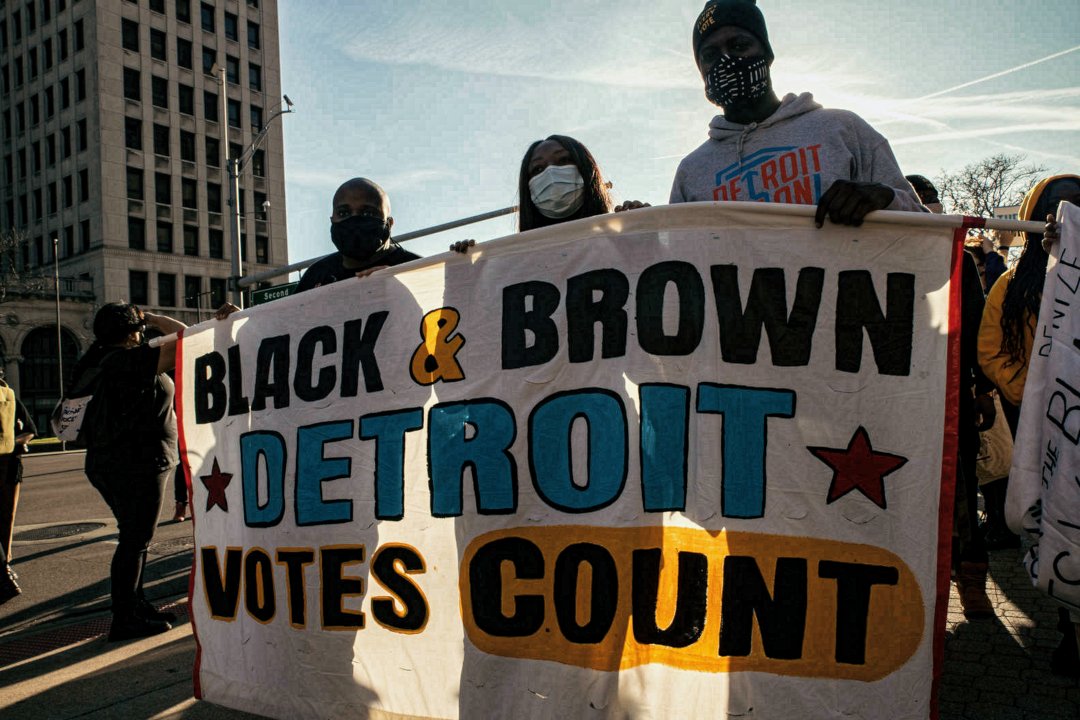
Black votes matter

Trump’s campaign to steal the election hasn’t stopped. It still depends on stealing Black votes. His No. 1 thug Rudy Giuliani wants the votes in Atlanta, Detroit, Milwaukee and Philadelphia thrown out.

[Trump backtracked on his statement that he would leave the White House if the Electoral College seated Joe Biden. Trump tweeted Nov. 28: “Biden can only enter the White House as President if he can prove that his ridiculous ‘80,000,000 votes’ were not fraudulently or illegally obtained. When you see what happened in Detroit, Atlanta, Philadelphia & Milwaukee, massive voter fraud, he’s got a big unsolvable problem!” – Editor]

All these cities have large Black communities with Atlanta and Detroit having Black majorities. If Trump is able to ditch the votes in these cities, he can overturn the results in Georgia, Michigan, Wisconsin and Pennsylvania and win the Electoral College.

That’s what Trump supporter Monica Palmer tried to do In Michigan’s Wayne County, which includes Detroit. Sitting on the county election board, Palmer wanted to certify just the votes of Detroit’s suburbs but not those of Detroit itself.

That’s despite the suburb of Livonia having the second highest number of county precincts with irregularities. While Detroit is nearly 80% Black, Livonia is less than 5% African American. Detroit also has large Arab and Latinx communities whose votes would have been thrown away.

It was the power of the people that stopped this outrage. Hundreds mobilized to stop the steal. Local congressperson Rep. Rashida Tlaib — a Palestinian member of “the squad” — denounced the racist attempt to disenfranchise Detroit’s voters.

In Milwaukee, racist Trump supporters are harassing election workers, many of whom are Black, during a recount. “It looks like [Trump is] looking to do pretty much everything he can to disenfranchise voters of color,” said Milwaukee County Executive David Crowley, the first Black person elected to that post. 

That’s nothing new. After the 1976 presidential election, former Wisconsin Gov. Warren Knowles claimed Black people were being driven around Milwaukee in a school bus and voting a zillion times. 

Then there’s North Carolina. Peaceful marchers, most of whom were Black, going to polls on Halloween in Alamance County were pepper-sprayed and 23 were arrested by Sheriff’s deputies. The Reverend Greg Drumwright and two others are now facing frame-up felony charges.  

Sheriff Terry Johnson, who ordered the attack, is also a notorious anti-immigrant and anti-Latinx bigot. 

Black voting power under attack

It was Black voters who prevented David Duke from being elected Louisiana’s governor in 1991. While 55% of white voters cast their ballots for the neo-Nazi, the Black community, with support from progressive whites, mobilized to stop Duke.

A Black shield stopped the deluge of anti-Jewish racism and fascist violence that would have followed Duke’s election. 

Ollie North wasn’t elected a U.S. senator in 1994 from Virginia because of the Black vote. North helped flood the U.S. with crack cocaine while Ronald Reagan was in the White House. Drug sales financed the contra terrorists trying to overthrow Nicaragua’s Sandinista government.

And it was the Black vote that blocked the super bigot sexual predator Roy Moore from becoming a U.S. senator from Alabama in 2018.

The Black vote was won by Black soldiers during the U.S. Civil War and by bloody struggles during the Reconstruction period that followed. The Fifteenth Amendment, passed in 1870, was supposed to guarantee the right to vote.

That right was swept away by the overthrow of Reconstruction by Ku Klux Klan terror. Black people fought for decades to defend their right to vote without any support from the federal government.

In 1898, the city government of Wilmington, N.C., was overthrown by a white racist mob. Sixty Black people were massacred in the coup. Within two years the right to vote was stolen from virtually all African Americans in North Carolina. 

People died for the 1965 Voting Rights Act. Harriette Moore and Harry T. Moore were bombed in their home on Christmas Day 1951. They were murdered by the Klan for registering Black voters. 

NAACP leader Medgar Evers fought for voting rights in Mississippi and was assassinated on June 12, 1963. The attack on demonstrators in Selma, Ala., in 1965, in which future Congressperson John Lewis was nearly beaten to death by George Wallace’s state troopers, shocked the world.

More than 40 years of political reaction in the U.S. have included vicious attacks on Black voting rights. The voter ID laws passed by over 30 states are deliberately crafted to limit voting by Asian, Black, Indigenous, Latinx and poor people in general.

The 24th Amendment, enacted in 1964, banned poll taxes. Since photo identification usually costs money, isn’t that a poll tax? Yet the U.S. Supreme Court has upheld almost all these discriminatory state ID laws.

Six judges on that capitalist court threw out the vital enforcement provisions of the Voting Rights Act in the 2013 Shelby v. Moore decision.

‘We’re not a democracy’

The struggle for Black voting rights empowers all poor and working people. Literacy tests were used to stop Indigenous people from voting in Arizona until 1970. 

One of the enforcers in Arizona who tried to prevent Black, Indigenous and Latinx people from voting in the 1964 election was William Rehnquist. The thug was rewarded for his strong-arming by being made chief justice of the U.S. Supreme Court.

Millions of white workers benefited when Harlem’s Adam Clayton Powell Jr. was chair of the Education and Labor Committee in the House of Representatives. The Black congressperson pushed through increases in the minimum wage and extended coverage to millions of low paid workers.

The Trump and Giuliani attack on Black votes is aimed at overturning the vote of 80 million people who voted against Trump. Among them were Asian voters who helped defeat Trump in Georgia.

While the super rich, like Michael Bloomberg, are willing to spend billions to buy elections, they sneer at democracy. Even cockroach capitalists consider it intolerable that the vote of poor and working people should count as much as theirs.

That was Robert L. Bartley’s attitude when he was the Wall Street Journal’s editorial page editor. He justified George W. Bush becoming president in 2000 despite getting half-a-million fewer votes than Al Gore.

Bartley did so on the basis that many of the Democratic votes came from union households” and “Blacks while Republican voters were allegedly “producers of wealth.” 

Listen up Wall Street Journal: if an election was held of only the essential workers who kept society together during the coronavirus pandemic, Trump would have lost in a landslide. 

Attacks on the idea of democracy used to come from the wingnuts of the John Birch Society. In an Oct. 7 tweet, Utah Sen. Mike Lee declared “We’re not a democracy.”

Lee wasn’t admitting that money talks during capitalist elections. He wants to get rid of any notion of democracy.

Poor and working people will show all the Trumps what real democracy looks like. That includes over two million workers in prison. Evicting Trump from the White House is just the first step.

Only by taking real democracy to the streets will we stop evictions and win compensation for all the jobless. We need to organize and fight more than before.

Strugglelalucha256


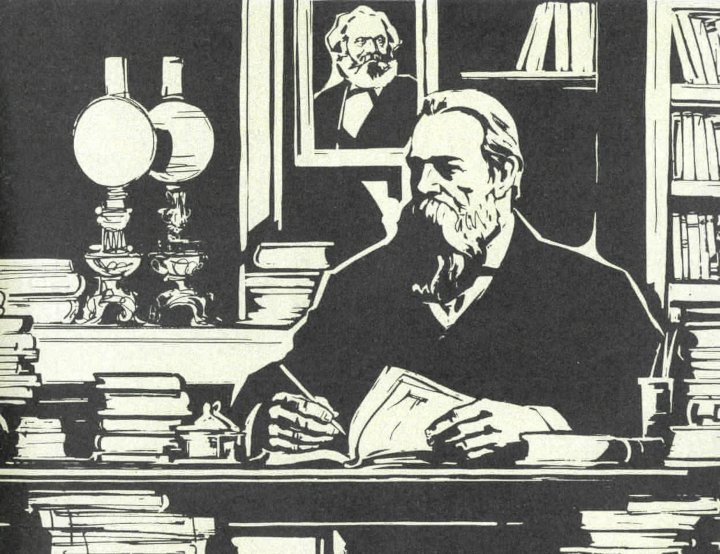
Frederick Engels at 200 – better than ever

Nov. 28, 2020, marks the 200th anniversary of the birth of Frederick Engels, co-founder of scientific socialism with Karl Marx. The following article, written by the Russian revolutionary V.I. Lenin after Engels’ death in 1895, reviews his historic contributions to the struggle for working-class emancipation and socialism.

What a torch of reason ceased to burn,
What a heart has ceased to beat!

On Aug. 5, 1895, Frederick Engels died in London. After his friend Karl Marx (who died in 1883), Engels was the finest scholar and teacher of the modern proletariat in the whole world. 

From the time that fate brought Karl Marx and Frederick Engels together, the two friends devoted their life’s work to a common cause. And so to understand what Frederick Engels has done for the proletariat, one must have a clear idea of the significance of Marx’s teaching and work for the development of the contemporary working-class movement. 

Marx and Engels were the first to show that the working class and its demands are a necessary outcome of the present economic system, which together with the bourgeoisie inevitably creates and organizes the proletariat. They showed that it is not the well-meaning efforts of noble-minded individuals, but the class struggle of the organized proletariat that will deliver humanity from the evils which now oppress it. 

In their scientific works, Marx and Engels were the first to explain that socialism is not the invention of dreamers, but the final aim and necessary result of the development of the productive forces in modern society. All recorded history hitherto has been a history of class struggle, of the succession of the rule and victory of certain social classes over others. And this will continue until the foundations of class struggle and of class domination – private property and anarchic social production – disappear. The interests of the proletariat demand the destruction of these foundations, and therefore the conscious class struggle of the organized workers must be directed against them. And every class struggle is a political struggle.

‘Engels’ name should be known to every worker’

These views of Marx and Engels have now been adopted by all proletarians who are fighting for their emancipation. But when in the 1840s the two friends took part in the socialist literature and the social movements of their time, they were absolutely novel. There were then many people, talented and without talent, honest and dishonest, who, absorbed in the struggle for political freedom, in the struggle against the despotism of kings, police and priests, failed to observe the antagonism between the interests of the bourgeoisie and those of the proletariat. These people would not entertain the idea of the workers acting as an independent social force. 

On the other hand, there were many dreamers, some of them geniuses, who thought that it was only necessary to convince the rulers and the governing classes of the injustice of the contemporary social order, and it would then be easy to establish peace and general well-being on earth. They dreamt of a socialism without struggle. 

Lastly, nearly all the socialists of that time and the friends of the working class generally regarded the proletariat only as an ulcer, and observed with horror how it grew with the growth of industry. They all, therefore, sought for a means to stop the development of industry and of the proletariat, to stop the “wheel of history.” 

Marx and Engels did not share the general fear of the development of the proletariat; on the contrary, they placed all their hopes on its continued growth. The more proletarians there are, the greater is their strength as a revolutionary class, and the nearer and more possible does socialism become. The services rendered by Marx and Engels to the working class may be expressed in a few words thus: they taught the working class to know itself and be conscious of itself, and they substituted science for dreams.

That is why the name and life of Engels should be known to every worker. That is why in this collection of articles, the aim of which, as of all our publications, is to awaken class-consciousness in the Russian workers, we must give a sketch of the life and work of Frederick Engels, one of the two great teachers of the modern proletariat.

An enemy of tyranny

Engels was born in 1820 in Barmen, in the Rhine Province of the kingdom of Prussia. His father was a manufacturer. In 1838 Engels, without having completed his high-school studies, was forced by family circumstances to enter a commercial house in Bremen as a clerk. 

Commercial affairs did not prevent Engels from pursuing his scientific and political education. He had come to hate autocracy and the tyranny of bureaucrats while still at high school. The study of philosophy led him further. 

At that time Hegel’s teaching dominated German philosophy, and Engels became his follower. Although Hegel himself was an admirer of the autocratic Prussian state, in whose service he was as a professor at Berlin University, Hegel’s teachings were revolutionary. Hegel’s faith in human reason and its rights, and the fundamental thesis of Hegelian philosophy that the universe is undergoing a constant process of change and development, led some of the disciples of the Berlin philosopher – those who refused to accept the existing situation – to the idea that the struggle against this situation, the struggle against existing wrong and prevalent evil, is also rooted in the universal law of eternal development. 

If all things develop, if institutions of one kind give place to others, why should the autocracy of the Prussian king or of the Russian tsar, the enrichment of an insignificant minority at the expense of the vast majority, or the domination of the bourgeoisie over the people, continue forever? 

Hegel’s philosophy spoke of the development of the mind and of ideas; it was idealistic. From the development of the mind it deduced the development of nature, of man, and of human, social relations. While retaining Hegel’s idea of the eternal process of development, Marx and Engels rejected the preconceived idealist view; turning to life, they saw that it is not the development of mind that explains the development of nature but that, on the contrary, the explanation of mind must be derived from nature, from matter. … 

Unlike Hegel and the other Hegelians, Marx and Engels were materialists. Regarding the world and humanity materialistically, they perceived that just as material causes underlie all natural phenomena, so the development of human society is conditioned by the development of material forces, the productive forces. On the development of the productive forces depend the relations into which men enter with one another in the production of the things required for the satisfaction of human needs. And in these relations lies the explanation of all the phenomena of social life, human aspirations, ideas and laws. 

The development of the productive forces creates social relations based upon private property, but now we see that this same development of the productive forces deprives the majority of their property and concentrates it in the hands of an insignificant minority. It abolishes property, the basis of the modern social order, it itself strives towards the very aim which the socialists have set themselves. All the socialists have to do is to realise which social force, owing to its position in modern society, is interested in bringing socialism about, and to impart to this force the consciousness of its interests and of its historical task. This force is the proletariat. 

Socialism and the working class

Engels got to know the proletariat in England, in the centre of English industry, Manchester, where he settled in 1842, entering the service of a commercial firm of which his father was a shareholder. Here Engels not only sat in the factory office but wandered about the slums in which the workers were cooped up, and saw their poverty and misery with his own eyes. 

But he did not confine himself to personal observations. He read all that had been revealed before him about the condition of the British working class and carefully studied all the official documents he could lay his hands on. The fruit of these studies and observations was the book which appeared in 1845: The Condition of the Working Class in England.” 

We have already mentioned the chief service rendered by Engels in writing “The Condition of the Working Class in England.” Even before Engels, many people had described the sufferings of the proletariat and had pointed to the necessity of helping it. Engels was the first to say that the proletariat is not only a suffering class; that it is, in fact, the disgraceful economic condition of the proletariat that drives it irresistibly forward and compels it to fight for its ultimate emancipation. And the fighting proletariat will help itself. The political movement of the working class will inevitably lead the workers to realise that their only salvation lies in socialism. On the other hand, socialism will become a force only when it becomes the aim of the political struggle of the working class. 

Such are the main ideas of Engels’ book on the condition of the working class in England, ideas which have now been adopted by all thinking and fighting proletarians, but which at that time were entirely new. These ideas were set out in a book written in absorbing style and filled with most authentic and shocking pictures of the misery of the English proletariat. 

The book was a terrible indictment of capitalism and the bourgeoisie and created a profound impression. Engels’ book began to be quoted everywhere as presenting the best picture of the condition of the modern proletariat. And, in fact, neither before 1845 nor after has there appeared so striking and truthful a picture of the misery of the working class.

Meeting Marx

It was not until he came to England that Engels became a socialist. In Manchester he established contacts with people active in the English labor movement at the time and began to write for English socialist publications. 

In 1844, while on his way back to Germany, he became acquainted in Paris with Marx, with whom he had already started to correspond. In Paris, under the influence of the French socialists and French life, Marx had also become a socialist. 

Here the friends jointly wrote a book entitled The Holy Family, or Critique of Critical Critique.” This book, which appeared a year before “The Condition of the Working Class in England,” and the greater part of which was written by Marx, contains the foundations of revolutionary materialist socialism, the main ideas of which we have expounded above. 

“The holy family” is a facetious nickname for the Bauer brothers, the philosophers, and their followers. These gentlemen preached a criticism which stood above all reality, above parties and politics, which rejected all practical activity, and which only “critically” contemplated the surrounding world and the events going on within it. These gentlemen, the Bauers, looked down on the proletariat as an uncritical mass. 

Marx and Engels vigorously opposed this absurd and harmful tendency. In the name of a real, human person – the worker, trampled down by the ruling classes and the state – they demanded, not contemplation, but a struggle for a better order of society. They, of course, regarded the proletariat as the force that is capable of waging this struggle and that is interested in it. 

Even before the appearance of “The Holy Family,” Engels had published in Marx’s and Ruge’s Deutsch-Franzosische Jahrbucher his “Critical Essays on Political Economy,” in which he examined the principal phenomena of the contemporary economic order from a socialist standpoint, regarding them as necessary consequences of the rule of private property. Contact with Engels was undoubtedly a factor in Marx’s decision to study political economy, the science in which his works have produced a veritable revolution.

1848 and the Communist Manifesto

From 1845 to 1847 Engels lived in Brussels and Paris, combining scientific work with practical activities among the German workers in those cities. Here Marx and Engels established contact with the secret German Communist League, which commissioned them to expound the main principles of the socialism they had worked out. Thus arose the famous Manifesto of the Communist Party of Marx and Engels, published in 1848. This little booklet is worth whole volumes: to this day its spirit inspires and guides the entire organized and fighting proletariat of the world.

The revolution of 1848, which broke out first in France and then spread to other West European countries, brought Marx and Engels back to their native country. Here, in Rhenish Prussia, they took charge of the democratic Neue Rheinische Zeitung published in Cologne. 

The two friends were the heart and soul of all revolutionary-democratic aspirations in Rhenish Prussia. They fought to the last ditch in defense of freedom and of the interests of the people against the forces of reaction. The latter, as we know, gained the upper hand. The Neue Rheinische Zeitung was suppressed. Marx, who during his exile had lost his Prussian citizenship, was deported; Engels took part in the armed popular uprising, fought for liberty in three battles, and after the defeat of the rebels fled, via Switzerland, to London.

Marx also settled in London. Engels soon became a clerk again, and then a shareholder, in the Manchester commercial firm in which he had worked in the forties. Until 1870 he lived in Manchester, while Marx lived in London, but this did not prevent their maintaining a most lively interchange of ideas: they corresponded almost daily. In this correspondence the two friends exchanged views and discoveries and continued to collaborate in working out scientific socialism. 

Engels and ‘Capital’

In 1870 Engels moved to London, and their joint intellectual life, of the most strenuous nature, continued until 1883, when Marx died. Its fruit was, on Marx’s side, Capital,” the greatest work on political economy of our age, and on Engels’ side, a number of works both large and small. Marx worked on the analysis of the complex phenomena of capitalist economy. Engels, in simply written works, often of a polemical character, dealt with more general scientific problems and with diverse phenomena of the past and present in the spirit of the materialist conception of history and Marx’s economic theory. 

Of Engels’ works we shall mention: the polemical work against Dühring (analyzing highly important problems in the domain of philosophy, natural science and the social sciences), The Origin of the Family, Private Property and the State,” “Ludwig Feuerbach,” an article on the foreign policy of the Russian government, splendid articles on the housing question, and finally, two small but very valuable articles on Russia’s economic development (“Frederick Engels on Russia,” translated into Russian by Zasulich, Geneva, 1894). 

Marx died before he could put the final touches to his vast work on capital. The draft, however, was already finished, and after the death of his friend, Engels undertook the onerous task of preparing and publishing the second and the third volumes of “Capital.” He published Volume II in 1885 and Volume III in 1894. (His death prevented the preparation of Volume IV.) 

These two volumes entailed a vast amount of labor. Adler, the Austrian Social-Democrat, has rightly remarked that by publishing Volumes II and III of “Capital” Engels erected a majestic monument to the genius who had been his friend, a monument on which, without intending it, he indelibly carved his own name. Indeed these two volumes of “Capital” are the work of two men: Marx and Engels. 

Old legends contain various moving instances of friendship. The European proletariat may say that its science was created by two scholars and fighters, whose relationship to each other surpasses the most moving stories of the ancients about human friendship. Engels always – and, on the whole, quite justly – placed himself after Marx. “In Marx’s lifetime,” he wrote to an old friend, “I played second fiddle.” His love for the living Marx, and his reverence for the memory of the dead Marx were boundless. This stern fighter and austere thinker possessed a deeply loving soul.

First and Second Internationals

After the movement of 1848-1849, Marx and Engels in exile did not confine themselves to scientific research. In 1864 Marx founded the International Working Men’s Association, and led this society for a whole decade. Engels also took an active part in its affairs. The work of the International Association, which, in accordance with Marx’s idea, united proletarians of all countries, was of tremendous significance in the development of the working-class movement. 

But even with the closing down of the International Association in the 1870s, the unifying role of Marx and Engels did not cease. On the contrary, it may be said that their importance as the spiritual leaders of the working-class movement grew continuously, because the movement itself grew uninterruptedly. 

After the death of Marx, Engels continued alone as the counsellor and leader of the European socialists. His advice and directions were sought for equally by the German socialists, whose strength, despite government persecution, grew rapidly and steadily, and by representatives of backward countries, such as the Spaniards, Romanians and Russians, who were obliged to ponder and weigh their first steps. They all drew on the rich store of knowledge and experience of Engels in his old age.

Marx and Engels, who both knew Russian and read Russian books, took a lively interest in the country, followed the Russian revolutionary movement with sympathy and maintained contact with Russian revolutionaries. They both became socialists after being democrats, and the democratic feeling of hatred for political despotism was exceedingly strong in them. 

This direct political feeling, combined with a profound theoretical understanding of the connection between political despotism and economic oppression, and also their rich experience of life, made Marx and Engels uncommonly responsive politically. That is why the heroic struggle of the handful of Russian revolutionaries against the mighty tsarist government evoked a most sympathetic echo in the hearts of these tried revolutionaries. 

On the other hand, the tendency, for the sake of illusory economic advantages, to turn away from the most immediate and important task of the Russian socialists, namely, the winning of political freedom, naturally appeared suspicious to them and was even regarded by them as a direct betrayal of the great cause of the social revolution. 

“The emancipation of the workers must be the act of the working class itself” – Marx and Engels constantly taught. But in order to fight for its economic emancipation, the proletariat must win itself certain political rights. Moreover, Marx and Engels clearly saw that a political revolution in Russia would be of tremendous significance to the West European working-class movement as well. 

Autocratic Russia had always been a bulwark of European reaction in general. The extraordinarily favorable international position enjoyed by Russia as a result of the war of 1870, which for a long time sowed discord between Germany and France, of course only enhanced the importance of autocratic Russia as a reactionary force. Only a free Russia, a Russia that had no need either to oppress the Poles, Finns, Germans, Armenians or any other small nations, or constantly to set France and Germany at loggerheads, would enable modern Europe, rid of the burden of war, to breathe freely, would weaken all the reactionary elements in Europe and strengthen the European working class. 

That was why Engels ardently desired the establishment of political freedom in Russia for the sake of the progress of the working-class movement in the West as well. In him the Russian revolutionaries have lost their best friend.

Let us always honor the memory of Frederick Engels, a great fighter and teacher of the proletariat!

Written in autumn 1895

Source: Marxists Internet Archive


Strugglelalucha256


Nov. 29 car and bicycle caravan to end the blockade of Cuba in Miami and other cities

On Sunday, Nov. 29, A bicycle and car caravan will roll in Miami to call for ending U.S. economic sanctions against Cuba. Activities in solidarity with the Miami caravan are planned for New York City, Washington, D.C., and Seattle.

In a press release organizers said: “We believe that these measures, maintained for more than 60 years with the aim of worsening the living conditions of the Cuban people and thereby achieving regime change in Havana, have been continuously punishing the Cuban family in a cruel and inhuman way.”

This event is organized and sponsored by the Cuban Protestón (Jorge Medina) and Puentes de Amor (Carlos Lazo) as well as by the influencers Yadira Escobar, QueenVega, Angela María Callis Vicente, (The Cuban little flower), El Invicto (Roberto García), Pellizcando (Liber Barrueta), Felipe, from Guateque Light, el Mambby (Emilio Juarez Amoros), Yosbani ( Deloquepicaelpollo), Evelio Ocho Cuba, Eduardo Bover, Manuel Tejeda, Medea Benjamin (CODEPINK), and other personalities, artists, youtubers and organizations.

Contact
Jorge Medina
Carlos Lazo
305-5914259
Porcuba1@yahoo.com


Full statement in English and Español

Democrats, Republicans, Cubans and non-Cubans, people of different political creeds and ideologies, we will meet next Sunday in the city of Miami to carry out a caravan of cars and bicycles, to ask for the end of the economic sanctions of the government of United States against Cuba.

We believe that these measures, maintained for more than 60 years with the aim of worsening the living conditions of the Cuban people and thereby achieving regime change in Havana, have been continuously punishing the Cuban family in a cruel and inhuman way.

This damage is also done to us who no longer live on the Island, but we maintain, above all, ties, love, protection, and the desire to help our relatives.

In the current pandemic conditions, as humanity faces Covid-19 and economies around the world have been affected, the suffering of the small island of Cuba also increases.

Current President Donald Trump has done nothing more than tighten measures against Cuba since he came to power and has had no humanitarian considerations in the current context.

Today, due to these administration measures, among other punishments, Cubans are prevented from using Western Union services to send remittances to their relatives on the island. And, above all, the amounts we can send are limited.

Last March, just when the pandemic was raging in our hemisphere, and both Cuba and the United States were being shaken, we addressed Trump with a humanitarian petition and managed to gather 20,000 signatures.(see also) The outgoing president did not make any positive gesture, on the contrary.

But the polls spoke on November 3, and soon President-elect Joe Biden will take over the country. We believe that it is necessary for him to know our cry and for the Cuban community in the United States to raise their voices.

That is why on October 10, the Cuban homeland date, and still without knowing whether or not he would be elected, we began a new petition for signatures to ask Biden to be the architect of the bridges of love that our peoples demand. We ask that you:

  • Reactivate the United States embassy in Havana so that the issuance of visas and the rest of the consular services is normalized.
  • Restore the Cuban Family Reunification Parole Program suspended by Trump since 2017.
  • Allow US airlines to once again fly to Cuban provinces.
  • Allow unlimited remittances to Cuba.
  • Decree the freedom of Americans to travel to Cuba. Current travel restrictions restrict the rights of US citizens.
  • Allow and encourage financial and commercial relations with the Island. Encourage economic investments and scientific and cultural exchanges between both peoples.

This petition can be signed at www.puentesdeamor.com and has already obtained more than 8000 signatures. Our hashtag #puentesdeamor is the currency that moves us.

May the economic sanctions that weigh on the Cuban family cease! May bridges of love be built between the peoples of Cuba and the United States! End of embargo! End the blockade!

We are summoning all Cubans, united by our families.

There is a time for resentment and a time for forgiveness. There is a time for darkness and a time for light. There is a time for hatred. This is the age of love! The family is sacred!

Date and time: Sunday, November 29, 2020, at 9:00 AM.

Location: 3825 NW 7th ST, Miami, FL 33126 (the Kmart parking lot).

This event is organized and sponsored by the Cuban Protestón (Jorge Medina) and Puentes de Amor (Carlos Lazo) as well as by the influencers Yadira Escobar, QueenVega, Angela María Callis Vicente, (The Cuban little flower), El Invicto (Roberto García), Pellizcando (Liber Barrueta), Felipe, from Guateque Light, el Mambby (Emilio Juarez Amoros), Yosbani ( Deloquepicaelpollo), Evelio Ocho Cuba, Eduardo Bover, Manuel Tejeda, Medea Benjamin (CODEPINK), and other personalities, artists, youtubers and organizations.

Contact
Jorge Medina
Carlos Lazo
305-5914259
Porcuba1@yahoo.com


NOTA DE PRENSA

Demócratas, republicanos, cubanos y no cubanos, personas de diversos credos políticos e ideologías, nos reuniremos el próximo domingo en la ciudad de Miami para realizar una caravana de autos y bicicletas, con la finalidad de pedir el cese de las sanciones económicas del gobierno de Estados Unidos contra Cuba.

Creemos que estas medidas, mantenidas durante más de 60 años con la finalidad de empeorar las condiciones de vida del pueblo cubano y conseguir por esa vía un cambio de régimen en La Habana, han estado castigando sostenidamente a la familia cubana de forma cruel e inhumana.

Ese daño también se nos hace a nosotros que ya no vivimos en la Isla, pero mantenemos, por encima de todo, vínculos, amor, protección, anhelo y deseos de ayudar a nuestros allegados.

En las actuales condiciones de pandemia, mientras la humanidad se enfrenta a la Covid-19 y las economías de todo el mundo se han afectado, el sufrimiento de la pequeña Isla de Cuba también se incrementa.

El actual presidente Donald Trump no ha hecho más que arreciar las medidas contra Cuba desde que llegó al poder y no ha tenido consideraciones humanitarias en el contexto actual.

Hoy, debido a esas medidas de la administración, entre otros castigos, se impide a los cubanos usar los servicios de Western Union para enviar remesas a sus familiares en la Isla. Y, encima, se limitan los montos que podemos enviar.

El pasado marzo, justo cuando la pandemia arreciaba en nuestro hemisferio, y tanto Cuba como Estados Unidos, estaban siendo azolados, nos dirigimos a Trump con una petición humanitaria y conseguimos reunir 20 mil firmas (Véase también). El presidente saliente no hizo ningún gesto positivo, al contrario.

Pero las urnas hablaron el pasado 3 de noviembre, y pronto el presidente electo Joe Biden tomará las riendas del país. Creemos que es necesario que él conozca nuestro clamor y que la comunidad de cubanos en Estados Unidos eleve sus voces.

Es por eso que el pasado 10 de octubre, fecha patria cubana, y aún sin saber si sería o no electo, comenzamos una nueva petición de firmas para pedirle a Biden que sea arquitecto de los puentes de amor que reclaman nuestros pueblos. Le pedimos que:

  • Reactive la embajada de los Estados Unidos en la Habana para que se normalice la emisión de visados y el resto de los servicios consulares.
  • Restaure el Programa de Reunificación Familiar (Cuban Family Reunification Parole Program) suspendido por Trump desde 2017.  
  • Permita que las aerolíneas estadounidenses puedan otra vez volar a las provincias cubanas.
  • Permita los envíos ilimitados de remesas a Cuba.
  • Decrete la libertad de los estadounidenses de viajar a Cuba. Las restricciones de viajes actuales restringen los derechos de los ciudadanos estadounidenses.
  • Permita e incentive las relaciones financieras y comerciales con la Isla. Estimule las inversiones económicas y los intercambios científicos y culturales entre ambos pueblos.

Esta petición puede ser firmada en www.puentesdeamor.com y ha conseguido ya más de 8000 adhesiones. Nuestro hashtag #puentesdeamor es la divisa que nos mueve.

¡Qué cesen las sanciones económicas que pesan sobre la familia cubana! ¡Qué se construyan puentes de amor entre los pueblos de Cuba y los Estados Unidos! ¡Fin del embargo! ¡Cese del bloqueo!

Estamos convocando a todos los cubanos, unidos por nuestras familias.

Hay un tiempo para el rencor y un tiempo para el perdón. Hay un tiempo para la oscuridad y un tiempo para la luz. Hay un tiempo para el odio. ¡Esta es la era del amor! ¡La familia es sagrada!

Día y hora: Domingo, 29 de noviembre de 2020, a las 9:00 AM.
Lugar: 3825 NW 7th ST, Miami, FL 33126 (el estacionamiento de Kmart).

Este evento está organizado y auspiciado por el Protestón Cubano (Jorge Medina) y por Puentes de Amor (Carlos Lazo) así como por los influencers Yadira Escobar, QueenVega, Angela María Callis Vicente, (La florecita cubana), El Invicto (Roberto García), Pellizcando (Liber Barrueta), Felipe, de Guateque Light, el Mambby (Emilio Juarez Amoros), Yosbani (Deloquepicaelpollo), Evelio Ocho Cuba, Eduardo Bover, Manuel Tejeda, Medea Benjamin (CODEPINK) y otras personalidades, artistas, youtubers y organizaciones.

Contacto Jorge Medina
Carlos Lazo
305-5914259
Porcuba1@yahoo.com

Strugglelalucha256


Whoever’s in the White House, get ready to fight

Nov. 25 — The year 2020 has been exhausting.

At the beginning of this year, a U.S. war of aggression against Iran seemed imminent. President Donald Trump ordered the illegal, provocative and downright racist assassination of Gen. Qasem Soleimani, commander of Iran’s Quds Force, responsible for beating back the threat of Islamic State (ISIS) forces in Syria, Iraq and throughout West Asia.

Then came the global pandemic, which killed almost 1.5 million people worldwide by late November. While some countries were able to take swift, organized, community-supported action to stop the spread — especially socialist countries like China, Vietnam and Cuba — those based on market-driven capitalism, with inadequate, privatized health care, were unable to meet the challenge. 

That was the U.S. most of all, with 12.7 million cases reported on Nov. 25 and 260,000 deaths, the worst in the world. Both numbers continue to soar with no end in sight. 

Millions of workers are reeling from the unnecessary, preventable deaths of loved ones, especially in the hardest-hit Black, Latinx and Indigenous communities.

Entwined with the pandemic, and looming even before COVID-19 was identified, was the latest global capitalist economic crisis, which has hit the world harder than any boom-and-bust cycle since the Great Depression of the 1930s. Millions were thrown out of work. 

Families are scraping by and joining miles-long lines for food assistance after the U.S. Congress and the White House failed to extend emergency benefits or further cash relief. At the end of 2020, more than 13 million unemployed workers will lose their jobless benefits. Almost 7 million households are threatened with eviction when emergency protections end on Dec. 31.

For those low-wage workers and health care workers lucky enough to keep their jobs — the so-called essential workers, also disproportionately oppressed and poor people, including undocumented migrants — every day is a struggle to stay safe from infection. 

A study by National Nurses United, the country’s largest nurses’ union, found that Filipinx workers have been one-third of the nurses who have died, despite being only 4 percent of nurses in the U.S. That’s because they are disproportionately on the frontlines in emergency rooms and care centers, and have less access to necessary equipment and health care themselves.

Black Lives uprising

In May, Minneapolis cops murdered George Floyd, a Black man, in broad daylight. The city and the whole country erupted in a mass uprising against racist police violence. Led by Black youth, millions took to the streets against the killer cops and their political enablers from city halls and statehouses to Washington. The New York Times reported that as many as 26 million people in the U.S. participated in demonstrations over the death of George Floyd.

The multinational uprising, which some have termed the largest protest movement in U.S. history, shook the racist foundations of the capitalist system. 

Lacking coordinated national leadership, this heroic movement was unable to sustain its early momentum as the capitalist state brought its forces to bear to suppress it. But valuable lessons were learned and the anger of the people has not gone away. 

Each new outrage, like the blatant grand jury manipulation to let off the cops who murdered Breonna Taylor in Louisville, Ky., brings people back into the streets.

And then there was the election. No, let’s call it what it really was: the selection, between two wealthy racist white men handpicked by the capitalist ruling class, by the billionaire oligarchs and landlords, to steer their ship of state. 

Having once more sabotaged Bernie Sanders and his campaign driven by idealistic young people just beginning to learn what socialism is (and isn’t), the Democratic Party bosses pushed Joe Biden onto the masses — Biden, a paragon of old-school Washington war mongering, systemic racism and mass incarceration, a trusted friend of Wall Street — as their only alternative to Donald Trump’s open appeals to white supremacy and fascism.

Despite the Democrats’ and Republicans’ best efforts, though, the Black Lives rebellion turned the November presidential election into a referendum on Trump’s racism. And Trump lost, by 6 million votes and counting.

Now, as we enter the last month of 2020, with Trump in office for eight more weeks, the threat of U.S. war on Iran looms again.

Get ready to fight

After all this — when the media announced on Nov. 7 that Trump had been defeated and Biden had won the necessary Electoral College votes to take office — the masses of workers and oppressed people let out a collective sigh of relief. In many places, people spontaneously came out into the streets to celebrate Trump’s defeat. 

This feeling is completely understandable. 

The tension ramped up again as Trump denied the results. To this day, Trump has refused to concede defeat. He and his backers in the ruling class, the capitalist state, and fascist gangs like the Proud Boys, Oath Keepers and Wolverine Watchmen, have not stopped plotting to overturn his electoral defeat.

Until Trump is out of the White House, we must remain on guard and ready to mobilize against a coup attempt. If Trump’s four years in power have taught anything, it is that the “venerable institutions” in which the Democratic establishment and corporate media urge the people to put their trust will not protect us.

But even if Trump departs and Biden takes the oath of office peacefully on Inauguration Day, Jan. 20, 2021, the fight is not over. Far from it.

Just look at who Biden is lining up as his Cabinet appointees and other high positions in his administration. Most are carryovers from the Obama administration or other representatives of the right-wing Democratic leadership. 

Biden’s former chief of staff, Bruce Reed, an advocate of austerity and cuts to Social Security, is his likely pick for the Office of Management and Budget. Antony Blinken, a warmonger on Iraq, Libya, Syria and Ukraine, is Biden’s choice for secretary of state. To head the Department of Homeland Security is Alejandro Mayorkas, an anti-communist Cuban American whose family fled the socialist revolution. And so on.

Biden is expected to nominate several women and people of color to positions that have been exclusively held by white men. Representation is important. Those who discount or ridicule it are not doing themselves any favors; it will not gain them an audience with the workers.

But if those being appointed to these positions are loyalists of the system that oppresses women, people of color, immigrants, LGBTQ2S people and all workers, then the value of that representation is limited.

Biden has also suggested that he may appoint “mainstream” Republicans, in the same spirit that his campaign solicited and trumpeted the support of war criminal George W. Bush and racist former Michigan Gov. Rick Snyder.

A return to 2016 won’t save us

The Democratic establishment epitomized by President-elect Joe Biden wants to turn the clock back to the “good old days” before Trump’s election in November 2016. 

Good days for them and their backers on Wall Street and the military-industrial complex, perhaps. For the workers and oppressed? Not so much.

What was the period of U.S. history before Trump turned up the flame of bigotry and repression? It was the period that gave rise to Trump and the resurgence of white supremacist, fascist movements.

It was the police murder of Mike Brown in Ferguson, Mo.; the birth of the phrase “Deporter In Chief”; the violent, coordinated crushing of the Occupy Wall Street movement; the declaration of Bolivarian Venezuela as a “special threat to U.S. national security.”

It was the pinnacle of mass incarceration of young Black and Brown men and women, built on policies that Sen. Joe Biden had an intimate part in crafting. It was Biden himself overseeing the construction of a regime in Ukraine based on the power of neo-fascist, white supremacist movements to serve U.S. military, political and corporate interests.

Anyone hoping for the incoming Democratic administration to enact a massive retooling of the country to be more equitable is in for a big disappointment. The will for a New Deal or a Green New Deal doesn’t exist within the capitalist class. 

The global decline of U.S. imperialist power and the tendency of the rate of profit to fall, as described 150 years ago by Karl Marx, undercut any liberal hopes. That’s why the best that the system can offer the workers is Biden and a return to pre-2016 misery. That’s why the return of Trump (or someone similar) in 2024 will hang over the next four years. 

Will Biden enact the national shutdown needed to bring the virus under control?

Will Biden rein in the police, much less defund them?

Will Biden fight for Medicare for All?

Will Biden stop wars and sanctions?

Will Biden stop the war on immigrants?

Will Biden defeat the white supremacist gangs threatening our communities?

Will Biden put workers before Wall Street?

Trump’s electoral defeat was a victory. It was a battle, and an important one. But the class war continues.

Under Trump or Biden, the job of socialists and communists, of all class-conscious workers, is to organize and fight for the rights of the workers and oppressed. Let’s use this historic moment to help our class shed its illusions and build a militant movement against the whole rotten capitalist system, for a socialist future.

Strugglelalucha256


National Day of Mourning livestream

For everyone who won’t be in Plymouth, the livestream and pre-recorded content for the National Day of Mourning on November 26 will run starting at approximately 12 noon EST via these sites: the United American Indians of New England (UAINE) website, at the UAINE Facebook group, on YouTube and at hate5six.If you miss it on Thursday, the livestream and prerecorded content will be put up at our website some time after Thursday. We’re not sure exactly which day, but it will be well worth watching!

National Day of Mourning

Since 1970, Native Americans and our supporters have gathered at noon on Cole’s Hill in Plymouth to commemorate a National Day of Mourning on the US thanksgiving holiday. Many Native Americans do not celebrate the arrival of the Pilgrims and other European settlers. Thanksgiving day is a reminder of the genocide of millions of Native people, the theft of Native lands, and the relentless assault on Native culture. Participants in National Day of Mourning honor Native ancestors and the struggles of Native peoples to survive today. It is a day of remembrance and spiritual connection as well as a protest of the racism and oppression which Native Americans continue to experience.

51st Annual National Day of Mourning
November 26, 2020
12:00 Noon
Coles Hill, Plymouth, MA

ORIENTATION FOR 50​th​ ANNIVERSARY NATIONAL DAY OF MOURNING 11.26.20

WHAT IS NATIONAL DAY OF MOURNING?
An annual tradition since 1970, Day of Mourning is a solemn, spiritual and highly political day. Many of us fast from sundown the day before through the afternoon of that day (and have a social after Day of Mourning so that participants in DOM can break their fasts). We are mourning our ancestors and the genocide of our peoples and the theft of our lands. NDOM is a day when we mourn, but we also feel our strength in action. Over the years, participants in Day of Mourning have buried Plymouth Rock a number of times, boarded the Mayflower replica, and placed ku klux klan sheets on the statue of William Bradford, etc.
WHEN AND WHERE IS DAY OF MOURNING?
Thursday, November 26, 2020 (U.S. “thanksgiving” day) at Cole’s Hill, Plymouth, Massachusetts, 12 noon SHARP. Cole’s Hill is the hill above Plymouth Rock in the Plymouth historic waterfront area.
WILL THERE BE A MARCH?
Yes, there will be a march through the historic district of Plymouth. Plymouth agreed, as part of the settlement of 10/19/98, that UAINE may march on National Day of Mourning without the need for a permit as long as we give the town advance notice.
PROGRAM
Although we very much welcome our non-Native supporters to stand with us, it is a day when only Indigenous people speak about our history and the struggles that are taking place throughout the Americas. Speakers will be by invitation only. This year’s NDOM will have livestreaming from Plymouth as well as messages from Indigenous struggles in many homelands!

Please note that NDOM is not a commercial event, so we ask that people do not sell merchandise or distribute leaflets at the outdoor program. Also, we ask that you do not eat (unless you must do so for medical reasons) at the outdoor speak-out and march out of respect for the participants who are fasting. Finally, dress for the weather!

SOCIAL
There will be NO pot-luck social this year due to COVID-19.
TRANSPORTATION
We have discouraged buses and carpooling this year due to COVID. If you cannot get to Plymouth, you can watch online!
DONATIONS
Monetary donations are gratefully accepted to help defray the costs of the day and of UAINE’s many other efforts during the year: 2020-2021 GoFundMe Fundraiser
FOR UPDATES
Please join and check the UAINE facebook group for updates on National Day of Mourning this year. Our UAINE website uaine.org will be updated, but not as quickly or frequently.

COVID-19 has hit Indigenous communities very hard, and we want to ensure that no one gets sick from attending National Day of Mourning. Everyone must wear a mask covering their mouth and nose – no exceptions!

IF YOU CAN’T ATTEND NATIONAL DAY OF MOURNING

How you can still support the National Day of Mourning even if you can’t attend – 2020 PDF

Other Campaigns

In addition to National Day of Mourning and supporting many other important struggles, UAINE works with other organizations to do lots more!

Indigenous Peoples Day MA
UAINE is providing leadership in the work of IndigenousPeoplesDayMA.org, which has been providing support and strategy for Indigenous Peoples Day campaigns in Massachusetts. Successful campaigns have included Cambridge, Brookline, and more, and we also have a bill before the state legislature. See the website IndigenousPeoplesDayMA.org for more information!
Massachusetts Indigenous Legislative Agenda
UAINE is also a key component of the Massachusetts Indigenous Legislative Agenda, which consolidates the efforts of those working on five important bills involving Indigenous issues that are currently before the MA legislature to make a statewide Indigenous Peoples Day, Prohibit the use of Native sports team names and Mascots, Redesign the State Flag & Seal, Support Native Education, and Protect Native Heritage. To learn more about this important work and how you can help to support it, go to MAIndigenousAgenda.org.
Christopher Columbus Statue
The Christopher Columbus statue in Boston’s ‘Christopher Columbus Waterfront Park’ has stood for decades as a representation of white supremacy and the celebration of Indigenous genocide caused by Columbus and his men. Like similar statues around the country and Confederate monuments, this Columbus statue has been a focus of protest repeatedly, including having its head knocked off on 6/10/2020. The City of Boston has temporarily removed the headless statue, but will not commit to removing it permanently.

Sign the Petition to Permanently Remove the Columbus Statue at Boston’s Waterfront Park

by Moonanum James and Mahtowin MunroEvery year since 1970, United American Indians of New England have organized the National Day of Mourning observance in Plymouth at noon on Thanksgiving Day. Every year, hundreds of Native people and our supporters from all four directions join us. Every year, including this year, Native people from throughout the Americas will speak the truth about our history and about current issues and struggles we are involved in.Why do hundreds of people stand out in the cold rather than sit home eating turkey and watching football? Do we have something against a harvest festival?Of course not. But Thanksgiving in this country — and in particular in Plymouth –is much more than a harvest home festival. It is a celebration of the pilgrim mythology.

According to this mythology, the pilgrims arrived, the Native people fed them and welcomed them, the Indians promptly faded into the background, and everyone lived happily ever after.

The truth is a sharp contrast to that mythology.

The pilgrims are glorified and mythologized because the circumstances of the first English-speaking colony in Jamestown were frankly too ugly (for example, they turned to cannibalism to survive) to hold up as an effective national myth. The pilgrims did not find an empty land any more than Columbus “discovered” anything. Every inch of this land is Indian land. The pilgrims (who did not even call themselves pilgrims) did not come here seeking religious freedom; they already had that in Holland. They came here as part of a commercial venture. They introduced sexism, racism, anti-lesbian and gay bigotry, jails, and the class system to these shores. One of the very first things they did when they arrived on Cape Cod — before they even made it to Plymouth — was to rob Wampanoag graves at Corn Hill and steal as much of the Indians’ winter provisions of corn and beans as they were able to carry. They were no better than any other group of Europeans when it came to their treatment of the Indigenous peoples here. And no, they did not even land at that sacred shrine called Plymouth Rock, a monument to racism and oppression which we are proud to say we buried in 1995.The first official “Day of Thanksgiving” was proclaimed in 1637 by Governor Winthrop. He did so to celebrate the safe return of men from the Massachusetts Bay Colony who had gone to Mystic, Connecticut to participate in the massacre of over 700 Pequot women, children, and men.

About the only true thing in the whole mythology is that these pitiful European strangers would not have survived their first several years in “New England” were it not for the aid of Wampanoag people. What Native people got in return for this help was genocide, theft of our lands, and never-ending repression. We are treated either as quaint relics from the past, or are, to most people, virtually invisible.

When we dare to stand up for our rights, we are considered unreasonable. When we speak the truth about the history of the European invasion, we are often told to “go back where we came from.” Our roots are right here. They do not extend across any ocean.

National Day of Mourning began in 1970 when a Wampanoag man, Wamsutta Frank James, was asked to speak at a state dinner celebrating the 350th anniversary of the pilgrim landing. He refused to speak false words in praise of the white man for bringing civilization to us poor heathens. Native people from throughout the Americas came to Plymouth, where they mourned their forebears who had been sold into slavery, burned alive, massacred, cheated, and mistreated since the arrival of the Pilgrims in 1620.

But the commemoration of National Day of Mourning goes far beyond the circumstances of 1970.

Can we give thanks as we remember Native political prisoner Leonard Peltier, who was framed up by the FBI and has been falsely imprisoned since 1976? Despite mountains of evidence exonerating Peltier and the proven misconduct of federal prosecutors and the FBI, Peltier has been denied a new trial. Bill Clinton apparently does not feel that particular pain and has refused to grant clemency to this innocent man.

To Native people, the case of Peltier is one more ordeal in a litany of wrongdoings committed by the U.S. government against us. While the media in New England present images of the “Pequot miracle” in Connecticut, the vast majority of Native people continue to live in the most abysmal poverty.

Can we give thanks for the fact that, on many reservations, unemployment rates surpass fifty percent? Our life expectancies are much lower, our infant mortality and teen suicide rates much higher, than those of white Americans. Racist stereotypes of Native people, such as those perpetuated by the Cleveland Indians, the Atlanta Braves, and countless local and national sports teams, persist. Every single one of the more than 350 treaties that Native nations signed has been broken by the U.S. government. The bipartisan budget cuts have severely reduced educational opportunities for Native youth and the development of new housing on reservations, and have caused cause deadly cutbacks in health-care and other necessary services.

Are we to give thanks for being treated as unwelcome in our own country?

Or perhaps we are expected to give thanks for the war that is being waged by the Mexican government against Indigenous peoples there, with the military aid of the U.S. in the form of helicopters and other equipment? When the descendants of the Aztec, Maya, and Inca flee to the U.S., the descendants of the wash-ashore pilgrims term them ‘illegal aliens” and hunt them down.

We object to the “Pilgrim Progress” parade and to what goes on in Plymouth because they are making millions of tourist dollars every year from the false pilgrim mythology. That money is being made off the backs of our slaughtered indigenous ancestors.

Increasing numbers of people are seeking alternatives to such holidays as Columbus Day and Thanksgiving. They are coming to the conclusion that, if we are ever to achieve some sense of community, we must first face the truth about the history of this country and the toll that history has taken on the lives of millions of Indigenous, Black, Latino, Asian, and poor and working class white people.

The myth of Thanksgiving, served up with dollops of European superiority and manifest destiny, just does not work for many people in this country. As Malcolm X once said about the African-American experience in America, “We did not land on Plymouth Rock. Plymouth Rock landed on us.” Exactly.

Source: United American Indians of New England – UAINE

Strugglelalucha256
https://www.struggle-la-lucha.org/2020/11/