CYCLICAL CAPITALIST CRISES: Behind the stock market turmoil

March 5 — The Dow index just fell 12 percent in one week, the worst week for stocks since the 2008 financial crisis. Many wonder if this could become a full-on stock market crash.

Among socialists, there is always a temptation to paint a fall on Wall Street in terms of an imminent economic or political collapse. And while that is a possibility, a market crash never causes an economic collapse. It’s more like a symptom of capitalism’s economic instability. 

On the other side, apologists for the capitalist system are saying that the momentous drop is merely a “correction.” The capitalist economists claim that the global stock market fall is unrelated to the fundamentals of the economy, that the market has been gripped by coronavirus jitters. Just give it a couple of weeks and all will be well.

What happens at the stock market isn’t capitalist production; it does not produce value. What happens at the stock market is a reflection of the conditions of capitalist production. 

The stock exchange concentrates all industry, agriculture, commerce and the means of production into the hands of the stock exchange operators, that is, the biggest banks and financial institutions, including central banks such as the Federal Reserve.

But the stock market is an integral part of the financial industry, and its crash is a forerunner of the economic situation, not the aftermath. 

A crisis of overproduction

Overproduction refers to cyclical crises of the capitalist system, caused by the anarchy of capitalist production.

Marxist economists often use the terms overproduction and overproduction crisis. But what exactly is overproduction? 

A common conception of overproduction is based on an incomplete understanding of Marx’s theory of surplus value. Workers get in wages and benefits only a fraction of the value they create during the workday. In effect, they work for themselves for part of the day in return for wages (paid labor) and for the capitalist the rest of the day free of charge (unpaid labor).

According to this view of overproduction, workers cannot purchase all the commodities they produce and that is what causes the crisis. This is called “underconsumption.” 

The underconsumption explanation says that a capitalist crisis can be overcome by raising wages and expanding credit. When workers take on debt, it expands demand for cars and housing and enables other major purchases. Raising wages and expanding credit can temporarily overcome the “underconsumption-ism” inherent in capitalism, allowing the economy to expand. 

Some have suggested that the current crisis is tied to the unprecedented expansion of consumer debt — mortgages, car loans, credit cards, student loans — to over $14 trillion, and the subsequent rise in delinquencies, that is, nonpayment of debt that has now reached a level last seen in the 2008 economic crash. 

Capitalist Keynesian economics is based on an underconsumption theory, that recessions are the result of inadequate consumer demand.

A major flaw in this underconsumptionist explanation of overproduction crises is the idea that it is only, or mainly, workers who are the buyers of all goods and services. 

However, capitalists as well as their unproductive (of surplus value) institutions, including the government, especially the Pentagon, are also buyers. The capitalists are the buyers of the machinery, the raw materials, the robotics, the computer systems, and the labor power that is required for production. And debt is not just consumer debt, but business debt, capital investments.

On underconsumption, Karl Marx said, “It is sheer redundancy to say that crises are produced by the lack of paying consumption or paying consumers. The capitalist system recognizes only paying consumers, with the exception of those in receipt of poor law support. … When commodities are unsalable, it means simply that there are no purchasers, or consumers, for them. 

“When people attempt to give this redundancy an appearance of some deeper meaning by saying that the working class does not receive enough of its own product and that the evil would be dispelled immediately if it received a greater share, i.e., if its wages were increased, all one can say is that crises are invariably preceded by periods in which wages in general rise and the working class receives a relatively greater share of the annual product intended for consumption,” Marx concluded.

A crisis of overproduction comes about because of the anarchy of capitalist production. Individual owners of means of production produce goods and services with no guarantee of a buyer. The inevitable result is a mass of commodities with no buyers (for many reasons, including a competitor’s product being cheaper or better, the product no longer being needed, or … you can come up with a few other reasons a product can’t be sold).

Under capitalism, it is not possible to prevent or avoid crises of overproduction, because they flow from an irresolvable contradiction of the system, the anarchy of production. 

In “Socialism: Utopian and Scientific,” Frederick Engels describes capitalist crises as collisions between two forces — production and the markets. Capitalists expand production seemingly without limit and are in competition among themselves to do that, but the markets expand only slowly if at all.

Since under capitalism, production cannot grow faster than the market, this contradiction is periodically resolved through a massive contraction of production, destruction of existing productive forces and mass unemployment. 

This resolution is only temporary. After the crisis, and after sometimes years of stagnation, production enters a new powerful expansion that leads once again to a new flooding of the market — and a new crisis.

Current crisis no exception

Most if not all capitalist crises since 1825 have tended to begin in the consumer goods sector, especially residential construction. Other durable consumer goods industries such as the auto industry, which became important during the last century, also tend to turn down before the rest of the economy does. 

The current crisis is no exception. The U.S. housing crisis is a construction crisis, a crisis of overproduction. There are more than 53,000 homeless people in Los Angeles, yet there are more than 100,000 vacant apartments and houses there. The housing is needed, but it remains vacant because it can’t be sold for a profit.

The auto industry is similarly in the grip of an overproduction crisis. As CNBC reported last November, “Global car sales expected to slide by 3.1 million this year in steepest drop since Great Recession.” 

Automakers are slashing the workforce at the fastest pace since the Great Recession a decade ago.

The crisis of global overproduction in the car industry, sharpened by the race to dominate in the transition to electric and hybrid vehicles, triggered the latest gigantic merger, that between the France-based PSA (Peugeot) and Fiat Chrysler.

The aircraft industry was in a crisis of oversupply, as the business press put it, which was relieved somewhat when the Boeing 737MAX was grounded. The financial press is now warning that the return of the 737MAX will trigger a crisis. “There could potentially be as many as 1,000 surplus aircraft next year,” Reuters reported. 

Indeed, the U.S. could be headed into recession.

A new recession will only increase the growing interest in socialism in the U.S., as shown in the Bernie Sanders campaign. Socialism, of course, is the only way to put an end to capitalist economic crises. That means replacing capitalism with socialism. Modifying capitalism can relieve some of the pain, but it won’t stop capitalist crises.

Capitalism is a virus that can’t be fixed. The disease is built into the system. Capitalism must be thrown out for the good health of all humanity.

Strugglelalucha256


Bronx, N.Y., March 12: Don Rafael Cancel Miranda presente!

Thursday, March 12, 2020 at 5:00 PM EDT

El Maestro, Inc.
1300 Southern Blvd, Bronx, New York 10459


Strugglelalucha256


Nepal: Mass march challenges U.S. military scheme

Have you heard of the U.S. Millennium Challenge Corporation (MCC)?

Yes, it sounds like a company that produces cheesy reality TV shows. But the truth is more dangerous. And it has workers and peasants in Nepal fighting mad.

On Feb. 25, thousands of people marched through the streets of Kathmandu, Nepal’s capital, to demand that the country’s Parliament reject participation in the MCC. Many carried banners and signs in Nepali and English denouncing the MCC, while others carried red flags. The action was organized by the Nepal Workers and Peasants Party (NWPP).

The angry crowd marched to the U.S. Embassy, where they were confronted by lines of police. After a standoff, a delegation of NWPP leaders was able to deliver a letter of protest addressed to U.S. President Donald Trump. Embassy staff refused to meet with them, sending out a security guard to take the letter.

At that moment, Trump was being wined and dined by the far-right prime minister of neighboring India, Narendra Modi. Trump’s visit to India unleashed a wave of violence against Muslims and supporters that left at least 24 people dead.

Trump and Modi also signed a $3 billion arms deal. The NWPP has led many protests against Indian military encroachment on its much smaller northern neighbor.

The letter addressed to Trump, signed by Parliament member Prem Suwal, says: “The [MCC] agreement is not only against the national interest of Nepal but also harms the sovereignty and national freedom of the country. Nepalese people refuse to accept the compact as Nepal and the Nepalese people always adhere to the nonalignment policy in the international sphere. … It’s an open secret that MCC is a project under the Indo-Pacific Strategy of the U.S. government.”

Denouncing the MCC compact as a prelude to subordination to the Pentagon, the letter continues: “The people of the world are quite aware that the presence of U.S. military bases in different parts of the world is the main source of threat to world peace. … The MCC compact is starkly juxtaposed with the sentiment of the Nepalese people, who have long been struggling for national freedom, safeguarding sovereignty, peace and prosperity.”

What is the MCC?

The MCC was established by President George W. Bush in 2004 as a way of placing more stringent requirements on poor countries to receive U.S. financial aid. At least 45 countries currently have MCC compacts or threshold agreements — mostly oppressed countries in the global South.

The MCC is supposed to be independent of institutions like the State Department and U.S. Aid for International Development. But the selection process and program administration are overseen by right-wing organizations like the Heritage Foundation, Freedom House and the Brookings Institution, which loyally serve U.S. imperialism, and its criteria are largely based on countries accepting market-driven economies, austerity budgets and cooperation with the U.S. military.

On Feb. 28, the government of Sri Lanka rejected an MCC agreement on the recommendation of an expert panel, which said it would damage the country’s sovereignty and was incompatible with the constitution.

‘Springboard against China’

Struggle-La Lucha spoke with Surendra Gosai, an educator and leader of the NWPP from Bhaktapur. He was part of the delegation that delivered the protest letter to the doors of the U.S. Embassy.

“The MCC and Indo-Pacific strategy is aimed at making Nepal a springboard against China,” Gosai explained. “The U.S. and India are both preparing for a new war against China. The provisions in the agreement will make Nepal a new colony of the U.S.

“We have been opposing the MCC in Parliament and in the streets,” he said. “Today, some 5,000 youths, teachers, peasants, workers and people from different walks of life participated in the protest. We walked two hours and around eight kilometers through the capital city to the U.S. Embassy, where we handed over the protest letter. Many people in the capital expressed their solidarity with us.”

Asked how poor and working people in the U.S. can help Nepalis resist the MCC, Gosai replied: “Joining hands and intensifying the anti-imperialist struggle would be a good way. Nepalese need solidarity and it’s important to share with the workers and peace-loving people of the world how we are resisting.”

Since the march in Kathmandu, Gosai has continued to travel around Nepal, participating in rallies and marches against the MCC in several cities and towns.

Photos: Balakrishna Banamala

Strugglelalucha256


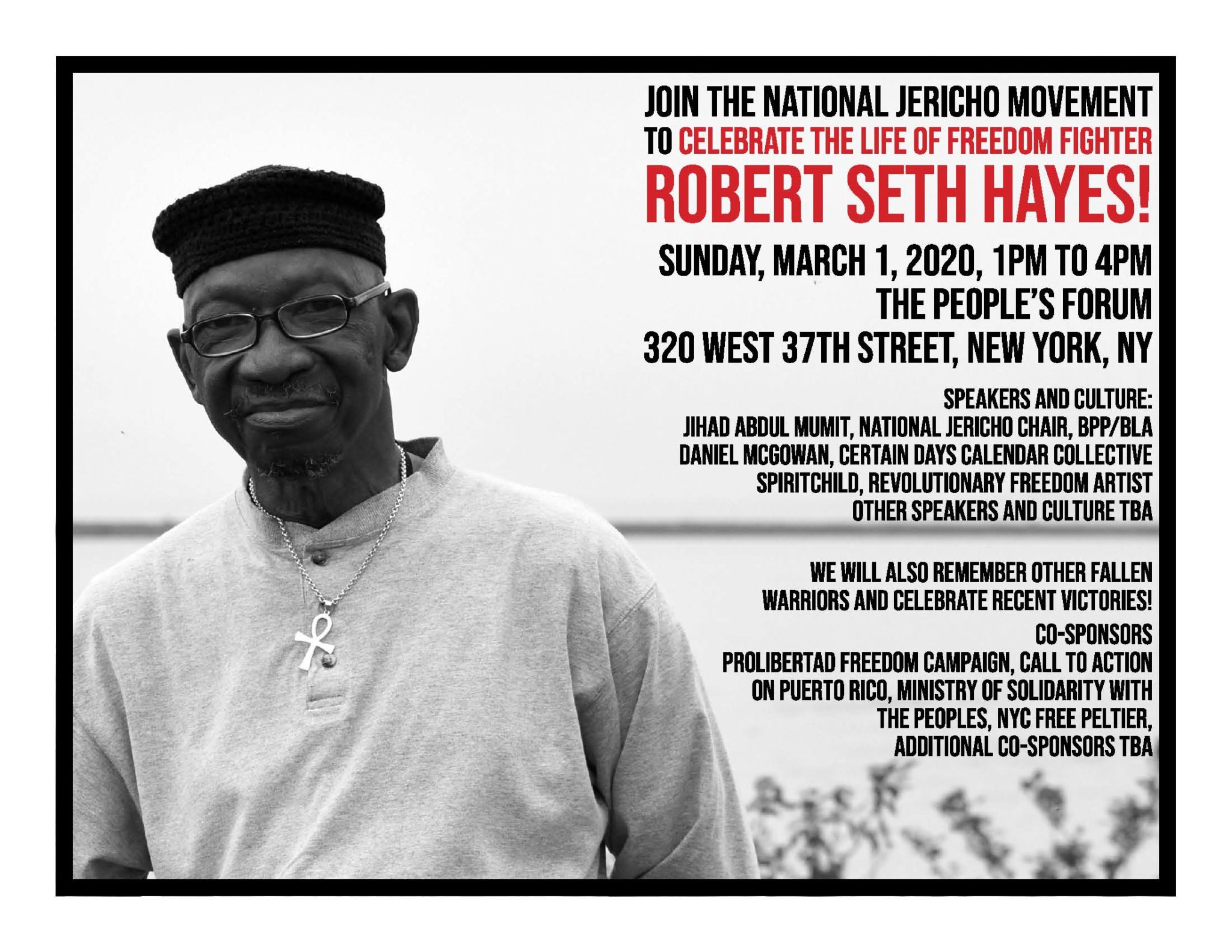
Robert Seth Hayes, ¡Presente!

Robert Seth Hayes was a freedom fighter who fought for all Black and oppressed people. The Black Panther Party and the Black Liberation Army member passed away last year on Dec. 21.

Hayes was a grandfather and political prisoner who spent 45 years in New York prisons until he was finally released in July 2018. On March 1, the People’s Forum in midtown Manhattan was filled with his comrades, friends and supporters to honor his memory.

The celebration of Hayes’ life was called by the National Jericho Movement for Recognition and Amnesty for All U.S. Political Prisoners. Co-sponsors were the ProLibertad Freedom Campaign; Call to Action on Puerto Rico, Holyrood Church Ministry of Solidarity with the Peoples; and NYC Free Peltier.

Claudia de la Cruz, executive director of the People’s Forum, welcomed people to the tribute. She reminded the audience that it was the 66th anniversary of when the Puerto Rican liberation fighters Lolita Lebrón, Rafael Cancel Miranda, Irvin Flores Rodríguez and Andres Figueroa Cordero attacked the U.S. House Representatives on March 1, 1954.

Messages were read from political prisoners David Gilbert, Russell Maroon Shoatz and Leonard Peltier. Gilbert, who had been locked up with Hayes, mentioned how Hayes would work in the tiny garden that prisoners were allowed to care for.

Russell Maroon Shoatz has been incarcerated for 48 years, including 22 years in solitary confinement. Shoatz described how Hayes experienced a lot of suffering but was known for his smile.

Anne Lamb, of the NYC Jericho Movement, spoke of how prison authorities “spent 20 years trying to kill Seth.” They refused to provide adequate medical care for Hayes, who developed hepatitis C and diabetes as a result. Hayes lived just 17 months after being released.

Shoatz’s daughter, Teresa Shoatz, said her father had stage 4 cancer, a condition that could have been prevented by earlier medical testing. 

Leonard Peltier, a leader of the American Indian Movement, also wrote in remembrance of Robert Seth Hayes. Often described as the Nelson Mandela of Indigenous people in the U.S., Peltier is beginning his 44th year of imprisonment. 

Mandela spent nearly 28 years in apartheid prisons. The jailhouse “democracy” of the United States has a worse record.

Robert Seth Hayes, Russell Shoatz and Leonard Peltier have spent more than 40 years in jail. So did Janet Africa, Janine Africa and Eddie Africa, who were in the audience. David Gilbert has spent nearly 40 years being locked up.

Free them all!

Pam Hanna, who was a comrade of Hayes’ in the Black Panther Party, described what a skilled person he was, including being a good cook. Hayes later conducted cooking classes for his fellow revolutionaries. 

Cultural performances were given by Ngoma and SpiritChild. While Ngoma performed “Music for My Soldiers,” people shouted out names of political prisoners. 

Brother Shep, a Black Panther Party veteran, offered a painting of Robert Seth Hayes. Ksisay Sadiki spoke of her father, Kamau Sadiki, a veteran of the Black Panther  Party and the Black Liberation Army who has been sentenced to life imprisonment.

Paulette D’auteuil of the International Leonard Peltier Defense Committee spoke of visiting Leonard Peltier at the federal prison in Coleman, Fla.

A statement was read from the prison branch of the Popular Front for the Liberation of Palestine mourning Robert Seth Hayes. Former political prisoner Daniel McCowan, who had been associated with the Earth Liberation Front, spoke about Hayes. McCowan represented the Certain Days Calendar Collective, which produced a beautiful calendar featuring dates of revolutionary history.

The national chair of the Jericho Movement, Jihad Abdulmumit, stressed the need to reach out to people. He urged the audience to engage in “critical thinking” in how to broaden the struggle to free all political prisoners.

A frequent call during the meeting was “What’s the call? Free them all!” Long live the memory of Robert Seth Hayes!

Strugglelalucha256


NYC March 6: VB50 report back & trivia night

Strugglelalucha256


A people’s response to COVID-19

We place no confidence in the anti-science, climate-change deniers of the Trump administration, the pathetically inadequate for-profit U.S. health care system, or Big Pharma and Wall Street to address the COVID-19 (novel coronavirus) crisis. The truth is that only a socialized health care system that provides equal access and quality care for all, regardless of ability to pay or immigration status, can address this situation, which is causing fear and anxiety for millions of people. 

The Affordable Care Act of 2010 actually imposes financial penalties on those unable to afford health insurance; an estimated 27 million people still have no coverage. That’s not counting the millions more undocumented workers, and those whose coverage is so minimal as to be useless. The infrastructure required to contain and treat outbreaks such as COVID-19 exists in countries like China and Cuba, but is sorely lacking in the United States, the richest country in the world, where the disparity of rich and poor is also greatest.

Can’t wait for November elections to respond

For an effective response to COVID-19 to succeed, it must involve the leadership of health care workers and members of the affected communities at all levels. The response to the COVID-19 crisis cannot wait for the outcome of the November elections.

As workers, organized and unorganized, unemployed and underemployed, Black, Latinx, Asian, Arab, Indigenous and white, undocumented people, women, LGBTQ2S people, students and youth, prisoners, homeless and disabled people, we must apply all forms of pressure to force the government to take the necessary measures for control and treatment of COVID-19, while ensuring that anti-Asian racism, xenophobia and other forms of discrimination against our communities or attacks on other countries are not substitued for real solutions. 

If the government fails to respond, what can be done? We must be prepared to take direct action to protect our class and communities, including taking over health care and other facilities in cooperation with health care workers and their unions, requisitioning medications and supplies, distributing food stores, and imposing a moratorium on rent and layoffs.

We must demand that all candidates for the U.S. presidency and other elected offices, as well as current elected officials, take a clear position. In particular, Bernie Sanders, who advocates Medicare for all, and the Sanders 2020 campaign, which has the most progressive stance on health care of all the Democratic and Republican campaigns, should be encouraged to participate and provide leadership on this question. 

  • We will not allow local, state or national “emergency declarations” to be used as an excuse for repression: for banning protests and strikes; nor for increasing the police occupation of Black and Brown communities; for jailing or deporting immigrants; or for the deployment of the National Guard or other military forces to prevent “looting,” that is, the liberation of the necessities of life and health from profiteers.
  • We demand that the U.S. government institute cooperation and assistance to other countries fighting the spread of COVID-19. We have seen how the Trump administration used the outbreak in Wuhan to score political points against China while sitting on its hands and doing nothing to assist in stopping the spread of the virus either here or abroad. This is unacceptable. The COVID-19 crisis is an international crisis and solving it requires international cooperation. 
  • Iran is suffering a severe outbreak and its efforts are being hampered by U.S.-imposed economic sanctions. All U.S. sanctions and blockades against other countries must be ended, including against Cuba, whose exemplary health care system and popular mobilizations in response to natural disasters are recognized as some of the best in the world.
  • In December 2019, the U.S. Congress, including most representatives and senators of both the Republican and Democratic parties, voted to give President Trump a $130-billion budget increase for the Pentagon. We demand that this money be rerouted from the bloated U.S. war machine to the international effort to stop the COVID-19 crisis and to create the infrastructure to deal with future pandemics. The many university research and development programs that operate in cooperation with the U.S. military industry should be repurposed for prevention and treatment of COVID-19, to save lives now and to improve the response to outbreaks in the future. 
  • Before President Trump silenced health officials and abruptly subordinated them to Vice President Mike Pence on Feb. 26, the Centers for Disease Control issued some advice to the public concerning COVID-19. One was for people to stock up on at least 2 to 3 weeks’ worth of nonperishable food items in case of a COVID-19 outbreak. But how many of us can afford to do that? More than three-quarters of U.S. workers live paycheck to paycheck, while a significant share of U.S. households would not be able to pay for an unexpected $400 emergency. Outrageously, this “advice” was given as the Agriculture Department is poised to deny SNAP benefits (food stamps) to 700,000 people beginning in April and decrease the benefits of millions more. The USDA rule changes must be suspended. Nationwide, about 20 percent of the population suffers hunger or is in imminent danger of going hungry. The government must provide adequate food to the entire population, regardless of ability to pay.
  • Another piece of CDC advice was for workers to be prepared to stay home from work or telecommute. But how many workers really have that option? Millions do not even have access to paid sick leave. As a recent article by the Economic Policy Institute states, “The CDC recommendations all seem well and good but how does someone with no paid sick days or insurance cope?” The Homeland Security Act gives the president the right to declare a “major disaster,” and allows the president to provide unemployment benefits to anyone who becomes unemployed because of it, including anyone unpaid because of sick leave. Declaring a disaster allows the president to tap the Disaster Relief Fund, which contains billions of dollars.
  • For COVID-19 to be contained and treated, people must be able to seek out and access health care and other resources. How can migrant workers and refugees do so when they are threatened with arrest and deportation by ICE and Border Patrol agents? There must be an immediate, unconditional end to deportations. The tens of thousands of refugees caged by the U.S. across the country must be released and provided with adequate housing, health care and other necessary resources to live a healthy life. So too must the ever-growing population of homeless people, including families, and those housed in substandard, overcrowded and unsafe conditions. There must be a nationwide moratorium on evictions starting immediately. This would not bring down the economy. In fact, it would be a boost to the economy in general.
  • What about the prisons? The U.S. has by far the largest prison population on earth, with some of the worst conditions, particularly when it comes to health care. Communities disproportionately affected by mass incarceration and the prisoners themselves must be put in charge of determining the necessary measures to adequately protect them.
  • According to Wall Street and the corporate media, the dramatic drop in the stock market in late February was caused by fear of COVID-19. But the profit system has been teetering on the edge of a recession for at least a year. Mass layoffs or wage cuts cannot be allowed to take place by blaming the virus. The government must institute an immediate moratorium on layoffs and wage cuts. 

These are just some examples of the measures that are required. Others will surely be raised and must also be addressed. Labor unions, community organizations, activist groups and socialists should take the lead in organizing people in every workplace, school and neighborhood to fight for these demands. 

The money, people-power and technology exist to respond to the threat of the COVID-19 outbreak and future dangers to the health and well-being of the people. But those resources must be taken over and mobilized by the people and for the people, not for the interests of the profit-hungry 1% who have shown time and again that they don’t care if we live or die.

Strugglelalucha256


Rafael Cancel Miranda, fighter for the independence of Puerto Rico

Official statement on the death of our beloved national hero Rafael Cancel Miranda:

Rafael Cancel Miranda, national hero and fighter for the independence of Puerto Rico, has died

The last survivor of the nationalist group that carried out the attack on the U.S. House of Representatives on March 1, 1954

The leader and former political prisoner Rafael Cancel Miranda passed away today at 9:10 p.m. at his residence in Río Piedras in the company of his closest relatives and comrades in struggle. For several weeks the renowned fighter for the independence of Puerto Rico had suffered from multiple health failures that kept him hospitalized.

As reported by his widow, María de los Ángeles Vázquez, and his youngest son, Rafael Cancel Vázquez, at the time of his departure, Cancel Miranda was alert and conscious and died peacefully surrounded by his loved ones.

Cancel Miranda was born on July 18, 1930, into a deeply nationalist family. His father, Rafael Cancel Rodríguez, a businessman and close collaborator of Don Pedro Albizu Campos, presided over the Junta de Mayagüez of the Nationalist Party. His mother, Rosa Miranda Pérez, came from a family of fishers in the Corsica de Rincón neighborhood. 

From a young age, Cancel Miranda identified with the movements aimed at fighting for the political freedom of his homeland and social and economic justice for all Puerto Ricans. He became aware at an early age of the colonial regime imposed by the United States government in his homeland and how it constituted the main impediment to his country’s development. Rafael Cancel Rodríguez and Don Pedro Albizu Campos were the guides in his patriotic formation and, at age 15, he formalized his commitment to the ideal of independence for Puerto Rico by joining the Nationalist Party and becoming a Cadete de la República.

On March 1, 1954, together with Lolita Lebrón, Irving Flores Rodríguez and Andrés Figueroa Cordero, he carried out the attack on the United States Congress, an act for which he was sentenced to 84 years in prison, of which he served 25-and-a-half years in federal prisons in the United States. Prior to this incarceration, he had served two years and one day in prison for refusing to enroll in the United States Army and participate in the Korean War.

In 1979, after intense campaigns for the release of the nationalists in Puerto Rico, the United States and other countries, as well as an exchange of prisoners proposed by Fidel Castro and the Revolutionary Government of Cuba, then-President of the United States Jimmy Carter signed the unconditional commutation of the sentences of the Puerto Rican nationalists.

Rafael Cancel Miranda arrived in Puerto Rico on Sept. 12, 1979, along with his comrades Lolita Lebrón and Irvin Flores Rodríguez. Andrés Figueroa Cordero had been released in 1977 for health reasons and died in March 1979.

Oscar Collazo López, who had been imprisoned since 1950 for his participation in the nationalist attack on the Blair House, the temporary residence of President Truman, also returned to the homeland with his comrades.

Following his release, Cancel Miranda continued his political activism for the independence of Puerto Rico and actively participated in the campaigns for the release of Puerto Rican political prisoners, as well as that of the Cuban Five heroes. A dedicated anti-imperialist, Bolivarian and internationalist, he supported with his writings, and on several occasions with his presence, the revolutionary struggles in the Caribbean countries, as well as in Central and South America, and supported, among other international struggles, the struggle of the Palestinian people.

He was a man of extraordinary human sensitivity who was deeply touched by the poverty and vulnerability of the Puerto Rican people. He was generous with the homeless whom he passed daily in the streets of the city, with the poor families who came to buy in the La Puertorriqueña furniture store, inherited from his father, and with friends and strangers who came to request his intercession in the solution of some personal situation.

Cancel Miranda also excelled as a writer. His extensive work, collected in nine books, as well as in national and international newspapers and magazines, consists of essays of political analysis, history of events and participants in the deeds of the Nationalist Party, as well as abundant poetry. His latest book, “Más allá del Espejismo” [“Beyond the Mirage”], was published in December 2019.

Rafael Cancel Miranda remained faithful to the nationalist ideal throughout his life and promoted with his example unity among all sectors of the independence movement, as well as the unity of “all Puerto Ricans in good faith.” He lived according to the maxim that guided his life: “You reach the goal sooner on your feet than on your knees.”

The acts of farewell and celebration of his life will take place in San Juan and Mayagüez. At the request of Cancel Miranda, flags should not be lowered to half-mast: For the patriots, the flags should fly as high as possible, always free, he said repeatedly.

March 2, 2020

Contacts: Madeline Ramírez and Alida Millán 

Translated for Struggle-La Lucha by Greg Butterfield

Video: Rafael Cancel Miranda on U.S. Crimes: International Tribunal on U.S. Colonial Crimes in Puerto Rico

Strugglelalucha256


Rafael Cancel Miranda, luchador por la independencia de Puerto Rico


Comunicado oficial sobre el fallecimiento de nuestro querido héroe nacional Rafael Cancel Miranda:

Fallece Rafael Cancel Miranda, Héroe Nacional y luchador por la Independencia de Puerto Rico

El último sobreviviente del comando nacionalista que llevó a cabo el ataque a la Cámara de Representantes del Congreso de los Estados Unidos el 1 de marzo de 1954

El líder y exprisionero político Rafael Cancel Miranda falleció hoy a las 9:10 p.m. en su residencia en Río Piedras en compañía de sus familiares y compañeros de lucha más cercanos. Desde hacía varias semanas el reconocido luchador por la independencia de Puerto Rico sufría de múltiples quebrantos de salud que lo mantuvieron hospitalizado.

Según informó su viuda María de los Ángeles Vázquez y su hijo menor Rafael Cancel Vázquez, al momento de su partida, Cancel Miranda estaba alerta y consciente y falleció en paz rodeado por sus seres queridos.

Cancel Miranda nació el 18 de julio del 1930 en el seno de una familia profundamente nacionalista. Su padre, Rafael Cancel Rodríguez, empresario y estrecho colaborador de don Pedro Albizu Campos, presidió la Junta de Mayagüez del Partido Nacionalista. Su madre, Rosa Miranda Pérez, provenía de una familia de pescadores del barrio Córcega de Rincón. Desde muy joven, Cancel Miranda se identificó con los movimientos orientados a luchar por la libertad política de su Patria y la justicia social y económica para los puertorriqueños y puertorriqueñas. Tomó conciencia a temprana edad del régimen colonial impuesto por el gobierno de Estados Unidos en su Patria y cómo éste constituía el impedimento principal para el desarrollo de su país. Su padre, Rafael Cancel Rodríguez, y don Pedro Albizu Campos fueron los guías en su formación patriótica y, a los 15 años de edad, formalizó su compromiso con el ideal de la independencia para Puerto Rico uniéndose al Partido Nacionalista e iniciándose como Cadete de la República.

El 1 de marzo de 1954, junto a Lolita Lebrón, Irving Flores Rodríguez y Andrés Figueroa Cordero, llevó a cabo el ataque al Congreso de Estados Unidos, acto por el cual fue sentenciado a cumplir 84 años de prisión, de los cuales cumplió 25 años y medio en prisiones federales en los Estados Unidos. Previo a esta encarcelación había cumplido dos años y un día de prisión por rehusar inscribirse en el ejército de los Estados Unidos y participar en la Guerra de Corea.

En el 1979, y tras intensas campañas por la excarcelación de los nacionalistas en Puerto Rico, Estados Unidos y otros países, así como un canje de prisioneros propuesto por Fidel Castro y el Gobierno Revolucionario de Cuba, el entonces presidente de los Estados Unidos, Jimmy Carter, firmó la conmutación incondicional de las sentencias de los nacionalistas puertorriqueños.

Rafael Cancel Miranda arribó a Puerto Rico el 12 de septiembre de 1979, junto a sus compañeros de comando Lolita Lebrón e Irvin Flores Rodríguez. Andrés Figueroa Cordero había sido excarcelado en 1977 por razones de salud y falleció en marzo de 1979.

Oscar Collazo López, quien había estado encarcelado desde 1950 por su participación en el ataque nacionalista a la Casa Blair, residencia temporal del Presidente Truman, también regresó a la Patria junto a sus compañeros.

Tras su excarcelación, Cancel Miranda continuó su activismo político a favor de la independencia de Puerto Rico y participó activamente en las campañas por la excarcelación de los prisioneros políticos puertorriqueños, así como la de los Cinco Héroes Cubanos. Dedicado antillanista, bolivariano e internacionalista, apoyó con sus escritos, y en varias ocasiones con su presencia, las luchas revolucionarias en los países antillanos, así como en Centro y Sur América, y respaldó, entre otras luchas internacionales, la lucha del pueblo palestino.

Fue hombre de extraordinaria sensibilidad humana a quien conmovía profundamente la pobreza y el desamparo de los puertorriqueños y puertorriqueñas. Fue generoso con las personas sin hogar con las que se cruzaba diariamente por las calles de la ciudad, con las familias pobres que se acercaban a comprar en la Mueblería La Puertorriqueña, heredada de su padre y con los amigos y los extraños que se acercaban para pedir su intercesión en la solución de alguna situación personal.

Cancel Miranda se destacó, además, como escritor. Su extensa obra, recogida en nueve libros, así como en periódicos y revistas nacionales e internacionales, consta de ensayos de análisis político, historia de los eventos y participantes en las gestas del Partido Nacionalista, así como abundante poesía. Su último libro, “Más allá del espejismo,” fue publicado en diciembre de 2019.

Rafael Cancel Miranda se mantuvo fiel al ideal nacionalista toda su vida y promovió con su ejemplo la unidad entre todos los sectores del movimiento independentista, así como la unidad “de todos los puertorriqueños de buena fe.” Vivió conforme a la máxima que guió su vida: “Se llega más pronto a la meta de pie que de rodillas.”

Los actos de despedida y celebración de su vida se efectuarán en San Juan y Mayagüez. Se solicita, a petición de Cancel Miranda, que no se bajen banderas a media asta: Por los patriotas, las banderas deben ondear lo más alto posible, siempre libres, afirmó en repetidas ocasiones.

2 de marzo de 2020

Contactos: Madeline Ramírez and Alida Millán

Video: Rafael Cancel Miranda sobre crímenes de Estados Unidos: Puerto Rico Tribunal 

Strugglelalucha256


How the Pentagon poisons the world

Despite climate change deniers like Donald Trump, there is a high level of awareness about the growing threat to our planet. 

If you’re in the age bracket that is now raising children or will soon, you know there is a chance that the world they’ll inherit will be unlike what previous generations have lived in. 

Unprecedented heat in places that were temperate and unimaginable cold in other areas; routine level 5 hurricanes; coastal populations forced to move inland because of rising sea levels; some island nations completely disappearing; thousands of animal species going extinct: all of that could become the new normal. Every instance of unchecked CO2 pollution bears more consequences.

But climate change isn’t a slow-motion train wreck. We don’t have to just watch in horror as it happens. It might surprise most people to learn that ending the military operations of U.S. imperialism — abolishing the Pentagon — would be the biggest step forward in making sure that the earth stays habitable for future generations.

The period of global warming coincides with the rise of industrial capitalism, and fossil fuels have been central to industry throughout its history. Historical records kept by the World Resources Institute show that since 1850, the U.S. and Europe — where capitalism is most advanced — have been responsible for nearly two-thirds of the heat-trapping contaminants currently in our atmosphere. 

There is one entity that rarely gets discussed when it comes to pointing the finger of blame for wrecking the planet we live on. The U.S. military spews more CO2 and other contaminants into the air than any single corporation. Each of the economies of 45 countries pollute less than the U.S. military. As a single entity, it is the worst polluter in the world.

Much of what we read excludes CO2 emissions by the U.S. military. The authors of a study called “U.S. Military Pollution,” published on TheEcologist.org, point to the Department of Defense concealing information about its role in global warming. 

 ”It’s no coincidence that U.S. military emissions tend to be overlooked in climate change studies. … In fact, the United States insisted on an exemption for reporting military emissions in the 1997 Kyoto Protocol. This loophole was closed by the Paris Accord, but with the Trump administration due to withdraw from the accord in 2020, this gap will return. Our study is based on data retrieved from multiple Freedom Of Information Act requests.”

 A June 2019 Brown University study calculates that between 2001 and 2017, all branches of the U.S. military emitted 1.2 billion metric tons of greenhouse gases. That amount included 400 million metric tons from the U.S. wars against Afghanistan, Iraq, Libya and Syria, as well as attacks in Pakistan.

In an article on Pentagon pollution posted on ClimateAndCapitalism.com, H. Patricia Hynes describes consumption of fuel by the air force: “The U.S. Air Force (USAF) is the single largest consumer of jet fuel in the world. 

“Fathom, if you can, the astronomical fuel usage of USAF fighter planes: the F-4 Phantom Fighter burns more than 1,600 gallons of jet fuel per hour and peaks at 14,400 gallons per hour at supersonic speeds. The B-52 Stratocruiser, with eight jet engines, guzzles 500 gallons per minute; ten minutes of flight uses as much fuel as the average driver does in one year of driving! 

“A quarter of the world’s jet fuel feeds the USAF fleet of flying killing machines; in 2006, they consumed as much fuel as U.S. planes did during the Second World War (1941-1945) —  an astounding 2.6 billion gallons,” Hynes reported.

Since the first U.S. attack on Iraq in 1990, the majority of U.S. military activity has been in the Arab world to maintain control over oil markets. According to PressTV, U.S. troops are stationed in 14 countries in the Middle East and North Africa; there is a huge U.S. base in Qatar; the Fifth Fleet is stationed in Bahrain; and there is a U.S. military airport in Oman. We can now add Al-Tanf in Syria, illegally occupied by the U.S. There may also be secret and illegal bases in occupied Palestine.

During all that military activity, the U.S. has killed over 500,000 people by some estimates, destroyed access to clean water, bombed hospitals and infrastructure, and left behind huge areas so contaminated with depleted uranium as to be uninhabitable. This has all been done to maintain control of oil markets, by the biggest single largest consumer of oil.

There is nothing wrong with being conscious of our personal “carbon footprint.” But workers don’t bear the blame for this horror show. It was energy capitalists who destroyed energy efficient mass transit in most cities in the U.S. It is the corporate class that is out to smash regulations that to a small extent limit the pollution of the planet. 

The frantic pace of industry and the frenzy for profit under capitalism is toxic. The imperialist death machine is even worse. The fight to end capitalist exploitation, stop climate change and end the endless imperialist wars is all one struggle. It is a race against time.

Strugglelalucha256
https://www.struggle-la-lucha.org/2020/03/page/7/