The hours of the coup offensive in Bolivia

Mine workers attend a rally in support Bolivia’s President Evo Morales in La Paz, Bolivia, November 5, 2019. Photo: teleSUR

These are days and hours of the coup offensive in Bolivia. The attempt to overthrow President Evo Morales is gaining strength, territory and its capacity for action. Like an announced bullet that arrives from the front and has a date: before next Tuesday.

That day the country will know the result of the audit in which the Organization of American States (OAS) is participating to see if there has been fraud in the October 20 elections that gave Morales victory in the first round. Those who are in the leadership want an outcome before that day and they believe they can achieve it.

They have several elements in their favor. In the first place, a mobilized social base with a perception of triumph, heterogeneous, that gathers accumulated discontents within the emergence of exclusive racist discourses and acts of the conservative/colonial country. That base has strength in Santa Cruz, Cochabamba, Potosí, and in La Paz; the final objective of the assault.

Secondly, these groups of confrontation have accumulated strength from the east to La Paz. Their displacement followed the direction of the coup’s strength in Santa Cruz that is acting as a strategic rearguard in the center of the country. It is the area where they carried out the most violent attacks, and La Paz is a point of definition of power.

These groups are in the process of mobilizing towards La Paz, where some have already carried out exercises of siege on the government palace in previous nights. One of the objectives of the offensive is to have managed to gather all the formations of opposition and to reinforce the mobilization with sectors coming from different points of the country to La Paz.

Thirdly, the leadership of Fernando Camacho, who went from heading the Santa Cruz Civic Committee to setting up his base of operations in La Paz and projecting an image of national leadership. His discourse seeks to distance himself from all acts of racism, separatism and coup d’état, in an attempt to shift the accusations and to bring in other sectors of society.

The expansion of these three factors seeks to unleash, through an escalating offensive, the rupture of three others. The first point to be achieved, and which has been achieved in part, is the Bolivian National Police. The images of riots on Friday night and Saturday morning showed how a sector of the police have been influenced and added to the coup process.

Secondly, the Bolivian Armed Force, a central element for a coup d’état to be successful, until noon Saturday has shown no public sign of a possible internal breakdown.

Thirdly, popular sectors, for the moment, are not playing a part in the mobilization in favor of the dismissal of Evo Morales, but some groups like the Association of Coca Producers of the Yungas, or mining sectors that have been present.

The calculation of this set of factors, articulated among themselves brought together  with the greatest force, has constructed a scenario in which the coup leader are demanding that the departure of Evo Morales is the only possible solution and that this will take place in a matter of hours or days.

Within this leadership, Carlos Mesa, who came in second on October 20, has been able to align himself with the narrative of those who are giving the ultimatum, but in a lesser capacity, but while leaving room for maneuvers in case of the defeat of the coup attempt.

The objective of the government, both of the presidency and of the social movements, seems to be to contain the escalation of the coup until the result of the audit. Within this framework, mobilizations have taken place almost daily, led by different organizations, such as the Bolivian Union of Workers, and the Bartolina Sisa Women’s Confederation.

The president’s call has been to defend the results of the election, the process of change, democracy, without opening the doors to the scenario of confrontation that seeks to generate the right, which means, as Evo has rejected, that they want to generate wounded, dead, through increasing acute violence.

This is a complex and increasingly unstable scenario. The outcome of the audit could lead to different conclusions. One of them could be the recognition that there has been no fraud, but that a second round would be necessary, something that the OAS has already announced would be the case after the first round.

The United States, which made clear from the outset that the result of October 20 had not been valid, has claimed that the path of the audit arbitrated by the OAS should be followed, that is, to a large extent, determining the outcome by themselves.

The government has stated that the outcome of the audit will be binding and that it would be willing to call for a second round if that emerges as a result. In that case there could be a division within the opposition between those who would be willing to go to that to that election contest and those who would not. Would Carlos Mesa accept and retreat from the coup discourse?

There are still many hours and days until Tuesday within this offensive framework that is accumulating strength and capacity for destabilization. The government, the process of change, still has cards to play in order to contain and de-escalate the situation.

Source:  Resumen

Strugglelalucha256


Another side of the Berlin Wall

Thirty years ago, a labor organization was on strike under very difficult conditions.

This workers’ organization and its leadership were castigated by the corporate media. The bosses threatened, cajoled and bribed people to cross the picket line. Scabs were brought in. The heads of the international union colluded with the capitalists to undermine the strike.

Eventually, the strike was lost. But that wasn’t enough for the bosses.

Not satisfied with lowering the workers’ wages and benefits and breaking the union, they sent their state apparatus after the strike leaders with accusations of heinous crimes. The former president was driven into exile to escape prosecution.

The labor organization in question was Amalgamated Transit Workers Union Local 1202, which went on strike against behemoth Greyhound Bus Lines in February 1990.

But everything written above also applies to the German Democratic Republic–socialist East Germany–and the fall of the Berlin Wall a few months earlier, in November 1989. Both the capitalist class and some misinformed progressives have been crowing over the 30th anniversary of that event.

Picket line means ‘Do not cross!’

Ask anyone who’s been on strike if it is ever okay to cross a picket line, and you will likely hear a resounding “No!”

The Berlin Wall — so maligned and condemned by war-making imperialists and hand-wringing liberals alike — was nothing but a picket line on a much larger scale.

The wall was erected in 1961 in response to provocations from U.S. imperialism and its West German junior partner meant to destroy the attempt to build socialism in eastern Germany. These provocations included infiltrating East Berlin with anti-communist agents, military threats and bribing specialists whose labor was need by the workers’ state — the so-called “brain drain.”

The disgusting myth that the Berlin Wall was erected to destroy the freedom of Berliners, immortalized in President John F. Kennedy’s famous donut speech (“Ich bin ein Berliner,” which translates as “I am a jelly donut”), is just the opposite of the truth. The capitalist powers wanted to crush the working class’s freedom to build a society unchained from the profit motive.

The Berlin Wall was a world away from the apartheid wall built by Israel around Palestinian population centers, the U.S./South Korean military wall that separates family members from North Korea or the expanded U.S. wall against immigrants on the border with Mexico.

What is the difference? Those walls are aimed at repressing the workers and oppressed. The Berlin Wall, by contrast, was built in defense of the workers and oppressed.

Socialist Germany’s accomplishments

The GDR wasn’t the product of a classical revolutionary uprising. It was formed by an alliance of German communist, socialist and workers’ movements that had resisted Nazism and survived World War II, and the Soviet Red Army that liberated the eastern part of the country, all under the military and economic pressure of the U.S.-initiated Cold War. It was only established after U.S. imperialism and its new allies in the vanquished German ruling class had begun to build up West Germany as a bulwark of aggression against the USSR and its allies.

In some ways, it was a halfway house of socialism.

But whatever its faults, the GDR was a workers’ state that provided jobs, housing and health care for all its residents. It provided aid and support, including military and medical aid, to national liberation movements throughout the world, including the struggle against apartheid in southern Africa.

The GDR provided a safe haven for refugees from fascist terror in countries like Chile and Argentina. Socialist Germany also provided jobs and education for guest workers and students from Asia, Africa and the Middle East — many of whom were terrorized or driven out of the GDR by fascist attackers in the early 1990s after reunification with imperialist West Germany.

East Germany was far ahead of any country in the world in lesbian, gay, bisexual and transgender rights and freedoms. The gay liberation movement as we know it grew up within the German socialist and communist movements of the 19th and early 20th centuries.

Regarding women’s rights to education, jobs and housing, and especially in establishing extensive child care, the GDR made enormous strides. Much of this progress was wiped away when the GDR fell.

The German Democratic Republic had a right to defend its sovereignty from imperialism, all the more so since the border between East and West Germany was also the border between the imperialist and the pro-socialist world camps.

Those who cannot or will not defend the right of a workers’ organization to defend itself — whether it is a union, a resistance movement or a workers’ state — will never be able to carry out a successful revolutionary struggle.

Sincere revolutionaries have to learn this lesson, and it is incumbent on those of us who lived through those terrible setbacks to help educate new generations.

Strugglelalucha256


I believe that socialism is the key to a better world

From a talk by Gloria Verdieu at Queen Bee’s Art and Cultural Center in San Diego. Verdieu shared the stage with poets from the San Diego / Tijuana reEvolutionary Poets Brigade at an evening of “Poetry, Education, and Voter Registration.”

Thank you for inviting me to speak at this important event. A lot of thought went into what I wanted to speak on since I am neither a Democrat nor a Republican. I am a socialist. I believe that socialism, which ultimately leads to communism, is the key to a better world for all of us. 

I thought about an essay by political prisoner Mumia Abu-Jamal entitled “Women of the World” which begins with the words:

“Who can think of the world’s women, and not marvel? There is no area of human endeavor upon which the mark of woman has not been made, and made well.”

I thought about Sisters in the Struggle, Black women who fought for a better world for everyone while focusing on justice and freedom for Black people: Sojourner Truth, Harriet Tubman, Ida B. Wells, Mary McLeod Bethune, Septima Clark, Fannie Lou Hamer and Ella Baker, all Black women of the Civil Rights and the Black Liberation movements. 

I thought about Black women who have embraced socialism, as I have, and who committed their lives to creating a better world for all people: 

Lucy Parsons, Mabel Byrd, Capitola Tasker, Lulia Jackson, Louise Thompson, Claudia Jones and Angela Davis.

Lucy Parsons, born in 1853, joined the Socialist Labor Party and fought for the rights of labor, Blacks and women until her death in 1942. 

In 1934, three Black women joined the U.S. delegation that traveled to Paris for the International Women’s Conference. Mabel Byrd was elected to be one of the conference secretaries. Capitola Tasker and Lulia Jackson stunned the conference with their eloquent testimonies about African-American struggles for human dignity.

Louise Thompson studied Karl Marx and V.I. Lenin and emerged as a leader in the Harlem Branch of the CPUSA. In the 1930s, her apartment became a forum where Black intellectuals and activists discussed the Bolshevik Revolution and the party’s position on African Americans in the South.

Claudia Jones was born in Trinidad and became one of the most respected members of the CPUSA. Jones joined after working with the CPUSA in the defense of the Scottsboro Brothers. 

Angela Davis’s commitment to the struggle of Black people intensified on Sept. 15, 1963, when four Black girls were murdered in the racist bombing of a Baptist church in Birmingham, Alabama: Denise McNair, Addie Mae Collins, Cynthia Wesley and Carole Robertson. As part of her militant activism, Angela Davis organized rallies and demonstrations defending the political prisoners known as the Soledad Brothers, and she herself became a political prisoner.

Okay, so what does a socialist country look and feel like? 

To answer this, I would like to read a portion of a speech given by W.E.B. Du Bois in 1959. Du Bois spent several months in Czechoslovakia, East Germany, the Soviet Union and China.  

I have been to socialist Cuba several times. On one visit, I got sick and was admitted into a Cuban hospital, where I stayed for 16 days in 2007.  I was 50 years old at the time, so I was in a room with seniors. I had 2 roommates in their 70s who had witnessed the 1959 Cuban Revolution. 

During that two-and-a-half weeks I was worried about my job, because my vacation time had run out and my boss did not know I was in Cuba.

So, here are some observations from Du Bois in 1959 that I also noticed during my stay in Cuba in 2007.

The people are ordinary folk; they are not in chains; they laugh and cry; they work and rest; there are homes and schools. Life goes on about the same as here. Of course with time and through observation you do see differences. 

One thing they fear which we do not, and that is war. They know what war is, what it costs in death and destruction, in dislocation of life, in disease and hurt.  The world fears war, except the United States. We laugh and joke about it. Our children play at murder. 

In socialist countries, certain fears are absent which never leave the waking hours of Western lands, and are always there in the hours of sleep. They are four in number: unemployment, old age, sickness and opportunity to rest.

Take any person you know, anyone you meet. Take yourself. We fear unemployment, losing our job, being unable to work. 

This, the socialist citizen does not fear. He or she may have to change work, may have to change the place of work, but of work at current pay they are always sure.

We fear old age. What will we do when we’re old? We are desperate to save enough to insure a decent life when we are too old to earn. Thousands of people walk our streets each day sick with fear of age. The citizens of socialist countries do not fear age. Every citizen is certain of support, of food and shelter and clothes, as long as they live. It may not be of the highest quality or what we prefer, but they will not freeze nor starve.

We are frightened of sickness and accident, and attack of some disease, being knocked over by a car. Any day, any time, we may be put to bed by such misadventure. We may be covered by insurance, but many people are not. We can seldom afford the best medical care, and we nearly always lose pay and burden our families when sick. In socialist countries medical care is given great attention. Physicians are being increased rapidly in number and distribution according to the need, even if that need is in a lonesome country district or in a far-off province, or late at night. Medical care is available for all. Of course, everybody cannot get the best, but none are neglected.

All workers need rest, but how many of us dare take it? Some provision or recreation is made, but most workers do not get adequate recreation, and can hardly afford what they take. In socialist lands, the vacation with pay is part of the work contract. The vacation will not be at a fashionable resort, it may not be what the worker would choose, but it will be rest with medical care, with food and recreation.

These systems are not perfect. They break down here and there, now and then, but they are successful. This kind of rest and protection stands in the midst of the supporters of socialism. 

Then there is the problem of children: the loss of time, the pain and discomfort of their birth, the time and money needed for their upbringing, the question of their education and life employment. Many people refuse to procreate children because of these problems so difficult to solve in capitalist lands with individual initiative. But in socialist lands the problem of children comes first. The working mother has rest time with pay during pregnancy. The children are in nurseries and kindergarten when small, and in school as they grow. There is higher education with pay for studying and school attendance and as they become of age, free training for earning a living is open to them according to talent. All of these programs again are not perfect. School facilities lag. School programs go wrong. Monies are wasted. All of this and more, yet the school systems of socialist lands outstrip the systems of Western Europe and of the United States. 

I can see the wealth of human ability the socialist lands are preserving and using for humanity, and see why they have little juvenile delinquency.

All this effort costs: in money, in freedom, in individual training. It means discipline. It means that individuals do what they are told to do, in many cases, rather than what they want to do. But is the situation much different here? Are we free in America to do what we please?                  

Of course not, in a world of natural law, in a world of human legislation, in a world of habit and inherited cultural patterns, the area of human freedom of action must be seriously curtailed. But it is further narrowed when industry, ownership of property, and distribution of income is directed by the owners of capital goods and by the men who own and control the labor of human beings. The question is not whether there will be discipline, but rather, who is to administer it and under what controls will most of the essential freedoms be conserved. The anarchy of individual rule and the rule of chance is inadmissible, just as complete slavery is unthinkable. Discipline involves planning, and planning is absolutely necessary for modern industry. We must not deceive ourselves by assuming that the industry of the United States is not planned. It is planned by the owners of capital and for the individual profit which the enterprises bring.  This may lead to much prosperity, but it also leads to financial crises, to poverty, to exploitation and unemployment, and to crime. Socialism, on the contrary, tries to plan for the general welfare of all citizens. It owns the wealth used for industry. It controls the labor which produces wealth and seeks to distribute property according to need and not by chance, inheritance or force.

One of the principles of socialism is democratic centralism. It takes the full participation of everyone in order for this process of democratic centralism to work. 

I am a registered voter and I believe in the democratic process, but I believe we must look carefully at what we are voting for because in this capitalistic system we continue to vote away our rights because we vote based on our individual needs and wants; not for the needs of everyone.

We must study socialism and capitalism, to figure out what it is going to take to make a better world for all people.

And we must fight for it!

Thank you for listening.


Strugglelalucha256


The people put Harold Washington in City Hall

The long shadow of the Chicago race riot, Part 7

By 1970, people of color were already close to half of Chicago’s population. The Daley machine — which still had white ward bosses on the overwhelmingly Black West Side — was untenable. So was the apartheid government in South Africa.

In both cases, it took a long struggle to get rid of the regime. The Black masses responded to the murders of Fred Hampton and Mark Clark by voting for Bernard Carey — the Republican candidate for states attorney — at the next election. Helping elect Hanrahan’s opponent seemed to be the only way to protest this atrocity.

Richard J. Daley was re-elected by wide margins in both 1971 and 1975. Despite these landslides, the ties that bound the Black masses to the Machine continued to disintegrate. Particularly significant was the defection of the African American congressman, Ralph M. Metcalfe.

Metcalfe had won a gold medal under the gaze of Adolf Hitler at the 1936 Olympics in Berlin. He was a member of the winning 400-meter relay team that included Jesse Owens. Incorporated into the Machine, the great athlete was elected alderman in 1955. 

When Dr. King came to Chicago in 1966, it wasn’t with Metcalfe’s backing. Following the death of Congressman William L. Dawson in 1970, Ralph Metcalfe was elected to fill the same First District seat. 

By inheriting Dawson’s congressional seat, Metcalfe automatically became the most prominent African American leader in the Daley Machine. But this didn’t translate to any real power or even influence. 

The turning point for Ralph Metcalfe came when a close friend, a well-known African American physician, was dragged out of a car and beaten up by Chicago cops. To the police it was just another case of “driving while Black.”

Behind Metcalfe’s public break with Daley was the pent-up wrath of the Black community. With the Black Panther Party decimated, this anger found its public expression within the Democratic Party itself. One African American politician after another came out in opposition to the Machine. 

The racist circus that broke out after Richard J. Daley died on Dec. 20, 1976, helped along this process. By this time, the City Council’s “President Pro Tempore” was usually a Black alderman. (Ralph Metcalfe had been chosen for the largely ceremonial post in 1969.)

This was pure tokenism. Yet it also meant that the African American Wilson Frost, who held this position, was supposed to succeed Daley. 

Frost was chased out of City Hall during Christmas week. The racist aldermen couldn’t tolerate a Black mayor even for a few months until a special election could be held.

The City Council rushed to select Michael Bilandic—another product of all-white Bridgeport—to be mayor. He was inaugurated on Dec. 28, 1976.

These thieves soon turned on each other. While Bilandic was able to win the special 1977 mayoral primary, he was defeated in 1979 by Jane Byrne. A string of fiascoes are the only things this pair of mayors are remembered for.

Fast Eddie, we are ready!

What finally smashed the Machine was the mass outpouring that elected Harold Washington as Chicago’s first Black mayor in 1983. Washington was Ralph Metcalfe’s successor as First District congressman. 

With Jane Byrne and Richard M. Daley dividing the machine vote in the Democratic primary, Washington won it with 36 percent of the vote. In the general election, Harold Washington beat the Republican Bernard Epton by a 52 percent to 48 percent margin.

These were more than elections. They were mobilizations of both the Black and Latinx masses. Tens of thousands of whites voted for Washington as well.

Communist leader Sam Marcy recognized that this election was a referendum on racism, despite the Democratic Party labels. Workers World newspaper ran three consecutive front pages devoted to this struggle against racism. 

Nearly as many people voted in Chicago as would cast ballots 14 years later in New York City. Around 1,290,000 people voted in Chicago’s 1983 election compared to the 1,409,347 votes cast in New York’s 1997 mayoral contest. This was despite Chicago having only 40 percent of New York City’s population.

The capitalist media did everything they could to prevent Washington from being elected. Five days before the election, the Chicago Tribune reported that Washington was being accused of child molestation.

Washington’s victory amounted to a limited but definite political revolution. The oppressed had thrown off the Daley machine that had throttled them for decades. 

Because of the gerrymandering of aldermanic districts, 29 racists controlled the City Council. Under the leadership of Edward Vrdolyak — a vulgar legal mouthpiece who was later convicted twice on corruption charges — these 29 bigots declared war on Harold Washington. This struggle wasn’t restricted to the race baiting antics of “Fast Eddie” Vrdolyak and his followers.

Rudy Lozano was the most dynamic supporter of Washington in mobilization of the Latinx community. An organizer for the International Ladies Garment Workers Union, Lozano nearly won a seat on the City Council.

Rudy Lozano was assassinated by unknown gunmen in his home on June 8, 1983. Like the murder of Polish-American labor leader John Kikulski sixty-three years before, this crime remains “unsolved” by the cops.

Behind Vrdolyak was Chicago’s capitalist class. Big capital let Fast Eddie paralyze the City Council just like they allowed racist mobs to murder African Americans in 1919.

“Fast Eddie, we are ready!” became the rallying cry of the masses. A federal judge was forced to order special City Council elections in 1986. Vrdolyak was licked.

Harold Washington was re-elected mayor in 1987. On Nov. 25th of the same year, he died of a heart attack. His picture hangs in thousands of Chicago homes as a cherished memory.

Source: Roosevelt University, External Studies Program, History 307, Module III, Chapter V, “The Decline of the Democratic Machine,1976-1983,” by Amy Reichler.  

Next: A city of struggle


Part 1: The long shadow of the 1919 Chicago race riot

Part 2: Bombings greet the Great Migration

Part 3: What did the unions do?

Part 4: Communists fight racism and evictions

Part 5: Chicago Mayor Daley’s racist machine

Part 6: Never forget Fred Hampton

Part 7: The people put Harold Washington in City Hall

Part 8: A city of struggle

Strugglelalucha256


Brazil’s ex-president Lula freed after 580 days in prison

Brazil’s former president Luiz Inacio Lula da Silva was released Friday, Nov. 8, after being held for 580 days at the Federal Police headquarters in Curitiba, southern Brazil.

Lula was greeted by a massive crowd of supporters waiting for him outside the building where he was incarcerated.

The court order to free the left-wing leader came after the ex-president’s lawyers filed a petition this morning, following a Supreme Court ruling last night, when the top court declared that a person convicted in a case can only be imprisoned after all possibilities of appeal are exhausted.

Lula will visit the Free Lula Vigil, a camp set up outside the Federal Police building where he was incarcerated, where activists and supporters have been denouncing, since April last year, the political motivations behind his conviction. Later, Lula will fly to São Bernardo do Campo, where he lives.

Throughout his time in prison, the ex-president frequently said the first thing he would do when he was released is visit the Free Lula camp. Every day for the past 580, the participants of the Free Lula camp shout good-morning, good-afternoon, and good-evening to the Workers’ Party leader, who heard his supporters from his cell and said the greetings helped to keep his spirit high.

By law, Lula could already enjoy semi-open prison conditions, but he had denied the modification of his sentence because he believes that it would damage his dignity. “I want you to know that I do not accept bargaining of my rights or my liberty,” the former president said.

::Exclusive | Lula: “We have to recover the Brazilian people’s rebellious spirit”::

Now the ex-president’s defense team will file a petition for the Supreme Court to rule on the habeas corpus that requests the annulation of the legal process of the Guarujá beachside apartment case. His lawyers Cristiano Zanin Martins and Valeska Martins argue that the former judge Sergio Moro and the prosecutors of Operation Car Wash were biased against Lula, “among other numerous illegalities.”

Political imprisonment

The ex-president has been incarcerated since April 7, 2018, after imprisonment was decreed by the Sérgio Moro, the ex-judge who was overseeing Operation Car Wash and the current Minister of Justice.

Moro himself was responsible for the conviction of Lula in the Guarujá beachside apartment case, sentencing him to prison for nine years and six months. The decision of Moro was upheld by a group of appeals judges, who increased his sentence to twelve years and one month in prison.

On September 20, 2016, Sergio Moro accepted an accusation presented by the Federal Prosecutors Office. Armed with the 59-page report, prosecutor Deltan Dallagnol affirmed that Lula committed crimes of passive corruption and money laundering by receiving unnecessary benefits from the construction company OAS.

A beachside apartment in Guarujá, on the coast of Sao Paulo, was allegedly set aside and remodeled under the orientation of the family of the ex-president. The accusation also alleged that Lula committed the crime of allowing the OAS to store the gifts he received while president.

On the day that the accusation was presented to the press, Dallagnol showed a PowerPoint presentation where he described Lula as the “maximum commander” and “biggest beneficiary” of the corruption schemes uncovered by Operation Car Wash.

The rush attitude by the head of the task force was disparaged by the then Supreme Court justice Teori Zavascki, who said Dallagnol “put on a show” and wasn’t taking the case and the investigation seriously.

Seventy-three witnesses testified in 23 hearings, and none of them stated that the beachside apartment was officially owned by Lula.

Moro only managed to prove that the ex-president only visited the apartment once in Guarajá. He weighed the declaration of a co-defendant against Lula: Léo Pinheiro, executive of construction company OAS. Pinheiro was sentenced to 16 years in prison in August 2015 for corruption, money laundering and organized crime, and he gave a series of revelations to the Federal Prosector’s Office between March and June of 2016.

With regards to the issue of the beachside apartment in Guarujá, the businessman insisted that Lula was innocent. According to him, the contractor tried to offer “benefits” to the ex-president to maintain a good relationship with the Workers’ Party (PT) governments, but there was not any response by Lula, who said he was not interested in buying the property he offered him.

According to the report of the newspaper Folha de S. Paulo, this attitude has made the Federal Prosecutor’s Office “lock in” plea bargain agreements with the construction company OAS. The report showed that the contractor was pressured to work out a plea bargain, which gave Pinheiro the chance to reduce his sentence by two thirds.

For this, it was necessary to alter the content of his testimony and “make it fit” the theory of the prosecution. On April 20, 2017, after almost a year of insisting, the OAS executive told Sergio Moro that Lula was the owner of the apartment and that he would have received the property in exchange for advantages for the company. The property and the cost of the remodeling, the accusation claimed, had been allegedly priced down for a “general counter-current of briberies” administered by the OAS group in collaboration with PT agents.

In order to justify the lack of documents that would prove that the property was owned by the former president, the solution found by the businessman and his lawyers was to say that “the evidence was destroyed” after Lula himself allegedly requested it.

Although the sentence reduction has been on the agenda after this testimony was shared, his plea bargain was not made official, which could imply that the executive of OAS did not have to swear on the veracity of the information nor present documents to support his allegations.

The same court that increased Lula’s prison sentence decided to reduce the businessman’s sentence from ten years and eight months in prison to three years and six months in semi-open conditions.

In his decision convicting Lula, Moro himself wrote that, even though there is no doubt that the files show that the property is owned by OAS, “that is not enough to solve the case.”

The ex-president’s lawyers believe that Judge Moro changed the accusation presented by the Federal Prosecutor’s Office to be able to charge him of corruption and money laundering. But because he could not prove that Lula owned or enjoyed the apartment, the judge started to work with the theory supported by Léo Pinheiro’s plea bargaining testimony.

Regarding the corruption and money laundering charges in the case of the construction company storing  the president’s belongings, Moro acquitted Lula and the other defendants due to lack of evidence.

Editing: Rodrigo Chagas | Translated by Aline Scátola and Zoe PC

Source: Peoples Dispatch

Strugglelalucha256


Hundreds stand tall in solidarity with the people of Latin America at Havana Conference

From Nov. 1-3 more than 1,350 delegates from 86 countries representing 789 organizations, came to Havana to participate in the Anti-imperialist Conference of Solidarity, for Democracy and Against Neoliberalism. Delegates traveled from all continents, particularly from Latin America and the Caribbean.  The conference was organized by the Cuban Institute of Friendship with the Peoples (ICAP), Central Organization of Cuban Trade Unions (CTC), along with the Cuban Chapter of Social Movements and the Continental Conference for Democracy and against Neoliberalism.

This historic conference took place at a decisive moment for all progressive forces that resist neoliberal policies as it becomes increasingly clear on the intention on the part of the United States to reconquer Latin America and take over all its natural resources aided by servile oppressive governments and local oligarchs.

José Ramón Machado Ventura, second secretary of the Communist Party of Cuba and Esteban Lazo Hernández, president of the National Assembly of People’s Power and the Council of State presided over the opening plenary.

In a moving opening presentation, with songs and verses, the children of Cuba’s National Theater group, “La Colmenita” inaugurated the Conference embracing with love and tenderness all of those in attendance.  Also present at the conference were renowned intellectuals and writers like Ignacio Ramonet, Atilio Boron, Stella Calloni, Abel Prieto, Omar Gonzalez, and Pedro Calzadilla.

Fernando Gonzalez Llort, President of ICAP and one of the Cuban Five welcomed participants. “We will be able to face the most challenging adversities. Neither with asphyxiation nor with laws will they be able to get a single concession from the Cuban people, who do not surrender and will continue with their principles of solidarity with the world” he said.

Cuban Foreign Minister Bruno Rodriguez Parrilla started his speech by saying: “You can feel in this room the deep expression of our peoples and solidarity with Cuba…There will be no sustainable development without the right to the development of the countries of the South, nor can it be without social justice.” Bruno also referred to how in the present time lies become habitual, intolerance grows and the imposition of supremacist ideas appears. “The intention is to impose a totalitarian model that destroys cultures.”

During the second day of the Conference, a special event about the struggle to free the beloved former President of Brazil, Luis Ignacio Lula da Silva Lula took place with the participation of a large delegation from his homeland, who were presented with boxes of thousands of petitions signed by Cubans demanding Lula’s freedom.

Other constant and heartfelt expressions of support of countries in struggle, including the independence of Puerto Rico, echoed in the convention center along with pronouncements in solidarity with the right to self-determination of the peoples of Palestine and the Sahrawi Arab Democratic Republic. The second-day delegates participated in 6 different commissions. Solidarity with Cuba and other Just Causes took place at the Latin America School of Medicine (ELAM). Other commissions met at the Palace of the Convention, the site of the conference.

At ELAM arriving buses from the conference were greeted by lines of medical students in their white coats. After a welcoming, plenary delegates divided up by region to develop proposals for action against the blockade. The talents of students were on display at the end of the day with music, dance and poetry.

At the same time at the Palace of the Convention rooms filled with people participating in the commissions including 1) The People in the Face of Free Trade and Transnationals, 2) Decolonization and Cultural Warfare. Strategic Communication and Social Struggle, 3) Youth: Strategies and Continuity in Struggles, 4) Democracy, Sovereignty and Anti-imperialism, and 5) Integration, Identities and Common Struggles.

The Decolonization and Cultural Warfare, Strategic Communication and Social Struggle commission was moderated by Pedro Calzadilla, Historian and General Coordinator of the Network in Defense of Humanity, and Omar González, Writer and journalist, and Coordinator of the Cuban chapter of the Network in Defense of Humanity. Among the panelist were Abel Prieto Jiménez, Director of the Martiano Program Office and President of the José Martí Cultural Society and Ignacio Ramonet, Spanish and French, Sociologist, writer and journalist.

The third and last day brought endless emotions as participants heard a declaration of Solidarity with the Cuban Revolution and a final declaration of the Anti-Imperialist Conference including proposals for an action plan that includes establishing a common communication strategy as a weapon of action for the coming months.

Participants were nurtured by three days of positive energy to return to their respective places and continue the struggle for a better world. But the symbolic culmination of the 3 day experience was the presence at the closing ceremony of Army General Raúl Castro Ruz, first secretary of the Central Committee of the Communist Party of Cuba, Cuban President Miguel Díaz-Canel Bermúdez and Venezuelan President Nicolas Maduro Moros.

President Maduro spoke first, and brought applauses and loud chanting from delegates when he shouted, “We hear him, we feel him, Fidel is present here!”

He talked with optimism of the future…”with the strong resistance we’ve had, we can say today, towards the end of 2019, that a new geopolitical situation is developing in the region and a new wave is rising to face neoliberalism.”

He talked about the situation in Bolivia saying “Evo Morales is going to resist and triumph over the fascist threat of the Bolivian Right. The Venezuelan President said that the deadline of the opposition was not set just against Evo but against the Bolivian people.

He also talked about the United States Administration and described them and the regional right as being stupid for blaming him and Raul for the events in Brazil, Chile and Ecuador.  “No! it is only the IMF that is the one to be blamed, together with its neoliberal recipients. The ones they are blaming are searching for alternatives to face those wild neoliberal policies of hunger and misery.”

“If there is anything we learned from Chavez, it was to be brave. I always remember how brave Chavez was when he came to Cuba. He came to Cuba to support Fidel during the worst time of the special period. “More than a few told Chavez; don’t go to Cuba or you will lose credibility! They were in the midst of the special period and Chavez said, “Fidel is the light for the Continent. I’m going!” And here he was 25 years ago. A dose of courage is needed to pave the ways of truth.”

“In Venezuela with courage we united the revolutionary processes that began with Bolivar and Marti. And that was followed by the unity between Fidel and Chavez. It’s necessary to take those paths of courage and dare to debunk myths, blackmail, and lies.”

Maduro finished his talk to a thunderous applause when he said, “Good and better times are rising in Latin America. Let’s have enough spiritual strength to continue pushing in our century and then no one will be able to take it from us.”

Following President Maduro, Cuban President Miguel Diaz Canel spoke. He described the discourse of Trump “as aggressive and dismissive of all those who do not share his approach. The decisions that he makes affect millions on Twitter with the most abhorrent behavior. He talks about socialism without the slightest idea of ​​what it means. And orders the end of any process or political program that intends to overcome prevailing injustice, as if he held the course of history in his hands.”

“He is not the first emperor to try this. And surely he will not be the last to fail. Because history can only be changed by the people. Fidel said many times that the lie was the main adversary to defeat in politics and that telling the truth is the first duty of every revolutionary. This is one of our fundamental missions as practitioners of revolutionary politics. The first enemy to cut down is the lie and even more so, the imperialist lie.”

He addressed all delegates by saying: “In your beautiful Declaration of Solidarity with the Cuban Revolution, you have written: “The peoples of the world need the example of Cuba”, and he recalled Marti’s statement that maintains its relevance: “Whoever rises today with Cuba rises for all time.” Thanks for saying it and doing it! He continued, “You have called today for unity among political forces and the social and popular movements of the left, to continue to raise consciousness, generate ideas, and organize for the struggle”.

“We see this struggle in the battle for the truth. We must defeat the lies on which wars of all kinds against our peoples are launched: informing, persuading, mobilizing, marching with the poor of the earth, who have grown tired of lies and abuse. Proposing and creating programs that respond to the most pressing demands of workers, students, farmers, intellectuals, and artists.”

“In memory of Fidel and Chávez, two of the greats of Our America, whom we were fortunate to meet, listen to, and follow in the most altruistic practice of solidarity, we look to their work as a guide for the new, challenging times that await us. I believe we all feel that great avenues are opening up, where free men now walk to build a better society. A better world is possible and urgently necessary! Let us fight for it!”

Venezuela and Cuba are at the center of the most vicious attacks and lies by US imperialism and their lackeys, and the significance of having the historic leader of the Cuban Revolution and the current presidents of both countries together on the same stage was not lost on the audience. The powerful speeches of both presidents sent a message of strength to the struggling people of the world and at the same time a message of defiance to the neo liberal policies of the Empire of the North. Despite all the attacks and attempts at economic strangulation that both countries are having to endure, here they were standing strong, without fear, surrounded by cheering allies.

To view more photos from the conference go to:

https://www.flickr.com/photos/16954978@N05/albums/72157711687678386

Source: Resumen

Strugglelalucha256


Brooklyn, NYC Fri. Nov. 22: 2nd FTP Emergency Action Against NYPD and MTA

Friday, November 22, 2019 at 5:15 PM – 7:00 PM EST

Downtown Brooklyn

On Nov.1st, 2,000 of us took the streets of Brooklyn to warn De Blasio, Cuomo, and their lapdog army the NYPD that we wasn’t playing fucking games with them no more! We drew a line in the fucking sand. That we refuse to tolerate their escalation of violence against poor people, against the black, brown, indigenous, undocumented, and trans folk on the streets and in our subways.

We said FUCK YOUR $2.75! Cops out of the MTA! We said No new jails on stolen land. We said you got 11 billion for new jails?! You got it to repair NYCHA and free transit!

WE MEANT THAT SHIT! This city is at war with its own people. Denying us housing while you build luxury condos, new museum wings, and jails. Hiring an army of pigs to beat us down and harass us in the subways cuz we can’t pay. Now, they hired Dermont Shea who is the bastard behind the gang database as the new police commissioner. His work will be used to sweep all of the youth off our blocks en masse. WE SAY FUCK THAT!

We ain’t taking this shit no more!

NOV.22nd… ALLL OUT NEW YORK. Keep your eyes wide open.

#FTP


Strugglelalucha256


Bolivian opposition carries out racist, misogynist attacks against government supporters

By Tanya Wadhwa

Frustrated by its defeat in the presidential elections held in the country on October 20 and emboldened by U.S. support, the Bolivian opposition has scaled up its attacks on supporters of the process of change led by President Evo Morales and the Movement Towards Socialism. On November 6, a series of atrocious aggressions against MAS supporters and elected officials were registered in the Cochabamba department.

In the Vinto municipality, one of the most disturbing attacks took place. An opposition mob, armed with sticks and stones and explosives, attacked the mayor’s office in Vinto in the Cochabamba department. The attackers set fire to the city hall and assaulted mayor Patricia Arce, of the MAS party.

Arce was dragged down the street and forced to walk barefoot several kilometers. The attackers cut her hair and sprayed red paint on her body. They also abused and insulted her and forced her to say that she would leave office.

While being held by her neck, Arce declared that she was willing to give her life for the project of transformation led by Morales’ government. “I am not afraid to tell my truth. I am in a free country. And I will not shut up. If they want to kill me, they can kill me. For this process of change, I will give my life,” she said.

The same day, in the morning, over 200,000 rural women hailing from the 16 provinces of the Cochabamba department peacefully marched through the streets of the capital towards the September 14 Plaza. The women mobilized to reject the hatred and racism faced by the Indigenous peasant communities by right-wing opposition groups. These groups have been carrying out violent protests and roadblocks in the country in rejection of the election results and disregarding the votes from rural regions that supported MAS and led to the victory of Morales in the general elections.

However, before reaching the plaza the women’s mobilization was attacked by the same violent opposition groups. A group of men armed with sticks and sharp objects took three women as hostage and forced them to walk in an unknown direction. The whereabouts of these three women are still not known.

The former leader of the Unified Trade Union Confederation of Peasant Workers of Bolivia (CSUTCB) Feliciano Vegamonte was also kidnapped in Quillacollo municipality. Later, a video circulated on social media, where he was seen sitting on his knees, with his hands joined, begging for his life. Over 15 people with sticks in their hands were forcing him to kneel down and apologize.

In addition, an opposition group called ‘Resistencia Cochala’ mobilized throughout the city and in areas near Cochabamba on motorbikes, threatening and attacking people that were thought to be supporters of the MAS.

The socio-political situation has been tense in Bolivia following the elections held on October 20. The shift from the tendency of the preliminary results, which indicated that a run-off would be necessary, was the justification for the Bolivian right-wing to refuse to recognize the results which declared Morales as the official winner, defeating Carlos Mesa of the CC with a lead of 10.56% of the votes. Since October 21, opponents of Morales have been mobilizing alleging that electoral fraud was committed.

In order to calm the growing tensions in the country, the Bolivian government invited the Organization of American States (OAS) to carry out an audit of the vote counting process and verify its validity and legitimacy. However, the ‘united’ opposition rejected the audit and insisted on annulling the results and holding fresh elections.

President Morales condemned the recent incidents of violence and attacks against women, Indigenous and poor people, that have been constant since the opposition’s mobilizations began.

On November 5, during a massive rally in defense of democracy in La Paz, Morales questioned the right-wing leaders for ignoring the popular vote and promoting acts of destabilization of his government. He claimed that the allegations of alleged fraud by the opposition were only a pretext for executing a coup.

The same day, the Radio Education Network of Bolivia (Erbol) leaked 16 audio files involving opposition leaders who are calling for a regime change in the country with the help of the US. The audios mention the US senators Marco Rubio, Bob Menendez and Ted Cruz. The audios also mention calls from opposition leaders to burn government buildings and carry out a general strike across the country, which has been happening in the country.

The protests, blockades and seizures of state institutions by Morales’ opponents continue in the country. The supporters of the MAS have also been carrying out massive peaceful mobilizations in defense of Evo Morales and his victory in the latest elections, and to denounce the ongoing coup effort.

Source: Peoples Dispatch

Strugglelalucha256


On the anniversary of the Lasaline Massacre the people of Haiti rage on against Moïse

As protests demanding the resignation of President Moïse in Haiti rage on this month, leaving at least 18 dead and close to 200 injured, it is worth remembering the devastating massacre that took place because of similar political opposition almost one year ago today. Beginning on Nov. 1, 2018 in an impoverished neighborhood of Port-au-Prince known as La Saline, estimates contend that hundreds of Haitians were murdered or injured, with hundreds more displaced. La Saline, a long-time stronghold of the oppositional Fanmi Lavalas Political Organization, has been severely damaged, enduring the destruction of infrastructures such as schools, homes and hospitals. The little media coverage mostly portrayed the violence as gang-related. The people of La Saline, however, as documented by first-hand observers, sternly argue that the killings were allegedly ordered by the Parti Haïtien Tèt Kale, the ruling party of Haiti, in association with the police. The PHTK, which came to power due to elections that were widely acknowledged to be corrupt, has been involved in numerous other corruption scandals and alleged human rights abuses. It is simply no wonder, then, that the people of Haiti are taking to the streets to protest this government. Infrastructure is being damaged, government-sponsored police are engaging in repressive and violent behavior, and there is little economic opportunity, which effectively limits social mobility. Democracy appears to be deeply undermined to the point of illegitimacy.
Despite the massacre and the ongoing protests, the United States continues to back Moïse, who appears to promote U.S. economic interests at the expense of the general Haitian public, with large sources of funding for the Haitian national police. With the recent wake of mainstream media covering the ongoing protests today, the United States’ response remains to be seen. With increased public outcry in the United States, Congress could be incentivized to reexamine foreign policy that currently creates a double standard in regard to democracy and U.S. economic interests.

For example, in Venezuela, contrary to Haiti, U.S. intervention currently imposes a seemingly coercive economic embargo to intentionally weaken the government of Nicolás Maduro. Despite less fraudulent elections, less government-backed violence and far more popular support of the government, the United States is leading a campaign to seemingly create an undemocratic regime change in Venezuela. Juan Guaidó, the opposition leader whom the United States backs and financially supports, has never stood for a presidential election, has been linked to paramilitaries and is widely discredited within the country as a viable candidate. There have already been several failed coup attempts against the Maduro government in Venezuela, and all Venezuelan assets have been frozen by the United States. Crippling economic policy against Venezuela has deeply harmed the people that the United States claims to protect. If the United States were to be true to its often-stated goal of advancing democracy and protecting the worlds’ poor, Haiti’s government would be the focus of human rights intervention to defend unarmed civilians against repressive government violence. As these cases underscore, the promotion of democracy and the protection of the world’s poor is not well supported by the United States. If it were otherwise, the realities on the ground in Haiti and Venezuela would differ greatly from those which we see today.

Rather, the U.S. government seeks to strongly promote the neoliberal economic model. Under this model, foreign governments promote free trade and open markets. International businesses reap the gains of natural resources and force abusive working conditions and little pay. International investment is encouraged. Businesses move their production to nations in which poor wages, poor working conditions and poor environmental standards thrive. As many scholars argue, the neoliberal economic model leads to corporate gains at the expense of public investment and people mired in poverty. The people of these nations and their interests are left out of the equation. Leftist governments like those of Jean-Bertrand Aristide — the first democratically elected president of Haiti, who has been tampered by a string of U.S.-backed coups — while often supported by the people of their country, are detested by the powerful and rich that gain from the neoliberal economic model, and smeared accordingly.

Understanding these truths allows for the realization that we should have expected the United States’ silence on the massacre of La Saline, as well as the ongoing protests. It is in line with the United States’ long-held neoliberal economic and geopolitical interests. This is hard to change. The ruling of the PHTK and the suppression of the Lavalas opposition puts money in the same corporate pockets that fuel campaign contributions in the United States. Only now, with the continued protests in Haiti and the loss of lives and injuries imposed on the protesters, is the mainstream media covering their demands. While the demands of the Haitian people should have been recognized much earlier, it is critical for the international public to listen to the Haitian protests and understand the harm the current Haitian government, backed by foreign interests such as the United States, has brought onto the spirited nation. Popular narratives must be challenged reflecting the voices of those who are deeply affected. The people being attacked and waging protests in Haiti must be heard. And the U.S. Congress should be deterred by its constituents from choosing to fiscally support the repressive Haitian police and, by proxy, the repressive political regime.

By Jonathan Molina on November 6, 2019

Source: Resumen

Strugglelalucha256


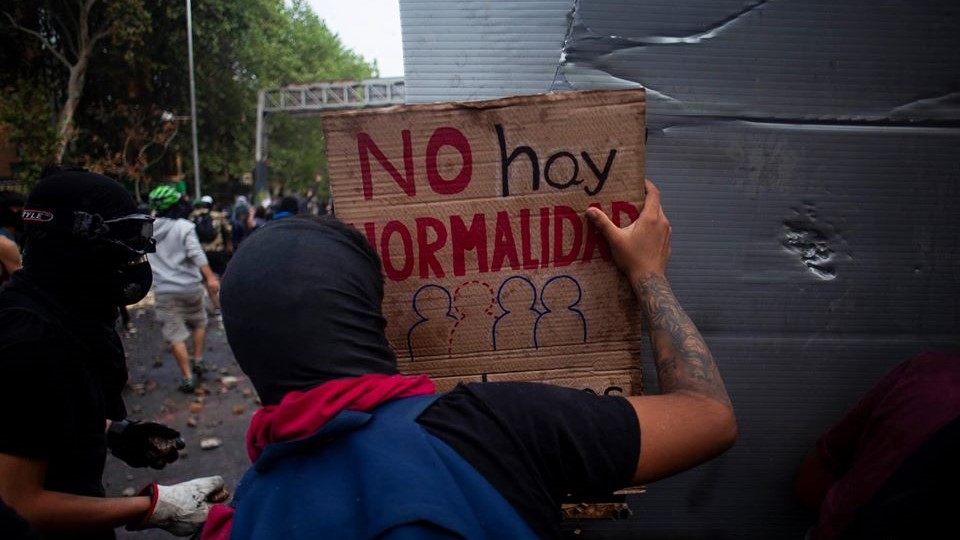
Anti-government protests in Chile enter a third week

“There is no normality” Chileans continue to mobilize against the government of Sebastian Piñera and demand a National Constituent Assembly. Photo: Frente Fotográfico

Chileans are demanding the resignation of President Sebastián Piñera, the establishment of a National Constituent Assembly and punishment for state officials, responsible for human rights violations during the protests.

While Chilean President Sebastián Piñera has claimed that normality has returned to Chile, protests in the country against the neoliberal policies imposed by his government entered a third week on November 4. As a part of the ‘Super Monday’ protest, called for by the Social Unity Board, tens of thousands of people once again took to the streets across the country, demanding the resignation of the president.

The Social Unity Board is a platform that brings together almost 100 social movements, students’ organizations and trade unions, including the Workers’ United Center (CUT), the National Association of Fiscal Employees (ANEF), etc. The board called on workers and people to hold different measures of protests, such as marches, demonstrations, cacerolazos* and roadblocks, throughout the country. The capital Santiago and the port city of Valparaiso were the epicenters of the massive mobilizations.

In the afternoon, hundreds of workers, activists, union and social leaders demonstrated outside the Former National Congress Building in Santiago and the Nation Congress of Chile in Valparaiso, to demand the legislators not to debate on the bills presented by Piñera’s administration that deepen the neoliberal model in the country.

They also demanded that a National Constituent Assembly be established, the government increase investment towards public services of health, housing, education and pensions, and the responsible police and military officials be punished for violating human rights during the repression of protests.

In the evening, in Santiago, once again thousands of people gathered at the Plaza Italia and peacefully marched along the Vicuña Mackenna Avenue with the aim to reach Plaza de los Heroes. However, in the mid-way, they were repressed by the national police force, the Carabineros. The Carabineros used tear gas and water cannons to suppress the protest.

The same day, Chilean human rights organizations and lawyers filed a legal complaint against President Piñera for carrying out systematic attacks against the civilian population during the last two weeks of social protests.

The Ombudsman’s Office, the People’s Defense Committee ‘Vergara Toledo Brothers’ and the Legal Cooperative went to the Seventh Court of Guarantee in Santiago to file a complaint against the president for the crime against humanity, established under Law 20,357.

The organizations demand that “that the described incidents be investigated” and that “the responsibility of President Sebastián Piñera be determined, as the perpetrator of the crime against humanity.”

According to a recently released report by the National Institute of Human Rights (INDH) in Chile, in the last 16 days of anti-government protests, due to police repression, over 23 people have been killed, 4,316 have been arrested,1,564 have been injured, 574 have been hospitalized due to serious injuries and 166 have been threatened, tortured or sexually harassed.

Feminist groups in Chile have carried out several protest actions to raise awareness to the abuses carried out by police officials and have deemed Chile ‘a patriarcal assassain state’. According to reports released by INDH, female detainees were forcibly undressed and forced to stand in the squat position. Several also denounced that security personnel touched them with their weapons and simulated penetration with their firearms. Rebeca Zamora of the Association of Feminist Lawyers of Chile said that security forces also threatened women with rape if they did not follow their orders, or even for participating in the protests.

Guatemalan human rights activist and Nobel Peace Prize winner, Rigoberta Menchú, arrived in Chile and expressed her concerns about the current situation of Human Rights in Chile. Menchú along with Joan Turner Jara, widow of Chilean revolutionary Víctor Jara, and Guillermo Whpei, president of the Foundation for Democracy, visited La Moneda, the Government Palace, and delivered a letter addressed to President Piñera on Monday November 4.

Rigoberta Menchú along with Joan Turner Jara, widow of Chilean revolutionary Víctor Jara, and Guillermo Whpei, president of the Foundation for Democracy

In the letter, she requested an end to police violence, respect the constitutional right to protest of the citizens, open spaces for dialogue and begin the process for a Constituent Assembly, as demanded by the Chilean society.

The popular uprising was sparked by a high school students’ protest against the increase in the cost of public transportation services in the capital, but tapped into the broader social discontent in the country. Since October 18, broad sectors of Chilean society have been mobilizing in different parts of the country against the austerity measures promoted by Pinera’s administration and in repudiation of the strong repression of social protests. The majority of the Chilean population rejected the state of emergency and curfews declared in different regions of the country, which reminded people of the brutality of the last civic-military dictatorship under Augusto Pinochet.

However, despite several attempts by the government to curb their indignation and the violent repression by national police and military forces, defying state of emergency and curfews, Chileans continue to resist.

*Cacerolazos is a form of popular protest in which people make noise by banging pots, pans, and other utensils in order to call for attention.

Source: Peoples Dispatch

Strugglelalucha256
https://www.struggle-la-lucha.org/2019/11/page/9/