‘What do we want? Justice! Boycott Wendy’s!’

SLL photo: Anne Pruden

New York, Nov. 18 — Hundreds of Immokalee farmworkers and supporters took over the block outside Wendy’s headquarters this afternoon. Inside the upscale Manhattan offices at 280 Park Avenue were several of Wendy’s board of directors.

The fast food giant refuses to pay the workers that pick their tomatoes a penny more per pound.  

Showing a colorful display of signs, flags and banners, this very multinational and youth-led rally had speakers and music. They exposed the Wendy’s bosses for refusing to support human rights protections for Florida farmworkers who harvest tomatoes. 

Wendy’s management refuses to agree to worker-led monitoring that has ended sexual harassment, forced labor and other longlasting abusive violations.

Militant supporters chanted, “Down, down, exploitation! Up, up, fair food nation!” at this lively, bilingual rally. Religious leaders voiced support.

Hundreds stepped into the streets. Marching for blocks, the Immokalee worker-led protest drew more support.

New York is a union town and should stand strong against the Wendy’s bosses. Until they comply with the fair food program, “Boycott Wendy’s!” is the message of the day.

Strugglelalucha256


The Social Evolution of Humanity: Marx and Engels were right!

New by Bob McCubbin

This study of the evolution of humanity focuses on human social/sexual relations and, in particular, the changing social status of women.

It offers a selection of scientific evidence that updates and augment the viewpoint expressed in Frederick Engels’ masterful work, “Origin of the Family, Private Property and the State.”

Sometime in the early 1970s, Bob McCubbin read Frederick Engels’ “Origin.” What an amazing book! Women had not always been oppressed. In fact, they had played important, even crucial roles in the advancement of our species over hundreds of thousands of years. McCubbin had found a new reason to hate capitalism. It was the overthrow of early communal society’s mother-right and the division of society into classes or rich and poor, that had brought about the oppression of women worldwide.


McCubbin is the author of “Roots of Lesbian and Gay Oppression: A Marxist View.” First published in 1976, during the first flush of the modern LGBTQ2S movement, McCubbin’s unparalleled achievement was to offer a historical analysis of when, where, why and how LGBTQ2S oppression developed.


Order on Amazon

Strugglelalucha256


‘Pressed to the Wall … But Fighting Back’: The Black Radical Tradition and the Legacy of the Chicago Race Riots 1919

Recently, I watched the opening episode of the new HBO series “Watchmen.” Like millions of other viewers, I was pleasantly surprised to see that the episode began with the white terrorist assault on the community of Greenwood in Tulsa, Okla., popularly known as the Black Wall Street Massacre. 

The Black Wall Street riot resulted in as many as 300 Black people killed and hundreds more injured and has left a critical mark on the Black popular memory in recent decades, which we will discuss later. The omnipresence of Black Wall Street in the Black imagination undoubtedly influenced its insertion into the debut episode. 

The premier episode opened with a young Willis Reeves sitting in a Black movie theater watching a motion picture while his mother played the score on a piano. This fictional film featured a Black sheriff coming to the rescue of a frontier town and recalled the cinematography of Oscar Micheaux, the father of Black Cinema, and his two early films, “The Homesteader” and “Within Our Gates,” the latter being a cultural response to D.W. Griffith’s “Birth of A Nation” and the Chicago Race Riot of 1919. 

Willie’s film-going experience is abruptly ended by a white supremacist aerial assault. Immediately after Willie is transported out of town, the building he was in explodes from another bomb, killing his parents. The episode then moves to the present, where an unarmed Black police officer is shot by a white supremacist. In the following scenes, it is revealed that the hero of the television show, played by Regina King is, once again, a police officer.

I know what you are wondering. “I thought this article was about Chicago 1919? Why in the world is he talking about Tulsa 1921?” For this reason, let’s turn to this popular social media meme.

This widely distributed meme displays the way the period of racial violence and resistance has been largely retained as part of the Black capitalist imagination. This sort of memory obscures the way that the accumulation of Black wealth was the precise purpose for the colonial violence African people in the United State have endured. 

Instead, the lesson of Black Wall Street has become that “the color of Black Power is green.” Neither “Watchmen,” this meme, nor the popular documentary series “Hidden Colors” makes mention of the African Blood Brotherhood, the revolutionary nationalist organization led by Black Communist Cyril Briggs, which took up arms and defended Greenwood. Black capitalist histories have instead erased the legacy of New Negro-era Black radicalism.

This article seeks to recover the history of interwar Black Radicalism’s response to white terror. I aim to make three points: 

  1. Cultural workers played a vital role in leading the call for armed self-defense and revolution; 
  2. This was an internationalist struggle where African descended people clearly understood the white terror in the U.S. as a form of colonial violence, they saw their local and national struggles as tied to the international revolutions and; 
  3. This legacy still informs the vanguard of African global revolution in the 21st century.

Ida B. Wells recognized lynchings as colonial violence

Let’s go back a little further, and then I promise we will move forward in time. In March 1892, three friends of Ida B. Wells–Thomas Moss, Calvin McDowell, and Henry Stewart–were killed as a part of the People’s Grocery lynching. Co-owners of the People’s Grocery, Moss, McDowell and Stewart were murdered at the moment that their business began to rival a local white grocery store. 

Wells credits this event for the radical shift in how she viewed lynchings. Before, she admits, she believed them to be excessive acts against criminals. Yet, as Megan Ming Francis notes, Wells discovered that the cause of lynchings is economic and not criminal. Unfortunately, when recounting the history of lynchings and racial violence, it is assumed that allegations of sexual assault were the leading cause. THEY WERE NOT. Ignoring this reality limits not only our analysis but our political practice.

Racial violence in the United States was a form of colonial violence. The purpose was to reinforce the unevenly structured relations between white people and Black people in the United States. Ida B. Wells, Marcus Garvey, Claude McKay and subsequent activists recognized this and it became the factor for Black international formation. In response to the death of her friends, Ida B. Wells noted that it was “a scene of shocking savagery that would have disgraced the Congo.”

Migration of the African working class

Black Internationalism of the early 20th century was the product of the contradictions of global Black migration. Before he was shot to death, Thomas Moss reportedly said: “Tell my people to go West — there is no justice for them here.” 

Ida B. Wells moved to Chicago, Ill. Jim Crow’s racial terror is one push factor that overdetermined the rural to urban migration of millions of African Americans known as the Great Migration. Yet, Black migrants were met with more white terrorism. 

Illinois was home to three of the largest destinations–Springfield, East Saint Louis and Chicago–in the Red Summer of 1919, a term dubbed by James Weldon Johnson, an NAACP leader at the time. Two years earlier, the U.S. had been rocked with a series of race riots, including the one in East Saint Louis. W.E.B. Du Bois and Johnson responded by organizing a silent march in protest.

Yet, two years later, African Americans did not respond passively to racial violence. In 1919, over forty cities in the U.S. experienced race riots and as many as 1,000 people were killed. Arguably the worst, however, was in Chicago between July 27th and Aug. 3rd.

However, the Red Summer represented a turning point. While white violence claimed the lives of 23 Black Chicagoans, responding in armed self-defense, 15 whites were killed. Similarly, just weeks earlier in Longview, Texas, Black residents used their rifles in self-defense. This prompted the publication of “If We Must Die,” which became an anthem of Black resistance. Not surprisingly, however, it was not originally published in a Black organ but instead in a new socialist publication, The Liberator, edging towards the political shifts in Black radical politics:

IF WE MUST DIE

IF we must die—let it not be like hogs

Hunted and penned in an inglorious spot,

While round us bark the mad and hungry dogs,

Making their mock at our accursed lot.

If we must die—oh, let us nobly die,

So that our precious blood may not be shed

In vain; then even the monsters we defy

Shall be constrained to honor us though dead!

Oh, Kinsmen! We must meet the common foe;

Though far outnumbered, let us show us brave,

And for their thousand blows deal one death-blow!

What though before us lies the open grave?

Like men we’ll face the murderous, cowardly pack,

Pressed to the wall, dying, but fighting back!

— Claude McKay (1919)

Claude McKay and the African Blood Brotherhood

Let us compare McKay’s poem to another piece of cultural work produced that year: Oscar Micheaux’s “Within Our Gates.” Also, a response to the Red Summer, Micheaux’s film, while groundbreaking, represented the respectability politics and pigmentocracy of the mainstream civil rights activists. 

“If We Must Die” helped prompt the organization of the African Blood Brotherhood (ABB) in September 1919. This was a period of global revolutionary struggle. McKay and others were inspired by the groundswell of anticolonial struggles amongst African people around the world as well as the Bolshevik Revolution, and even the Irish Revolution. Even Marcus Garvey, who spoke disparagingly of white American socialists, spoke favorably of Lenin, the Bolsheviks and he supported Irish struggles. However, it is important to note that the ABB and McKay were inspired by the Communist International and the Bolsheviks, but not organized by them. They organized independently.

McKay represented another Black migration, the movement of African and Caribbean migrants from the periphery of the Western empire to its metropolitan centers. In 1912, McKay immigrated to the United States from Jamaica to attend Tuskegee Institute but was quickly shocked by the white power he encountered. 

As Winston James argues in “Holding Aloft the Banner of Ethiopia: Caribbean Radicals in Early Twentieth-Century America,” these confrontations with American racial capitalism had a jolting impact on Caribbean migrants for whom class and other privileges eroded. For in the United States, “race became the modality through which class was lived.” Immigration of African and Caribbean people to the U.S. in the early 20th century generated cross identification within the African diaspora that caused a multidirectional shift in identity and politics.

McKay, Cyril Briggs, Grace Campbell, Otto Huiswood and the leadership of the ABB developed the Universal Negro Improvement Association into a vanguard organization in the Black Freedom struggle. Sympathetic with the mass movement and respectful of the leadership of Marcus Garvey and the UNIA, they had all embraced socialism, in its different forms. Sympathetic with the struggles of the global working class, they also gained inspiration from the anticolonial struggles and socialist revolutions of the age. The ABB’s internationalism is captured in Briggs’s 1920 statement, “The cause of freedom, whether in Asia or Ireland or Africa, is our cause.”

The ABB also forged unity between African American and Afro-Caribbean migrants. As Minkah Makalani notes in his seminal text on Black internationalism “In the Cause of Freedom: Radical Black Internationalism from Harlem to London, 1917-1939”:

“The ABB’s membership consisted largely of workers — skilled laborers in Chicago; coal miners in West Virginia; World War I Veterans in Tulsa, Oklahoma; Anglo-Caribbean migrant laborers in the Domincan Republic and Panama.” 

At its peak, the ABB had 8,000 members. This paled in comparison to the millions in the ranks of the UNIA. Fashioned as “revolutionary secret order,” the ABB sought to raise the consciousness of the global African working class through what later became known as programmatic influence.

In 1921, the ABB gained a surge in popularity as reports of their armed defense of Tulsa spread. The following year, the ABB merged with the Communist Party. Vladimir Lenin had already stressed the importance of solidarity with anticolonial struggles in Africa and Asia. 

Yet, it is people like McKay and Huiswood who not only sharpened the Communist International’s position on the Negro Question: that is, the right to self-determination for the Black working class in the United States and Africa. The end result was, in fact, a synthesis of communist and Garveyist thought at the Sixth Comintern in 1928 with the production of the Black Belt Thesis on the U.S. and the Native Republic Thesis on South Africa, which demanded Black independence in the U.S. and national leadership in South Africa.

The one downfall, however, is that the ABB and the UNIA never found complete unity. The conflict between the ABB and the UNIA was hastened by government agitation — the first Black agents of the then Bureau of Investigation (now FBI) were hired to infiltrate and bring down both movements. 

However, the ABB suffered from its own failure to accept the will of the people. The African masses had chosen Garvey and the UNIA. As many argue, in the United States the movement would have been much stronger if the ABB leadership had made a stauncher commitment to principled engagement from within as members of the UNIA. In South Africa, far away from the center of conflict in New York, activists such as James La Guma synthesized Garveyism and Socialism — it would not be until the 1960s that these efforts would be reignited.

The Hip Hop Generation

As I have tried to show in my discussion of McKay’s response to the Red Summer, cultural work and cultural workers were central to Black radical formation. Cultural workers have the ability to move us beyond contemporary crises and enable the masses to imagine a new world beyond oppression — historian Robin Kelley refers to these radical productions as freedom dreams. 

Much of the contemporary freedom dreaming has been devoid of meaningful Black internationalism and calls to arms. Instead, appeals to the American nation-state and calls for nonviolent direct action have predominated.

This year marks the 25th anniversary of the end of apartheid, the creation of NAFTA and the creation of Operation Gatekeeper. Defined by a rise in neoliberal policy and cultural production, this period has been defined by an increased transnational movement of capital but a fracturing of Black international unity. 

We must remember that 1994 was also the year of the Rwandan Genocide and the U.S. invasion of Haiti. Confronted with images (1) a tendency of reformist activists would join with the Democratic Party or, at the least, further engage the arena of electoral politics; (2) a new generation of cultural nationalism would emerge. Far more intersectional than its predecessors, this tendency would be just as biologically determined as earlier forms of cultural nationalism. If not more turmoil throughout the African diaspora, the last 25 years have consisted of crosscurrents of disidentification. At no place is this sharper than at many college campuses. Yet this tide has begun to recede. And, once again, it is the product of struggle and cultural production.

Too often the activism in the era of Black Lives Matter has targeted local, state and national reforms as organizational goals — and even worse, mere demands to make white politicians “say black lives matter” became the terrain of struggle. We saw this fatal contradiction during the 2016 election season. 

Following a 2015 interaction between BLM activists and Hillary Clinton, I proposed that three dimensions would emerge from this age of Black radicalism: 

  • a tendency of reformist activists would join with the Democratic Party or, at the least, further engage the arena of electoral politics; 
  • a new generation of cultural nationalism would emerge. Far more intersectional than its predecessors, this tendency would be just as biologically determined as earlier forms of cultural nationalism, if not more; and 
  • revolutionary socialist tendencies would inevitably spread.

Recent studies show that the masses of youth are embracing socialism. This turn towards socialism has been matched with calls for armed self-defense. Chants such as “Fist Up! Fight Back!” and “Black Power Matters” guide the masses at demonstrations. As well, groups such as the Huey P. Newton Gun Club and Guerilla Maneframe have sought to train the masses of the African Working Class. This is the true legacy of 1919 — socialism and self-defense.


Strugglelalucha256


Bolivia resists racist coup

On Nov. 19, the tenth day of the coup against legitimate, democratically elected Bolivian President Evo Morales, police and soldiers fired from helicopters into a crowd of protesters — Indigenous people, workers and peasants — blockading a fuel depot in El Alto, the South American country’s largest city and a center of resistance near the capital, La Paz. 
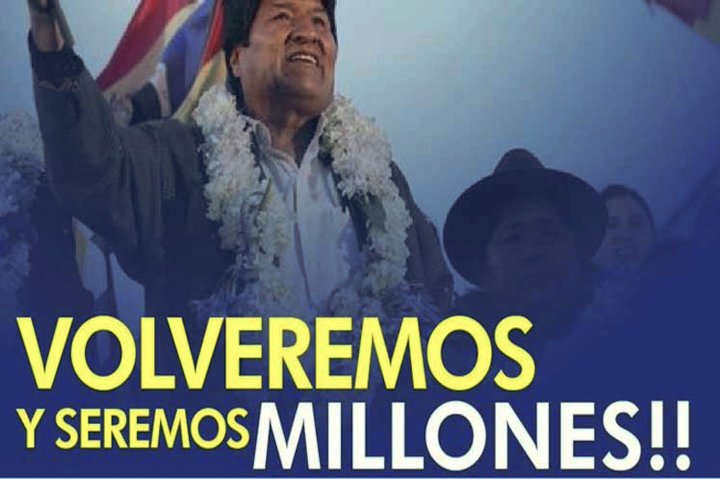
The protesters were demanding the resignation of self-proclaimed interim President Jeanine Añez. Reports say at least one person and possibly as many as six were killed and 23 wounded.

Four days earlier, in the Indigenous stronghold of Huayllani, Cochabamba, nine people were shot dead during protests against the U.S.-backed coup regime. A relative of Armando Carballo, a peasant farmer who was among the victims, said: “My brother-in-law died with three gunshot impacts. Leaves a 2-year-old girl in the orphanage. We ask for justice for our brother.”

In all, at least 24 people have been killed, more than 700 wounded and over a thousand arrested since the military ousted Bolivia’s first Indigenous president on Nov. 10, after the U.S.-dominated Organization of American States supported opposition claims of election fraud — without proof

Morales and Vice President Álvaro García Linera, both representing the Movement Towards Socialism (MAS), were forced to leave the country, accepting asylum in Mexico under threat of assassination by police groups.

“We will be back and join the fight to strengthen our social forces,” Morales told Al-Jazeera.

The coup plotters, fronted by Añez, proclaimed the military free to fire on unarmed protesters with no consequences. Independent journalists are being driven from the country. So were Cuban health workers, after four of them were arrested on bogus charges of funding the anti-coup protests. Diplomats of Bolivarian Venezuela were expelled. Añez and another pretender “president,” Juan Guaidó of Venezuela, have expressed their mutual admiration.

Undefeated and fighting back

Looking at these facts in isolation, the situation seems grim. 

But the Bolivian people are not giving up. They have not been defeated. They are fighting back.

Despite the danger, protests are growing. Braving teargas and live ammunition, huge marches from the countryside are converging on urban centers, especially La Paz. While the repressive forces were attacking in El Alto on Nov. 19, thousands of rural teachers marched into the capital at the head of a major labor demonstration. 

Many protesters carry the colorful Wiphala flag — representing the Indigneous people of Bolivia and surrounding countries — which was torched by the racist-fascist forces that earlier mobilized against President Morales. 

Indigenous-led groups are organizing armed self-defense. Communities have established bodies of self-government.

This mass courage and determination helps to strengthen the resolve of the political representatives of the movement in La Paz. The Congress, where members of the MAS form a majority, have refused to accept Morales’ forced resignation or to recognize the legitimacy of the coup regime. 

Significantly, there are reports that rank-and-file soldiers, many of them Indigenous people themselves, are starting to break away and join the protesters, refusing to repress the people. 

A report sent by email to Morales supporters on Nov. 20 states: “The coup regime inside Bolivia is falling apart at the seams. According to sources inside the military, there has been friction, both between the military and the police, and between their respective leaders and foot soldiers.”

The report continues: “Bolivian media have reported that Bruce Williamson at the U.S. Embassy in La Paz has operated as a bag man, doling out millions of dollars to generals and police chiefs. Local media have reported that the general who told Morales to resign has already left for the USA with his money. The Bolivian news report states that it expects more generals to follow suit as they are fearful of being put on trial for their repressive acts, not to mention their corruption.”

The mask of “democracy” and “human rights” fashioned by their masters in Washington fits poorly on the crude white supremacists, anti-Indigenous racists and fascists at the center of the coup, and the military and police officials trained by the Pentagon’s infamous “School of the Americas” and the FBI. Añez herself is known for her racist, anti-Indigenous views.

International struggle

Most important, the struggle of the Bolivian people is not isolated. A furious class struggle rages across the South American continent and the Caribbean, where the people of Haiti continue to resist under harsh repression. 

Everywhere, the forces of the people — workers and peasants, Indigenous and Afro-descendants, women and LGBTQ2S people — are measuring their strength against the capitalist oligarchs and their repressive forces (military, police, death squads), behind whom stands U.S. imperialism.

In Brazil, the people’s relentless struggle and the resulting internal conflicts within the ruling class won the release of former President Lula da Silva of the Workers Party just days before the coup in Bolivia.

In Chile, the people continue to rise after more than a month of mass protests, despite horrific violence like police targeting the eyes of demonstrators, blinding more than 200 so far. They have forced the Sebastián Piñera government to agree to rewrite the Pinochet-era constitution. 

But the half-measures proposed by the U.S. stooges in Santiago have not demobilized the people, who demand a Constituent Assembly and genuine change in the relationship between rich and poor, a process that was brutally postponed more than four decades ago by the coup that overthrew Salvador Allende’s socialist government on 9/11/1973. 

Chilean protesters have proclaimed, “Neoliberalism was born in Chile, and it will die here.”

On Nov. 21, workers and students in Colombia will stage a general strike against the death-squad regime of President Iván Duque. Repression against Indigenous communities and left forces by the traitorous Lenin Moreno government in Ecuador is setting the stage for a new uprising like the one that won concessions against an International Monetary Fund austerity plan earlier this fall. 

Following the election of a new, left-leaning president in October, workers in Argentina have held massive protests in Buenos Aires and other cities against the coup in Bolivia and in solidarity with the Indigenous resistance there. Resistance is building in Peru and Uruguay, too.

Bolivarian Venezuela and socialist Cuba — fortresses of popular power besieged by U.S. imperialism and its oligarchic allies with blockades, sanctions, military threats and slanders — continue to resist and offer every assistance they can to the people in struggle.

In Bolivia and elsewhere, the masses are learning valuable lessons every day: by developing new, effective tactics of resistance; that the state cannot be merely taken over but must be smashed and replaced with the power of the workers and oppressed; how the capitalist media turn reality on its head, portraying right-wing violence as heroic while ignoring or disparaging genuine popular protest.

Let’s take inspiration from the resisting people of Bolivia to strain with every fibre of our being toward destroying the evil system of capitalism and imperialism in the U.S. and around the world. In the words of the socialist anthem, The Internationale, “a better world’s in birth.”

Strugglelalucha256


Open letter: Peoples of the world with Evo!

People’s organizations condemn U.S.-instigated coup in Bolivia

We, allied anti-imperialist organizations and individuals across the world, condemn the rightwing coup against Indigenous President Evo Morales that forced him and other members of the Bolivian government to resign. This coup is being undertaken to inflict the worst kind of violence upon class-conscious, Indigenous revolutionaries who, under the banner of Indigenous socialism, have forged the path toward self-determination and peace.

To this day, no evidence exists to demonstrate that the October 20 elections which Evo Morales won were fraudulent. As early as one day later–on October 21–the Organization of American States (OAS) released a public statement in an attempt to discredit the election results

without any supporting evidence. For all its claims of multilateralism and diversity, the OAS receives a disproportionate amount of its funding from Washington, D.C.

This is not the first time that the United States government engaged in a coup in Latin America. This is not the first time that the U.S. government fully supported a member of the local economic and political elite whose aim is to restore the ruling elite bloc’s policies which are hostile to the interests of the majority.

Evo Morales’ rival, former Bolivian President Carlos Mesa, an agent of the Washington, D.C.-based think tank, the Inter-American Dialogue, and a political figure known for his hostility towards Indigenous socialism and partiality to multinational big business, has the qualifications of an ideal imperialist comprador.

The contributions of the Movement for Socialism (MAS)–under the leadership of Evo Morales–enjoy enormous support from the Indigenous population and the working class of Bolivian society. Its contributions to the political and economic advancements of Bolivia through the painstaking economic and cultural empowerment of Indigenous people and workers is well known and is inspiring, especially at this time of neoliberal attacks on the world’s working people.

We stand together in unity with Bolivian workers, peasants and Indigenous people in their struggle against U.S. intervention and economic imperialism. We strongly condemn the comprador elite in Bolivia who are agents of U.S. imperialism. We are prepared to reinforce all efforts to bring the perpetrators of violence to justice, may it be in the form of support for our Bolivian friends and comrades and/or an international people’s tribunal that will hold the culprits in this electoral destabilization and rightist coup fully accountable for their crimes against humanity.

El mundo con Evo, so are we!

U.S. hands off Bolivia!

Defend the right to self-determination!

Defend the people’s right to live in peace!

Signed by:

    1. American Indian Movement Southern California
    2. Anakbayan USA
    3. BAYAN (New Patriotic Alliance) Philippines
    4. BAYAN- USA
    5. Black Workers for Justice
    6. Candidatura d’Unitat Popular Països Catalans
    7. Coordinadora Nacional Sindical y Social (CNUSS-Guatemala)
    8. Covert Action Magazine (USA)
    9. For the People – North Amerikan Federation (USA)
    10. Frente Populare (Italy)
    11. Frente Popular Revolucionario (FPR Mexico)
    12. Fundación Amancio (Guatemala)
    13. Human Rights Alliance for Child Refugees & Families (USA)
    14. International League of Peoples’ Struggle-Australia (ILPS)
    15. ILPS Canada
    16. ILPS Guatemala
    17. ILPS Philippines
    18. LPS Commission 1 The cause of national liberation, democracy and social liberation against imperialism and all reaction
    19. ILPS Commission 11 Struggle of teachers and other education workers against imperialism and for an alternative future
    20. International Women’s Alliance
    21. Inti Barrios: Costureras de Sueños (Mexico)
    22. Juventudes Socialistas del Perú
    23. Journal of Labor and Society
    24. May Day Committee (Melbourne Australia)
    25. Malcolm X Grassroots Movement (MXGM)
    26. New Afrikan People’s Organization (NAPO)
    27. New York Boricua Resistance
    28. New York Peace Council
    29. Occupy ICE Los Angeles
    30. October Revolution Centenary (New York City)
    31. Philippine-U.S. Solidarity Organization PUSO Seattle
    32. Philippines-Bolivarian Venezuela Friendship Association
    33. Potere al Popolo (Italy)
    34. Proles of the Roundtable (USA)
    35. Regional Council of Africans in the Americas
    36. Union of Cypriots (Cyprus)
    37. Unión del Barrio (USA)
    38. Carol Araullo – Chair, BAYAN Philippines
    39. Alessio Arena – Fronte Popolare, Italy
    40. Christopher Connery, Professor, University of California Santa Cruz
    41. Diego Gullotta, Professor of Sociology, PRC
    42. Giuliano Granato – National Coordination, Potere al Popolo, Italy
    43. Andrew Kahn, Voice of América Blog
    44. Liza Maza – Secretary-General, International League of Peoples’ Struggle
    45. Mateo Bernabé López Pérez, Coordinadora nacional sindical y social, Guatemala
    46. Florentino López Martínez, Frente Popular Revolucionario Mexico
    47. Immanuel Ness – author, Southern Insurgency: The Coming of the Global Working Class (2016) and Chair, New York Peace Council
    48. Ben Norton, journalist, USA
    49. Paloma Polo – filmmaker, Spain
    50. Sarah Raymundo – Chair, Philippines-Bolivarian Venezuela Friendship Association
    51. Renato Reyes Jr.,  Secretary-General BAYAN-Philippines
    52. Akinyele Umoja, author, We Will Shoot Back: Armed Resistance in the Mississippi Freedom Movement (2013)
    53. Samuel Villatoro, Fundación Amancio, Guatemala
    54. Samidoun: Palestinian Prisoner Solidarity Network
    55. Socialist Unity Party/Partido de Socialismo Unido (USA)
    56. Oz Karahan – President, Union of Cypriots (Cyprus)
    57. Loan Tran, International Action Center (U.S.)
    58. Alliance for Global Justice
    59. Chuck Kaufman, National Co-Coordinator, Alliance for Global Justice (U.S.)
    60. Prof. Jose Maria Sison, Chairperson Emeritus, International League of Peoples’ Struggle
    61. Students and Youth for a New America
    62. Dakota Lily, activist, Students and Youth for a New America, NYC-NJ-PA
    63. Congress of Teachers and Educators for Nationalism and Democracy-UP (CONTEND-UP)
    64. Gwen Bautista, Artist and Independent Curator
    65. People’s Power Assembly (Baltimore, MD USA)
    66. Youth Against War & Racism (Baltimore, MD USA)
    67. Malcolm Guy, Vice-Chair External, International League of Peoples’ Struggle
    68. Centre d’appui aux Philippines / Centre for Philippine Concerns (Montréal)
    69. Concerned Artists of the Philippines
    70. Antares Gomez Bartolome (Quezon City, Ph)
    71. Danny Haiphong, Contributing Writer, Black Agenda Report
    72. Cindy Sheehan, National Coordinator of March on the Pentagon and Host/Producer of Cindy Sheehan’s Soapbox
    73. March on the Pentagon
    74. Cindy Sheehan’s Soapbox
    75. Carlos Martinez, writer, Invent the Future (London, GB)
    76. Ann Garrison, Journalist, San Francisco Bay View, Black Agenda Report, Pacifica Radio
    77. ILPS Commission 4
    78. FMLN-Vancouver
    79. Solidaridad Ayotzinapa Vancouver
    80. Venezuela Peace and Solidarity Committee of Vancouver
    81. Jesús Rodríguez-Espinoza – Editor, Orinoco Tribune
    82. United National Antiwar Coalition
    83. Committee to Stop FBI Repression
    84. Chicago Committee for Human Rights in the Philippines
    85. Jaime Coreas Jiménez, FMLN Vancouver
    86. María Luisa Meléndez, FMLN Vancouver
    87. Clara Sorrenti, Activist, Communist Party of Canada – Forest City Club
    88. Venezuela Peace and Solidarity Committee of Vancouver
    89. Leslie Salgado, Friends of Latin America, Columbia, MD
    90. Michele & Rick Tingling-Clemmons, Gray Panthers of Metropolitan Washington

Go here to add your name to the list, then click SHARE in upper right corner.

Strugglelalucha256


Hundreds in New York march to stand with Gaza, Palestinian resistance

Hundreds of people took to the streets in Times Square in New York City on Friday, Nov. 15, to protest Israeli attacks on Gaza and support the Palestinian struggle for liberation.

The protest came as part of the call for an international day of solidarity with Palestinian resistance issued from Gaza after Israeli assassinations and bombing raids over two days of attacks killed 34 Palestinians, including eight members of one family, and injured 111 more.

Organizers of the protest included the Samidoun Palestinian Prisoner Solidarity Network as well as Al-Awda New York, Within Our Lifetime – United for Palestine, American Muslims for Palestine, the NY4Palestine Coalition, Labor for Palestine, Jews for Palestinian Right of Return, Code Pink, the International Action Center and Struggle–La Lucha.

Demonstrators gathered for brief speeches and ongoing chanting in solidarity with Palestine. 

Chants echoed through the evening as protesters carried signs and Palestinian flags.

Demonstrators marched through Times Square to Herald Square, chanting the entire route and calling for the boycott of Israel and a liberated Palestine from the river to the sea.

The protest ended with a strong call for further actions from Nerdeen Kiswani of Within Our Lifetime – United for Palestine.

Joe Catron, U.S. coordinator of the Samidoun Palestinian Prisoner Solidarity Network, said that the demonstration was the largest and most enthusiastic action for Palestine in New York since December 2017, when Donald Trump announced that the U.S. recognized Jerusalem as the capital of Israel.

He emphasized the importance of continuing these activities against Zionist occupation, apartheid and colonization, and in support of the Palestinian resistance.

Catron noted that these are especially important in the U.S., which exercises its full imperial power in support of the Zionist colonization of Palestine, including through the provision of $3.8 billion annually in military aid.

Photo: Joe Catron

Strugglelalucha256


Los Angeles protest condemns Bolivia coup

Demonstrators gathered in front of the Bolivian Consulate in Los Angeles on Nov. 16 to denounce the U.S.-backed coup and repression in Bolivia. Signs and banners expressed solidarity with the democratically elected president of Bolivia, Evo Morales. 

People from the city’s large Latinx community, including Bolivian activists, took the mic and gave impassioned anti-imperialist talks, inspired by the Indigenous-led resistance to the coup.

“Any politicians who call themselves progressive or left have to say something about this,” declared John Parker, speaking on behalf of the Socialist Unity Party and Struggle-La Lucha newspaper. “Why? Because this is an example of imperialism, and U.S. imperialism is the most dangerous thing to humanity today.”

The action was called by the Answer Coalition, AIM SoCal, Me Too Survivors March and others. Other organizations participating included Unión del Barrio, the International League of Peoples’ Struggle, the Socialist Unity Party and the Party for Socialism and Liberation. 


Talk by Struggle-La Lucha’s John Parker

SLL photos: Scott Scheffer

Strugglelalucha256


San Diego Dec. 14: Welcome Freedom Fighter Pam Africa


Welcome Freedom Fighter Pam Africa
Free Mumia Abu-Jamal, Leonard Peltier & all political prisoners

Saturday, December 14 – 2:30 pm
Malcolm X Library & Performing Arts Center
5148 Market Street, San Diego, CA

Join us to welcome freedom fighter Pam Africa, who will be visiting Los Angeles and San Diego to give an update on Mumia, the remaining MOVE political prisoners and recently release MOVE members, as well as the ongoing struggle free all political prisoners.

Speakers:
– Pam Africa of the International Concerned Family & Friends of Mumia Abu-Jamal
– Zola Fish Muhammad is an activist member of the Choctaw Nation and organizer in the Leonard Peltier Defense Committee, Socialist Unity Party, San Diego Committee Against Police Brutality and People’s Power Assembly.

Sponsored by Struggle-La Lucha newspaper and Socialist Unity Party – San Diego
For more information please email: dadji@aol.com


Strugglelalucha256


A city of struggle

The long shadow of the Chicago race riot, Part 8

The sudden death of Harold Washington in 1987 was a godsend to Chicago’s power structure. Most of Washington’s supporters wanted Alderman Timothy Evans to be made mayor. 

Alderman Ed Burke and other racists saw an opportunity to split the Black members of the City Council. Eleven years before, these bigots revolted when the Black President Pro Tempore Wilson Frost proclaimed himself mayor.

Now, in 1987, they threw their support to the African American President Pro Tempore Eugene Sawyer. The masses were outraged at this treachery. At least 5,000 people protested outside City Hall. 

Sawyer was elected mayor at 4:01 a.m. on Dec. 2, 1987, by a vote of 29-19. Only five Black aldermen voted for him. 

Sawyer was soon gotten rid of. Richard M. Daley beat him in the 1989 primary. The Daley family had become so hated by African Americans that Richard-the-second got just 5 percent of the Black vote. 

With millions in campaign funds provided by big business, Daley defeated Timothy Evans in the general election. (Evans ran on the Harold Washington Parry ticket.) 

The son of the pig who had Fred Hampton and Mark Clark murdered was re-elected mayor five times. What happened to the hopes of all those who put Harold Washington in City Hall?

A long depression for Black workers 

The movement that elected Harold Washington was a concluding act to the struggles of the 1960s and 1970s. It served as a springboard to the Rev. Jesse Jackson’s presidential campaign in 1984.

The Daley Machine had to be broken. It was broken, at least temporarily.

In the meantime, Chicago, like most other big cities in the Midwest and Northeast, has shrunk. Chicago’s population has fallen from nearly 3.6 million in 1960 to 2.7 million today.

It’s still a powerhouse. Chicago’s metropolitan region has grown to nearly 10 million people.

In the early 1980s, the Black community suffered the biggest drop in income since the Great Depression of the 1930s. Between 1978 and 1982, the median income of African American families in the Midwest fell by nearly 36 percent.

Deliberate deindustrialization was the culprit. U.S. Steel’s South Works in Chicago shut down. So did nearby Wisconsin Steel that was owned by International Harvester. Employment at Stewart Warner fell from 5,000 in the 1970s in Chicago to 20 in the late 1990s. 

It wasn’t just automation or even capitalist decay that got rid of these jobs. Big capital was determined to get rid of its dependence on Black workers in basic industry.

Back in 1970, a quarter of the workers in U.S. steel mills and auto plants were Black. Many of the new auto plants built since then were in areas with small numbers of African Americans.

Even in 2018, African Americans in the Midwest were poorer than they were 40 years before. Adjusted for inflation, Black family median income there in 2018 was just $44,790, as compared to $48,510 in 1978.

White workers suffered too. Hundreds of thousands of white workers were thrown out of factories along with their Black and Latinx sisters and brothers. White family income dropped 7 percent from 1978 to 1982, one-fifth of the decrease for African American families.

While African American median family income in the Midwest was the highest of any region in 1978, by 1982 it was the lowest, even below the South. 

A small reverse migration to the South began because that’s where the jobs were. Instead of being employed in the big plants, many Black youth were being railroaded to the big prisons.

It was this economic reaction ― which scattered, demoralized and incarcerated large numbers of workers ― that allowed the Daley family to make a comeback.

Welcome fellow workers and fighters

While the Great Migration of African Americans came to an end, another Great Migration began of Latinx people. Chicago’s Latinx community is now 800,000 strong. Two million live in the metropolitan region. 

Immigrant bashing is old rotten news. The Honorable Marcus Garvey was an immigrant from Jamaica who was framed and deported.

For decades there’s been a Mexican community in Chicago. But in the early 1930s, a massive deportation drive across the U.S. rounded up hundreds of thousands of Mexican people.

Thirty miles from Chicago, the U.S. Steel works in Gary, Ind., fired every Mexican worker who wasn’t a U.S. citizen. Mexicans were among those shot in 1937’s Memorial Day massacre.

Over the last 40 years, millions of Mexican people have been forced to leave their country by increased poverty. Between 1981 and 1986 alone, vampire-like U.S. and other foreign banks sucked $63.6 billion in interest payments out of Mexico. That’s worth over $200 billion in today’s dollars. In those same years, real wages for Mexican workers were cut almost in half.

Hundreds of thousands of U.S. workers lost their jobs because of the North America Free Trade Agreement. But millions of Mexicans were shoved off their land by heavily subsidized U.S. corn exports that jumped from two million tons in 1992 to over ten million tons in 2008.

Puerto Ricans were driven out of their beautiful homeland by Wall Street’s colonial occupation and its Operation Bootstrap. The Lincoln Park neighborhood was a center of Chicago’s Puerto Rican community. Led by José “Cha Cha” Jiménez, the Young Lords became a revolutionary force for change.

Power broker Robert Moses drove out thousands of Puerto Rican families from Manhattan’s Upper West Side to build Lincoln Center. Mayor Richard J. Daley’s urban removal program drove Puerto Ricans and other poor people out of Lincoln Park.

More than three million people have left Central American countries to come to the U.S. because of intense poverty and death squads. U.S. corporations, like United Fruit, are responsible for both. 

The name “Chicago” is derived from the Indigenous word “checagou.” But Indigenous people were driven out with the 1833 Treaty of Chicago.

Today around 80,000 Indigenous people live in the Chicago area. A key factor was the Indian Relocation Act of 1956, which offered one-way tickets to Indigenous families to move from reservations to what were often urban slums. 

Hundreds of thousands of Asian people have also come to the Chicago region. 

All of these workers from other lands — and Indigenous people whose land was stolen—are playing an increasing role in the working-class struggle.

An outstanding example is how immigrant workers revived May Day in the city where it was born. In 2006, 300,000 people came out in Chicago to celebrate International Workers’ Day. 

Fire sales and police torture

The second edition of Daley family rule was not quite as crude, but it was just as corrupt. Chicago became a leader in privatizing its infrastructure.

The Chicago Skyway, a toll road that links the Indiana toll road to the Dan Ryan expressway, was leased to private investors in 2005 for $1.83 billion. This was chump change for giving it away. The buyers made a billion-dollar profit when they flipped the Skyway ten years later. 

Daley also handed over Chicago’s parking meters. Wheeler-dealers led by Wall Street’s Morgan Stanley investment bank gobbled them up in 2008. Morgan Stanley had earlier grabbed a 99-year-long lease on the city’s parking garages. 

The $1.16 billion that the city got for the meters was a billion dollars too low. Chicago had to give $20 million back to the new owners in 2018 because construction had taken a large number of parking meters out of service.

What really rocked the city were revelations about police torture. Between 1972 and 1991, police commander Jon Burge and his “midnight crew” used electric shocks, strangulation and burning to coerce confessions from over 110 Black prisoners. Ten were sent to death row. 

In 1982, Richard M. Daley, then Cook County state’s attorney, was told about Burge’s crew torturing Andrew Wilson. Daley refused to investigate.

These outrages helped lead Illinois Gov. George Ryan to commute the sentences of 167 prisoners on death row. Ryan pardoned four condemned prisoners who had been tortured.

The deep state, which is the real state apparatus of police and prisons, paid Ryan back. The former governor was jailed for five years on corruption charges.

Ryan may have been guilty. But why haven’t any members of the Daley family been prosecuted?

Fight back

Daley eventually wore out his welcome with big business by a series of contracting scandals, some of which involved his son Patrick. Former congressperson and investment banker Rahm Emanuel was put into City Hall in 2011. 

Emanuel continued the attacks on poor people. He closed 50 schools in 2013. 

The Chicago Teachers Union led a fightback against these cuts. In their recent 2019 strike, the CTU demanded smaller class sizes as well as nurses and counselors in every school. Teachers are fighting for the “common good.”

The 25,000 members of the CTU are militant and strong. They’ve gone on strike almost a dozen times in the last 50 years. In 1987, the teachers walked out for 19 days, while a 2012 strike lasted more than a week.

These strikes echo the Chicago teacher’s revolt in 1933. Teachers stormed the City National Bank and Trust Co., demanding their back pay. They confronted bank president and former U.S. Vice President Charles Dawes. 

The vicious Chicago Police Department continues to kill, brutalize and frame people. Just between 2008 and 2015, they killed 108 people. More than 1,600 people have been shot by cops since 1986. 

The 2014 police murder of Laquan McDonald horrified the city. Police Officer Jason Van Dyke shot the 17-year-old Black youth 16 times.

The police brass tried to cover up the murder. Mayor Emanuel suppressed a video of this shooting until after he was re-elected. Community outrage finally compelled the state to prosecute Van Dyke, who was convicted of second-degree murder.

Leading the struggle against police atrocities is the Chicago Alliance Against Racist and Political Repression. One of its co-chairs is the former prisoner and longtime activist Frank Chapman, author of “The Damned Don’t Cry.” Together with community members, they are demanding a Civilian Police Accountability Council (CPAC).

In the spirit of the Haymarket martyrs and Fred Hampton, the people of Chicago are fighting back.

Sources: “Divided We Stand: American Workers and the Struggle for Black Equality” by Bruce Nelson; “Organized Labor and the Black Worker 1619-1973” by Philip S. Foner

End of series


Part 1: The long shadow of the 1919 Chicago race riot

Part 2: Bombings greet the Great Migration

Part 3: What did the unions do?

Part 4: Communists fight racism and evictions

Part 5: Chicago Mayor Daley’s racist machine

Part 6: Never forget Fred Hampton

Part 7: The people put Harold Washington in City Hall

Part 8: A city of struggle

Strugglelalucha256


Los Angeles Nov. 30: ‘The Revolution will not be Televised’ film showing

Film Showing: ‘The Revolution will not be Televised’

Saturday, November 30 – 6:00pm
Harriet Tubman Center for Social Justice
5278 W. Pico Blvd. (east of Fairfax and west of La Brea)
Los Angeles, CA
In April 2002, an Irish film crew happened to be filming a documentary on Venezuelan President Hugo Chavez in Caracas when a U.S.-backed coup was launched, just like in Bolivia. The film crew captured the violence unleashed by the right wing and popular resistance that defeated the coup. This documentary was the result, and it helped to expose the lies of the U.S. media as they tried to blame the loyal Venezuelan military for the horrific attack.
PLUS: Update on Bolivia
The growing fight against the racist coup
– Accessible hall
– Snacks, drinks available
– Donations accepted, no one turned away for lack of funds
Sponsored by Socialist Unity Party / Partido de Socialismo Unido
For more information, call 323-306-6240
Strugglelalucha256
https://www.struggle-la-lucha.org/2019/11/page/3/