Los Angeles Nov. 9: Emergency demonstration – Defend people’s uprisings in Haiti & Chile

Los Angeles: Emergency Demonstration – Defend People’s Uprisings in Haiti & Chile
U.S. Out of Latin America!

Saturday, Nov. 9 from 12 to 2 pm
Northeast Corner of MacArthur Park
W. 6th St. & S. Alvarado, Los Angeles

Demonstration called by: Harriet Tubman Center for Social Justice
For info: 323 306­-6240

On Facebook

Strugglelalucha256


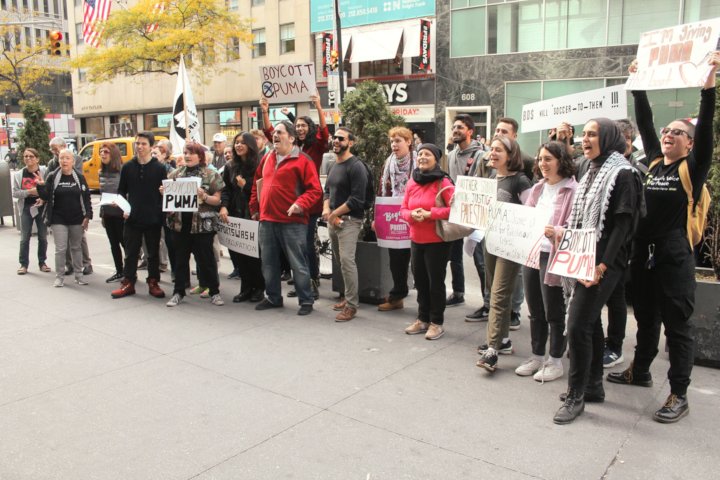
New York Nov. 9: Protest to free Palestinian prisoners and #BoycottPuma

Hosted by Samidoun Palestinian Prisoner Solidarity Network

Saturday, November 9, 2019 at 4:00 PM – 5:00 PM EST

PUMA (609 Fifth Avenue, New York)
609 Fifth Avenue, New York, New York 10017

Bring signs, flags, and banners demanding freedom for Heba al-Labadi, Khalida Jarrar, Samer Arbeed, and all Palestinian political prisoners, and an end to PUMA’s support for Israeli settler-colonialism in occupied Palestine!

Khalida Jarrar, leading Palestinian feminist, leftist and parliamentarian, was seized in the pre-dawn hours of October 31, 2019 by Israeli occupation forces. The heavily armed force invaded her home with over a dozen military vehicles and 80 soldiers only eight months after she was last released from Israeli prison. She had been jailed there for 20 months with no charge and no trial under administrative detention. During Khalida’s imprisonment, over 275 organizations around the world joined the call for her freedom, and protests and mobilizations around the world highlighted her case. It is time to act again and demand Khalida’s immediate release!

Heba al-Labadi is a 24-year-old Palestinian with Jordanian citizenship. She has been on hunger strike since September 24, 2019 against her administrative detention – imprisonment without charge or trial. She is one of 425 Palestinians detained without charge or trial, many of whom spend years at a time jailed under indefinitely renewed administrative detention orders. There are over 5,500 Palestinians imprisoned in total by the Israeli occupation. Heba al-Labadi launched her hunger strike after five weeks of harsh interrogation involving techniques amounting to torture, including sleep deprivation, threats against her family, verbal abuse and sleep deprivation. Heba has been jailed by the Israeli occupation since 20 August, when she entered Palestine with her mother to attend a wedding in Nablus.

Samer Arbeed is being held in Hadassah hospital after severe Israeli torture under interrogation and brutal beatings that caused him to lose consciousness for weeks. He has been shackled to his bed and even tear-gassed in his hospital room by Israeli forces despite the fact that he has 11 broken ribs and pneumonia as well as kidney dysfunction so severe he now requires dialysis. He suffered from none of these medical conditions prior to being seized by Israeli occupation forces on September 25, although his wife witnessed occupation soldiers begin to beat him immediately upon arresting him. He has been banned from lawyers’ visits and his lawyers were not informed that he was tear-gassed; in a medical report delivered by the intensive care unit at the hospital, it was noted that Samer’s lung health has further deteriorated due to contamination in his ventilation apparatus. He is being subjected to continuous interrogation even as he remains in his hospital room due to Israeli torture.

Khalida, Heba and Sameer have all, independently of one another, organized and spoken out for Palestinian prisoners. Khalida is one of the most prominent international advocates for Palestinian prisoners and their rights and the former vice-chair of the board of directors of Addameer Prisoner Support & Human Rights Association. Heba has written and campaigned about Palestinian political prisoners and urged their freedom, including that of Georges Abdallah, jailed in France for 35 years. Samer Arbeed volunteered and worked for organizations demanding freedom for prisoners – and has been previously targeted for his work.

Join the international days of action to speak out for Khalida, Heba, Samer and all of the thousands of Palestinians held behind bars. Torture, arbitrary detention and abuse are taking place in full view of the world and we must speak out to stand with these Palestinians demanding their most fundamental rights. Free all Palestinian prisoners! Freedom for Palestine!

Strugglelalucha256


The Russian Revolution changed the world forever

One-hundred-and-two years ago on Nov. 7, 1917, workers and peasants overthrew the capitalist government in Russia.

Two million soldiers in the Russian army had died in World War I. Russia was ruled by the cruel Czar Nicholas II.

Like the United States, the Russian Empire was a big prison of oppressed nationalities. Uzbeks, Kazakhs, Poles, Ukrainians, Georgians, Finns, Armenians and other peoples were denied self-determination.

Russian peasants and workers were also oppressed. Many had been serfs, a sort of land slavery. Serf families couldn’t be broken up and sold like cattle, as African slaves were in the U.S., but they could be worked to death. Thirty thousand serfs died building St. Petersburg, the former Russian capital.

Serfdom was abolished in 1861, two years after John Brown’s raid at Harper’s Ferry. The outbreak of the U.S. Civil War may have influenced the czar to get rid of serfdom before the serfs got rid of him.

Lenin and the Bolsheviks

By 1914, serfdom was gone, but 30,000 big landlords still ruled the countryside. The vast majority of people were peasants who couldn’t read or write. Women had no rights.

Foreign capital poured into Russia, grabbing huge profits from long workdays in the factories. Striking workers were shot down.

Oppression breeds revolution. V.I. Lenin was the greatest leader of Russia’s revolution. He built a communist party commonly known as the Bolsheviks.

Lenin was 17 when his older brother Alexander was hanged in 1887 for trying to assassinate Czar Alexander III. That’s the same age Black revolutionary Jonathan Jackson was in 1970, when he was killed trying to free his older brother George Jackson and other political prisoners.

Lenin studied the teachings of Karl Marx. Lenin taught that workers had to be imbued with Marx’s revolutionary knowledge and determination to win.

Soviets vs. pogroms

The first Russian Revolution broke out in 1905. Workers went on strike, shutting down factories and railroads. Peasants burned the gentry’s mansions. Czarism was on the ropes.

Workers formed councils called soviets. These councils had no formal legislative power, but they had great authority among the workers, peasants and soldiers.

European banks poured in loans to save czarist tyranny. The 1905 Revolution was defeated. The czar was able to pit peasant soldiers against workers and even other peasants, just as billionaires divide poor and working people in the U.S. today with racism and anti-immigrant bigotry.

Mass lynchings called pogroms killed Jewish people, just as the Ku Klux Klan did to African Americans here.

The Bolsheviks fought pogroms with guns in hand. Lenin waged war on racism. He enriched Marxism by teaching that workers in the big capitalist countries had to support revolts in the colonies.

“What emotion, enthusiasm, clear- sightedness and confidence it instilled into me!” was how Vietnamese leader Ho Chi Minh described Lenin’s “Theses on the National and Colonial Questions.”

Peace, land and bread

Sick of war and hunger, women textile workers in Petersburg went on strike on March 8, 1917, International Working Women’s Day. The holiday commemorates a 1908 march of women garment workers in New York City.

Five days later, czarism was overthrown. Workers, peasants and soldiers made that revolution, but capitalists controlled the new government.

For the next eight months Lenin’s Bolsheviks won millions of poor people to socialist revolution by demanding bread, peace and land. Despite Lenin and other leaders being forced underground, Bolsheviks won majorities in the soviets that sprung up everywhere.

These soviets overthrew capitalist politician Alexander Kerensky on Nov. 7 (Oct. 25 by the old Russian calendar). Many peoples, not just Russians, rose up to break their chains.

Peasants threw out their landlords. Bolsheviks exposed secret treaties among the imperialists that divided up colonies. This revolutionary energy helped overthrow Germany’s kaiser and end World War I in 1918.

Capitalist governments, including the U.S., then waged war against the Soviets on a dozen fronts. But the Red Army, organized and led by another Bolshevik leader, Leon Trotsky, was victorious.

The 73-year war

Following Lenin’s death the enormous difficulties involved in trying to build socialism in a very underdeveloped country, encircled by imperialism, led to struggles in the party and then to backward steps. Soviet leader Joseph Stalin purged Bolshevik opponents while making concessions to careerists and increasing inequality.

Nevertheless, at the same time the Soviet Union launched the first and biggest affirmative action program in history. Every person had the right to education in their own language. The Soviet five-year plans created the world’s second-biggest economy. Everyone had a job.

But the Soviet Union remained the target of world capitalism. German big capital handed power to Adolph Hitler’s Nazi Party so the Nazis could crush the German working class. German imperialism invaded the Soviet Union in 1941.

With Stalin leading the government, the Soviet Union defeated Hitler, but nearly 26 million Soviet people died in World War II. The Red Army liberated all of Eastern Europe from Nazi rule, including the extermination camp at Auschwitz.

The Pentagon spent $5.5 trillion on nuclear weapons aimed at the Soviet Union. This relentless pressure undermined socialist solidarity and finally led to the downfall of the Soviet Union in 1991.

Despite this tremendous defeat, the lessons of the October Revolution will live forever.

Strugglelalucha256


Lessons of October: The struggle against imperialist war

November 7, 2019, marks the 102nd anniversary of the Great October Socialist Revolution in Russia, led by the Bolshevik Party. Struggle-La Lucha is sharing this article by Sam Marcy, a leading Marxist thinker and fighter of the second half of the twentieth century, which reviews some of the important lessons of that great workers’ and peasants’ revolution and its continued significance for the workers and oppressed. 

October 30, 1982

It is astonishing that 65 years after the October Revolution in Russia so many profound lessons are still relevant today as they were the day after the victory of the revolution.

Take the question, for instance, of the struggle against war. Its urgency proclaims itself every day in the headlines of the world press.

There have been two world wars; two predatory wars in Asia – in Korea and Vietnam; three wars in the Middle East; a whole series of decades-long interventions both overt and covert in Africa and Latin America; a missile crisis in the Caribbean that threatened a world holocaust; and capping all this, the most rece”Peace. Land. Bread.” Women lead the 1917 Russian Revolution. The Bolsheviks said that in the event of an imperialist war, the workers’ party would, in accordance with the International’s resolution, strive to utilize the economic and political crisis of the bourgeoisie and the war it created to overthrow it.nt genocidal war, again in the Middle East, against Lebanon.

Such is the glorious record of the imperialist free enterprise system in this century, a century of the most stupendous technological and scientific discoveries and inventions, the most splendid achievements which would assure peace and happiness for suffering humanity were it not for the incubus of monopoly capitalism.

The Damocles Sword of nuclear war, which has hung over the planet ever since Hiroshima and Nagasaki, is more threatening than ever.

(Legend has it that Dionysius the Elder (430-367 BCE), a cruel and oppressive ruler, had a sword suspended by a single hair from the ceiling of a banquet hall above the head of Damocles. This was meant to punish the courtier for his servility and excessive obsequiousness and to demonstrate the precariousness of his rank.)

One might well say that the war danger in general and nuclear peril in particular is history’s punishment to humanity for the failure of the leadership of working-class parties to assimilate the great anti-war lessons of the October Socialist Revolution.

War and revolution

The war not only contributed heavily to making the revolution possible, it also provoked a revolutionary situation in almost every leading capitalist country in the world.

Most importantly, it brought about revolutionary struggles in Germany, Italy, and Hungary, and caused a tremendous revolutionary upsurge in France. Mutinies in the armed forces followed. It also brought about a rapid leftward swing of the working class in Britain; the great General Strike of 1926 was really a continuation of the consequences of the imperialist war.

Yet despite the unsurpassed suffering of the masses as a result of the havoc wrought by the war, nowhere else in Europe did a proletarian revolution succeed.

The war in and of itself could not have brought the Bolsheviks to power. The war merely accelerated all the social, political, and economic processes which existed during peacetime.

While the imperialist war interrupted the progress of the working-class movement in Russia, as elsewhere in Europe, once the war was on in earnest, once the carnage and suffering took an ever-increasing toll, the very same processes which had been either submerged or driven underground began to surface and accelerate.

The class struggle, even when it appears to be almost dormant, nevertheless exists. It can be muffled, stifled, mutilated. But the objective process of capitalist exploitation is remorseless and relentless. And in time of imperialist war, it accelerates and intensifies.

War, therefore, is not some utterly external factor which suddenly collapses over the heads of the masses. It is an outgrowth of peacetime tendencies inherent in the mode of capitalist production.

Socialist International and World War I

The reason the war was a central factor contributing to the victory of the October Revolution, but failed to have the same effect in France, Italy, or even Germany, must be traced to the position taken toward the approaching conflict by the great socialist parties of Western Europe in the peacetime period immediately before the war.

It is often mistakenly said that the outbreak of the First World War caught the leadership of the socialist parties completely off guard. It is certainly true that the masses as a whole were taken off guard in the light of the official leadership’s default. Large sections of the working class and lower ranking and middle officials of the Social Democratic parties were also taken by surprise.

But certainly the official leadership of the Second International, if it was taken by surprise, should not have been. It had no cause to be.

The years preceding the outbreak of the war were characterized by considerable anti-war agitation on the part of the socialist parties of Germany, France, and other European countries. There were also a variety of bourgeois pacifist organizations such as exist in many parts of the West today.

However, it was socialist and working-class agitation against the war which was predominant. In a general way the anti-war struggle was carried on as an inseparable part of the struggle against capitalism.

It was, of course, limited by the times, which were considered a period of so-called peaceful capitalist development. It was also limited by the large metropolitan cities where it was strong — Berlin, Hamburg, Paris, Marseilles and, in a different way, London – where the socialist movement was developing agitation against militarism.

It is important to know that there was a strong, working-class peace movement and that anti-war agitation was one of the political aspects of the socialist and working-class struggle. Any talk about the leadership of the Second International being surprised or overwhelmed by a totally unexpected outbreak of war is false.

The Socialist International, as it existed at the time, held frequent international congresses where the anti-war struggle was discussed. There were at least two socialist congresses where the approach of war was very seriously discussed and acted upon with firmness and resolution.

These congresses are of singular significance. They mark the apex of the growth of the socialist and working-class movement in Europe. They demonstrate the highest point of class consciousness and working-class internationalism which the working-class movement had known up to that time.

Stuttgart and Basel Congresses

The first of these congresses was held in Stuttgart, Germany, in 1907. Five years later, in 1912, another congress in Basel, Switzerland, discussed and reaffirmed Stuttgart resolution.

It is extremely illuminating to examine this resolution in detail. It has been quoted many times in the polemics of Lenin against Karl Kautsky, the leader and outstanding theoretician of the Second International and the right-wing Social Democrats during the war.

It is to be noted that the Basel meeting was not regarded as just another congress. It was entitled an “Extraordinary International Socialist Congress.” It was held on November 24-25, 1912, and the Basel Manifesto was subsequently published in the Vorwarts, the organ of the Social Democratic Party of Germany.

“If a war threatens to break out,” said the resolution,” it is the duty of the working classes and their parliamentary representatives in the countries involved, supported by the coordinating activity of the International Socialist Bureau to exert every effort in order to prevent the outbreak of the war. …

“In case war should break out anyway,” the resolution continues, “it is their duty to intervene in favor of its speedy termination and with all their powers to utilize the economic and political crisis created by the war to arouse the people and thereby hasten the downfall of capitalist class rule.

“The congress urged the proletariat … to devote the utmost force and energy to planned and concerted action. On the one hand,” the resolution continues, “the universal craze for armaments has aggravated the high cost of living, thereby intensifying class antagonisms and creating in the working class an implacable spirit of revolt; the workers want to put a stop to this system of panic and waste.” (Emphasis in original.)

It warns “the ruling classes of all states not to increase by belligerent actions the misery of the masses brought on by the capitalist method of production.”

It continues, “Let the governments remember that with the present condition of Europe and the mood of the working class, they cannot unleash a war without danger to themselves. Let them remember that the Franco-German War of 1870 was followed by the revolutionary outbreak of the Paris Commune. That the Russo-Japanese War of 1905 set into motion the revolutionary energies of the peoples of the Russian Empire. That competition in military and naval armaments gave the class conflicts in England and on the continent an unheard-of sharpness, and unleashed an enormous wave of strikes.

“Furthermore, it would be insanity for the governments not to realize that the very idea of the monstrosity of a world war would inevitably call forth the indignation and the revolt of the working class.

“The proletarians consider it a crime to fire at each other for the profits of the capitalists, the ambitions of dynasties, or the greater glory of secret diplomatic treaties.”

Finally it calls upon the workers of all countries “to oppose the power of the international solidarity of the proletariat to capitalist imperialism.” It ends with a clarion call to the workers: “To the capitalist world of exploitation and mass murder, oppose in this way the proletarian world of peace and fraternity of all peoples!”

‘Use war crisis to end capitalist rule’

It is to be noted that this resolution, passed at both the Stuttgart and Basel congresses, did not confine itself to mobilizing the masses to end the war only after the war is on. It does not merely confine itself to the peace theme. And it doesn’t suffer from separating the economic struggle from the political struggle.

On the contrary, the resolution directs itself to the working class and warns that if war breaks out, then the working class must utilize the economic and political crisis not merely to end the war but to arouse all the people and thereby hasten the downfall of capitalist rule.

This resolution is remarkable because it brought up to date the strategic approach and tactical orientation of the working class in a new period of capitalist development. In the earlier, so-called progressive period of capitalist development, it had been permissible to side with one’s own capitalist country if it were acting to complete the bourgeois democratic revolution in the struggle against feudalism, if it were carrying out a struggle essential to the development of a unified capitalist state, in order to attain autonomy within its own borders.

That was the epoch of the bourgeois national revolutions. It was the epoch in which the bourgeoisie constituted itself within the framework of a national state, without which it could not fully develop.

It was therefore a period when the criterion for support of and participation in a bourgeois war was whether or not it promoted a progressive and necessary tendency of the bourgeoisie in the struggle against dangerous feudal remnants and in order to constitute the bourgeoisie in a national, that is centralized, state.

The Stuttgart and Basel resolutions recognized, by implication if not by explicitly saying so, that it was now the epoch of imperialist wars, that the previous progressive period of capitalism had ended. The capitalist class could no longer carry on a war on a progressive basis, and the workers therefore ought not to support it.

These resolutions were also the highest theoretical exposition of the Marxist approach to capitalist wars at the time. Indeed, the very idea of formulating the question of war as it was done at these two socialist congresses was in itself an expression of the high degree of class-consciousness and working-class international solidarity that the socialist movement had achieved at the time.

Significance of Basel still in dispute

As we noted earlier, Basel was a specially convened congress to consider the war danger. The resolution gave expression, to the fullest extent possible, to the yearnings of the working class for peace and at the same time to their readiness to struggle.

Efforts to downplay the significance of the resolution as merely a ceremonial act lacking in real significance are post-war lies of right-wing social-democrats and bourgeois historians.

The congress was attended by the most important leaders in the world movement. It met at the time of the Balkan war crisis, which, as the resolution pointed out, had a potential of engulfing all of Europe. And it specifically warned the British, French, and German governments that the Socialist International knew what they were up to.

On no account can it be said that the resolution was just one of those things passed at socialist congresses. It wasn’t.

It was a question, however, whether the leadership of the Socialist International had the will, determination, and readiness to follow up the mandate given by the International and utilize the crisis created by the war to overturn the capitalist system.

There is another school of thought which, decades after the resolution on imperialist war, minimized the significance of the legacy of Stuttgart and Basel. According to this interpretation, the resolutions were framed by “the leftists.”

The insidious thought behind this is that a small group of fanatics positioned themselves in the resolutions committee and put over a line really contrary to the “moderate, reasonable, and pragmatic” positions of the European socialist leaders.

Prestige of the left

It is true, of course, that the resolutions were written by Lenin (on behalf of the Bolsheviks), Julius Martov (who was in the left-wing of the Mensheviks), and Rosa Luxemburg. The truth of the matter, of course, is that Lenin, Martov, and Luxemburg represented the Russian Revolution of 1905 and the great strike struggles that were developing in Russia, especially around the time of the Basel congress.

The Russian revolutionary movement had tremendous prestige on the European continent, very much like the heroic Vietnamese, Cubans, Palestinians, and other oppressed peoples who are carrying on a revolutionary struggle against imperialism. In many ways, Russia at the time was in the category of a somewhat backward country which was oppressing its peoples at home, but was also an oppressor abroad in concert with the other imperialist powers.

The prestige of the left, as represented by the Russian and Polish delegations, was something the opportunists had to reckon with. At the same time, it is to be noted that no one really challenged the validity of the resolutions.

It should be added that in an effort to go even further to the left than the resolution, Jaures from France, in a left opportunist maneuver, tried to amend the key paragraph (relating to the utilization of the economic and political crisis created by the war to overthrow capitalist class rule) by calling the workers to “insurrection.” This was, however, properly defeated.

It was typical of Jaures at the time that he cast himself in the role of being more left than the leadership, and at the same time was a proponent of ministerialism — the practice of accepting posts in a bourgeois cabinet.

The Copenhagen congress of 1904 had condemned the opportunist practice of taking cabinet posts in a bourgeois government. Jaures frowned at this manifestation of adhering to orthodox Marxist principles and impugned the motives of the German Social Democratic leaders, especially Kautsky, who, along with the other socialist leaders of the International, at the time still opposed the practice of accepting cabinet posts in a bourgeois government.

“It is all well and good for you, German comrades,” said Jaures, “to speak against accepting cabinet posts in the bourgeois government. Is it because you are unable to get such posts, since no German government would offer any at all?”

Whatever the motivation, the fact remains that all the German Social Democratic leaders, along with most of the French, Italian, Belgian, Dutch, Swedish, and Japanese, when they were able to attend, took the position of the congress as embodied in the resolutions.

What made the Bolsheviks different?

What distinguished the Bolsheviks from the various socialist parties in the Second International in Europe, and their Russian counterpart, the Mensheviks?

The Bolsheviks, especially Lenin, took most seriously that last, exceptionally significant, sentence quoted above. In the event of an imperialist war, the workers’ party would, in accordance with the International’s resolution, strive to utilize the economic and political crisis of the bourgeoisie and the war it created to overthrow it. Lenin’s conception, in particular, gave the workers the opportunity to intensify the class struggle against the bourgeoisie.

War, according to Lenin, was merely a continuation of the politics of the bourgeoisie by other means. Of course, Kautsky himself knew this very well, as did other leaders. Yet a profound gulf separated the Bolsheviks from the other socialist parties, except for the emerging left wings within the latter. Only the Bolsheviks had pursued a resolute, irreconcilable class struggle against the bourgeoisie and at the same time had fought relentlessly against any softening, watering down, diversion, or distortion of the anti-war thesis in the working-class movement with vigor and perseverance.

Struggle against opportunism

This in essence was what the struggle against opportunism was all about. Opportunism means the sacrifice of the larger issues affecting the working class in the interest of illusory, minor, everyday gains. Opportunism in varying degrees is a common phenomenon in all the labor movements of the world. But it took on an exceptional character in Western Europe in this period when the working-class movement grew in breadth, as Lenin put it, yet at the same time accumulated practices and distortions of socialist tactics in the class struggle that militated against firm adherence to principle.

It was in the struggle against opportunism that the Bolsheviks grew strong.

This was not so in the other European parties. It is true that in 1899 Kautsky and others had taken up the theoretical cudgels to defend Marxism from the revisionism of Bernstein. But by and large that was a long way from a steady, consistent struggle against opportunism and all its manifestations in the trade unions, among the trade union leaders, in the parliamentary fraction of the German Social Democratic Party within the Reichstag, and on the many other fronts.

The trend toward opportunism in practice, as distinguished from revolutionary phraseology, was permitted to grow automatically as though it were an inevitable and necessary accompaniment to socialism and a demonstration of the variety of thought and diversity of tendencies which all contributed progressively to making social democracy a mighty movement of the working class and its allies.

It was in the fight against opportunism and the struggle to pursue a rigidly working-class approach that Leninist doctrine over the years created a qualitatively different party in Russia than that which existed in Western Europe.

National chauvinism vs. revolutionary defeatism

As is well known, the Socialist International broke down as a result of the war and each of the socialist parties took a chauvinist position toward the war. In Russia itself, the Bolsheviks struggled against the Mensheviks, the social-democratic minority who generally leaned in the same direction as their European counterparts.

The sharpness and clarity with which Lenin fought against the war showed that he had a qualitatively different class approach than did the Mensheviks in Russia or the social democrats abroad. The formula which Lenin devised in the struggle against the war is aptly summed up in his sentence, “The defeat of one’s own capitalist government is the lesser evil in the struggle against the war.” (“The Defeat of One’s Own Government in Imperialist War,” Selected Works of Lenin in 12 Volumes, Vol. 5, page 142.)

In this way, Lenin was updating the formula proposed at the Stuttgart and Basel congresses of utilizing the difficulties created by the imperialist war to overthrow the capitalist class.

“A revolutionary class in a reactionary war cannot but desire the defeat of its own government.

“This is an axiom,” says Lenin. “It is disputed only by conscious partisans or by the helpless satellites of the social-chauvinists.”

Lenin continues, “The opponents of the defeat slogan are simply afraid of themselves when they refuse to recognize the very obvious fact that there is an inseparable connection between the revolutionary agitation against the government and facilitating defeat.”

Further on he says, “To repudiate the defeat slogan means reducing one’s revolutionary actions to an empty phrase or mere hypocrisy.”

If the French, German, British, Russian, and Italian workers, as well as the Americans and Japanese, Lenin reckons, had all in the course of this imperialist war devoted their energies to defeating the war effort of their respective capitalist countries, it would have been an act of international proletarian solidarity on the part of each of them.

Those who were promoting the defeatist strategy of Lenin were in reality also promoting international solidarity as against the artificial divisions which the world imperialist bourgeoisie had created in the interest of imperialist super-profits.

Other socialist organizations said they were for stopping the war, were for peace. But, with the exception of the Bolsheviks and the Serbian Social Democratic Party, they all said the continuation of the war was necessary in order to stop the aggression of the other imperialist powers. In this way, French workers were ordered to kill German workers, and German workers were ordered to kill French workers, until aggression was stopped and imperialist peace achieved – after an imperialist war.

A difference in class approach

Thus, one of the fundamental and most significant differences between the Bolsheviks and all other socialist organizations was not merely on how to stop the war. It was a different class approach.

With the other socialists, the class struggle stopped with the outbreak of the war and national unity became the order of the day.

The defense budget took preeminence, just as it does today in all of the capitalist countries. Cuts in the living standard of the workers became necessary to overcome the crisis created by war expenditures. The workers would have to wait for an improvement until after the war – if they were still alive.

With the Bolsheviks, the class struggle did not stop with the outbreak of the war but took on a more intensified and vigorous form and had to be prosecuted to the end.

When the first Russian revolution, which overthrew the czar, broke out in February, there was no thought among the Menshevik leaders of really stopping the war or overthrowing the rule of the bourgeoisie.

But Lenin’s way was to continue the class struggle so as to make sure the government would not participate on behalf of the bourgeoisie in the continuation of the war.

On each and every question, no matter how small, the issue always revolved itself around the attitude to the bourgeoisie. How to win the peasants away from the landlords and enlist them on the side of the proletariat. How to rally them all under the banner of the working class and separate them out from the bourgeoisie while isolating the latter.

All throughout the peaceful period preceding the war, during the war, and during the course of the whole revolution, a red thread runs through all of Leninist strategy and tactics. The struggle against the war in peacetime as in wartime is a struggle against the bourgeoisie. It is inseparable from the struggle against capitalism. To defeat the efforts of the warmakers, it is necessary to defeat the ruling class, making no fundamental distinction between the ruling class at war and the ruling class during peacetime.

Further reading: “The Bolsheviks and War” by Sam Marcy 

Strugglelalucha256


From Damascus to New York, solidarity with imprisoned Palestinians

Throughout the world, movements for social justice and people’s liberation recognize that one of the most important acts of solidarity is support for political prisoners. Those who have sacrificed their freedom for the liberation struggle and suffer in the clutches of the oppressor must not be forgotten. The people must fight for their health and freedom to give confidence to others to join the struggle.

Occupied Palestine is a crucible of political prisoners. Subjected to decades of brutal military occupation and apartheid rule by the Zionist Israeli state and its U.S. masters, the Palestinian people continue to fight for their homeland. And today, up to 5,500 Palestinians, including children, are held in Israeli prisons, where they are subject to indefinite detention, isolation and torture of all sorts.

The incredible injustice that Palestinians are subject to, and the heroic resistance of prisoners imbued with the Palestinian spirit of resistance, is demonstrated by the case of Heba al-Labadi. 

Al-Labadi is a young Palestinian woman with Jordanian citizenship — forced to live in the diaspora as are so many banished from their homeland by the racist occupation. In August, she was seized by the Israeli military at a border crossing as she accompanied her mother to a family wedding. 

Al-Labadi was tortured and interrogated for weeks before being hit with a six-month “administrative detention” order — which allows Israel to hold Palestinians without charge or trial, and can be renewed indefinitely. The charge against her was publishing “inciting posts” on social media. She launched a hunger strike on Sept. 24.

Finally, after weeks of international outcry and protests, Heba al-Labadi suspended her hunger strike on Nov. 5, after 42 days. According to al-Labadi’s attorney, an agreement was reached for her to be released and returned to Jordan, along with another Jordanian citizen illegally held by Israel, Abdelrahman Meri. 

Supporters remain on alert until her safe return and concerned for the long-term effects of torture she endured.

Protest supports prisoners, hits Turkey-U.S. invasion

The fight for imprisoned and exiled freedom fighters intersects with many other struggles. Think of how Mumia Abu-Jamal and Assata Shakur have inspired the movement against racist police terror in the U.S.

And so in Damascus, the Syrian capital, an important rally was held on Oct. 29 in a public park. The action supported the struggle of Palestinian prisoners and condemned NATO member Turkey’s invasion of eastern Syria in collaboration with the Trump and Netanyahu regimes.

The action was organized by the Popular Front for the Liberation of Palestine (PFLP), a leading Marxist voice of the Palestinian resistance, and the Syrian Unified Communist Party, just a day after U.S. President Donald Trump bragged at a conference of police chiefs in Chicago that “We’re keeping the oil” in eastern Syria. “Remember that. I’ve always said: Keep the oil. We want to keep the oil – $45 million a month. Keep the oil.”

“What I intend to do, perhaps, is make a deal with ExxonMobil or one of our great companies to go in there and do it properly,” Trump said at an earlier news conference.

Washington, first under the Obama administration and later under Trump, violated Syria’s sovereignty and international law by arming and funding reactionary groups in a failed attempt to overthrow the country’s government. Earlier in October, Trump briefly bluffed that he was going to withdraw U.S. troops illegally stationed in eastern Syria — opening the way for Turkey to invade. 

Many displaced Palestinians live in Syria, and Israel illegally occupies the Syrian territory of Golan Heights.

The Damascus protesters linked the struggle to defend Syria’s sovereignty with the cause of prisoners in the Israeli occupation’s prisons, “affirming that the detainees’ case is not only a humanitarian one, but it is the most important case of the conflict with the Zionist enemy and a main part of the struggle of the Palestinian people for their legitimate and inalienable rights,” the Syrian Arab News Agency reported.

Speakers drew parallels between the determined struggle of the Palestinian prisoners and that of the Syrian people, who have persevered through years of U.S.-Turkish-Israeli sponsored terrorist war and continue to resist foreign interference in Syria’s internal affairs and to defend the country’s sovereignty.

They fear Khalida Jarrar

Before dawn on Oct. 31, some 80 heavily armed soldiers and a dozen military vehicles surrounded the home of Khalida Jarrar in the West Bank. Jarrar was seized and detained, as were other members of the PFLP. More raids were reported on Nov. 5.

Jarrar was taken to Ofer prison, where an Israeli military court on Nov. 3 extended her detention for another eight days, citing “secret evidence” by the military prosecution.

An outspoken member of the Palestinian Legislative Council, a leading feminist and advocate for prisoners, Jarrar has been an implacable voice for the Palestinian cause at home and abroad. As such, she is deeply feared by the racist occupiers, and has been jailed many times — most recently for 20 months under administrative detention. She was released just eight months ago.

The PFLP condemned the Israeli raids against Jarrar, Ali Jaradat and “dozens of cadres in different parts of the West Bank, as well as the storming of the homes of detained comrades” as “nothing but a failed and desperate attempt to break the will of the Front and … discourage it from continuing the path of resistance that it has planned with its solid positions and the sacrifices of its comrades, martyrs and prisoners.”

The PFLP called on the people to take the streets in protest and “pledged to the masses of our people that we will continue the path of resistance and will not deviate from it, however the targeting of its leaders, cadres and institutions escalates.”

Join Days of Action Nov. 8-11

Samidoun Palestinian Prisoners Solidarity Network has called for Days of Action Nov. 8-11, highlighting the cases of Khalida Jarrar, Heba al-Labadi and Samer Arbeed. 

Arbeed, a husband and father detained on Sept. 25, has been brutalized so severely that he is hospitalized and hooked up to a dialysis machine. But the torture continues — Israel interrogators even tear gassed Arbeed in his hospital room!

During the days of actions, supporters are urged to organize or join an event or protest for the Palestinian prisoners, write letters and make phone calls to protest the violation of Palestinian prisoners’ rights, and support the Boycott, Divest and Sanctions (BDS) movement.

In New York, an action is planned for Nov. 9. In addition to raising the plight of the Palestinian prisoners, the protest will support the #BoycottPuma campaign to force the sneaker company to withdraw from lucrative dealings with Israel.

For more information on planned actions, updates on prisoners’ cases, and downloadable protest signs and flyers, visit Samidoun.net.

Photos: Oct. 29 rally in Damascus, Syria, supports Palestinian prisoners.

Strugglelalucha256


Stop state fascism in the Philippines!

New York, Nov. 4 — A picket line outside the Philippines Consulate tonight on Manhattan’s Fifth Avenue protested police raids carried out in metropolitan Manila and Negros Island. They chanted, “Activism is not a crime!”

The action was called by BAYAN Northeast to protest the arrests carried out by police and the Philippine Army’s 3rd Infantry Division on Oct. 31. The regional offices of the National Federation of Sugar Workers, the women’s organization Gabriela and Bayan Muna were raided. Phony “evidence” was planted to conduct future frame-ups.

Sixty-two activists were seized in metropolitan Manila and the island of Negros. One couple that was arrested had their children seized.

A few days before, on Oct. 26, the Philippine military dropped 500-pound bombs on Samar Island.  

Behind the dictator Duterte, in the Philippines, is the racist pig in the White House. Last year, Trump and the Pentagon provided at least $193.5 million for the Philippine military. At least $145.6 million more has been sent in 2019.

The result is the murder of hundreds of Indigenous leaders, unionists, teachers, lawyers, activists and even priests since 2016. Duterte imposed martial law on the island of Mindanao in 2017, and there is talk of extending it elsewhere.

The demonstrators in New York City linked the police violence in the Philippines with the killings by police in the U.S. The U.S. labor movement and all progressive people should show solidarity with the Filipino people. Oust the U.S.-Duterte regime!  

Strugglelalucha256


Never forget Fred Hampton

The long shadow of the Chicago race riot, Part 6

By 1960, Chicago’s Black community reached 813,000 people, nearly a quarter of the city’s total population. The Great Migration of African Americans continued until the mid-1970s’ capitalist economic crisis.

Northern industry needed Black labor. Tens of thousands of African Americans were employed in factories like U.S. Steel’s massive South Works and International Harvester. 

The McCormick family fortune started with Cyrus McCormick’s harvester works. Old man McCormick supported slavery and during the Civil War gave $50,000 — worth over $1 million today — to pro-Confederate “copperhead” terrorists.

On May 3, 1886, Chicago police killed two striking workers at the McCormick works. Some reports say six were killed. The protest rally called the next day led to the frame-up and hanging of the Haymarket Martyrs.

The McCormick family bought the Chicago Tribune, which became the Midwest’s biggest newspaper. The Tribune allegedly wrote some of the speeches given by Joseph McCarthy for his anti-communist witch hunt. It was notorious for its racism and attacks on any progressive struggle. One example occurred in 1968. 

By that time, 60 percent of the city’s bus operators were African American. These drivers paid dues to Local 241 of the Amalgamated Transit Union, yet they weren’t allowed to vote in union elections. Only 3,500 retired workers, all of whom were white, were permitted to do so.

This intolerable situation led to the formation of a Black caucus, called the Concerned Transit Workers. Two wildcat strikes were called by the CTW in the summer of 1968 that shut down most bus routes. (The second one began the day before the Democratic Convention opened.) 

Local newspapers, like the Tribune, called this struggle for justice “a Black Power plot.” An injunction was issued not only against the CTW but also against sympathy strikes by workers on the elevated lines.

By September, the capitalist state — and the firing of 42 drivers — forced the CTW to call off its strike. But this struggle was crucial to eventually ending what a CTW leader called “the old plantation system” in Local 241.

Shoot to kill

Months before these bus strikes, African Americans on Chicago’s West Side rebelled after Dr. King’s assassination.  Mayor Daley’s response was to issue his infamous “shoot to kill” order to the police at a news conference. 

Daley was so vicious that he repudiated his hand-picked police superintendent, James Conlisk, for not being bloodthirsty enough. Nine Black people were killed by the police.

For many African Americans, the “shoot to kill” order was the breaking point between themselves and the Daley machine. Even Daley felt the necessity to backtrack from his murderous statements. His press secretary then attacked the media for reporting what Daley had said, not what he later said he meant.

Black people knew very well what the pig in City Hall meant. Many responded by boycotting the November 1968 elections. Even though the number of African Americans had increased since 1964, the Black vote declined.

The Black P. Stone Nation helped this movement along and it was a reason that Abdul Malik Ka’bah — then known as Jeff Fort — was years later sentenced to 168 years in jail.

The Black Panthers 

Like an awakening giant, Chicago’s Black community was resuming its position at the forefront of the African American struggle. The Black Panther Party filled the political vacuum that was created by the CIA-FBI-New York police assassination of Malcolm X.

One of the many reasons that the capitalist state was eager to silence Malcolm X was the escalating U.S. war against Vietnam. In 1965, African American GIs accounted for almost a quarter of U.S. combat deaths in Vietnam. 

The Black Panther Party denounced this genocidal war. Hundreds of Vietnam veterans, like Geronimo Ji Jaga, joined the Panthers.

Under the leadership of Fred Hampton, the Illinois chapter of the Black Panther Party became the largest in the country. This writer remembers attending a Chicago Free Bobby Seale rally in 1969, where six buses of supporters came from Rockford, Ill.

Fred Hampton grew up in Maywood, a Black suburb just west of Chicago. His father worked at International Harvester.

A natural leader, Hampton was quarterback of his high school football team. He became a revolutionary and infused everyone around him with his revolutionary optimism. Like Hugo Chávez, Fred Hampton had an electric-like ability to connect with the masses. 

The Chicago police busted him for handing out hundreds of ice cream bars to kids. While in jail, Hampton won over the leader of a Puerto Rican gang to revolutionary politics. The group was called the Young Lords.

Millions of children have free school breakfasts today because of the Panthers’ Free Breakfast for Children programs. In Chicago, the Black Panther Party also started a People’s Medical Care Center. Up to 200 people a week benefited from these programs. 

“You can kill the revolutionary, but you can’t kill the revolution,” was Hampton’s best known saying. On Dec. 4, 1969—fifty years after the “race riots”—Fred Hampton was murdered in his sleep by the cops. He was only 21 years old. A fellow Panther, Mark Clark, was also killed in the early morning raid at 2337 West Monroe St. conducted by the office of State Attorney Edward Hanrahan.

The police and the capitalist media lied about these assassinations and described them as a furious gun battle between the cops and the Panthers. The Chicago Tribune printed a large picture of a door that they claimed was riddled by bullet holes created by the Panthers’ gunfire.

The bullet holes were actually nails. The truth came out because the Panthers were able to conduct tours of the blood-soaked rooms on Monroe Street.

Thousands of people, including this writer, attended Fred Hampton’s funeral at the First Baptist Church in Melrose Park, Ill. Among the speakers was Claude Lightfoot of the Communist Party.

William O’Neal was an FBI informant within the Panthers who provided information to the pigs about the Panther house. Tormented by guilt, he committed suicide in 1990 by running onto the Eisenhower Expressway.

Besides Hampton and Clark, five other Panthers were killed by Chicago police. A quarter of all the Black Panther Party members who were gunned down across the country were members of its Illinois chapter.

The Daley machine and the FBI weren’t able to kill the revolution, but assassinating Fred Hampton helped delayed it.

Sources: “The Hidden Civil War, the Story of the Copperheads” by Wood Gray, “Organized Labor and the Black Worker 1619-1973” by Philip S. Foner and “Boss, Richard J. Daley of Chicago” by Mike Royko 

Next:  The people put Harold Washington in City Hall  


Part 1: The long shadow of the 1919 Chicago race riot

Part 2: Bombings greet the Great Migration

Part 3: What did the unions do?

Part 4: Communists fight racism and evictions

Part 5: Chicago Mayor Daley’s racist machine

Part 6: Never forget Fred Hampton

Part 7: The people put Harold Washington in City Hall

Part 8: A city of struggle

Strugglelalucha256


Message from Chilean activist at the Anti-Imperialist Solidarity Conference in Cuba

The struggle in Chile continues until we achieve the long-awaited constituent assembly, awaited for 30 years by our past generations, our mothers and grandmothers. Today young Chileans have produced a wonderful and multigenerational social awakening. We have nothing to lose, today we are going for everything. We got tired and united, they have taken us so much that they took away our fear!

Greetings to the North American and Caribbean peoples, a greeting of hope for their struggle that belongs to everyone!

Gabriel Garcia
Cuba solidarity coordinator, Communist Party of Chile

Photos: Gabriel Garcia with Miranda Bachman of Youth Against War and Racism at the Anti-Imperialist Solidarity Conference in Havana, Cuba. SLL photo

Strugglelalucha256


Mensaje del activista chileno en la Conferencia de Solidaridad Antiimperialista en Cuba

La lucha en chile sigue hasta conseguir la esperada asamblea constituyente, esperada por 30 años por nuestras generaciones pasadas nuestras madres y abuelas. Hoy en dia los jovenes chilenos produjeron un despertar social maravilloso y multigeneracional, no tenemoa nada que perder, hoy vamos por todo. Nos cansamos nos unimos, nos han quitado tanto que nos quitaron el miedo!

Saludos al pueblo norteamericano y del caribe un esperanzador saludo en su lucha que es de todos!

Gabriel Garcia
Coordinadora solidaridad con Cuba, Partido Comunista de Chile

Strugglelalucha256


Chicago Mayor Daley’s racist machine

Mayor Richard Daley stands at the microphone during the 1968 Democratic National Convention in Chicago.

The long shadow of the Chicago race riot, Part 5

In the spring of 1937 the Congress of Industrial Organizations—the mighty CIO—seemed unstoppable. General Motors had caved in after the 44-day occupation of their plants in Flint, Mich., and signed a union contract with the United Auto Workers.

Soon afterwards United States Steel signed a union contract, too. CIO president John L. Lewis, who led the United Mine Workers, talked of organizing 25 million workers. Hundreds of thousands of Black workers joined the CIO. So did Mexican workers in steel mills and copper mines as well as Puerto Rican workers in New York City sweatshops.

The wealthy and powerful counterattacked. During the Little Steel strike, 18 workers were killed by police. Cleveland cops under the city’s safety director Elliot Ness killed two strikers.

On May 30, 1937, Chicago’s Democratic Mayor Ed Kelly had cops kill ten steelworkers and supporters, most of whom were shot in the back. Democratic President Franklin Roosevelt defended this “Memorial Day massacre.” He quoted Shakespeare, saying “a plague on both your houses,” meaning that labor was just as responsible for this bloodshed as big business. 

Ten weeks before the Chicago atrocity, Roosevelt’s colonial governor in Puerto Rico, General Blanton Winship, had his cops kill 19 people in Ponce on March 21. These supporters of the Nationalist Party were marching peacefully. Winship was never prosecuted but Nationalist Party leader Pedro Albizu Campos was jailed for sedition.

Working and poor people in the United States will never be free while workers in U.S. colonies are in chains.

They called it “clout”

By the 1960’s, Chicago had the last big urban political machine. At least 20,000 people holding city and county jobs were expected to “turn out the vote.” The first day of the 1968 Democratic Convention, delegates were greeted by 20,000 patronage employees holding signs reading “We love Mayor Daley.” 

The whole world watched Daley’s cops beat anti-war protesters during the convention. Chicago had a police “red squad” that was as large as New York City’s. It sought to infiltrate and destroy Black organizations and the left.

Machine pickings were so lush that Roman Pucinski quit congress to become a member of the City Council. As an Alderman, Pucinski knew that he would get more graft and control far more jobs than as a mere member of Congress! (This was called “clout.”)

The vast corruption was expensive. All of this loot was really stolen from the working class. The bourgeoisie simply viewed it as a tax on their profits.

After every election, the Chicago Tribune ran a full-page containing pictures of graveyards and abandoned buildings where “ghost voters” had been registered by the Machine. But no Republicans were demanding Voter ID laws. 

Yet the ruling class put up with these costly shenanigans and contributed heartily to the machine’s election war chest. This was partly because so much of this plunder came back to them in the form of huge bond issues, inflated construction contracts, tax abatements and the like.

Capitalists also viewed this corruption as a necessary tax. It supported a political machine that suppressed the class struggle in the industrial capital of the United States. 

Growing Black and Latinx communities had to be “kept in their place” while white workers had to be continually injected with racist poison. 

Housing segregation accomplished both objectives and was immensely profitable to the slumlords and banks to boot. Public housing was built where it could reinforce residential apartheid.

The most notorious example was the Robert Taylor Homes. Stretching more than a mile along State Street — just east of the Dan Ryan Expressway — the Taylor Homes was the largest housing project in the United States. These 28 identical sixteen-story buildings housing 27,000 people became Chicago’s Soweto. 

The route of the expressway had been shifted west so it would serve as a ghetto wall. Even housing for the elderly was kept out of white areas since some African American seniors might become tenants.

This segregationist policy served to fuel a racist tension in many white neighborhoods. A riot erupted in the all-white Bridgeport section when two Black students moved into an apartment in October 1963. The racial violence broke out just a block-and-a-half from Mayor Daley’s bungalow.

Working with the mob and fighting Dr. King

Like every other Black community, Chicago’s police served as an occupying army. The cops collaborated with organized crime to pour drugs into African American and Latin neighborhoods.

Mafia boss Sam Giancana was virtually an open partner in the Daley Machine. Giancana was the CIA’s accomplice in many of the assassination attempts against the liberator Fidel Castro. 

The combination of the Machine, cops and white gangsters practically stifled the second largest Black Community in the country. Daley’s dependence upon an avalanche of Black votes to remain in power only intensified this political strangulation.

Ever since the Depression, large majorities of African Americans in the North have voted for the Democratic Party. But in Chicago, one’s job was often tied to making sure family members — and even neighbors — voted “the straight Democratic ticket.”

Most of the so-called “patronage jobs” were low-paying. For many Black workers at Cook County Hospital and elsewhere, staying employed meant producing votes. This intimidation even extended to those living in public housing projects.

It was reminiscent of how some plantation owners in Alabama after Reconstruction — but before the right-to-vote was taken away from African Americans — would troop their Black field hands to the polls. In Daley’s 1963 reelection campaign, 115,000 of his 139,000-vote winning margin came from wards within the African American Congressman William L. Dawson’s district.  

Despite being locked into these humiliating conditions, resistance began to sprout in Chicago’s Black community. School boycotts were held in 1963 to protest the racist policies of School Superintendent Benjamin Willis. Open housing marches led by Dick Gregory went to Daley’s Bridgeport neighborhood. 

Dr. Martin Luther King came to the city and formed the Chicago Freedom Movement. Fifty thousand people assembled in Soldier’s Field on July 15, 1966. On the hottest day of the year, they cheered King’s denunciations of “rat-infested slums” and “inferior, segregated and overcrowded schools.”

For a year the Chicago Freedom Movement conducted marches, including one to the racist suburb of Cicero. Racists violently attacked the protesters. Dr. King was struck by a brick. As in 1919, the Chicago police looked on with approval. 

Like his 1961-1962 attempt to desegregate Albany, Georgia, which also ran into a stone wall, Martin Luther King was forced to retreat from Chicago. Some think one cause was the loss of tens of thousands of jobs at the stockyards. Meat packing had moved west to Iowa, Kansas and Nebraska where the feed lots were.

By the 1950s, a good majority of the stockyard workers were African American. If there had still been 20,000 or even 10,000 members of the Packing House Workers in the Union Stockyards in 1966 — while a big drop from the 50,000 workers that were once employed there — the Chicago Freedom Movement might have been more successful.

But even with the decline of the stockyards, Daley couldn’t keep the lid on the Black liberation struggle.

Sources: “Boss, Richard J. Daley of Chicago” by Mike Royko;  “Organized Labor and the Black Worker 1619-1973” by Philip S. Foner.  

Next: Never forget Fred Hampton


Part 1: The long shadow of the 1919 Chicago race riot

Part 2: Bombings greet the Great Migration

Part 3: What did the unions do?

Part 4: Communists fight racism and evictions

Part 5: Chicago Mayor Daley’s racist machine

Part 6: Never forget Fred Hampton

Part 7: The people put Harold Washington in City Hall

Part 8: A city of struggle

Strugglelalucha256
https://www.struggle-la-lucha.org/2019/11/page/10/