Struggle – La Lucha news podcast on RadioJustice.org
Struggle-La Lucha Radio (International Working Women’s Day) – episode 2

Behind Trump’s walkout of Korea summit
On Feb. 28, U.S. President Donald Trump and Workers’ Party of Korea Chairperson Kim Jong Un met in Hanoi, Vietnam, to officially open the second summit between the United States and the Democratic People’s Republic of Korea (commonly referred to as North Korea in the U.S. media).
Since 2006, the DPRK has faced a slew of sanctions from the United Nations and Washington. Western powers have argued that the sanctions were necessary until the DPRK ended its nuclear weapons program, which only exists for defensive purposes.
The sanctions have had damaging effects on the socialist country’s economy. They include restrictions on Korea’s imports; prohibition of certain U.S assistance to countries that aid North Korea; a cap on labor exports; a cap on the import of oil; a ban on the import of natural gas; and other policies that limit the DPRK’s economic development.
This summit’s stated purpose was for the two countries and their respective leaders to come to agreements regarding Korea’s nuclear program and the vast array of economic sanctions.
Vietnam welcomes Kim Jong Un
When DPRK leader Kim Jong Un arrived in the Socialist Republic of Vietnam, he was greeted by throngs of excited Vietnamese citizens. Crowds lined the streets to see the North Korean delegation as it made its way from the Dong Dang railway station to the summit location.
The two countries share a strong and storied alliance, dating back over five decades. Vietnamese revolutionary leader Ho Chi Minh worked closely with Kim Jong Un’s grandfather, DPRK founder Kim Il Sung. To this day, the countries’ leaders work closely together in continued efforts to strengthen their respective socialist states.
The Vietnamese government and Communist Party were excited to host the summit. After all, it was the culmination of years of diplomatic talks and overtures between the DPRK, China and Vietnam on one side, and the U.S. and its allies on the other.
The Vietnamese government and its people prepared thoroughly to provide a setting that would increase the likelihood of the summit’s success.
Trump walks out
At the start of the summit, there was hope that maybe this event would bring an end to decades of U.S.-led diplomatic and economic warfare on North Korea. There was hope that maybe this event would conclude in a legitimate peace treaty between the two countries. (Washington has refused to sign an official peace treaty since the end of the Korean War in 1953.)
There was hope that the people of socialist Korea, with the help of their allies, would finally achieve a major victory in their struggle against imperialist pressure.
Unfortunately, no such hopes were realized because the summit ended less than 48 hours later, when Donald Trump walked out of negotiations — a move praised by both Republicans and Democrats.
However, the summit’s unfortunate result was in no part the fault of the North Korean delegation’s obstinance or unwillingness to negotiate.
The corporate media would have us believe that the DPRK’s delegation, particularly Kim Jong Un, was unreasonable, immovable and illogical. In reality, it was the Trump administration’s own unreasonable expectations that led to the summit’s premature end. This is yet another chapter where North Korea’s goodwill and willingness to negotiate is met with imperialist obfuscation and animus.
In a post-summit press conference, the reason that Trump gave for ending the summit was North Korea’s refusal to accept anything less than a complete removal of U.N. and U.S. sanctions on the DPRK.
This was not the case. According to DPRK Foreign Minister Ri Yong Ho, Korea asked for relief from five U.N. sanctions imposed in 2016-2017 — out of a total of 11 — that were particularly harmful to the country’s economy.
But the question must be asked: why should the DPRK accept any deal with the U.S. to warm relations that does not involve the removal of all sanctions?
It seems that Trump expected the DPRK to end its nuclear program entirely while remaining under the boot of overwhelming trade restrictions, and also while South Korea remains under U.S. military occupation, as it has been for more than seven decades.
This expectation makes it abundantly clear that the U.S. intends to keep pursuing Korea’s total submission to the imperialist agenda.
Going forward
Since the conclusion of the summit, the U.S. government and the capitalist media have continued to propagandize that North Korea is a rogue state developing nuclear weapons so it can wreak global havoc for havoc’s sake. This is the same lie that the imperialist powers have used since the DPRK’s nuclear program started in the 1980s.
We must reject this racist ruling-class line. This portrayal plays on “yellow terror” anti-Asian stereotypes and falsely establishes the U.S. as a reasonable paragon of justice.
The wisdom of North Korea’s strong self-defense measures is amply demonstrated by Washington’s willful destruction of other sovereign countries that dared to resist U.S. dictates, such as Libya and Iraq. Moreover, this summit took place at the very moment when the U.S. was again attempting regime change against one of the DPRK’s allies: Bolivarian Venezuela.
We must say to the U.S. and its imperialist allies within the U.N.: Hands off the Democratic People’s Republic of Korea! The continued economic warfare on the people of the DPRK is nothing more than a cheap double standard and an attempt to destroy a heroic socialist nation.
Washington has no right to police other nations on nuclear weapons when the U.S itself poses the greatest threat to the safety of the planet with an arsenal of nukes numbering over 10,000. Only one country has ever militarily deployed a nuclear weapon: the U.S.
U.S. efforts to stifle the economy of North Korea must end. The global working class must stand with the DPRK as it continues its efforts to defend itself and find a diplomatic path to the easing of sanctions.
While the U.S.-DPRK summit in Vietnam did not have the best outcome, there is no doubt that the people of North Korea and progressive forces around the world will continue the struggle against imperialist economic warfare.
Claudia Jones: Afro-Caribbean communist woman in struggle
As Black History Month 2019 concludes and Women’s History Month begins, we want to take time to honor a revolutionary Afro-Caribbean im/migrant woman who unfortunately isn’t discussed as widely as she deserves to be, given her immense contributions to Marxist theory and organizing the struggle. Her name is Claudia Jones.
Her life was full of hardship, pain and suffering — but also unbreakable courage and dedication to fight for the full liberation of the Black nation and all oppressed peoples worldwide.
Wherever she lived, Jones was on the front lines, leading movements of resistance against injustice.
Jones was born Claudia Cumberbatch on Feb. 21, 1915, in Port of Spain, the capital city of the island of Trinidad. In 1924, when she was 8 years old, she arrived in New York with her parents, aunt and sisters. Her mother died less than a decade later at the young age of 37. Claudia then became ill with tuberculosis. She would suffer complications throughout her life. Her father, meanwhile, struggled to find steady employment due to racism, anti-migrant bigotry and the economic collapse of the Great Depression.
Jones became one of the most important political organizers in the Communist Party USA as well as an enormously important figure in the Black freedom struggle. Due to her life experiences, from a young age she had a very deep understanding of the class struggle and the way various oppressions intersect.
Joining the Communist Party
In the mid-1930s, Jones became an activist and organizer on the Scottsboro Nine case. More commonly referred to as the Scottsboro Boys, these nine African-American youths were falsely accused of raping two white women. The Scottsboro Nine were convicted by an all-white jury and sentenced to death — without evidence, investigation or a fair trial.
The Communist Party and the NAACP led the defense efforts on behalf of these youths. Legal appeals, demonstrations, international solidarity campaigns and other tactics challenged the corrupt and racist injustice system that was seeking to lynch these young Black men.
This defense campaign was ultimately successful in saving the Scottsboro Nine from being executed — the common fate of Black people targeted with those kinds of accusations. Jones’ experience with the defense led her to join the Communist Party and the Young Communist League.
By the early 1940s, Jones was a leader in the two organizations. She also gained experience as a people’s journalist, working as a writer and editor for various Black and progressive publications. She became a member of the CPUSA’s National Committee as well as the secretary of the National Women’s Commission.
Advancing understanding of intersectionality
Jones developed much needed theory regarding the woman question, the national question and the way these oppressions intersect.
One of her best-known pieces was first published in the June 1949 edition of Political Affairs, the theoretical magazine of the CPUSA, dedicated to “The Struggle Against White Chauvinism.” Her widely studied essay, later released as a pamphlet, was called “An End to the Neglect of the Problems of the Negro Woman.” Following are excerpts from this work:
“An outstanding feature of the present stage of the Negro liberation movement is the growth in the militant participation of Negro women in all aspects of the struggle for peace, civil rights and economic security. Symptomatic of this new militancy is the fact that Negro women have become symbols of the Negro people. This growth of militancy among Negro women has profound meaning, both for the Negro liberation movement and for the emerging anti-fascist, anti-imperialist coalition.
“To understand this militancy correctly, to deepen and extend the role of Negro women in the struggle for peace and for all interests of the working class and the Negro people, means primarily to overcome the gross neglect of the special problems of Negro women. This neglect has too long permeated the ranks of the labor movement generally, of Left-progressives, and also of the Communist Party. The most serious assessment of these shortcomings by progressives, especially by Marxist-Leninists, is vitally necessary if we are to help accelerate this development and integrate Negro women in the progressive and labor movement and in our own Party.
“The bourgeoisie is fearful of the militancy of the Negro woman, and for good reason. The capitalists know, far better than many progressives seem to know, that once Negro women begin to undertake action, the militancy of the whole Negro people, and thus of the anti-imperialist coalition, is greatly enhanced.
“Historically, the Negro woman has been the guardian, the protector, of the Negro family. From the days of the slave traders down to the present, the Negro woman has had the responsibility of caring for the needs of the family, of militantly shielding it from the blows of Jim Crow insults, of rearing children in an atmosphere of lynch terror, segregation and police brutality, and of fighting for an education for the children.
“The intensified oppression of the Negro people, which has been the hallmark of the postwar reactionary offensive, cannot therefore but lead to an acceleration of the militancy of the Negro woman. As mother, as Negro, and as worker, the Negro woman fights against the wiping out of the Negro family, against the Jim Crow ghetto existence which destroys the health, morale and very life of millions of her sisters, brothers and children.
“Viewed in this light, it is not accidental that the American bourgeoisie has intensified its oppression, not only of the Negro people in general, but of Negro women in particular. Nothing so exposes the drive to fascization in the nation as the callous attitude which the bourgeoisie displays and cultivates toward Negro women.”
Surveillance, repression, deportation
Jones was targeted by the state as her theoretical contributions and political organizing increasingly posed a threat to white supremacist capitalism. She had been monitored by the FBI since the early days of her membership in the CPUSA.
Jones was first arrested in January 1948, during the early days of the Cold War witch hunt, based on her migrant status and radical political organizing. She was soon released after posting bail, but it was only the beginning of her travails with the criminal injustice system.
She had applied for and sought citizenship status for many years but was denied time and time again because of her affiliation with the CPUSA. (To this day, U.S. citizenship can be denied to migrants based on membership in a communist organization, affiliation with anyone who is a member, or any other political stand deemed hostile to U.S. imperialism.)
The state next targeted her through the McCarran Act and the Smith Act, federal measures used against the organizing efforts of revolutionary organizations and particularly those members who were most vulnerable by lacking citizenship status.
By the early 1950s, Claudia Jones was in a women’s prison awaiting deportation. Due to her health problems and the horrendous living conditions in prison, she suffered a heart attack.
Many public figures, community members and communist organizers came to her defense, including her friend Paul Robeson, who demanded Jones’ release from prison and that she be given proper medical attention.
Jones was finally released in late October 1955 while deportation orders were being prepared. A farewell was held at the Hotel Theresa in Harlem. Hundreds of people showed up to express their solidarity and commitment to continuing the struggle. This was the same hotel where Fidel Castro stayed in 1960 and held his historic meeting with Malcolm X.
Blocked from returning to her native Trinidad in the midst of the growing anti-colonial movement in the British-ruled islands of the Caribbean, Jones was deported to Britain. This certainly didn’t stop her from continuing her radical organizing.
Repression breeds resistance
While Jones was dealing with her deportation and worsening health, she remained dedicated to the struggle against imperialism, capitalism and all of its tools of repression. Though hospitalized for long periods, she continued to expand her work through all of this hardship. She became a member of the Communist Party of Great Britain and joined the West Indian Forum.
Jones was active in organizing the Caribbean migrant population in London. By 1958, she had co-founded the West Indian Workers’ and Students’ Association and the West Indian Gazette newspaper. It would later be renamed the West Indian Gazette and Afro-Asian Caribbean News. The publication played a major role in the Caribbean diaspora community, helping to found the first Caribbean carnival in London. It later became the Notting Hill Carnival, an annual event that continues to this day.
Jones helped to organize the Afro-Asian Caribbean Conference. In 1964, she traveled to China and met with communist leader Mao Zedong. She also attended women’s conferences in the Soviet Union.
She organized demonstrations against apartheid in South Africa, along with rallies calling for the freedom of political prisoner Nelson Mandela. Jones embodied the spirit of international proletarian solidarity.
Left of Karl Marx
Claudia Jones died of heart failure in December 1964 at age 49. She was buried in the east section of Highgate Cemetery in London. Her gravestone is located near that of Karl Marx, directly to the left.
Marx’s tomb has been in the news recently due to two separate acts of vandalism. It’s crucial that we defend against these attacks on the legacy of Karl Marx — a tradition that Claudia Jones continued and developed.
Jones’ gravestone reads, “Valiant fighter against racism and imperialism who dedicated her life to the progress of socialism and the liberation of her own Black people.”
In the spirit of Claudia Jones, the struggle continues!
Sources: Carole Boyce-Davies, “Left of Karl Marx: The Political Life of Black Communist Claudia Jones,” Duke University Press, 2008; Carole Boyce-Davies, “Claudia Jones: Beyond Containment,” Ayebia Clarke Publishing, 2011; Claudia Jones, “An End to the Neglect of the Problems of the Negro Woman,” Political Affairs, 1949; Claudia Jones, West Indian Gazette and Afro-Asian Caribbean News.
Teachers and communities unite to win
March 2 — After seven days on strike, members of the Oakland Education Association (OEA) have reached a tentative deal in what seems a resounding victory! A vote to ratify the deal is scheduled to take place on Saturday, March 2.
According to OEA’s website, where more detailed information is available, the offer includes an 11 percent salary increase over four years, a 3 percent bonus, more focus on retaining teachers (Oakland has a very low retention rate of teachers because of the astronomical cost of housing.), lower classroom sizes, a five-month moratorium on the planned closure of 24 Oakland schools, a moratorium on the growth of charter schools and other advances.
Oakland’s school board could only have been stunned by the energy, militancy and widespread support demonstrated during the strike. They have been trying to meet to discuss $20.2 million in budget cuts for the next school year, but board members were blocked from entering the building by union members and the board had to postpone their budget ax meeting twice. Charter school workers sent messages of solidarity and joined the picket lines. Thousands of students marched through Oakland in solidarity with their teachers.
The demands in the Oakland strike were very similar to those in the strike that took place in Los Angeles in early January: salary increases, smaller classroom sizes, more nurses, counselors, librarians and other support staff, and more oversight of charter schools. All of the demands are linked to the growth of charter schools, which draw funds away from public education budgets, yet are not subject to regulation and oversight that defends equality in education. As charters have become more prevalent, public education budgets have been starved for funds and have lost students and other staff.
The current and ongoing series of teachers’ strikes nationally in 2018 and 2019 began with a February 2018 teachers’ strike in West Virginia. West Virginia teachers were among the lowest paid in the country. The strike was initially unauthorized; in other words, it started as a wildcat strike. The odds against successful labor actions in a right-to-work state are stacked heavily in favor of the bosses. Politicians and the courts have progressively confined workers’ ability to organize inside a restricting fence of legality. Year after year, the fenced in area gets smaller and smaller, and that has been especially true in so-called right-to-work states. It wasn’t entirely expected that West Virginia teachers would win, but they did. They won a 5 percent wage increase for all public employees in West Virginia. Their strike did something else that was unexpected, too. It raised awareness nationwide about the growing exploitation of teachers and other education workers, and about the defunding of public education. Their struggle made people more aware that as the giant capitalist economy in the U.S. has transitioned from an industrial economy to a service economy, what was supposed to be one of the high ideals of capitalism — public education — is being thrown overboard as part of the broad corporate offensive against unions, an offensive that has continued for decades.
Even more importantly, it also reminded workers that when we fight back — we win! By the summer of 2018, teachers’ strikes had broken out in Oklahoma, Washington, Arizona, Kentucky, Colorado and North Carolina. Among those states only Colorado is not a right-to-work state. Each strike yielded at least a partial victory, and even in states where there weren’t strikes on the horizon, state governments noticed that the militancy was spreading. Arkansas, New Mexico, Maryland, South Carolina and Louisiana are among states in which increases in funding for teachers’ salaries have happened or are likely to happen.
Teachers have continued fighting back in 2019 with a January strike in Los Angeles in which it became clear that they were striking for their students and to defend public education as much as to defend their rights as workers. Agreement on salary was close near the beginning of the strike, but the negotiating team held out for more funding for badly needed librarians, counselors, lower class sizes and reduced testing. The strike ended with a gain on almost every demand, including a salary increase, more money for support staff, class size reductions and a cap on charter schools. Los Angeles has the highest number of charter schools — 274 — in the country.
On Feb. 11, after 15 months of negotiations, 2,000 members of the Denver Classroom Teachers Association (DCTA) struck. Colorado’s teachers are among the lowest paid in the country, earning an average of $46,155 in 2016, so salary increases were a major issue.
After just three days on the picket line, DCTA won a pay increase of 11.25 percent and cost of living increases in the future for all public education staff. They also won a new promotion system based on seniority, experience and training that was an answer to a bonus system that was based on “merit.”
WV teachers act: Bad law? It shall not pass!
In an interesting twist in the teachers’ 2018/2019 strike timeline, soon after the victory in Denver, teachers in West Virginia came to the forefront again. This time, an issue that didn’t exist in West Virginia at the time of their strike one year ago sparked another walkout, and West Virginia teachers turned the tables on bosses and politicians, who are accustomed to have the courts and legal system at their disposal. Teachers soundly defeated a bill working its way through the state legislature that would have legalized charter schools in West Virginia — sweetened by an additional 5 percent salary increase for teachers. The Feb. 20 Washington Post reported on the reaction to the offer of a 5 percent salary increase: “Teachers are willing to forsake their raises for the proposition that public education must be protected and that their voices must be protected,” said Randi Weingarten, president of the American Federation of Teachers, who went to Charleston, W.Va., for the strike on Tuesday. “I am done being disrespected,” said Jessica Maunz Salfia, who teaches at Spring Mills High School in Berkeley County, W.Va.
Charters have been legalized in 43 states and the District of Columbia, but are still not legal in West Virginia. Unions representing public school workers have lost a lot of membership over the years as both Democratic and Republican politicians have jumped on the “school choice” bandwagon.
How did the workers turn back this legislation? Did they send a team to lobby some politicians who were on the fence? Did they offer to concede on some other issue in return for support against this bill? Did they promise to canvas for some Democrat in the next primary? None of that. They walked off the job en mass in what was their second strike in less than a year. Teachers in 54 of West Virginia’s 55 counties struck and hundreds of union members occupied the rotunda of the state Capitol building in Charleston just like they did in 2018!
It was within hours of the beginning of the strike on Tuesday, Feb. 19, that the education bill was pulled from the floor. Wary of politicians’ treachery, and as if adding an exclamation point at the end of a sentence, the unions added one more day to the strike so that their message would be clear. When they were confident that the bill really was dead, the strike was called off. Then on Thursday, after they went back to teaching, the West Virginia House of Delegates and Senate passed a different bill. This one simply gave the teachers the 5 percent raise. Yes! This all really happened in a right-to-work state.
Free Puerto Rico! Drop charges on Elimar Chardón Sierra
On February 15, U.S. District Court Judge Laura Taylor Swain allowed Puerto Rico bankruptcy cases and debt restructuring to go forward, despite recognizing the unconstitutional appointment of the Oversight Board that filed those cases.
Enraged at the decision, a young Puerto Rican music teacher, Elimar Chardón Sierra, called the judge to express the pain she felt — the cry of the colonized Puerto Rican people facing new austerity hardships while the wealthy and developers flourish through the terms of the court-imposed bankruptcy.
A week later the FBI interviewed Chardón Sierra at her school and arrested her, charging her with the federal offense of “Making Harassing Telephone Calls in Interstate Communication,” threatening a potential two-year prison term.
Expressing the wish the judge would experience the same pain that she and so many of the Puerto Rican people are enduring as a result of the court decision, Chardón Sierra called the judge outside of working hours. She thought she would be investigated for her expressions, because t freedom of expression for the colonies doesn’t exist.
The call was made outside of work hours; however, the teacher’s job is threatened, despite her impeccable work record.
Puerto Rican women are the faces of the criminalization of opposition to U.S. colonial rule. U.S. courts sentenced Nina Droz Franco — falsely accused of conspiracy to burn a concrete Banco Popular building during the May Day 2017 march — to three years in U.S. federal prison in June 2018.
A press conference to show support for Chardón Sierra will be held on Wednesday, March 6, at 10:30 am in the Bar Association conference room in San Juan, Puerto Rico. Support will be expressed from Amnesty International’s Puerto Rico Section; ACLU Puerto Rico; the Caribbean Human Rights Institute; Kilómetro 0; Citizens Front for Debt Audit; and the Bar Association.
Send your support by signing the online petition to the Puerto Rican Dept. of Education: http://chng.it/fLpDc9tW
As U.S. coup stalls in Venezuela, Haiti rebels
As Ralph Ellison portrayed in his groundbreaking book “Invisible Man,” the plight and the struggles of African peoples are often ignored by mainstream media. And because of the ability of the ruling class to spread the racist idea that countries consisting of dark-skinned peoples are of no consequence, that invisibility manifests as apathy and ignorance even amongst some progressive news outlets.
Take Haiti, for example. The protests that exploded in July 2018 appeared as if coming out of thin air — as if coming from a fourth dimension into our three dimensional world, missing the element of time and history giving context. But those protests — of fuel price increases of 38 percent to 50 percent by President Jovenel Moïse’s government — were also a culmination of anger at the consistent violence, poverty, shortages and stolen elections in collusion with U.S. and European imperialism.
Also at the center of the complaints against the Moïse government is the consistent corruption that culminated in proven theft of the $4 billion in Petrocaribe loans given by Venezuela to Haiti for social service relief programs, money that wound up in the pockets of government officials and members of the Haitian Parliament.
However, the protests also reflect a history of unwavering determination against those assaults. Those out in the streets are the descendants of a people who won the first successful slave revolution in 1804 — freeing themselves and defeating the mighty French military.
The militant protests in July 2018 stopped business as usual and forced the announced price hikes demanded by the International Monetary Fund (IMF) to be rescinded. Then, in October, they tried to implement fuel price increases again, which were also stopped by more militant protests.
All of the protests have been met with brutal repression, and, as of early February, as the repression increased so did the militancy. Flights on major airlines are restricting travel to Haiti and the government has canceled Carnival. According to the Miami Herald: “Observers say this is only the third time in recent memories that the Haitian government has canceled Carnival. The previous two occasions were in 1986, after the fall of the nearly 30-year Duvalier family dictatorship and in 2010, after the country’s massive earthquake.”
CNN reports that, as of Feb. 16, the U.S. and Canadian governments have warned people not to travel to Haiti “due to crime and civil unrest.” The Canadian government has issued a travel advisory to “avoid all travel to Haiti.”
Although CNN reports this week say that the protests have calmed down, a conflicting report this week says that the protests have gotten so intense that family members of President Jovenel Moïse are reportedly leaving the country in fear. According to a report by Yves Engler on Feb. 22:
“The Haiti Information Project reported that they may have helped family members of President Jovenel Moïse’s unpopular government flee the country. HIP tweeted, ‘troops & plainclothes from Canada providing security at Toussaint Louverture airport in Port-au-Prince today as cars from Haiti’s National Palace also drop off PHTK govt official’s family to leave the country today. … Two days after Canadian troops were spotted at the airport five heavily armed former U.S. soldiers were arrested. The next day the five Americans and two Serbian colleagues flew to the U.S. where they will not face charges. One of them, former Navy SEAL Chris Osman, posted on Instagram that he provided security ‘for people who are directly connected to the current President’ of Haiti. … Dozens of anti-government protesters and individuals living in neighborhoods viewed as hostile to the government have been killed as calls for the president to step down have grown in recent months.”
Haiti is again showing that its invisibility belies its importance. And its historical relevance to today’s struggles against imperialism not only parallel the current crisis of Venezuela, but are where the history of Venezuela and all of Latin America’s fight against colonialism begins.
Hugo Chávez on Haiti
On Jan. 12, 2010, after the devastating earthquake in Haiti, former President Hugo Chávez, announcing to the foreign ministers of the Bolivarian Alliance for the Americas (ALBA) the canceling of Venezuela’s debt, explained, “Haiti has no debt with Venezuela, just the opposite: Venezuela has a historical debt with that nation, with that people for whom we feel not pity but rather admiration, and we share their faith, their hope.”
Chávez is referring to the military assistance and training that the victors of the first successful slave revolution provided to Venezuela’s Simón Bolívar, who was instrumental in helping Latin America liberate itself from Spanish colonialism. Venezuela’s Simón Bolívar is addressing Alexander Petion, the first president of liberated Haiti: “Should I not let it be known to later generations that Alexandre Petion is the true liberator of my country?”
Bolívar also borrowed Petion’s constitution when he wrote the constitution for newly liberated Bolivia. In the private letters of Simón Bolívar, published in “El Libertador: Writings of Simón Bolívar,” by David Bushnell, the chapter titled Bolivian Constitution quotes Bolívar:
“The president of Bolivia is endowed with powers similar to those of the American executive, but with restrictions beneficial to the people. His term of office is the same as that of the presidents of Haiti. I have chosen as the model for Bolivia the executive of the most democratic republic in the world. The island of Haiti (forgive my digression) found herself in a state of constant insurrection. After having tried every type of government known to man — empire, monarchy, republic — and a few never seen before, she had to resort to the distinguished [Alexandre] Pétion to save her. The people put their trust in him, and the destiny of Haiti has not wavered since.”
U.S.-led sabotage and corruption against economy
Like Venezuela after its independence, Haiti’s economic growth was sabotaged with invasions and coups — in Haiti’s case from 1915 to 1934 with the occupation initiated by then-President Woodrow Wilson. In 1929, a brutal suppression by U.S. soldiers of a nationwide strike killed at least 1,500 people.
This repression forced a change in the constitution, setting up the financial basis for U.S. ownership of Haiti’s assets and land. Later on, the U.S. would use more subtle but just as effective forms to steal resources from the Haitian people using cheap rice subsidized to U.S. farmers to drive Haitian rice farmers out of business, while at the same time increasing “humanitarian” aid, using rice as a weapon to supposedly provide the food to those negatively impacted by the predatory trade policies of the U.S. through the U.S. Agency for International Development (USAID). The rice would then be distributed into the Haitian market at cheaper prices than the Haitian rice to further flood the market.
This was done to force an end to the domestic production of rice and other agricultural production for domestic needs into production for export only. These policies are also mandatory dictates from the IMF, using future loans as extortion to force government compliance, resulting in the dependence on foreign imports and “aid” and the loss of livelihoods in Haiti, increasing poverty exponentially.
A clear example of this is written on the Haiti Solidarity website in an article titled: How the United States Crippled Haiti’s Rice Industry by Leslie Mullin:
“Ronald Reagan’s 1984 Caribbean Basin Initiative prompted a major increase in U.S. food aid to Haiti. In 1984, Haiti received $11 million in food aid; from 1985-88, Haiti received $54 million in food aid. The Caribbean Basin Initiative called for integrating Haiti into the global market by redirecting 30 percent of Haiti’s domestic food production towards export crops, a plan that USAID experts systematically carried out.”
It’s therefore no wonder why the CIA World Factbook admits that the unemployment rate in Haiti is over 40 percent (2010 estimate) and that two-thirds of the labor force do not have full-time jobs while 58.5 percent of Haitian people (2012 estimate) live below the poverty line and only 38 percent (2013 estimate) have electricity.
In spite of all this, the movement of resistance continues to grow, as witnessed during the protests in Haiti from 2015 to 2017 against fraudulent U.S.-sponsored elections. That rise in the movement led to the first democratic elections in Haiti in 1991.
When Jean-Claude Duvalier, also known as Baby Doc, the son of Haiti’s infamous dictator Francois Duvalier, was forced to flee the country due to popular anger and protest, he was followed by a junta supported by the U.S. and instructed by the IMF into policies severely hurting Haitian farmers. This forced another rebellion that led to the democratic election of Jean-Bertrand Aristide and his Lavalas Movement. Like President Maduro in the 2018 elections in Venezuela, he also received 67 percent of the vote.
Aristide’s policies were dedicated to working towards an economy that benefits the poor and forces the rich to pay taxes while fighting off IMF austerity and ruling-class corruption. And as the Bolivarian Revolution began to make tremendous strides at its birth in reducing poverty by redirecting priorities towards working and poor people, so did the Aristide government.
According to an article by Robert Roth, co-founder of the Haiti Action Committee, titled Haiti: Roots of an Uprising:
“Despite two U.S.-orchestrated coups against the administrations of former president Aristide, despite a sophisticated COINTELPRO-style campaign aimed at dividing and marginalizing Fanmi Lavalas and its allies, despite 14 years of United Nations military occupation, despite stolen elections, and despite the grinding economic misery facing most Haitian families, the popular movement has persisted.
“Why? This is a movement that has sunk its roots deep — and it remains the central force in the country capable of building an alternative to corruption and repression. During the years that the Lavalas governments were in power, more schools were built than in the entire previous history of Haiti. Health clinics sprouted up throughout the country, as the Aristide administrations spent unprecedented amounts on health care.”
The U.S. responded to progress made by Haiti with the same solution it tried against Venezuela — a coup. It failed in 2002 against the Bolivarian government, but succeeded against Aristide. Leslie Mullin writes:
“Just seven months after his inauguration, President Aristide and the democratic government were overthrown in a bloody military coup led by General Raoul Cedras. Trained in the United States and funded by the CIA, Cedras commanded the Haitian Army. His regime unleashed the collective violence of Haiti’s repressive forces against its own people. From 1991 to 1994, nearly five thousand Lavalas activists and supporters of the constitutional government were massacred; many others were savagely tortured and imprisoned. Rape as a political weapon was widespread. Three hundred thousand Haitians were driven into hiding, while tens of thousands fled the country.”
The final parallel between Haiti and Venezuela — the list of war criminals following suit with U.S. war crimes against sovereign countries filled with Black and Brown people is a further crime of racist genocide. Whether they are Canadian, French or even South American countries marching to the beat of imperialism, people should disrupt and shut down those embassies in concert and solidarity with the protests of the courageous people of Haiti. Let’s build a militant solidarity movement in defense of our international Haitian family and reject the invisibility of the glorious legacy and current Black struggle in Haiti.
Venezuela Bolivariana derrotó firmemente la fecha para el cambio de régimen

Washington, D.C. — Venezuela Bolivariana derrotó firmemente la fecha del 23 de febrero establecida por los Estados Unidos para el cambio de régimen. Los provocativos planes ampliados por los medios de prensa corporativos de violar las leyes Venezolanas que sirven para controlar sus fronteras e importaciones, fueron sólidamente rechazados. Las barreras humanas unidas de la policía venezolana, las fuerzas militares y las masas chavistas detuvieron firmemente la “ayuda” militarizada.
Frustrados por su fracaso político, en el lado de la frontera Colombiana, los camiones que supuestamente transportaban ayuda humanitaria fueron incendiados en las cercanías de pandillas que llenaban botellas de gasolina – mejor llamadas bombas molotov.
La entrega el 21 de febrero, de 7.5 toneladas de medicina demuestra que la noción de que el presidente Nicolás Maduro Moros rehúsa “ayuda humanitaria” es una mentira. Estos envíos semanales son comprados por Venezuela, eludiendo las sanciones bloqueadoras estadounidenses, que prohíbe y castiga estas ventas a través del mercado dominado por el dólar. La Organización Panamericana de la Salud, la Organización Mundial de la Salud y otras entidades afiliadas a las Naciones Unidas continúan trabajando con el gobierno Bolivariano. La Cruz Roja y otras agencias de ayuda internacionales han condenado la politización de la ayuda humanitaria. Ellos no participaron en los eventos en Cúcuta, Colombia, aunque su símbolo de la cruz roja fue fraudulentamente utilizado allí.
El pretendiente a presidente respaldado por los Estados Unidos, Juan Guaidó, ha aumentado su llamado a la intervención militar estadounidense, apoyado por los peligrosos comentarios del Secretario de Estado de los EE.UU. Mike Pompeo y el senador Marco Rubio. El vice presidente de los EE.UU Mike Pence programó una reunión el 25 de febrero con Juan Guaidó y el presidente Colombiano de derecha, Iván Duque, en Bogotá, para planear una nueva agresión.
¿Qué líder convocaría ese desastre contra su propio pueblo? Los observadores solo deben acordarse de la invasión de Iraq, de Libia, recordar la agresión estadunidense contra Siria y la devastación armada de Yemen por parte de los Estados Unidos. Como el canciller venezolano Jorge Arreaza señaló en una entrevista de una hora en Democracy Now, las bombas de los Estados Unidos no discriminan entre las familias de los pro-chavistas y la oposición.
El apoyo sereno, firme y unido de la Revolución Bolivariana hacia el Presidente Maduro y la resistencia a las provocaciones en la frontera ya han producido grietas en la alianza pro-estadounidense. El 25 de febrero, tanto España como la Unión Europea se distanciaron del llamado a guerra de los Estados Unidos y Guaidó y anunciaron que no apoyarán una intervención militar.
Medios de prensa corporativos siguen cómplices de cambio de régimen por el imperialismo estadounidense
Los medios de prensa corporativos internacionales en EE.UU y Bretaña continúan orientando su cobertura para legitimar el plan de golpe Guaidó-EE.UU. Que 150 ciudades en el mundo se manifestaron contra la guerra de los EE.UU. hacia Venezuela de alguna manera no es de interés periodístico. ¿Donde están las entrevistas que muestran que los trabajadores y los pobres en los Estados Unidos recuerdan las descaradas mentiras que llevaron a la invasión estadounidense de Iraq y la destrucción de Libia?
¿Por qué la interrupción el 21 de febrero, de la conferencia de prensa intentada por el monigote de los Estados Unidos queriendo normalizar a los conspiradores del golpe no fue cubierta en las noticias de las 6, cuando Medea Benjamin y Ariel Gold de Code Pink tomaron el micrófono y hablaron la verdad?
Ha habido algún progreso en la Radio Pública Nacional. Demostraciones como las de Detroit han denunciado sus informes parciales.
Estas y otras voces más continúan movilizando y educando a amplios sectores de los pobres y los trabajadores estadounidenses quienes no ganan nada con otra guerra de EE.UU. para llenar los bolsillos de los bancos y los monopolios internacionales de combustibles fósiles como Exxon Mobil.
Una demonstración nacional se va a llevar a cabo en Washington, D.C., el 16 de marzo y otra dos sábados más tarde, el 30 de marzo, antes de que la Organización del Tratado del Atlántico Norte se reúna el 4 de abril. Esta última fecha es un insulto por ser el aniversario del asesinato del Reverendo Martin Luther King. Apoye las manifestaciones de protesta, constrúyalas, asista. En Los Ángeles, el 16 de marzo, vaya a McArthur Park a las 11 a.m. para un esfuerzo de múltiples organizaciones, y más tarde en el día con la Answer Coalition.
TeleSUR y otros medios de comunicación internacionales son recursos que contrarrestan la narrativa imperialista. TeleSUR mismo puede desaparecer del Internet y de las ondas de radio si se produce un golpe de estado. Algunos medios de prensa independientes en los EE.UU. están disponible en línea, incluidas estaciones de radio como WPFW-FM en Washington, DC, medios de comunicación que se oponen a las guerras de los Estados Unidos contra personas de raza negra y marrón y contra la clase trabajadora dentro de los Estados Unidos y en el exterior.
Who is responsible for the economic crisis in Venezuela?
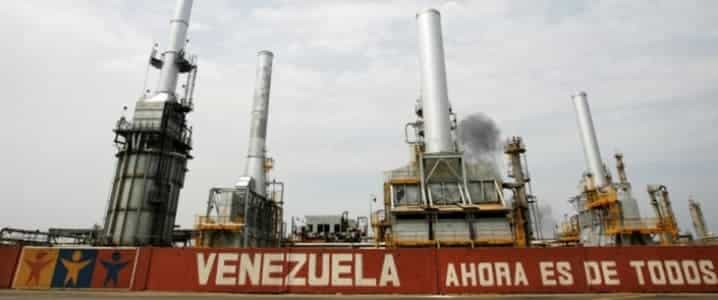
The Trump administration has imposed a full-scale economic blockade against Venezuela. The assets of the state oil company held abroad, including Citgo, its U.S. branch, have been seized and handed over to the puppet Guaidó “government.” Venezuelan bank accounts have been frozen, including $1.2 billion in gold bullion held in the Bank of England.
Venezuela is one of a bloc of three large oil-producing countries not under U.S. domination. The other two are Iran and Russia.
Trump’s sanctions on Venezuela have been economically devastating.
The sanctions have hobbled Venezuela’s oil industry so fully that the country has half a billion dollars worth of oil sitting in ships off its coast, Bloomberg reported Feb. 25.
From August 2017 to August 2018, earlier sanctions cost Venezuela about $6 billion, reports Venezuela Analysis.
“In August 2017, Trump’s sanctions made it illegal for the Venezuelan government to obtain financing from the U.S., which was devastating for two reasons: all the Venezuelan government’s outstanding foreign currency bonds are governed under New York state law; and one of the Venezuelan government’s major assets, the state-owned Citgo corporation, is based in Texas. The sanctions also blocked Citgo from sending profits and dividends back to Venezuela (which had been averaging about $1 billion USD per year since 2015).”
An accompanying chart shows that Venezuelan oil production followed essentially the same pattern as Colombia’s during 2016 and most of 2017 — until August, which is when Trump’s sanctions came into force.
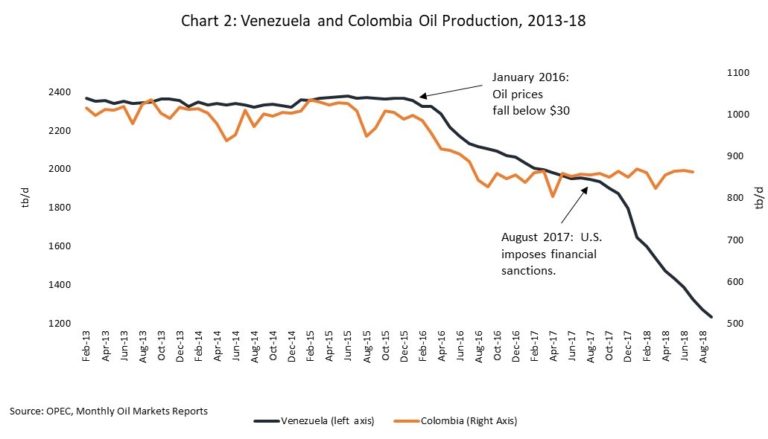
While Venezuela has been having a hard time selling its oil, the rest of the world is struggling to find the premium heavy oil that Venezuela produces. The tightness in heavy oil supply translated into higher prices for Colombia’s oil, which competes with Venezuelan oil in the global market.
The goal of Trump’s sanctions is to starve Venezuela, hoping that that will bring about either a collapse of the government or a coup. But no one thinks that a collapse is near or likely, and the U.S. coup attempt with Guaidó failed.
The economic crisis in Venezuela
Some say that Maduro, a school bus driver by profession, has been a terrible president and economic manager. But, despite what these opponents might be saying, the economic crisis was not caused by Maduro’s presidency or the Chavistas in Bolivarian Venezuela.
Does this mean the policies of Maduro’s government are perfect? Of course not. Perfection is unknown in any sphere of human activity, so it is certain that one could find errors or mistakes in the policies and practices of the Venezuelan government.
However, as a cause of the current crisis, any mistakes made by Maduro or other Chavistas, or even corruption within the Venezuelan government, are not driving forces for the economy. In reality, those who claim that the mistakes of Maduro and the Chavistas or corruption among the Chavistas are the cause of the Venezuelan economic crisis are, whether they know it or not, simply echoing U.S. imperialist propaganda.
How oil prices affect the Venezuelan economy
Venezuela has a monoculture economy, a legacy of colonialism. That means that the world market price of a single commodity largely governs the state of its economy. When the price of oil is high, U.S. dollars flow into Venezuela. The Venezuelan economy booms and employment grows. But when the price of oil drops, money flows out. When this happens, the economy falls into crisis.
Isn’t Bolivarian Venezuela — under both President Chávez and President Maduro — subject to the criticism that they have failed to end Venezuela’s monoculture oil economy? Not at all, because the very name Bolivarian Revolution points to the road out of a monoculture economy. “Bolivarian” refers to Simón Bolívar, who in the 19th century attempted unsuccessfully to unite Latin America into a single nation-state. This points to a road out of the trap of an oil economy that Venezuela finds itself in and that is what they are fighting for.
Under Chávez, the government distributed oil revenues to the working class and poor of the cities and countryside. Massive housing construction programs built more than 2.5 million homes. A crash program to tackle illiteracy was carried out. Health care became available to the mass of poor and working-class people for the first time. Agriculture was developed and 6.6 million acres of land was redistributed to 180,000 landless peasant families.
Chávez also adopted the banner of Simón Bolívar. Making Latin America a single nation-state would go a long way to solving the problem of monoculture economies that lead to periodic extreme economic crises and hyperinflation.
Trump blames the “socialist” policies of Venezuela for the economic crisis, not the colonial monoculture economy or U.S. sanctions. Trump’s message to our movement is clear. If you push for “socialist” policies such as Medicare for all or a $15 minimum wage, the result will be runaway inflation and an economic crisis like is occurring in Venezuela.
In his State of the Union address, Trump pointed to the crisis in Venezuela and boasted that the U.S. would never be a “socialist country.” He did not mean socialism in the Marxist sense — if he had meant that he would have said the U.S. would never be a communist country — but rather “socialism” like Medicare for All, a $15-an-hour minimum wage or the Green New Deal.
Trump is at least partly right. You cannot fully be for Medicare for All and a $15-an-hour minimum wage if you do not support the fight of Bolivarian Venezuela against Trump, Wall Street and Big Oil.
Kevin Cooper, an appeal for freedom and prison abolition
To very little fanfare, in December 2018, new DNA testing was ordered for California death row inmate Kevin Cooper, a Black man accused of killing four white people.
For over 30 years, Cooper has been on California’s death row for the gruesome Chino Hills murders in 1983. Chino Hills is a semi-rural town east of Los Angeles in the San Gabriel Valley. Cooper has maintained his innocence in the crime, investigative journalists and legal experts have insisted Cooper is the victim of a framing by law enforcement and deadly crime partners, and radical anti-prison activists have been the only ones to mobilize in defense of Cooper.
Cooper’s case is of crucial importance to the fight against mass incarceration. Cooper’s case highlights the racism in prosecution, not only in law enforcement.
The forensic lab and San Bernardino County sheriff’s department, which in subsequent years to the Cooper case had been proven to lie and plant evidence at the scene of crimes, settled upon Cooper as their main suspect in the crime. Evidence and personal accounts suggest that at least three white-presenting men were responsible for the killings. With what the Pulitzer Prize-winning journalist Nicholas Kristof has described as a clear cover-up, why hasn’t Cooper’s case been the cause célèbre it deserves to be?
Liberal prison reform versus radical prison abolition
In recent years, prison reform activities have gained increased celebrity within liberal and moderate conservative aspects of U.S. society. With rivaling superstar couples of Kim Kardashian and Kanye West and Jay-Z and Beyoncé in opposite corners, some cases that radical activists have been advocating for quite some time have gained much notoriety.
Jay-Z produced a six-part series on the late Kalief Browder and has been a part of a popular campaign to bail out people awaiting trial. Jay-Z and Beyoncé quietly spent millions of dollars to help the defense of the formerly incarcerated rapper Meek Mills — and they have now united with Meek Mills and New England Patriots owner Robert Kraft to push for further prison reform legislation. As well, Kardashian and West have appealed to Donald Trump and social media for prison reform and clemency.
In the summer of 2018, Alice Marie Johnson was released from federal custody following appeals from Kardashian and West. In late December 2018, President Trump signed the First Step Act, passed by the Senate by a margin of 87 to 12. Van Jones described the bill as a “Christmas Miracle.” On Jan. 7 of this year, incarcerated former sex worker Cyntoia Brown had her sentence of 51 years to life commuted to 15 years. For over a decade, Cyntoia’s case had been relegated to the ranks of anti-prison activists and former sex workers. Yet, again, her commutation has been attributed to the work of Kim Kardashian and others.
It must be made explicitly clear that all of the people released do not only deserve to be released, they should have never been incarcerated in the first place. Radicals are critical of liberal prison reformism, especially these partnerships of elected officials and entertainers, because of their frequent use of what might be called “the question of innocence.”
As Mills College professor Priya Kandaswamy has noted: “From the vantage point of people who have historically been perceived as guilty, innocence is not a viable ground on which to build political claims. These experiences highlight the often deadly consequences of making rights contingent on innocence and expose the fact that innocence and guilt are socially constructed categories that hinge upon one’s relationship to the state, not on one’s own character or actions.”
Popular concern over mass incarceration has too often focused its gaze on the innocence and even value of the incarcerated person. Liberal prison reformers forego criticism of the racial capitalist incarceration regime which, in fact, makes the question of innocence or guilt quite irrelevant.
In short, to suggest that the only reason someone deserves to be released is because they are innocent or “don’t belong there” reasons to suggest that there are, in fact, people who do belong in prison. This contradiction explains the lenient sentences from the “Affluenza” case to Brock Peters, even in the face of public outcry. It also explains why Kevin Cooper was charged with these murders and why popular concern has overlooked Cooper and countless other incarcerated people.
Free ‘em all!
Amongst radical anti-prison activists, the terms “Free ‘em all” and “All prisoners are political prisoners” are popular sayings. In San Diego, this is why members of the Committee Against Police Brutality and the Leonard Peltier Defense Committee simultaneously struggle for the release of prominent political prisoners like Leonard Peltier and Mumia Abu-Jamal as well as advocating for the release of gang members and addicts rounded up in unjust federal drug indictments.
For radical activists, mass incarceration has been proven to not be about right or wrong. It is about the warehousing of surplus populations of people of color and the poor that society has valued disposable. As Kristoff notes, Cooper had recently escaped from the minimum security yard at the California Institute for Men in Chino “and deputies who examined his file and mugshot saw a black man with a huge Afro who fit their narrative of an incorrigible criminal. He had a long arrest record dating back to when he was 7 years old.” Cooper was arrested because he fit the dominant notion of a criminal and not because he committed the crime. Investigators singled in on Cooper and then made the evidence fit.
Prosecutors alleged that Cooper killed Douglas and Peggy Ryen, their 10-year-old daughter Jessica and a family friend, 11-year-old Christopher Hughes, because he wanted to steal their station wagon. Meanwhile, the companion of the man that many other people assume to be one of the actual killers, all white presenting, came forward with evidence that it was likely her partner — whose name this article has chosen to withhold.
The man’s companion identified a bloody t-shirt and missing hatchet as likely to be his property. She also presented bloody coveralls as evidence. Blonde and brown hairs were even found in the hands of the victims. The investigators discarded the coveralls and, advocates suggest, began to falsify evidence to imply that Cooper committed the murders. Former FBI agent and deputy head of the bureau’s Los Angeles office has frankly admitted that: “The evidence was planted, he was framed, the cops lied on the stand.”
New testing ordered
Previously, California Gov. Jerry Brown and Kamala Harris, in her role as state attorney general, refused to allow new DNA testing in the case. Yet, following Kristof’s exposé in the New York Times, the now-Sen. Kamala Harris and Sen. Dianne Feinstein reversed their positions and advocated for the advanced DNA testing that Brown ordered, as previously noted.
Radical activists who have consistently demanded the release of Cooper anxiously await the results of the new testing. Prison abolitionists and anti-police terror organizations in the San Francisco Bay Area continue to hold rallies outside the San Quentin State Prison, where Cooper is held captive.
For activists, this account of misjustice evinces the need for a complete overturning of the U.S. incarceration industry, including an end to the death penalty. Cooper’s freedom does not hinge on the exceptional nature of his case.
There is strong evidence that at least 15 of the nearly 1,500 prisoners executed since the reinstitution of the death penalty in 1976 have been innocent, and many others put to death before 1976 have been posthumously pardoned. In fact, the 2011 execution of Troy Davis was a crucial catalyst of the contemporary Movement for Black Lives. Still, activists understand that this heavy lifting towards prison abolition must be led first and foremost by the people — not entertainers and not politicians.
Jefferson Davis and Juan Guaidó: two presidential imposters
Donald Trump and Juan Guaidó hated Nicolás Maduro for being re-elected president of the Bolivarian Republic of Venezuela in 2018.
Well, slave master Jefferson Davis, as president of the Southern Confederacy, revolted against Abraham Lincoln being elected president of the United States in 1860.
The U.S. in 1860 had 31.4 million people, while last year 32.4 million people lived in Venezuela. That’s almost the same.
But there was a big difference in the election results. Abraham Lincoln got 1,865,908 votes, just 39.8 percent of the total — though still far more than his nearest competitor. Despite U.S.-instigated calls for an election boycott, Nicolás Maduro won 6,245,862 votes, or 67.8 percent.
Unlike Venezuela’s elections, no women and virtually no Black or Indigenous people could vote in the U.S. in 1860. Yet the entire capitalist media have attacked President Maduro’s re-election as “undemocratic”!
Who’s supporting whom?
After being prompted by the Trump regime, Juan Guaidó declared himself to be Venezuela’s president on Jan. 23. But nobody had cast a single vote for him for that position.
That didn’t prevent Trump from immediately recognizing Guaidó and directing that revenues from Venezuelan oil sold to the U.S. be given to this impostor. This robbery was followed by the Bank of England seizing over a billion dollars of Venezuela’s gold.
That heist and recognizing Guaidó came naturally to the Tory government in London. Royal Dutch Shell — which is incorporated in Britain — was sucking oil profits from Venezuela even before Rockefeller’s Standard Oil Trust did.
The wannabe fascist Brazilian president, Jair Bolsonaro, also recognized Guaidó. Bolsonaro was elected because popular former President Luiz Inácio “Lula” da Silva was jailed on frame-up charges and kicked off the ballot.
That’s the sort of “democracy” that Big Oil and its media adore.
Despite threats from the Trump regime, fewer than 60 of the United Nations’ 193 members have recognized the phony Guaidó.
The People’s Republic of China, India, Mexico, Bolivia, Cuba, Nicaragua and over a hundred other countries representing the majority of humankind have continued to recognize the democratically elected Nicolás Maduro.
Out of the African Union’s 55 member states, only the reactionary monarchy of Morocco has recognized Guaidó. So did apartheid Israel, whose military killed 54 Palestinian children last year.
South Africa, whose people overthrew apartheid, supports Maduro.
Solidarity stopping intervention
Like Juan Guaidó, Jefferson Davis also craved recognition. The slave-owning Confederacy hoped for diplomatic relations and military support from Britain.
At the time, Britain was the “the workshop of the world” and its biggest industry was cotton textiles. Cotton was the Confederacy’s main export, and the heart and soul of virtually every British banker, landlord and capitalist was with the Confederacy.
British Prime Minister Lord Palmerston sent 10,000 troops to Canada. He allowed the “Alabama” and other Confederate warships to be built in British shipyards.
Like U.S. liberals who are lining up behind Guaidó, that great liberal and future prime minister, William Gladstone, also supported the slave masters. Gladstone’s own father owned over 2,500 enslaved Africans and was actually given “reparations” for their freedom!
What stopped the British wealthy and powerful from recognizing the Confederacy of Jefferson Davis was the British working class. Despite a “cotton famine” throwing thousands of them out of work, mass action by British workers stopped their exploiters from intervening on the side of the Confederacy.
“Hold the Fort,” a song of Union Army soldiers, became one of the anthems of the British labor movement. A little over 50 years later, British workers also stopped their ruling class from strangling the Bolshevik Revolution.
Karl Marx played a key role in the anti-slavery struggle, which led to a successful fight to expand voting rights for British workers. Marx wrote in his book “Capital” that “Labor in the white skin can never free itself as long as labor in the black skin is branded.”
Another result was the First International of working people, which was formed in 1864 with Marx’s guidance.
Poor and working people in the U.S. have to show the same solidarity with embattled Venezuela today. Don’t believe the lies of the corporate media!
Trump and his minions are threatening another war. The labor movement has to declare: Hands off Venezuela!
It is the Bolivarian Revolution in Venezuela and its democratically elected president, Nicolás Maduro, who are standing firm so that “government of the people, by the people, for the people, shall not perish from the earth.”
https://www.struggle-la-lucha.org/2019/03/page/4/
1